Adhyaya 63
The Hymn to Gaṇapati (and the Rule of Worshipping Gaṇeśa First)
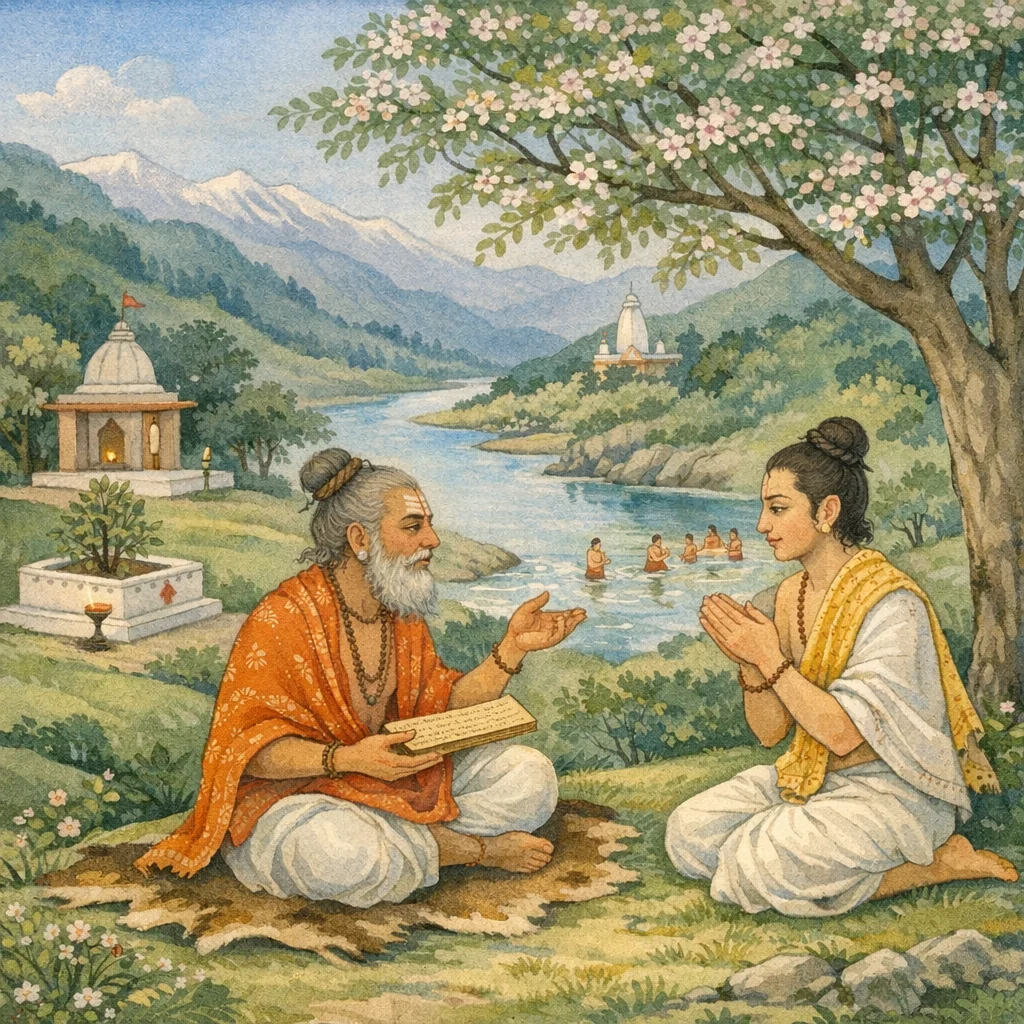
Pulastya opens by recalling an earlier occasion when Sañjaya questioned Bhīṣma about the proper order of worship among the deities and which act of worship grants decisive efficacy to rites. In the cited instruction, Vyāsa establishes Gaṇeśa as the first worship (prathama-pūjā), for he removes obstacles and makes undertakings fruitful. An exemplifying narrative follows: Pārvatī offers a divine modaka called Mahābuddhi and sets a contest of “who is foremost.” Gaṇeśa, rather than relying on pilgrimages, vows, or sacrifices, circumambulates his parents; this is proclaimed superior to pilgrimages, austerities, and yajñas, thereby confirming his precedence in all ritual acts. The chapter then prescribes Caturthī worship and fasting, and provides a stotra framework including the recitation of twelve names. It promises success, protection, and attainment of a heavenly state.
Shlokas
Verse 1
पुलस्त्य उवाच । एतस्मिन्नंतरे पूर्वं व्यासशिष्यो महामुनिः । नमस्कृत्य गुरुं भीष्म संजयः परिपृच्छति
Pulastya said: Earlier, at this very juncture, Sañjaya—the great sage and disciple of Vyāsa—having bowed to his teacher Bhīṣma, questioned him.
Verse 2
देवानां पूजनोपायं क्रमं ब्रूहि सुनिश्चितम् । अग्रे पूज्यतमः कोसौ को मध्यो नित्यपूजने
Tell me with certainty the proper method and sequence for worshipping the gods: who is to be worshipped first as the most worthy, and who is to be worshipped in the middle in daily worship?
Verse 3
अंते च पूजा कस्यैव कस्य को वा प्रभावकः । किंवा कं च फलं ब्रह्मन्पूजयित्वा लभेन्नरः
And, in the end, whose worship is truly decisive, and who is the one that grants its efficacy? Or else, O Brahman—what fruit does a man obtain by worshipping whom?
Verse 4
व्यास उवाच । गणेशं पूजयेदग्रे त्वविघ्नार्थं परे त्विह । विनायकत्वमाप्नोति यथा गौरीसुतो हि सः
Vyāsa said: One should first worship Gaṇeśa here at the outset, for the removal of obstacles. In this way one attains the status of a Vināyaka—just as he indeed is, the son of Gaurī.
Verse 5
पार्वत्यजनयत्पूर्वं सुतौ महेश्वरादिमौ । सर्वलोकधरौ शूरौ देवौ स्कंदगणाधिपौ
Formerly, Pārvatī bore these two sons from Maheśvara—both heroic deities, Skanda and Gaṇādhipa (Gaṇeśa), who uphold all the worlds.
Verse 6
तौ च दृष्ट्वा नगसुता सिध्यर्थं पर्यभाषत । इदं तु मोदकं पुत्रौ देवैर्दत्तं मुदान्वितैः
Seeing the two of them, the mountain-born maiden spoke to bring success to their undertaking: “Sons, this sweet modaka has been given by the delighted gods.”
Verse 7
महाबुद्धीति विख्यातं सुधया परिनिर्मितम् । गुणं चास्य प्रवक्ष्यामि शृणुतं तु समाहितौ
It is renowned as “Mahābuddhi,” fashioned from the nectar of immortality. I shall now declare its qualities as well—listen attentively, with your minds collected.
Verse 8
अस्यैवाघ्राणमात्रेण अमरत्वं लभेद्ध्रुवम् । सर्वशास्त्रार्थतत्त्वज्ञः सर्वशस्त्रास्त्रकोविदः
By merely smelling it alone, one surely attains immortality; one becomes a knower of the true purport of all scriptures and skilled in all weapons and missiles.
Verse 9
निपुणः सर्वतंत्रेषु लेखकश्चित्रकृत्सुधीः । ज्ञानविज्ञानतत्त्वज्ञः सर्वज्ञो नात्र संशयः
He becomes skillful in all treatises and tantras, an accomplished writer and painter, truly wise; a knower of the principles of knowledge and realized understanding—indeed, he is omniscient, of this there is no doubt.
Verse 10
पुत्रौ धर्मादधिकतां प्राप्य सिद्धिशतं व्रजेत् । यस्तस्य वै प्रदास्यामि पितुस्ते संमतं त्विदम्
“May your two sons, having attained excellence beyond dharma, go on to hundreds of siddhis. And I shall indeed give her to the one who is worthy of her—this too is approved by your father.”
Verse 11
श्रुत्वा मातृमुखादेवं वचः परमकोविदः । स्कंदस्तीर्थं ययौ सद्यः सर्वं त्रिभुवनस्थितं
Thus hearing those words from his mother’s mouth, Skanda—supremely wise—set out at once for Skanda’s sacred tīrtha, a holy place renowned throughout the three worlds.
Verse 12
बर्हिणं स्वं समारुह्य त्वभिषेकः कृतः क्षणात् । पितरौ प्रदक्षिणं कृत्वा लंबोदरधरस्सुधीः
Mounting his own peacock, his abhiṣeka—his consecration—was performed in an instant. Having circumambulated his parents, the wise one, bearing the pot-bellied Lord (Gaṇeśa), proceeded onward.
Verse 13
तत एव मुदायुक्तः पित्रोरेवाग्रत स्थितः । पुरतश्च तथा स्कंदो मे देहीति ब्रुवन्स्थितः
Right then, filled with joy, he stood before his parents; and Skanda too stood in front, saying, “Give him to me.”
Verse 14
ततस्तु तौ समीक्ष्याथ पार्वती विस्मिताब्रवीत् । सर्वतीर्थाभिषेकैस्तु सर्वदेवैर्न तैस्तथा
Then, having looked at them both, Pārvatī spoke in amazement: “Not by the anointing baths of all tīrthas, nor even by all the gods, could this be accomplished in such a manner.”
Verse 15
सर्वयज्ञव्रतैर्मंत्रैर्योगैरन्यैर्यमैस्तथा । पित्रोरर्चाकृतः कोपि कलां नार्हति षोडशीम्
By all sacrifices and vows, by mantras, by yoga, and by other disciplines and restraints as well—no one attains even one sixteenth part of the merit of one who has worshipped the parents.
Verse 16
तस्मात्सुतशतादेषोऽधिकः शतगुणैरपि । अतो ददामि हेरम्बे मोदकं देवनिर्मितम्
Therefore, this one surpasses even a hundred sons—indeed, a hundredfold. Hence, O Heramba, I offer you this modaka, fashioned by the gods.
Verse 17
अस्यैव कारणादस्य अग्रे पूजा मखेषु च । वेदशास्त्रस्तवादौ च नित्यं पूजाविधासु च
For this very reason, his worship comes first in sacrifices; and the Vedas and Śāstras, at the beginning, always place him first in the prescribed rules of worship as well.
Verse 18
पार्वत्या सह भूतेशो ददौ तस्मै वरं महत् । अस्यैव पूजनादग्रे देवास्तुष्टा भवंतु च
Bhūteśa (Lord Śiva), together with Pārvatī, granted him a great boon: “By worshipping him first hereafter, may the gods also become pleased.”
Verse 19
सर्वासामपि देवीनां पितॄणां च समंततः । तपो भवतु नित्यं च पूजितेऽग्रे गणेश्वरे
May the austerities of all the goddesses and of the ancestors, on every side, become ever fruitful—when Gaṇeśvara is worshipped first (before all others).
Verse 20
ततः सर्वेषु यज्ञेषु पूजयेद्गणपं द्विजः । कोटिकोटिगुणं तेषु देवदेवी वचो यथा
Therefore, in all sacrifices a twice-born man should worship Gaṇapa; for in those rites the fruit is multiplied by crores upon crores—so declares the word of the Divine Goddess.
Verse 21
दत्वा सर्वगुणं पुण्यं देवदेव्या तथा मुदा । कृतं गणाधिपत्यं च सर्वदेवाग्रतस्तदा
Thus, having joyfully bestowed upon the Devadevyā that meritorious gift endowed with every excellence, he then, in the presence of all the deities, conferred the lordship of the Gaṇas.
Verse 22
तस्मात्प्राज्येषु यज्ञेषु स्तोत्रेषु नित्यपूजने । गणेशं पूजयित्वा तु सर्वसिद्धिं लभेन्नरः
Therefore, in grand sacrifices, in hymns, and in daily worship, a person who first worships Gaṇeśa attains complete success in all undertakings.
Verse 23
एवं ज्ञात्वा तु देवैस्तु दयितप्राप्ति काम्यया । पूजितश्चाथसर्वैस्तु स्वर्गमोक्षार्थतो ध्रुवम्
Knowing thus, the gods—desiring the attainment of what was dear to them—then worshipped him all together, with the assured aim of gaining heaven and liberation.
Verse 24
नक्ताहारश्चतुर्थ्यां तु पूजयित्वा गणाधिपं । लिंगे वा प्रतिमा चित्रे देवः पूज्यो भवेद्यदि
On Caturthī, if one eats only at night and worships Gaṇādhipa, then—whenever the deity is to be worshiped—whether in a liṅga, in an image (mūrti), or in a painted representation, he should indeed be worshiped in that form.
Verse 25
गणाधिप नमस्तुभ्यं सर्वविघ्नप्रशांतिद । उमानंदप्रद प्राज्ञ त्राहि मां भवसागरात्
O Lord of the Gaṇas, salutations to You—You who pacify all obstacles. O wise one who grants joy to Umā, rescue me from the ocean of saṃsāra.
Verse 26
हरानंदकरध्यान ज्ञानविज्ञानद प्रभो । विघ्नराज नमस्तुभ्यं प्रसन्नो भव सर्वदा
O You who bring joy to Hara through sacred contemplation, O Lord who bestows knowledge and realized wisdom—O Vighnarāja, I bow to You. Be ever gracious and pleased.
Verse 27
कृतोपवासो गणपं पूजयेद्यो नरो मुदा । सर्वपापविनिर्मुक्तः सुरलोके महीयते
A person who, having observed a fast, worships Gaṇapati with joy is freed from all sins and is honored in the world of the gods.
Verse 28
स्तोत्रं तस्य प्रवक्ष्यामि नामद्वादशकं शुभं । ओंनमो गणपतये मंत्र एष उदाहृतः
I shall now proclaim his auspicious hymn of twelve names. The mantra is thus spoken: “Oṃ, homage to Gaṇapati.”
Verse 29
गणपतिर्विघ्नराजो लंबतुंडो गजाननः । द्वैमातुरश्च हेरम्ब एकदंतो गणाधिपः
Gaṇapati—Vighnarāja, the long-trunked, elephant-faced one; Heramba of the two mothers; the single-tusked Gaṇādhipa, Lord of the Gaṇas.
Verse 30
विनायकश्चारुकर्णः पशुपालो भवात्मजः । द्वादशैतानि नामानि प्रातरुत्थाय यः पठेत्
“(They are:) Vināyaka, Cārukarṇa, Paśupāla, and Bhavātmaja. Whoever, rising early at dawn, recites these twelve names…”
Verse 31
विश्वं तस्य भवेद्वश्यं न च विघ्नं भवेत्क्वचित् । महाप्रेताश्शमं यांति पीड्यते व्याधिभिर्न च । सर्वपापाद्विनिर्मुक्तो ह्यक्षयं स्वर्गमश्नुते
For him, the whole world becomes compliant, and nowhere do obstacles arise. Even mighty spirits of the departed are pacified, and he is not afflicted by disease. Freed from all sins, he attains the imperishable heaven.
Verse 63
इति श्रीपाद्मपुराणे प्रथमे सृष्टिखंडे गणपतिस्तोत्रं नाम । त्रिषष्टितमोऽध्यायः
Thus ends the sixty-third chapter, called “The Hymn to Gaṇapati,” in the First Book of the Śrī Padma Purāṇa, in the Sṛṣṭikhaṇḍa (Section on Creation).