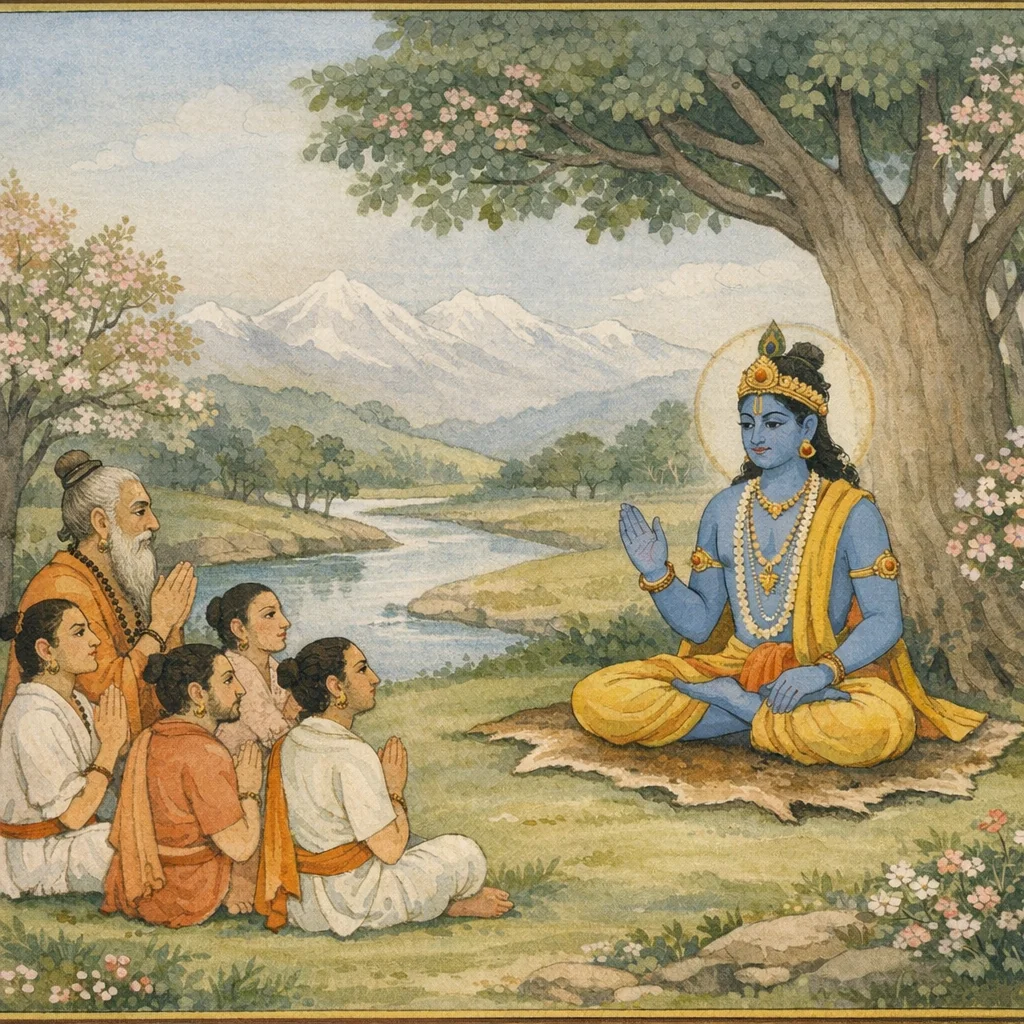
Adhyaya 62
The Greatness of the Gaṅgā: Purification, Ancestor Rites, and Liberation
Chapter 62 is a Gaṅgā-māhātmya in which Vyāsa answers the brāhmaṇas’ questions about the destruction of sins, even grave offenses. The Gaṅgā’s saving power is praised through remembering her name, seeing her, touching her, bathing in her, drinking her waters, and performing ancestor rites such as piṇḍa and tilodaka, all said to bring profound purification. Devotion to Gaṅgā is repeatedly linked with heaven, non-return, and mokṣa, with special emphasis on her heightened efficacy in Kali-yuga and at auspicious times like saṅkrānti, vyatīpāta, and eclipses. A stuti and a “root-mantra” are given, presenting her as Viṣṇu-pādodakī and Nārāyaṇī. An embedded origin account—Nārada questioning Brahmā—explains her theological status and descent: she is the water from Viṣṇu’s foot, held in Śiva’s locks, and brought down to earth through Bhagiratha. The chapter ends with a phalaśruti declaring that hearing, teaching, or reciting it yields merit equal to bathing in the Gaṅgā and also uplifts one’s ancestors.
Shlokas
Verse 1
। द्विजाऊचुः । मज्जनादखिलं पापं क्षयं यांति सुनिश्चितम् । महापातकमन्यच्च तदादेशं वदस्व नः
The brāhmaṇas said: “By bathing in the sacred waters, all sins certainly come to destruction. Tell us the prescribed rule regarding great sins and the other grave offenses as well.”
Verse 2
पापात्पूतोऽक्षयं नाकमश्नुते दिवि शक्रवत् । सुरयोनेर्न हानिः स्यादुपदेशं वदस्व नः
“Purified of sin, one attains the imperishable heaven—like Śakra (Indra) in the celestial realm. There would be no falling away from a divine birth; therefore, tell us the instruction by which this is achieved.”
Verse 3
अत्र भोग्यं परं सर्वं मृते स्वर्गे सुरोत्तमः । कलिपापहतानां च स्वर्गसोपानमुच्यते
“Here, all supreme enjoyments are attainable; and after death, one reaches the excellent heaven. This is also said to be a stairway to heaven for those struck down by the sins of the Kali age.”
Verse 4
व्यास उवाच । गतिं चिंतयतां विप्रास्तूर्णं सामान्यजन्मनाम् । स्त्रीपुंसामीक्षणाद्यस्माद्गंगा पापं व्यपोहति
Vyāsa said: “O brāhmaṇas, for ordinary people who contemplate their spiritual goal, the Gaṅgā swiftly removes sin—since, from merely seeing her, the sins of both women and men are washed away.”
Verse 5
गंगेति स्मरणादेव क्षयं याति च पातकम् । कीर्तनादतिपापानि दर्शनाद्गुरुकल्मषम्
By merely remembering the name “Gaṅgā,” sin is destroyed. By praising her, even grievous sins are removed; and by her very sight, the heaviest defilement is cleansed away.
Verse 6
स्नानात्पानाच्च जाह्नव्यां पितॄणां तर्पणात्तथा । महापातकवृंदानि क्षयं यांति दिनेदिने
By bathing in the Jāhnavī (Gaṅgā), by drinking her water, and likewise by offering libations (tarpaṇa) to the ancestors, hosts of great sins diminish day by day.
Verse 7
अग्निना दह्यते तूलं तृणं शुष्कं क्षणाद्यथा । तथा गंगाजलस्पर्शात्पुंसां पापं दहेत्क्षणात्
Just as dry cotton and dry grass are burned by fire in an instant, so too, by the touch of Gaṅgā’s water, a person’s sin is burned away in a moment.
Verse 8
संप्राप्नोत्यक्षयं स्वर्गं गंगास्नानेन केशवम् । यशो राज्यं लभेत्पुण्यें स्वर्गमंते परां गतिम्
By bathing in the Gaṅgā and worshipping Keśava, one attains an imperishable heaven; through that merit one gains fame and sovereignty, and at the end reaches heaven—and ultimately the supreme state.
Verse 9
पितॄनुद्दिश्य गंगायां यस्तु पिंडं प्रयच्छति । विधिना वाक्यपूर्वेण तस्य पुण्यफलं शृणु
Now hear the meritorious fruit of the one who, intending his forefathers, offers a piṇḍa in the Gaṅgā, according to proper procedure and with the prescribed ritual utterances.
Verse 10
अन्नैकेन तु साहस्रं वर्षं पूज्यः सुरालये । तिलेन द्विगुणं विद्धि तथा मेध्यफलेन च
With a single offering of food-grain, one becomes worthy of honor in the abode of the devas for a thousand years. Know that with sesame the fruit is doubled, and likewise with pure, auspicious fruits as well.
Verse 11
गव्येन विधिना विप्राः स्वर्गस्यांतो न विद्यते । एवं पिंडप्रदानेन नित्यं क्रतुशतं भवेत्
O brāhmaṇas, by the prescribed rite involving a cow, there is no end to the merit that leads to svarga. In the same way, by offering piṇḍas, one continually attains the merit of a hundred sacrifices.
Verse 12
पितरो निरयस्था ये धन्यास्ते मर्त्यवासिनः । धनपुत्रयुतारोग्यं सुखसंमानपूजिताः
Blessed indeed are those mortals whose ancestors, though dwelling in naraka, are remembered and aided; such people are endowed with wealth and sons, enjoy good health, and live happily—honored and revered.
Verse 13
रसातलगता ये च ये च कीटा महीतले । स्थावरे पक्षिसंघादौ ते मर्त्या धनिनो नृपाः
Those who dwell in Rasātala, and those who are insects upon the earth; those among the immobile beings and among flocks of birds—such souls become mortals, and become wealthy kings.
Verse 14
तत्तत्पुत्रैश्च पौत्रैश्च गोत्रैर्दौहित्रकैस्तथा । जामातृभागिनेयैश्च सुहृन्मित्रैः प्रियाप्रियैः
—together with their sons and grandsons, their kinsmen and their daughters’ sons; likewise with sons-in-law and nephews; with well-wishers and friends—both dear and not dear.
Verse 15
प्रदीयते जलं पिंडं यथोपकरणान्वितम् । गंगातोयेषु तीरेषु तेषां स्वर्गोऽक्षयो भवेत्
When water and the piṇḍa-offering are duly given, together with the proper requisites, upon the banks of the Gaṅgā’s waters, an imperishable heaven becomes theirs.
Verse 16
पिंडादूर्ध्वं स्थिता ये च पितरो मातृगोत्रजाः । भवंति सुखिनः सर्वे मर्त्याश्शतसहस्रशः
All those ancestral spirits who are uplifted by the piṇḍa-offering—especially the forefathers connected through the mother’s lineage—become happy, in hundreds of thousands.
Verse 17
स्वर्गे तस्य स्थिताः सत्वा अधःस्था मध्यवासिनः । नित्यं वांञ्छंति सद्गंगां गच्छंतु सुरनिम्नगाम्
The beings who dwell in his heaven—and those below, who live in the middle regions—constantly long for the true Gaṅgā. May they go to that divine river that flows among the gods.
Verse 18
एको गच्छति गंगां यः पूयंते तस्य पूरुषाः । एतदेव महापुण्यं तरते तारयत्यपि
If even one person goes to the Gaṅgā, his forefathers are purified. This alone is a great merit: it carries one across and helps others cross as well.
Verse 19
गंगा कृत्स्नगुणं वक्तुं न शक्तश्चतुराननः । अतः किंचिद्वदाम्यत्र भागीरथ्या द्विजा गुणम्
Even four-faced Brahmā is not capable of describing the Gaṅgā’s virtues in their entirety. Therefore, O twice-born ones, I shall state here only a little of Bhāgīrathī’s excellence.
Verse 20
मुनयः सिद्धगंधर्वा ये चान्ये सुरसत्तमाः । गंगातीरे तपस्तप्त्वा स्वर्गलोकेऽच्युताभवन्
Sages, Siddhas, Gandharvas, and other foremost celestials—having performed austerities on the bank of the Gaṅgā—became imperishable in the heavenly realm.
Verse 21
दिव्येन वपुषा सर्वे कामगेन रथेन च । अद्यापि न निवर्तंते रत्नपूर्णक्षयेषु वै
All of them, with divine bodies and with a chariot that moves at will, even today do not turn back—indeed, they remain in those inexhaustible realms filled with jewels.
Verse 22
प्रासादा यत्र सौवर्णास्सर्वलोकोर्ध्वगाश्शिवाः । इष्टद्रव्यैः सुसंपूर्णाः स्त्रियो यत्र मनोरमाः
Where there are golden palaces, auspicious and rising above all the worlds; where delightful women are present, well-adorned and fully furnished with cherished possessions.
Verse 23
पारिजातः समाः पुष्पवृक्षाः कल्पद्रुमोपमाः । गंगातीरे तपस्तप्त्वा तत्रैश्वर्यं लभंति हि
Flowering trees like the Pārijāta—comparable to wish-fulfilling trees—are found there. Having performed austerities on the bank of the Gaṅgā, people indeed obtain prosperity and lordly fortune in that very place.
Verse 24
तपोभिर्बहुभिर्यज्ञैर्व्रतैर्नानाविधैस्तथा । पुरुदानैर्गतिर्या च गंगां संसेवतां च सा
The spiritual attainment gained through many austerities, many sacrifices, diverse vows, and abundant gifts—that same attainment belongs to those who devotedly resort to and serve the Gaṅgā.
Verse 25
जारजं पतितं दुष्टमंत्यजं गुरुघातिनम् । सर्वद्रोहेण संयुक्तं सर्वपातकसंयुतम्
One born of adultery—fallen and wretched, wicked, an outcaste, a slayer of his teacher—bound to every treachery and stained with all sins.
Verse 26
त्यजंति पितरं पुत्राः प्रियं पत्न्यः सुहृद्गणाः । अन्ये च बांधवाः सर्वे गंगा तु न परित्यजेत्
Sons may abandon their father; beloved wives and circles of friends may forsake one; and all other relatives too may turn away—but the Gaṅgā should never be abandoned.
Verse 27
यथा माता स्वयं जन्ममलशौचं च कारयेत् । क्रोडीकृत्य तथा तेषां गंगा प्रक्षालयेन्मलम्
Just as a mother herself performs the cleansing for the newborn, removing the impurity of birth, so too does the Gaṅgā: taking them into her lap, she washes away their defilement.
Verse 28
भवंति ते सुविख्याता भोग्यालंकारपूजिताः । दर्शने क्रियते गंगा सकृद्भक्त्या नरैस्तु यैः
Those who, even once, behold the Gaṅgā with devotion—thus as it were making her manifest—become widely renowned and are honored with enjoyments and adornments.
Verse 29
तेषां कुलानां लक्षं तु भवात्तारयते शिवा । स्मृतार्ति हर्त्री यैर्ध्याता संस्तुता साधुमोदिता
Śivā, the auspicious Goddess, delivers a hundred thousand lines of their families from worldly existence; she removes the anguish of those who remember her—those who meditate upon her and praise her, and she is gladdened by the virtuous.
Verse 30
गंगा तारयते नॄणामुभौ वंशौ भवार्णवात् । संक्रांतिषु व्यतीपाते ग्रहणे चंद्रसूर्ययोः
The Gaṅgā delivers human beings—and both lines of their ancestors—from the ocean of worldly existence, especially at saṅkrānti, at vyatīpāta, and during eclipses of the Moon and the Sun.
Verse 31
पुण्ये स्नात्वा तु गंगायां कुलकोटिं समुद्धरेत् । शुक्लपक्षे दिवामर्त्या गंगायामुत्तरायणे
By bathing in the sacred Gaṅgā, one can uplift a crore of one’s family line. This is especially so when a mortal bathes by day in the Gaṅgā during the bright fortnight, in the Sun’s northward course (uttarāyaṇa).
Verse 32
धन्या देहं विमुंचंति हृदिस्थे च जनार्दने । अनेन विधिना यस्तु भागीरथ्या जले शुभे
Blessed are those who cast off the body while Janārdana abides within the heart; and blessed, too, is the one who, by this prescribed rite, (does so) in the auspicious waters of the Bhāgīrathī (Gaṅgā).
Verse 33
प्राणांस्त्यक्त्वा व्रजेत्स्वर्गं पुनरावृत्तिवर्जितम् । यो गंगानुगतो नित्यं सर्वदेवानुगो हि सः
Having given up his life-breath, he goes to heaven, free from return (rebirth). For the one who constantly follows the Gaṅgā is indeed a follower of all the gods.
Verse 34
सर्वदेवमयो विष्णुर्गंगा विष्णुमयी यतः । गंगायां पिंडदानेन पितॄणां वै तिलोदकैः
Viṣṇu embodies all the gods, and the Gaṅgā is filled with Viṣṇu’s presence. Therefore, by offering piṇḍas in the Gaṅgā—together with sesame-water oblations—one indeed benefits the Pitṛs (ancestors).
Verse 35
नरकस्था दिवं यांति स्वर्गस्था मोक्षमाप्नुयुः । परदारपरद्रव्य बाधा द्रोहपरस्य च
Those who are in hell rise to heaven, and those who are in heaven may attain mokṣa—when they abandon violating another’s spouse and another’s property, harming others, and treachery toward others.
Verse 36
गतिर्मनुष्यमात्रस्य गंगैव परमा गतिः । वेदशास्त्रविहीनस्य गुरुनिंदापरस्य च
For all human beings, the Gaṅgā alone is the supreme refuge and final goal—especially for one who is devoid of the Vedas and śāstras, and for one devoted to condemning the guru.
Verse 37
समयाचारहीनस्य नास्ति गंगासमा गतिः । किं यज्ञैर्बहुवित्ताढ्यैः किं तपोभिः सुदुष्करैः
For one who is devoid of proper conduct and right observances, there is no attainment comparable to the Gaṅgā. Of what use are sacrifices rich in abundant wealth, and of what use are exceedingly difficult austerities?
Verse 38
स्वर्गमोक्षप्रदा गंगा सुखसौभाग्यपूजिता । नियमैः परमैर्नित्यं किं योगैश्चित्तरोधकैः
The Gaṅgā bestows heaven and mokṣa and is revered as the giver of happiness and good fortune. When one continually follows the highest niyamas, what need is there of yogic practices that restrain the mind?
Verse 39
भुक्तिमुक्तिप्रदा गंगा सुखमोक्षाग्रतः स्थिता । अनेकजन्मसंघात पापं पुंसां विनश्यति
The Gaṅgā bestows both bhukti (worldly enjoyment) and mukti (liberation); she stands before one as happiness and mokṣa. The sins of men, accumulated over many births, are destroyed.
Verse 40
स्नानमात्रेण गंगायां सद्यः स्यात्पुण्यभाङ्नरः । प्रभासे गोसहस्रस्य राहुग्रस्ते दिवाकरे
By merely bathing in the holy Gaṅgā, a person at once becomes a recipient of merit (puṇya). At Prabhāsa too—when Rāhu eclipses the sun—the merit is said to equal the gift of a thousand cows.
Verse 41
लभते यत्फलं दाने गंगास्नानाद्दिनेदिने । दृष्ट्वा तु हरते पापं स्पृष्ट्वा तु लभते दिवम्
Day after day, by bathing in the Gaṅgā one attains the very fruit that comes from charitable giving. Merely seeing her removes sin; and by touching her one reaches heaven.
Verse 42
प्रसंगादपि सा गंगा मोक्षदा त्ववगाहिता । सर्वेन्द्रियाणां चापल्यं वासनाशक्तिसंभवम्
Even if one comes to her only by chance, that Gaṅgā—once one immerses in her—becomes a giver of liberation (mokṣa). The restlessness of all the senses arises from the force of latent impressions (vāsanās).
Verse 43
निर्घृणत्वं ततो गंगा दर्शनात्प्रविनश्यति । परद्रव्याभिकांक्षित्वं परदाराभिलाषिता
Then, by the mere sight of the Gaṅgā, cruelty is destroyed; likewise, the craving for another’s wealth and the desire for another’s wife are eradicated.
Verse 44
परधर्मे रुचिश्चैव दर्शनादेव नश्यति । यदृच्छालाभ संतोषस्स्वधर्मेषु प्रवर्तते
One’s attraction to another’s dharma is destroyed merely by truly seeing. Content with whatever comes unasked, one proceeds steadily in one’s own dharma.
Verse 45
सर्वभूतसमत्वं च गङ्गायां मज्जनाद्भवेत् । यस्तु गंगां समाश्रित्य सुखं तिष्ठति मानवः
By bathing in the sacred Gaṅgā, one attains equal-mindedness toward all beings. And the person who, taking refuge in the Gaṅgā, lives in contentment is especially blessed.
Verse 46
जीवन्मुक्तस्स एवेह सर्वेषामुत्तमोत्तमः । गंगां संश्रित्य यस्तिष्ठेत्तस्य कार्यं न विद्यते
He alone is a jīvanmukta here, the most excellent among all, who dwells taking refuge in the Gaṅgā; for him, no further duty remains to be done.
Verse 47
कृतकृत्यस्स वै मुक्तो जीवन्मुक्तश्च मानवः । यज्ञो दानं तपो जप्यं श्राद्धं च सुरपूजनम्
Truly fulfilled and liberated is that human being—a jīvanmukta—for whom sacrifice (yajña), charity (dāna), austerity (tapas), recitation (japa), ancestral rites (śrāddha), and worship of the devas have all been accomplished.
Verse 48
गंगायां तु कृतं नित्यं कोटिकोटि गुणं भवेत् । अन्यस्थाने कृतं पापं गंगातीरे विनश्यति
Indeed, whatever is done upon the Gaṅgā each day is multiplied by crores upon crores. And sin committed elsewhere is destroyed on the bank of the Gaṅgā.
Verse 49
गंगातीरे कृतं पापं गंगास्नानेन नश्यति । आत्मनो जन्मनक्षत्रे जाह्नवीसंगते दिने
Sin committed on the bank of the Gaṅgā is destroyed by bathing in the Gaṅgā—especially on the day when one’s own birth-star (janma-nakṣatra) coincides with an auspicious day connected with Jāhnavī, the Gaṅgā.
Verse 50
नरः स्नात्वा तु गंगायां स्वकुलं च समुद्धरेत् । आदरेण यथा स्तौति धनवंतं सदा नरः
Having bathed in the sacred Gaṅgā, a man uplifts and redeems his own lineage; just as one continually praises the wealthy with respect to win their favor, so here too one should act with reverence and devotion.
Verse 51
सकृद्गंगां तथा स्तुत्वा भवेत्स्वर्गस्य भाजनम् । अश्रद्धयापि गंगायां योसौ नामानुकीर्तनं
By praising the Gaṅgā even once, one becomes fit for heaven; and even without faith, whoever utters the name of Gaṅgā in her regard gains merit.
Verse 52
करोति पुण्यवाहिन्यास्स वै स्वर्गस्य भाजनम् । क्षितौ भावयतो मर्त्यान्नागांस्तारयतेप्यधः
He who causes the holy, merit-bearing stream to flow becomes truly fit for heaven; and by sustaining mortals upon the earth, he also delivers the Nāgas dwelling below.
Verse 53
दिवि तारयते देवान्गंगा त्रिपथगा स्मृता । ज्ञानतोज्ञानतो वापि कामतोऽकामतोपि वा
In heaven, Gaṅgā delivers the devas and is remembered as the ‘three-pathed’ river (tripathagā). Whether approached knowingly or unknowingly, with desire or without desire, she grants passage and deliverance.
Verse 54
गंगायां च मृतो मर्त्यः स्वर्गं मोक्षं च विंदति । या गतिर्योगयुक्तस्य सत्वस्थस्य मनीषिणः
A mortal who dies in the Gaṅgā attains heaven and also mokṣa (liberation)—the very destiny of the wise sage, established in sattva and united with yoga.
Verse 55
सा गतिस्त्यजतः प्राणान्गंगायां तु शरीरिणः । चांद्रायणसहस्राणि यश्चरेत्कायशोधनम्
Such is the destiny of an embodied being who relinquishes life in the Gaṅgā: it is equal to performing thousands of Cāndrāyaṇa penances, as a purification of the body.
Verse 56
पानं कुर्याद्यथेच्छं च गंगांभः स विशिष्यते । तावत्प्रभावस्तीर्थानां देवानां तु विशेषतः
One may drink as much as one wishes; yet the water of the Gaṅgā is pre-eminent. To that extent is the potency of the tīrthas—and, even more so, of the gods in particular.
Verse 57
तावत्प्रभावो वेदानां यावन्नाप्नोति जाह्नवीम् । तिस्रः कोट्योर्धकोटी च तीर्थानां वायुरब्रवीत्
Vāyu said: “The power of Vedic merit extends only so long as one has not reached the Jāhnavī (Gaṅgā). There are three crores and an additional half-crore of sacred tīrthas.”
Verse 58
दिविभुव्यन्तरिक्षे च तानि ते सन्ति जाह्नवि । विष्णुपादाब्जसंभूते गंगे त्रिपथगामिनि
In heaven, on earth, and in the mid-region, those sacred places of yours are found, O Jāhnavī—O Gaṅgā, born from the lotus-feet of Viṣṇu, who flows along the three paths.
Verse 59
धर्मद्रवेति विख्याते पापं मे हर जाह्नवि । विष्णुपादप्रसूतासि वैष्णवी विष्णुपूजिता
O Jāhnavī (Gaṅgā), famed as the “flow of Dharma,” remove my sin. You have sprung from Viṣṇu’s feet; you are Vaiṣṇavī, revered and worshipped by Viṣṇu.
Verse 60
त्राहि मामेनसस्तस्मादाजन्ममरणांतिकात् । श्रद्धया धर्मसंपूर्णे श्रीमता रजसा च ते
Protect me from that sin, from my birth until the final end of death—O You, complete in dharma, endowed with faith, and possessed of auspicious splendor and noble vigor.
Verse 61
अमृतेन महादेवि भागीरथि पुनीहि मां । त्रिभिः श्लोकवरैरेभिर्यः स्नायाज्जाह्नवी जले
O Mahādevī, O Bhāgīrathī, purify me with nectar (amṛta). Whoever bathes in the waters of the Jāhnavī (Gaṅgā) while reciting these three excellent verses becomes purified.
Verse 62
इति श्रीपाद्मपुराणे प्रथमे सृष्टिखंडे गंगामाहात्म्यंनाम । द्विषष्टितमोऽध्यायः
Thus ends the sixty-second chapter, called “The Greatness of the Gaṅgā,” in the first section (Sṛṣṭikhaṇḍa) of the Śrī Padma Purāṇa.
Verse 63
सकृज्जपान्नरः पूतो विष्णुदेहे प्रतिष्ठति । मंत्रश्चायं । ओंनमो गंगायै विश्वरूपिण्यै नारायण्यै नमोनमः
By reciting it even once, a person becomes purified and attains a place in the body (abode) of Viṣṇu. And this is the mantra: “Oṁ—salutations to Gaṅgā, the universal-formed one; to Nārāyaṇī—salutations again and again.”
Verse 64
जाह्नवीतीरसंभूतां मृदं मूर्ध्ना बिभर्ति यः । सर्वपापविनिर्मुक्तो गंगास्नानं विना नरः
A man who bears upon his head the earth taken from the banks of the Jāhnavī (Gaṅgā) becomes freed from all sins—even without bathing in the Gaṅgā.
Verse 65
गंगाजलोर्मिनिर्धूत पवनं स्पृशते यदि । स पूतः कल्मषाद्घोरात्स्वर्गं चाक्षयमश्नुते
If one is touched by the wind purified by the waves of the Gaṅgā’s waters, one is cleansed of dreadful sin and attains the imperishable heaven.
Verse 66
यावदस्थि मनुष्यस्य गंगातोये प्रतिष्ठति । तावद्वर्षसहस्राणि स्वर्गलोके महीयते
So long as a person’s bone remains established in the waters of the Gaṅgā, for that many thousands of years he is honored in the heavenly world.
Verse 67
पित्रोर्बंधुजनानां च अनाथानां गुरोरपि । गंगायामस्थिपातेन नरः स्वर्गान्न हीयते
By consigning the bones into the Gaṅgā—whether of one’s parents, relatives, the helpless, or even one’s teacher—a person does not fall away from heaven.
Verse 68
गंगां प्रतिवहेद्यस्तु पितॄणामस्थिखंडकम् । पदेपदेश्वमेधस्य फलं प्राप्नोति मानवः
A person who carries even a fragment of his ancestors’ bones to the River Gaṅgā attains, at every step, the merit of performing an Aśvamedha sacrifice.
Verse 69
धन्या जानपदा ये च पशवः पक्षिकीटकाः । स्थावरा जंगमाश्चान्ये गंगातीरसमाश्रिताः
Blessed are those lands and their people; blessed too are the animals, birds, and insects—indeed, all other beings, stationary and moving, that dwell upon the banks of the Gaṅgā.
Verse 70
क्रोशांतर मृता ये च जाह्नव्या द्विजसत्तमाः । मानवा देवतास्संति इतरे मानवा भुवि
O best of the twice-born, those who die within a krośa’s distance of Jāhnavī (Gaṅgā) become divine beings; others remain merely human upon the earth.
Verse 71
गंगास्नानाय संगच्छन्पथि संम्रियते यदि । स च स्वर्गमवाप्नोति गंगास्नानफलं लभेत्
If a person, while traveling to bathe in the Gaṅgā, dies on the way, he attains heaven and receives the same merit as bathing in the Gaṅgā.
Verse 72
गंगाजले प्रयास्यंति ते जीवाः पथि ये मृताः । कीटाः पंतंगाश्शलभाः पादाघातेन गच्छतां
Even those beings who die on the road while journeying toward the waters of the Gaṅgā—worms, flying insects, and moths—go onward to a higher state through the very contact of the travelers’ footsteps.
Verse 73
ये वदंति समुद्देशं गंगां प्रति जनं द्विजाः । ते च यांति परं पुण्यं गंगास्नानफलं नराः
Those twice-born who proclaim to people the direction leading to the Gaṅgā—those men too attain supreme merit, equal to the fruit of bathing in the Gaṅgā.
Verse 74
जाह्नवीं ये च निंदंति पाषण्डैर्हतचेतसः । ते यांति नरकं घोरं पुनरावृत्तिदुर्लभम्
Those who revile Jāhnavī (the river Gaṅgā), their minds ruined by heretical ways, go to a dreadful hell—one from which return to a favorable rebirth is hard to obtain.
Verse 75
दुस्थोवापि स्मरन्नित्यं गंगेति परिकीर्तयन् । पठन्स्वर्गमवाप्नोति किमन्यैर्बहुभाषितैः
Even one in a wretched state—if he constantly remembers and repeatedly chants the name “Gaṅgā”—by that recitation he attains heaven. What need, then, is there for many other words?
Verse 76
गंगागंगेति यो ब्रूयाद्योजनानां शतैरपि । मुच्यते सर्वपापेभ्यो विष्णुलोकं स गच्छति
Whoever utters “Gaṅgā, Gaṅgā,” even from a hundred yojanas away, is freed from all sins and goes to the world of Viṣṇu.
Verse 77
अंधाश्च पंगवस्ते च वृथाभव समुद्भवाः । गर्भपाताद्विपद्यंते ये गंगां न गता नराः
Those men who have not gone to the Gaṅgā become blind and lame, born into a futile existence; they fall into misfortune—as if through a miscarriage.
Verse 78
न कीर्तयंति ये गंगां जडतुल्या नराधमाः । परान्नोपदिशंति स्म वातूलाश्चित्तविभ्रमाः
Those who do not praise the Gaṅgā are the lowest of men, dull like the inert. They do not commend the food offered to others; they are as if mad, their minds thrown into confusion.
Verse 79
न पठंति जना ये च तेषां शास्त्रं विनिष्फलम् । गंगापुण्यफलं विप्राः कुधियः पतिताधमाः
Those people who do not study—scripture becomes fruitless for them. O brāhmaṇas, such men of perverse understanding are the lowest of the fallen, and they forfeit the meritorious fruit associated with the sacred Gaṅgā.
Verse 80
पाठयंति जना ये च श्रद्धया निपठंति च । गच्छंति ते दिवं धीरास्तारयंति पितॄन्गुरून्
Those who teach this, and those who recite it with faith—those steadfast ones go to heaven, and they also deliver their ancestors and their teachers.
Verse 81
पाथेयकं गच्छतां यो वसु शक्त्या प्रयच्छति । भागीरथ्या लभेत्स्नानं यः परान्नेन गच्छति
One who, according to his means, gives wealth as provisions to travelers attains the merit of bathing in the Bhāgīrathī (Gaṅgā); and one who helps travelers with food likewise gains that merit.
Verse 82
कर्तुः स्नानफलं विद्याद्द्विगुणं प्रेरकस्य च । इच्छयानिच्छया चापि प्रेरणेनान्यसेवया
Know that the merit of the sacred bath gained by the doer accrues twofold to the one who prompts him—whether the prompting is done willingly or unwillingly, and whether by encouragement or by service that facilitates another’s act.
Verse 83
जाह्नवीं यो गतः पुण्यां स गच्छेन्निर्जरालयम् । द्विजा ऊचुः । गंगायाः कीर्तनं व्यास श्रुतं त्वत्तो विनिर्मलम्
Whoever goes to the holy Jāhnavī (Gaṅgā) attains the abode of the immortals. The twice-born said: “O Vyāsa, we have heard from you this spotless account in praise of the Gaṅgā.”
Verse 84
गंगा कस्मात्किमाकारा कुतः सा ह्यतिपावनी । व्यास उवाच । शृणुध्वं कथयाम्यद्य कथां पुण्यां पुरातनीं
“Why is she called Gaṅgā? What is her form, and from where did that supremely purifying river arise?” Vyāsa said: “Listen; today I shall relate an ancient and holy account.”
Verse 85
यां श्रुत्वा मोक्षमार्गं च प्राप्नोति नरसत्तमः । ब्रह्मलोकं पुरा गत्वा नारदो मुनिपुंगवः
O best of men, by hearing this one attains the path to mokṣa, liberation. In former times the sage Nārada, foremost among ascetics, went to Brahmaloka.
Verse 86
नत्वा विधिं च पप्रच्छ पूतं त्रैलोक्यपावनम् । किं सृष्टं च त्वया तात संमतं शंभुकृष्णयोः
Having bowed to Vidhi (Brahmā), he questioned that purified one, the sanctifier of the three worlds: “O revered father, what have you created that is approved by both Śambhu (Śiva) and Kṛṣṇa?”
Verse 87
सर्वलोकहितार्थाय भुवःस्थाने समीहितम् । देवी वा देवता का वा सर्वासामुत्तमोत्तमा
For the welfare of all worlds, it is sought and established in the earthly realm. Whether she is a goddess or whatever deity she may be—among all, she is the most excellent of the excellent.
Verse 88
यां समासाद्य देवाश्च दैत्यमानुषपन्नगाः । अंडजाः स्वेदजा वृक्षा ये चान्य उद्भिज्जादयः
Having reached her, the gods, the Daityas, humans, and serpents—along with egg-born beings, sweat-born creatures, trees, and other sprout-born life-forms—all resort to her.
Verse 89
सर्वे यांति शिवं ब्रह्मन्समग्रं विभवं ध्रुवम् । ब्रह्मोवाच । सृजता च पुरा प्रोक्ता माया प्रकृतिरूपिणी
O Brahmin, all attain Śiva—complete, steadfast, and endowed with full divine glory. Brahmā said: In ancient times, while creating, Māyā—of the very nature of Prakṛti—was declared as the creative power.
Verse 90
आद्या भव स्वलोकानां त्वत्तो भवं सृजाम्यहम् । एतच्छ्रुत्वा परा सा च सप्तधा चाभवत्तदा
“O Primordial One, become the source of your own worlds; from you I shall create existence.” Hearing this, that Supreme Power then became sevenfold at that time.
Verse 91
गायत्रीवाक्च स्वर्लक्ष्मीस्सर्वसस्य वसुप्रदा । ज्ञानविद्या उमादेवी शक्तिबीजा तपस्विनी
She is Gāyatrī and Vāk, the power of sacred speech; she is Svarga-Lakṣmī, bestower of wealth upon all. She is knowledge and learning; she is the goddess Umā—the seed of śakti, an ascetic devoted to tapas.
Verse 92
वर्णिका धर्मद्रवा च एतास्सप्त प्रकीर्तिताः । गायत्रीप्रभवा वेदा वेदात्सर्वं स्थितं जगत्
Thus these seven—Varṇikā and Dharmadravā among them—have been proclaimed. The Vedas arise from the Gāyatrī, and upon the Veda the entire universe is established.
Verse 93
स्वस्ति स्वाहा स्वधा दीक्षा एता गायत्रिजा स्मृताः । उच्चारयेत्सदा यज्ञे गायत्रीं मातृकादिभिः
‘Svasti’, ‘Svāhā’, ‘Svadhā’, and ‘Dīkṣā’ are remembered as born of Gāyatrī. Therefore, in every yajña one should always recite the Gāyatrī along with the Mātṛkās and the other associated sacred formulae.
Verse 94
क्रतौ देवाः स्वधां प्राप्य भवेयुरजरामराः । ततस्सुधारसं देवा मुमुचुर्धरणीतले
In the kratu (sacrifice), the gods, having obtained their due portion, would become free from old age and death. Then the gods poured the nectar-like essence upon the surface of the earth.
Verse 95
अथ सस्यवती पृथ्वी ओषधीनां परा शुभा । फलमूलैरसैर्भक्ष्यैर्जनाः सुस्थतराभवन्
Then the earth grew rich in crops—supremely auspicious and abundant in healing herbs; and by fruits, roots, juices, and nourishing foods, people became ever more healthy and firmly established.
Verse 96
भारती सर्वलोकानां चानने मानसे स्थिता । तथैव सर्वशास्त्रेषु धर्मोद्देशं करोति सा
Bhāratī (Sarasvatī), abiding in the speech and in the mind of all beings, likewise sets forth the teaching of dharma in all the śāstras.
Verse 97
विज्ञानं कलहं शोकं मोहामोहं शिवाशिवम् । तया विना जगत्सर्वं यात्यतत्त्वमिति स्मृतम्
Knowledge and discernment, conflict and sorrow, delusion and its cessation, the auspicious and the inauspicious—without her, the whole world is said to fall into unreality, bereft of true principle.
Verse 98
कमलासंभवश्चैव वस्त्रभूषणसंचयः । सुखं राज्यं त्रिलोके तु ततः सा हरिवल्लभा
From her arise prosperity and abundance, along with stores of garments and ornaments; she grants a happy sovereignty in the three worlds—therefore she is beloved of Hari (Viṣṇu).
Verse 99
उमया हेतुना शंभोर्ज्ञानं लोकेषु संततम् । ज्ञानमाता च सा ज्ञेया शंभोरर्धाङ्गवासिनी
Because of Umā, Śambhu’s wisdom is continually present throughout the worlds. She should be known as the Mother of knowledge, dwelling as the half-body of Śambhu.
Verse 100
वर्णिकाशक्तिरत्युग्रा सर्वलोकप्रमोहिनी । सर्वलोकेषु लोकानां स्थितिसंहारकारिणी
The Varṇikā-śakti is exceedingly fierce, deluding all the worlds; and in every realm she brings about the sustaining and the dissolution of beings.
Verse 101
देव्या च निहतौ पूर्वमसुरौ मधुकैटभौ । रुरुश्चापि हतो घोरः सर्वलोकपरिश्रुतः
In former times the Goddess slew the two Asuras, Madhu and Kaiṭabha; and the dreadful Ruru too was killed, whose terror was renowned throughout all the worlds.
Verse 102
सर्वदेवैकजेतारं सा जघ्ने महिषासुरम् । निहता लीलया देव्या येऽसुरा दैत्यपुंगवाः
She slew Mahiṣāsura, the sole conqueror of all the gods; and those Asuras—foremost among the Daityas—were destroyed by the Goddess with ease, as though in play.
Verse 103
एवं बलानि दैत्यानां निहत्य सर्वदा तया । पालितं मोदितं चैव कृत्स्नमेतज्जगत्त्रयम्
Thus, by her, the forces of the Daityas were ever slain; and this entire threefold world was protected and also gladdened.
Verse 104
धर्मद्रवस्वरूपा च सर्वधर्मप्रतिष्ठिता । महतीं तां समालोक्य मया कमंडलौ धृता
She was the very essence of dharma, as though in fluid form, the foundation of all righteous duties. Beholding her vastness, I held her within my kamaṇḍalu, my water-pot.
Verse 105
विष्णुपादाब्जसम्भूता शंभुना शिरसा धृता । अस्माभिश्च त्रिभिर्युक्ता ब्रह्मविष्णुमहेश्वरैः
Born from the lotus of Viṣṇu’s feet, borne upon Śambhu’s head, and united with us three—Brahmā, Viṣṇu, and Maheśvara.
Verse 106
धर्मद्रवा परिख्याता जलरूपा कमंडलौ । बलियज्ञेषु संभूता विष्णुना प्रभविष्णुना
Known as Dharmadravā, she is water in the kamaṇḍalu; she arose during Bali’s sacrifices, brought forth by Viṣṇu—the all-powerful source of manifestation.
Verse 107
छद्मना छलितः पूर्वं बलिर्बलवतां वरः । ततः पादद्वयेनैव क्रांतं सर्वं महीतलम्
Formerly, Bali—the foremost among the mighty—was deceived by a disguise; thereafter, with just two steps, the entire surface of the earth was traversed.
Verse 108
नभः पादश्च ब्रह्माण्डं भित्वा मम पुरः स्थितः । मया संपूजितः पादः कमण्डलुजलेन वै
Then that Foot reached the sky, piercing through the cosmic egg, and stood before me. I duly worshiped that Foot with the water of my ascetic water-pot (kamaṇḍalu).
Verse 109
प्रक्षाल्यैवार्चितात्पादाद्धेमकूटेऽपतज्जलम् । तत्कूटाच्छंकरं प्राप्य भ्रमते सा जटास्थिता
The water that had washed the worshiped feet fell upon Hemakūṭa. From that peak it reached Śaṅkara, and there it moves about, abiding in his matted locks.
Verse 110
ततो भगीरथेनैव समाराध्य शिवं भुवि । आनीयाराधितो नित्यं तपसा गजपुंगवः
Then Bhagiratha alone duly propitiated Śiva upon the earth; and having brought him there, the foremost of elephants was ever worshipped through austerity (tapas).
Verse 111
तेन भित्वा नगं वीर्यात्त्रिभिर्दंतैः कृतं बिलम् । ततस्त्रिबिलगा यस्मात्त्रिस्रोता लोकविश्रुता
With his might he pierced the mountain, making three openings with his tusks. Therefore she is known as Tribilagā (“the river of the three holes”) and as Trisrotā (“the three-streamed one”), famed throughout the world.
Verse 112
हरिब्रह्महरयोगात्पूता लोकस्य पावनी । समासाद्य च तां देवीं सर्वधर्मफलं लभेत्
Purified through association with Hari, Brahmā, and Hara, she becomes the purifier of the worlds. By approaching and revering that Goddess, one obtains the fruit of all dharmic merits.
Verse 113
पाठयज्ञपरैः सर्वैर्मंत्र होम सुरार्चनैः । सा गतिर्न भवेज्जंतोर्गंगा संसेवया च या
Whatever goal is attained by those devoted to recitation-sacrifices, mantra-japa, fire-offerings, and worship of the gods—such a destiny is not achieved by a person as it is achieved through devoted service to the Gaṅgā.
Verse 114
धर्मस्य साधनोपायो ह्यतः परो न विद्यते । त्रैलोक्यपुण्यसंयोगात्तस्मात्तां व्रज नारद
There is no means higher than this for accomplishing dharma. Since it is conjoined with the merit of the three worlds, therefore go to it, O Nārada.
Verse 115
गंगातोयास्थिसंयोगात्सुतास्ते सगरस्य च । स्वर्गताः पितृभिश्चैव स्वपूर्वापरजैः सह
Through the contact of their bones with the sacred waters of the Gaṅgā, those sons of Sagara attained heaven—together with their forefathers and with their own earlier and later descendants.
Verse 116
ततो ब्रह्ममुखाच्छ्रुत्वा नारदो मुनिपुंगवः । गंगाद्वारे तपः कृत्वा ब्रह्मणा सदृशोभवत्
Then, having heard it from Brahmā’s own mouth, Nārada—the foremost among sages—performed austerities (tapas) at Gaṅgādvāra and became comparable to Brahmā.
Verse 117
सर्वत्र सुलभा गंगा त्रिषुस्थानेषु दुर्लभा । गंगाद्वारे प्रयागे च गंगासागरसंगमे
The Gaṅgā is easy to access everywhere, yet she is truly rare in three places: at Gaṅgādvāra, at Prayāga, and at the confluence where the Gaṅgā meets the ocean.
Verse 118
त्रिरात्रेणैकरात्रेण नरो याति परां गतिम् । तस्मात्सर्वप्रयत्नेन सद्यो मुक्तिं विचिंतयेत्
By observing the prescribed vow for three nights—or even for a single night—a man attains the highest state. Therefore, with every effort, one should contemplate immediate liberation (mokṣa).
Verse 119
ततो गच्छत धर्मज्ञाः शिवां भागीरथीमिह । अचिरेणैव कालेन स्वर्गं मोक्षं प्रगच्छथ
Therefore, O knowers of dharma, go from here to the auspicious Bhāgīrathī (Gaṅgā). In a very short time, you will attain heaven and liberation (mokṣa).
Verse 120
विशेषात्कलिकाले च गंगा मोक्षप्रदा नृणां । कृच्छ्राच्च क्षीणसत्वानामनंतः पुण्यसंभवः
Especially in the age of Kali, the sacred Gaṅgā bestows mokṣa upon human beings; for those whose inner strength has waned and who struggle through hardship, her merit is inexhaustible, the wellspring of boundless virtue.
Verse 121
ततस्ते ब्राह्मणा हृष्टाः श्रुत्वा व्यासाद्गिरं शुभाम् । गंगायां तु तपस्तप्त्वा मोक्षमार्गं ययुस्तदा
Then those brāhmaṇas, delighted on hearing Vyāsa’s auspicious words, performed tapas upon the Gaṅgā’s banks and thereafter set forth upon the path to mokṣa.
Verse 122
य इदं शृणुयान्मर्त्यः पुण्याख्यानमनुत्तमम् । सर्वं तरति दुःखौघ गंगास्नानफलं लभेत्
Any mortal who listens to this unsurpassed, merit-filled sacred narrative crosses over the entire flood of sorrow and attains the same spiritual fruit as bathing in the Gaṅgā.
Verse 123
सकृदुच्चारिते चैव सर्वयज्ञफलं लभेत् । दानं जप्यं तथा ध्यानं स्तोत्रं मंत्रं सुरार्चनम्
Even by uttering it just once, one gains the fruit of all yajñas (sacrifices)—and likewise the merit of dāna (charity), japa (recitation), dhyāna (meditation), stotra (hymns), mantras, and the worship of the devas.
Verse 124
तत्रैव कारयेद्यस्तु स चानंतफलं लभेत् । तस्मात्तत्रैव कर्त्तव्यं जपहोमादिकं नरैः
Whoever causes these rites to be performed right there obtains endless fruit. Therefore, people should perform right there practices such as japa (recitation) and homa (fire-offering).
Verse 125
अनंतं च फलं प्रोक्तं जन्मजन्मसु लभ्यते
An endless reward is declared; it is attained across birth after birth.