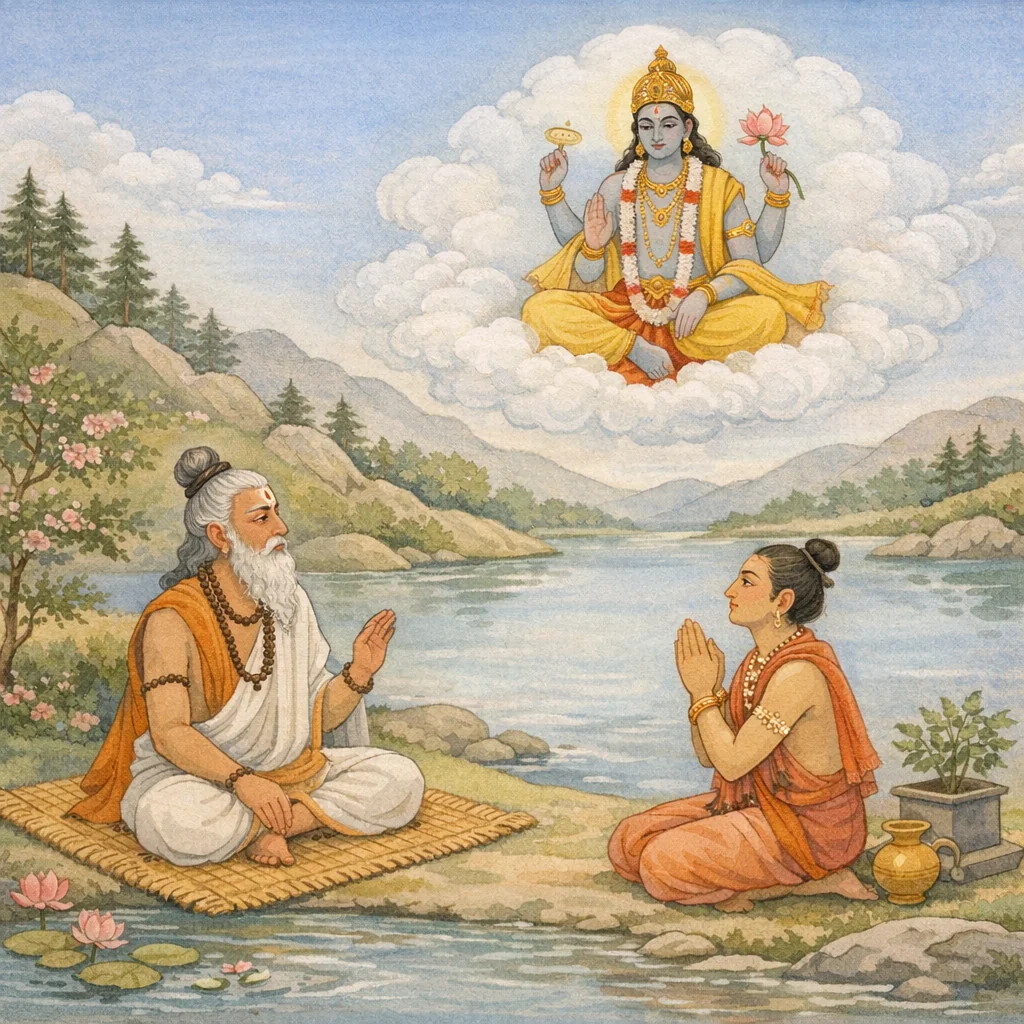
Adhyaya 57
Praise of Digging Wells and Building Water-Reservoirs (The Merit of Water-Works)
Chapter 57 extols water as the ritual and social foundation of dharma: it sustains life and purity, supports śrāddha rites, nourishes agriculture, and serves daily needs. Therefore, digging wells and building ponds and puṣkariṇīs is praised as the highest form of public charity. The discourse describes vast heavenly reward—dwelling in heaven for a kalpa—and uses “drop-by-drop” imagery to show that the merit of providing water is immeasurable, benefiting one across births and among all social classes. A testing narrative contrasts monetary gifts with the enduring merit of a sacred water-work: a stone slab is cast into the tank, and under Dharma’s witness the merits are weighed, revealing water-provision as superior and inexhaustible. The chapter ends by warning that disrespect brings sorrow, and that proclaiming or hearing this dharma teaching destroys sin, grants merit, and may lead toward liberation.
Shlokas
Verse 1
द्विजा ऊचुः । कीर्तिर्धर्मोथ लोकेषु सर्वाणि प्रवराणि च । वद नो मुनिशार्दूल यदि नोऽस्ति त्वनुग्रहः
The twice-born said: “Tell us, O tiger among sages, of fame (kīrti) and dharma in the worlds, and of all that is most excellent as well—if indeed you grant us your favor.”
Verse 2
व्यास उवाच । यस्य खाते वने गावस्तृप्यंति मासमेव च । यद्वा सप्तदिनात्पूतः सर्वदेवैः स पूजितः
Vyāsa said: In the forest, if by a pit he has made the cows are satisfied for a full month, or even if within seven days one becomes purified—such a person is honored and worshipped by all the gods.
Verse 3
पुष्करिण्या विशेषेण पूता या यज्ञकर्मणा । यत्फलं जलदानेन सर्वमत्रास्यि तच्छृणु
Listen: the sacred reservoir (puṣkariṇī), especially sanctified by sacrificial rites (yajña), bestows here in full whatever merit arises from the charitable gift of water (dāna).
Verse 4
हायने हायने चैव कल्पं कल्पं विधीयते । दानात्स्वर्गमवाप्नोति तोयदः सर्वदो भुवि
Year after year, and age after age, the sacred rite is duly ordained. By dāna one attains heaven; the giver of water is, on earth, a giver of everything.
Verse 5
मेघे वर्षति खाते च जायंते ये तु शीकराः । तावद्वर्षसहस्राणि दिवमश्नाति मानवः
As many droplets as spring forth when the rain-cloud pours and the rain strikes the earth, for that many thousands of years a human being enjoys heaven.
Verse 6
तोयैरन्नादिपाकैश्च प्रसन्नो मानवो भवेत् । प्राणानां च विनान्नैश्च धारणन्नैव जायते
By water and by cooked foods such as rice and the like, a person becomes content; and without food, the sustaining of the life-breaths does not arise at all.
Verse 7
पितॄणां तर्पणं शौचं रूपं वै गंध्यनाशनम् । बीजं त्विहार्जितं सर्वं सर्वं तोये प्रतिष्ठितम्
The libations offered to the ancestors, purification, beauty, and the removal of foul odor—every seed that is produced here: all of it is established in water.
Verse 8
वस्त्रस्य धावनं रुच्यं भाजनानां तथैव च । तेनैव सर्वकार्यं च पानीयं मेध्यमेव च
Washing clothes with it is pleasing, and so too is the cleansing of vessels; by that very water all tasks are accomplished, and the drinking water becomes pure indeed.
Verse 9
तस्मात्सर्वप्रयत्नेन वापीकूपतटाककम् । कारयेच्च बलैः सर्वैस्तथा सर्वधनेन च
Therefore, with every possible effort, one should have wells, ponds, and tanks constructed—using all one’s strength and likewise all one’s wealth.
Verse 10
ततो विनिर्जले देशो यो ददाति जलाशयम् । वासरे वासरे तस्य कल्पं स्वर्गं विनिर्दिशेत्
Therefore, whoever provides a reservoir of water in a waterless region—day after day for that person, one should declare a kalpa-long stay in heaven.
Verse 11
त्रिविष्टपाच्च्युतो विप्रो वेदशास्त्रार्थपारगः । लोकबंधुः स धर्मात्मा तपस्तप्त्वा दिवं व्रजेत्
That brahmin, fallen from the heavenly realm yet skilled in the purport of the Vedas and the śāstras—friend and benefactor of the world, righteous in soul—having performed tapas, should ascend again to heaven.
Verse 12
एवं जन्माष्टकं प्राप्य एकस्याक्षयमिष्यते । क्षत्त्रियाणां कुले जातः सार्वभौमो भवेन्नृपः
Thus, by obtaining (or observing) this set of eight births, the fruit of a single rite is said to become imperishable. Born in the lineage of kṣatriyas, a king becomes a universal sovereign.
Verse 13
विशोऽक्षयं धनं विद्याज्जन्मजन्मसु यत्प्रियम् । शूद्रादयोन्त्यजाश्चान्ये लभंते स्वर्गतिं मुहुः
Know that for the Vaiśya, inexhaustible wealth is that which remains dear across birth after birth. Even Śūdras, the so-called antyajas, and others repeatedly attain the path to heaven.
Verse 14
चतुर्हस्तप्रमाणं तु कूपं खनति यः पुमान् । परोपकारकं नित्यं कल्पं स्वर्गं तु हायने
A man who digs a well measuring four cubits, ever engaged in benefiting others, attains heaven for a full kalpa (aeon); and even for a year he enjoys heavenly merit.
Verse 15
द्विगुणे द्विगुणं विद्याच्छतं चैव चतुर्गुणे । विंशत्किष्कुप्रमाणां तु दद्यात्पुष्करिणीं तु यः
One should understand that when it is doubled, the result is doubled; and when it is quadrupled, it becomes a hundred. And whoever provides a puṣkariṇī, a lotus-pond, of the measure of twenty kiṣkus—
Verse 16
विष्णोर्धाम लभेत्सोपि दिव्यभोगं तथैव च । अनंतरं नृपो जातो धनी वागीश्वरो भवेत्
He too attains the abode of Viṣṇu and likewise enjoys divine delights; thereafter, when born again, he becomes a king—wealthy and a lord of speech, eloquent.
Verse 17
एवं द्विस्त्रिश्चतुर्वापि गुणतो भोग्यमिष्यते । विस्तीर्णे प्रचुरं विद्धि सहस्रेणाच्युतो दिवः
Thus it is said to be enjoyed two, three, or even four times over, according to its qualities. Know that, when it is extensive, it becomes abundant—measured by a thousand; and the imperishable Acyuta is indeed divine.
Verse 18
सहस्राद्द्विगुणेनैव सुरपूज्यो भवेन्नरः । जंतवस्तत्र ये संति यावंतो जीवनं ययुः
By merit doubled a thousandfold, a man becomes worthy of worship even by the gods. And all the creatures that dwell there live out the full span of life allotted to them.
Verse 19
तत्संख्याका जनास्तस्य किंकराः पृष्टलग्नकाः । भवंति सततं गेहे पुरे जनपदेषु च
People equal to that number become his attendants, ever clinging close behind him—constantly in his home, in the city, and throughout the countryside.
Verse 20
विहाय पितरं भोग्या धने क्षीणे यथा वनम् । पक्षिणस्सूकरश्चैव महिषी करिणी तथा
When wealth is exhausted, dependents abandon their protector—just as creatures leave a forest once its resources are spent: birds, boars, and likewise the buffalo-cow and the she-elephant.
Verse 21
उपदेष्टा च कर्त्ता च षडेते स्वर्गगामिनः । दिव्यं च पक्षिणां चैव शतं स्वर्गं विनिर्दिशेत्
Both the instructor and the doer—these six kinds of persons are said to go to heaven. Moreover, one should also proclaim a “divine” heaven for birds; indeed, a hundred heavens are spoken of.
Verse 22
क्रोडो वर्षसहस्रं तु महिष्ययुतहायनम् । देवरूपं समास्थाय करिण्या लक्षमुच्यते
A “kroḍa” is said to be a thousand years; a “mahiṣīyuta” is a span of ten thousand years. Assuming a divine form, this measure is stated as a “lakṣa” by the female elephant.
Verse 23
कोट्येकमुपदेष्टुश्च कर्तुरक्षयमेव च । पुरा धनिसुतेनैव कृतः ख्यातो जलाशयः
A single instruction (in merit) is worth a koṭi; and for the doer, the fruit is truly inexhaustible. Long ago, the son of Dhani constructed a renowned reservoir.
Verse 24
अयुतधनव्ययेनैव प्राणेनैव बलेन च । सर्वसत्वोपकाराय शिवश्रद्धायुतेन च
By spending vast wealth, and even one’s own life and strength—all for the welfare of every being—endowed with faith in Śiva.
Verse 25
कालेन कियता चापि क्षीणवित्तोऽभवत्किल । कश्चिदर्थी धनी तस्य मूल्यदानाय चोद्यतः
After some time, it is said, he became bereft of wealth. Then a certain rich man, in need of something, urged him on, ready to pay its price.
Verse 26
विमृश्य धनिना चोक्तं व्याहारं शृणुताधुना । दीनारस्यायुतं वा ते दास्याम्यस्याश्च कारणात्
After due reflection, the wealthy man spoke: “Now hear my proposal. I shall give you ten thousand dīnāras, and that too on account of her.”
Verse 27
लब्धं ते पुष्करिण्याश्च पुण्यं लाभात्प्रमन्यसे । शक्त्या दत्वाथ मूल्यं तां स्वीयां कर्तुं व्यवस्थितः
You deem the merit connected with the sacred pond to be a gain you have obtained; and then, having paid its price according to your means, you have resolved to make it your own.
Verse 28
एवमुक्ते स तं प्राह वासरेप्ययुतं पुनः । फलं भवति वै नित्यं पुण्यं पुण्यविदो विदुः
When this was said, he replied: “Even if it is done ten thousand times in a single day, its fruit indeed arises unfailingly—ever as merit, as the knowers of merit declare.”
Verse 29
एतस्मिन्निर्जले देशे शिवं खातं कृतं च मे । स्नानपानादिकं कर्म सर्वे कुर्वंत्यभीष्टतः
In this waterless region, I have had a Śiva-well dug and made. Here everyone performs acts such as bathing and drinking, exactly as they desire.
Verse 30
तस्मान्मेप्ययुतार्थस्य नैत्यकं फलमिष्यते । ततस्तस्याभवद्धास्यं तथैव च सभासदाम्
“Therefore, even for me—though my aim is not properly fulfilled—no lasting result will arise.” Then he became an object of ridicule, and so too did the members of the assembly.
Verse 31
ह्रिया च पीडितः सोपि वाक्यमेतदुवाच ह । सत्यमेतद्वचोस्माकं परीक्षां कुरु धर्मतः
Afflicted by shame, he too spoke these words: “Our statement is true—test us in accordance with dharma.”
Verse 32
मत्सरात्स तु तं प्राह शृणु मे वचनं पितः । दीनारायुत मे तत्ते दत्वा चानीय प्रस्तरम्
But, out of envy, he said to him: “Father, listen to my words. Give me ten thousand dīnāras, and then bring a stone slab.”
Verse 33
पातयिष्यामि ते खाते यथायोगं प्रमज्जतु । उन्मज्जति च यत्काले प्रस्तरः संतरत्यपि
“I shall drop you into the pit; sink down as is fitting. And when the time comes that you rise up again, even a stone will be able to float across.”
Verse 34
क्षयं यास्यति नो वित्तं नोचेन्मे धर्मतो हि सा । बाढमुक्त्वायुतं तस्य गृहीत्वा स्वगृहं गतः
“My wealth will not diminish—indeed, it is rightfully given according to dharma.” Saying, “So be it,” he took a ten-thousand sum from him and returned to his own house.
Verse 35
साक्षिणामग्रतस्तेन प्रस्तरः पातितस्तथा । पुष्करिण्यां महत्यां च दृष्टं नरसुरासुरैः
In the very presence of the witnesses, he likewise caused a stone slab to be cast down; and in the great sacred tank it was seen by men, gods, and demons.
Verse 36
ततो धर्मतुलायां तु तुलितं धर्मसाक्षिणा । दीनारायुतदानस्य पुष्करिण्या जलस्य तु
Then, upon the scale of Dharma, it was weighed, with Dharma himself as witness—the merit of giving ten thousand dīnāras, and the merit of the water of the sacred puṣkariṇī.
Verse 37
न समं तु दिनैकं तु जलस्य धर्मतो भृशम् । धनिनो मानसं दुःखं मोघार्थं च परेऽहनि
Not even a single day is truly the same as another in the matter of water—its nature changes greatly; and for the wealthy, mental anguish arises, and on the following day their efforts too become fruitless.
Verse 38
शिलोच्चयोऽभवत्तीर्णो द्वीपवच्च जलोपरि । ततः कोलाहलः शब्दो जनानां समुपस्थितः
A lofty mass of rock rose up, standing above the waters like an island. Then a clamorous uproar—the sound of many people—arose all around.
Verse 39
तच्छ्रुत्वाद्भुतवाक्यं च मुदा तौ चागतौ ततः । दृष्ट्वा शैलं तथाभूतं कृतं तेनायुतं तथा
Hearing those wondrous words, the two of them, filled with joy, came there. And seeing the mountain just as it was described, they saw that it had indeed been fashioned by him in that very manner.
Verse 40
ततः खाताधिपेनैव शैलं दूरे निपातितम् । पुण्यं खातस्य चोत्खाते प्रलुप्तस्य सुतेन हि
Then, by Khātādhipa himself, the mountain was hurled far away. And the puṇya connected with Khāta—through the act of digging and excavation—was indeed obtained by the son of Pralupta.
Verse 41
सोपि नाकं समारुह्य जन्मजन्मसु निर्वृतः । गोत्रमातृगणानां च नृपाणां सुहृदां तथा
He too, ascending to heaven, remains fulfilled and blissful through birth after birth—together with the groups of his lineage and mothers, and likewise with kings and friends.
Verse 42
सखीनां चोपकर्तॄणां खातं खात्वाऽक्षयं फलम् । तपस्विनामनाथानां ब्राह्मणानां विशेषतः
By digging a well or reservoir, one gains an imperishable reward—especially when it is done for friends and benefactors, and in particular for ascetic, helpless brāhmaṇas.
Verse 43
खातं तु जनयित्वा तु स्वर्गं चाक्षयमश्नुते । तस्मात्खातादिकं विप्राः शक्तितो यः करिष्यति
Having caused a dug water-reservoir (a tank or well) to be made, one attains the imperishable heaven. Therefore, O brāhmaṇas, whoever—according to his ability—will undertake works such as digging (tanks, wells, and the like)…
Verse 44
सर्वपापक्षयात्पुण्यं मोक्षं यायान्न संशयः । य इदं श्रावयेल्लोके धर्माख्यानं महोत्कटम्
By the destruction of all sins, one gains merit and attains liberation (mokṣa)—of this there is no doubt. Whoever causes this mighty narration of dharma to be heard in the world…
Verse 45
सर्वखातप्रदानस्य फलमश्नाति धार्मिकः । ग्रहणे भास्करस्यैव भागीरथ्यां तटे वरे
A righteous person partakes of the full merit of giving all kinds of charitable gifts—when, at the time of the Sun’s eclipse, he performs the rite on the excellent bank of the Bhāgīrathī (Gaṅgā).
Verse 46
गवां कोटिप्रदानस्य फलं श्रुत्वा लभेन्नरः । न च दारिद्रतामेति न शोकं व्याधिसंचयम्
A person who listens to the fruit of donating ten million cows attains that merit; and he does not fall into poverty, nor into sorrow, nor into an accumulation of diseases.
Verse 57
असंमानं महद्दुःखमुभयोर्नाधिगच्छति । इति श्रीपाद्मपुराणे प्रथमे सृष्टिखंडे खातादिकीर्तनंनाम सप्तपंचाशत्तमोऽध्यायः
Disrespect is a great sorrow; by it neither of the two attains well-being. Thus ends the fifty-seventh chapter, called “Khātādikīrtana,” in the first book, the Sṛṣṭikhaṇḍa, of the sacred Padma Purāṇa.