Adhyaya 49
Brahmin Right Conduct: Morning Remembrance, Bathing, Purification, and Tarpaṇa Method
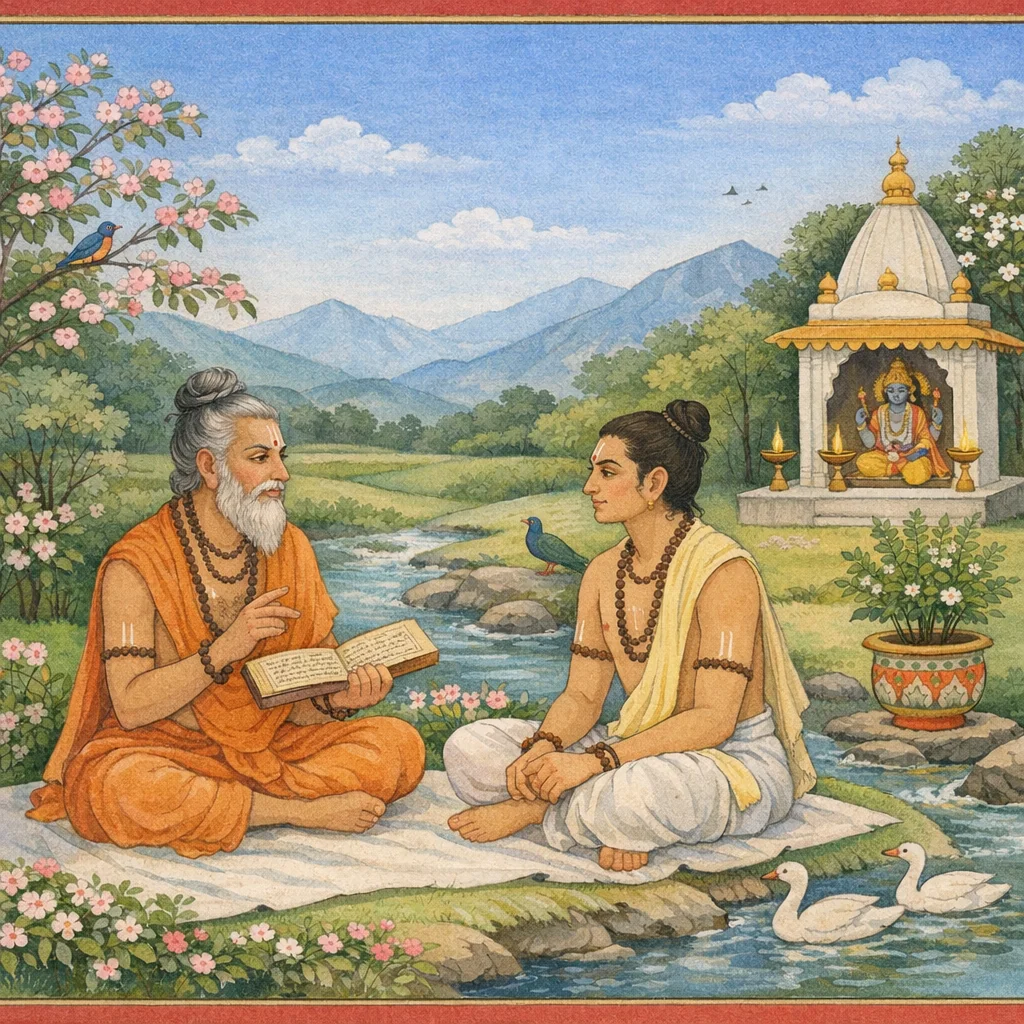
Nārada asks Brahmā how a brāhmaṇa’s tejas increases or is destroyed. Brahmā replies by laying out a disciplined āhnika: rising in the late night or at dawn, remembering the deities and exemplary holy figures, and then undertaking hygienic and ritual purification—proper directions for evacuation, use of the tooth-stick, restraint in sandhyā observance, and meditation on Sarasvatī prescribed according to the time of day. The chapter explains applying clay (mṛd) with a sin-destroying mantra, Vedic modes of bathing, and the doctrine of water as Viṣṇu’s domain. It then teaches Pitṛ-tarpaṇa in detail: proper times, kuśa and black sesame, hand-gestures, orientation, purity of clothing, and prohibitions that nullify the rite. The teaching widens into rules of conduct (śauca, etiquette, avoidances, and ethics of speech), concluding that right conduct grants heaven and liberation.
Shlokas
Verse 1
नारद उवाच । केनाचारेण विप्रस्य ब्रह्मतेजो विवर्धते । केनाचारेण तस्यैव ब्राह्मं तेजो विनश्यति
Nārada said: By what conduct does a Brahmin’s brahmatejas—his spiritual radiance—increase? And by what conduct does that same sacred radiance perish?
Verse 2
ब्रह्मोवाच । शयनीयात्समुत्थाय रात्र्यंशे द्विजसत्तमः । देवांश्चैव स्मरेन्नित्यं तथा पुण्यवतो ध्रुवम्
Brahmā said: Rising from his bed during a portion of the night, the best of the twice-born should ever remember the gods—and likewise Dhruva, the steadfast one renowned for merit.
Verse 3
गोविंदं माधवं कृष्णं हरिं दामोदरं तथा । नारायणं जगन्नाथं वासुदेवमजं विभुम्
Govinda, Mādhava, Kṛṣṇa, Hari, and also Dāmodara; Nārāyaṇa, Jagannātha, Vāsudeva—the unborn, all-pervading Lord.
Verse 4
सरस्वतीं महालक्ष्मीं सावित्रीं वेदमातरम् । ब्रह्माणं भास्करं चन्द्रं दिक्पालांश्च ग्रहांस्तथा
(One should remember) Sarasvatī, Mahālakṣmī, and Sāvitrī—the Mother of the Vedas—as well as Brahmā, the Sun, the Moon, the guardians of the directions, and the planets too.
Verse 5
शङ्करं च शिवं शंभुमीश्वरं च महेश्वरम् । गणेशं च तथा स्कन्दं गौरीं भागीरथीं शिवाम्
I bow to Śaṅkara—Śiva, Śambhu, the Lord (Īśvara), and Maheśvara; and also to Gaṇeśa and Skanda; to Gaurī; and to Bhāgīrathī (Gaṅgā), the auspicious one (Śivā).
Verse 6
पुण्यश्लोको नलो राजा पुण्यश्लोको जनार्दनः । पुण्यश्लोका च वैदेही पुण्यश्लोको युधिष्ठिरः
King Nala is celebrated by holy fame; Janārdana (Viṣṇu) is celebrated by holy fame. Vaidehī (Sītā) too is celebrated by holy fame; and Yudhiṣṭhira is celebrated by holy fame.
Verse 7
अश्वत्थामा बलिर्व्यासो हनूमांश्च विभीषणः । कृपः परशुरामश्च सप्तैते चीरजीविनः
Aśvatthāmā, Bali, Vyāsa, Hanumān, Vibhīṣaṇa, Kṛpa, and Paraśurāma—these seven are the long-lived, the immortal ones.
Verse 8
एतान्यस्तु स्मरेन्नित्यं प्रातरुत्थाय मानवः । ब्रह्महत्यादिभिः पापैर्मुच्यते नात्र संशयः
But a person who, rising early in the morning, remembers these daily is freed from sins such as brahmahatyā (slaying a brāhmaṇa); of this there is no doubt.
Verse 9
सकृदुच्चरिते तात सर्वयज्ञफलं लभेत् । गवां शतसहस्राणां दानस्य फलमश्नुते
O dear one, by uttering it just once, a person attains the merit of all yajñas (sacrifices) and enjoys the fruit of donating a hundred thousand cows.
Verse 10
ततश्चापि शुचौ देशे मलमूत्रं परित्यजेत् । दक्षिणाभिमुखो रात्रौ दिवा कुर्यादुदङ्मुखः
Thereafter, in a pure place, one should void feces and urine—facing south at night, and facing north by day.
Verse 11
परतो दंतकाष्ठं च तृणैरुदुंबरादिभिः । अतः परं च संध्यायां संयतश्च द्विजो भवेत्
Thereafter, one should cleanse the teeth with a tooth-stick made from grasses or from trees such as the udumbara. Then, at the time of sandhyā, the twice-born should become self-restrained.
Verse 12
पूर्वाह्णे रक्तवर्णां तु मध्याह्ने शुक्लवर्णिकाम् । सायं सरस्वतीं कृष्णां द्विजो ध्यायेद्यथाविधि
In the forenoon, the twice-born should meditate upon Sarasvatī as red-hued; at midday, as white; and in the evening, upon Sarasvatī as dark—according to the prescribed rite.
Verse 13
ततः समाचरेत्स्नानं यथाज्ञानेन यत्नतः । अंगं प्रक्षालयित्वा तु मृद्भिः संलेपयेत्ततः
Thereafter, one should carefully perform the bath according to one’s understanding. Having washed the body, one should then anoint it with purifying earth (clay).
Verse 14
शिरोदेशे ललाटे च नासिकायां हृदि भ्रुवोः । बाह्वोः पार्श्वे तथा नाभौ जान्वोरङ्घ्रिद्वये तथा
On the region of the head, on the forehead, on the nose, in the heart, and between the eyebrows; on the arms, on the sides, likewise on the navel, on the knees, and on both feet as well.
Verse 15
एका लिंगे गुदे तिस्रस्तथा वामकरे दश । उभयोः सप्त दातव्या मृदः शुद्धिमभीप्सता
One application of sacred earth is to be given to the generative organ; three to the anus; ten to the left hand; and seven to both hands together—by one who seeks purification.
Verse 16
अश्वक्रांते रथक्रांते विष्णुक्रांते वसुंधरे । मृत्तिके हर मे पापं यन्मया पूर्वसंचितम्
O Earth—trodden by horses, traversed by chariots, and sanctified by the stride of Viṣṇu—O sacred clay, remove the sins I have accumulated from the past.
Verse 17
अनेनैव तु मंत्रेण मृत्तिकां यस्तनौ क्षिपेत् । सर्वपापक्षयस्तस्य शुचिर्भवति मानवः
But whoever, using this very mantra, applies sacred earth to the body—every sin of his is destroyed, and the person becomes pure.
Verse 18
ततस्तु वेदपूर्वेण स्नानं कुर्याद्विचक्षणः । नदे नद्यां तथा कूपे पुष्करिण्यां तटाकके
Then a discerning person should bathe in the manner prescribed by the Vedas—whether in a stream, a river, a well, a lotus-pond, or a lake.
Verse 19
जलराशौ च वप्रे च घटस्नानं तथोत्तरम् । कारयेद्विधिवन्मर्त्यः सर्वपापक्षयाय च
A mortal should duly perform ghaṭa-snāna, the pot-bath, in a body of water and at a tank or embankment, and then the subsequent rite as well, for the complete destruction of all sins.
Verse 20
प्रातःस्नानं महापुण्यं सर्वपापप्रणाशनम् । यः कुर्यात्सततं विप्रो विष्णुलोके महीयते
Bathing at dawn is supremely meritorious and destroys all sins. The brāhmaṇa who performs it regularly is honored in Viṣṇu’s world.
Verse 21
प्रातः संध्यासमीपे च यावद्दंडचतुष्टयम् । तावत्पानीयममृतं पितॄणामुपतिष्ठते
Near the morning sandhyā, for as long as four daṇḍas endure, the water offered remains present for the Pitṛs as amṛta, nectar-like.
Verse 22
परतो घटिकायुग्मं यावद्यामैकमाह्निकम् । मधुतुल्यं जलं तस्मिन्पितॄणां प्रीतिवर्धनम्
For two ghaṭikās—up to a full yāma and the day’s daily rite (āhnika)—the water offered becomes like honey, increasing the satisfaction of the Pitṛs.
Verse 23
ततस्तु सार्द्धयामैकं जलं क्षीरमयं स्मृतम् । क्षीरमिश्रं जलं तावद्यावद्दण्डचतुष्टयम्
Then, for one sārdha-yāma, the water is said to become milk-like; and for as long as four daṇḍas, the water remains mixed with milk.
Verse 24
अतः परं च पानीयं यावद्धि प्रहरत्रयम् । तत्परं लोहितं प्रोक्तं यावदस्तंगतो रविः
After that, it should be regarded as drinkable water for as long as three praharas; thereafter it is declared to be reddish, until the sun has set.
Verse 25
चतुर्थप्रहरे स्नाने रात्रौ वा तर्पयेत्पितॄन् । तत्तोयं रक्षसामेव ग्रहणेन विना स्मृतम्
If, during a bath in the fourth watch or at night, one offers the śrāddha libations to the Pitṛs, that water is said in tradition to be fit only for the Rākṣasas—unless it is the time of an eclipse.
Verse 26
पानीयं सर्वसिर्द्ध्य्थं पुरैव निर्मितं मया । रक्षार्थं तस्य तोयस्य यक्षाश्चैव धुरंधराः
“Long ago I created this water for the attainment of every success; and for the protection of that water, the Yakṣas—mighty guardians—were appointed.”
Verse 27
न प्राप्नुवंति पितरो ये च लोकांतरं गताः । दुष्प्राप्यं सलिलं तेषामृते स्वान्मर्त्यवासिनः
The Pitṛs who have departed to another world do not obtain (water) on their own; for them, water is difficult to access—except through their own kin who dwell among mortals.
Verse 28
तस्माच्छिष्यैश्च पुत्रैश्च पौत्रदौहित्रकादिभिः । बंधुवर्गैस्तथा चान्यैस्तर्पणीयं पितृव्रतैः
Therefore, those devoted to the ancestral vow should offer the tarpaṇa to the Pitṛs—by disciples, sons, grandsons, grandsons through daughters, and the like; by groups of relatives, and also by others.
Verse 29
नारद उवाच । जलस्य दैवतं ब्रूहि तर्पणस्य विधिं मयि । यथा जानामि देवेश तत्वतो वक्तुमर्हसि
Nārada said: “Tell me the presiding deity of water, and instruct me in the proper method of tarpaṇa. O Lord of the gods, so that I may know it correctly in its true principle—please explain it as it really is.”
Verse 30
ब्रह्मोवाच । जलस्य देवता विष्णुःस र्वलोकेषु गीयते । जलपूतो भवेद्यस्तु विष्णुस्तच्छंकरो भवेत्
Brahmā said: “Viṣṇu is praised in all the worlds as the presiding deity of water. Whoever is purified by water—there Viṣṇu becomes present; and that very presence becomes Śaṅkara.”
Verse 31
जलं गंडूषमात्रं तु पीत्वा पूतो भवेन्नरः । विशेषात्कुशसंसर्गात्पीयूषादधिकं जलम्
By drinking only a mouthful of water, a person becomes purified. Water is especially purifying when it has been in contact with kuśa grass; indeed, such water is regarded as superior even to nectar (amṛta).
Verse 32
सर्वदेवालयो दर्भो मयायं निर्मितः पुरा । कुशमूले भवेद्ब्रह्मा कुशमध्ये तु केशवः
This sacred darbha grass is an abode of all the gods; I fashioned it long ago. At the root of the kuśa is Brahmā, and in the middle of the kuśa is Keśava (Viṣṇu).
Verse 33
कुशाग्रे शंकरं विद्धि कुश एते प्रतिष्ठिताः । कुशहस्तः सदा मेध्यः स्तोत्रं मंत्रं पठेद्यदि
Know that Śaṅkara abides at the tip of kuśa grass, and that these kuśa blades are established as sacred supports. If one holds kuśa in the hand, one is always ritually pure, especially when reciting hymns (stotra) and mantras.
Verse 34
सर्वं शतगुणं प्रोक्तं तीर्थे साहस्रमुच्यते । कुशाः काशास्तथा दूर्वा यवपत्राणि व्रीहयः
All (religious merit) is said to become a hundredfold; at a tīrtha it is declared to become a thousandfold. (Offerings) such as kuśa grass, kāśa grass, dūrvā grass, barley leaves, and rice are mentioned.
Verse 35
बल्वजाः पुंडरीकाश्च कुशास्सप्त प्रकीर्तिताः । आनुपूर्व्येण मेध्याः स्युः कुशा लोके प्रतिष्ठिताः
Balvaja and Puṇḍarīka, together with seven kinds of kuśa-grass, are proclaimed. In proper sequence they are held to be purifying; thus kuśa is established in the world as a sacred purifier.
Verse 36
विना मंत्रेण यत्स्नानं सर्वं तन्निष्फलं भवेत् । अमृतात्स्वादुतामेति संस्पर्शाच्च तिलस्य च
Any bathing performed without mantra becomes wholly fruitless. Yet through contact with sesame (tilā) it attains sweetness, as though it were nectar—amṛta.
Verse 37
तस्माच्च तर्पयेन्नित्यं पितॄंस्तिलजलैर्बुधः । दशभिश्च तिलैस्तावत्पितॄणां प्रीतिरुत्तमा
Therefore a wise person should daily satisfy the Ancestors (Pitṛs) by offering tarpaṇa with water mixed with sesame; for even with ten sesame seeds, the Ancestors’ satisfaction becomes excellent.
Verse 38
अग्निस्तंभभयाद्देवा न चेच्छन्त्यतिविस्तरम् । स्नात्वा यस्तर्पयेन्नित्यं तिलमिश्रोदकैः पितॄन्
Out of fear of the fiery pillar, the gods (devas) did not wish to proceed too far. But whoever, after bathing, continually offers libations to the Ancestors with water mixed with sesame—
Verse 39
नीलपंडविमोक्षेण त्वमावास्या तिलोदकैः । वर्षासु दीपदानेन पितॄणामनृणो भवेत्
By performing the rite of Nīlapaṇḍa-vimokṣa, by offering sesame-water (tilodaka) on the new-moon day (Amāvāsyā), and by giving lamps during the rainy season, one becomes free from debt to the Ancestors (Pitṛs).
Verse 40
वत्सरैकममायां तु तर्पयेद्यस्तिलैः पितृन् । विनायकत्वमाप्नोति सर्वदेवैः प्रपूज्यते
But whoever, on the day of amāvasyā (new moon), offers tarpaṇa to the ancestors with sesame for a full year attains the status of Vināyaka and is worshipped by all the gods.
Verse 41
युगाद्यासु च सर्वासु यस्तिलैस्तर्पयेत्पितॄन् । उक्तं यद्वाप्यमायां तु तस्माच्छतगुणाधिकम्
Whoever, at all the beginnings of the yugas and on every sacred occasion, offers tarpaṇa to the ancestors with sesame—whatever reward is declared for it—becomes a hundredfold in the month of Māgha.
Verse 42
अयने विषुवे चैव राकामायां तथैव च । तर्पयित्वा पितृव्यूहं स्वर्गलोके महीयते
Likewise, on the solstices, on the equinox, and on the full-moon night as well—having offered tarpaṇa to the host of ancestors—one is honored in the heavenly world.
Verse 43
तथा मन्वंतराख्यायामन्यस्यां पुण्यसंस्थितौ । ग्रहणे चंद्रसूर्यस्य पुण्यतीर्थे गयादिषु
Likewise, in another sacred period known as a Manvantara, and during eclipses of the Moon and the Sun, when one is established in holiness—especially at sacred tīrthas such as Gayā and the like—great merit is obtained.
Verse 44
तर्पयित्वा पितॄन्याति माधवस्य निकेतनम् । तस्मात्पुण्याहकं प्राप्य तर्पयेत्पितृसंचयम्
Having offered tarpaṇa to the ancestors, one attains the abode of Mādhava (Viṣṇu). Therefore, upon obtaining an auspicious day, one should offer tarpaṇa to the hosts of forefathers.
Verse 45
तर्पणं देवतानां च पूर्वं कृत्वा समाहितः । अधिकारी भवेत्पश्चात्पितॄणां तर्पणे बुधः
Having first, with a collected mind, performed tarpaṇa (libations) to the deities, the wise one thereafter becomes duly qualified to offer tarpaṇa to the ancestors (Pitṛs).
Verse 46
श्राद्धे भोजनकाले च पाणिनैकेन दापयेत् । उभाभ्यां तर्पणे दद्याद्विधिरेष सनातनः
At a śrāddha and at the time of serving food, one should offer with a single hand; but in tarpaṇa one should give with both hands—this is the eternal rule.
Verse 47
दक्षिणाभिमुखो भूत्वा शुचिस्तु तर्पयेत्पितॄन् । तृप्यतामिति वाक्येन नामगोत्रेण वै पुनः
Facing south and remaining ritually pure, one should offer tarpaṇa to the ancestors, again invoking them by name and lineage, with the words, “May you be satisfied.”
Verse 48
अकृष्णैर्यत्तिलैर्मोहात्तर्पयेत्पितृसंचयम् । भूम्यां ददाति यदपो दाता चैव जले स्थितः
If, out of delusion, one offers tarpaṇa to the assemblage of the Pitṛs using sesame seeds that are not black, and if one pours the water-offering onto the ground while the giver himself stands in water—such a rite is deemed improperly performed.
Verse 49
वृथा तद्दीयते दानं नोपतिष्ठति कस्यचित् । स्थले स्थित्वा जले यस्तु प्रयच्छेदुदकं नरः
That gift is offered in vain; it benefits no one—when a man, standing on dry ground, offers water as a libation into water.
Verse 50
नोपतिष्ठेत्पितॄणां तु सलिलं तन्निरर्थकम् । आर्द्रवासा जले यस्तु कुर्यादुदकतर्पणम्
Water offered to the Pitṛs does not reach them; it becomes fruitless if one performs the water-oblation while in the water, wearing wet garments.
Verse 51
पितरस्तस्य तृप्यंति सहदेवैस्सदानघ । रजकैः क्षालितं वस्त्रमशुद्धं कवयो विदुः
O sinless one, his ancestors are satisfied, along with the gods; yet the wise declare that a garment washed by washermen is impure.
Verse 52
हस्तप्रक्षालने चैव पुनर्वस्त्रं तु शुध्यति । शुष्कवासाः शुचौ देशे स्थाने यत्तर्पयेत्पितॄन्
By washing the hands, one’s garment becomes purified again. Wearing dry clothes, in a clean place and proper spot, one should offer the satisfying tarpaṇa oblations to the Pitṛs.
Verse 53
ततो दशगुणेनैव तुष्यंति पितरो ध्रुवम् । स्नानं संध्यां च पाषाणे खड्गे वा ताम्रभाजने
Then indeed the Pitṛs are surely satisfied tenfold. One should perform bathing and the Sandhyā (twilight worship) upon a stone, or upon a sword, or in a copper vessel.
Verse 54
तर्पणं कुरुते यस्तु प्रत्येकं च शताधिकम् । रौप्यांगुलीयं तर्जन्यां धृत्वा यत्तर्पयेत्पितॄन्
But whoever performs tarpaṇa—offering to each ancestor a hundred libations and more—while wearing a silver ring on the index finger, and thus offers to the Pitṛs, gains special merit.
Verse 55
सर्वं च शतसाहस्रगुणं भवति नान्यथा । तथैवानामिकायां तु धृत्वा स्वर्णांगुलीं बुधः
And everything becomes a hundred-thousand-fold in merit—never otherwise. Likewise, the wise one, placing a golden ring upon the ring-finger…
Verse 56
तर्पयेत्पितृसंदोहं लक्षकोटिगुणं भवेत् । अंगुष्ठदेशिनी मध्ये सव्यहस्तस्य खड्गकम्
One should offer tarpaṇa, libations, to the multitude of ancestors; the merit becomes a hundred-thousand–crore times greater. Between the thumb and index finger of the left hand is formed the ‘khaḍga’, a sword-like hand-configuration.
Verse 57
धृत्वानामिकया रत्नमंजलेरक्षयंफलं । स्नानार्थमभिगच्छंतं देवाः पितृगणैः सह
Having placed upon the ring-finger the jeweled cluster whose fruit is inexhaustible, the gods—together with the hosts of the Pitṛs—approached him as he went to bathe.
Verse 58
वायुभूतानुगच्छंति तृषार्ताः सलिलार्थिनः । निराशास्ते निवर्तंते वस्त्रनिष्पीडनेन च
Tormented by thirst, seekers of water follow after what is only wind; but disappointed, they turn back—having wrung out their clothes in vain.
Verse 59
तस्मान्न पीडयेद्वस्त्रमकृत्वा पितृतर्पणम् । तिस्रःकोट्योऽर्धकोटी च यानि लोमानि मानुषे
Therefore, one should not wring or squeeze a cloth without first offering tarpaṇa, libations, to the Pitṛs; for in a human being there are three crores and a half crores of hairs.
Verse 60
स्रवंति सर्वतीर्थानि तस्मान्न परिपीडयेत् । देवाः पिबंति शिरसि श्मश्रुतः पितरस्तथा
All sacred tīrthas flow there; therefore one should not torment or injure it. The Devas drink there at the head, and likewise the Pitṛs drink from the beard.
Verse 61
चक्षुषोरपि गंधर्वा अधस्तात्सर्वजंतवः । देवाः पितृगणाः सर्वे गंधर्वा जंतवस्तथा
From the eyes, too, the Gandharvas arise; and below them are all living beings. There are the Devas and all the hosts of Pitṛs, and likewise the Gandharvas and other creatures as well.
Verse 62
स्नानमात्रेण तुष्यंति स्नानात्पापं न विद्यते । नित्यस्नानं च यः कुर्यात्स नरः पुरुषोत्तमः
By bathing alone, the deities are pleased; through bathing, sin does not remain. And the man who performs daily bathing—he is the best of men, a puruṣottama.
Verse 63
सर्वपापैर्विनिर्मुक्तो नाकलोकेमहीयते । स्नानं तर्पणपर्यंतं देवा महर्षयो विदुः
Freed from all sins, one is honored in the heavenly world. The Devas and great ṛṣis know and prescribe the rite that begins with bathing and extends up to the offering of tarpaṇa (libations).
Verse 64
अतः परं च देवानां पूजनं कारयेद्बुधः । गणेशं पूजयेद्यस्तु विघ्नस्तस्य न जायते
Thereafter, the wise person should arrange the worship of the Devas. But whoever worships Gaṇeśa—obstacles do not arise for him.
Verse 65
आरोग्यार्थं च सूर्यं च धर्ममोक्षाय माधवम् । शिवं च कृत्यकामार्थं सर्वकामाय चंडिकाम्
For health one should worship Sūrya; for dharma and liberation, Mādhava (Viṣṇu); for success in rites and desired works, Śiva; and for the fulfillment of all wishes, Caṇḍikā, the Goddess.
Verse 66
देवांस्तु पूजयित्वा तु वैश्वदेवबलिं चरेत् । वह्निकार्यं ततः कृत्वा यज्ञं ब्राह्मणतर्पणम्
After worshipping the gods, one should perform the offering known as the Vaiśvadeva bali. Then, having completed the rites connected with the sacred fire, one should carry out sacrifice (yajña) and the satisfying of Brahmins through offerings and hospitality.
Verse 67
देवानां सर्वसत्वानां पुनस्त्रिविष्टपं व्रजेत् । गतागतं स्थिरं कृत्वा कामान्मोक्षं सुखं दिवम्
For the gods and for all beings, one goes again to Triviṣṭapa (heaven). Having made the cycle of coming and going cease and become steady, one attains the desired goals—liberation, happiness, and the heavenly state.
Verse 68
तस्मात्सर्वप्रयत्नेन नित्यं कर्माणि कारयेत् । नारद उवाच । किमर्थं च जलं तात देवाः पितृगणैः सह
Therefore, with every effort, one should unfailingly have the prescribed rites performed. Nārada said: “For what purpose, dear one, do the gods along with the hosts of ancestors (Pitṛs) require water?”
Verse 69
न प्राप्नुवंति सर्वज्ञ लभंते मानवा यथा । ब्रह्मोवाच । पुरा सृष्टं मया तोयं सर्वदेवमयामृतम्
O omniscient one, they do not attain it in the way that human beings obtain their gains. Brahmā said: “Formerly, I created that water—nectar-like (amṛta), and imbued with all the gods.”
Verse 70
तस्यैव रक्षणार्थं च रक्षा यक्षा धनुर्धराः । घ्नंति ते पितरं देवमस्मद्वाक्यान्न मानुषम्
And solely for his protection, the bow-bearing guardians—Rākṣasas and Yakṣas—slay even their own father, the divine Lord, in obedience to our command, not any mere man.
Verse 71
पशवः पक्षिणः कीटा मर्त्यलोके व्यवस्थिताः । मर्त्यजाताश्च देवा ये तथैव मानुषा ध्रुवम्
Beasts, birds, and insects are established in the mortal world; and even those gods who are born into mortality are likewise truly human—certainly.
Verse 72
तर्पयित्वा गुरुं नित्यं सुरलोके प्रतिष्ठिताः । अस्नायी च मलं भुंक्ते अजपी पूयशोणितम्
Having regularly satisfied and honoured the guru, they become established in the world of the gods. But one who does not bathe eats filth, and one who does not recite japa consumes pus and blood.
Verse 73
अकृत्वा तर्पणं नित्यं पितृहा चोपजायते । ब्रह्महत्यासमं पापं देवानामप्यपूजने
If one fails to perform the daily tarpaṇa (water-offering), one becomes, as it were, a slayer of the ancestors. Neglecting the worship of the gods too is a sin equal to brahmahatyā—the killing of a brāhmaṇa.
Verse 74
सन्ध्याकृत्यमकृत्वा च सूर्यं हंति च पापकृत् । नारद उवाच । ब्राह्मणस्य सदाचारक्रमं ब्रूहि च कर्मणाम्
A sinful person, by neglecting the sandhyā (twilight) rites, as it were ‘kills’ the Sun. Nārada said: “Tell me, in due order, the proper conduct and duties of a brāhmaṇa.”
Verse 75
इतरेषां च वर्णानां प्रवृत्तमखिलं वद । ब्रह्मोवाच । आचाराल्लभते चायुराचाराल्लभते सुखम्
“And also tell in full the proper conduct of the other social orders.” Brahmā said: “From right conduct (ācāra) one gains long life; from right conduct one gains happiness.”
Verse 76
आचारात्स्वर्गं मोक्षं च आचारो हंत्यलक्षणम् । अनाचारो हि पुरुषो लोके भवति निंदितः
From right conduct one attains heaven and even liberation (mokṣa); right conduct destroys ill-omen and disgrace. But a man devoid of proper conduct becomes condemned in the world.
Verse 77
दुःखभागी च सततं व्याधितोल्पायुरेव च । नरके नियतं वासो ह्यनाचारान्नरस्य च
A man of evil conduct becomes a constant sharer of sorrow—ever afflicted by disease, short-lived; and for such an immoral person, residence in hell is assured.
Verse 78
आचाराच्च परं लोकमाचारं शृणु तत्त्वतः । गोमयेन गृहे नित्यं प्रकुर्यादुपलेपनम्
Through right conduct one reaches the higher world; now hear true conduct in its essence: one should regularly plaster the home with cow-dung, for purity.
Verse 79
प्रक्षालयेत्ततः पीठं काष्ठं पात्रं शिलातलम् । भस्मना कांस्यपात्रं तु ताम्रमम्लेनशुद्ध्यति
Then one should wash the seat, wooden items, vessels, and stone surfaces. Bronze vessels are cleansed with ash, while copper is purified with something sour (acidic).
Verse 80
शिलापात्रं तु तैलेन फालंगो वालकेन तु । स्वर्णरौप्यादिपात्रं तु जलमात्रेण शुध्यति
A stone vessel is purified with oil; a phālaṅga vessel with sand. But vessels of gold, silver, and the like are purified by water alone.
Verse 81
अग्निना लोहपात्रं तु पाकप्रक्षालनेन तु । खननाद्दाहनाच्चैव उपलेपन धावनात्
An iron vessel is purified by fire; likewise by washing after cooking. It is also purified by digging it out, by burning, and by smearing it with a purifying coating and washing it.
Verse 82
पर्जन्यवर्षणाच्चैव भूरमेध्या विशुध्यति । तैजस्सानां मणीनां च सर्वस्याश्ममयस्य च
By the rain of the clouds, even earth that has become impure is purified; likewise radiant metals, gems, and everything made of stone are purified.
Verse 83
भस्मभिर्मृत्तिकाभिश्च शुद्धिरुक्ता मया पुरा । शय्या भार्या शिशुर्वस्त्रमुपवीतं कमंडलुः
Formerly I have explained purification by means of sacred ash and clay; likewise, rules of purity apply regarding the bed, the wife, the child, the garment, the sacred thread, and the water-pot (kamandalu).
Verse 84
आत्मनः कथिताश्शुद्धा न परेषां कदाचन । न भुंजीतैकवस्त्रेण न स्नायादेकवाससा
One should deem oneself purified only by one’s own proper conduct—never by relying on others. One should not eat wearing only a single garment, nor should one bathe wearing only a single garment.
Verse 85
न धारयेत्परस्यैवं स्नानवस्त्रं कदाचन । संस्कारं केशदंतानां प्रातरेव समाचरेत्
One should never, in this manner, wear another person’s bathing cloth. Early in the morning one should duly groom the hair and cleanse the teeth.
Verse 86
गुरूणां च नमस्कारं नित्यमेव समाचरेत् । हस्तपादे मुखे चैव पंचार्द्रो भोजनं चरेत्
One should always, day by day, offer salutations to one’s teachers; and one should eat only after washing the hands, feet, and mouth.
Verse 87
पंचार्द्रकस्तु भुंजानः शतं वर्षाणि जीवति । देवतानां गुरोराज्ञां स्नातकाचार्ययोरपि
One who eats the five kinds of ārdra (fresh ginger) lives for a hundred years—provided he also follows the commands of the gods, the guru, the king, and likewise of the snātaka and the ācārya.
Verse 88
नाक्रामेत्कामतश्छायां विप्रस्य दीक्षितस्य च । गोगणं देवतं विप्रं घृतं मधु चतुष्पथम्
One should not, out of mere whim, step upon the shadow of a brāhmaṇa or of one who is consecrated (dīkṣita). Nor should one trample upon a herd of cows, a deity, a brāhmaṇa, clarified butter (ghee), honey, or a crossroads.
Verse 89
प्रदक्षिणं प्रकुर्वीत प्रख्यातांश्च वनस्पतीन् । गोविप्रावग्निविप्रौ च विप्रौ द्वौ दंपती तथा
One should perform pradakṣiṇā, reverential circumambulation, of renowned sacred trees; likewise of a cow, of brāhmaṇas, of the sacred fire, and also of a brāhmaṇa couple (husband and wife).
Verse 90
तयोर्मध्ये न गच्छेत स्वर्गस्थोपि पतेद्ध्रुवम् । उच्छिष्टो न स्पृशेदग्निं ब्राह्मणं दैवतं गुरुम्
One should not pass between the two; even one dwelling in heaven would surely fall by doing so. And while in a state of ucchiṣṭa (impurity after eating), one should not touch the sacred fire, a brāhmaṇa, a deity, or one’s guru.
Verse 91
स्वशीर्षं पुष्पवृक्षं च यज्ञवृक्षमधार्मिकम् । त्रीणि तेजांसि नोच्छिष्ट उदीक्षेत कदाचन
While in a state of ucchiṣṭa, one should never look upon three radiant things: one’s own head, a flowering tree, and the ‘sacrificial tree’ of one who is unrighteous.
Verse 92
सूर्याचंद्रमसावेवं नक्षत्राणि च सर्वशः । नेक्षेद्विप्रं गुरुं देवं राजानं यतिनां वरम्
Thus one should not gaze upon the sun or the moon, nor upon the stars in general; likewise, one should not stare at a brāhmaṇa, one’s teacher, a deity, a king, or the foremost among ascetics.
Verse 93
योगिनं देवकर्माणं धर्माणां कथकं द्विजम् । नदीनां च प्रतीरे च पत्युश्च सरितां तथा
A yogin engaged in divine rites; a twice-born reciter of dharma; the banks of rivers; and likewise the lord who presides over streams—all these are to be regarded as sacred and worthy of reverence.
Verse 94
यज्ञवृक्षस्य मूले च उद्याने पुष्पवाटके । शरीरस्य मलत्यागं न कुर्याज्जीवने तथा
One should not void bodily waste at the root of the sacred sacrificial tree, nor in a garden or a flower-grove; likewise, one should never do so in places where living beings dwell.
Verse 95
विप्रस्यायतने गोष्ठे रम्ये राजपथेषु च । न क्षौरं कारयेद्धीरः कुजस्याह्नि कदाचन
A wise person should never have shaving or tonsure done on the day of Mars (Tuesday)—whether in a brāhmaṇa’s dwelling, in a cowshed, in pleasant places, or upon royal highways.
Verse 96
मलं न धारयेद्दंते नखं न वदने क्षिपेत् । तैलाभ्यंगं न कुर्वीत वासरे रविभौमयोः
One should not keep impurities upon the teeth, nor put nail-parings into the mouth. Nor should one perform an oil anointing and massage on the day of the Sun (Sunday) and the day of Mars (Tuesday).
Verse 97
स्वगात्रासनयोर्वाद्यं गुरोरेकासनादनम् । न हरेच्छ्रोत्रियस्वं च देवस्यापि गुरोरपि
One should not make music by striking one’s own body or seat, nor sit upon the same seat as the guru. One should not take the property of a śrotriya (a Veda-learned man)—nor that belonging to a deity, nor to the guru.
Verse 98
राज्ञस्तपस्विनां चैव पंगोरंधस्य योषितः । पंथा देयो ब्राह्मणाय गोभ्यो राजभ्य एव च
One should yield the way to a king, to ascetics, to the lame, to the blind, and to women; likewise, the right of way should be given to a brāhmaṇa, to cows, and to royal persons as well.
Verse 99
रोगिणे भारतप्ताय गुर्विण्यै दुर्बलाय च । विवादं न च कुर्वीत नृप विप्र चिकित्सकैः
O king, one should not enter into dispute with physicians who are treating a sick person, one afflicted by fever, a pregnant woman, or a weak person.
Verse 100
ब्राह्मणं गुरुपत्नीं च दूरतः परिवर्जयेत् । पतितं कुष्ठसंयुक्तं चांडालं च गवाशिनम्
From afar one should avoid association with a Brahmin and with the guru’s wife; likewise one should shun the fallen, the leper, the caṇḍāla, and the eater of cow-flesh.
Verse 101
निर्धूतं ज्ञानहीनं च दूरतः परिवर्जयेत् । स्त्रियं दुष्टां च दुर्वृत्तामपवाद प्रदायिनीम्
Keep far away and avoid one who is cast out and devoid of true knowledge; likewise avoid a wicked woman of ill conduct who spreads slander.
Verse 102
कुकर्मकारिणीं दुष्टां सदैव कलहप्रियाम् । प्रमत्तामधिकांगीञ्च निर्लज्जां बाह्यचारिणीम्
A woman who commits wicked deeds—vile by nature and ever fond of quarrels; reckless, excessively sensuous, shameless, and maintaining only outward, false propriety—should be avoided.
Verse 103
व्ययशीलामनाचारां दूरतः परिवर्जयेत् । मलिनां नाभिवंदेत गुरुपत्नीं कदाचन
From afar one should avoid a wasteful woman of ill conduct; and one should never bow to or salute a tainted guru’s wife.
Verse 104
न स्पृशेत्तां च मेधावी स्पृष्ट्वा स्नानेन शुद्ध्यति । स तया सह केलिं च वर्जयेच्च सदैव हि
A wise person should not touch her; if he has touched her, he is purified by bathing. And indeed, he should always avoid amorous play with her.
Verse 105
शृणुयाच्च वचो नूनं न पश्येच्च गुरोः स्त्रियम् । वधूं पुत्रस्य भ्रातुश्च स्वपुत्रीं युवतीं ध्रुवम्
One should surely listen to the teacher’s words, yet should not gaze upon the teacher’s wife; likewise, one should avoid looking upon one’s son’s bride, one’s brother’s wife, and one’s own young daughter—without exception.
Verse 106
अन्यां च गुरुपत्नीं च नेक्षेत्स्पर्शं न कारयेत् । ताभिः सह कथालापं तथा भ्रूभंगदर्शनम्
One should not look upon another man’s wife, nor upon the teacher’s wife; one should not initiate or engage in physical contact. Likewise, one should avoid conversation with them, and even the exchange of suggestive glances or eyebrow-signals.
Verse 107
कलहं निस्त्रपां वाणीं सदैव परिवर्जयेत् । न दद्याच्च सदा पादं तुषांगारास्थिभस्मसु
One should always avoid quarrel and shameless speech. And one should never place the foot upon chaff, embers, bones, or ashes.
Verse 108
कार्पासास्थिषु निर्माल्ये चितिकाष्ठे चितौ गुरौ । शुष्कं मीनं न भक्षेत पूतिगंधिममेध्यकम्
One should not eat dried fish that has a foul smell and is impure—especially when one is among cotton-seeds or husks, discarded garlands, funeral-pyre wood, a cremation ground, or in the presence of one’s teacher.
Verse 109
विघसं चान्यदुच्छिष्टं पाकार्थं च परस्य च । न स्थातव्यं न गंतव्यं क्षणमप्यसता सह
One should not stay with, nor even go with, a wicked person even for a moment—whether it be for eating leftovers (vighasa), other remnants, for the sake of cooking, or for another’s purposes.
Verse 110
न तिष्ठेच्च क्षणं धीरो दीपच्छाये कलिद्रुमे । अस्पृश्यैस्सह चालापं पतितैः कुपितैः सह
A wise person should not remain even for a moment in the shadow of the Kali-tree (the age of Kali), nor should he engage in conversation with the untouchable, the fallen, or the wrathful.
Verse 111
न कुर्यात्क्षणमात्रं तु कृत्वा गच्छेच्च रौरवम् । कनिष्ठं नाभिवंदेत पितृव्यं मातुलं तथा
One should not commit such a wrong even for a moment; having done so, one would go to the Raurava hell. One should not offer reverence to a younger relative; rather, one should offer reverence to one’s paternal uncle and maternal uncle as well.
Verse 112
उत्थाय चासनं दद्यात्कृतांजल्यग्रतः स्थितः । तैलाभ्यक्तं तथोच्छिष्टमार्द्रवस्त्रं च रोगिणम्
Rising up, one should offer a seat, standing in front with folded hands. One should also attend to the sick person—one who is oil-smeared, left with unclean remnants, and wearing damp clothes.
Verse 113
पारावारगतोद्विग्नं वहंतं नाभिवादयेत् । यज्ञस्यांतर्गतं नष्टं क्रीडंतं स्त्रीजनैः सह
One should not offer salutations to a person who is distressed while crossing to the far shore (i.e., in peril), nor to one who is carrying a burden; nor to one who has gone missing within the precincts of a sacrifice; nor to one who is sporting together with women.
Verse 114
बालक्रीडागतं चापि पुष्पयुक्तं कुशैर्युतम् । शिरः प्रावृत्य कर्णौ वा अप्सु मुक्तशिखोपि वा
Even if it has become disordered through children’s play, even if adorned with flowers and furnished with kuśa-grass—whether one covers the head and ears, or even if one enters water with the hair left loose—the rule still applies.
Verse 115
अकृत्वा पादयोः पूजां नाचामेद्दक्षिणामुखः । उपवीतविहीनश्च नग्नको मुक्तकच्छकः
Without first worshipping the feet (of elders or of the deities), one should not perform ācamana facing south; nor should one do so without the sacred thread, nor while naked, nor with the lower garment loosened or improperly tucked.
Verse 116
एकवस्त्रपिधानश्च आचांतो नैव शुध्यति । मध्यमाभिर्मुखं पूर्वं तिसृभिः समुपस्पृशेत्
One who performs ācamana while wearing only a single garment does not become purified. First, one should touch and cleanse the mouth with the middle fingers, and then complete the rite with three fingers.
Verse 117
अंगुष्ठदेशिनीभ्यां च नासां च तदनंतरम् । अंगुष्ठानामिकाभ्यां च चक्षुषी समुपस्पृशेत्
Then, with the thumb and index finger one should touch the nostrils; immediately after that, with the thumb and ring finger one should gently touch the two eyes.
Verse 118
कनिष्ठांगुष्ठतश्श्रोत्रे नाभिमंगुष्ठकेन तु । तलेन हृदयं न्यस्य सर्वाभिर्मस्तकोपरि
Placing the little finger and thumb at the ears, the thumb at the navel, setting the palm upon the heart, and then placing both hands (all the fingers) upon the crown of the head—thus one performs the prescribed arrangement of gestures.
Verse 119
बाहूचाग्रेण संस्पृश्य ततः शुद्धो भवेन्नरः । अनेनाचमनं कृत्वा मानवः प्रयतो भवेत्
By touching (the water) with the tip of the forearm or hand, a man becomes purified. Having performed ācamana in this manner, a person becomes disciplined, restrained, and attentive in conduct.
Verse 120
सर्वपापैर्विनिर्मुक्तः स्वर्गं चाक्षयमश्नुते । प्राणस्त्रिपुटशृंग्या च व्यानोपानश्च मुद्रया
Freed from all sins, one attains the imperishable heaven. By the mudrā called Tripuṭa-śṛṅgī, prāṇa is regulated, and likewise vyāna and apāna are controlled through the mudrā.
Verse 121
समानस्तु समस्ताभिरुदानस्तर्जनीं विना । नागः कूर्मश्च कृकरो देवदत्तो धनंजयः
Samāna abides in all (the fingers); Udāna is in all except the index finger. The vital winds are: Nāga, Kūrma, Kṛkara, Devadatta, and Dhanañjaya.
Verse 122
उपप्रीणंतु ते प्रीता येभ्यो भूमौ प्रदीयते । शयनं चार्द्रपादेन शुष्कपादेन भोजनम्
May those beings to whom an offering is made upon the ground be satisfied and pleased: sleep while the feet are still wet, and eat when the feet are dry.
Verse 123
नांधकारे च शयनं भोजनं नैव कारयेत् । पश्चिमे दक्षिणे चैव न कुर्याद्दंतधावनम्
One should not lie down to sleep or take food in darkness. Likewise, one should not clean the teeth while facing the west or the south.
Verse 124
उत्तरे पश्चिमे चैव न स्वपेद्धि कदाचन । स्वप्नादायुः क्षयं याति ब्रह्महा पुरुषो भवेत्
One should never sleep with the head placed toward the north or the west. From such sleep one’s lifespan is said to diminish, and a man may even incur the sin of slaying a brāhmaṇa.
Verse 125
न कुर्वीत ततः स्वप्नं शस्तं च पूर्वदक्षिणम् । आयुष्यं प्राङ्मुखो भुंक्तेऽयशस्यं दक्षिणामुखः
Therefore one should not sleep with the head turned toward the east or the south. Eating while facing east fosters longevity; eating while facing south brings ill repute.
Verse 126
श्रियं प्रत्यङ्मुखो भुंक्ते यशो भुङ्क्त उदङ्मुखः । प्राच्यां नरो लभेदायुर्याम्यां प्रेतत्वमश्नुते
Facing west, one enjoys prosperity; facing north, one enjoys fame. Facing east, a man gains long life; but facing south, he attains the state of a preta, a restless departed spirit.
Verse 127
वारुणे च भवेद्रोगी आयुर्वित्तं तथोत्तरे । देवानामेकभुक्तं तु द्विभुक्तं स्यान्नरस्य च
In Varuṇa’s quarter one becomes afflicted with disease; in the northern quarter there are life and wealth. For the devas it is proper to eat once, but for humans it should be twice.
Verse 128
त्रिभुक्तं प्रेतदैत्यस्य चतुर्थं कौणपस्य तु । निरामिषं हविर्देवा मत्स्यमांसादि मानुषाः
Three (kinds of food) are consumed by the preta-demon; a fourth is that of the carrion-eater. The gods partake of oblations (havis) that are free from meat, while human beings eat fish, meat, and the like.
Verse 129
पूतिपर्युषितं दुष्टमन्ये भुंजंत्यनावृताः । स्वर्गस्थितानामिह जीवलोके चत्वारि तेषां हृदये च संति
Some, shameless and unrestrained, eat foul, stale, and impure food. Even while dwelling in heaven, here in the world of living beings, four such defilements remain lodged in their hearts.
Verse 130
दानं प्रशस्तं मधुरा च वाणी देवार्चनं ब्राह्मणतर्पणं च । कार्पण्यवृत्तिस्वजनेषु निंदा कुचेलता नीचजनेषु भक्तिः
Commendable are charity and sweet speech; so too the worship of the Devas and offerings that satisfy the Brāhmaṇas. But a miserly temper, slander of one’s own kin, wearing filthy rags, and devotion to base people—these are to be avoided.
Verse 131
अतीव रोषः कटुका च वाणी नरस्य चिह्नं नरकागतस्य । नवनीतोपमा वाणी करुणा कोमलं मनः
Excessive anger and harsh speech are the marks of a man bound for hell. But speech like fresh butter, compassion, and a tender heart are the marks of the virtuous.
Verse 132
धर्मबीजप्रसूतानामेतत्प्रत्यक्ष लक्षणम् । दयादरिद्रहृदयं वचः क्रकच कर्कशम्
This is the visible mark of those born from the seed of righteousness: their hearts are rich in compassion, yet their speech is harsh like a saw.
Verse 133
पापबीजप्रसूतानामेतत्प्रत्यक्ष लक्षणम् । श्रावयेच्छृणुयाद्वापि सदाचारादिकं नरः
This is the visible sign of those born from the seed of sin: a man neither recites nor even listens to teachings such as right conduct and kindred virtues.
Verse 134
आचारादेः फलं लब्ध्वा पापात्पूतोऽच्युतो दिवि
Having obtained the fruit of right conduct and related virtues, purified of sin, he became imperishable in heaven, in the presence of Acyuta.