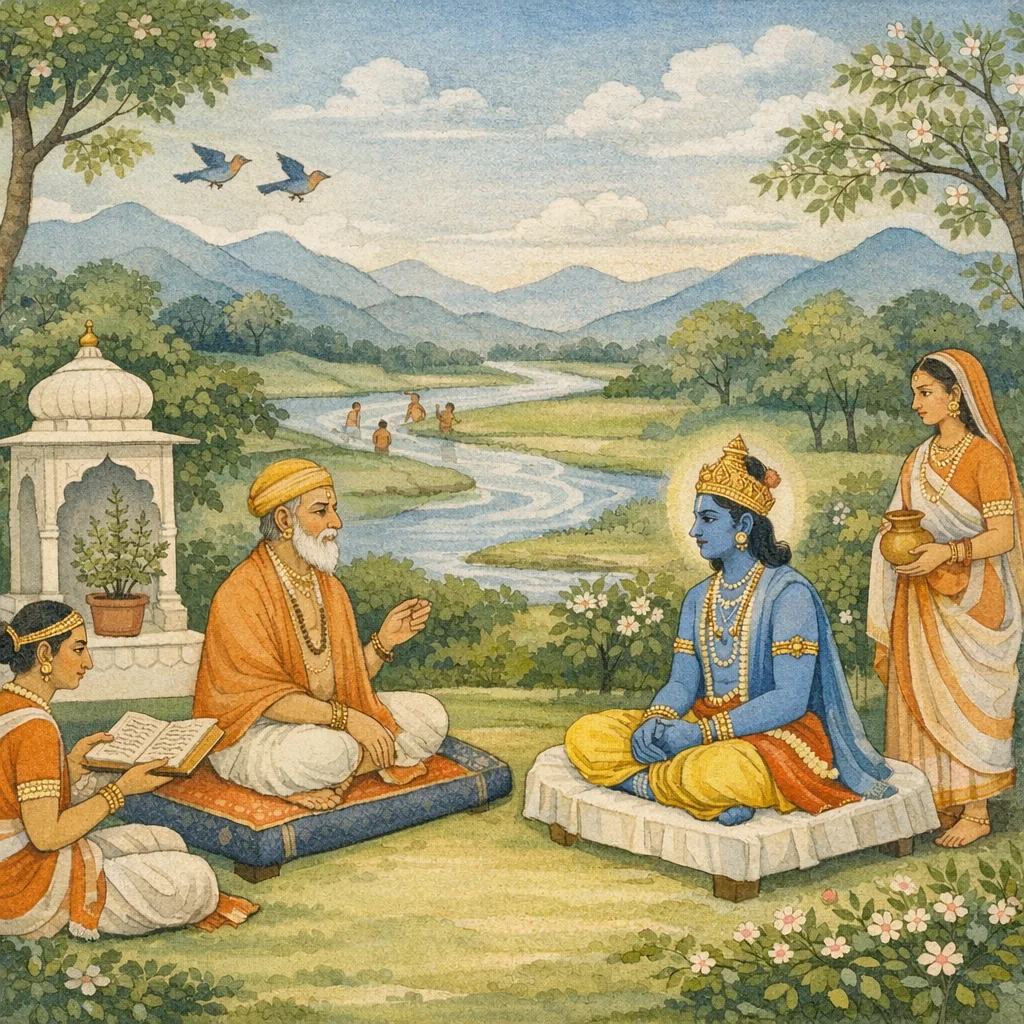
Adhyaya 41
The Tārakāmaya War: Divine Mustering, Māyā Countermeasures, Aurva Fire, and Viṣṇu’s Slaying of Kālanemi
Chapter 41 portrays the devas’ mustering for the Tārakāmaya war: Indra’s martial procession, the Lokapālas stationed in the quarters, and the cosmic powers—Sun, Moon, Wind, Fire, and Varuṇa—entering the fray. The asuras unleash māyā through Maya, but the devas counter it as Soma’s frost and Varuṇa’s pāśa (noose) dispel the delusion. A lengthy doctrinal interlude then extols brahmacarya and mind-born creation, culminating in the birth of Aurva and the Aurva-fire. This fire is set within the ocean as Baḍavāmukha, the hidden conflagration destined to blaze forth at the world’s dissolution. As the war intensifies, Kālanemi rises and briefly dominates the cosmos, until Viṣṇu—Gadādhara, Trivikrama—expands in might, wields the cakra, and slays him. Order is restored: the guardians of the directions are reassigned, ritual order reaffirmed, and Viṣṇu departs with Brahmā to Brahmaloka.
Shlokas
Verse 1
पुलस्त्य उवाच । आदित्या वसवो रुद्रा अश्विनौ च महाबलौ । सबलाः सानुगाश्चैव संनह्यन्त यथाक्रमम्
Pulastya said: The Ādityas, the Vasus, the Rudras, and the mighty Aśvins—together with their forces and attendants—armed themselves and made ready, each in due order.
Verse 2
पुरुहूतश्च पुरतो लोकपालः सहस्रदृक् । ग्रामणीः सर्वदेवानामारुरोह वरद्विपम्
In front went Puruhūta (Indra), the world-guardian, the thousand-eyed leader of all the gods; he mounted the excellent elephant that grants boons.
Verse 3
सव्ये चास्य रथः पार्श्वे पक्षिप्रवरकेतनः । सुरारुचक्रचरणो हैमच्छत्रपरिष्कृतः
On his left side stood his chariot, bearing the emblem of the foremost of birds; its wheels and fittings shone with a celestial radiance, and it was adorned with a golden parasol.
Verse 4
देवगंधर्वयक्षौघैरनुयातः सहस्रशः । दीप्तिमद्भिश्च स्वर्गस्थैर्ब्रह्मर्षिभिरभिष्टुतः
He was followed in thousands by hosts of Devas, Gandharvas, and Yakṣas, and was praised by radiant Brahmarṣis dwelling in heaven.
Verse 5
वज्रविस्फारितोद्भूतैर्विद्युदिंद्रायुधप्रभैः । युक्तं बलाहकगणैः पर्वतैरिव कामगैः
It was filled with clusters of rain-clouds—gleaming like lightning and Indra’s thunderbolt—moving at will like mountains that can roam wherever they desire.
Verse 6
यमारूढः स भगवान्पर्येति सकलं जगत् । हविर्दानेषु गायंति विप्रा मखमुखेस्थिताः
Mounted upon Yama, that revered Lord traverses the whole world; and at the offering of oblations, the Brahmins stationed at the mouth of the sacrifice chant his praises.
Verse 7
स्वर्गसंग्रामयातेषु देवतूर्यनिनादिषु । सेंद्रं तमुपनृत्यंति शतशो ह्यप्सरोगणाः
When the heavenly battle-march was underway and the sounds of divine instruments resounded, hundreds of hosts of Apsarās danced around him—Indra together with his retinue.
Verse 8
केतुना नागराजेन राजमानो यथा रविः । युक्तो हयसहस्रेण मनोमारुतरंहसा
Shining with the serpent-king Ketu like the sun, he was harnessed to a thousand horses and sped on with a swiftness like that of the mind and the wind.
Verse 9
सम्यग्रथवरो भाति युक्तो मातलिना तदा । कृत्स्नः परिवृतो मेरुर्भास्करस्येव तेजसा
Then that excellent chariot, properly harnessed by Mātali, shone forth—so that Mount Meru, wholly surrounded by its radiance, blazed like the Sun himself.
Verse 10
यमस्तु दंडमुद्यम्य कालयुक्तं च मुद्गरं । तस्थौ सुरगणानीके दैत्यानां चैव दर्शयन्
But Yama, raising his staff and also a mace empowered by Time, stood amid the host of the gods, pointing out the Daityas.
Verse 11
चतुर्भिः सागरैर्युक्तो लेलिहानैश्च पन्नगैः । शंखमुक्तांगदधरो बिभ्रत्तोयमयं वपुः
Endowed with the four oceans and with serpents that lick the waters, bearing conch, pearls, and armlets, he bore a body fashioned of water.
Verse 12
कालपाशान्समाविध्य हयैः शशिकरोपमैः । वाय्वीरितजलाकारैः कुर्वन्लीलाः सहस्रशः
Piercing the nooses of Time with horses radiant like moonbeams, and assuming forms like water driven by the wind, he performed thousands upon thousands of playful feats.
Verse 13
पांडुरोद्धूतवसनः प्रवालरुचिरांगदः । मणिश्यामोत्तमवपुर्हारकेणार्चितोदरः
He wore pale garments, tossed by the wind; his armlets shone with the luster of coral. His excellent body was dark like a sapphire gem, and his waist was adorned with a splendid necklace.
Verse 14
वरुणः पाशधृङ्मध्ये देवानीकस्य तस्थिवान् । युद्धवेलामभिलषन्भिन्नवेल इवार्णवः
Varuṇa, holding his noose, stood in the midst of the army of the gods—longing for the tide of battle, like the ocean when its shoreline is broken.
Verse 15
यक्षराक्षससैन्येन गुह्यकानां गणैरपि । युक्तश्च शंखपद्माभ्यां निधीनामधिपः प्रभुः
Attended by the armies of Yakṣas and Rākṣasas, and also by the hosts of the Guhyakas, the Lord—the sovereign of treasures—was accompanied by the two treasure-deities, Śaṅkha and Padma.
Verse 16
राजराजेश्वरःश्रीमान्गदापाणिरदृश्यत । विमानयोधी धनदो विमाने पुष्पके स्थितः
The illustrious King of kings appeared, bearing a mace in his hand. Kubera, bestower of wealth and warrior of aerial chariots, was seated in the Puṣpaka vimāna.
Verse 17
स राजराजः शुशुभे यक्षेशो नरवाहनः । पूर्वपक्षे सहस्राक्षः पितृराजश्च दक्षिणे
That King of kings shone in splendor: Kubera, lord of the Yakṣas, mounted upon a man. On the eastern side stood Sahasrākṣa (Indra), and on the southern side the king of the Pitṛs (Yama).
Verse 18
वरुणः पश्चिमे पक्ष उत्तरे नरवाहनः । चतुःपक्षाश्च चत्त्वारो लोकपाला महाबलाः
Varuṇa is stationed on the western side, and in the north is Naravāhana. Thus, in the four quarters stand the four mighty guardians of the worlds.
Verse 19
आत्मदिक्षुचरंतश्चतस्यदेवबलस्यते । सूर्यः सप्ताश्वयुक्तेन रथेनानिलगामिना
And by the power of that divine force, they move in their own directions. The Sun proceeds on a chariot yoked with seven horses, swift as the wind.
Verse 20
श्रिया जाज्वल्यमानेन दीप्यमानैश्च रश्मिभिः । उदयास्तमयौ चक्रे मेरुपर्यन्तगामिना
Blazing with splendor and shining with its rays, it brought about sunrise and sunset, as it moved as far as Mount Meru.
Verse 21
त्रिदिव द्वारचक्रेण तपसा लोकमव्ययम् । सहस्ररश्मियुक्तेन भ्राजमानेन तेजसा
By austerity, with the wheel at the gate of heaven, he attained the imperishable realm—radiant with a splendor endowed with a thousand rays.
Verse 22
चचार मध्ये देवानां द्वादशात्मा दिवाकरः । सोमः श्वेतहयो भाति स्यंदने शीतरश्मिमान्
In the midst of the gods moves the Sun, whose nature is twelvefold; and the Moon—cool-rayed—shines in his chariot drawn by white horses.
Verse 23
हिमतोयप्रपूर्णाभिर्भाभिराह्लादयञ्जगत् । तमृक्षयोगानुगतं शिशिरांशुं द्विजेश्वरम्
With its radiance filled with snowy, cooling moisture, it gladdens the world—the cool-rayed lord of the twice-born, the Moon, moving in conjunction with the lunar mansions.
Verse 24
शशच्छायांकिततनुं नैशस्य तमसः क्षयम् । ज्योतिषामीश्वरं व्योम्नि रसदं प्रभुमव्ययम्
Whose body is marked with the moon’s radiance; who brings an end to the darkness of night; the Lord of all luminaries in the sky—bestower of delight—the sovereign Master, imperishable.
Verse 25
ओषधीनां पवित्राणां निधानममृतस्य च । जगतः परमं भागं सौम्यं सर्वमयं रसम्
It is the treasury of holy medicinal herbs and of immortality itself—the supreme, gentle portion of the world, a life-sap permeating all.
Verse 26
ददृशुर्दानवाः सोमं हिमप्रहरणं स्थितम् । यः प्राणः सर्वभूतानां पंचधा भिद्यते नृषु
The Dānavas beheld Soma, standing there as a weapon of frost. He is the vital breath of all beings, which in human beings is divided fivefold.
Verse 27
सप्तस्कंधगतो लोकांस्त्रीन्दधार चकार च । यमाहुरग्निकर्त्तारं सर्वप्रभवमीश्वरम्
Entering into the seven regions, he both sustained and fashioned the three worlds—him they call the maker of fire, the Lord, the source from whom all arises.
Verse 28
सप्तस्वरगता यस्य योनिर्गीर्भिरुदीर्यते । यं वदंति चलं भूतं यं वदंत्यशरीरिणम्
Whose source is proclaimed by sacred utterances as permeated by the seven notes; whom they call a moving being, and whom they also call bodiless.
Verse 29
यमाहुराकाशगमं शीघ्रगं शब्दयोनिजम् । स वायुः सर्वभूतायुरुद्धतः स्वेन तेजसा
They call it Vāyu (Wind)—moving through space, swift, born from sound; it is the life-breath of all beings, impelled by its own innate power.
Verse 30
ववौ प्रव्यथयन्दैत्यान्प्रतिलोमं सतोयदः । मारुतो देवगंधर्वैर्विद्याधरगणैः सह
Then the wind blew against the current, greatly tormenting the Daityas, together with the gods, Gandharvas, and hosts of Vidyādharas.
Verse 31
चिक्रीड रश्मिभिश्शुभ्रैर्निर्मुक्तैरिव पन्नगैः । सृजंतः सर्पपतयस्तीव्रं रोषमयं विषम्
They sported with radiant beams, like serpents set loose; and the lords of serpents, as they poured them forth, released a fierce poison born of wrath.
Verse 32
शरभूता विलग्नाश्च चेरुर्व्यात्तानना दिवि । पर्वताश्च शिलाशृंगैः शतशाखैश्च पादपैः
Clinging like śarabhas, with gaping mouths they roamed through the sky; and even the mountains—together with their rocky peaks and trees of a hundred branches—were set in motion.
Verse 33
उपतस्थुः सुरगणान्प्रहर्तुं दानवं बलम् । यः स देवो हृषीकेशः पद्मनाभस्त्रिविक्रमः
The host of Dānavas stood ready to strike the companies of the gods. That very Lord—Hṛṣīkeśa, Padmanābha, Trivikrama—is the God who prevails.
Verse 34
युगांते कृष्णवर्त्मा च विश्वस्य जगतः प्रभुः । सर्वयोनिः समधुहा हव्यभुक्क्रतुसंस्थितः
At the end of the age, the Lord of the universe and of the whole world—whose path is dark and mysterious—is the source of all wombs, the gatherer of honey (the essence), the eater of sacrificial oblations, and the One established in the rite of yajña.
Verse 35
भूम्यम्बुव्योमभूतात्मा श्यामः शांतिकरोरिहा । अविघ्नममरादीनां चक्रे चक्रगदाधरः
The dark-hued Lord—whose very Self is the essence of earth, water, and sky, and who bestows peace—here made all things free of obstacles for the gods and others, He who bears the discus and the mace.
Verse 36
सव्येनालभ्य महतीं सर्वायुधविनाशिनीं । करेण कालीं वपुषा शत्रुकालप्रदां गदां
Touching with his left hand that mighty mace—the destroyer of all weapons—dark-hued in form and the giver of the death-hour to enemies, he grasped it firmly in his hand.
Verse 37
शेषैर्भुजैः प्रदीप्ताभैर्भुजगारिध्वजः प्रभुः । दधारायुधजालानि शार्ङ्गादीनि महाबलः
With his remaining arms, blazing with radiance, the Lord—bearing the serpent as his emblem—held a multitude of weapons, beginning with the Śārṅga bow, in his great might.
Verse 38
स कश्यपस्यात्मभवं द्विजं भुजगभोजनम् । भुजगेंद्रेण वदने निविष्टेन विराजितम्
He was a twice-born son of Kaśyapa, a consumer of serpents, and he shone with the king of serpents settled in his mouth.
Verse 39
अमृतारंभसंयुक्तं मंदराद्रिमिवोच्छितम् । देवासुरविमर्देषु बहुशो दृष्टविक्रमम्
Linked with the churning for nectar, towering like Mount Mandara, its prowess has been witnessed many times in the clashes between the gods and the demons.
Verse 40
महेंद्रेणामृतस्यार्थे वज्रेण कृतलक्षणम् । विचित्रपत्रवसनं धातुमंतमिवाचलम्
Marked by Mahendra (Indra) with the vajra for the sake of obtaining nectar, it appeared like a mineral-rich mountain, draped in a covering of wondrous, leaf-like hues.
Verse 41
स्फीतक्रोधावलंबेन शीतांशुसमतेजसा । भोगिभोगावसक्तेन मणिरत्नेन भास्वता
Supported by swelling wrath, bearing a radiance equal to the moon, and shining with a jewel-gem—brilliant, clinging to the coils of a serpent.
Verse 42
पक्षाभ्यां चारुपत्राभ्यामावृतं दिवि लीलया । युगांते सेंद्रचापाभ्यां तोयदाभ्यामिवांबरम्
With two wings like lovely leaves, it playfully covered the sky; at the end of an age, the firmament was as though wrapped by two rain-clouds bearing Indra’s rainbow.
Verse 43
नीललोहितपीताभिः पताकाभिरलंकृतम् । अरुणावरजं श्रीमानारुह्य समरे प्रभुः
Adorned with blue, red, and yellow banners, the glorious Lord mounted Aruṇa’s younger brother and entered the battle.
Verse 44
सुवर्णवर्णवपुषं सुपर्णं खेचरोत्तमम् । तमन्वयुः सुरगणा मुनयश्च समाहिताः
The gods and the sages, composed in mind, followed him—golden-hued in body, winged, and the foremost of sky-goers.
Verse 45
गीर्भिः परममंत्राभिस्तुष्टुवुश्च गदाधरम् । तद्वैश्रवणसंश्लिष्टं वैवस्वतपुरःसरम्
With sacred utterances and the most excellent mantras, they praised Gadādhara (Viṣṇu), accompanied by Vaiśravaṇa (Kubera) and preceded by Vaivasvata (Yama).
Verse 46
वारिराजपरिक्षिप्तं देवराजविराजितम् । पवनाबद्धनिर्घोषं संप्रदीप्त हुताशनम्
Encircled by lordly waters, radiant with the splendor of the king of the Devas; roaring with a wind-driven thunder, the fire blazed forth, fully kindled.
Verse 47
विष्णोर्जिष्णोः सहिष्णोश्च भ्राजिष्णोस्तेजसावृतम् । बलं बलवदुद्रिक्ते युद्धाय समवर्तत
Then the mighty power—cloaked in the splendor of Viṣṇu, the victorious, the forbearing, the radiant—rose in full force, prepared for battle.
Verse 48
स्वस्त्यस्तु देवेभ्य इति बृहस्पतिरभाषत । स्वस्त्यस्तु दैत्येभ्य इति उशना वाक्यमाददे
Bṛhaspati declared, “May there be auspicious well-being for the Devas.” And Uśanā (Śukrācārya) replied, “May there be auspicious well-being for the Daityas.”
Verse 49
ताभ्यां बलाभ्यां संजज्ञे तुमुलो विग्रहस्तथा । सुराणामसुराणां च परस्परजयैषिणाम्
From the might of those two hosts arose a fierce, tumultuous conflict as well—between the Suras and the Asuras—each intent on conquering the other.
Verse 50
दानवा दैवतैः सार्द्धं नानाप्रहरणोद्यमाः । समीयुर्युध्यमाना वै पर्वता इव पर्वतैः
The Dānavas, brandishing weapons of many kinds, clashed with the Devas in battle—like mountains colliding with mountains.
Verse 51
तत्सुरासुरसंयुक्तं युद्धमत्यद्भुतं बभौ । धर्माधर्मसमायुक्तं दर्पेण विनयेन च
That battle—joined by the devas and the asuras—appeared exceedingly wondrous, mingled with both dharma and adharma, and marked alike by arrogance and by humility.
Verse 52
ततो हयैः प्रजवितैर्वारणैश्च प्रचोदितैः । उत्पतद्भिश्च गगने सासिहस्तैः समंततः
Then, with horses urged on and elephants driven forward, and with sword-wielding warriors leaping up into the sky on every side, the battle surged all around.
Verse 53
क्षिप्यमाणैश्च मुसलैः संपतद्भिश्च सायकैः । चापैर्विस्फार्यमाणैश्च पात्यमानैः सुदारुणैः
With clubs being hurled, arrows flying in volleys, bows being twanged and drawn back, and with fierce weapons striking down, the battle raged.
Verse 54
तद्युद्धमभवद्घोरं देवदानवसंकुलम् । जगतस्त्रासजननं युगसंवर्तकोपमम्
That battle became terrifying, crowded with gods and Dānavas; it generated fear throughout the world, resembling the fury of the cosmic dissolution at the end of an age.
Verse 55
स्वहस्तमुक्तैः परिघैर्मुद्गरैश्चैव पर्वतैः । दानवास्समरे जघ्नुर्देवानिंद्रपुरोगमान्
In the battle, the Dānavas struck down the gods—Indra at their head—using iron clubs hurled from their own hands, as well as hammers and even mountains.
Verse 56
ते वध्यमाना बलिभिर्दानवैर्जितकाशिभिः । विषण्णवदना देवा जग्मुरार्तिं परां मृधे
Struck down by the mighty Dānavas—who had conquered Kāśī—the gods, their faces cast in despair, fell into extreme distress amid the battle.
Verse 57
ते चास्त्रशूलमथिताः परिघैर्भिन्नमस्तकाः । भिन्नोरस्का दितिसुतैः स्रवद्रक्ता रणे बहु
And they—shaken by weapons and tridents, their heads split open by iron clubs, their chests torn apart by the sons of Diti—shed much blood upon the battlefield.
Verse 58
सूदिताः शरजालैश्च निर्यत्नाश्च शरैः कृताः । प्रविष्टा दानवीं मायां न शेकुस्ते विचेष्टितम्
Tormented by volleys of arrows, and rendered helpless by those shafts, they entered the demoness’s illusion—yet they were unable to act or move at all.
Verse 59
उत्तंभितमिवाभाति निष्प्राण सदृशाकृति । बलं सुराणामसुरैर्निष्प्रयत्नायुधं कृतम्
The army of the gods appeared as if propped up—its form like that of the lifeless—because the Asuras had rendered the gods’ weapons ineffective, as though without any effort.
Verse 60
दैत्यचापच्युतान्घोरांश्छित्वा वज्रेण तान्शरान् । शक्रो दैत्यबलं घोरं विवेश बहुलोचनः
Having cut down with his thunderbolt those dreadful arrows released from the demons’ bows, Śakra (Indra), the many-eyed one, plunged into the terrible host of the demons.
Verse 61
स दैत्यप्रमुखान्सर्वान्हत्वा दैत्यबलं महत् । तामसेनास्त्रजालेन तमोभूतमथाकरोत्
Having slain all the foremost Dāityas and the mighty host of the asuras, he then, with a net of Tāmāsa weapons, plunged them into darkness.
Verse 62
तेऽन्योन्यं नान्वबुध्यंत दैत्यानां वाहनानि च । घोरेण तमसाविष्टाः पुरुहूतस्य तेजसा
They could not recognize one another—nor even the mounts of the Dāityas—having been enveloped in dreadful darkness by the radiance of Puruhūta (Indra).
Verse 63
मायापाशैर्विमुक्तास्तु यत्नवंतः सुरोत्तमाः । शिरांसि दैत्यसंघानां तमोभूतान्यपातयन्
Freed from the bonds of illusion (māyā), the most excellent of the gods—striving with effort—caused the heads of the hosts of asuras, now sunk into darkness, to fall.
Verse 64
अपध्वस्ता विसंज्ञाश्च तमसा नीलवर्चसा । पेतुस्ते दानवास्सद्यश्छिन्नपक्षा इवाद्रयः
Struck down and rendered senseless by that blue-lustred darkness, those Dānavas at once fell—like mountains with their wings cut off.
Verse 65
तत्राभिभूतदैत्यैंद्रमंधकारमिवांतरं । दानवं देहसदनं तमोभूतमिवाभवत्
There, when the lord of the Dānavas was overpowered, the inner space of his being became as though covered in darkness; and the Dānava’s body—his bodily abode—seemed to have turned into darkness itself.
Verse 66
तथाऽसृजन्महामायां मयस्तां तामसीं दहन् । युगांतोद्योतजननीं सृष्टा मौर्वेण वह्निना
Then Māyā brought forth Mahāmāyā; and, burning that dark (tāmasī) power with a fire born of Mūrva, he manifested the Mother of the blaze that shines at the end of the yuga.
Verse 67
स ददाह च तां शाक्रीं माया मयविकल्पिता । दैत्याश्चादित्यवपुषा सद्य उत्तस्थुराहवे
He burned up that illusion—an Indra-like apparition conjured by magic; and the Dānavas, assuming the forms of the Ādityas, at once rose up for battle.
Verse 68
मायां मौर्वीं समासाद्य दह्यमाना दिवौकसः । भेजिरे चंद्रविषयं शीतांशुसलिलह्रदम्
When the gods, scorched by heat, encountered the Māyā called Maurvī, they made for the realm of the Moon—a lake filled with the waters of the cool-rayed one.
Verse 69
ते दह्यमाना और्वेण वह्निना नष्टचेतसः । शशंसुर्वज्रिणं देवाः संतप्ताः शरणैषिणः
Burning in the Aurva fire and bereft of composure, the gods—tormented and seeking refuge—praised Vajrin (Indra).
Verse 70
संतप्ते मायया सैन्ये हन्यमाने च दानवैः । चोदितो देवराजेन वरुणो वाक्यमब्रवीत्
When the army was being scorched by Māyā and struck down by the Dānavas, Varuṇa—urged by the king of the gods—spoke these words.
Verse 71
पुरा ब्रह्मर्षिजः शक्र तपस्तेपे सुदारुणम् । उर्वः स पूर्वं तेजस्वी सदृशो ब्रह्मणो गुणैः
In ancient times, O Śakra, the son of a Brahmarṣi performed exceedingly severe austerities (tapas). Formerly, that radiant Urva was comparable to Brahmā in his qualities.
Verse 72
तं तपंतमिवादित्यं तपसा जगदव्ययं । उपतस्थुर्मुनिगणा देवा देवर्षिभिः सह
As he blazed with tapas like the sun, sustaining the imperishable world through his austerity, hosts of sages and the gods—together with the divine seers (devarṣis)—came and attended upon him.
Verse 73
हिरण्यकशिपुश्चैव दानवो दानवेश्वरः । ॠषिं विज्ञापयामास पुरा परमतेजसम्
And Hiraṇyakaśipu too—the Dānava, lord of the Dānavas—formerly made a petition to a sage (ṛṣi) of supreme brilliance.
Verse 74
ऊचुर्ब्रह्मर्षयस्ते तु वचनं धर्मसंहितम् । ॠषिवंशेषु भगवंश्छिन्नमूलमिदं कुलं
Then those Brahmarṣis spoke words consonant with dharma: “O Blessed One, among the lineages of the ṛṣis, this family has had its roots cut off.”
Verse 75
एकस्त्वमनपत्यश्च गोत्रा याऽन्यो न विद्यते । कौमारं व्रतमास्थाय क्लेशमेवानुवर्तसे
You are alone and without offspring; there is no other of your gotra. Yet, having undertaken the vow of kaumāra (celibate youth), you only continue in hardship.
Verse 76
बहूनि विप्रगोत्राणि मुनीनां भावितात्मनाम् । एकदेहानि तिष्ठंति विविक्तानि विना प्रजाः
Many Brahmin lineages of sages—whose selves are disciplined—remain as single-bodied communities, dwelling in seclusion and without progeny.
Verse 77
एवंभूतेषु सर्वेषु पुत्रैर्मे नास्ति कारणम् । भवांश्च तापसश्रेष्ठः प्रजापति समद्युतिः
With all my sons being such as they are, I find in them no sufficient cause or support. And you—best among ascetics—are a Prajāpati, radiant with equal splendor.
Verse 78
तत्प्रवर्तस्व वंशाय वर्धयात्मानमात्मना । समाधत्स्वोर्जितं तेजो द्वितीयां कुरु वै तनुं
Therefore, set your lineage in motion; by your own power, expand yourself. Gather and concentrate your mighty splendor, and indeed fashion a second body.
Verse 79
स एवमुक्तो मुनिभिर्मुनिर्मनसि ताडितः । जगर्ह तानृषिगणान्वचनं चेदमब्रवीत्
Thus addressed by the sages, the sage—struck within his mind—rebuked that assembly of seers and spoke these words.
Verse 80
यथा हि विहितो धर्मो मुनीनां शाश्वतः पुरा । आर्षं हि केवलं कर्म वन्यमूलफलाशिनः
For the eternal dharma of the sages was ordained in ancient times: their practice is purely the ṛṣi-way—living on forest roots and fruits alone.
Verse 81
ब्रह्मयोनौ प्रसूतस्य ब्राह्मणस्यात्मवर्तिनः । ब्रह्मचर्यं सुचरितं ब्रह्माणमपि चालयेत्
The well-observed vow of brahmacarya of a self-restrained brāhmaṇa—born from Brahmā’s own source—can stir even Brahmā himself.
Verse 82
जनानां वृत्तयस्तिस्रो ये गृहाश्रमवासिनः । अस्माकं च वने वृत्तिर्वनाश्रमनिवासिनां
For those who dwell in the gṛhastha-āśrama, three ways of livelihood are spoken of; but for us, who abide in the vanāśrama, our livelihood is in the forest.
Verse 83
अब्भक्षा वायुभक्षाश्च दंतोलूखलिनस्तथा । अश्मकुट्टादयो यत्र पंचाग्नितपसश्च ये
There are ascetics who subsist on water alone, and those who subsist on air; likewise those who, in austerity, use their teeth as a mortar, and those who pound their food upon stone; and those who perform the five-fire tapas.
Verse 84
एते तपसि तिष्ठंतो व्रतैरपि सुदुश्चरैः । ब्रह्मचर्यं पुरस्कृत्य प्रार्थयंति परां गतिम्
Abiding in austerity and observing even very difficult vows, they set brahmacarya foremost and pray for the supreme state.
Verse 85
ब्रह्मचर्याद्ब्रह्मणस्य ब्राह्मणत्वं विधीयते । एवमाहुः परे लोके ब्राह्मचर्यविदो जनाः
Through brahmacarya a man’s brāhmaṇa status is established; thus, in the higher world, declare those who truly know brahmacarya.
Verse 86
ब्रह्मचर्ये स्थितो धर्मो ब्रह्मचर्ये स्थितं तपः । ये स्थिता ब्रह्मचर्ये तु ब्राह्मणा दिवि ते स्थिताः
Dharma abides in brahmacarya; austerity (tapas) too is established in brahmacarya. Those brāhmaṇas who remain steadfast in brahmacarya are themselves established in heaven.
Verse 87
नास्ति योगं विना सिद्धिर्नास्ति योगं विना यशः । नास्ति लोके यशोमूलं ब्रह्मचर्यात्परंतपः
Without yoga there is no siddhi, and without yoga there is no renown. In this world, the very root of true fame is brahmacarya, O scorcher of foes.
Verse 88
यो निगृह्येंद्रियग्रामं भूतग्रामं च पंचकम् । ब्रह्मचर्यं समाधत्ते किमतः परमं तपः
One who restrains the host of senses and also the group of the five elements, and who firmly undertakes brahmacarya—what austerity could be higher than this?
Verse 89
अयोगकेशधरणमसंकल्प व्रत क्रिया । अब्रह्मचर्या चर्या च त्रयं स्याद्दंभसंज्ञितं
Wearing matted hair without true yoga, performing vows and rites without sincere resolve, and conduct that violates brahmacarya—these three are known as hypocrisy (dambha).
Verse 90
क्व दाराः क्व च संयोगः क्व च भावविपर्ययः । नन्वियं ब्रह्मणा सृष्टा मनसा मानसी प्रजा
Where are wives, and where is conjugal union? Where could there be any reversal of feelings? Surely this is a mind-born progeny—created by Brahmā through his mind.
Verse 91
यद्यस्ति तपसो वीर्यं युष्माकं विजितात्मनाम् । सृजध्वं मानसान्पुत्रान्प्राजापत्येन कर्मणा
If the power of your austerities truly abides in you who have conquered yourselves, then create mind-born sons—by the Prajāpati’s act of progenitive creation.
Verse 92
मनसा निर्मिता योनिराधातव्या तपस्विभिः । नो दारयोगं बीजं च व्रतमुक्तं तपस्विनां
For ascetics, the ‘womb’ to be established is one fashioned by the mind; for those practicing austerity, neither union with a wife nor the begetting of seed is declared to be their vow.
Verse 93
यदिदं लुप्तधर्माख्यं युष्माभिरिह निर्भयैः । व्याहृतं सद्भिरत्यर्थमसद्भिरिव संमतं
This teaching, known as the ‘lost dharma’, has been spoken here by you fearlessly; though it has been declared emphatically by the good, it is now treated as if approved by the wicked.
Verse 94
वपुर्दीप्तांतरात्मानमेष कृत्वा मनोमयं । दारयोगं विना स्रक्ष्ये पुत्रमात्मतनूरुहं
Having fashioned this radiant-bodied being, inwardly luminous and mind-born, I shall create—without union with a wife—a son who is a shoot from my own self.
Verse 95
एवमात्मानमात्मा मे द्वितीयं जनयिष्यति । प्राजापत्येन विधिना दिधक्षंतमिव प्रजाः
Thus my Self will generate a second self—by the Prajāpati-ordained method—bringing forth creatures, as though kindling them into being.
Verse 96
वरुण उवाच । उर्वस्तु तपसाविष्टो निवेश्योरुं हुताशने । ममंथैकेन दर्भेण पुत्रस्य प्रसवारणिं
Varuṇa said: “Urvaśī, absorbed in tapas, set her thigh upon the sacrificial fire; and with a single blade of darbha grass she churned the araṇi, the fire-stick that brings forth a son.”
Verse 97
तस्योरुं सहसा भित्वा वरोऽसौ ह्यग्निरुत्थितः । जगतो दहनाकांक्षी पुत्रोग्निस्समपद्यत
Splitting his thigh suddenly, that excellent Fire indeed sprang forth; longing to burn the world, he came to be as a son—Agni.
Verse 98
उर्वस्योरुं विनिर्भिद्य और्वो नामांतकोऽनलः । दिधक्षुरिव लोकांस्त्रीन्जज्ञे परमकोपनः
Splitting open Urva’s thigh, there was born the fiery being named Aurva—like a flame of destruction—supremely wrathful, as if intent on burning the three worlds.
Verse 99
उत्पद्यमानश्चोवाच पितरं दीनया गिरा । क्षुधा मे बाधते तात जगद्भक्षेत्यजस्व मां
As he was being brought forth, he spoke to his father in a pitiable voice: “Father, hunger torments me. Let me go, so that I may devour the worlds.”
Verse 100
त्रिदिवारोहिभिर्ज्वालैर्जृम्भमाणो दिशो दश । निर्दहन्सर्वभूतानि ववृधे सोंतकोपमः
With flames rising up to the heavens, spreading out in all ten directions, burning all living beings, it grew—resembling the fury of the fire of cosmic dissolution.
Verse 101
एतस्मिन्नंतरे ब्रह्मा मुनिमुर्वं समागतः । उवाच वार्यतां पुत्रो जगतस्त्वं दयां कुरु
Meanwhile, Brahmā approached the sage Urva and said: “Restrain your son; show compassion to the world.”
Verse 102
अस्यापत्पस्यते विप्र करिष्ये साह्यमुत्तमं । तथ्यमेतद्वचः पुत्र शृणु त्वं वदतां वर
O brāhmaṇa, seeing this misfortune that has befallen him, I shall render the finest help. This statement is true, my son—listen, O best of speakers.
Verse 103
और्व उवाच । धन्योस्म्यनुगृहीतोस्मि यन्मे त्वं भगवन्शिशोः । मतिमेतां ददासीह परमात्मन्हिताय वै
Aurva said: “Blessed am I; I am truly graced, O Lord, since you grant me here this understanding for the welfare of the Supreme Self and devotion to Him.”
Verse 104
प्रभातकाले संप्राप्ते कांक्षितव्ये समागमे । भगवंस्तर्पितः पुत्रः कैर्हव्यैः प्राप्स्यते सुखम्
When the morning hour has arrived and the longed-for meeting is at hand, the son—having satisfied the Lord through offerings—will attain happiness through the Kairhavyas.
Verse 105
कुत्र चास्य निवासः स्याद्भोजनं तु किमात्मकम् । विधास्यतीह भगवान्वीर्यतुल्यं महौजसः
And where will his dwelling be, and of what kind will his food be? How will the Blessed Lord—of great splendor—ordain here a counterpart equal to his own power?
Verse 106
ब्रह्मोवाच । बडवामुखे च वसतिः समुद्रे वै भविष्यति । ममयोनिर्जलं विप्र तच्चामेयं व्रजत्वयं
Brahmā said: “In the ocean there shall indeed be a dwelling at the Mare’s-mouth (Baḍavāmukha). O brāhmaṇa, this water is born of my own womb; it is immeasurable—go forth and proceed with it.”
Verse 107
तत्राऽयमास्ते नियतं पिबन्वारिमयं हविः । तद्वारिविस्तरं विप्र विसृजाम्यालयं च तम्
There he abides unfailingly, restrained, drinking an oblation made of water. O brāhmaṇa, I release that vast expanse of water, and I also let go of that abode.
Verse 108
ततो युगांते भूतानामेष चाहं च पुत्रक । सहितो विचरिष्यावो निष्पुराणकराविह
Then, at the end of the yuga, my child, this one and I together shall roam here, making the world bereft of the Purāṇas.
Verse 109
एषोग्निरंतकाले तु सलिलाशी मया कृतः । दहनः सर्वभूतानां सदेवासुररक्षसाम्
This fire, at the time of dissolution, I have made to be water-consuming; it becomes the burner of all beings—of the devas, the asuras, and the rākṣasas as well.
Verse 110
एवमस्त्विति तं सोग्निः संवृतज्वालमंडलः । प्रविवेशार्णवमुखं नत्वोर्वं पितरं प्रभुम्
“So be it,” said that Fire, drawing in the circle of his flames; and, having bowed to his father, the lord Urva, he entered the mouth of the ocean.
Verse 111
प्रतियातस्ततो ब्रह्मा ते च सर्वे महर्षयः । और्वस्याग्नेः प्रभावज्ञाः स्वांस्वां गतिमुपागताः
Then Brahmā departed, and all those great sages too; knowing the might of Aurva’s fire, each returned to his own abode.
Verse 112
हिरण्यकशिपुर्दृष्ट्वा तदा तन्महदद्भुतम् । उर्वं प्रणतसर्वांगो वाक्यमेतदुवाच ह
Then Hiraṇyakaśipu, beholding that great marvel, bowed down in full prostration and spoke these words.
Verse 113
भगवन्नद्भुतमिदं संवृत्तं लोकसाक्षिकम् । तपसा ते मुनिश्रेष्ठ परितुष्टः पितामहः
O Bhagavān, this wondrous event has occurred with the whole world as its witness. O best of sages, by your austerities the Grandsire, Brahmā, has been fully pleased.
Verse 114
अहं तु तव पुत्रस्य तव चैव महाव्रत । भृत्य इत्यवगंतव्यः श्लाघ्यस्त्वमिह कर्मणा
But I am to be regarded as a servant—of your son and of you as well, O great-vowed one. You are indeed worthy of praise here because of your conduct.
Verse 115
तन्मां पश्य समापन्नं तवैवाराधने रतम् । यदि सीदेन्मुनिश्रेष्ठ तवै वस्यात्पराजयः
Look upon me now, come to you and devoted solely to your worship. O best of sages, if I were to suffer or fail, that defeat would be yours alone.
Verse 116
उर्व उवाच । धन्योस्म्यनुगृहीतोस्मि यस्य तेऽहं गुरुर्मतः । नास्ति ते तपसानेन भयं चैवेह सुव्रत
Urva said: “Blessed am I; truly I am favored, since you regard me as your teacher. By this austerity of yours, O steadfast in vows, there is no fear for you here.”
Verse 117
तामेव मायां गृह्णीष्व मम पुत्रेण निर्मिताम् । निरिंधिनामग्निमयीं दुःस्पर्शां पावकैरपि
Take up that very māyā, fashioned by my son—an unfueled, fire-made power, so untouchable that even flames cannot touch it.
Verse 118
एषा ते स्वस्य वंशस्य वशगारि विनिग्रहे । रक्षिष्यत्यात्मपक्षं च विपक्षं च प्रधक्ष्यति
She will be a controlling force for the restraint of your own lineage; she will protect your side, and she will utterly destroy the opposing side as well.
Verse 119
वरुण उवाच । एषा दुर्विषहा माया देवैरपि दुरासदा । और्वेण निर्मिता पूर्वं पावकेनोर्वसूनुना
Varuṇa said: “This māyā is exceedingly hard to endure—indeed, difficult even for the gods to overcome. Long ago it was fashioned by Aurva, by Pāvaka, the son of Urvasū.”
Verse 120
तस्मिंस्तु व्यथिते दैत्ये निर्वीर्यैषा न संशयः । शापो ह्यस्याः पुरा दत्तः सृष्टा येनैव तेजसा
But when that Daitya was distressed, she became powerless—of this there is no doubt; for a curse had previously been given to her by the very radiance through which she had been created.
Verse 121
यद्येषा प्रतिहंतव्या कर्तव्यो भगवान्सुखी । दीयतां मे सखो शक्र तोययोनिर्निशाकरः
If indeed she must be restrained or struck down, and the Blessed Lord is to be made content, then grant him to me, my friend Śakra—the Moon, Niśākara, born of the ocean.
Verse 122
तेनाहं सहसं गम्य यादोभिश्च समावृतः । मायामेतां हनिष्यामि त्वत्प्रसादान्न संशयः
Therefore I shall go there at once, surrounded by the beings of the waters; and by your grace I will destroy this māyā—of that there is no doubt.
Verse 123
एवमस्त्वितिसंहृष्टः शक्रस्त्रिदशवर्धनः । संदिदेशाग्रतः सोमं युद्धाय शिशिरायुधम्
“So be it,” said Śakra (Indra), delighted, the increaser of the gods; and he directed Soma to go in front for battle, armed with the weapon of cold.
Verse 124
गच्छ सोम सहायन्त्वं कुरु पाशधरस्य वै । असुराणां विनाशाय जयार्थं त्रिदिवौकसाम्
Go, O Soma—be indeed a helper of the wielder of the noose, for the destruction of the asuras and for the victory of the dwellers of heaven.
Verse 125
त्वं मतः प्रतिवीर्यश्च ज्योतिषामपि चेश्वरः । त्वन्मयान्सर्वलोकेषु रसान्वेदविदो विदुः
You are regarded as the countervailing power, and indeed the Lord even of the luminaries. The knowers of the Veda understand that, in all worlds, the essences (rasa) are permeated by you and are of your very nature.
Verse 126
त्वया समो न लोकेस्मिन्विद्यते शिशिरायुधः । क्षयवृद्धीतवाव्यक्तेसागरेचैवचांबरे
O wielder of the cool weapon, none in this world is equal to you. In you—the unmanifest—both decrease and increase abide, in the ocean and likewise in the sky.
Verse 127
प्रवर्तयस्यहोरात्रात्कालं संमोहयन्जगत् । लोकच्छायामयं लक्ष्म तवांकः शशविग्रहः
You set time in motion through day and night, bewildering the world. O auspicious mark, your emblem is the world’s shadow, taking the form of a hare seen in the moon.
Verse 128
न विदुः सोम ते मायां ये च नक्षत्रयोनयः । त्वमादित्यपथादूर्ध्वं ज्योतिषां चोपरिस्थितः
O Soma, even those born of the lunar mansions (the Nakṣatras) do not comprehend your wondrous power. You abide above the Sun’s path, standing higher than all the luminaries.
Verse 129
तमः प्रोत्सार्य सहसा भासयस्यखिलं जगत् । शीतभानुर्हिमतनुर्ज्योतिषामधिपः शशी
Driving away darkness at once, you illuminate the entire world—O Moon, the cool-rayed one, with a frost-like body, the lord among luminaries.
Verse 130
अपि तत्कालयोगात्मा इज्यो यज्ञरथोऽव्ययः । ओषधीशः क्रियायोनिरपां योनिरनुष्णगुः
He is also the very soul of yoga in due time; the One worthy of worship; the imperishable chariot of sacrifice (yajña); the Lord of medicinal herbs; the womb-source of sacred action; the origin of the waters; and the one whose movement or radiance is not hot.
Verse 131
शीतांशुरमृताधारश्चपलः श्वेतवाहनः । त्वं कांतिः कांतवपुषां त्वं सोमः सोमपायिनाम्
You are the cool-rayed one, the support of amṛta; swift-moving, with a white chariot. You are the radiance of radiant-bodied beings; you are Soma for those who drink Soma.
Verse 132
सौम्यस्त्वं सर्वभूतानां तिमिरघ्नस्त्वमृक्षराट् । तद्गच्छ त्वं महासेन वरुणेन वरूथिना
You are gentle toward all beings; you are the dispeller of darkness, the king of the stars. Therefore go forth, O Mahāsena, together with Varuṇa, well-protected by his host.
Verse 133
शमयस्वासुरीं मायां यया दह्यामहे रणे । सोम उवाच । यन्मां वदसि युद्धार्थं देवराजवरप्रद
“Pacify the demonic māyā by which we are being burned in battle.” Soma said: “As for what you tell me—to fight—O bestower of boons to the king of the gods (Indra)… ”
Verse 134
एष वर्षामि शिशिरं दैत्यमायापकर्षणं । एतान्मे शीतनिर्दग्धान्पश्यस्व हिमवेष्टितान्
“Behold—I shall pour down this wintry cold that strips away the Daityas’ magic. Look at them: scorched by frost, wrapped about with snow.”
Verse 135
तथा हिमकरोत्सृष्टाः सपाशा हिमवृष्टयः । वेष्टयंति च तान्दैत्यान्वायुर्मेघगणानिव
Likewise, the snow-showers released by the Moon—like nooses—enclosed those Daityas, just as the wind envelops masses of clouds.
Verse 136
तौ पाशशीतांशुधरौ वरुणेंदू महाबलौ । जघ्नतुर्हिमपातैश्च पाशपातैश्च दानवान्
Those two mighty ones—Varuṇa and Indu, bearers of the noose and of icy, cooling power—struck down the Dānavas with showers of frost and volleys of nooses.
Verse 137
द्वावंबुनाथौ समरे तौ पाशहिमयोधिनौ । मृधे चेरतुरंभोभिः क्षुब्धाविव महार्णवौ
Those two lords of the waters, warriors of noose and frost, moved about in battle; in the fight they surged like waves, as though two vast oceans were churned into turmoil.
Verse 138
ताभ्यामापूरितं सर्वं तद्दानवबलं महत् । जगत्संवर्त्तकांभोदैः प्रवर्षैरिव संवृतं
That vast host of Dānavas was wholly engulfed by those two, as though covered by the torrential rains of world-dissolving clouds at the time of cosmic dissolution.
Verse 139
तावुद्यतावंबुनाथौ शशांकवरुणावुभौ । शमयामासतुस्तां तु मायां दैत्येन्द्रनिर्मितां
Then those two—Śaśāṅka (the Moon) and Varuṇa, lord of the waters—sprang into action and dispelled that māyā, the illusion wrought by the king of the Dānavas.
Verse 140
शीतांशुजालनिर्दग्धाः पाशैश्चास्कंदिता रणे । न शेकुश्चलितुं दैत्या विशिरस्का इवाद्रयः
Scorched by a net of moonlike rays and bound fast by nooses in battle, the Daityas could not even stir—like headless mountains.
Verse 141
शीतांशु निहतास्ते तु दैत्यास्सर्वे निपातिताः । हिमप्लावित सर्वांगानिरूष्माण इवाग्नयः
Struck by the Moon (Śītāṃśu), all those Daityas were cast down; their bodies, drenched in an icy flood, were like fires whose heat has been quenched.
Verse 142
तेषां तु दिवि दैत्यानां निपतंति शुभानि वै । विमानानि विचित्राणि निपतंत्युत्पतंति च
Yet in the heaven of those Daityas, their auspicious, wondrous vimānas fall down—and then rise and soar again.
Verse 143
तान्पाशहस्तग्रथितान्छादितान्शीतरश्मिभिः । मयो ददर्श मायावी दानवान्दिवि दानवः
Then Maya, the sorcerous Dānava, beheld in heaven those Dānavas—tightly bound by the noose in the captor’s hand and veiled in chilling rays.
Verse 144
सशैलजालां विततां खड्गपट्टसहासिनीम् । पादपोत्करकूटस्थां कंदराकीर्णकाननां
It lay spread out like a net of mountains, resounding with the clang of swords and blades; set upon rugged peaks thick with clustered trees, and filled with forests strewn with caves.
Verse 145
सिंहव्याघ्रगणाकीर्णां नदद्भिर्देवयूथपैः । ईहामृगगणाकीर्णां पवनाघूर्णितद्द्रुमाम्
It was filled with troops of lions and tigers, resounding with the roars of the leaders of divine bands; crowded with herds of antelopes, its trees whirled and shaken by the wind.
Verse 146
निर्मितां स्वेन पुत्रेण कूजंतीं दिविकामगां । प्रथितां पार्वतीं मायां ससृजे स समंततः
Then, on every side, he created an illusory form of Pārvatī—fashioned by his own son—cooing sweetly and roaming the heavens at will, renowned in all directions.
Verse 147
सासिशब्दैश्शिलावर्षैः संपतद्भिश्च पादपैः । जघान देवसंघांस्ते दानवानभ्यजीवयत्
With the clang of swords, with showers of stones, and with trees hurled down upon them, he struck down the hosts of gods; and he revived the Dānavas.
Verse 148
नैशाकरी वारुणी च माये अंतर्हिते तदा । अभवद्घोरसंचारा पृथिवी पर्वतैरिव
Then, when the two Māyās—Naiśākarī and Vāruṇī—had vanished, the earth became dreadful to traverse, as though it were nothing but mountains.
Verse 149
न चारुद्धो द्रुमगणैर्देवो दृश्यत कश्चन । तदपध्वस्तधनुषं भग्नप्रहरणाविलम्
Yet no god at all was seen, though hemmed in by masses of trees—his bow cast aside, his weapons broken, and his form in disarray.
Verse 150
निष्प्रयत्नं सुरानीकं वर्जयित्वा गदाधरं । स हि युद्धगतः श्रीमानीशो न स्म व्यकंपत
Avoiding the deva host that offered little resistance, he confronted Gadādhara; for that glorious Lord, engaged in battle, did not even tremble.
Verse 151
सहिष्णुत्वाज्जगत्स्वामी न चुक्रोध गदाधरः । कालज्ञः कालमेघाभः समीक्षन्कालमाहवे
By his forbearance, the Lord of the universe—Gadādhara—did not grow angry. Knowing the proper time, dark as a rain-laden cloud, he watched for the right moment in the battle.
Verse 152
देवासुरविमर्दं च द्रष्टुकामस्तदा हरिः । ततो भगवतादिष्टौ रणे पावकमारुतौ
Then Hari, wishing to witness the clash between the gods and the asuras, commanded Pāvaka (Fire) and Māruta (Wind) to act in the battle.
Verse 153
चोदितौ विष्णुवाक्येन ततो मायां व्यकर्षतां । ताभ्यामुद्भ्रांतवेगाभ्यां प्रबुद्धाभ्यां महाहवे
Urged on by Viṣṇu’s words, the two then drew forth their power of illusion; and in that great battle, both—roused and fully awakened—surged forward with bewildering speed.
Verse 154
दग्धा सा पार्वती माया भस्मीभूता ननाश ह । सोनिलोनलसंयुक्तस्सोनलश्चानिलाकुलः
That illusory form of Pārvatī was burned; reduced to ashes, it perished. And that fire—joined with the wind—became turbulent, while the wind too grew agitated with the fire.
Verse 155
दैत्यसेनां ददहतुर्युगांतेष्विव मूर्च्छितौ । वायुः प्रजवितस्तत्र पश्चादग्निश्च मारुतात्
They burned the army of the Daityas, raging as though at the end of an age. There, the wind rose violently, and afterward fire sprang forth from that wind.
Verse 156
चेरतुर्दानवानीके क्रीडंतावनलानिलौ । भस्मीभूतेषु भूतेषु प्रपतत्सूत्पतत्सु च
Fire and Wind ranged through the hosts of the Dānavas, sporting as in play; and as beings were turned to ashes, they fell and sprang up again amid tumult.
Verse 157
दानवानां विमानेषु निपतत्सु समंततः । वातस्कंधापविद्धेषु कृतकर्मणि पावके
As the aerial chariots of the Dānavas fell on every side, struck down by fierce gusts of wind, the Fire—its task accomplished—still blazed on.
Verse 158
मायावधे प्रवृत्ते तु स्तूयमाने गदाधरे । निष्प्रयत्नेषु दैत्येषु त्रैलोक्ये मुक्तबंधने
When the slaying of Māyā was underway and Gadādhara was being praised, while the Daityas stood powerless and without resolve, the bondage of the three worlds was released.
Verse 159
प्रहृष्टेषु च देवेषु साधुसाध्विति जल्पिषु । जये दशशताक्षस्य दैत्यानां च पराजये
When the gods were filled with joy, crying, “Well done! Well done!”, as the ten-and-hundred-eyed one was victorious and the Dāityas were defeated—
Verse 160
दिक्षु सर्वासु शुद्धासु प्रवृत्ते धर्मविस्तरे । अपावृते चंद्रपथे स्वस्थानस्थे दिवाकरे
When all the directions were purified and the wide expanse of dharma began to spread; when the moon’s path was unobstructed and the sun stood established in its own proper station—
Verse 161
प्रवृत्तिस्थेषु भूतेषु नृषु चारित्रवत्सु च । अभिन्नबंधने मृत्यौ हूयमाने हुताशने
When beings are engaged in worldly activity, and even among men of good conduct—when death arrives with bonds unbroken, and when oblations are being poured into the sacrificial fire of the yajña—(then…)
Verse 162
यज्ञशोभिषु देवेषु स्वर्गमार्गं दिशत्सु च । लोकपालेषु सर्वेषु दिक्षु संधानवर्तिषु
When the gods, adorned by the splendor of the yajña, were pointing out the path to heaven, and when all the Lokapālas, guardians of the quarters, were stationed at the junctions of the directions—
Verse 163
भावे तपसि सिद्धानामभावे पापकर्मणाम् । देवपक्षे प्रमुदिते दैत्यपक्षे विषीदति
When Dharma is present, the siddhas, perfected through tapas, attain success; when it is absent, those who pursue sinful deeds prevail. When the side of the gods rejoices, the side of the daityas sinks into despair.
Verse 164
त्रिपादविग्रहे धर्मेऽधर्मे पादपरिग्रहे । अपावृत्ते महाद्वारे वर्तमाने च सत्पथे
When Dharma stands firm on three feet and Adharma has seized only one; when the great gate is opened wide and the true path is actively set in motion—
Verse 165
लोकेषु धर्मवृत्तेषु प्रवृत्तेष्वाश्रमेषु च । प्रजारक्षणयुक्तेषु राजमानेषु राजसु
When, in the worlds, people are engaged in righteous conduct, when the āśramas—the stages of life—are actively observed, and when kings shine in rule, devoted to the protection of their subjects, the realm truly shines.
Verse 166
प्रशांतेषु च लोकेषु शांते तमसि दानवे । अग्निमारुतयोस्तस्मिन्वृत्ते संग्रामकर्मणि
When the worlds had grown calm, the demon of darkness was pacified, and the warlike strife between Fire and Wind had come to an end,
Verse 167
तन्मया विमला लोकास्ताभ्यां जयकृतक्रियाः । तीव्रं दैत्यभयं श्रुत्वा मारुताग्निकृतं महत्
By that power the worlds were made pure; and by those two the rites for victory were performed. Hearing of the fierce fear of the Daityas—greatly wrought by wind and fire—
Verse 168
कालनेमीति विख्यातो दानवः प्रत्यदृश्यत । भास्कराकारमुकुटः शिंजिताभरणांगदः
Then the Dānava famed as Kālanemi came into view, wearing a crown shaped like the sun and adorned with jingling ornaments and armlets.
Verse 169
मंदराद्रिप्रतीकाशो महारजतसंवृतः । शतप्रहरणोदग्रः शतबाहुः शताननः
He shone like Mount Mandara, clad in gleaming silver; towering with a hundred weapons, with a hundred arms and a hundred faces.
Verse 170
शतशीर्षः स्थितः श्रीमान्शतशृंग इवाचलः । कक्षे महति संवृद्धो निदाघ इव पावकः
Glorious, he stood with a hundred heads, like a mountain with a hundred peaks; grown vast in his mighty embrace, he blazed like fire in the heat of summer.
Verse 171
धूम्रकेशो हरिश्मश्रुर्दंतुरो विकटाननः । त्रैलोक्यांतरविस्तारं धारयन्विपुलं वपुः
With smoke-grey hair and tawny beard, with protruding teeth and a fearsome face, he bore a vast body that seemed to span the inner expanse of the three worlds.
Verse 172
बाहुभिस्तुलयन्व्योम क्षिपन्पद्भ्यां महीधरान् । ईरयन्मुखनिःश्वासैर्वृष्टिकारान्बलाहकान्
With his arms he seemed to weigh the sky; with his feet he hurled the mountains; and with the blasts of his breath from his mouth he drove the rain-bearing clouds.
Verse 173
तिर्यगायतरक्ताक्षं मंदरोदग्रवर्चसाम् । दिधक्षंतमिवायांतं सर्वान्देवगणान्मृधे
In battle, all the hosts of gods saw him approaching—his red eyes cast sidelong, his splendor towering like Mandara—coming on as though he meant to burn them all.
Verse 174
तर्जयंतं सुरगणांश्छादयंतं दिशो दश । संवर्तकाले हृषितं दृष्टं मृत्युमिवोत्थितम्
They saw him—threatening the hosts of gods, veiling the ten directions—exultant at the time of cosmic dissolution, like Death itself risen up.
Verse 175
सुतलेनोच्छ्रयवता विपुलांगुलिपर्वणा । लंबाभरणपूर्णेन किंचिच्चलितकर्मणा
With an elevated sole and broad finger-joints, laden with long ornaments, and with movements that were slightly unsteady in action.
Verse 176
उच्छ्रितेनाग्रहस्तेन दक्षिणेन वपुष्मता । दानवान्देवनिहतान्ब्रुवन्तं तिष्ठतेति च
With his right hand raised before him, and with a mighty presence, he addressed the Dānavas—those struck down by the devas—saying, “Stand, and face me!”
Verse 177
तं कालनेमिं समरे द्विषतां कालनेमिनम् । वीक्षंते स्म सुराः सर्वे भयविह्वललोचनाः
In the battle, all the gods gazed upon that Kālanemi—Kālanemi, slayer of foes—with eyes trembling in fear.
Verse 178
तं वीक्षंते स्म भूतानि ग्रसंतं कालनेमिनम् । त्रिविक्रमं विक्रमं तं नारायणमिवापरम्
Beings beheld him as he devoured Kālanemi—him, the mighty Trivikrama—like another Nārāyaṇa in power and stride.
Verse 179
सोभ्युच्छ्रयं पुनः प्राप्तो मारुताघूर्णितांबरः । प्रक्रामदसुरो योद्धुं त्रासयन्सर्वदेवताः
Rising once more to great height, his garment whirling in the wind, the asura strode forth to fight, terrifying all the gods.
Verse 180
समेयिवान्सुरेंद्रेण परिष्वक्तो भ्रमन्रणे । कालनेमिर्बभौ दैत्यः सविष्णुरिव मंदरः
Meeting with Indra, and clasped by him as they whirled in battle, the daitya Kālanemi appeared like Mount Mandara with Viṣṇu upon it.
Verse 181
अथ विव्यथिरे देवाः सर्वे शक्रपुरोगमाः । कालनेमिनमायांतं दृष्ट्वा कालमिवापरम्
Then all the gods, led by Śakra (Indra), were shaken with fear on seeing Kālanemi approach—like another embodiment of Time, Death itself.
Verse 182
दानवाननुपिप्रीषुः कालनेमिर्महासुरः । व्यवर्धत महातेजास्तपांते जलदो यथा
Kālanemi, the great Asura, eager to gratify the Dānavas, grew in mighty splendor—like a rain-cloud swelling at the end of the hot season.
Verse 183
तं त्रैलोक्यांतरगतं दृष्ट्वा ते दानवेश्वराः । उत्तस्थुरपरिश्रांताः पीत्वेवामृतमुत्तमम्
Seeing him who had passed within the expanse of the three worlds, those lords of the Dānavas rose up, free from fatigue, as though they had drunk the finest nectar of immortality.
Verse 184
ते वीतभयसंत्रासा मयतारपुरोगमाः । तारकामयसंग्रामे सततं जितकाशिनः
Fearless and unshaken, with Maya and Tārā at their head, they were ever victorious in the battle between Tāraka and Maya, continually conquering Kāśī.
Verse 185
रेजुरायोधनगता दानवा युद्धकांक्षिणः । मंत्रमभ्यसतां तेषां व्यूहं च परिधावताम्
The Dānavas, eager for battle, advanced to the battlefield. They shone forth as they practiced their mantras and ran about, forming and circling in battle-formations.
Verse 186
प्रेक्षतां चाभवत्प्रीतिर्दानवं कालनेमिनम् । ये तु तत्र मयस्यासन्मुख्या युद्धपुरस्सराः
Among those who watched, affection arose for Kālanemi the Dānava. Yet those who stood there on Maya’s side were foremost—leaders who advanced at the very front of the battle.
Verse 187
ते तु सर्वे भयं त्यक्त्वा हृष्टा योद्धुमुपस्थिताः । मयस्तारो वराहश्च हयग्रीवश्च दानवः
Then all of them, casting aside fear and filled with exhilaration, stood ready to fight—Mayastāra, Varāha, and the Dānava Hayagrīva.
Verse 188
विप्रचित्तिसुतः श्वेतः खरलंबावुभावपि । अरिष्टो बलिपुत्रश्च किशोराख्यस्तथैव च
Śveta, the son of Vipracitti, and Kharalamba (the two of them); also Ariṣṭa; and Kiśora, the son of Bali—these too were named.
Verse 189
सुर्भानुश्चामरप्रख्यश्चक्रयोधी महासुरः । एतेऽस्त्रवेदिनः सर्वे सर्वे तपसि सुस्थिताः
Surbhānu, and also Āmara-prakhya, and Cakra-yodhī—the great Asura: all of these were skilled in the lore of weapons, and all were firmly established in tapas, sacred austerity.
Verse 190
दानवाः कृतिनो जग्मुः कालनेमिनमुद्धतम् । ते गदाभिस्सुगुर्वीभिश्चक्रैरथपरश्वधैः
The capable Dānavas went forth to the arrogant Kālanemi, bearing exceedingly heavy maces, chakra-weapons, and battle-axes.
Verse 191
कालकल्पैश्च मुसलैः क्षेपणीयैश्च मुद्गरैः । अश्मभिश्चास्त्रसदृशैस्तथा शैलैश्च दारुणैः
With pestles dreadful as Death itself, with hammers fit to be hurled, with stones like weapons, and likewise with fierce boulders and mountains.
Verse 192
पट्टिशैर्भिंडिपालैश्च परिघैश्चोत्तमायसैः । घातिनीभिश्च गुर्वीभिः शतघ्नीभिस्तथैव च
With swords and javelins, with iron clubs of the finest metal, and also with heavy, deadly weapons, and with śataghnīs—spiked engines of war.
Verse 193
युगैर्यंत्रैश्च निर्मुक्तैर्लांगलैरुग्रताडितैः । दोर्भिरायतमानैश्च पाशैश्च परिघादिभिः
Released by yokes and devices, struck fiercely with ploughshares, stretched out by mighty arms, and bound with nooses, bars, and other such implements.
Verse 194
भुजंगवक्त्रैर्लेलिहानैर्विसर्पद्भिश्च सायकैः । वज्रैः प्रहरणीयैश्च दीप्यमानैश्च तोमरैः
With arrows whose mouths were like serpents—licking and slithering—together with vajra-like weapons fit for striking, and with blazing javelins.
Verse 195
विकोशैरसिभिस्तीक्ष्णैः शूलैश्च शितनिर्मलैः । दैत्यैः संदीप्यमानैश्च प्रगृहीतशरासनैः
By demons brandishing unsheathed, razor-sharp swords, and spotless, gleaming spears—by daityas blazing with fury, grasping their bows.
Verse 196
ततः पुरस्कृत्य तदा कालनेमिनमाहवे । सा दीप्तशस्त्रप्रवरा दैत्यानां रुरुचे चमूः
Then, setting Kālanemi at the forefront of the battle, that Daitya host—foremost with blazing weapons—shone forth in radiant splendor.
Verse 197
यैर्निमीलितसर्वांगा वनालीवांबुदागमे । देवतानामपि चमूर्मुमुदे शक्रपालिता
By them—whose whole bodies seemed to close up, like a line of forest-creepers at the coming of rain—even the army of the gods rejoiced, guarded by Śakra (Indra).
Verse 198
उपेता शिशिरोष्णाभ्यां तेजोभ्यां चंद्रसूर्ययोः । वायुवेगवती सौम्या तारागणपताकिनी
Endowed with the cool and the burning radiances of the Moon and the Sun, swift as the wind, gentle in nature, and bearing the hosts of stars as her banner.
Verse 199
तोयदा बद्धवसना ग्रहनक्षत्रहासिनी । यमेंद्रधनदैर्गुप्ता वरुणेन च धीमता
Clad in tightly bound raiment, Toyadā—who makes the planets and the stars seem to smile—was guarded by Yama, Indra, and Dhanada (Kubera), and also by the wise Varuṇa.
Verse 200
सा प्रदीप्ताग्निपवना नारायणपरायणा । सासमुद्रौघसदृशी दीप्यमाना महाचमूः
That mighty host blazed like fire driven by a fierce wind; wholly devoted to Nārāyaṇa, it shone like the surging mass of the ocean’s flood.