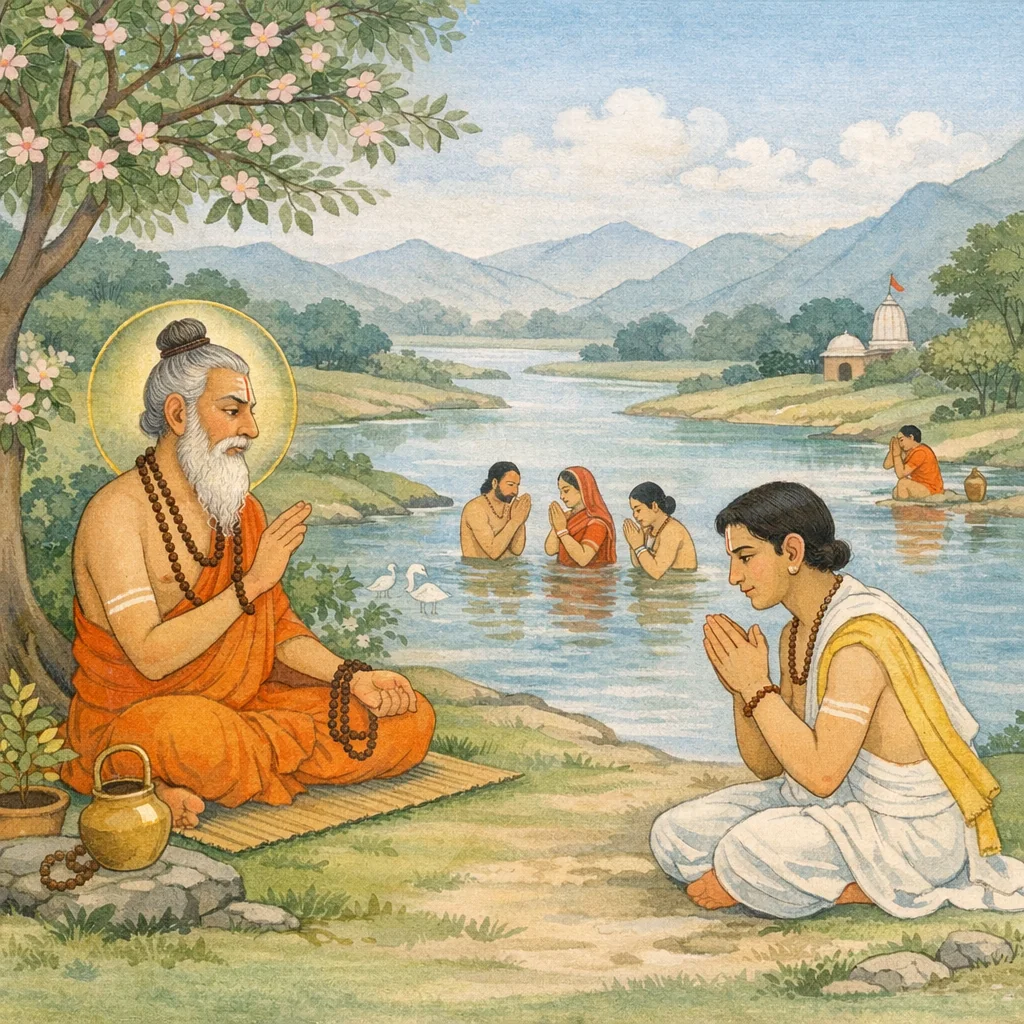
Adhyaya 35
The Supremacy of Food-Charity and the Rāma–Śambūka Episode (Child Revived through Rājadharma)
Adhyaya 35 reaffirms Purāṇic authority and teaches that anna-dāna (the gift of food) is the highest of gifts, said to uphold even Indra’s sovereignty. Pulastya, citing an older account from Agastya, turns to Rāma of the Raghu line after Rāvaṇa’s fall: sages arrive, are honored with arghya and hospitality, and depart while hinting at a duty yet to be fulfilled. Soon Rāma is confronted by a brāhmaṇa carrying his dead child, whose lament casts the realm’s disorder upon the king’s responsibility. Nārada explains yuga-dharma, warning that forbidden tapas performed within the kingdom makes the ruler share in the sin. Rāma searches out the cause, finds the ascetic Śambūka—a Śūdra engaged in severe austerities—and kills him; the devas praise Rāma and grant a boon. Rāma asks that the brāhmaṇa’s son be restored to life, and the child is revived at once.
Shlokas
Verse 1
भीष्म उवाच । उक्तं भगवता सर्वं पुराणाश्रयसंयुतं । तथा श्वेतेन ब्रह्मांडं गुरवे प्रतिपादितं
Bhīṣma said: “All this was spoken by the Blessed Lord, grounded in the authority of the Purāṇas; and likewise the Brahmāṇḍa (Purāṇa) was expounded by Śveta to his teacher.”
Verse 2
श्रुत्वैतत्कौतुकं जातं यथा तेनास्थिलेहनं । कृतं क्षुधापनोदार्थे अन्नदानाद्विना द्विज
Hearing this, a curiosity arose in me: how did he, without giving food as dāna, come to lick bones merely to ward off hunger, O twice-born one?
Verse 3
तदहं श्रोतुमिच्छामि पृथिव्यां ये च पार्थिवाः । अन्नदानाद्दिवं प्राप्ताः क्रतवश्चान्नमूलकाः
Therefore I wish to hear of those kings on earth who attained heaven through the gift of food—and of the yajñas as well, for sacrificial rites are rooted in food.
Verse 4
कथं तस्य मतिर्नष्टा श्वेतस्य च महात्मनः । न दत्तं तेनान्नदानमृषिभिर्वा न दर्शितम्
How did the understanding of the great-souled Śveta become lost? Did he not offer the charity of food, or was it not taught to him by the ṛṣis?
Verse 5
अहो माहात्म्यमन्नस्य इह दत्तस्य यत्फलम् । परत्र भुज्यते पुंभिः स्वर्गश्चाक्षयतां व्रजेत्
Ah! How great is the glory of giving food: the fruit of food donated here is enjoyed by a person in the hereafter, and heaven itself becomes imperishable for him.
Verse 6
अन्नदानं परं विप्राः कीर्तयंति सदोत्थिताः । अन्नदानात्सुरेद्रेण त्रैलोक्यमिह भुज्यते
O brāhmaṇas, ever vigilant in praise, you proclaim the gift of food to be supreme; for by the offering of food, even the lord of the gods enjoys sovereignty over the three worlds.
Verse 7
शतक्रतुरिति प्रोक्तः सर्वैरेव द्विजोत्तमैः । तेनावस्थां तत्सदृशीं प्राप्तवांस्त्रिदशेश्वरः
All the foremost brāhmaṇas addressed him as “Śatakratu”; and by that, the lord of the thirty gods attained a state befitting that name and merit.
Verse 8
दानदेवगतः स्वर्गं त्वत्तः सर्वं श्रुतं मया । अपरं च पुरावृत्तं निवृत्तं यदि कर्हिचित्
From you I have heard everything about heaven attained through the divine power of giving, that is, through charity. If there is any other ancient account—anything ever left untold—please relate that as well.
Verse 9
भूयोपि श्रोतुमिच्छामि तन्मे वद महामते । पुलस्त्य उवाच । एतदाख्यानकं पूर्वमगस्त्येन महात्मना
“I wish to hear it again; tell me that, O great sage.” Pulastya said: “This very narrative was formerly told by the great-souled Agastya…”
Verse 10
रामाय कथितं राजंस्तत्ते वक्ष्यामि सांप्रतम् । भीष्म उवाच । कस्मिन्वंशे समुत्पन्नो रामोऽसौ नृपसत्तमः
O King, I shall now tell you what was related to Rāma. Bhīṣma said: “In which lineage was that Rāma—foremost among kings—born?”
Verse 11
यस्यागस्त्येन कथितश्चेतिहासः पुरातनः । पुलस्त्य उवाच । रघुवंशे समुत्पन्नो रामो नाम महाबलः
Pulastya said: “That ancient traditional account which was narrated by Agastya—now hear it. In the Raghu dynasty there arose a mighty one named Rāma.”
Verse 12
देवकार्यं कृतं तेन लंकायां रावणो हतः । पृथिवीं राज्यसंस्थस्य ऋषयोऽभ्यागता गृहे
By him the task of the gods was accomplished: in Laṅkā, Rāvaṇa was slain. And when he had become firmly established in sovereignty over the earth, the sages came to his house.
Verse 13
प्राप्तास्ते तु महात्मानो राघवस्य निवेशनम् । प्रतीहारस्ततो राममगस्त्यवचनाद्द्रुतम्
Those great-souled sages then arrived at Rāghava’s dwelling. Thereupon the doorkeeper, at Agastya’s instruction, quickly informed Rāma.
Verse 14
आवेदयामास ऋषीन्प्राप्तास्तांश्च त्वरान्वितः । दृष्ट्वा रामं द्वारपालः पूर्णचंद्रमिवोदितम्
Seeing Rāma—like the full moon newly risen—the gatekeeper hastened and announced to the arriving sages that they had come.
Verse 15
कौसल्यासुत भद्रं ते सुप्रभाताद्य शर्वरी । द्रष्टुमभ्युदयं तेद्य सम्प्राप्तो रघुनंदन
“O son of Kausalyā, blessings upon you. The night has now turned to a fair dawn. O Raghunandana, I have come today to behold your rise to prosperity and glory.”
Verse 16
अगस्त्यो मुनिभिः सार्धं द्वारि तिष्ठति ते नृप । श्रुत्वा प्राप्तान्मुनीन्रामस्तान्भास्करसमद्युतीन्
“O king, Agastya—together with the sages—stands at your gate.” Hearing that the sages had arrived, Rāma went forth to meet those ascetics, radiant like the sun.
Verse 17
प्राह वाक्यं तदा द्वास्थं प्रवेशय त्वरान्वितः । किमर्थं तु त्वया द्वारि निरुद्धा मुनिसत्तमाः
Then he spoke these words to the gatekeeper: “Let them enter at once, without delay. For what reason have the foremost sages been stopped by you at the door?”
Verse 18
रामवाक्यान्मुनींस्तांस्तु प्रावेशयद्यथासुखम् । दृष्ट्वा तु तान्मुनींन्प्राप्तान्प्रत्युवाच कृतांजलि
At Rāma’s instruction, he ushered those sages in and had them seated comfortably. Seeing the sages who had arrived, he addressed them with folded hands.
Verse 19
रामोऽभिवाद्य प्रणत आसनेषु न्यवेशयत् । ते तु कांचनचित्रेषु स्वास्तीर्णेषु सुखेषु च
Rāma, having respectfully greeted them and bowed in reverence, seated them upon seats—comfortable, well-spread, and adorned with golden designs.
Verse 20
कुशोत्तरेषु चासीनाः समंतान्मुनिपुंगवाः । पाद्यमाचमनीयं च ददौ चार्घ्यं पुरोहितः
Seated all around upon seats of kuśa grass, those foremost sages were honored as the priest offered them water for washing the feet, water for sipping, and also the arghya offering.
Verse 21
रामेण कुशलं पृष्टा ऋषयः सर्व एव ते । महर्षयो वेदविद इदं वचनमब्रुवन्
When Rāma inquired after their well-being, all those sages—great seers, learned in the Vedas—spoke these words.
Verse 22
कुशलं ते महाबाहो सर्वत्र रघुनंदन । त्वां तु दिष्ट्या कुशलिनं पश्यामो हतविद्विषम्
All is well with you everywhere, O mighty-armed joy of the Raghu line. By good fortune we now see you safe and sound, with your enemies slain.
Verse 23
हृता सीतातिपापेन रावणेन दुरात्मना । पत्नी ते रघुशार्दूल तस्या एवौजसा हतः
Sītā has been abducted by Rāvaṇa, exceedingly sinful and wicked-souled. O tiger among the Raghu race, she is your wife—yet he will be slain by her very spiritual power.
Verse 24
असहायेन चैकेन त्वया राम रणे हतः । यादृशं ते कृतं कर्म तस्य कर्ता न विद्यते
O Rāma, single-handed and without any ally, you have slain him in battle. Such a deed as you have performed has no equal performer to be found.
Verse 25
इह संभाषितुं प्राप्ता दृष्ट्वा पूताः स्म सांप्रतम् । दर्शनात्तव राजेंद्र सर्वे जातास्तपस्विनः
We have come here to speak with you; indeed, upon seeing you just now, we have been purified. O king of kings, by the mere sight of you, all of us have become ascetics.
Verse 26
रावणस्य वधात्तेद्य कृतमश्रुप्रमार्जनम् । दत्वा पुण्यामिमां वीर जगत्यभयदक्षिणाम्
Today, through the slaying of Rāvaṇa, your tears have been wiped away. O hero, having bestowed this sacred gift—fearlessness upon the world—as a dakṣiṇā, you have fulfilled your duty.
Verse 27
दिष्ट्या वर्धसि काकुत्स्थ जयेनामितविक्रम । दृष्टस्संभाषितश्चासि यास्यामश्चाश्रमान्स्वकान्
By good fortune you prosper, O Kakutstha—victorious one of immeasurable valor. We have seen you and spoken with you; now we shall depart to our own hermitages.
Verse 28
अरण्यं ते प्रविष्टस्य मया चेंद्रशरासनम् । अर्पितं चाक्षयौ तूणौ कवचं च परंतप
When you entered the forest, I gave you Indra’s bow, along with two inexhaustible quivers and a coat of mail, O scorcher of foes.
Verse 29
भूयोप्यागमनं कार्यमाश्रमे मे रघूद्वह । एवमुक्त्वा तु ते सर्वे मुनयोंतर्हिताऽभवन्
“Come again to my hermitage, O scion of Raghu.” Having spoken thus, all those sages then vanished from sight.
Verse 30
गतेषु मुनिमुख्येषु रामो धर्मभृतां वरः । चिंतयामास तत्कार्यं किं स्यान्मे मुनिनोदितम्
When the foremost sages had departed, Rāma—best among the upholders of dharma—reflected on that task, wondering, “What might be the matter that the sage has enjoined upon me?”
Verse 31
भूयोप्यागमनं कार्यमाश्रमे रघुनंदन । अवश्यमेव गंतव्यं मयाऽगस्त्यस्य सन्निधौ
“O delight of the Raghu line, I must come again to the hermitage. Indeed, I must certainly go to be in the presence of Agastya.”
Verse 32
श्रोतव्यं देवगुह्यं तु कार्यमन्यच्च यद्वदेत् । एवं चिंतयतस्तस्य रामस्यामिततेजसः
“One should listen to the divine secret, and also carry out whatever other task may be enjoined.” While he reflected thus—Rāma of immeasurable splendor…
Verse 33
करिष्ये नियतं धर्मं धर्मो हि परमा गतिः । सुतवर्षसहस्राणि दश राज्यमकारयत्
“I shall unfailingly practice the ordained Dharma, for Dharma indeed is the supreme goal.” Thus he caused the kingdom to be governed for ten thousand years.
Verse 34
ददतो जुह्वतश्चैव जग्मुस्तान्येकवर्षवत् । प्रजाः पालयतस्तस्य राघवस्य महात्मनः
As the great-souled Rāghava continued to bestow gifts and perform sacrificial offerings (yajña), those many days passed for him as though they were but a single year, while he protected his subjects.
Verse 35
एतस्मिन्नेव दिवसे वृद्धो जानपदो द्विजः । मृतं पुत्रमुपादाय रामद्वारमुपागतः
On that very day, an aged brāhmaṇa from the countryside, carrying his dead son, arrived at Rāma’s gate.
Verse 36
उवाच विविधं वाक्यं स्नेहाक्षरसमन्वितम् । दुष्कृतं किंतु मे पुत्र पूर्वदेहांतरे कृतम्
He spoke many words, filled with affectionate expressions: “But, my son, what evil deed was done by me in a former body?”
Verse 37
त्वामेकपुत्रं यदहं पश्यामि निधनं गतम् । अप्राप्तयौवनं बालं पंचवर्षं गतायुषम्
When I see you—my only son—gone to death, a mere child who had not yet reached youth, only five years of age, whose span of life has ended—
Verse 38
अकाले कालमापन्नं दुःखाय मम पुत्रक । अकृत्वा पितृकार्याणि गतो वैवस्वतक्षयम्
O my son, you have met death before your time, bringing me sorrow. Without having performed the duties owed to your forefathers, you have gone to the abode of Vaivasvata (Yama).
Verse 39
रामस्य दुष्कृतं व्यक्तं येन ते मृत्युरागतः । बालवध्या ब्रह्मवध्या स्त्रीवध्या चैव राघवम्
Rāma’s misdeed is manifest—because of it, death has come upon you. Upon Rāghava rests the guilt of killing a child, a brāhmaṇa, and a woman.
Verse 40
प्रवेक्ष्यति न सन्देहः सभार्ये तु मृते मयि । शुश्राव राघवः सर्वं दुःखशोकसमन्वितम्
“There is no doubt—when I die along with my wife, he will surely enter the fire.” Rāghava heard all of this, filled with grief and sorrow.
Verse 41
निवार्य तं द्विजं रामो वसिष्ठं वाक्यमब्रवीत् । किं मयाद्य च कर्तव्यं कार्यमेवं विधे स्थिते
Stopping that brāhmaṇa, Rāma spoke to Vasiṣṭha: “What should I do today? What indeed is to be done, now that matters stand thus by fate?”
Verse 42
प्राणानहं जुहोम्यग्नौ पर्वताद्वा पतेह्यहम् । कथं शुद्धिमहं यामि श्रुत्वा ब्राह्मणभाषितम्
I am ready to offer my very life into the fire, or even to leap from a mountain. Having heard the words spoken by the brāhmaṇa, how shall I attain purity?
Verse 43
वसिष्ठस्याग्रतः स्थित्वा राज्ञो दीनस्य नारदः । प्रत्युवाच श्रुतं वाक्यमृषीणां सन्निधौ तदा
Standing before Vasiṣṭha, Nārada then replied to the sorrowful king, repeating the words he had heard, in the presence of the sages.
Verse 44
शृणु राम यथाकालं प्राप्तो वै बालसंक्षयः । पुरा कृतयुगे राम सर्वत्र ब्राह्मणोत्तरम्
Listen, O Rāma: in due time the decline of children indeed came to pass. In former days, in the Kṛta Yuga, O Rāma, the Brāhmaṇas everywhere held the foremost place.
Verse 45
अब्राह्मणो न वै कश्चित्तपस्तपति राघव । अमृत्यवस्तदा सर्वे जायंते चिरजीविनः
O Rāghava, then indeed no non-Brāhmaṇa undertook austerities; at that time all were free from death and were born long-lived.
Verse 46
त्रेतायुगे पुनः प्राप्ते ब्रह्मक्षत्रमनुत्तमम् । अधर्मो द्वापरे तेषां वैश्यान्शूद्रांस्तथाविशत्
When the Tretā Yuga returned, the Brāhmaṇas and Kṣatriyas became excellent once again; but in the Dvāpara Yuga, unrighteousness likewise entered among the Vaiśyas and Śūdras.
Verse 47
एवं निरंतरं जुष्टमुद्भूतमनृतं पुनः । अधर्मस्य त्रयः पादा एको धर्मस्य चागतः
Thus, as falsehood was continually indulged and repeatedly arose, unrighteousness came to stand on three legs, while righteousness remained with only one.
Verse 48
ततः पूर्वे भृशं त्रस्ता वर्णा ब्राह्मणपूर्वकाः । भूयः पादस्तु धर्मस्य द्वितीयः समपद्यत
Then the earlier classes—beginning with the Brāhmaṇas—became greatly frightened; and once again the second ‘foot’ (quarter) of Dharma came to be established.
Verse 49
तस्मिन्द्वापरसंज्ञे तु तपो वैश्यं समाविशत् । युगत्रयस्य वैधर्म्यं धर्मस्य प्रतितिष्ठति
In the age called Dvāpara, austerity (tapas) entered the Vaiśya estate; thus the differing marks of the three yugas become established as the enduring pattern of dharma.
Verse 50
कलिसंज्ञे ततः प्राप्ते वर्तमाने युगेंतिमे । अधर्मश्चानृतं चैव ववृधाते नरर्षभ
When the age called Kali arrives and the final yuga is underway, unrighteousness (adharma) and falsehood indeed increase, O best among men.
Verse 51
भविता शूद्रयोन्यां तु तपश्चर्या कलौ युगे । स ते विषयपर्यंते राजन्नुग्रतरं तपः
In the Kali yuga, your austerity will indeed bear fruit as a birth among the Śūdras. O king, even to the farthest bounds of your realm, that will be for you an even harsher penance.
Verse 52
शूद्रस्तपति दुर्बुद्धिस्तेन बालवधः कृतः । यस्याधर्ममकार्यं वा विषये पार्थिवस्य हि
The foolish Śūdra suffers, for he has committed the killing of a child—when, within the king’s realm, he performs adharma or some forbidden deed.
Verse 53
पुरे वा राजशार्दूल कुरुते दुर्मतिर्नरः । क्षिप्रं स नरकं याति यावदाभूतसंप्लवम्
O tiger among kings, a man of wicked intent who commits such an act in a city swiftly goes to hell and remains there until the cosmic dissolution.
Verse 54
चतुर्थं तस्य पापस्य भागमश्नाति पार्थिवः । सत्त्वं पुरुषशार्दूल गच्छस्व विषयं स्वकम्
The king partakes of a fourth share of that sin. O noble one, tiger among men—go now to your own domain.
Verse 55
दुष्कृतं यत्र पश्येथास्तत्र यत्नं समाचर । एवं ते धर्मवृद्धिश्च बलस्य वर्धनं तथा
Wherever you see wrongdoing, there apply earnest effort to restrain and correct it. Thus your righteousness will increase—and likewise your strength will grow.
Verse 56
भविष्यति नरश्रेष्ठ बालस्यास्य च जीवनम् । नारदेनैवमुक्तस्तु साश्चर्यो रघुनंदनः
“O best of men, this child will indeed live.” Thus spoken by Nārada, Raghunandana was filled with wonder.
Verse 57
प्रहर्षमतुलं लेभे लक्ष्मणं चेदमब्रवीत् । गच्छ सौम्य द्विजश्रेष्ठं समाश्वासय लक्ष्मण
He felt boundless joy, and then said this to Lakṣmaṇa: “Go, dear one—go to the best of the twice-born and console him, O Lakṣmaṇa.”
Verse 58
बालस्य च शरीरं त्वं तैलद्रोण्यां निधापय । गंधैश्च परमोदारैस्तैलैश्चैव सुगंधिभिः
And you should place the child’s body in an oil-trough, using the finest fragrances and also sweet-smelling oils.
Verse 59
यथा न शीर्यते बालस्तथा सौम्य विधीयताम् । यथा शरीरं गुप्तं स्याद्बालस्याक्लिष्टकर्मणः
O gentle one, arrange it so that the child does not waste away, and that the child’s body—whose deeds are not yet burdened by hardship—remains well protected.
Verse 60
विपत्तिः परिभेदो वा न भवेत्तत्तथा कुरु । तथा संदिश्य सौमित्रं लक्ष्मणं शुभलक्षणम्
“Act so that neither calamity nor dissension may arise.” Having thus instructed Saumitra—Lakṣmaṇa of auspicious marks—he then gave further direction.
Verse 61
मनसा पुष्पकं दध्यावागच्छेति महायशाः । इंगितं तत्तु विज्ञाय कामगं हेमभूषितम्
That illustrious one merely contemplated Puṣpaka in his mind, as if saying, “Come!”; and it, understanding his intention, came at will, adorned with gold.
Verse 62
आजगाम मुहूर्तात्तु समीपं राघवस्य हि । सोब्रवीत्प्राञ्जलिर्वाक्यमहमस्मि नराधिप
After a short while, he came near Rāghava. With folded hands he spoke: “I am here, O lord of men.”
Verse 63
अग्रे तव महाबाहो किंकरः समुपस्थितः । भाषितं सुचिरं श्रुत्वा पुष्पकस्य नराधिप
Before you, O mighty-armed one, your servant stands ready. Having listened long to the words of Puṣpaka, O lord of men.
Verse 64
अभिवाद्य महर्षींस्तान्विमानं सोध्यरोहत । धनुर्गृहीत्वा तूणौ च खड्गं चापि महाप्रभम्
Having bowed in reverence to those great sages, he mounted the aerial chariot. Taking up his bow, his quivers, and a splendid, mighty sword, he made ready to depart.
Verse 65
निक्षिप्य नगरे वीरौ सौमित्रि भरतावुभौ । प्रायात्प्रतीचीं त्वरितो विचिन्वन्सुसमाहितः
Leaving in the city the two heroes—Saumitrī and Bharata—he swiftly set out westward, searching with a steady, well-collected mind.
Verse 66
उत्तरामगमत्पश्चाद्दिशं हिमवदाश्रिताम् । पूर्वामपि दिशां गत्वा तथाऽपश्यन्नराधिपः
Afterwards, the king went to the northern quarter, sheltered by the Himālaya; and having also gone to the eastern quarter, the lord of men beheld the same there as well.
Verse 67
सर्वां शुद्धसमाचारामादर्शमिव निर्मलाम् । ततो दिशं समाक्रामद्दक्षिणां रघुनंदनः
Seeing all as pure in conduct, spotless like a polished mirror, Raghu’s descendant then set forth toward the southern direction.
Verse 68
शैलस्य उत्तरे पार्श्वे ददर्श सुमहत्सरः । तस्मिन्सरसि तप्यंतं तापसं सुमहत्तपः
On the northern side of the mountain, he beheld a very great lake. In that lake he saw an ascetic engaged in austerities, one whose tapas was exceedingly great.
Verse 69
ददर्श राघवो भीमं लंबमानमधोमुखं । तमुपागम्य काकुत्स्थस्तप्यमानं तु तापसम्
Rāghava beheld a dreadful ascetic, hanging upside down with his face turned toward the earth. Drawing near, Kakutstha saw the sage absorbed in severe austerity.
Verse 70
उवाच राघवो वाक्यं धन्यस्त्वममरप्रभ । कस्यां योनौ तपोवृद्धिर्वर्तते दृढनिश्चय
Rāghava spoke: “Blessed are you, O lord of the immortals. In what womb—what state of existence—does the true increase of austerity abide, O you of steadfast resolve?”
Verse 71
अहं दाशरथी रामः पृच्छामि त्वां कुतूहलात् । कोर्थो व्यवसितस्तुभ्यं स्वर्गलोकोथ वेतरः
I am Rāma, son of Daśaratha. Out of curiosity I ask you: what purpose have you resolved upon—attaining the heavenly world, or something else?
Verse 72
किमर्थं तप्यसे वा त्वं श्रोतुमिच्छामि तापस । ब्राह्मणो वासि भद्रं ते क्षत्रियो वाथ दुर्जयः
For what purpose do you practise austerities? I wish to hear, O ascetic. Tell me—are you a brāhmaṇa, auspicious one, or an unconquerable kṣatriya?
Verse 73
वैश्यस्तृतीयवर्णो वा शूद्रो वा सत्यमुच्यताम् । तपः सत्यात्मकं नित्यं स्वर्गलोकपरिग्रहे
Whether one is a vaiśya of the third order or a śūdra, let the truth be spoken: austerity whose very essence is truth, practiced constantly, leads to the attainment of the heavenly worlds.
Verse 74
सात्विकं राजसं चैव तच्च सत्यात्मकं तपः । जगदुपकारहेतुर्हि सृष्टं तद्वै विरिंचिना
Austerity (tapas) is of the sāttvika and the rājasa kinds, and it is grounded in truth. Indeed, that tapas was created by Viriñci (Brahmā) for the welfare of the world.
Verse 75
रौद्रं क्षत्रियतेजोजं तत्तु राजसमुच्यते । परस्योत्सादनार्थाय तच्चासुरमुदाहृतम्
That fierce power, born of kṣatriya valor, is called ‘rājasa’; and when it is used for the destruction of another, it is declared to be ‘āsuric’ (demonic).
Verse 76
अंगानि निह्नुते यो वा असृग्दिग्धानि भागशः । पंचाग्निंसाधयेद्वापि सिद्धिं वा मृत्युमेव वा
Whether one hides (by mutilating) his limbs, smears parts of his body with blood, or even undertakes the five-fire austerity, he may attain an occult siddhi—or else meet only death.
Verse 77
आसुरो ह्येष ते भावो न च मे त्वं द्विजो मतः । सत्यं ते वदतः सिद्धिरनृते नास्ति जीवितम्
This disposition of yours is truly āsuric; in my view you are not a dvija (brahmin). If you speak the truth, you will attain siddhi; in falsehood there is no life, no true sustenance.
Verse 78
तस्य तद्भाषितं श्रुत्वा रामस्याक्लिष्टकर्मणः । अवाक्शिरास्तथा भूतो वाक्यमेतदुवाच ह
Hearing those words of Rāma, whose deeds were unblemished, the being stood with head bowed down and then spoke these words.
Verse 79
स्वागतं ते नृपश्रेष्ठ चिराद्दृष्टोसि राघव । पुत्रभूतोस्मि ते चाहं पितृभूतोसि मेनघ
Welcome to you, best of kings—after a long time you have been seen, O Rāghava. I am as a son to you, and you are as a father to me, O sinless one.
Verse 80
अथवा नैतदेवं हि सर्वेषां नृपतिः पिता । सत्वमर्च्योऽसि भो राजन्वयं ते विषये तपः
Or rather, this is not so at all: the king is not the father of everyone. Yet you, O King, are worthy of honor; we are performing austerity within your realm.
Verse 81
चरामस्तत्रभागोस्ति पूर्वं सृष्टः स्वयंभुवा । न धन्याः स्मो वयं राम धन्यस्त्वमसि पार्थिव
‘We are roaming here; there is a share for us in that place, created long ago by the Self-born (Brahmā). We are not fortunate, O Rāma—fortunate are you, O king.’
Verse 82
यस्य ते विषये ह्येवं सिद्धिमिच्छंति तापसाः । तपसा त्वं मदीयेन सिद्धिमाप्नुहि राघव
In regard to that very matter of yours for which ascetics seek such attainment—by my own austerity, O Rāghava, may you attain success.
Verse 83
यदेतद्भवता प्रोक्तं योनौ कस्यां तु ते तपः । शूद्रयोनिप्रसूतोहं तप उग्रं समास्थितः
As for what you asked—‘In which womb (birth) was your austerity performed?’—I was born from a Śūdra womb, yet I undertook severe austerities.
Verse 84
देवत्वं प्रार्थये राम स्वशरीरेण सुव्रत । न मिथ्याहं वदे भूप देवलोकजिगीषया
O Rāma, O you of noble vow—while in this very body I pray for divine status. O king, I speak no falsehood; it is from the longing to attain the world of the devas.
Verse 85
शूद्रं मां विद्धि काकुत्स्थ शंबूकं नाम नामतः । भाषतस्तस्य काकुत्स्थः खड्गं तु रुचिरप्रभं
“Know me to be a Śūdra, O Kakutstha; by name I am called Śambūka.” As he spoke, O Kakutstha, (Rāma) took up a sword of splendid radiance.
Verse 86
निष्कृष्य कोशाद्विमलं शिरश्चिच्छेद राघवः । तस्मिन्शूद्रे हते देवाः सेन्द्राश्चाग्निपुरोगमाः
Drawing his spotless sword from its scabbard, Rāghava cut off his head. When that Śūdra had been slain, the devas—along with Indra, with Agni at their head—were pleased.
Verse 87
साधुसाध्विति काकुत्स्थं प्रशशंसुर्मुहुर्मुहुः । पुष्पवृष्टिश्च महती देवानां सुसुगंधिनी
Crying, “Well done! Well done!”, the devas again and again praised Kakutstha. And there was a great shower of flowers from the gods, richly fragrant.
Verse 88
आकाशाद्विप्रमुक्ता तु राघवं सर्वतोकिरत् । सुप्रीताश्चाब्रुवन्देवा रामं वाक्यविदांवरम्
Released from the sky, they showered Rāghava from all sides; and the devas, delighted, addressed Rāma—the foremost among those skilled in speech.
Verse 89
सुरकार्यमिदं सौम्य कृतं ते रघुनंदन । गृहाण च वरं राम यमिच्छसि महाव्रत
O gentle one, joy of the Raghu line—this work of the gods has been accomplished by you. Therefore, O Rāma, accept a boon: whatever you desire, O great-vowed one.
Verse 90
त्वत्कृतेन हि शूद्रोऽयं सशरीरोऽभ्यगाद्दिवं । देवानां भाषितं श्रुत्वा राघवः सुसमाहितः
Indeed, because of what you have done, this Śūdra has gone to heaven in his very body. Hearing the words spoken by the gods, Rāghava became fully composed and attentive.
Verse 91
उवाच प्राञ्जलिर्वाक्यं सहस्राक्षं पुरंदरम् । यदि देवाः प्रसन्ना मे वरार्हो यदि वाप्यहम्
With folded hands he addressed Purandara, the thousand-eyed one: “If the gods are pleased with me—if I too am worthy of a boon—then …”
Verse 92
कर्मणा यदि मे प्रीता द्विजपुत्रः स जीवतु । वरमेतद्धि भवतां कांक्षितं परमं हि मे
If you are pleased with me because of my actions, then let that son of a brāhmaṇa live. This indeed is the boon you desire—and it is the highest request for me.
Verse 93
ममापराधाद्बालोऽसौ ब्राह्मणस्यैकपुत्रकः । अप्राप्तकालः कालेन नीतो वैवस्वत क्षयम्
Because of my offence, that boy—the sole son of a brāhmaṇa—though not yet at the time of death, has been taken by Time to the realm of Vaivasvata (Yama).
Verse 94
तं जीवयत भद्रं वो नानृती स्यामहं गुरोः । द्विजस्य संश्रुतो ह्यर्थो जीवयिष्यामि ते सुतम्
“Revive him—may good be upon you. I must not become false before my teacher, for a promise has indeed been made to the brāhmaṇa. I will restore your son to life.”
Verse 95
मदीयेनायुषा बालं पादेनार्द्धेन वा सुराः । जीवेदयं वरो मह्यं वरकोट्यधिको वृतः
“O gods, let this child live by my own lifespan—by a quarter, or even by half of it. This boon has been chosen by me; it surpasses a crore of other boons.”
Verse 96
राघवस्य तु तद्वाक्यं श्रुत्वा विबुधसत्तमाः । प्रत्यूचुस्ते महात्मानं प्रीताः प्रीतिसमन्विताः
Hearing those words of Rāghava, the best among the gods—delighted and filled with affection—replied to that great-souled one.
Verse 97
निर्वृतो भव काकुत्स्थ ब्राह्मणस्यैकपुत्रकः । जीवितं प्राप्तवान्भूयः समेतश्चापि बंधुभिः
“Be at peace, O Kakutstha: the brāhmaṇa’s only son has regained his life, and he has also been reunited with his kinsmen.”
Verse 98
यस्मिन्मुहूर्ते काकुत्स्थ शूद्रोयं विनिपातितः । तस्मिन्मुहूर्ते सहसा जीवेन समयुज्यत
“O descendant of Kakutstha, at the very moment this Śūdra fell down, at that same moment he was suddenly reunited with life.”
Verse 99
स्वस्ति प्राप्नुहि भद्रं ते साधयामः परंतपः । अगस्त्यस्याश्रमपदे द्रष्टारः स्म महामुनिम्
May auspiciousness be yours; may good befall you, O vanquisher of foes. We shall fulfill our purpose: we go to the site of Agastya’s āśrama to behold the great muni.
Verse 100
स तथेति प्रतिज्ञाय देवानां रघुनंदनः । आरुरोह विमानं तं पुष्पकं हेमभूषितम्
Having pledged to the devas, “So be it,” Raghunandana (Rāma) then ascended that Puṣpaka vimāna, adorned with gold.