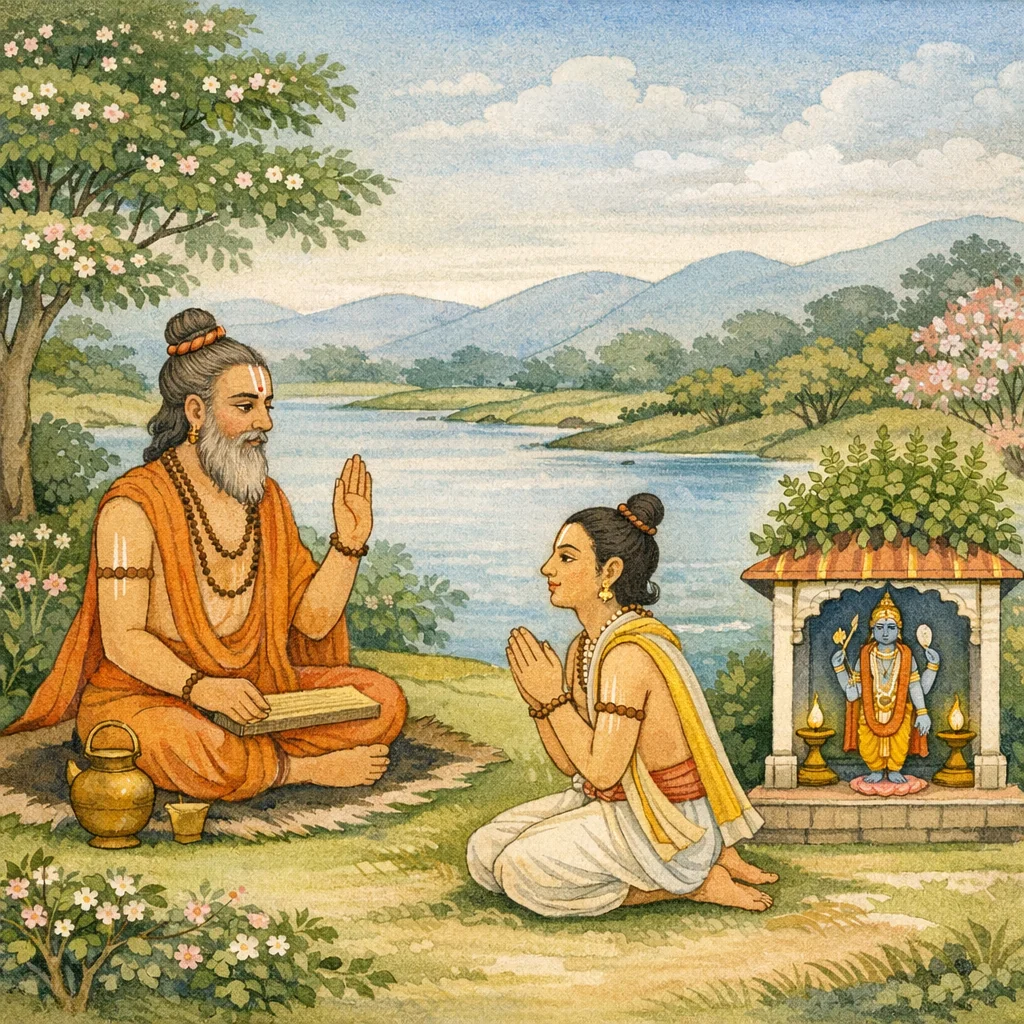
Adhyaya 32
The Tale of the Five Pretas and the Glory of Puṣkara & the Eastern Sarasvatī
Bhīṣma asks Pulastya how preta-bhāva arises and how it comes to an end. Pulastya relates an exemplar: a disciplined brāhmaṇa pilgrim encounters five terrifying pretas, who disclose their karmic causes, their “name-as-sin” identities, and the foul sustenance they obtain where household purity, dharma, and śrāddha are neglected. The brāhmaṇa teaches protective dharmas and remedies—vows such as Kṛcchra and Cāndrāyaṇa, maintaining the sacred fire, equanimity, honoring guest and guru, proper śrāddha timing, charity, and reverence for cows and tīrthas—then states explicit causes of becoming a preta: abandoning kin, grave crimes, impure food relations, betrayal, and atheistic concealment of dakṣiṇā. The chapter then turns to Puṣkara-māhātmya: auspicious calendrical yogas in Kārtika, invocation mantras, and Sarasvatī’s eastern manifestation (Prācī). It proclaims extraordinary merit for bathing, giving, and offering piṇḍa/tarpaṇa there, culminating in divine praise and the establishment of primal tīrthas such as Śuddhāvaṭa and Āditīrtha.
Shlokas
Verse 1
भीष्म उवाच । केन कर्मविपाकेन प्रेतत्वं जायते पुनः । केन वात्र प्रमुच्येत तन्मे ब्रूहि महामते
Bhīṣma said: By what fruition of karma does one again become a preta, a restless departed spirit? And by what means is one released from that state? Tell me this, O great-minded one.
Verse 2
पुलस्त्य उवाच । अहं ते कथयिष्यामि सर्वमेतदशेषतः । यच्छ्रुत्वा न पुनर्मोहं यास्यते नृपसत्तम
Pulastya said: I shall tell you all of this in full, without remainder; on hearing it, O best of kings, you will not fall into delusion again.
Verse 3
येन जायेत प्रेतत्वं येन चास्मात्प्रमुच्यते । प्राप्नोति नरकं घोरं दुस्तरं त्रिदशैरपि
By that one becomes a wandering preta, and by that one is released from that state; but he who acts contrary attains a dreadful hell, hard to cross even for the gods.
Verse 4
सतां संभाषणे चैव पुण्यतीर्थानुकीर्त्तने । मानवास्तु प्रमुच्यंत आपन्नाः प्रेतयोनिषु
By conversing with the virtuous and by reciting the names and praises of the sacred tīrthas, human beings—even if fallen into the state of a preta—are released from that condition.
Verse 5
श्रूयते हि पुरा भीष्म ब्राह्मणः संशितव्रतः । पृथुस्सर्वत्र विख्यातः संतोषे च सदा स्थितः
It is indeed heard from ancient times, O Bhīṣma, that there was a brāhmaṇa of steadfast vows named Pṛthu—renowned everywhere and ever established in contentment.
Verse 6
स्वाध्याययुक्तो गेहेषु नित्ययोगश्च योगवित् । जपयज्ञविधानेन युक्तं कालं क्षिपेच्च सः
Engaged in svādhyāya while dwelling at home, ever established in yoga and skilled in its practice, he should pass his time rightly—devoted to the discipline of the japa-yajña, the sacrifice of recitation.
Verse 7
युक्तः क्षमादयाभ्यां च क्षांत्यायुक्तश्च तत्त्ववित् । अहिंसाहितचित्तश्च मार्द्दवे च तथास्थितः
Endowed with forbearance and the other virtues, united with patience, he is a knower of reality. His mind is established in ahiṃsā, and he remains firmly grounded in gentleness.
Verse 8
ब्रह्मचर्यसमायुक्तस्तपोयोगसमन्वितः । युक्तः स पितृकार्येषु युक्तो वैदिककर्मसु
Endowed with the discipline of brahmacarya and enriched by austerity and yogic practice, he is fit for the rites owed to the ancestors and fit for Vedic duties.
Verse 9
परलोकभयेयुक्तो युक्तस्सत्यवचः प्रति । युक्तो मधुरवाक्येषु युक्तश्चातिथिपूजने
Disciplined by fear of the hereafter, he is devoted to truthful speech; he is devoted to sweet words, and he is also devoted to honoring guests.
Verse 10
इष्टापूर्तसमायुक्तो युक्तो द्वंद्वविवर्जने । स्वकर्मविधिसंयुक्तो युक्तः स्वाध्यायकर्मसु
He is devoted to iṣṭa and pūrta (pious rites and public benefactions), disciplined in remaining free from the pairs of opposites, and—being aligned with the proper rules of his own duties—steadfast in self-study and the performance of prescribed acts.
Verse 11
एवं कर्माणि कुर्वंतस्संसारविजिगीषया । बहून्यब्दान्यतीतानि ब्राह्मणस्य गृहे सतः
Thus, while he continued performing such deeds with the aim of overcoming worldly existence, many years passed as he stayed in the Brahmin’s house.
Verse 12
तस्य बुद्धिरियं जाता तीर्थाभिगमनं प्रति । पुण्यैस्तीर्थजलैरेतत्क्लिन्नं कुर्यां कलेवरम्
Then this resolve arose in him—to set out for the sacred fords (tīrthas): “With the holy waters of the tīrthas, sanctified by merit, I shall moisten and purify this body.”
Verse 13
प्रयतः पुष्करे स्नात्वा भास्करस्योदयं प्रति । कृतजप्यनमस्कारोप्यद्ध्वानं प्रत्यपद्यत
Self-restrained, he bathed at Puṣkara; facing the Sun’s rising, and having performed japa and reverent salutations, he then set out upon the journey.
Verse 14
अग्रतः पंचपुरुषानपश्यत्सोति भीषणान् । वने कंटकवृक्षाढ्ये निर्जने पक्षिवर्जिते
Before him he saw five men, exceedingly terrifying, in a forest thick with thorny trees—desolate and devoid of birds.
Verse 15
तान्दृष्ट्वा विकृताकारान्सुघोरान्पापदर्शनान् । ईषत्संत्रस्तहृदयो व्यतिष्ठन्निश्चलाकृतिः
Seeing them—misshapen in form, exceedingly dreadful, and of sinful appearance—his heart grew slightly alarmed, yet he stood still, motionless in posture.
Verse 16
अवलंब्य ततो धैर्य्यं भयमुत्सृज्य दूरतः । पप्रच्छ मधुराभाषी के यूयं विकृताः कुतः
Then, taking hold of courage and casting fear far away, the sweet-spoken one asked: “Who are you—so strangely formed—and from where have you come?”
Verse 17
किं वा चैव कृतं कर्म ये नप्राप्ताश्च वैकृतम् । कथमेवंविधाः सर्वे प्रस्थिताः कुत्र चाध्वनि
“What deed, indeed, have you done—you who have not attained the transformed (higher) state? How have you all become such, and on what road, bound for where, do you travel?”
Verse 18
प्रेता ऊचुः । क्षुत्पिपासान्विता नित्यं महादुःखसमावृताः । हृतप्रज्ञा वयं सर्वे नष्टसञ्ज्ञाविचेतसः
The pretas said: “We are ever beset by hunger and thirst, shrouded in great suffering. All of us are bereft of discernment; our awareness is lost and our minds are confounded.”
Verse 19
न जानीमो दिशं चापि प्रदिशं चापि कां च न । नांतरिक्षं महीं चापि न जानीमो दिवं तथा
We do not know even the directions, nor any of the intermediate directions; we do not know the expanse of the sky or the earth, and likewise we do not know heaven.
Verse 20
यदेतद्दुःखमाख्यातमेतदेव सुखं भवेत् । प्रभातमिदमाभाति भास्करोदयदर्शनात्
What is spoken of as sorrow may itself become happiness; this dawn shines forth upon beholding the Sun’s rising.
Verse 21
अहं पर्युषितो नाम सूचीमुखस्तथाऽपरः । शीघ्रगो रोहकश्चैव पंचमो लेखकस्तथा
“I am named Paryuṣita; another is Sūcīmukha. Then there are Śīghraga and Rohaka, and the fifth is called Lekhaka.”
Verse 22
ब्राह्मण उवाच । प्रेतानां कर्मजातानां नाम्ना वै संभवः कुतः । किं तत्कारणमुद्दिश्य यतो यूयं सनामकाः
The brāhmaṇa said: “How do the pretas—beings born of their own karma—come to have names? For what cause are you endowed with specific names?”
Verse 23
प्रेता ऊचुः । अहं स्वादु सदा भुंजे दद्यां पर्युषितं द्विजे । एतत्कारणमासाद्य नाम पर्युषितो मम
The pretas said: “I always partake of what is sweet; yet I once gave a brāhmaṇa stale, leftover food. Because of that very cause, my name became ‘Paryuṣita’—the Stale, the Leftover One.”
Verse 24
सूचिता बहवोऽनेन विप्राश्चान्नाद्यकांक्षिणः । एतत्कारणमुद्दिश्य सूचीमुखाभिधो मतः
By this deed, many brāhmaṇas who longed for food and provisions were pointed out and exposed. For this very reason he is held to be known as ‘Sūcīmukha’—the Needle-faced, the Needle-mouthed.
Verse 25
शीघ्रं गतोऽस्मि विप्रेण याचितः क्षुधितेन च । एतत्कारणमुद्दिश्य शीघ्रगो द्विजसत्तम
“I went at once, being entreated by a hungry brāhmaṇa. For this very reason I am known as ‘Śīghraga’—the swift-goer, O best of the twice-born.”
Verse 26
गृहोपरि सदा स्वादु भुंक्ते द्विजभयेन हि । उद्विग्नमानसस्तत्र तेनासौ रोहकः स्मृतः
Out of fear of the brāhmaṇas, he always ate tasty food atop his house; yet his mind remained anxious there. Therefore he came to be remembered as ‘Rohaka’.
Verse 27
मौने चापि स्थितो नित्यं याचितो विलिखन्महीम् । अस्माकमपि पापिष्ठो लेखको नाम नामतः
He ever remained in silence; and when requested, he would inscribe upon the ground. Even among us he is the most sinful—known only by the name ‘Lekhaka’, the scribe, in name alone.
Verse 28
कृच्छ्रेण लेखको याति रोहकस्तु अवाक्शिराः । शीघ्रगः पंगुतां प्राप्तः सूची सूचीमुखोऽभवत्
With difficulty the scribe goes on; the climber becomes head-down; the swift one turns lame; and the needle becomes needle-faced—reduced to a mere needle-mouth.
Verse 29
पर्युषितो लम्बग्रीवो लंबोदर उदाहृतः । बृहद्वृषणलंबोष्ठः पापादस्मादजायत
From that sin was born one stale and foul-smelling, long-necked and called “pot-bellied”; with great testicles and drooping lips—thus he arose from that evil.
Verse 30
एतत्ते सर्वमाख्यातमात्मवृत्तं सहेतुकम् । पृच्छस्व यदि ते श्रद्धा पृष्टाश्च कथयामहे
All this—my own account together with its causes—has been fully told to you. If you have faith, then ask; and when questioned, we shall explain further.
Verse 31
ब्राह्मण उवाच । ये जीवा भुवि तिष्ठंति सर्वेप्याहारमूलकाः । युष्माकमपि चाहारं श्रोतुमिच्छामि तत्त्वतः
The Brāhmaṇa said: “All living beings that dwell upon the earth are sustained by food. I wish to hear, in truth, about your food as well.”
Verse 32
प्रेता ऊचुः । शृणुष्वाहारमस्माकं सर्वसत्वविगर्हितम् । यच्छ्रुत्वा निंदसे विप्र भूयोभूयश्च नित्यशः
The pretas said: “Listen to our food—abhorred by all beings. Hearing of it, O Brāhmaṇa, you condemn us again and again, day after day.”
Verse 33
श्लेष्ममूत्रपुरीषेण योषिदङ्गमलेन च । गृहाणि त्यक्तशौचानि प्रेता भुंजंति तत्र वै
In houses where purity has been abandoned, the pretas (restless spirits) indeed feed there—on phlegm, urine, feces, and the impurities from a woman’s body.
Verse 34
स्त्रीभिर्दग्धानि कीर्णानि प्रकीर्णोच्छिष्टकानि च । मलेनापि जुगुप्स्यानि प्रेता भुंजंति तत्र वै
There, indeed, the departed spirits (pretas) eat food that has been burnt by women, scattered about, consisting of leftovers strewn here and there, and even made loathsome by filth.
Verse 35
चित्तलज्जाविहीनानि होमहीनानि यानि च । व्रतैश्चैव विहीनानि प्रेता भुंजंति तत्र वै
Those offerings (or acts) that are devoid of inner shame and restraint, that lack the sacred fire-offering, and that are also bereft of vowed observances—there, indeed, the pretas partake of them.
Verse 36
गुरवो नैव पूज्यंते स्त्रीजितानि गृहाणि च । क्रोधलोभगृहीतानि प्रेता भुंजंति तत्र वै
In those households where teachers are not honored, where the home is dominated by (mere) sensual attachment to women, and where anger and greed hold sway—there indeed the pretas feed.
Verse 37
त्रपा मे जायते तात कथ्यमाने स्वभोजने । अस्मात्परतरं चान्यन्न वक्तुमपि शक्यते
O dear one, I feel ashamed when my own eating is spoken of. Beyond this, there is nothing else that can even be spoken.
Verse 38
निवृत्तिं प्रेतभावस्य पृच्छामस्त्वां दृढव्रत । यथा न भवति प्रेतस्तन्मे वद तपोधन
We ask you, O steadfast in vows, about the means to end the state of being a preta. Tell me, O treasure of austerity, how one may not become a preta.
Verse 39
ब्राह्मण उवाच । एकरात्र द्विरात्रादि कृच्छ्रचांद्रायणदिभिः । व्रतैरन्यैः कृतैर्नित्यं न प्रेतो जायते नरः
The Brāhmaṇa said: By regularly performing one-night, two-night, and other such observances—such as the Kṛcchra and Cāndrāyaṇa vows and other vows—a man does not become a preta.
Verse 40
त्रीनग्नीन्पञ्च चैकं वा योऽहन्यहनि सेवते । स वै भूतदयापन्नो न प्रेतो जायते नरः
A man who, day after day, maintains the three sacred fires, or the five, or even a single fire—being endowed with compassion for living beings—does not become a preta after death.
Verse 41
तुल्यो मानेऽपमाने च तुल्यः कांचनलोष्टयोः । तुल्यः शत्रौ च मित्रे च न प्रेतो जायते नरः
A person who remains the same in honor and dishonor, who regards gold and a clod of earth alike, and who is equal toward enemy and friend—such a man is not born as a preta.
Verse 42
देवताऽतिथिपूजासु गुरुपूजासु नित्यशः । रतो वै पितृपूजासु न प्रेतो जायते नरः
A man who is constantly devoted to honoring the gods and guests, to worshiping his teacher, and who is indeed devoted to the worship of the ancestors—such a person does not become a preta after death.
Verse 43
शुक्लांगारकसंयुक्ता चतुर्थी जायते यदा । श्रद्धया श्राद्धकृत्तस्यां न प्रेतो जायते नरः
When Caturthī (the fourth lunar day) occurs in conjunction with Śukla (the bright fortnight) and Aṅgāraka (Mars/Tuesday), then—if one performs the śrāddha on that day with faith—a man is not born as a preta (a restless spirit).
Verse 44
जितक्रोधविमर्शोयस्तृष्णासंगविवर्जितः । क्षमावान्दानशीलश्च न प्रेतो जायते नरः
A man who has conquered anger, is guided by discernment, is free from craving and attachment, and who is forgiving and charitable—such a person is not born as a preta (a restless departed spirit).
Verse 45
गोब्राह्मणांश्च तीर्थानि पर्वतांश्च नदीस्तथा । देवांश्चैव तु यो वन्द्यान्न प्रेतो जायते नरः
A person who reveres cows and Brāhmaṇas, sacred pilgrimage-sites (tīrthas), mountains and rivers, and also the gods—such a man is not born as a preta (a restless spirit) after death.
Verse 46
प्रेता ऊचुः । श्रुताश्च विविधा धर्माः पृच्छामो दुःखिता मुने । येन वै जायते प्रेतस्तन्नो वद महामते
The pretas said: “We have heard of many kinds of dharmas, O sage. Afflicted with suffering, we ask you—by what does one become a preta? Tell us that, O great-minded one.”
Verse 47
ब्राह्मण उवाच । शूद्रान्नेन तु भुक्तेन ब्राह्मणेन विशेषतः । म्रियते ह्युदरस्थेन स वै प्रेतो भवेन्नरः
The Brāhmaṇa said: If a Brāhmaṇa—especially—eats food associated with a Śūdra, he is said to die because of what remains lodged in his belly; that man indeed becomes a preta (a restless departed spirit).
Verse 48
मातरं पितरं भ्रातॄन्भगिनीं सुतमेव च । अदृष्टदोषांस्त्यजति स प्रेतो जायते नरः
A man who abandons his mother, father, brothers, sister, and even his own son—though they bear no evident fault—after death becomes a preta, a restless departed spirit.
Verse 49
अयाज्ययाजनाच्चैव याज्यस्य च विवर्जनात् । रतो वै शूद्रसेवासु स प्रेतो जायते नरः
By officiating sacrifices for those unfit to be officiated for, and refusing those who are fit, and by being devoted to serving Śūdras, such a man is born as a preta, a restless ghost.
Verse 50
न्यासापहर्ता मित्रध्रुक्शूद्रपाकरतः सदा । विस्रंभघाती कूटस्थः स प्रेतो जायते नरः
A man who steals entrusted property, betrays friends, is ever intent on degrading Śūdras, kills those who trust him, and remains deceitful—such a person is born as a preta, a restless spirit.
Verse 51
ब्रह्महा गोघ्नकः स्तेनः सुरापो गुरुतल्पगः । भूमिकन्यापहर्त्ता च स प्रेतो जायते नरः
A slayer of a brāhmaṇa, a killer of a cow, a thief, a drinker of intoxicants, one who violates the teacher’s bed, and one who abducts a maiden—such a man is born as a preta, a restless spirit.
Verse 52
सामान्यां दक्षिणां लब्ध्वा एक एव निगूहति । नास्तिकीभावनिरतः स वै प्रेतोभिजायते
Having obtained the customary dakṣiṇā, if one conceals it for oneself alone and does not share it, and is devoted to an atheistic disposition, he indeed is born as a preta, a restless spirit.
Verse 53
एवं ब्रुवाणे विप्रेन्द्र आकाशे दुंदुभिस्वनः । पुष्पवृष्टिः पपातोर्व्यां देवैर्मुक्ता सहस्रशः
As he spoke thus, O best of Brahmins, the sound of celestial kettledrums resounded in the sky, and a rain of flowers—released by the gods in thousands—fell upon the earth.
Verse 54
प्रेतानां तु विमानानि आगतानि समंततः । अस्य विप्रस्य संभाषात्पुण्यसंकीर्तनेन च
Then, from all directions, aerial chariots for the departed spirits arrived—brought about by this brāhmaṇa’s conversation and by the singing and proclamation of meritorious deeds.
Verse 55
तस्मात्सर्वप्रयत्नेन सतां संभाषणं कुरु । यदि ते श्रेयसा कार्यं गंगासुत अतंद्रितः
Therefore, with every effort, keep the company and conversation of the virtuous. If you seek the highest good, O son of Gaṅgā, be ever vigilant and unremitting.
Verse 56
तिलकं सर्वधर्मस्य पञ्चप्रेतकथामिमाम् । पठेल्लक्षं योऽस्य कुले न प्रेतो जायते नरः
This account of the ‘five pretas’ is the tilaka—the hallmark and sanctifier—of all dharma. Whoever recites it a hundred thousand times, within his lineage no man is born as a preta.
Verse 57
शृणोति वाप्यभीक्ष्णं वा श्रद्धया परयान्वितः । भक्त्या समन्वितो वापि न प्रेतो जायते नरः
A man who listens to this, even repeatedly, endowed with supreme faith and joined with devotion, is not born as a preta.
Verse 58
भीष्म उवाच । अंतरिक्षे किमर्थं तु पुष्करं परिकीर्त्यते । मुनिभिर्धर्मशीलैश्च लभ्यते तत्कथं त्विह
Bhīṣma said: “Why is Puṣkara spoken of as being in the mid-region (the sky, the atmosphere)? And if it is attainable only by sages of righteous conduct, how is it to be attained here by us?”
Verse 59
येन तल्लभ्यते लब्धं लब्धं चैव फलप्रदम् । तन्मे सर्वं समाचक्ष्व कौतुकादेव पृच्छतः
Tell me in full—for I ask out of eager curiosity—by what means that is attained; and once attained, how it becomes fruitful and grants results.
Verse 60
पुलस्त्य उवाच । ऋषिकोटिस्समायाता दक्षिणापथवासिनी । स्नानार्थं पुष्करे राजन्पुष्करं च वियद्गतम्
Pulastya said: “O King, a crore of sages dwelling in the southern region assembled; they came to Puṣkara for the sacred bath, and Puṣkara too rose upward, becoming bound for heaven.”
Verse 61
मत्वाते मुनयः सर्वे प्राणायामपरायणाः । ध्यायमानाः परं ब्रह्म स्थिता द्वादशवत्सरान्
Thinking thus, all the sages—devoted to the discipline of breath-control (prāṇāyāma)—remained for twelve years, meditating upon the Supreme Brahman.
Verse 62
ब्रह्मा महर्षयस्तत्र देवास्सेन्द्रास्समागताः । ऋषयोंतर्हिताः प्रोचुर्नियमांस्ते सुदुष्करान्
There, Brahmā, the great sages, and the gods together with Indra assembled. Then the sages, having withdrawn into seclusion, declared those disciplines (niyamas)—very difficult to practice.
Verse 63
आकारणं पुष्करस्य मंत्रेण क्रियतां द्विजाः । आपोहिष्ठेति तिसृभिरृग्भिः सांनिध्यमेष्यति
O twice-born ones, perform the invocation of Puṣkara by the mantra; by the three Ṛgvedic verses beginning with “Āpo hi ṣṭhā…”, the deity’s presence is attained.
Verse 64
अघमर्षणजप्येन भवेद्वै फलदायकम् । विप्रैर्वाक्यावसाने तु सर्वैस्तैस्तु तथा कृतम्
By the japa of the Aghamarṣaṇa hymn, it indeed becomes bestowing of results. And when the recitation concluded, all those brāhmaṇas did exactly so.
Verse 65
कृतेन पुण्यतां प्राप्ता ये निदेशाच्च ते द्विजाः । गर्हिता धर्मशास्त्रेषु ते विप्रा दक्षिणोत्तराः
Those twice-born who attained merit through such acts and by instruction are, however, censured in the Dharmaśāstras—those brāhmaṇas known as the ‘dakṣiṇottara’ (southern and northern) ones.
Verse 66
ये चान्ये पार्वतीयाश्च श्राद्धेनार्हंति केतनम् । एतस्मात्कारणाद्राजन्वियत्येवं समास्थितम्
And those other mountain-dwelling beings as well are entitled to receive śrāddha offerings in their abodes. For this reason, O King, it has been ordained thus in the celestial realm.
Verse 67
कार्तिक्यां पुष्करं स्नानात्पूततामभियच्छति । ब्रह्मणा सहितं राजन्सर्वेषां पुण्यदायकम्
O King, bathing at Puṣkara in the month of Kārtika bestows purity; and with Brahmā in attendance, it becomes a giver of merit for all.
Verse 68
तत्रागतास्तु ये वर्णाः सर्वे ते पुण्यभाजनाः । द्विजैस्तुल्या न संदेहो विना मंत्रेण ते नृप
O king, all the social orders who have come there are vessels of merit. Without doubt they are equal to the twice-born, though they are without Vedic mantras.
Verse 69
आग्नेयं तु यदा ऋक्षं कार्तिक्यां भवति क्वचित् । महती सा तिथिर्ज्ञेया स्नाने दाने तथोत्तमा
But whenever the Agneya nakṣatra occurs in the month of Kārtika, that day should be known as a great and highly auspicious occasion—excellent for ritual bathing and for charitable giving.
Verse 70
यदा याम्यं तु भवति ऋक्षं तस्यां तिथौ क्वचित् । तिथिः सापि महापुण्या यतिभिः परिकीर्तिता
Whenever, on some occasion, the nakṣatra becomes ‘Yāmya’ on that lunar day (tithi), that tithi too is declared by ascetics to be greatly meritorious.
Verse 71
प्राजापत्यं यदा ऋक्षं तिथौ तस्यां नराधिप । सा महाकार्तिकी प्रोक्ता देवानामपि दुर्लभा
O king, when the nakṣatra called Prājāpatya coincides with that lunar day (tithi), that occasion is called the Great Kārtikī—rare even for the gods.
Verse 72
यदा चार्के गुरौ सोमे वारेष्वेतेषु वै त्रिषु । त्रीण्येतानि च ऋक्षाणि स्वयं प्रोक्तानि ब्रह्मणा
And when it is Sunday, Thursday, or Monday—on these three weekdays—these three nakṣatras were declared by Brahmā himself.
Verse 73
अत्राश्वमेधिकं पुण्यं स्नातस्य भवति ध्रुवम् । दानमक्षयतां याति पितॄणां तर्पणं तथा
Here, for one who bathes, the merit of an Aśvamedha sacrifice surely arises. Charity becomes inexhaustible, and likewise the libations offered in satisfaction of the ancestors bear unfailing fruit.
Verse 74
विशाखासु यदा भानुः कृत्तिकासु च चंद्रमाः । स योगः पुष्करो नाम पुष्करेष्वतिदुर्लभः
When the Sun is in Viśākhā and the Moon is in Kṛttikā, that conjunction is called the Puṣkara-yoga—exceedingly rare among the Puṣkara sacred occasions.
Verse 75
अंतरिक्षावतीर्णे तु तीर्थे पैतामहे शुभे । स्नानं येऽत्र करिष्यंति तेषां लोका महोदयाः
At the auspicious sacred ford called Paitāmaha, where (the divine presence) has descended from the sky, those who bathe here will attain worlds of great prosperity and exalted fortune.
Verse 76
न स्पृहांतेन्यपुण्यस्य कृतस्याप्यकृतस्य च । करिष्यंति महाराज सत्यमेतदुदाहृतम्
They will not desire another’s merit—whether it has already been earned or not. They will act accordingly, O great king; this is the truth that has been declared.
Verse 77
तीर्थानां प्रवरं तीर्थं पृथिव्यामिह पठ्यते । नास्मात्परं पुण्यतीर्थं लोकेषु नृप पठ्यते
This is taught to be the foremost of all sacred tīrthas upon the earth. O king, in all the worlds no holier tīrtha than this is taught.
Verse 78
कार्तिक्यां तु विशेषेण पुण्या पापहरा शुभा । उदुंबरवनात्तस्मादागता च सरस्वती
But in the month of Kārtika in particular, she is supremely sacred—auspicious and a remover of sins. From that Udumbara forest, Sarasvatī too came forth (arrived).
Verse 79
तया तत्पूरितं तीर्थं पुष्करं मुनिसेवितम् । दक्षिणे शिखरं भाति पर्वतस्याविदूरतः
By her, that sacred ford—Puṣkara, frequented by sages—was filled. To the south, not far from the mountain, a peak shines forth.
Verse 80
नीलांजनचयप्रख्यं वर्णतो नीलशाद्वलम् । तया तच्छिखरं तस्य खस्थितं पुष्करं यथा
It looked like a mass of blue collyrium—dark in hue, with a deep-blue grassy sheen. By it, that mountain’s summit appeared like Puṣkara, as though poised in the sky.
Verse 81
प्रावृट्काले वियत्पूर्णं घनवृंदमिवोच्छ्रितम् । कदंबपुष्पगंधाढ्यं कुटजार्जुनभूषितम्
In the season of rains, the sky was filled and towering like a mass of clouds—rich with the fragrance of kadamba blossoms, and adorned with kuṭaja and arjuna trees.
Verse 82
रथमार्गमिवारोढुं रवेस्तच्छिखरं स्थितम् । वृत्तैस्सपुलकैस्स्निग्धैः स्त्रीणामिव पयोधरैः
That summit stood as though it were the Sun’s roadway to be mounted—rounded, bristling with bumps, and glossy, like the breasts of women.
Verse 83
श्रीफलैः शिखरं भाति समन्तात्सुमनोहरैः । गुंजद्भिः षट्पदकुलैः समंतादुपशोभितम्
All around, the mountain peak shone with lovely śrīphala fruits, and on every side it was adorned by swarms of humming bees.
Verse 84
कोकिलारावरुचिरं शिखि केका रवाकुलम् । शृंगे मनोहरे तस्मिन्नुद्गतासु मनोरमा
That lovely peak resounded sweetly with the calls of cuckoos and was filled with the cries of peacocks; upon that enchanting summit, a beautiful maiden appeared, rising up there.
Verse 85
पुण्यापुण्यजलोपेता नदीयं ब्रह्मणस्सुता । वंशस्तंबात्सुविपुला प्रवृत्ता चोत्तरामुखी
This river, endowed with waters that bear both merit and demerit, is said to be a daughter of Brahmā; issuing forth from a great bamboo-stem, it flows vast and full, turning its course northward.
Verse 86
गत्वा ततो नातिदूरात्पुनर्याति पराङ्मुखी । ततः प्रभृति सा देवी प्रसन्ना प्रकटास्थिता
Having gone from there not very far, she turned back again, facing away. From that time onward, that Goddess remained manifest, serene and gracious.
Verse 87
अन्तर्धानं परित्यज्य प्राणिनामनुकम्पया । कनका सुप्रभा चैव नन्दा प्राची सरस्वती
Out of compassion for living beings, she abandoned her state of concealment and became manifest as Kanakā, Suprabhā, Nandā, Prācī, and Sarasvatī.
Verse 88
पंचस्रोताः पुष्करेषु ब्रह्मणा परिभाषिता । तस्यास्तीरे सुरम्याणि तीर्थान्यायतनानि च
In Puṣkara, Brahmā appointed the five sacred streams; and upon their banks are delightful tīrthas (pilgrimage-fords) and holy shrines as well.
Verse 89
संसेवितानि मुनिभिः सिद्धैश्चापि समंततः । तेषु सर्वेषु भविता धर्महेतुः सरस्वती
These places are frequented on all sides by sages and by siddhas as well; among them all, Sarasvatī will be the cause and the source of dharma.
Verse 90
हाटकक्षितिगौरीणां तत्तीर्थेषु महोदयम् । दानं दत्तं नरैः स्नातैर्जनयत्यक्षयं फलम्
For those connected with Hāṭaka, Kṣiti, and Gaurī, there is great spiritual uplift at their tīrthas; and any gift given there by men after bathing yields imperishable fruit.
Verse 91
धान्यप्रदानं प्रवरं वदंति तिलप्रदानं च तथा मुनींद्राः । यैस्तेषु तीर्थेषु नरैः प्रदत्तं तद्धर्महेतु प्रवरं प्रदिष्टम्
The foremost sages declare that the gift of grain is supremely excellent, and so too the gift of sesame. Whatever people give at those tīrthas is proclaimed an excellent cause of dharma (merit).
Verse 92
प्रायोपवेशं प्रयतः प्रयत्नाद्यस्तेषु कुर्यात्प्रमदा पुमान्वा । तीर्थेपि संयोज्य मनोपि चेत्थं भुंक्ते फलं ब्रह्मगृहे यथेष्टम्
A disciplined woman or man—whoever, with sincere effort, undertakes there the vow of fasting unto death, and who, even at a tīrtha, thus fixes the mind—enjoys the desired fruit in Brahmā’s abode.
Verse 93
तस्योपकंठे म्रियते हि यैस्तु कर्मक्षयात्स्थावरजंगमैश्च । ते चापि सर्वे सकलं प्रसह्य लभंति यज्ञस्य फलं दुरापम्
Indeed, whoever—whether an immobile being or a moving creature—dies near that sacred place through the exhaustion of past karma, all of them without exception overcome their condition and obtain the hard-to-attain fruit of yajña (sacrifice).
Verse 94
ततस्तु सा धर्मफलारणी च जन्मादिदुःखार्दितचेतसां तु । सर्वात्मना चारुफला सरस्वती सेव्या प्रयत्नात्पुरुषैर्महानदी
Therefore the great river Sarasvatī—an abundant source of dharma’s fruits, bestowing beautiful results—should be served and revered with one’s whole being and earnest effort by those whose minds are afflicted by the sorrows that begin with birth.
Verse 95
तत्र ये सलिलं पूतं पिबंति सततं नराः । न ते मनुष्या देवास्ते जगत्यामिह संस्थिताः
Those who there continually drink that purified water are not merely human; they are gods dwelling here in this world.
Verse 96
यज्ञैर्दानैस्तपोभिश्च यत्फलं प्राप्यते द्विजैः । तदत्र स्नानमात्रेण शूद्रैरपि स्वभावजैः
The merit that the twice-born (dvija) obtain through yajñas, gifts, and austerities—here that very fruit is gained merely by bathing, even by Śūdras, as they are by their very nature.
Verse 97
दर्शनात्पुष्करस्यापि महापातकिनोपि ये । तेपि तत्पापनिर्मुक्ताः स्वर्गं यांति तनुक्षये
Even those guilty of great sins, by merely beholding Puṣkara, are freed from that sin; and when the body comes to its end, they go to heaven.
Verse 98
तत्रोपवासी यज्ञस्य पुंडरीकस्य यत्फलम् । तत्प्राप्नोति नरः क्षिप्रमल्पायासेन पुष्करे
In Puṣkara, a man who keeps a fast there swiftly gains the very merit of the Puṇḍarīka sacrifice, with only slight effort.
Verse 99
माघमासे तिलान्यस्तु प्रयच्छति च स द्द्विजे । यथाशक्ति च भक्त्या च स विष्णुभवने वसेत्
Whoever, in the month of Māgha, gives sesame seeds to a brāhmaṇa according to one’s means and with devotion, dwells in the abode of Viṣṇu.
Verse 100
तत्रोपवासं स्नानं च पंचगव्याशनं तथा । यः करोति नरः सोपि देहांते स्वर्गमाप्नुयात्
Whoever there performs fasting and bathing, and likewise partakes of pañcagavya, that person too attains heaven at life’s end.
Verse 101
वसंति तत्समीपस्था येपि तस्करजातयः । तेपि तस्यानुभावेन स्वर्यांति च न संशयः
Even those born among thieves, if they dwell nearby, by its spiritual potency they too reach heaven—of this there is no doubt.
Verse 102
ये पुनः शूद्रवृत्तिस्थास्त्रिरात्रोपोषिता नराः । प्रयच्छंति द्विजेष्वर्थं ब्रह्मशक्तिसमन्विताः
But those men who, though engaged in Śūdra occupations, observe a three-night fast and then offer wealth to the twice-born are endowed with the power of Brahman.
Verse 103
ते मृता यानमारूढाः पद्मासनचतुर्भुजाः । ब्रह्मणा सह सायुज्यं प्राप्नुवंत्यपुनर्भवम्
After death they ascend a celestial chariot, appearing seated upon a lotus and four-armed; they attain union with Brahmā and reach the state of no return, freed from rebirth.
Verse 104
गंगोद्भेदं यत्र गंगा संप्राप्ता सरितां वराम् । सरस्वतीं द्रष्टुकामा सांत्वार्थे प्रोद्गतांऽबरात्
There, at the place called Gaṅgodbheda, Gaṅgā reached the foremost of rivers. Wishing to see Sarasvatī, she rose up from the sky to console her.
Verse 105
तत्र गत्वा पयःपूतं सुरसिद्धनिषेवितम् । सारस्वतं च विमलं विद्याधरगणार्चितम्
Having gone there, one beholds the Sarasvata sacred place, purified by holy waters, frequented by devas and siddhas—spotless, and worshipped by hosts of Vidyādharas.
Verse 106
पीतमेकांजलिमितं येनाप्तं तेन तत्परं । अवलोक्य दिशं पूर्वामाह गंगे सखि त्वया
Having drunk only a single palmful of water, she became intent upon the one who had obtained it; then, looking toward the eastern quarter, she said, “O Gaṅgā, my friend—because of you …”
Verse 107
एकाकिनी वियुक्तास्मि क्व यास्येहमबांधवा । तां विज्ञाय ततो गंगा रुदंतीं शोककर्शिताम्
“I am alone, separated—where shall I go, without any kin?” Understanding her thus, Gaṅgā then saw her weeping, worn down by sorrow.
Verse 108
पूर्वदेशात्समायाता द्रष्टुं तां दीनमानसाम् । दृष्ट्वा च तां महाभागां परिष्वज्य तु पीडिताम्
Having come from the eastern land to behold her whose heart was cast down, and seeing that most blessed woman now afflicted, they embraced her.
Verse 109
नेत्रे प्रमृज्य चैतस्याः प्राह गंगा वचस्तदा । मा रोदीस्त्वं महाभागे दुःष्करं ते कृतं सखि
Then Gaṅgā, wiping her eyes, spoke these words: “Do not weep, O blessed one; you have accomplished what is hard to accomplish, my friend.”
Verse 110
देवकार्यं यदन्येन कर्तुं शक्येत नैव हि । एतस्मात्ते महाभागे द्रष्टुं देवाः समागताः
Since this divine task truly cannot be accomplished by anyone else, therefore, O greatly blessed one, the gods have assembled to behold you.
Verse 111
एषां च क्रियतां पूजा वाङ्मनः काय कर्मणा । सरस्वती सुरेंद्राणां कृत्त्वा पूजा विधिक्रमम्
Let worship of them be performed with speech, mind, and bodily action. Sarasvatī, having duly carried out the prescribed order of worship, offered pūjā to the lords of the gods.
Verse 112
क्रमेण ब्रह्मजा पश्चात्संगता तु सखीजनम् । ज्येष्ठमध्यमयोर्मध्ये संगमो लोकविश्रुतः
In due course, Brahmā’s daughter thereafter joined the circle of her female companions; and between the eldest and the middle sister there arose a meeting-place renowned throughout the world.
Verse 113
पश्चान्मुखी ब्रह्मसुता जाह्नवी तु उदङ्मुखी । ततस्ते विबुधाः सर्वे पुष्करं ये समागताः
The daughter of Brahmā faced west, while Jāhnavī (Gaṅgā) faced north. Then all the gods assembled at Puṣkara likewise acted in accordance.
Verse 114
विदित्वा दुष्करं कर्म तस्या स्तुतिमकारयन् । त्वं बुद्धिस्त्वं मतिर्लक्ष्मीस्त्वं विद्या त्वं गतिः परा
Recognizing her deed as hard to accomplish, they caused a hymn of praise to be made for her: “You are intellect; you are understanding; you are Lakṣmī; you are knowledge; you are the supreme refuge.”
Verse 115
त्वं श्रद्धा त्त्वं परा निष्ठा बुद्धिर्मेधा रतिः क्षमा । त्वं सिद्धिस्त्वं स्वधा स्वाहा त्वं पवित्रं मतं महत्
You are faith; you are the supreme steadfastness; you are intelligence, insight, delight, and forbearance. You are accomplishment; you are Svadhā and Svāhā; you are purity itself—held to be the highest truth.
Verse 116
संध्या रात्रिः प्रभा भूतिर्मेधा श्रद्धा सरस्वती । यज्ञ विद्या महाविद्या गुह्यविद्या च शोभना
You are twilight, night, radiance, and prosperity; you are intelligence, faith, and Sarasvatī. You are the knowledge of sacrifice, the great knowledge, and the secret, splendid knowledge—each auspicious and resplendent.
Verse 117
आन्वीक्षिकी तु या वार्ता दंडनीतिश्च कथ्यते । नमोस्तु ते पुण्यजले नमः सागरगामिनि
That inquiry into reasoning which is called discourse, and that which is known as the science of governance—salutations to you, O holy waters; salutations to you who flow to the ocean.
Verse 118
नमस्ते पापनिर्मोके नमो देवि जगत्प्रिये । एवं स्तुता हि सा देवी दिव्या स्वार्थपरायणैः
Salutations to You, O liberator from sin; salutations, O Goddess beloved of the world. Thus was that radiant Goddess praised by those intent upon their own aims.
Verse 119
एवं सा प्राङ्मुखी तत्र स्थिता देवी सरस्वती । सर्वतीर्थमयी देवी सर्वामरसमन्विता
Thus, facing east, the goddess Sarasvatī stood there—she who embodies all sacred pilgrimage places, the Goddess accompanied by all the immortals.
Verse 120
प्राची सेति बुधैर्ज्ञेया ब्रह्मणो वचनं तथा । तत्र शुद्धावटंनाम तीर्थं पैतामहं स्मृतम्
According to the statement of Brahmā, the wise should understand that it is called “Prācī.” There, a sacred ford named Śuddhāvaṭa is remembered as a tīrtha belonging to the Grandfather (Brahmā).
Verse 121
दर्शनेनापि वै तस्य महापातकिनोपि ये । भोगिभोगान्समश्नंति विशुद्धा ब्रह्मणोंतिके
Even by merely beholding it, even those guilty of great sins partake of the enjoyments of the blessed; purified, they come into the presence of Brahmā.
Verse 122
प्रायोपवेशं ये तत्र प्रकुर्वंति नरोत्तमाः । ते मृता ब्रह्मयानेन दिवं यांत्यकुतोभयाः
Those best of men who there undertake prāyopaveśa (fasting unto death), upon dying, ascend to heaven by the path of Brahmā (the Brahma-yāna), going fearlessly, with no cause for dread from any quarter.
Verse 123
तत्राल्पमपि यैर्दानं दत्तं ब्रह्मविदात्मनाम् । जन्मांतरशतं तेषां तैर्दत्तं भावितात्मनाम्
Even a small gift, offered there to those whose very nature is Brahman-realization, becomes for the giver a merit that endures through hundreds of lifetimes—so potent is the giving of those purified in mind and heart.
Verse 124
खण्डस्फुटितसंस्कारं तत्र कुर्वन्ति ये नराः । ते ब्रह्मलोकमासाद्य मोदन्ते सुखिनस्सदा
Those who, there, perform the rites of repair and re-consecration for what is broken or damaged—having attained Brahmaloka, they rejoice, ever happy.
Verse 125
योऽत्र पूजाजपोहोमः कृतो भवति देहिनाम् । अनन्तं तत्फलं सर्वं ब्रह्मभक्तिरतात्मनाम्
Whatever worship, mantra-recitation, or fire-offering is performed here by embodied beings—its entire fruit becomes infinite for those whose minds are absorbed in devotion to Brahmā.
Verse 126
तत्र दीपप्रदानेन ज्ञानचक्षुरतींद्रियः । प्राप्नोति धूपदानेन स्थानं ब्रह्मनिषेवितम्
There, by offering a lamp one gains the suprasensory eye of knowledge; and by offering incense one attains a realm frequented and served by Brahmā.
Verse 127
अथ किं बहुनोक्तेन संगमे यत्प्रदीयते । तदनंतफलं प्रोक्तं जीवतो वा मृतस्य च
But what need is there to say much? Whatever is given at a sacred gathering is declared to yield endless fruit—whether for one who is living or for one who has died.
Verse 128
स्नानाज्जपात्तथा होमादनंतफलसाधकम् । रामेणागत्य वै तत्र पिंडं दशरथस्य च
By sacred bathing, by the recitation of japa, and likewise by the fire-offering (homa), one attains fruits without end. There Rāma came and offered the piṇḍa, the funerary oblation, for Daśaratha as well.
Verse 129
दत्तं श्राद्धं तत्र तेन मार्कंडेयेन दर्शिते । तत्र वापी चतुःकोणा तत्र पिंडप्रदा नराः
There, in the place shown by Mārkaṇḍeya, the śrāddha was performed. There is also a four-cornered stepwell, and there people offer piṇḍas for the departed.
Verse 130
हंसयुक्तेन यानेन सर्वे यांति त्रिविष्टपम् । तस्यां वाप्यां तु वै ब्रह्मा पितृमेधं चकार ह
In a chariot yoked with swans, all of them go to Triviṣṭapa, the heavenly realm. And in that sacred pool, indeed, Brahmā performed the rite called Pitṛmedha.
Verse 131
यज्ञं यज्ञविदां श्रेष्ठः समाप्तवरदक्षिणम् । वसवः पितरो ज्ञेया रुद्राश्चैव पितामहाः
That sacrifice—supreme among those who know the rites—was completed, with the proper dakṣiṇā duly bestowed. The Vasus are to be understood as the Pitṛs, and the Rudras likewise as the Pitāmahas.
Verse 132
आदित्याश्च ततस्तेषां विहिताः प्रपितामहाः । त्रिविधा अपि आहूय पुनरुक्ता विरिंचिना
Then the Ādityas were appointed for them as the prapitāmahas. And, having summoned the threefold division as well, Viriñci (Brahmā) addressed them again.
Verse 133
भवद्भिः पिंडदानाद्यं ग्राह्यमत्र स्थितैस्सदा । यत्कृतं पितृकार्यं च तदनंतफलं भवेत्
While staying in this place, you should always accept the offerings, beginning with piṇḍa-dāna (the funeral rice-balls). Whatever ancestral rite is performed here becomes merit of endless fruit.
Verse 134
वृत्यर्थं पितरस्तेषां तुष्टाश्चैव पितामहाः । लभंते तर्पणात्तृप्तिं पिंडदानात्त्रिविष्टपम्
For their sustenance, their Pitṛs (ancestors) and also the forefathers are pleased; from tarpaṇa (the offering of water) they gain satisfaction, and from piṇḍa-dāna they attain Triviṣṭapa, the heavenly realm.
Verse 135
तस्मात्सर्वं परित्यज्य प्राचीने पिंडदो भवेत् । दत्वा पुत्रः प्रयत्नेन पितॄन्सर्वांश्च तर्पयेत्
Therefore, setting aside all else, one should offer the piṇḍa toward the eastern direction. Having offered it, the son should, with earnest effort, satisfy (tarpay) all the ancestors.
Verse 136
प्राचीनेश्वरदेवस्य पुरोभूतं प्रतिष्ठितम् । आदितीर्थं तदित्युक्तं दर्शनादपि मुक्तिदम्
Set in place before the deity Prācīneśvara, it stands established there. Therefore it is called ‘Ādi-tīrtha’, the primal sacred ford, and even the mere sight of it bestows liberation.
Verse 137
स्पृष्ट्वा तु सलिलं तत्र मुच्यते जन्मबंधनात् । अवगाहनाद्ब्रह्मणोऽसौ भवत्यनुचरः सदा
By merely touching the water there, one is released from the bondage of repeated birth; and by bathing—immersing—in it, one becomes forever an attendant of Brahmā.
Verse 138
आदितीर्थे नरः स्नात्वा यः प्रदद्यात्समाधिना । अन्नमल्पमपि प्रायः प्रायशस्स्वर्गमाप्नुयात्
After bathing at Āditīrtha, one who, with concentrated devotion, gives even a small portion of food, in most cases attains heaven.
Verse 139
यस्तत्र ब्रह्मभक्तानां नरः स्नात्वा ददेद्धनम् । कृसेरणापि हेम्ना च स स्वर्गे मोदते सुखी
Whoever, having bathed there, gives wealth in charity to devotees of Brahmā—even as little as a slender particle of gold—rejoices happily in heaven.
Verse 140
प्राचीसरस्वती तत्र नरैः किं मृग्यते परम् । तस्यां स्नानात्फलं तृप्त्यै तपोयज्ञादिलक्षणम्
There, at the Prācī Sarasvatī, what higher gain do people seek? By bathing in her, one attains a fruit of full satisfaction, akin in nature to the results of austerity, sacrifice, and the like.
Verse 141
ये पिबंति नराः पुण्यां प्राचीं देवीं सरस्वतीम् । न ते नराः सुरा ज्ञेया मार्कंडेयर्षिरब्रवीत्
“Those who drink the sacred waters of the holy eastern Sarasvatī, the Goddess, should not be regarded as mere mortals,” thus spoke the sage Mārkaṇḍeya.
Verse 142
सरस्वती नदीं प्राप्य न स्नाने नियमः क्वचित् । भुक्ते वा न च वा भुक्ते दिवा वा यदि वा निशि
On reaching the Sarasvatī river, there is no restriction whatsoever regarding bathing—whether one has eaten or not, whether by day or by night.
Verse 143
तत्तीर्थं सर्वत्तीर्थानां प्राचीनं प्रवरं स्मृतत् । पापघ्नं पुण्यजननं प्राणिनां परिकीर्तितम्
That sacred ford is remembered as the most ancient and foremost of all pilgrimage places; it is renowned as a destroyer of sin and a begetter of merit for living beings.
Verse 144
ये पुनर्भावितात्मानस्तत्र स्नात्वा जनार्दनम् । पूजयन्ति यथाशक्ति ते प्रयांति त्रिविष्टपम्
But those whose minds are purified—having bathed there—worship Janārdana according to their capacity; they depart to Triviṣṭapa, the heavenly realm.
Verse 145
देवानां प्रवरो विष्णुस्तेन यत्र सरस्वती । सेविता तत्परं तीर्थं क्षितौ ब्रह्मसुतोऽब्रवीत्
Among the gods, Viṣṇu is the foremost. Therefore, the place on earth where Sarasvatī is worshipped is a supreme tīrtha—so declared Brahmā’s son.
Verse 146
ततस्तस्मान्महातीर्थं मन्यमाना महोदयम् । मंदाकिनीमुदीक्षंती स्थिता तत्र सरस्वती
Then, regarding that place as a great tīrtha—highly auspicious and bestowing great prosperity—Sarasvatī remained there, gazing upon the Mandākinī.
Verse 147
तत्तीर्थं सर्वतीर्थानां परं स्वायंभुवोऽब्रवीत् । मंदाकिन्यासमं यत्र प्राप्य पुण्यसमागमम्
That sacred tīrtha, the Self-born (Brahmā) declared, is supreme among all pilgrimage places—where, on reaching it, one attains a meritorious confluence, equal to the Mandākinī.
Verse 148
तत्रस्थाने स्थिता देवैः स्तुता देवी सरस्वती । मत्वा चैकाकिनीं तां तु दीनास्यां दीनमानसां
There, in that place, the goddess Sarasvatī stood, praised by the gods; and seeing her alone—her face downcast and her mind distressed—they deemed her sorrowful.
Verse 149
सखीं तदाऽसृजद्ब्रह्मा रूपिणीं विमलेक्षणाम् । हरिणीं हरिरप्याशु जज्ञे कमललोचनाम्
Then Brahmā created a companion—fair in form and with spotless eyes. And Hari (Viṣṇu) too swiftly manifested a doe, lotus-eyed.
Verse 150
वज्रिणीमपि देवेशो वज्रपाणिर्विसृष्टवान् । सुकुरंगरुचिं देवो नीलकंठो वृषध्वजः
The Lord of the gods, Vajrapāṇi (Indra), also created Vajriṇī; and the god Nīlakaṇṭha, whose banner bears the bull (Śiva), created Sukuraṅgaruci.
Verse 151
सखीं संजनयामास सरस्वत्यास्त्रिलोचनः । विलोक्यमाना सा राजन्सखीभिः सुरसुंदरी
O King, the three-eyed Lord (Trilocana) caused a female companion to arise for Sarasvatī. That heavenly beauty, as she was beheld, was surrounded by her female friends.
Verse 152
प्रहृष्टा यातुमारब्धा देवादेशान्महानदी । ततः सखीभिः सार्द्धं सा प्राचीनागंतुमुद्यता
Delighted, the great river set out to depart in accordance with the command of the gods. Then, accompanied by her friends, she prepared to go to the eastern region.
Verse 153
सरस्वती समस्तानां तासां श्रेष्ठतमा स्मृता । प्राचीसरस्वतीतोयं ये पिबंति मृगा भुवि
Among all those sacred rivers, Sarasvatī is remembered as the most excellent. On earth, the deer who drink the waters of the eastern Sarasvatī (Prācī Sarasvatī)…
Verse 154
तेपि स्वर्गं गमिष्यंति यज्ञैर्द्विजवरा यथा । चिंतामणिरिवात्रैषा प्राची ज्ञेया सरस्वती
They too will go to heaven, just as the best of the twice-born attain it through sacrifices (yajñas). Here, this eastern Sarasvatī should be known as a cintāmaṇi, a wish-fulfilling jewel.
Verse 155
तथा कामफलस्येयं हेतुभूता महानदी । दक्षिणां दिशमालोक्य पुनः पश्चान्मुखी गता
Likewise, this great river became a cause of the fruits of desire. Looking toward the southern direction, it then turned back and flowed westward.
Verse 156
उक्ता तया तथा गंगा दिशं प्राचीं व्रजस्व ह । विस्मर्तव्या न चाहं ते व्रज देवि यथागतम्
So addressed by her, Gaṅgā said: “Go indeed to the eastern direction. You must not forget me; go, O goddess, just as you came.”