Adhyaya 29
The Vow of the Bed of Good Fortune (Saubhāgya-śayana) and the Saubhāgyāṣṭaka
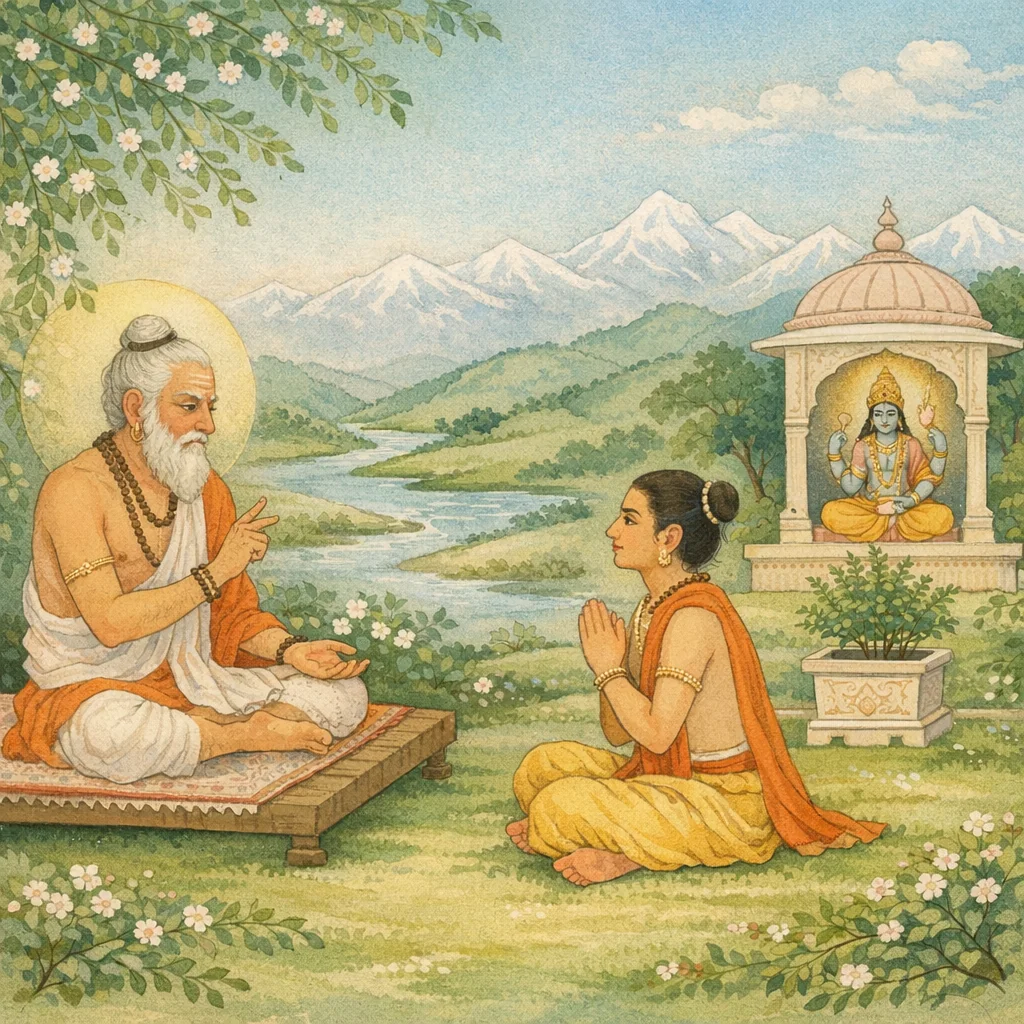
Pulastya teaches Bhīṣma the Saubhāgya-śayana, a sacred vow said to bestow the fruits of all desires. The chapter weaves in its mythic origin: during the cosmic burning, saubhāgya (good fortune) gathers and abides upon Viṣṇu’s chest, then is later released amid motifs of rivalry. Dakṣa drinks it and gains beauty, while the remainder becomes an eightfold set of auspicious substances, the saubhāgyāṣṭaka. From Dakṣa is born Satī/Lalitā, praised as the bestower of both bhoga and mokṣa. When Bhīṣma asks the rite’s procedure, Pulastya prescribes a springtime tṛtīyā observance: ritual bathing, worship of Śiva and Gaurī, offerings, a nyāsa-like sequence of salutations over the body’s parts, and recitation of the Saubhāgya-aṣṭaka. He details month-by-month dietary and ritual variations across a year, concluding with dāna—especially the gift of a bed, golden images, and a cow or bull. Its merit is said to bring marital harmony, prosperity, fame, heavenly attainments, and liberation-oriented results.
Shlokas
Verse 1
एकोनत्रिंशोऽध्यायः । पुलस्त्यौवाच । तथैवान्यत्प्रवक्ष्यामि सर्वकामफलप्रदम् । सौभाग्यशयनंनाम यत्पुराणविदो विदुः
Chapter Twenty-Nine. Pulastya said: “In the same manner, I shall now expound another teaching that grants the fruits of all desires—what the knowers of the Purāṇas call the rite named Saubhāgya-śayana, the ‘Bed of Good Fortune.’”
Verse 2
पुरा दग्धेषु लोकेषु भूर्भुवः स्वर्महादिषु । सौभाग्यं सर्वभूतानामेकस्थमभवत्तदा
Formerly, when the worlds—Bhūḥ, Bhuvaḥ, Svaḥ, Mahā, and the rest—were burned, the good fortune of all beings was then gathered into a single place.
Verse 3
वैकुंठं सर्वमासाद्य विष्णोर्वक्षस्थले स्थितम् । ततः कालेन कियता पुनः सर्गविधौ नृपः
Having reached all of Vaikuṇṭha, it came to abide upon Viṣṇu’s chest. Then, after some time had passed, O king, the procedure of creation began again.
Verse 4
अहंकारवृतेलोके प्रधानपुरुषान्विते । स्पर्द्धायां च प्रवृद्धायां कमलासनकृष्णयोः
When the world was enveloped by ego, and the principles of Pradhāna (primordial matter) and Puruṣa (spirit) were in operation, a rivalry arose and grew between Kamalāsana (Brahmā, seated on the lotus) and Kṛṣṇa (Viṣṇu).
Verse 5
पिंगाकारा समुद्भूता वह्निज्वालातिभीषणा । तयाभितप्तस्य हरेर्वक्षसस्तद्विनिःसृतम्
A tawny-hued form arose, terrifying like the blazing flames of fire; and, scorched by her, that radiance—essence—issued forth from Hari’s chest.
Verse 6
यद्वक्षःस्थलमाश्रित्य विष्णोः सौभाग्यमास्थितम् । रसरूपं न तद्यावदाप्नोति वसुधातले
That auspicious fortune which abides upon Viṣṇu’s chest—taking refuge there—so long as it remains, does not attain a merely earthly form as a common essence upon the surface of the world.
Verse 7
उत्क्षिप्तमंतरिक्षात्तु ब्रह्मपुत्रेण धीमता । दक्षेण पीतमात्रं तद्रूपलावण्यकारकम्
But when it was hurled into the sky by the wise son of Brahmā, Dakṣa merely drank it; and that act became the cause of his beauty and charm.
Verse 8
बलंतेजोमहज्जातं दक्षस्य परमेष्ठिनः । शेषं यदपतद्भूमावष्टधा तद्व्यजायत
From Dakṣa, the exalted lord, there arose immense strength and radiance; and the remainder that fell upon the earth became divided into eight parts and came into being.
Verse 9
ततस्त्वोषधयो जाताः सप्त सौभाग्यदायिकाः । इक्षवस्तरुराजश्च निष्पवावश्शालिधान्यकम्
Then there arose seven plants, bestowers of prosperity: sugarcane, the king of trees, niṣpava (a pulse), and śāli rice-grain.
Verse 10
विकारवच्च गोक्षीरं कुसुंभं कुसुमं तथा । लवणं चाष्टमं तद्वत्सौभाग्याष्टकमुच्यते
Likewise, there are modified cow’s milk, kusuṃbha (safflower), flowers, and salt as the eighth; thus this is called the “eightfold set of auspicious substances” (saubhāgyāṣṭaka).
Verse 11
पीतं यद्ब्रह्मपुत्रेण योगज्ञानविदा पुरा । दुहिता साभवत्तस्माद्या सतीत्यभिधीयते
That which was once drunk by the son of Brahmā, the knower of yoga and sacred wisdom—from him a daughter was born, who is known by the name Satī.
Verse 12
लोकानतीत्य लालित्याल्ललिता तेन चोच्यते । त्रैलोक्यसुंदरीं देवीमुपयेमे पिनाकधृत्
Transcending the worlds by her grace and charm, she is therefore called Lalitā. Pinākadhṛt (Śiva, bearer of the bow Pināka) took as his consort that goddess, the beauty of the three worlds.
Verse 13
त्रिविश्वसौभाग्यमयीं भुक्तिमुक्तिफलप्रदाम् । तामाराध्य पुमान्भक्त्या नारी वा किं न विंदति
She is the very embodiment of good fortune across the three worlds, bestowing the fruits of both worldly enjoyment and liberation. When a man—or even a woman—worships Her with devotion, what is it that they do not attain?
Verse 14
भीष्म उवाच । कथमाराधनं तस्या ललिताया मुने वद । यद्विधानं च जगतः शांतये तद्वदस्व मे
Bhīṣma said: “O sage, tell me—how is that Lalitā to be worshipped? And tell me the prescribed method by which the world attains peace.”
Verse 15
पुलस्त्य उवाच । वसंतमासमासाद्य तृतीयायां जनप्रियः । शुक्लपक्षस्य पूर्वाह्णे तिलैः स्नानं समाचरेत्
Pulastya said: “When the spring month arrives, on the third lunar day—O beloved of the people—during the forenoon of the bright fortnight, one should duly perform a bath using sesame (seeds).”
Verse 16
तस्मिन्नहनि सा देवी किल विश्वात्मना सती । पाणिग्रहणिकैर्मंत्रैरुदूढा वरवर्णिनी
On that very day, so it is said, the goddess Satī was duly wedded by Viśvātmanā through the mantras prescribed for the rite of taking the hand; she, the lady of excellent complexion.
Verse 17
तया सहैव विश्वेशं तृतीयायामथार्चयेत् । फलैर्नानाविधैर्दीपैर्धूपैर्नैवेद्यसंयुतैः
Then, together with her, one should worship Viśveśa on the third day, offering various fruits, lamps of many kinds, incense, and naivedya, the food offering.
Verse 18
प्रतिमां पंचगव्येन तथा गंधोदकेन च । स्नापयित्वार्चयेद्गौरीमिंदुशेखरसंयुताम्
After bathing the image with pañcagavya, the five products of the cow, and with perfumed water, one should worship Goddess Gaurī, united with Induśekhara, the moon-crested Lord Śiva.
Verse 19
नमोस्तु पाटलायै तु पादौ देव्याः शिवस्य च । शिवायेति च संकीर्त्य जयायै गुल्फयोर्द्वयोः
Salutations to Pāṭalā, as the feet of the Goddess and of Śiva. Uttering “Śivā,” one should offer reverence; and to Jayā, as the two ankles.
Verse 20
त्र्यंबकायेति रुद्रस्य भवान्यै जंघयोर्युगम् । शिरो रुद्रेश्वरायेति विजयायै च जानुनी
Uttering “Tryambaka,” one should offer the pair of shanks to Rudra; uttering “Bhavānī,” the pair of thighs; uttering “Rudreśvara,” the head; and uttering “Vijayā,” the pair of knees.
Verse 21
संकीर्त्य हरिकेशाय तथोरुवरदे नमः । ईशायेति कटिं रत्यै शंकरायेति शंकरम्
Having chanted “Harikeśa,” he then bowed, saying, “Obeisance to Uruvarada.” Saying “Īśāya,” he touched the waist for Rati; and saying “Śaṅkarāya,” he touched Śaṅkara.
Verse 22
कुक्षिद्वयं च कोटव्यै शूलिनं शूलपाणये । मंगलायै नमस्तुभ्यमुदरं चाभिभूजयेत्
One should venerate the two sides of the waist as Koṭavī, and the trident-bearer as Śūlin/Śūlapāṇi; and, bowing to Maṅgalā, one should duly worship the belly as well.
Verse 23
सर्वात्मने नमो रुद्रमीशान्यै च कुचद्वयम् । शिवं वेदात्मने तद्वद्रुद्राण्यै कंठमर्चयेत्
One should bow to Rudra as the Self of all, and worship Īśānī at her two breasts; likewise, one should worship Śiva as the very essence of the Vedas, and worship Rudrāṇī at her throat.
Verse 24
त्रिपुरघ्नाय विश्वेशमनंतायै करद्वयम् । त्रिलोचनायेति हरं बाहू कालानलप्रिये
To Tripuraghna, slayer of Tripura—O Viśveśa—she offered both hands to Anantā. Saying, “To the Three-eyed One,” she embraced Hara with her arms, O beloved of the fire of Time.
Verse 25
सौभाग्यभवनायेति भूषणानि सदार्चयेत् । स्वाहास्वधायै च मुखमीश्वरायेति शूलिनम्
One should always worship the ornaments with the mantra “O abode of good fortune.” One should worship the face with “Svāhā, Svadhā,” and worship Śūlin with the mantra “To Īśvara.”
Verse 26
अशोकवनवासिन्यै पूज्यावोष्ठौ च भूतिदौ । स्थाणवे च हरं तद्वदास्यं चंद्रमुखप्रिये
To the goddess dwelling in the Aśoka grove, one should offer the venerable lips that bestow prosperity; to Sthāṇu, and likewise to Hara; and one should offer the mouth as well, O beloved one with a moon-like face.
Verse 27
नमोर्धनारीशहरमसितांगीति नासिकाम् । नम उग्राय लोकेशं ललितेति पुनर्भ्रुवौ
Salutation to Ardhanārīśvara and to Hara; “Asitāṅgī”—thus I salute the nose. Salutation to Ugrā, the Lord of the world; “Lalitā”—thus again I salute the eyebrows.
Verse 28
शर्वाय पुरहर्त्तारं वासुदेव्यै तथालकम् । नमः श्रीकंठनाथाय शिवकेशांस्तथार्चयेत्
One should worship Śarva as the destroyer of the (three) cities, and likewise Vāsudevī with the offering of a lock of hair; and, saying “Obeisance to the Lord of Śrīkaṇṭha,” one should then worship the form known as Śiva-keśa as well.
Verse 29
भीमोग्रभीमरूपिण्यै शिरः सर्वात्मने नमः । हरमभ्यर्च्य विधिवत्सौभाग्याष्टकमग्रतः
With bowed head, obeisance to Her whose form is terribly fierce; obeisance to the All-Self. Having duly worshiped Hara (Śiva) according to rule, one should then recite the Saubhāgya-aṣṭaka in front of him.
Verse 30
स्थापयेत्स्निग्धनिष्पावान्कुसुंभक्षीरजीरकम् । तरुराजेक्षुलवणं कुस्तुंबुरुमथाष्टमम्
One should place (as ingredients) unctuous niṣpāva beans, safflower, milk, and cumin; along with tarurāja, sugarcane, salt, and—eighth—coriander (kustumburu).
Verse 31
दद्यात्सौभाग्यकृद्यस्मात्सौभाग्याष्टकमित्युत । एवंनिवेद्य तत्सर्वमग्रतः शिवयोः पुनः
One should give this offering, for it brings good fortune; therefore it is called the “Saubhāgyāṣṭaka,” the Eightfold rite of auspicious fortune. Having thus presented all of it, one should again place it before Śiva and his consort.
Verse 32
चैत्रे शृंगाटकान्प्राश्य स्वपेद्भूमावरिंदम । पुनः प्रभाते च तथा कृतस्नानजपः शुचिः
In the month of Caitra, having eaten water-chestnuts, he should sleep upon the ground, O subduer of foes. Then again at dawn, being pure, he should perform bathing and the recitation of prayers.
Verse 33
संपूज्य द्विजदांपत्यं माल्यवस्त्रं विभूषणैः । सौभाग्याष्टकसंयुक्त सौवर्णं प्रतिमाद्वयम्
Having duly honored the brāhmaṇa couple with garlands, garments, and ornaments, one should offer a pair of golden images, accompanied by the eight auspicious tokens of good fortune.
Verse 34
प्रीयतां मेत्र ललिता ब्राह्मणाय निवेदयेत् । एवं संवत्सरं यावत्तृतीयायां सदा नृप
“Let the offering called Lalitā be pleasing to me; it should be presented to a brāhmaṇa.” Thus, O king, one should do so always on the third lunar day (tṛtīyā) for as long as a year.
Verse 35
प्राशने दानमंत्रे च विशेषोयं निबोध मे । गोशृंगांबु मधौ प्रोक्तं वैशाखे गोमयं पुनः
Understand from me this special rule regarding the act of eating the consecrated offering and the mantra for giving: in the month of Madhu it is prescribed to use water from a cow’s horn; and again, in Vaiśākha, the use of cow-dung is prescribed.
Verse 36
ज्येष्ठे मंदारकुसुमं बिल्वपत्रं शुचौ स्मृतम् । श्रावणे दधिसंप्राश्यं नभस्ये तु कुशोदकम्
In the month of Jyeṣṭha, mandāra blossoms are prescribed; in Śuci (Āṣāḍha), bilva leaves are enjoined. In Śrāvaṇa one should partake of curd, and in Nabhas (Bhādrapada) one should use water infused with kuśa grass.
Verse 37
क्षीरं चाश्वयुजे मासि कार्त्तिके पृषदाज्यकम् । मार्गशीर्षे तु गोमूत्रं पौषे संप्राशयेद्घृतम्
In the month of Āśvayuja one should take milk; in Kārttika, pṛṣadājyaka; in Mārgaśīrṣa, cow’s urine; and in Pauṣa, one should partake of sacred ghee.
Verse 38
माघे कृष्णतिलांस्तद्वत्पंचगव्यं च फाल्गुने । ललिता विजया भद्रा भवानी कुमुदा शिवा
In the month of Māgha one should offer black sesame; likewise, in Phālguna, pañcagavya. (These are linked with the divine names:) Lalitā, Vijayā, Bhadrā, Bhavānī, Kumudā, and Śivā.
Verse 39
वासुदेवी तथा गौरी मंगला कमला सती । उमा च दानकाले तु प्रीयतामिति कीर्त्तयेत्
At the time of giving (charity), one should recite: “May Vāsudevī, Gaurī, Maṅgalā, Kamalā, Satī, and Umā be pleased.”
Verse 40
तस्मिंस्तु द्वादशे मासि द्वादश्यां कृष्णमर्चयेत् । तथा लक्ष्मीं च तत्रैव भर्त्रा सार्धमथार्चयेत्
Then, in the twelfth month, on the twelfth lunar day (Dvādaśī), one should worship Kṛṣṇa; and in that same place, one should also worship Lakṣmī together with her Lord (Viṣṇu).
Verse 41
पौर्णमास्यामतस्तद्वत्सपत्नीकः पितामहः । उपासनीयो विदुषा परत्रा भीतिमिच्छता
Therefore, on the full-moon day as well, the Pitāmaha (Brahmā), together with his consort, should be worshipped by the learned who seek freedom from fear in the hereafter.
Verse 42
सौभाग्याष्टकं तद्वच्च दातव्यं भूतिमिच्छता । मल्लिकाशोककमलं कदंबोत्पलचंपकम्
Likewise, one who longs for prosperity should offer the Saubhāgyāṣṭaka. One should also present jasmine, aśoka blossoms, lotus, kadamba, utpala (water-lily), and campaka flowers.
Verse 43
कुब्जकं करवीरं च बाणमम्लानपंकजम् । सिंदुवारं च सर्वेषु मासेषु कुसुमं स्मृतम्
Kubjaka, karavīra (oleander), bāṇa, the unfading lotus, and sinduvāra—these are remembered as flowers fit for offering in all months.
Verse 44
जपाकुसुंभकुसुमं मालती शतपत्रिका । यथालाभं प्रशस्तानि करवीरं च सर्वदा
Hibiscus (japā), safflower blossoms (kusumbha), mālatī jasmine, and the hundred-petalled flower are all praiseworthy when offered as one is able; and karavīra (oleander) is always acceptable.
Verse 45
एवं संवत्सरं यावदुपोष्य विधिवन्नरः । स्त्री च नक्तं कुमारी च शिवमभ्यर्च्य भक्तितः
Thus, observing the fast in the prescribed manner for as long as a year, a man—together with his wife—and also a maiden who eats only at night, should worship Śiva with devotion.
Verse 46
व्रतांते शयनं दद्यात्सर्वोपस्करसंयुतम् । उमामहेश्वरौ हैमौ वृषभं च गवा सह
At the conclusion of the vow, one should donate a bed complete with all its accessories; and also golden images of Umā and Maheśvara, together with a bull and a cow.
Verse 47
स्थापयित्वा च शयनं ब्राह्मणाय निवेदयेत् । द्वादश्यां वत्सरं त्वेकं महालक्ष्म्या च केशवम्
Having prepared a bed as a sacred gift, one should offer it to a brāhmaṇa. On the Dvādaśī day, for the span of one year, one should worship Keśava together with Mahālakṣmī.
Verse 48
ब्रह्माणं सह सावित्र्या पूजयित्वा नरस्त्विह । सर्वान्कामानवाप्नोति मनसा समभीप्सितान्
Here, a person who worships Brahmā together with Sāvitrī attains all desires—those longed for in the mind.
Verse 49
अन्यान्यपि यथाशक्ति मिथुनान्यंबरादिभिः । धान्यालङ्कारगोदानैरन्यैश्च धनसञ्चयैः
And, according to one’s capacity, one should also give other gifts—pairs of items, garments and the like, grain, ornaments, gifts of cows, and other forms of accumulated wealth.
Verse 50
वित्तशाठयेन रहितः पूजयेद्गतविस्मयः । एवं करोति यः सम्यक्सौभाग्यशयनव्रतम्
Free from deceit regarding wealth, and with humble steadiness without display, one should perform worship. Whoever thus performs the Saubhāgya-śayana vow properly does so in the right manner.
Verse 51
सर्वान्कामानवाप्नोति पदं वा नित्यमश्नुते । फलस्यैकस्य च त्यागमेतत्कुर्वन्समाचरेत्
By doing this, one attains all desired aims, or else reaches the eternal state. Therefore, while performing it, one should duly practice the relinquishment of a single fruit of the act.
Verse 52
यशः कीर्तिमवाप्नोति प्रतिमासं नराधिप । सौभाग्यारोग्यरूपैश्च वस्त्रालंकारभूषणैः
O king, month by month he attains fame and renown, together with good fortune, health, and beauty, and he also gains garments, ornaments, and adornments.
Verse 53
न वियुक्तो भवेद्राजन्सौभाग्यशयनप्रदः । यस्तु द्वादशवर्षाणि सौभाग्यशयनव्रतम्
O king, one will not be separated from one’s spouse; this rite bestows the blessed conjugal bed. And whoever, for twelve years, undertakes the vow called Saubhāgya-Śayana…
Verse 54
करोति सप्त चाष्टौ वा ब्रह्मलोके महीयते । पूज्यमानो वसेत्सम्यक्यावत्कल्पायुतं नरः
Whether he performs seven or even eight such acts, that man is honored in Brahmā’s world; duly worshipped, he dwells there rightly for ten thousand kalpas.
Verse 55
विष्णोर्लोकमथासाद्य शिवलोकगतस्तथा । नारी वा कुरुते या तु कुमारी वा नरेश्वर
Having attained the world of Viṣṇu, one likewise reaches the world of Śiva. O lord of men, whether a married woman or an unmarried maiden performs this, she attains that result.
Verse 56
सापि तत्फलमाप्नोति देव्यनुग्रहलालिता । शृणुयादपि यश्चैव प्रदद्यादथवा मतिम्
She too attains that very reward, cherished by the Goddess’s grace; and so does anyone who listens to it, or causes it to be given to others, or offers assent and encouragement.
Verse 57
सोपि विद्याधरो भूत्वा स्वर्गलोके चिरं वसेत् । इदमिह मदनेन पूर्वसृष्टं शतधनुषा च कृतं नरेण तद्वत्
He too, becoming a Vidyādhara, would dwell for a long time in the heavenly world. Even so, this arrangement here was formerly fashioned by Madana, and likewise it was made by the man named Śatadhanu.
Verse 58
कृतमथ पवनेन नंदिना च किमु जननाथमहाद्भुतं न वा स्यात्
If such a deed was accomplished by the Wind and by Nandin, then why should something truly wondrous not be possible for the Lord of beings?