Adhyaya 27
The Procedure for the Consecration of a Pond
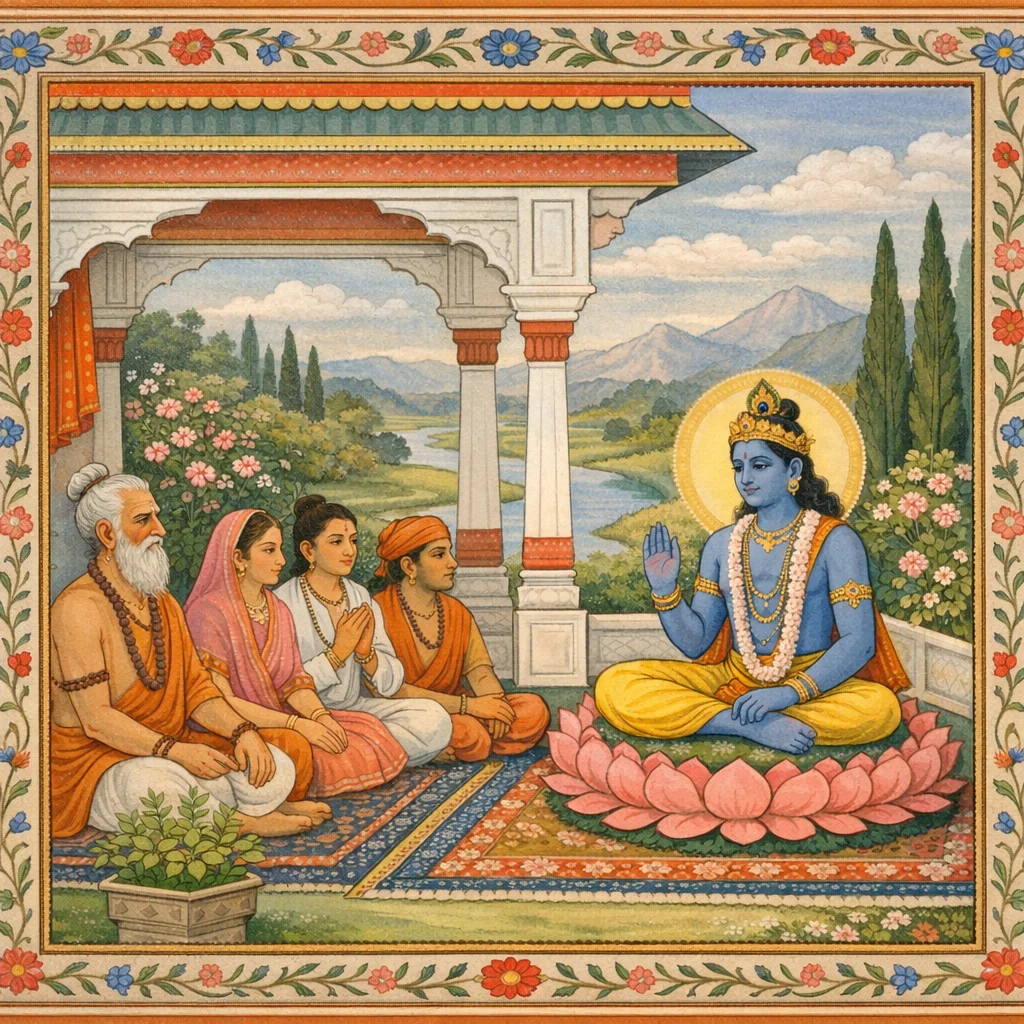
Bhīṣma asks Pulastya for the complete protocol for consecrating ponds and other water-reservoirs—covering the qualifications of priests, the altar’s design, the proper fees (dakṣiṇā), auspicious timing, and the leadership of the rite. Pulastya teaches a Veda-modeled ceremony: choose a favorable time (bright fortnight, Uttarāyaṇa), purify the site, and construct a square vedī and a four-faced maṇḍapa with surrounding pits and wooden standards. Appoint Veda-masters as hotṛs, reciters, and doorkeepers; install the kalaśas and implements, and set up a short yūpa. The sacrificer (yajamāna) undergoes purification and night-long preliminaries; a maṇḍala is drawn, Varuṇa-centered placements are made, deities are installed and adhivāsana performed, followed by a multi-day homa with prescribed sūktas and chants by Ṛg, Yajur, Sāma, and Atharva specialists. The rite concludes with extensive dāna—ornaments, beds, vessels, cows, and meals—and declares that preserving water through all seasons equals great śrauta sacrifices, granting heaven and ultimately attainment of Viṣṇu’s abode.
Shlokas
Verse 1
भीष्म उवाच । तटाकारामकूपेषु वापीषु नलिनीषु च । विधिं वदस्व मे ब्रह्मन्देवतायतनेषु च
Bhīṣma said: O Brahman, tell me the proper procedure concerning ponds and reservoirs, wells, stepwells, and lotus-pools—and also regarding the abodes (temples) of the gods.
Verse 2
के तत्र ऋत्विजो विप्रा वेदी वा कीदृशी भवेत् । दक्षिणाबलयः कालः स्थानमाचार्य एव च
Who, then, are the officiating priests—the learned brāhmaṇas—there? What kind of altar should there be? What are the dakṣiṇā (sacrificial fees) and ritual accessories? What is the proper time and place, and who indeed should be the presiding teacher?
Verse 3
द्रव्याणि कानि शस्तानि सर्वमाचक्ष्व सुव्रत । पुलस्त्य उवाच । शृणु राजन्महाबाहो तटाकादिषु यो विधिः
“Tell me fully, O you of noble vow, what materials are held to be proper.” Pulastya said: “Listen, O king, mighty-armed one, to the procedure prescribed for ponds and the like.”
Verse 4
पुराणेष्वितिहासोयं पठ्यते राजसत्तम । प्राप्य पक्षं शुभं शुक्लं संप्राप्ते चोत्तरायणे
O best of kings, this sacred legend is recited in the Purāṇas when the auspicious bright fortnight has arrived, and when Uttarāyaṇa—the sun’s northward course—has begun.
Verse 5
पुण्येह्नि विप्रैः कथिते कृत्वा ब्राह्मणवाचनम् । अशुभैर्वर्जिते देशे तटाकस्य समीपतः
On an auspicious day, as instructed by the brāhmaṇas, having arranged the recitation by brāhmaṇas, one should perform it in a place free from inauspicious influences, near a pond.
Verse 6
चतुर्हस्तां समां वेदीं चतुरश्रां चतुर्मुखीम् । तथा षोडशहस्तः स्यान्मंडपश्च चतुर्मुखः
One should make the vedī, the altar-platform, four hands in measure—level and square, with four faces; likewise, the maṇḍapa, the pavilion, should be sixteen hands in measure and also four-faced.
Verse 7
वेद्यास्तु परितो गर्तारत्निमात्रास्त्रिमेखलाः । नव सप्ताथ वा पंच ऋजुवक्त्रा नृपात्मज
O prince, around the vedī there should be pits, each a cubit in measure, arranged in three encircling lines; they should be nine, or seven, or else five in number, with straight openings.
Verse 8
वितस्तिमात्रा योनिः स्यात्षट्सप्तांगुलि विस्तृता । गर्ताश्च हस्तमात्राः स्युस्त्रिपर्वोच्छ्रितमेखलाः
The yoni, the womb-shaped base, should be one span in measure and broadened by six or seven finger-breadths. The pits should be one cubit in size, and the surrounding mekhalā ridges should rise to the height of three finger-joints.
Verse 9
सर्वतस्तु सवर्णाः स्युः पताकाध्वजसंयुताः । अश्वत्थोदुंबरप्लक्षवटशाखाकृतानि तु
On every side they should be of one uniform color, furnished with banners and standards; and they should be fashioned from the branches of the aśvattha, udumbara, plakṣa, and vaṭa trees.
Verse 10
मंडपस्य प्रतिदिशं द्वाराण्येतानि कारयेत् । शुभास्तत्राष्टहोतारो द्वारपालास्तथाष्ट वै
In each direction of the pavilion (maṇḍapa), one should construct these doorways. There, eight auspicious hotṛ-invokers and likewise eight door-guardians are to be appointed.
Verse 11
अष्टौ तु जापकाः कार्या ब्राह्मणा वेदपारगाः । सर्वलक्षणसंपूर्णान्मंत्रज्ञान्विजितेंद्रियान्
Eight jāpaka-reciters are to be appointed—Brahmins who have mastered the Vedas—complete in all proper marks, versed in mantras, and with their senses subdued.
Verse 12
कुलशीलसमायुक्तान्स्थापयेद्वै द्विजोत्तमान् । प्रतिगर्तेषु कलशा यज्ञोपकरणानि च
Indeed, one should seat the best of the twice-born (dvija)—those endowed with good lineage and conduct—and in the prepared pits place the kalaśa water-pots and the implements required for the yajña.
Verse 13
व्यजने चासनं शुभ्रं ताम्रपात्रं सुविस्तरम् । ततस्त्वनेकवर्णास्युर्बलयः प्रतिदैवतम्
There should be a fan and a pure white seat, and a broad copper vessel. Then, for each deity, there should be offerings—worship-portions—in many colors.
Verse 14
आचार्यः प्रक्षिपेद्भूमावनुमंत्र्य विचक्षणः । अरत्निमात्रो यूपः स्यात्क्षीरवृक्षविनिर्मितः
Having granted the proper mantric sanction, the wise officiating ācārya should set it into the earth. The yūpa, the sacrificial post, should be only a forearm in height, fashioned from a milky-sapped tree.
Verse 15
यजमानप्रमाणो वा संस्थाप्यो भूतिमिच्छता । हेमालंकारिणः कार्याः पंचविंशति ऋत्विजः
Or else, one who seeks prosperity should establish it in proportion to the yajamāna, the sacrificer; and twenty-five ṛtvij priests should be appointed, adorned with ornaments of gold.
Verse 16
कुंडलानि च हैमानि केयूरकटकानि च । तथांगुलिपवित्राणि वासांसि विविधानि च
Golden earrings, armlets and bangles, as well as finger-rings, and garments of various kinds—these too are prescribed among the gifts.
Verse 17
दद्यात्समानि सर्वेषामाचार्ये द्विगुणं स्मृतम् । दद्याच्छयनसंयुक्तमात्मनश्चापि यत्प्रियम्
One should give equal gifts to all; but for the ācārya it is declared that the gift should be doubled. One should also offer a bed with its proper furnishings, and likewise whatever is most dear to oneself.
Verse 18
सौवर्णौ कूर्ममकरौ राजतौ मत्स्यडुण्डुभौ । ताम्रौ कुंभीरमंडूका वायसः शिंशुमारकः
Two are of gold—shaped as a tortoise and a makara; two are of silver—shaped as a fish and a ḍuṇḍubha. Two are of copper—shaped as a crocodile and a frog; and one, of crow-like hue, shaped as a śiṃśumāra.
Verse 19
एवमासाद्य तत्सर्वमादावेव विशांपते । शुक्लमाल्याम्बरधरः शुक्लंगंधानुलेपनः
Thus, having obtained all this at the very outset, O lord of men, he wore white garlands and white garments, and was anointed with white, fragrant unguents.
Verse 20
सर्वौषध्युदकैः सर्वैः स्नापितो वेदपारगैः । यजमानः सपत्नीकः पुत्रपौत्रसमन्वितः
Bathed with waters infused with every medicinal herb by those learned in the Vedas, the sacrificer—together with his wife—was attended by his sons and grandsons.
Verse 21
पश्चिमद्वारमासाद्य प्रविशेद्यागमंडपम् । ततो मंगलशब्देन भेरीणां निःस्वनेन च
Reaching the western gate, he should enter the sacrificial pavilion; then proceed amid auspicious cries and the resounding sound of kettle-drums.
Verse 22
रजसा मंडलं कुर्यात्पंचवर्णेन तत्त्ववित् । षोडशारं ततश्चक्रं पद्मगर्भं चतुर्मुखम्
A knower of principles should draw a circular diagram with rajas (red pigment), using five colours. Then he should make a sixteen-spoked wheel, and within it a lotus-wombed, four-faced form.
Verse 23
चतुरश्रं तु परितो वृत्तं मध्ये सुशोभनम् । वेद्याश्चोपरितः कृत्वा ग्रहान्लोकपतींस्ततः
Make it square all around, with a beautiful circle in the middle; then, having arranged it upon the altar, establish thereafter the planets and the guardians of the worlds.
Verse 24
संन्यसेन्मंत्रतः सर्वान्प्रतिदिक्षु विचक्षणः । कलशं स्थापयेन्मध्ये वारुणं मंत्रमाश्रितम्
The skilled practitioner should, with mantras, place all offerings in each of the directions; then, in the center, he should set the kalaśa (water-pot), taking refuge in the Varuṇa-mantra.
Verse 25
ब्रह्माणं च शिवं विष्णुं तत्रैव स्थापयेद्बुधः । विनायकं च विन्यस्य कमलामंबिकां तथा
There itself, the wise one should install Brahmā, Śiva, and Viṣṇu; and, having also placed Vināyaka, he should likewise place Kamalā and Ambikā.
Verse 26
शांत्यर्थं सर्वलोकानां भूतग्रामं न्यसेत्ततः । पुष्पभक्ष्यफलैर्युक्तमेवं कृत्वाधिवासनम्
Then, for the sake of peace for all the worlds, one should place the host of beings; and, having thus performed the consecratory adhivāsana rite, it should be furnished with flowers, food-offerings, and fruits.
Verse 27
कुंभांश्च रत्नगर्भांस्तान्वासोभिः परिवेष्टयेत् । पुष्पगंधैरलंकृत्य द्वारपालान्समंततः
And those pots, filled with jewels, should be wrapped with cloth; having adorned the place with fragrant flowers, one should station doorkeepers all around.
Verse 28
यजद्ध्वमिति तान्ब्रूयादाचार्यमभिपूजयेत् । बह्वृचौ पूर्वतः स्थाप्यौ दक्षिणेन यजुर्विदौ
He should tell them, “Perform the yajña (sacrifice),” and he should duly honor the ācārya (teacher). The knowers of the Ṛg-veda (bahvṛcas) should be stationed to the east, and the experts in the Yajur-veda to the south.
Verse 29
सामगौ पश्चिमे स्थाप्यावुत्तरेण अथर्वणौ । उदङ्मुखो दक्षिणतो यजमान उपाविशेत्
Having stationed the two Sāma-chanters in the west and the Atharva priests to the north, the sacrificer should sit on the southern side, facing north.
Verse 30
यजध्वमिति तान्ब्रूयाद्याजकान्पुनरेव तान् । उत्कृष्टमंत्रजाप्येन तिष्ठध्वमिति जापकान्
He should again address the officiating priests, saying, “Perform the sacrifice,” and he should speak to the mantra-chanters, saying, “Continue, with the finest repetition of mantras.”
Verse 31
एवमादिश्य तान्सर्वान्संधुक्ष्याग्निं समंत्रवित् । जुहुयादाहुतीर्मंत्रैराज्यं च समिधस्तथा
Having thus instructed them all, the knower of mantras should kindle the fire, and then offer oblations into it with mantras—offering ghee as well as fuel-sticks likewise.
Verse 32
ऋत्विग्भिश्चैव होतव्यं वारुणैरेव सर्वतः । ग्रहेभ्यो विधिवद्धुत्वा तथेंद्रायेश्वराय च
The oblation should indeed be offered by the officiating priests, using the Varuṇa-related rites and mantras throughout. Having duly made the offerings to the planetary deities, one should also offer to Indra and to Īśvara.
Verse 33
मरुद्भ्यो लोकपालेभ्यो विधिवद्विश्वकर्मणे । शान्तिसूक्तं च रौद्रं च पावमानं च मंगलम्
In due ritual order, one should offer or recite the Śānti-sūkta, the Raudra hymn, the purificatory Pāvamāna, and auspicious benedictions—addressed to the Maruts, the guardians of the worlds, and to Viśvakarman.
Verse 34
जपेच्च पौरुषं सूक्तं पूर्वतो बह्वृचः पृथक् । शाक्रं रौद्रं च सौम्यं च कौश्मांडं जातवेदसम्
He should first recite the Pauruṣa Sūkta, and then, separately, the hymns of the Bahvṛcas (Ṛgvedic reciters): the Śākra, the Raudra, the Saumya, the Kauśmāṇḍa, and the Jātavedasa.
Verse 35
सौरं सूक्तं जपेयुस्ते दक्षिणेन यजुर्विदः । वैराजं पौरुषं सूक्तं सौपर्णं रुद्रसंहितम्
Those who know the Yajurveda of the southern recension should recite the Saura Sūkta; likewise the Vairāja and Pauruṣa hymns, the Sauparṇa hymn, and the Rudra-saṃhitā.
Verse 36
शैशवं पंचनिधनं गायत्रं ज्येष्ठसाम च । वामदेव्यं बृहत्साम रौरवं च रथंतरम्
‘Śaiśava’, ‘Pañcanidhana’, the ‘Gāyatra’, and ‘Jyeṣṭha-sāman’; ‘Vāmadevya’, ‘Bṛhat-sāman’, ‘Raurava’, and also ‘Rathantara’—these are the sacred chants and hymn-forms.
Verse 37
गवां व्रतं विकीर्णं च रक्षोघ्नं च यमं तथा । गायेयुः सामगा राजन्पश्चिमद्वारमाश्रिताः
O King, the Sāma-chanters, stationed at the western gate, would sing the hymns of the cows’ vow, the Vikīrṇa (scattered chant), the Rakṣoghna (demon-slaying chant), and likewise the Yama chant.
Verse 38
आथर्वणाश्चोत्तरतः शांतिकं पौष्टिकं तथा । जपेयुर्मनसा देवमाश्रिता वरुणं प्रभुम्
And the Atharvaveda priests, facing north, should mentally recite the pacificatory and prosperity-bestowing rites, taking refuge in Varuṇa, the Lord.
Verse 39
पूर्वे द्युरभितो रात्रावेवं कृत्वाधिवासनम् । गजाश्वरथवल्मीक संगमाद्व्रजगोकुलात्
Thus, having performed the preliminary consecratory rites through the night until daybreak, they set out from the confluence—passing the places known as Gaja, Aśva, Ratha, and Valmīka—and proceeded onward from Vraja and Gokula.
Verse 40
मृदमादाय कुंभेषु प्रक्षिपेदोषधीस्तथा । रोचनां च ससिद्धार्थां गंधान्गुग्गुलुमेव च
Having taken clay, one should place it into the pots; likewise one should add medicinal herbs, together with rocanā, white mustard-seed, fragrant substances, and guggulu resin as well.
Verse 41
स्नापनं तस्य कर्त्तव्यं पंचगव्यसमन्वितं । पूर्वं कर्तुर्महामंत्रैरेवं कृत्वा विधानतः
One should perform his ritual bathing, accompanied by the pañcagavya. First, having done so with the great mantras of the officiant, one should proceed in this manner according to the prescribed rule.
Verse 42
अतिवाह्य क्षपामेवं विधियुक्तेन कर्मणा । ततः प्रभाते विमले संजाते तु शतं गवां
Having thus passed the night, performing the rite in accordance with the prescribed rules, then—when the pure morning dawned—there appeared a hundred cows.
Verse 43
ब्राह्मणेभ्यः प्रदातव्यमष्टषष्ट्यथवा पुनः । पंचाशद्वाथ षट्त्रिंशत्पंचविंशति वा पुनः
These offerings should be given to the brāhmaṇas—either sixty-eight, or fifty; or else thirty-six, or again twenty-five.
Verse 44
ततश्चावसरप्राप्ते शुद्धे लग्ने सुशोभने । वेदशब्दैः सगंधर्वैर्वाद्यैश्च विविधैः पुनः
Then, when the auspicious moment had arrived—at a pure and splendid ascendant—Vedic recitations rose again, accompanied by Gandharvas and by many kinds of musical instruments.
Verse 45
कनकालंकृतां कृत्वा जले गामवतारयेत् । सामगाय च सा देया ब्राह्मणाय विशांपते
Having adorned the cow with gold, one should lead her down into the water; and that cow should then be gifted to a Brāhmaṇa who sings the Sāmaveda, O lord of the people.
Verse 46
पात्रीमादाय सौवर्णी पंचरत्नसमन्विताम् । ततो निक्षिप्य मकरान्मत्स्यादींश्चैव सर्वशः
Taking a golden vessel adorned with the five gems, he then placed within it crocodiles, fishes, and other aquatic beings of every kind.
Verse 47
धृतां चतुर्भिर्विप्रैश्च वेदवेदांगपारगैः । महानदीजलोपेतां दध्यक्षतविभूषिताम्
Carried by four vipras—masters of the Vedas and the Vedāṅgas—it was supplied with water from a great river and adorned with curd and unbroken grains of rice.
Verse 48
उत्तराभिमुखां न्युब्जां जलमध्ये तु कारयेत् । आथर्वणेन सुस्नातां पुनर्मायां तथैव च
He should make her face north and have her placed, submerged, in the midst of the water. Having had her bathed well with an Atharvaṇa rite, he should then arrange Māyā again in the same manner.
Verse 49
आपोहिष्ठेति मंत्रेण क्षिप्त्वागत्य च मंडपं । पूजयित्वा सदस्यान्वै बलिं दद्यात्समंततः
Having sprinkled (water) with the mantra beginning “āpohiṣṭhā…”, and then entering the maṇḍapa, he should worship the assembled participants and duly offer the ritual bali all around.
Verse 50
पुनर्दिनानि होतव्यं चत्वारि राजसत्तम । चतुर्थीकर्म कर्त्तव्यं देयं तत्रापि शक्तितः
O best of kings, again for four days the oblations should be offered; and on the fourth day the prescribed rite should be performed, and gifts should be given there too, according to one’s capacity.
Verse 51
कृत्वा तु यज्ञपात्राणि यज्ञोपकरणानि च । ऋत्विग्भ्यस्तु समं दद्यान्मंडपं विभजेत्पुनः
Having prepared the vessels for the sacrifice and the other sacrificial implements, one should distribute them equally to the officiating priests (ṛtvik), and then once again apportion the maṇḍapa into proper sections.
Verse 52
हेमपात्रीं च शय्यां च विप्राय च निवेदयेत् । ततः सहस्रं विप्राणामथवाऽष्टशतं तथा
One should present a golden vessel and a bed to a brāhmaṇa; thereafter, (one should make offerings) to a thousand brāhmaṇas—or likewise to eight hundred.
Verse 53
भोजनीयं यथाशक्ति पंचाशद्वाथ विंशतिः । एवमेष पुराणेषु तटाकविधिरुच्यते
One should provide a meal according to one’s capacity—fifty (persons), or else twenty. Thus, in the Purāṇas, this is declared to be the prescribed procedure concerning a pond (taṭāka).
Verse 54
कूपवापीषु सर्वासु तथा पुष्करिणीषु च । एष एव विधिर्दृष्टः प्रतिष्ठासु तथैव च
In all wells and stepwells, and likewise in lotus-ponds, this very same procedure is prescribed; and the same rule applies in consecrations (pratiṣṭhā) as well.
Verse 55
मंत्रतस्तु विशेषः स्यात्प्रासादोद्यानभूमिषु । अयं त्वशक्तावर्धेन विधिर्दृष्टः स्वयंभुवा
But in the case of palaces, gardens, and lands, there is a special distinction according to the mantra. This procedure, with allowance for one who lacks ability, was laid down by Svayambhū (Brahmā) himself.
Verse 56
स्वल्पेष्वेकाग्निवत्कार्यो वित्तशाठ्यविवर्जितैः । प्रावृट्काले स्थितं तोयमग्निष्टोमसमं स्मृतम्
Those who are free from deceit regarding wealth should perform the prescribed rite even with small means, as one would maintain the single sacred fire. Water stored during the rainy season is remembered to be equal in merit to the Agniṣṭoma sacrifice.
Verse 57
शरत्कालस्थितं यत्स्यात्तदुक्तफलदायकम् । वाजपेयातिरात्राभ्यां हेमंते शिशिरे स्थितम्
Whatever is performed in the autumn season yields the stated results; and that which is undertaken in Hemanta and Śiśira, the winter seasons, grants the fruits of the Vājapeya and Atirātra sacrifices.
Verse 58
अश्वमेधसमं प्राहुर्वसंतसमये स्थितम् । ग्रीष्मेपि यत्स्थितं तोयं राजसूयाद्विशिष्यते
They declare that water found in the spring season is equal in merit to the Aśvamedha sacrifice; and the water that remains available even in summer is considered superior even to the Rājasūya.
Verse 59
एतान्महाराज विशेषधर्मान्करोति चोर्व्यामतिशुद्धबुद्धिः । स याति ब्रह्मालयमेव शुद्धः कल्पाननेकान्दिवि मोदते च
O great king, one who on this earth practices these special duties with a most purified mind—himself made pure—indeed goes to Brahmā’s abode and rejoices in heaven for many aeons.
Verse 60
अनेकलोकान्विचरन्स्वरादीन्भुक्त्वा परार्धद्वयमङ्गनाभिः । सहैव विष्णोः परमं पदं यत्प्राप्नोति तद्योगबलेन भूयः
Wandering through many worlds beginning with Svarga, and enjoying their pleasures for two parārdhas with celestial maidens, he again attains Viṣṇu’s supreme abode—through the power of yoga.