Adhyaya 20
The Greatness of the Gaṇḍakī River and the Śālagrāma Stone
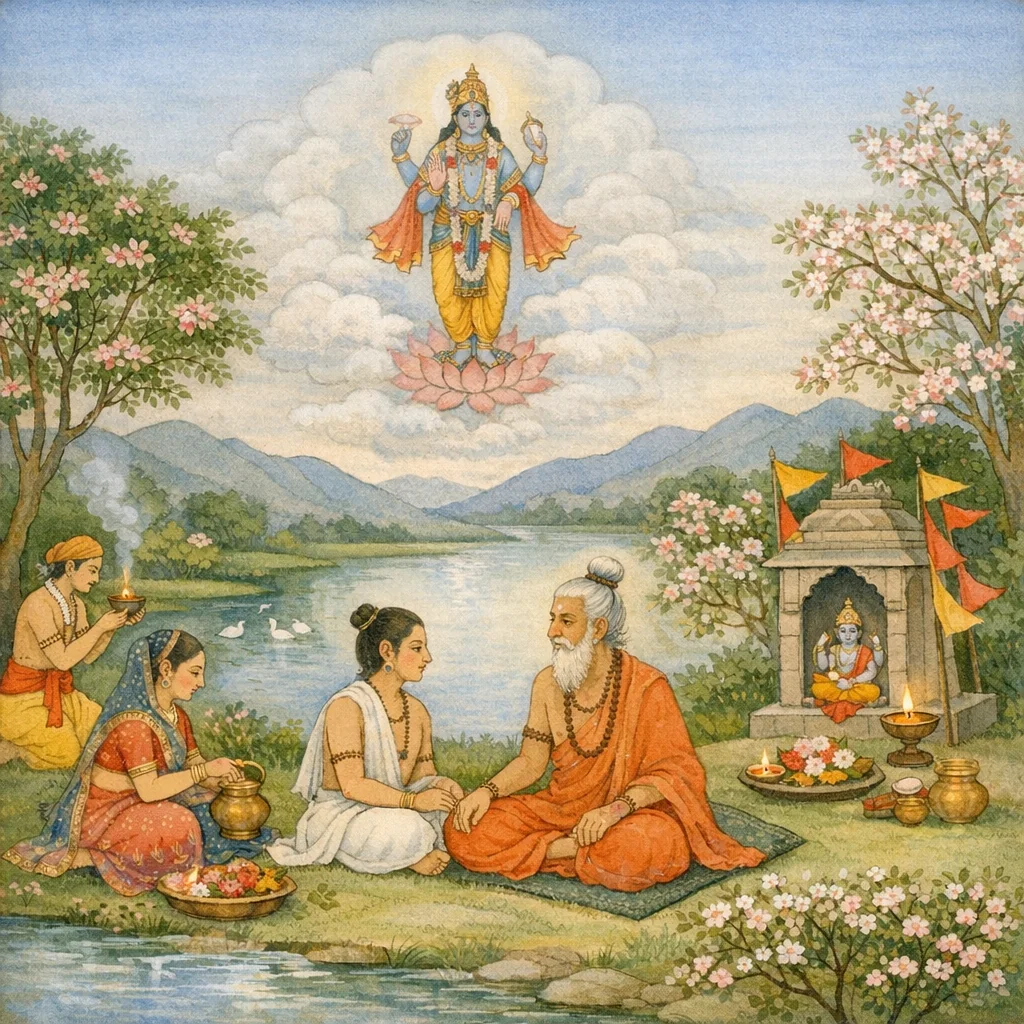
A king travels amid Vaiṣṇava kīrtana, visits many tīrthas, and reaches a sin-destroying river distinguished by stones bearing the imprint of the cakra. Asking an ascetic brāhmaṇa to identify it, he is told it is the Gaṇḍakī, whose sight, touch, and waters burn away the sins of mind, body, and speech. The teaching then unfolds the greatness of Śālagrāma: cakra-marked stones are Bhagavān Himself; their worship grants liberation, and the pādāmṛta—water that has bathed Śālagrāma—purifies instantly. Rules, requisites, and cautions for proper worship are stated. In an exemplum, a grievous sinner seized by Yamadūtas is rescued through tulasī, the name “Rāma,” and contact with Śālagrāma, after which the Viṣṇudūtas proclaim the stone’s immediate saving power.
Shlokas
Verse 1
सुमतिरुवाच । अथ प्रयाते भूपाले सर्वलोकसमन्विते । महाभागैर्वैष्णवैश्च गायकैः कृष्णकीर्तनम्
Sumati said: Then, when the king had departed—accompanied by people of every class—there arose the singing of Kṛṣṇa’s praises by the most fortunate Vaiṣṇavas and their bards.
Verse 2
शुश्रावासौ महाराजो मार्गे गोविंदकीर्तनम् । जय माधव भक्तानां शरण्य पुरुषोत्तम
On the way, that great king heard the chanting of Govinda’s names: “Victory to Mādhava—refuge of devotees—O Puruṣottama!”
Verse 3
मार्गे तीर्थान्यनेकानि कुर्वन्पश्यन्महोदयम् । तापसब्राह्मणात्तेषां महिमानमथा शृणोत्
Along the way he visited many tīrthas, sacred fords, and beheld great auspiciousness; then from an ascetic brāhmaṇa he heard of their greatness and glory.
Verse 4
विचित्रविष्णुवार्ताभिर्विनोदितमना नृपः । मार्गेमार्गे महाविष्णुं गापयामास गायकान्
Delighted in mind by wondrous accounts of Viṣṇu, the king had singers chant the praises of Mahāviṣṇu at every stage of the journey.
Verse 5
दीनांधकृपणानां च पंगूनां वासनोचितम् । दानं ददौ महाराजो बुद्धिमान्विजितेंद्रियः
That great king—wise and self-controlled—gave charity suited to the needs of the poor, the blind, the destitute, and the lame.
Verse 6
अनेकतीर्थविरजमात्मानं भव्यतां गतम् । कुर्वन्ययौ स्वीयलोकैर्हरिध्यानपरायणः
Having purified himself through many tīrthas and attained an auspicious state, he departed with his own celestial attendants, wholly devoted to meditation on Hari.
Verse 7
नृपो गच्छन्ददर्शाग्रे नदीं पापप्रणाशिनीम् । चक्रांकितग्रावयुतां मुनिमानस निर्मलाम्
As the king proceeded onward, he beheld before him a river that destroys sin—adorned with stones marked with the cakra, and pure as the minds of sages.
Verse 8
अनेकमुनिवृंदानां बहुश्रेणिविराजिताम् । सारसादिपतत्रीणां कूजितैरुपशोभिताम्
Adorned by multitudes of sages, resplendent with many rows, and beautified by the calls of birds such as cranes.
Verse 9
दृष्ट्वा पप्रच्छ विप्राग्र्यं तापसं धर्मकोविदम् । अनेकतीर्थमाहात्म्य विशेषज्ञानजृंभितम्
On seeing that foremost of brāhmaṇas—the ascetic, well-versed in dharma and radiant with distinct knowledge of the greatness of many sacred tīrthas—he questioned him.
Verse 10
स्वामिन्केयं नदी पुण्या मुनिवृन्दनिषेविता । करोति मम चित्तस्य प्रमोदभरनिर्भरम्
O master, which sacred river is this—frequented by multitudes of sages—that fills my heart completely with overflowing joy?
Verse 11
इति श्रुत्वा वचस्तस्य राजराजस्य धीमतः । वक्तुं प्रचक्रमे विद्वांस्तीर्थमाहात्म्यमुत्तमम्
Having thus heard the words of that wise king of kings, the learned man began to speak of the supreme greatness of the sacred pilgrimage-place (tīrtha).
Verse 12
ब्राह्मण उवाच । गंडकीयं नदी राजन्सुरासुरनिषेविता । पुण्योदकपरीवाह हतपातकसंचया
The brāhmaṇa said: “O King, the Gaṇḍakī River is frequented by both gods and asuras. Its stream bears sacred waters, and it destroys accumulated heaps of sin.”
Verse 13
दर्शनान्मानसं पापं स्पर्शनात्कर्मजं दहेत् । वाचिकं स्वीय तोयस्य पानतः पापसंचयम्
By merely beholding it, the sin of the mind is burned away; by touching it, the sin born of deeds is consumed; and by drinking its own water, the accumulated heap of sins committed by speech is destroyed.
Verse 14
पुरा दृष्ट्वा प्रजानाथः प्रजाः सर्वा विपावनीः । स्वगंडविप्रुषोनेक पापघ्नीं सृष्टवानिमाम्
In ancient times, the Lord of creatures, seeing all beings in need of purification, created this sacred stream—a destroyer of sins—from the many droplets that fell from His own cheeks.
Verse 15
एनां नदीं ये पुण्योदां स्पृशंति सुतरंगिणीम् । ते गर्भभाजो नैव स्युरपि पापकृतो नराः
Those who touch this river—whose waters bestow merit and are richly filled with waves—will not enter the womb again (be reborn), even if they are men who have committed sins.
Verse 16
अस्यां भवा ये चाश्मानश्चक्रचिह्नैरलंकृताः । ते साक्षाद्भगवंतो हि स्वस्वरूपधराः पराः
And the stones found here, adorned with the marks of the discus (cakra), are indeed directly the Blessed Lord Himself—supreme beings who assume their own proper forms.
Verse 17
शिलां संपूजयेद्यस्तु नित्यं चक्रयुतां नरः । न जातु स जनन्या वै जठरं समुपाविशेत्
A man who daily worships a sacred stone marked with the discus (chakra) will never again enter his mother’s womb.
Verse 18
पूजयेद्यो नरो धीमाञ्छालग्रामशिलां वराम् । तेनाचारवता भाव्यं दंभलोभवियोगिना
The wise person who worships the excellent Śālagrāma stone should live with good discipline and right conduct, free from hypocrisy and greed.
Verse 19
परदार परद्रव्यविमुखेन नरेण हि । पूजनीयः प्रयत्नेन शालग्रामः सचक्रकः
Indeed, a man who turns away from another’s wife and another’s wealth should, with earnest effort, worship the Śālagrāma, marked with the cakra (discus).
Verse 20
इति श्रीपद्मपुराणे पातालखंडे रामाश्वमेधे शेषवात्स्यायनसंवादे । गंडकीमाहात्म्यंनाम विंशोऽध्यायः
Thus, in the Śrī Padma Purāṇa, in the Pātālakhaṇḍa, within the account of Rāma’s Aśvamedha sacrifice, in the dialogue between Śeṣa and Vātsyāyana, ends the twentieth chapter, called “The Greatness of the Gaṇḍakī.”
Verse 21
अपि पापसहस्राणां कर्ता तावन्नरो भवेत् । शालग्रामशिलातोयं पीत्वा पूतो भवेत्क्षणात्
Even if a man has committed thousands of sins, upon drinking the water that has bathed the Śālagrāma stone, he becomes purified in an instant.
Verse 22
ब्राह्मणः क्षत्रियो वैश्यः शूद्रो वेदपथि स्थितः । शालग्रामं पूजयित्वा गृहस्थो मोक्षमाप्नुयात्
A brāhmaṇa, kṣatriya, vaiśya, or śūdra—established on the path of the Veda—by worshipping the Śālagrāma, even as a householder, attains liberation (mokṣa).
Verse 23
न जातु चित्स्त्रिया कार्यं शालग्रामस्य पूजनम् । भर्तृहीनाथ सुभगा स्वर्गलोकहितैषिणी
A woman should never, on her own, perform the worship of the Śālagrāma stone—especially when she is without her husband—even if she is fortunate and intent on the welfare of the heavenly realm.
Verse 24
मोहात्स्पृष्ट्वापि महिला जन्मशीलगुणान्विता । हित्वा पुण्यसमूहं सा सत्वरं नरकं व्रजेत्
Even a woman endowed with good birth, conduct, and virtues—if, out of delusion, she engages in improper contact—casts away her amassed merit and swiftly goes to hell.
Verse 25
स्त्रीपाणिमुक्तपुष्पाणि शालग्रामशिलोपरि । पवेरधिकपातानि वदंति ब्राह्मणोत्तमाः
The foremost of Brahmins declare that flowers which fall from a woman’s hand upon the Śālagrāma stone are regarded as an excessive offence in worship.
Verse 26
चंदनं विषसंकाशं कुसुमं वज्रसंनिभम् । नैवेद्यं कालकूटाभं भवेद्भगवतः कृतम्
Sandal-paste becomes as though poison; flowers become like thunderbolts; and the food-offering becomes like the deadly Kālakūṭa—when it is offered without true devotion to the Lord.
Verse 27
तस्मात्सर्वात्मना त्याज्यं स्त्रिया स्पर्शः शिलोपरि । कुर्वती याति नरकं यावदिंद्राश्चतुर्दश
Therefore a woman should, with all her being, avoid touching upon the stone surface; if she does so, she goes to hell for as long as fourteen Indras endure.
Verse 28
अपि पापसमाचारो ब्रह्महत्यायुतोऽपि वा । शालग्रामशिलातोयं पीत्वा याति परां गतिम्
Even one of sinful conduct—even one burdened with the sin of slaying a brāhmaṇa—by drinking the water that has washed the Śālagrāma sacred stone, attains the supreme state.
Verse 29
तुलसीचंदनं वारि शंखो घंटाथ चक्रकम् । शिला ताम्रस्य पात्रं तु विष्णोर्नामपदामृतम्
Tulasi and sandalwood, water, the conch, the bell, and the discus; the sacred stone and a copper vessel—together with the nectar of Viṣṇu’s Name and the pādāmṛta, the water sanctified by His feet: these are the revered requisites.
Verse 30
पदामृतं तु नवभिः पापराशिप्रदाहकम् । वदंति मुनयः शांताः सर्वशास्त्रार्थकोविदाः
The pādāmṛta, the sacred water, is said to burn up heaps of sins in nine ways—so declare the serene sages, well-versed in the meaning of all śāstras.
Verse 31
सर्वतीर्थपरिस्नानात्सर्वक्रतुसमर्चनात् । पुण्यं भवति यद्राजन्बिंदौ बिंदौ तदद्भुतम्
O King, the merit that arises from bathing at all tīrthas and from duly honoring every sacrifice—astonishingly, that very merit is obtained in each and every drop.
Verse 32
शालग्रामशिला यत्र पूज्यते पुरुषोत्तमैः । तत्र योजनमात्रं तु तीर्थकोटिसमन्वितम्
Where the Śālagrāma sacred stone is worshipped by the foremost devotees of the Supreme Person, even a single yojana around that place is endowed with the merit of crores of holy pilgrimage-sites.
Verse 33
शालग्रामाः समाः पूज्याः समेषु द्वितयं नहि । विषमा एव संपूज्या विषमेषु त्रयं नहि
Śālagrāma stones that are even and symmetrical should be worshipped; among such even ones, worship as a pair is not prescribed. But uneven, asymmetrical ones too are indeed to be worshipped; among such uneven ones, worship as a set of three is not prescribed.
Verse 34
द्वारावती भवं चक्रं तथा वै गंडकीभवम् । उभयोः संगमो यत्र तत्र गंगा समुद्रगा
Dvārāvatī is said to become the sacred Cakra-tīrtha, and likewise the holy place arising from the Gaṇḍakī. Where these two meet—there it is understood that the Gaṅgā flows into the ocean.
Verse 35
रूक्षाः कुर्वंति पुरुषा नायुः श्रीबलवर्जितान् । तस्मात्स्निग्धा मनोहारि रूपिण्यो ददति श्रियम्
Dryness leaves men bereft of vitality, prosperity, and strength; therefore what is unctuous, pleasing to the mind and beautiful in form bestows Śrī—well-being and good fortune.
Verse 36
आयुष्कामो नरो यस्तु धनकामो हि यः पुमान् । पूजयन्सर्वमाप्नोति पारलौकिकमैहिकम्
Whether a man desires long life or desires wealth, by worshipping he attains everything—both otherworldly blessings and this-worldly gains.
Verse 37
प्राणांतकाले पुंसस्तु भवेद्भाग्यवतो नृप । वाचि नाम हरेः पुण्यं शिला हृदि तदंतिके
O king, at the time of death a man is truly fortunate: the sacred name of Hari is upon his tongue, and a holy śilā rests upon his heart, placed close beside him.
Verse 38
गच्छत्सु प्राणमार्गेषु यस्य विश्रंभतोऽपि चेत् । शालग्रामशिला स्फूर्तिस्तस्य मुक्तिर्न संशयः
When the life-breath departs along its pathways, if—even unconsciously—an inner remembrance of the Śālagrāma-śilā arises in someone, that person attains liberation (mokṣa); of this there is no doubt.
Verse 39
पुरा भगवता प्रोक्तमंबरीषाय धीमते । ब्राह्मणा न्यासिनः स्निग्धाः शालग्रामशिलास्तथा
Formerly the Blessed Lord spoke this to the wise Ambarīṣa: that brāhmaṇas, renunciants, and affectionate devotees—and likewise the sacred Śālagrāma stones—are to be revered.
Verse 40
स्वरूपत्रितयं मह्यमेतद्धि क्षितिमंडले । पापिनां पापनिर्हारं कर्तुं धृतमुदं च ता
This threefold manifestation of my own nature is indeed present upon the earth, assumed in order to remove the sins of sinners and to uplift them.
Verse 41
निंदंति पापिनो ये वा शालग्रामशिलां सकृत् । कुंभीपाके पचंत्याशु यावदाभूतसंप्लवम्
Those sinful people who even once revile the Śālagrāma-śilā are quickly cooked in the Kumbhīpāka hell, until the dissolution of all beings—the cosmic deluge.
Verse 42
पूजां समुद्यतं कर्तुं यो वारयति मूढधीः । तस्य मातापिताबंधुवर्गा नरकभागिनः
Whoever, in foolish understanding, prevents a person who has risen to perform worship—his mother, father, and entire circle of relatives become destined for hell.
Verse 43
यो वा कथयति प्रेष्ठं शालग्रामार्चनं कुरु । सकृतार्थो नयत्याशु वैकुंठं स्वस्य पूर्वजान्
And whoever, beloved one, urges another saying, “Perform the worship of Śālagrāma,”—that person, having fulfilled life’s purpose, swiftly leads his own forefathers to Vaikuṇṭha.
Verse 44
अत्रैवोदाहरंतीममितिहासं पुरातनम् । मुनयो वीतरागाश्च कामक्रोधविवर्जिताः
Here itself they cite this ancient legend—sages who were free from attachment, and devoid of desire and anger.
Verse 45
पुरा कीकटसंज्ञे वै देशे धर्मविवर्जिते । आसीत्पुल्कसजातीयो नरः शबरसंज्ञितः
Formerly, in a land known as Kīkaṭa—devoid of dharma—there lived a man of the Pulkaśa tribe, known by the name Śabara.
Verse 46
नित्यं जंतुवधोद्युक्तः शरासनधरो मुहुः । तीर्थं प्रति यियासूनां बलाद्धरति जीवितम्
Ever intent on killing creatures, repeatedly bearing a bow, he forcibly takes the life of those who are setting out toward a sacred pilgrimage-site (tīrtha).
Verse 47
अनेकप्राणिहत्याकृत्परस्वे निरतः सदा । सदा रागादिसंयुक्तः कामक्रोधादिसंयुतः
He has slain many living beings, is ever intent on another’s wealth, and is always entangled in passions—joined to desire, anger, and the like.
Verse 48
विचरत्यनिशं भीमे वने प्राणिवधंकरः । विषसंसक्तबाणाग्र रूढचापगुणोद्धुरः
He roams unceasingly in the dreadful forest, bent on the slaughter of creatures—his arrow-tips smeared with poison, his bowstring drawn tight and taut.
Verse 49
सैकदा पर्यटन्व्याधः प्राणिमात्रभयंकरः । कालं प्राप्तं न जानाति समीपेऽप्युग्रमानसः
Wandering again and again, the hunter—terror to every living creature—does not know that his appointed hour has arrived, though it is near, for his mind is fierce and blinded.