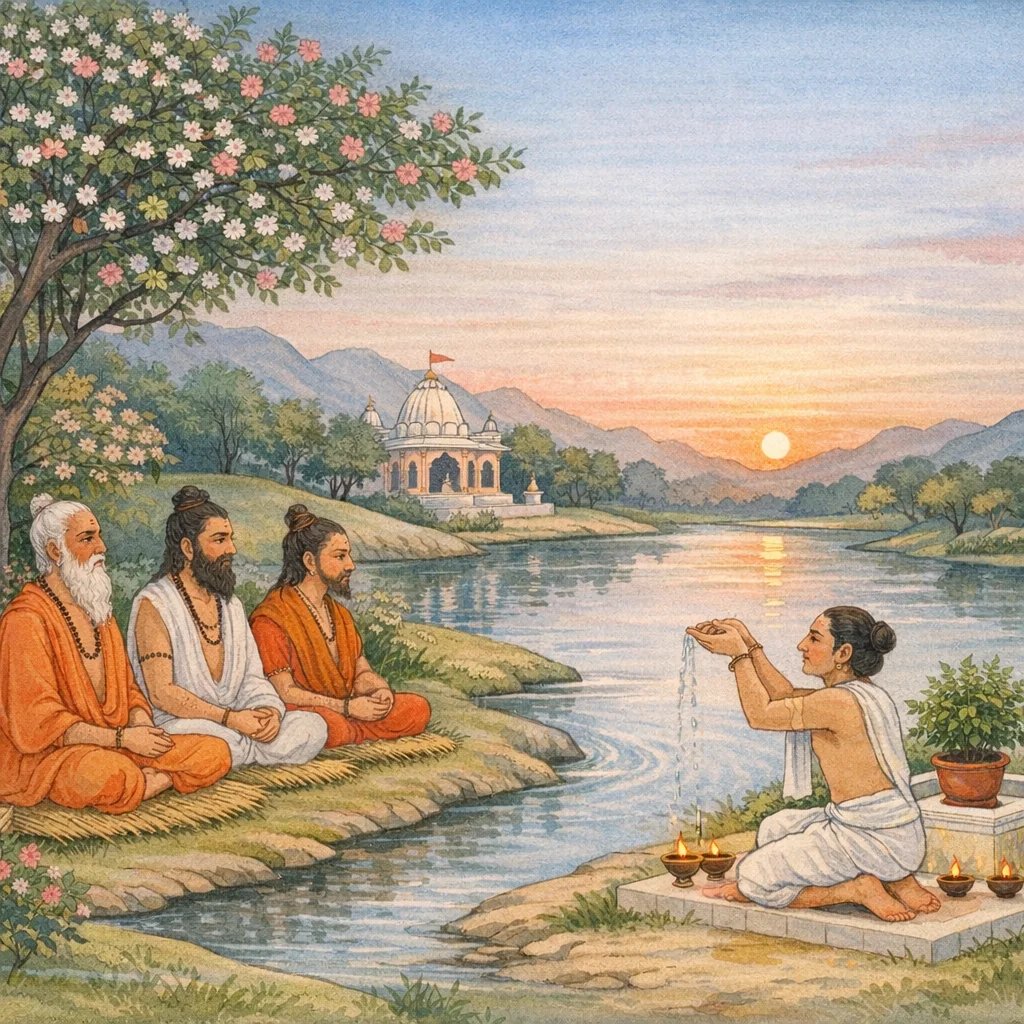
Adhyaya 15
Description of Cyavana’s Austerity and Enjoyment
PP.5.15 recounts Sukanyā’s long, ascetic service to the aged and blinded sage Cyavana, upheld as an exemplar of steadfast strī-dharma and yogic purity. Through patient care and unwavering chastity, her wifely duty becomes a path of spiritual discipline. The Aśvinī-kumāras, divine physicians, arrive and are duly honored, then offer a boon. Sukanyā asks that her husband regain his sight and well-being. A sacrificial thread follows: Cyavana’s consent to grant the Aśvins a share in the yajña legitimizes their claim, and they repay him with transformative aid, unfolding imagery of rejuvenation. An episode of three equally handsome men tests Sukanyā’s discernment and fidelity. The chapter closes with divine prosperity: Cyavana manifests a wish-fulfilling aerial chariot (vimāna) and a jewel-like, luxuriant abode, showing how tapas, dharma, and grace can culminate in both enjoyment (bhoga) and spiritual assurance—fearlessness and freedom from sorrow.
Shlokas
Verse 1
सुमतिरुवाच । अथर्षिः स्वाश्रमं गत्वा मानव्या सह भार्यया । मुदं प्राप हताशेष पातको योगयुक्तया
Sumati said: Then the sage returned to his own hermitage with his wife Mānavī, and he attained joy—his every sin utterly destroyed—through her steadfast practice of yoga.
Verse 2
सा मानवी तं वरमात्मनः पतिं । नेत्रेणहीनं जरसा गतौजसम् । सिषेव एनं हरिमेधसोत्तमं । निजेष्टदात्रीं कुलदेवतां यथा
That mortal woman, Mānavī, attended upon him—her own chosen husband—though he was bereft of sight and his vigor had waned with age; she served that best of the pious as one serves the family deity (kuladevatā) who grants one’s cherished desires.
Verse 3
शूश्रूषती स्वं पतिमिंगितज्ञा । महानुभावं तपसां निधिं प्रियम् । परां मुदं प्राप सती मनोहरा । शची यथा शक्रनिषेवणोद्यता
Attentively serving her own husband, discerning his unspoken wishes, the lovely and virtuous Satī attained supreme joy in her beloved—the great-souled treasure-house of austerities—just as Śacī delights in devoted attendance upon Śakra (Indra).
Verse 4
चरणौ सेवते तन्वी सर्वलक्षणलक्षिता । राजपुत्री सुंदरांगी फलमूलोदकाशना
That slender princess, endowed with every auspicious mark and lovely-limbed, served (his) feet, sustaining herself only on fruits, roots, and water.
Verse 5
नित्यं तद्वाक्यकरणे तत्परा पूजने रता । कालक्षेपं प्रकुरुते सर्वभूतहिते रता
Ever engaged in carrying out his words, wholly devoted and delighting in worship, she spends her time absorbed in the welfare of all beings.
Verse 6
विसृज्य कामं दंभं च द्वेषं लोभमघं मदम् । अप्रमत्तोद्यता नित्यं च्यवनं समतोषयत्
Casting off desire, hypocrisy, hatred, greed, sin, and pride, and remaining ever vigilant and steadfast, they continually pleased Cyavana.
Verse 7
एवं तस्य प्रकुर्वाणा सेवां वाक्कायकर्मभिः । सहस्राब्दं महाराज सा च कामं मनस्यधात्
Thus, rendering him service by speech, by body, and by deeds for a thousand years, O great king, she then conceived a desire in her mind.
Verse 8
कदाचिद्देवभिषजावागतावाश्रमे मुनेः । स्वागतेन सुसंभाव्य तयोः पूजां चकार सा
Once, two divine physicians arrived at the sage’s hermitage. Welcoming them with due honor, she performed worship in their honor.
Verse 9
शर्यातिकन्याकृतपूजनार्घ । पाद्यादिना तोषितचित्तवृत्ती । तावूचतुः स्नेहवशेन सुंदरौ । वरं वृणुष्वेति मनोहरांगीम्
Pleased in heart and mind by the daughter of King Śaryāti—who had worshipped them with offerings and hospitality such as water for the feet—the two handsome ones, moved by affection, said to the lovely-limbed maiden: “Choose a boon.”
Verse 10
तुष्टौ तौ वीक्ष्य भिषजौ देवानां वरयाचने । मतिं चकार नृपतेः पुत्री मतिमतां वरा
Seeing those two physicians pleased at the gods’ request for a boon, the king’s daughter—foremost among the wise—made up her mind.
Verse 11
पत्यभिप्रायमालक्ष्य वाचमूचे नृपात्मजा । दत्तं मे चक्षुषी पत्युर्यदि तुष्टौ युवां सुरौ
Perceiving her husband’s intention, the king’s daughter spoke: “If you two gods are pleased, then grant me the eyes of my husband.”
Verse 12
इत्येतद्वचनं श्रुत्वा सुकन्या या मनोहरम् । सतीत्वं च विलोक्येदमूचतुर्भिषजां वरौ
Hearing these words, the charming Sukanyā—her chaste fidelity clearly seen—then spoke thus to the two foremost physicians.
Verse 13
त्वत्पतिर्यदि देवानां भागं यज्ञे दधात्यसौ । आवयोरधुना कुर्वश्चक्षुषोः स्फुटदर्शनम्
If your husband truly offers the Devas their rightful share in the yajña, then even now grant to us both clear sight through our eyes.
Verse 14
च्यवनोऽप्योमिति प्राह भागदाने वरौजसोः । तदा हृष्टावश्विनौ तमूचतुस्तपतां वरम्
Even Cyavana uttered “Oṁ” as the sacrificial shares were being apportioned for the mighty one. Then, delighted, the Aśvin twins said to him: “Choose a boon, O best of ascetics.”
Verse 15
इति श्रीपद्मपुराणे पातालखंडे शेषवात्स्यायनसंवादे रामाश्वमेधे । च्यवनस्य तपोभोगवर्णनं नाम पंचदशोऽध्यायः
Thus, in the Śrī Padma Purāṇa, in the Pātālakhaṇḍa, in the dialogue of Śeṣa and Vātsyāyana, in the section on Rāma’s Aśvamedha, ends the fifteenth chapter, entitled “The Description of Cyavana’s Austerity and Enjoyment.”
Verse 16
ह्रदं प्रवेशितोऽश्विभ्यां स्वयं चामज्जतां ह्रदे । पुरुषास्त्रय उत्तस्थुरपीच्या वनिताप्रियाः
Led into the lake by the Aśvins, they themselves immersed in the water. Then three men arose, exceedingly handsome and beloved of women.
Verse 17
रुक्मस्रजः कुंडलिनस्तुल्यरूपाः सुवाससः । तान्निरीक्ष्य वरारोहा सुरूपान्सूर्यवर्चसः
They wore golden garlands and earrings, were alike in form, and were clad in fine garments. Seeing those handsome ones—radiant with the splendor of the sun—the fair-hipped lady looked on.
Verse 18
अजानती पतिं साध्वी ह्यश्विनौ शरणं ययौ । दर्शयित्वा पतिं तस्यै पातिव्रत्येन तोषितौ
Not recognizing her husband, the chaste and virtuous woman sought refuge with the Aśvins. Pleased by her wifely fidelity (pativratya), they revealed her husband to her.
Verse 19
ऋषिमामंत्र्य ययतुर्विमानेन त्रिविष्टपम् । यक्ष्यमाणे क्रतौ स्वीयभागकार्याशयायुतौ
Having taken leave of the sage, the two departed in a celestial vimāna for Triviṣṭapa (heaven), intent on securing their rightful shares in the sacrifice about to be performed.
Verse 20
कालेन भूयसा क्षामां कर्शितां व्रतचर्यया । प्रेमगद्गदया वाचा पीडितः कृपयाब्रवीत्
Seeing her grown emaciated over a long time, worn down by the observance of vows, he—his voice choking with love and stirred by compassion—spoke.
Verse 21
तुष्टोऽहमद्य तव भामिनि मानदायाः । शुश्रूषया परमया हृदि चैकभक्त्या । यो देहिनामयमतीव सुहृत्स्वदेहो । नावेक्षितः समुचितः क्षपितुं मदर्थे
O passionate one, O honored lady—today I am pleased with your supreme service and your single-pointed devotion in the heart. This body of yours, so dear and truly a benefactor to embodied beings, should not be neglected; it is not fitting that it be worn away for my sake.
Verse 22
ये मे स्वधर्मनिरतस्य तपः समाधि । विद्यात्मयोगविजिता भगवत्प्रसादाः । तानेव ते मदनुसेवनयाऽविरुद्धान् । दृष्टिं प्रपश्य वितराम्यभयानशोकान्
The divine favors I have attained—through steadfastness in my own dharma, through austerity (tapas) and deep samādhi, and through knowledge and the yoga of the Self, all won by the Lord’s grace—those very boons, not opposed to your devoted service to me, behold with your own eyes. I grant you a vision that makes one fearless and free from sorrow.
Verse 23
अन्ये पुनर्भगवतो भ्रुव उद्विजृंभ । विस्रंसितार्थरचनाः किमुरुक्रमस्य । सिद्धासि भुंक्ष्व विभवान्निजधर्मदोहान् । दिव्यान्नरैर्दुरधिगान्नृपविक्रियाभिः
Others, again, are but an expansion of the Lord’s brow; their arrangements of meaning and speech collapse—what indeed can they accomplish for Urukrama, Viṣṇu of mighty strides? You have attained perfection; therefore enjoy the prosperities that are the yield of your own dharma—divine boons, hard for men to obtain through the fickle dealings of kings.
Verse 24
एवं ब्रुवाणमबलाखिलयोगमाया । विद्याविचक्षणमवेक्ष्य गताधिरासीत् । संप्रश्रयप्रणयविह्वलया गिरेषद् । व्रीडाविलोकविलसद्धसिताननाह
Seeing him—so skilled in knowledge and speaking thus—the woman, the very embodiment of all yogic māyā, became inwardly composed. Then, her voice trembling slightly with reverent affection, she spoke, her face lit by a shy glance and a gentle smile.
Verse 25
सुकन्योवाच । राद्धं बत द्विजवृषैतदमोघयोग । मायाधिपे त्वयि विभो तदवैमि भर्तः । यस्तेऽभ्यधायि समयः सकृदंगसंगो । भूयाद्गरीयसि गुणः प्रसवः सतीनाम्
Sukanyā said: “Truly fulfilled is this boon, O best of Brahmins—this unfailing union! Now I understand, my lord: in you, O Master of māyā, O all-pervading one, it is fitting so. The condition laid down for you—that there be bodily union only once—may it become an even greater virtue: the begetting of offspring for virtuous wives.”
Verse 26
तत्रेति कृत्यमुपशिक्ष्य यथोपदेशं । येनैष कर्शिततमोति रिरंसयात्मा । सिध्येत ते कृतमनोभव धर्षिताया । दीनस्तदीशभवनं सदृशं विचक्ष्व
Having instructed him in what should be done there, exactly as taught, he said: “By this, may this self—tormented by dense darkness—be comforted. May your purpose succeed, O you whose desire has been aroused, in the case of the afflicted one. And you, though wretched, seek a dwelling of the Lord that is fitting.”
Verse 27
सुमतिरुवाच । प्रियायाः प्रियमन्विच्छंश्च्यवनो योगमास्थितः । विमानं कामगं राजंस्तर्ह्येवाविरचीकरत्
Sumati said: Seeking what would please his beloved, Cyavana entered into yogic concentration; and at that very moment, O king, he manifested a vimāna—an aerial chariot that moves according to one’s wish.
Verse 28
सर्वकामदुघं रम्यं सर्वरत्नसमन्वितम् । सर्वार्थोपचयोदर्कं मणिस्तंभैरुपस्कृतम्
Lovely and granting every desired wish, endowed with all gems, increasing and overflowing with every prosperity, it was adorned with pillars of jewels.
Verse 29
दिव्योपस्तरणोपेतं सर्वकालसुखावहम् । पट्टिकाभिः पताकाभिर्विचित्राभिरलंकृतम्
Furnished with a divine covering, bringing comfort at all times, it was adorned with variegated bands and banners.
Verse 30
स्रग्भिर्विचित्रमालाभिर्मंजुसिंजत्षडंघ्रिभिः । दुकूलक्षौमकौशेयैर्नानावस्त्रैर्विराजितम्
It shone splendidly with garlands and variegated wreaths; sweetly humming six-footed beings were there, and it gleamed with many garments—fine dukūla cloth, linen, and silk.
Verse 31
उपर्युपरि विन्यस्तनिलयेषु पृथक्पृथक् । कॢप्तैः कशिपुभिः कांतं पर्यंकव्यजनादिभिः
In the dwellings arranged tier upon tier, separately in each, a lovely lodging was prepared with well-made bedding—cushions, couches, fans, and the like.
Verse 32
तत्रतत्र विनिक्षिप्त नानाशिल्पोपशोभितम् । महामरकतस्थल्या जुष्टं विद्रुमवेदिभिः
Here and there were objects placed about, adorned with many kinds of craftsmanship—furnished with a great emerald-paved floor and enriched with coral altars.
Verse 33
द्वाःसु विद्रुमदेहल्या भातं वज्रकपाटकम् । शिखरेष्विंद्रनीलेषु हेमकुंभैरधिश्रितम्
At the doorway a diamond-like door-panel shone, set within coral masonry; and upon peaks of sapphire-blue Indranīla it was crowned with golden finials, like sacred pots.
Verse 34
चक्षुष्मत्पद्मरागाग्र्यैर्वज्रभित्तिषु निर्मितैः । जुष्टं विचित्रवैतानैर्मुक्ताहारावलंबितैः
It was adorned with radiant, peerless rubies set into diamond-like walls, embellished with wondrous canopies, and hung with garlands of pearls.
Verse 35
हंसपारावतव्रातैस्तत्र तत्र निकूजितम् । कृत्रिमान्मन्यमानैस्तानधिरुह्याधिरुह्य च
Here and there it resounded with the cooing of flocks of swans and pigeons; and people, taking them to be artificial, kept mounting them again and again.
Verse 36
विहारस्थानविश्राम संवेश प्रांगणाजिरैः । यथोपजोषं रचितैर्विस्मापनमिवात्मनः
With pleasure-gardens, resting-places, sleeping-quarters, courtyards and open yards—arranged as one wished—it seemed as though the place was fashioned to delight and astonish oneself.
Verse 37
एवं गृहं प्रपश्यंतीं नातिप्रीतेन चेतसा । सर्वभूताशयाभिज्ञः स्वयं प्रोवाच तां प्रति
Thus, as she looked upon the house with a mind not overly pleased, the One who knows the intentions dwelling in all beings spoke to her of his own accord.
Verse 38
निमज्ज्यास्मिन्ह्रदे भीरु विमानमिदमारुह । सुभ्रूर्भर्तुः समादाय वचः कुवलयेक्षणा
“After immersing yourself in this lake, O timid one, mount this celestial chariot. The lotus-eyed lady, taking up her husband’s words, addressed the fair-browed woman.”
Verse 39
सरजो बिभ्रती वासो वेणीभूतांश्च मूर्द्धजान् । अंगं च मलपंकेन संछन्नं शबलस्तनम्
Wearing dust-stained garments, her hair gathered into braids, and her body smeared and covered with grimy mud—her breasts mottled in appearance—she appeared soiled and disheveled.
Verse 40
आविवेश सरस्तत्र मुदा शिवजलाशयम् । सांतःसरसि वेश्मस्थाः शतानि दशकन्यकाः
Joyfully, he entered the lake there—Śiva’s sacred reservoir. Within that inner lotus-lake were houses, and in them dwelt hundreds of maidens of about ten years of age.
Verse 41
सर्वाः किशोरवयसो ददर्शोत्पलगंधयः । तां दृष्ट्वा शीघ्रमुत्थाय प्रोचुः प्रांजलयः स्त्रियः
All the young women, fragrant like lotuses, saw her; and on seeing her, they quickly rose and, with hands joined in reverence, addressed her.
Verse 42
वयं कर्मकरीस्तुभ्यं शाधि नः करवाम किम् । स्नानेन ता महार्हेण स्नापयित्वा मनस्विनीम्
“We are your maidservants—command us. What shall we do? Having bathed that noble, resolute lady with a most precious bathing-rite and fragrant waters…”
Verse 43
दुकूले निर्मले नूत्ने ददुरस्यै च मानद । भूषणानि परार्घ्यानि वरीयांसि द्युमंति च
O bestower of honor, they gave her two new, spotless garments, and also splendid ornaments—most excellent and exceedingly precious.
Verse 44
अन्नं सर्वगुणोपेतं पानं चैवामृतासवम् । अथादर्शे स्वमात्मानं स्रग्विणं विरजोंबरम्
He then obtained food endowed with every excellent quality, and also a drink like nectarean liquor. Then, in a mirror, he saw his own self—garlanded and clad in spotless garments.
Verse 45
ताभिः कृतस्वस्त्ययनं कन्याभिर्बहुमानितम् । हारेण च महार्हेण रुचकेन च भूषितम्
Honoured greatly by those maidens, with auspicious rites performed for him, he was adorned with a most precious necklace and with a radiant ornament.
Verse 46
निष्कग्रीवं वलयिनं क्वणत्कांचननूपुरम् । श्रोण्योरध्यस्तया कांच्या कांचन्या बहुरत्नया
With a golden neck-ornament, adorned with bracelets, and wearing tinkling golden anklets—her hips were encircled by a golden girdle set with many gems.
Verse 47
सुभ्रुवा सुदता शुक्लस्निग्धापांगेन चक्षुषा । पद्मकोशस्पृधा नीलैरलकैश्च लसन्मुखम्
She was fair-browed and lovely-toothed; with eyes whose white, lustrous corners glanced softly. Her radiant face was framed by dark-blue curls, rivaling the beauty of a lotus-bud.
Verse 48
यदा सस्मार दयितमृषीणां वल्लभं पतिम् । तत्र चास्ते सहस्त्रीभिर्यत्रास्ते स मुनीश्वरः
When she remembered her beloved husband—dear to the ṛṣis and cherished as lord—she found herself there, in the very place where that sage-lord was staying, accompanied by a thousand women.
Verse 49
भर्तुः पुरस्तादात्मानं स्त्रीसहस्रवृतं तदा । निशाम्य तद्योगगतिं संशयं प्रत्यपद्यत
Then, seeing her husband before her—his very self surrounded by a thousand women—and observing that extraordinary yogic state of his, she fell into doubt.
Verse 50
सतां कृत मलस्नानां विभ्राजंतीमपूर्ववत् । आत्मनो बिभ्रतीं रूपं संवीतरुचिरस्तनीम्
She shone forth as never before, bathed in the purifying wash prepared by the virtuous; and she bore her own form, her beautiful breasts modestly covered.
Verse 51
विद्याधरी सहस्रेण सेव्यमानां सुवाससम् । जातभावो विमानं तदारोहयदमित्रहन्
Attended by a thousand Vidyādharī maidens and clad in splendid garments, the slayer of foes—his resolve now awakened—made her ascend that celestial chariot (vimāna).
Verse 52
तस्मिन्नलुप्तमहिमा प्रिययानुषक्तो । विद्याधरीभिरुपचीर्णवपुर्विमाने । बभ्राज उत्कचकुमुद्गणवानपीच्य । स्ताराभिरावृत इवोडुपतिर्नभःस्थः
There, his glory undiminished and devoted to his beloved, he shone in the aerial vimāna, his form adorned by Vidyādharī maidens—like the lord of the stars, the moon in the sky, surrounded by fully blossomed white kumuda lotuses and by the stars.
Verse 53
तेनाष्टलोकपविहारकुलाचलेंद्र । द्रोणीष्वनंगसखमारुतसौभगासु । सिद्धैर्नुतोद्युधुनिपातशिवस्वनासु । रेमे चिरं धनदवल्ललनावरूथी
With him, the lordly mountain—renowned as the pleasure-ground of the eight worlds—long reveled in its valleys, made sweet by breezes, companions of Kāma; in places echoing with the auspicious sound of cascading streams, praised by the Siddhas, amid the splendid retinue of Kubera’s beloveds.
Verse 54
वैश्रंभके सुरवने नंदने पुष्पभद्रके । मानसे चैत्ररथ्ये च सरे मे रामया रतः
In Vaiśrambhaka, in the divine forest, in Nandana, in Puṣpabhadraka, in Mānasarovara, and in Caitraratha as well—at all these lakes I delight in the company of my Rāmā.