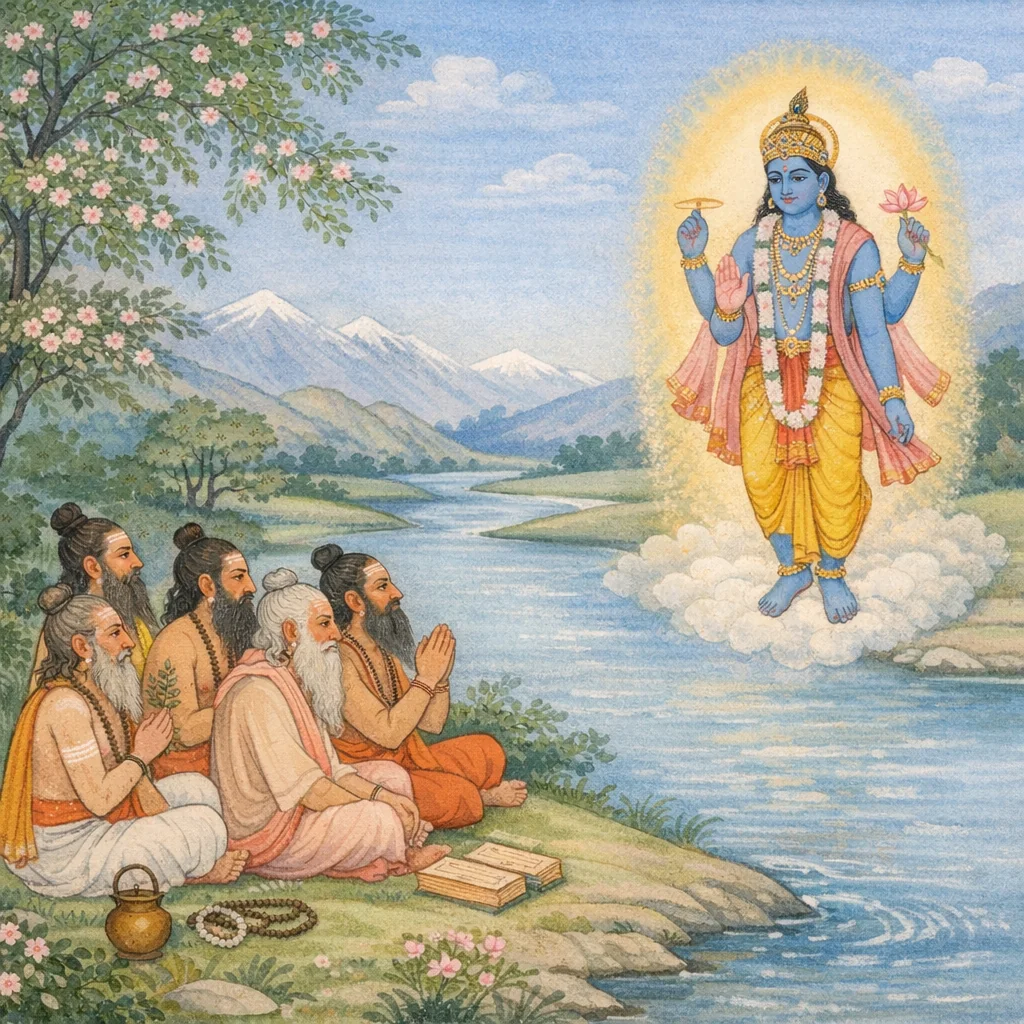
Adhyaya 1
Bharata’s Austerity at Nandigrāma and Rāma’s Sight of Nandigrāma
Chapter PP.5.1 begins with invocatory salutations and sets a layered frame: the sages ask Sūta for the sacred life-story of Śrī Rāma. Sūta recalls how Vātsyāyana questioned Śeṣa about the remaining Purāṇic accounts, especially Rāma’s Aśvamedha narrative. Śeṣa praises the devotee’s inquiry and proclaims the sin-destroying power of hearing and remembering the Rāma-kathā. The narration then turns to the time after Rāvaṇa’s fall: Rāma installs Vibhīṣaṇa in Laṅkā, boards the Puṣpaka with Sītā, and journeys home, pointing out tīrthas and āśramas. Near Ayodhyā he beholds Nandigrāma, where Bharata lives in severe austerity, consumed by separation and repeatedly reciting Rāma’s story; and Rāma laments the hardships Sītā endured in exile.
Shlokas
Verse 1
इति श्रीपद्मपुराणे पातालखंडे शेषवात्स्यायनसंवादे रामाश्वमेधे रघुनाथस्य । भरतावासनंदिग्रामदर्शनोनाम प्रथमोऽध्यायः
Thus, in the Śrī Padma Purāṇa, in the Pātāla-khaṇḍa, in the dialogue between Śeṣa and Vātsyāyana—concerning Raghunātha’s Rāma-Aśvamedha—ends the First Chapter, called “Bharata’s dwelling and the sight of Nandigrāma.”
Verse 2
ऋषय ऊचुः । श्रुतं सर्वं महाभाग स्वर्गखंडं मनोहरम् । त्वत्तोऽधुना वदायुष्मञ्छ्रीरामचरितं हि नः
The sages said: “O greatly fortunate one, we have heard in full the delightful Svarga-khaṇḍa. Now, O venerable sage, please tell us the sacred life-story of Śrī Rāma.”
Verse 3
सूत उवाच । अथैकदा धराधारं पृष्टवान्भुजगेश्वरम् । वात्स्यायनो मुनिवरः कथामेतां सुनिर्मलाम्
Sūta said: Once, the excellent sage Vātsyāyana questioned the Lord of Serpents—who upholds the earth—about this exceedingly pure sacred narrative.
Verse 4
श्रीवात्स्यायन उवाच । शेषाशेष कथास्त्वत्तो जगत्सर्गलयादिकाः । भूगोलश्च खगोलश्च ज्योतिश्चक्रविनिर्णयः
Śrī Vātsyāyana said: From you I wish to hear the remaining and as-yet-untold accounts—such as the creation and dissolution of the world—together with the determination of the terrestrial sphere, the celestial sphere, and the system of the cycles of the luminaries.
Verse 5
महत्तत्त्वादिसृष्टीनां पृथक्तत्त्वविनिर्णयः । नानाराजचरित्राणि कथितानि त्वयानघ
You, O sinless one, have explained the creation beginning with Mahat, the distinct determination of the various tattvas (principles), and the many histories of kings.
Verse 6
सूर्यवंशभवानां च राज्ञां चारित्रमद्भुतम् । तत्रानेकमहापापहरा रामकृता कथा
Wondrous indeed is the life-story of the kings born in the Solar dynasty; within it is the narrative of Rāma, which removes many great sins.
Verse 7
तस्य वीरस्य रामस्य हयमेधकथा श्रुता । संक्षेपतो मया त्वत्तस्तामिच्छामि सविस्तराम्
I have heard, in brief, the account of the Aśvamedha (horse-sacrifice) of that heroic Rāma; from you I now wish to hear the same in full detail.
Verse 8
या श्रुता संस्मृता चोक्ता महापातकहारिणी । चिंतितार्थप्रदात्री च भक्तचित्तप्रतोषदा
That sacred narrative—when heard, remembered, or recited—destroys even the gravest sins; it grants the desired aims and brings deep satisfaction to the hearts of devotees.
Verse 9
शेष उवाच । धन्योसि द्विजवर्य त्वं यस्य ते मतिरीदृशी । रघुवीरपदद्वंद्व मकरंद स्पृहावती
Śeṣa said: “Blessed are you, best of the twice-born, for your mind is of such a kind—yearning for the nectar-like pollen of the twin lotus-feet of the heroic Rāghava.”
Verse 10
वदंति मुनयः सर्वे साधूनां संगमं वरम् । यस्मात्पापक्षयकरी रघुनाथकथा भवेत्
All the sages declare that association with the holy is the highest boon, for from it arises the story of Raghunātha, which brings about the destruction of sins.
Verse 11
त्वया मेऽनुग्रहः सृष्टो यद्रामः स्मारितः पुनः । सुरासुरकिरीटौघ मणिनीराजितांघ्रिकः
By you, grace has been bestowed upon me, since Rāma has been remembered again—He whose feet are made resplendent by the jeweled radiance of the amassed crowns of gods and demons.
Verse 12
रावणारिकथा वार्द्धौ मशको मादृशः कियान् । यत्र ब्रह्मादयो देवा मोहिता न विदंत्यपि
In the great ocean of the tale of Rāvaṇa’s foe, what weight could a gnat like me possibly have—where even the gods, beginning with Brahmā, are bewildered and do not fully comprehend it?
Verse 13
तथापि भो मया तुभ्यं वक्तव्यं स्वीयशक्तितः । पक्षिणः स्वगतिं श्रित्वा खे गच्छंति सुविस्तरे
Even so, O dear one, I must tell you what I can, according to my own capacity. Birds, relying on their natural mode of movement, travel widely through the sky.
Verse 14
चरितं रघुनाथस्य शतकोटिप्रविस्तरम् । येषां वै यादृशी बुद्धिस्ते वदंत्येव तादृशम्
The account of Raghunātha’s deeds spreads in vastness to a hundred crores; people speak of it only in a way that accords with the understanding they themselves possess.
Verse 15
रघुनाथसतीकीर्तिर्मद्बुद्धिं निर्मलीमसाम् । करिष्यति स्वसंपर्कात्कनकं त्वनलो यथा
Raghunātha’s pure and holy fame will cleanse my impure mind by its own touch, just as fire turns ore into gold.
Verse 16
सूत उवाच । इत्युक्त्वा तं मुनिवरं ध्यानस्तिमितलोचनः । ज्ञानेनालोकयांचक्रे कथां लोकोत्तरां शुभाम्
Sūta said: Having thus addressed that best of sages, with eyes stilled in meditation, he began to behold—through spiritual knowledge—the auspicious, transcendental narrative.
Verse 17
गद्गदस्वरसंयुक्तो महाहर्षांकितांगकः । कथयामास विशदां कथां दाशरथेः पुनः
With a voice choked with emotion and his body marked by great joy, he once again narrated clearly the story of Daśaratha’s son, Rāma.
Verse 18
शेष उवाच । लंकेश्वरे विनिहते देवदानवदुःखदे । अप्सरोगणवक्त्राब्जचंद्रमः कांतिहर्तरि
Śeṣa said: When the lord of Laṅkā was slain—he who brought suffering to devas and dānavas—his splendor vanished, that radiance which seemed to steal the moonlight from the lotus-like faces of the hosts of apsarases.
Verse 19
सुराः सर्वे सुखं प्रापुरिंद्र प्रभृतयस्तदा । सुखं प्राप्ताः स्तुतिं चक्रुर्दासवत्प्रणतिं गताः
Then all the gods—beginning with Indra—attained happiness. Having gained that joy, they offered praise and bowed down in reverence like devoted servants.
Verse 20
लंकायां च प्रतिष्ठाप्य धर्मयुक्तं बिभीषणम् । सीतयासहितो रामः पुष्पकं समुपाश्रितः
And having installed Vibhīṣaṇa in Laṅkā—one devoted to dharma—Rāma, accompanied by Sītā, boarded the Puṣpaka aerial chariot.
Verse 21
सुग्रीवहनुमत्सीतालक्ष्मणैः संयुतस्तदा । बिभीषणोऽपि सचिवैरन्वगाद्विरहोत्सुकः
Then, accompanied by Sugrīva, Hanumān, Sītā, and Lakṣmaṇa, Vibhīṣaṇa too—along with his ministers—followed after them, restless and eager, pained by separation.
Verse 22
लंकां स पश्यन्बहुधा भग्नप्राकारतोरणाम् । दृष्ट्वाऽशोकवनं तत्र सीतास्थानं मुमूर्च्छ ह
As he looked upon Laṅkā—its ramparts and gateways shattered in many places—when he saw there the Aśoka grove, Sītā’s abode, he fainted.
Verse 23
शिंशपांस्तत्र वृक्षांश्च पुष्पितान्कोरकैर्युतान् । राक्षसीभिः समाकीर्णान्मृताभिर्हनुमद्भयात्
There, the śiṃśapā and other trees, blossoming and filled with buds, were strewn all around with rākṣasī women—lying dead out of fear of Hanumān.
Verse 24
इत्थं सर्वं विलोक्याशु रामः प्रायात्पुरीं प्रति । ब्रह्मादिदेवैः सहितः स्वीयस्वीयविमानकैः
Thus, having swiftly beheld all this, Rāma set out toward the city, accompanied by Brahmā and the other gods, each in their own celestial vimāna.
Verse 25
देवदुंदुभिनिर्घोषाञ्छृण्वञ्छ्रोत्रसुखावहान् । तथैवाप्सरसां नृत्यैः पूज्यमानो रघूत्तमः
Raghūttama (Rāma), hearing the thunderous, ear-delighting sounds of the gods’ kettledrums, was likewise honored by the dances of the apsarās.
Verse 26
सीतायै दर्शयन्मार्गे तीर्थान्याश्रमवंति च । मुनींश्च मुनिपुत्रांश्च मुनिपत्नीः पतिव्रताः
Along the way, he showed Sītā the sacred tīrthas and āśramas, as well as the munis, the munis’ sons, and the sages’ devoted wives (pativratās), steadfast in their vows.
Verse 27
यत्रयत्र कृतावासाः पूर्वं रामेण धीमता । तान्सर्वान्दर्शयामास लक्ष्मणेन समन्वितः
Wherever the wise Rāma had formerly dwelt, all those places he showed again, accompanied by Lakṣmaṇa.
Verse 28
इत्येवं दर्शयंस्तस्यै रामोऽद्राक्षीत्स्वकां पुरीम् । तस्याः पुनः समीपे तु नंदिग्रामं ददर्श ह
Thus, while showing her in this manner, Rāma beheld his own city; and again, near it, he also saw Nandigrāma.
Verse 29
यत्र वै भरतो राजा पालयन्धर्ममास्थितः । भ्रातुर्वियोगजनितं दुःखचिह्नं वहन्बहु
There indeed King Bharata ruled, firmly established in dharma, bearing many marks of sorrow born of separation from his brother.
Verse 30
गर्तशायी ब्रह्मचारी जटावल्कलसंयुतः । कृशांगयष्टिर्दुःखार्तः कुर्वन्रामकथां मुहुः
Dwelling in a pit, living as a brahmacārin, with matted locks and bark garments—thin-limbed like a staff, afflicted by sorrow—he again and again recounted the sacred tale of Rāma.
Verse 31
यवान्नमपि नो भुंक्ते जलं पिबति नो मुहुः । उद्यंतं सवितारं यो नमस्कृत्य ब्रवीति च
He eats not even barley-food, nor does he drink water again and again; bowing to the rising Sun, he then recites his prescribed prayer.
Verse 32
जगन्नेत्रसुरस्वामिन्हर मे दुष्कृतं महत् । मदर्थे रामचंद्रोऽपि जगत्पूज्यो वनं ययौ
O Hara, Lord of the devas, eye of the universe—destroy my great sin. For my sake even Rāmacandra, worshipped by all the world, went to the forest.
Verse 33
सीतया सुकुमारांग्या सेव्यमानोऽटवीं गतः । या सीता पुष्पपर्यंके वृंतमासाद्य दुःखिता
Attended by tender-limbed Sītā, he went into the forest. That very Sītā, upon reaching a couch of flowers, became distressed.
Verse 34
या सीता रविसंतापं कदापि प्राप नो सती । मदर्थे जानकी सा च प्रत्यरण्यं भ्रमत्यहो
That virtuous Sītā, who never once endured the scorching heat of the sun—she, Jānakī, now wanders back into the forest for my sake. Alas!
Verse 35
या सीता राजवृंदैश्च न दृष्टा नयनैः कदा । सा सीता दृश्यते नूनं किरातैः कालरूपिभिः
That Sītā whom even multitudes of kings have never beheld with their eyes—surely that very Sītā is now being seen by Kirātas who bear the form of Time (Death).
Verse 36
या सीता मधुरं त्वन्नं भोजिता न बुभुक्षति । सा सीताद्य वनस्थानि फलानि प्रार्थयत्यहो
That Sītā who, even when served sweet and delicious food, would not feel hunger—today that very Sītā longs for fruits found in the forest. Alas!
Verse 37
इत्येवमन्वहं सूर्यमुपस्थाय वदत्यदः । प्रातःप्रातर्महाराजो भरतो रामवल्लभः
Thus, day after day, having duly worshipped the Sun, the great king Bharata—beloved of Rāma—would say this every morning.
Verse 38
यश्चोच्यमानः सचिवैः समदुःखसुखैर्बुधैः । नीतिज्ञैः शास्त्रनिपुणैरिति प्रोवाच तान्नृपः
And when he was being addressed by his ministers—wise men, equal-minded in sorrow and joy, skilled in polity and well-versed in the scriptures—the king spoke to them as follows.
Verse 39
अमात्या दुर्भगं मां किं प्रब्रूत पुरुषाधमम् । मदर्थे मेऽग्रजो रामो वनं प्राप्यावसीदति
O ministers, why do you speak to me—unfortunate and the lowest of men? For my sake, my elder brother Rāma has gone to the forest and now languishes there.
Verse 40
दुर्भगस्य मम प्रस्वाः पापमार्जनमादरात् । करोमि रामचंद्रांघ्रिं स्मारं स्मारं सुमंत्रिणः
Though I am unfortunate, I earnestly undertake the cleansing of my sins, again and again remembering the feet of Rāmacandra, as the good counselor remembers them.
Verse 41
धन्या सुमित्रा सुतरां वीरसूः स्वपतिप्रिया । यस्यास्तनूजो रामस्य चरणौ सेवतेऽन्वहम्
Blessed is Sumitrā—most blessed—hero-bearing and devoted to her husband, for her own son serves the feet of Rāma day after day.
Verse 42
यत्र ग्रामे स्थितो नूनं भरतो भ्रातृवत्सलः । विलापं प्रकरोत्युच्चैस्तं ग्रामं स ददर्श ह
He then indeed saw that village where Bharata—ever devoted to his brother—was staying and loudly lamenting.