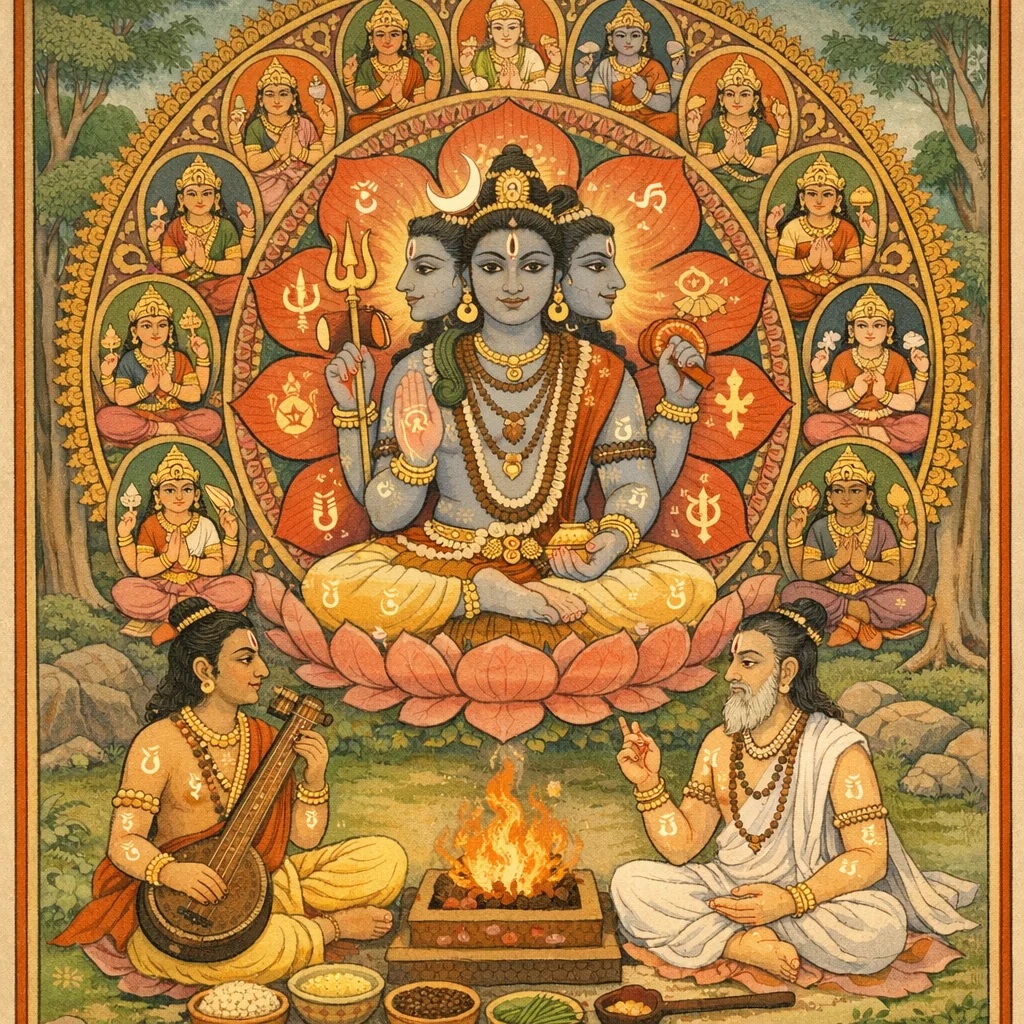
The Exposition of the Maheśa Mantra (Mahēśa-mantra-prakāśana)
Sanatkumāra teaches Nārada a complete Śaiva mantra-sādhana that grants both worldly enjoyment and liberation. The chapter classifies five-, six-, and eight-syllabled mantras, assigns ṛṣi–chandas–devatā, and lays out layered nyāsa: ṣaḍaṅga-nyāsa, finger-nyāsa aligned to the five faces (Īśāna, Tatpuruṣa, Aghora, Vāmadeva, Sadyojāta), jātis/kalā placements (including thirty-eight kalās), and protective golaka/vyāpaka deployments. It gives the dhyāna of Maheśvara—five-faced, three-eyed, moon-crested, weapon-bearing—then specifies japa–homa ratios and offerings (pāyasa, sesame, aragvadha, karavīra, sugar-candy, dūrvā, mustard, apāmārga). It also details āvaraṇa pūjā with Śaktis, Mātṛkās, Lokapālas, astras, and attendant deities (Gaṇeśa, Nandin, Mahākāla, Caṇḍeśvara, Skanda, Durgā). Specialized rites for Mṛtyuñjaya, Dakṣiṇāmūrti (vāk-siddhi/exegesis), Nīlakaṇṭha (poison-removal), Ardhanārīśvara, Aghorāstra (bhūta-vetāla suppression), Kṣetrapāla and Baṭuka (bali/protection), and Caṇḍeśvara are taught, culminating in a Śiva-stotra proclaiming his cosmic immanence and saving power.
Shlokas
Verse 1
सनत्कुमार उवाच । अथ वक्ष्ये महेशस्य मन्त्रं सर्वार्थसाधकम् । यं समाराध्य मनुजो भुक्तिं मुक्तिं च विंदति ॥ १ ॥
Sanatkumāra said: Now I shall teach the mantra of Maheśa, the accomplisher of all aims; by worshipping it with full devotion, a human being attains both worldly enjoyment and liberation.
Verse 2
हृदयं सबकः सूक्ष्मो लांतोऽनन्तान्वितो मरुत् । पंचाक्षरो मनुः प्रोक्तस्ताराद्योऽयं षडक्षरः ॥ २ ॥
“The heart(-mantra)” is (the one called) Sabaka—subtle in nature; the Marut (mantra) is joined with “Ananta” and ends with the syllable “lāṃ”. The “manu” is declared to be of five syllables; and this (other mantra), beginning with the “tārā” (i.e., “oṃ”), is of six syllables.
Verse 3
वामदेवी मुनीश्छन्दः पंक्तिरीशोऽस्य देवता । षड्भिर्वर्णैः षडङ्गानि कुर्यान्मंत्रेण देशिकः ॥ ३ ॥
For this mantra, Vāmadevī is the ṛṣi (seer), Munīś is the metre, and Paṅkti is its presiding deity. Using the mantra’s six syllables/letters, the initiated teacher should perform the placing of the six limbs (ṣaḍaṅga-nyāsa).
Verse 4
मंत्रवर्णादिकान्न्यस्येन्मंत्रमूर्तिर्यथाक्रमम् । तर्जनीमध्ययोरंत्यानामिकांगुष्ठके पुनः ॥ ४ ॥
One should perform nyāsa, placing the mantra’s syllables and the rest in due order, so that the mantra-form is established. Again, the placements are to be done on the index and middle fingers, and on the ring finger and the thumb.
Verse 5
ताः स्युस्तत्पुरुषाघोरभववामेशसंज्ञिकाः । वक्त्रहृत्पादगुह्येषु निजमूर्द्धनि ताः पुनः ॥ ५ ॥
These (mantric powers/placements) are called Tatpuruṣa, Aghora, Bhava, and Vāmeśa; by nyāsa they are to be placed in the mouth, the heart, the feet, and the secret region—and again upon one’s own head.
Verse 6
प्राग्याम्यवारुणोदीच्यमध्यवक्त्रेषु पंचसु । मन्त्रांगानिन्यसेत्पश्चाज्जातियुक्तानि षट् क्रमात् ॥ ६ ॥
Then, upon the five faces—east, south, west, north, and the central face—one should place the limbs of the mantra; thereafter, in due order, one should assign the six parts together with their respective jātis (classifications/phonetic types).
Verse 7
कुर्वीत गोलकन्यासं रक्षायै तदनन्तरम् । हृदि वक्त्रेंऽसयोरूर्वोः कंठे नाभौ द्विपार्श्वयोः ॥ ७ ॥
Then, for protection, one should perform the placement called “golaka-nyāsa,” assigning it thereafter to the heart, the face, the shoulders, the thighs, the throat, the navel, and both sides of the body.
Verse 8
पृष्ठे हृदि तथा मूर्ध्नि वदने नेत्रयोर्नसोः । दोःपत्संधिषु साग्रेषु विन्यसेत्तदनन्तरम् ॥ ८ ॥
Then, immediately thereafter, one should place (perform nyāsa) upon the back, the heart, and the crown of the head; upon the face, the eyes, and the nose; and also upon the joints of the arms and legs, together with their extremities.
Verse 9
शिरोवदनहृत्कुक्षिसोरुपादद्वये पुनः । हृदि वक्त्रांबुजे टंकमृगा भयवरेष्वथ ॥ ९ ॥
Again, in the pair of (divine) feet, in the thighs, in the belly, in the heart, in the face, and in the head—then, in the heart and in the lotus of the mouth—one should contemplate the prescribed emblems: the aṅkuśa (goad), the deer, the gesture of fearlessness (abhaya), and the boon-giving hand (varada).
Verse 10
वक्त्रांसहृत्सपादोरुजठरेषु क्रमान्न्यसेत् । मूलमन्त्रस्य षड वर्णान्यथावद्देशिकोत्तमः ॥ १० ॥
The excellent teacher should, in proper sequence, place (perform nyāsa of) the six syllables of the root-mantra upon the mouth, the shoulders, the heart, together with the feet, the thighs, and the belly, exactly as prescribed.
Verse 11
मूर्ध्नि भालोदरांसेषु हृदये ताः पुनर्न्यसेत् । पश्चादनेन मन्त्रेण कुर्वीत व्यापकं सुधीः ॥ ११ ॥
He should again place those (mantric powers) upon the crown of the head, the forehead, the belly, the shoulders, and the heart. Thereafter, using this mantra, the wise practitioner should perform the all-pervading (vyāpaka) nyāsa.
Verse 12
नमोस्त्वनंतरूपाय ज्योतिर्लिंगामृतात्मने । चतुर्मूर्तिवपुश्छायाभासितांगाय शंभवे ॥ १२ ॥
Salutations to You, O Śambhu of endless forms—whose very essence is the nectar-like Jyotirliṅga—and whose limbs shine forth, illumined by the radiance and shadow-play of the body constituted of the fourfold manifestation.
Verse 13
एवं न्यस्तशरीरोऽसौ चिन्तयेत्पार्वतीपतिम् । ध्यायेन्नित्यं महेशानं रौप्यपर्वतसन्निभम् ॥ १३ ॥
Thus, with the body established through nyāsa, one should contemplate the Lord of Pārvatī; one should ever meditate on Maheśāna, who shines like a mountain of silver.
Verse 14
चारुचंद्रावतंसं च रत्नाकल्पोज्ज्वलांगकम् । परश्वधवराभीतिमृगहस्तं शुभाननम् ॥ १४ ॥
He wore a lovely crescent moon as an ornament upon his head; his limbs shone with jeweled adornments. In his hands he bore an axe (paraśu), the boon-bestowing gesture (varada), the sign of fearlessness (abhaya), and a deer—his face serene and auspicious.
Verse 15
पद्मासीनं समंतात्तु स्तुतं सुमनसां गणैः । व्याघ्रकृत्तिं वसानं च विश्वाद्यं विश्वरूपकम् ॥ १५ ॥
Seated upon a lotus, praised on all sides by hosts of the pure-minded, clad in a tiger-skin—He is the beginning of the universe and the One whose form is the universe itself.
Verse 16
त्रिनेत्रं पंचवक्त्रं च सर्वभीतिहरं शिवम् । तत्त्वलक्षं जपेन्मंत्रं दीक्षितः शैववर्त्मना ॥ १६ ॥
Initiated on the Śaiva path, one should chant in japa the mantra that signifies the tattvas, meditating on Śiva as the three-eyed, five-faced Lord who removes all fear.
Verse 17
तावत्संख्यसहस्राणि जुहुयात्पायसैः शुभैः । ततः सिद्धो भवेन्मन्त्रः साधकाऽभीष्टसिद्धिदः ॥ १७ ॥
One should offer into the fire that very number, in thousands, as oblations of auspicious pāyasa (rice-milk). Thereafter the mantra becomes perfected, granting the practitioner the desired attainments.
Verse 18
देवं संपूजयेत्पीठे वामादिनवशक्तिके । वामा ज्येष्ठा तथा रौद्री काली कलपदादिका ॥ १८ ॥
On the sacred pīṭha endowed with the nine Śaktis beginning with Vāmā, one should worship the Deity in full. These Śaktis are Vāmā, Jyeṣṭhā, Raudrī, Kālī, Kalapadā, and the others.
Verse 19
विकारिण्याह्वया प्रोक्ता बलाद्या विकरिण्यथ । बलप्रमथनी पश्चात्सर्वभूतदमन्यथ ॥ १९ ॥
She is declared by the name Vikāriṇī, the Transforming Power. Next is Balā (Strength), then Vikāriṇī; thereafter Balapramathanī (the Subduer of Strength), and then Sarvabhūtadamanī (the Tamer of all beings).
Verse 20
मनोन्मनीति संप्रोक्ताः शैवपीठस्य शक्तयः । नमो भगवते पश्चात्सकलादि वदेत्ततः ॥ २० ॥
These are proclaimed as the Śaktis of the Śaiva pīṭha, beginning with (the state/power called) Manonmanī. Thereafter one should utter the mantra “namo bhagavate”, and then recite the series beginning with “Sakala” and so on.
Verse 21
गुणात्मशक्तिभक्ताय ततोऽनंताय तत्परम् । योगपीठात्मने भूयो नमस्तारादिको मनुः ॥ २१ ॥
Then homage is offered to the devotee of the Śakti whose essence is the guṇas; thereafter to the Infinite; and to That Supreme Reality. Again, the Tārā-mantra and the rest bow in reverence to Him whose very nature is the Yogic Seat (Yogapīṭha).
Verse 22
अमुना मनुना दद्यादासनं गिरिजापतेः । मूर्तिं मूलेन संकल्प्य तत्रावाह्य यजेच्छिवम् ॥ २२ ॥
With this very mantra one should offer an āsana, a seat, to Girijā’s Lord (Śiva). Visualizing the Deity’s form through the root-mantra, one should invoke Him there and then worship Śiva.
Verse 23
कर्णिकायां यजेन्मूर्तिरीशमीशानदिग्गजम् । शुद्धस्फटिकसंकाशं दिक्षु तत्पुरुषादिका ॥ २३ ॥
In the lotus’s pericarp (karnikā), one should worship the Deity-form as Īśa, the Lord, together with the directional elephant of Īśāna (the northeast). He is to be contemplated as shining like pure crystal; and in the other directions are to be placed Tatpuruṣa and the rest of the Lord’s forms.
Verse 24
पीतांजनश्वेतरक्ताः प्रधानसदृशायुधाः । चतुर्वक्त्रसमायुक्ता यथावत्ताः प्रपूजयेत् ॥ २४ ॥
One should duly worship them as adorned with yellow (garments/unguents), white and red hues, bearing weapons resembling those of the principal Deity, and furnished with four faces.
Verse 25
कोणेष्वर्चेन्निवृत्त्याद्यास्तेजोरूपाः कलाः क्रमात् । अङ्गानि केसरस्थानि विघ्नेशान्पन्नगान्यजेत् ॥ २५ ॥
In the corners of the diagram/altar, one should worship in due order the radiant divine powers beginning with Nivṛtti. One should also worship the limbs placed at the petal-sites, and offer reverence to Vighneśa, Remover of obstacles, and to the serpent-deities (Nāgas).
Verse 26
अनंतं सुखनामानं शिवोत्तममनंतरम् । एकनेत्रमेकरुद्रं त्रिमूर्तिं तदनंतरम् ॥ २६ ॥
He is Ananta, the Infinite—his very name is bliss; the Supreme Auspicious Lord, without end. He is the One-Eyed, the One Rudra, the Lord of three forms; and his praise goes on, measureless.
Verse 27
पश्चाच्छीकंठनामानं शिखंडिनमिति क्रमात् । रक्तपीतसितारक्तकृष्णरक्तांजनासितान् ॥ २७ ॥
Next, in due sequence, they are spoken of as “bearing the name Śīkaṇṭha” and as “Śikhaṇḍin”; and they are further distinguished by colors—red, yellow, white, red, black, red, collyrium-dark, and black.
Verse 28
किरीटार्पितबालेंदून्पद्मस्थान्भूषणान्वितान् । त्रिनेत्राञ्छूलवज्रास्त्रचापहस्तान्मनोरमान् ॥ २८ ॥
Charming deities were beheld—bearing the young crescent moon set upon their crowns, seated upon lotuses, adorned with ornaments, three-eyed, and holding in their hands the trident, the vajra-weapon, and the bow.
Verse 29
उत्तरादि यजेत्पश्चाद्रुद्रं चंडेश्वरं पुनः । ततो नंदिमहाकालौ गणेशं वृषभं पुनः ॥ २९ ॥
After worshipping the deities beginning with the northern direction and proceeding onward, one should then worship Rudra and again Caṇḍeśvara. Thereafter one should worship Nandin and Mahākāla, then Gaṇeśa, and once more the Bull, Vṛṣabha (Nandin).
Verse 30
अथ भृंगिं रिटिं स्कंदमेतान्पद्मासनस्थितान् । स्वर्णतोयारुणश्याममुक्तेंदुसितपाटलान् ॥ ३० ॥
Then one should contemplate (or depict) Bhṛṅgī, Riṭi, and Skanda—these deities seated upon lotus-thrones—bearing hues like golden water, dawn-red, dark-blue, and also pearl, moon-white, and pale-rose.
Verse 31
इंद्रादयस्ततः पूज्या वज्राद्यायुधसंयुताः । इत्थं संपूजयेद्देवं सहस्रं नित्यशो जपेत् ॥ ३१ ॥
Thereafter, Indra and the other deities—bearing weapons such as the vajra (thunderbolt)—should be worshipped. Having thus duly worshipped the Lord, one should daily repeat (the mantra) a thousand times.
Verse 32
सर्वपापविनिर्मुक्तः प्राप्नुयाद्वांछितं श्रियम् । द्विसहस्रं जपन् रोगान्मुच्यते नात्र संशयः ॥ ३२ ॥
Freed from all sins, one attains the prosperity one desires. By performing two thousand repetitions (of the mantra), one is released from diseases—of this there is no doubt.
Verse 33
त्रिसन्मंत्रं जपन्मंत्रं दीर्घमायुरवाप्नुयात् । सहस्रवृद्धया प्रजपन्सर्वकामानवाप्नुयात् ॥ ३३ ॥
By repeating the mantra three times, one attains long life. By performing japa with a thousandfold increase, one attains all desired aims.
Verse 34
आज्यान्वितैस्तिलैः शुद्धैर्जुहुयाल्लक्षमादरात् । उत्पातजनितान् क्लेशान्नाशयेन्नात्र संशयः ॥ ३४ ॥
With pure sesame seeds mixed with ghee, one should carefully offer a hundred thousand oblations in the homa; thereby the sufferings produced by ominous portents are destroyed—of this there is no doubt.
Verse 35
शतलक्षं जपन्साक्षाच्छिवो भवति मानवः । षडक्षरः शक्तिरुद्धः कथितोऽष्टाक्षरो मनुः ॥ ३५ ॥
By repeating it a hundred thousand times, a human being becomes directly like Śiva. The six-syllabled one is declared to be Śakti, sealed and restrained within; the eight-syllabled one is taught as the manu—the mantra itself.
Verse 36
ऋषिश्छन्दः पुरा प्रोक्तो देवता स्यादुमापतिः । अंगानि पूर्वमुक्तानि सौम्यमीशं विचिंतयेत् ॥ ३६ ॥
The seer (ṛṣi) and the metrical pattern (chandas) have already been stated earlier; the presiding deity here is Umāpati (Śiva). Having performed the limbs (aṅgas) as previously taught, one should contemplate the gentle, auspicious Lord.
Verse 37
बंधूकाभं त्रिनेत्रं च शशिखंडधरं विभुम् । स्मेरास्यं स्वकरैः शूलं कंपालं वरदाभये ॥ ३७ ॥
I meditate upon that all-pervading Lord—radiant like the bandhūka flower, three-eyed, bearing the crescent moon as His crest—smiling in countenance, and holding in His own hands the trident, the skull-bowl (kapāla), and the gestures of boon-giving and fearlessness.
Verse 38
वहंतं चारुभूपाढ्यं वामोरुस्थाद्रिकन्यया । भुजेनाश्लिष्टदेहं तं चिंतयेन्मनसा हृदि ॥ ३८ ॥
One should contemplate within the heart that beautiful Lord, richly adorned with royal splendor, bearing His beloved—while the mountain-born maiden (Pārvatī), seated upon His left thigh, embraces His body with her arm.
Verse 39
मनुलक्षं जपेन्मंत्रं तत्सहस्रं यथाविधि । जुहुयान्मान्मधुससिक्तैरारग्वधसमिद्वरैः ॥ ३९ ॥
One should repeat the mantra one hundred thousand times; thereafter, in the prescribed manner, one should perform a thousand oblations in the fire (homa), offering excellent āragvadha twigs that have been sprinkled with honey.
Verse 40
प्राक्प्रोक्ते पूजयेत्पीठे गंधपुष्पैरुमापतिम् । अंगावृतैर्बहिः पूज्या हृल्लेखाद्या यथापुरा ॥ ४० ॥
On the pīṭha described earlier, one should worship Umāpati (Śiva) with fragrances and flowers. Outside the main seat, the deities beginning with Hṛllekhā and the rest—encompassed by their respective coverings of the limbs—are to be worshipped, just as previously taught.
Verse 41
मध्यप्राग्दक्षिणोदीच्यपश्चिमेषु विधानतः । यजेत्पूर्वादिपत्रेषु वृषभाद्याननुक्रमात् ॥ ४१ ॥
According to the prescribed procedure, one should worship in the central, eastern, southern, northern, and western sections; and upon the petals, beginning with the eastern petal, one should worship in sequence starting from Vṛṣabha (Taurus) and the remaining zodiacal signs.
Verse 42
शूलटंकाक्षवलयकमंडलुलसत्करम् । रक्ताकारं त्रिनयनं चंडेशमथ पूजयेत् ॥ ४२ ॥
Then one should worship Caṇḍeśa, whose hands shine as they bear a trident, a battle-axe, a rosary, a bracelet, and a kamaṇḍalu (water-pot); red in form and three-eyed.
Verse 43
चक्रशंखाभयाभीष्टकरां मरकतप्रभाम् । दुर्गां प्रपूजयेत्सौम्यां त्रिनेत्रां चारुभूषणाम् ॥ ४३ ॥
One should duly worship the gentle Goddess Durgā, radiant like an emerald. In her hands she bears the discus and conch, granting fearlessness and the boons one desires; she is three-eyed and adorned with lovely ornaments.
Verse 44
कल्पशाखांतरे घंटां दधानं द्वादशेक्षणम् । बालार्काभं शिशुं कांतंषण्मुखं पूजयेत्ततः ॥ ४४ ॥
Then, in the intermediate branch of the ritual arrangement (kalpa), one should worship the charming, childlike deity—radiant like the rising sun—who bears a bell, has twelve eyes, and six faces.
Verse 45
नंदितं च यजेत्सौम्यां । रत्नभूषणमंडितम् परश्वधवराभीतिटंकिनं श्यामविग्रहम् ॥ ४५ ॥
One should also worship the gentle (Saumyā) form called Nandita—adorned with jeweled ornaments—bearing an axe, bestowing boons, showing the gesture of fearlessness, holding a small bell, and possessing a dark-hued (śyāma) body.
Verse 46
पाशांकुशवराभीष्टधारिणं कुंकुमप्रभम् । विघ्ननायकमभ्यर्चेच्चंद्रार्द्धकृतशेखरम् ॥ ४६ ॥
One should worship the Lord who holds the noose and the goad, who grants boons and cherished fulfillments—radiant like vermilion—Gaṇeśa, the leader over obstacles, whose crest is adorned with the half-moon.
Verse 47
श्यामं रक्तोत्पलकरं वामांकन्यस्ततत्करम् । द्विनेत्रं रक्तवस्त्राढ्यं सेनापतिमथार्चयेत् ॥ ४७ ॥
Then one should worship the Commander (Senāpati), visualizing him as dark-hued, holding a red lotus; with his left hand placed upon his left thigh; two-eyed, and richly adorned in red garments.
Verse 48
ततोऽष्टमातरः पूज्या ब्राह्याद्याः प्रोक्तलक्षणाः । इंद्रादिकान्लोकपालान्स्वस्वदिक्षु समर्चयेत् ॥ ४८ ॥
Then the Eight Mother-goddesses—beginning with Brāhmī, whose characteristics have been described—should be worshipped. One should also duly worship Indra and the other guardians of the worlds (Lokapālas), each in their respective directions.
Verse 49
वज्रादीनि तदस्त्राणि तद्बहिः क्रमतोऽर्चयेत् । एवं यो भजते मन्त्री देवं शंभुमुमापतिम् ॥ ४९ ॥
One should then worship, in proper sequence, the divine weapons beginning with the Vajra, placing them outside that (inner enclosure). Thus does the mantra-knowing practitioner worship the Lord Śambhu, the consort of Umā.
Verse 50
स भवेत्सर्वलोकानां सौभाग्यश्रेयसां पदम् । सांतसद्यांतसंयुक्तो बिन्दुभूषितमस्तकः ॥ ५० ॥
He becomes, for all worlds, the very abode of good fortune and true prosperity—endowed with the proper initial and terminal sounds, and with the head adorned by the sacred bindu/tilaka mark.
Verse 51
प्रासादाख्यो मनुः प्रोक्तो भजतां सर्वसिद्धिदः । षड्दीर्घयुक्तबीजेन षडंगविधिरीरितः ॥ ५१ ॥
The mantra called “Prāsāda” has been proclaimed; for devotees who worship in bhakti it bestows every siddhi. With its seed-syllable joined to the six long vowels, the sixfold ancillary rite (ṣaḍaṅga-vidhi) is taught.
Verse 52
षडर्णवत्तु मुन्याद्याः प्रोक्ताश्चास्यापि नारद । ईशानाद्या न्यसेन्मूर्तीरंगुष्ठादिषु देशिकः ॥ ५२ ॥
O Nārada, the sages and the rest are taught here as in the six-syllabled practice as well. Likewise, the teacher (deśika) should perform nyāsa, placing the divine forms beginning with Īśāna upon the thumb and the other fingers.
Verse 53
ईशानाख्यं तत्पुरुषमघोरं तदनंतरम् । वामदेवाह्वयं सद्योजातबीजं क्रमाद्विदुः ॥ ५३ ॥
In proper sequence they recognize: first Īśāna, then Tatpuruṣa, next Aghora, then the one called Vāmadeva, and finally the seed-mantra of Sadyojāta.
Verse 54
उकाराद्यैः पञ्चह्रस्वौर्विलोमान्संयुतं च यत् । तत्तदंगुलिभिर्भूयस्तत्तदिकान्न्यसेत् ॥ ५४ ॥
Using the five short vowels beginning with ‘u’, and also the syllables formed by combining them in reverse order, one should again perform nyāsa, placing each syllable upon its corresponding finger in the proper sequence.
Verse 55
शिरोवदनहृद्गुह्यपाददेशे यथाक्रमात् । उर्द्धप्राग्दक्षिणोदीच्यपश्चिमेषु मुखेषु च ॥ ५५ ॥
In due order—at the head, the mouth, the heart, the secret (generative) region, and the region of the feet—there are also faces oriented respectively upward, eastward, southward, northward, and westward.
Verse 56
ततः प्रविन्यसेद्विद्वानष्टत्रिंशत्कलास्तनौ । ईशानाद्या ऋचः सम्यगंगुलीषु यथाक्रमात् ॥ ५६ ॥
Then the learned practitioner should carefully place (nyāsa) the thirty-eight kalās upon the body; and, beginning with Īśāna, he should correctly assign the corresponding ṛc-verses to the fingers in due order.
Verse 57
अंगुष्ठादिकनिष्ठांतं न्यसेद्देशिकसत्तमः । मूर्द्धास्यहृदयांभोजगुह्यपादे तु ताः पुनः ॥ ५७ ॥
The most excellent preceptor should perform nyāsa from the thumb onward up to the little finger; and then he should again place those (mantras/energies) upon the head, the mouth, the lotus of the heart, the secret region, and the feet.
Verse 58
वक्त्रे मूर्धादिषु न्यस्य भूयोऽङ्गानि प्रकल्पयेत् । तारपंचकमुच्चार्य सर्वज्ञाय हृदीरितम् ॥ ५८ ॥
Placing (the mantra) upon the mouth, the head, and the other parts by nyāsa, one should again arrange the limb-nyāsas. Having uttered the fivefold ‘tāra’ syllables, one should recite from the heart the mantra addressed to the Omniscient Lord.
Verse 59
अमृते तेजो मालिनि तृप्तायेति पदं पुनः । तदंते ब्रह्मशिरसे शिरोगं ज्वलितं ततः ॥ ५९ ॥
Again one should utter the mantra-words: “amṛte, tejaḥ, mālini, tṛptāya.” Thereafter, at its end, one should apply it to the Brahma-śiras (the head-mantra), placing it upon the head; then it blazes forth in radiance.
Verse 60
शिखिं शिखाय परतोऽनादिबोधाय तच्छिखा । वज्रिणे वज्रहस्ताय स्वतंत्राय तनुच्छदम् ॥ ६० ॥
Salutations to the Crested One, to Him who bears the sacred topknot; to the Supreme beyond all, the awakener of beginningless awareness, whose crest is that very pure radiance. Salutations to the wielder of the Vajra, to Him with the thunderbolt in hand; to the Independent Lord, the covering and support of embodied existence.
Verse 61
सौं सौं हौमिति संभाष्य परतो तों गुह्यशक्तये । नेत्रमुक्तं श्लीपशुं हुं फडंते नेत्रं शक्तये ॥ ६१ ॥
Having uttered the prescribed seed-syllables “sauṃ, sauṃ, haum,” one should then apply “toṃ” for the secret power (guhya-śakti). Next, to empower the ‘eye’ (netra-śakti), one should employ the netra-mantra—ending with “huṃ phaṭ”—as the formula that releases and activates the eye-energy.
Verse 62
अस्त्रमुक्तं षडंगानि कुर्यादेवं समाहितः । पूर्वदक्षिणपश्चात्प्राक्सौम्यमध्येषु पंचसु ॥ ६२ ॥
Having released (or deployed) the astrā-mantra, the practitioner—composed and attentive—should perform the sixfold auxiliary acts (ṣaḍaṅga) in the five positions: east, south, west, north, and the center.
Verse 63
वक्त्रेषु पंच विन्यस्येदीशानस्य कलाः क्रमात् । ईशानः सर्वविद्यानां शशिनी प्रथमा कला ॥ ६३ ॥
Placing the five kalās in the five faces, one should arrange, in due order, the kalās of Īśāna. Īśāna is the lord of all vidyās (sacred knowledges), and Śaśinī is the first of his kalās.
Verse 64
ईश्वरः सर्वभूतानां मंगला तदनंतरम् । ब्रह्माधिपतिः शब्दांते ब्रह्मणोऽधिपतिः पुनः ॥ ६४ ॥
He is the Lord of all beings; next, He is called Maṅgala, the Auspicious. At the conclusion of the sacred Word, He is praised as Brahmādhipati; and again, He is Brahmaṇo’dhipati, the Lord of Brahman.
Verse 65
ब्रह्मेष्टदा तृतीयास्याच्छिवो मे अस्तु तत्परा । मरीचिः कथिता विप्र चतुर्थी च सदाशिवे ॥ ६५ ॥
“Brahmeṣṭadā” is to be placed/recited as the third assignment; may Śiva be supremely devoted to That. O brāhmaṇa, Marīci is declared in this order, and the fourth assignment is in Sadāśiva.
Verse 66
अंशुमालिन्यथ परा प्रणवाद्या नमोन्विताः । पूर्वपश्चिमयाम्योदग्वक्त्रेषु तदनंतरम् ॥ ६६ ॥
Then (the mantra-series) beginning with “Aṃśumālinī”; and thereafter the next set, beginning with the praṇava (Oṃ) and joined with the salutation “namaḥ,” is to be placed upon the faces oriented to the east, west, south, and north.
Verse 67
चतस्रो विन्यसेन्मंत्री पुरुषस्य कलाः क्रमात् । आद्या तत्पुरुषायेति विद्महे शांतिरीरिता ॥ ६७ ॥
The mantra-knowing practitioner should, in order, place (perform nyāsa of) the four kalās of the Puruṣa. The first is recited as “tatpuruṣāya iti vidmahe”; this is declared to be the śānti (pacificatory) formula.
Verse 68
महादेवाय शब्दांते धीमहि स्यात्ततः परम् । विद्या द्वितीया कथिता तन्नो रुद्रः पदं ततः ॥ ६८ ॥
At the end of the sacred sound (Śabda) we meditate upon Mahādeva; from that the Supreme arises. This is taught as the second Vidyā; from that, may Rudra grant us that station (pada).
Verse 69
प्रतिष्ठा कथिता पश्चात्तृतीया स्यात्प्रचोदयात् । निवृत्तिस्तत्परा सर्वा प्रणवाद्या नमोन्विता ॥ ६९ ॥
After the rite of establishment (pratiṣṭhā) has been explained, the third formula should be employed as “pracodayāt,” the impelling. All nivṛtti—withdrawal from worldly engagement—is centered on that Supreme; it begins with the praṇava (Oṃ) and is joined with “namaḥ.”
Verse 70
हृदि चांसद्वये नाभिकुक्षौ पृष्ठेऽथ वक्षसि । अथोरसि कला न्यस्येदष्टौ मंत्री यथाविधि ॥ ७० ॥
Then, in the heart, on both shoulders, at the navel and the abdomen, on the back and on the chest—thus upon the torso—one skilled in mantra should, according to the prescribed rule, perform the nyāsa of the eight kalās (divine energies).
Verse 71
अघोरेभ्यस्तथा पूर्वमीरिता प्रथमा कला । अथ घोरेभ्य इत्यंते मोहास्यात्तदनंतरम् ॥ ७१ ॥
Earlier, the first kalā was taught beginning with “aghorebhyaḥ”. Then, when it ends with “ghorebhyaḥ”, immediately thereafter mohā—delusion—arises.
Verse 72
अघोरांते क्षमा पश्चात्तृतीया परिकीर्तिता । घोरतरेभ्यो निद्रा स्यात्सर्वेभ्यः सर्वतत्परा ॥ ७२ ॥
After Aghorā, Kṣamā—forbearance and forgiveness—is declared as the third. Beyond the more terrible conditions is Nidrā, sleep; wholly devoted to that Principle, she is supreme over all.
Verse 73
व्याधिस्तु पंचमी प्रोक्ता शर्वेभ्यस्तदनंतरम् । मृत्युर्निगदिता षष्ठी नमस्ते अस्तु तत्परम् ॥ ७३ ॥
‘Vyādhi’—disease—is declared to be the fifth, immediately following all those. ‘Mṛtyu’—death—is stated to be the sixth. To You, wholly devoted to that highest Reality, be obeisance: namaḥ.
Verse 74
क्षुधा स्यात्सप्तमी रुद्ररूपेभ्यः कथिता तृषा । अष्टमी कथिता एताध्रुवाद्या नमसान्विताः ॥ ७४ ॥
Among the forms of Rudra, the seventh is said to be Kṣudhā (Hunger), and the eighth is declared to be Tṛṣā (Thirst). These—beginning with Dhruvā and the rest—are to be recited together with the salutation “namaḥ”.
Verse 75
गुह्ययुग्मोरुयुग्मेषु जानुजंघास्फिजोः पुनः । कट्यां पार्श्वद्वये वामकला न्यस्येत्त्रयोदश ॥ ७५ ॥
One should perform nyāsa by placing the left kalā upon the pair of secret organs and the pair of thighs; again upon the knees, the shanks (lower legs), and the buttocks; and then upon the waist and both sides—thus the thirteenth placement is completed.
Verse 76
प्रथमा वामदेवाय नमोंते स्याद्रुजा कला । स्याज्ज्येष्ठाय नमो रक्षा द्वितीया परिकीर्तिता ॥ ७६ ॥
The first formula is: “Obeisance to Vāmadeva”; it becomes the kalā that wards off disease. The second, proclaimed as protection, is: “Obeisance to Jyeṣṭha.”
Verse 77
कलकामा पंचमी स्यात्ततो विकरणाय च । नमः संयमनी षष्ठी कथिता तदनन्तरम् ॥ ७७ ॥
The fifth is called Kalakāmā; after that comes (the kalā) for Vikaraṇa. Next, the sixth is declared as Namaḥ-saṃyamanī.
Verse 78
बलक्रिया सप्तमीष्टा कला विकरणाय च । नमो वृद्धिस्त्वष्टमी स्याद्बलांते च स्थिरा कला ॥ ७८ ॥
The seventh kalā is revered as Balakriyā, meant to remove defects and disorders. The eighth kalā is said to be Namo-vṛddhi; and at the culmination of strength there is the steady kalā, Sthirā.
Verse 79
पश्चात्प्रमथनायांते नमो रात्रिरुदीरिता । सर्वभूतदमनाय नमोंते भ्रामणी कला ॥ ७९ ॥
Thereafter, in the closing phase, obeisance to You who bring about the final churning and dissolution—thus You are proclaimed as Night. Obeisance to You, the kalā Bhāmraṇī, the whirling power that subdues all beings.
Verse 80
नमोंते मोहिनी प्रोक्ता मन्त्रज्ञैर्द्वादशी कला । मनोन्मन्यै नमः पश्चाज्ज्वरा प्रोक्ता त्रयोदशी ॥ ८० ॥
Salutations to You—as Mohinī, proclaimed by the knowers of mantras as the twelfth kalā (power). Thereafter, salutations to Manonmanī; and Jvarā is declared as the thirteenth (kalā).
Verse 81
प्रणवाद्याश्चतुर्थ्यंता नमोंतास्तु प्रकीर्तिताः । पाददोस्तननासासु मूर्ध्नि बाहुयुगे न्यसेत् ॥ ८१ ॥
The mantras are said to begin with Praṇava (Oṁ), end with the dative fourth case, and conclude with “namaḥ”. One should perform nyāsa by placing them on the feet, the hands, the breasts, the nostrils, the head, and on both arms.
Verse 82
सद्योजातभवाः सम्यगष्टौ मन्त्राः कलाः क्रमात् । सद्योजातं प्रपद्यामि सिद्धिः स्यात्प्रथमा कला ॥ ८२ ॥
In due order, there are eight mantras that arise from Sadyōjāta, along with their corresponding kalās (phases/powers). I take refuge in Sadyōjāta; the first kalā is said to be Siddhi (spiritual attainment).
Verse 83
सद्योजाताय वै भूयो नमः स्याद् वृद्धिरीरिता । भवेद्युतिस्तृतीया स्यादभवे तदनन्दरम् ॥ ८३ ॥
Again, ‘namaḥ’ is to be used for Sadyōjāta—this is declared as vṛddhi (increase). The third application is yuti (union); and when that is absent, one should employ what immediately follows thereafter.
Verse 84
लक्ष्मी चतुर्थी कथिता ततो नातिभवेपदम् । मेधा स्यात्पञ्चमी प्रोक्ता कलाभूयो भवस्व माम् ॥ ८४ ॥
Thus the Lakṣmī-Caturthī has been explained; from it, one does not fall into misfortune. The Medhā-Pañcamī is also declared—may You, for my sake, grant even greater wisdom, skill, and accomplishment.
Verse 85
प्राज्ञा समीरिता षष्ठी भवांते स्यात्प्रभा कला । उद्भवाय नमः पश्चात्सुधा स्यादष्टमी कला ॥ ८५ ॥
“Prājñā” is declared as the sixth kalā; at the close of the preceding one is the kalā called “Prabhā.” After that comes the reverential utterance “namaḥ udbhavāya,” and “Sudhā” is said to be the eighth kalā.
Verse 86
प्रणवाद्याश्चतुर्थ्यंता कलाः सर्वा नमोन्विताः । अष्टात्रिंशत्कलाः प्रोक्ताः पंच ब्रह्मपदादिकाः ॥ ८६ ॥
All the kalās—beginning with the Praṇava (Oṁ) and extending up to the caturthī—are to be recited together with the utterance “namo.” These are declared to be thirty-eight kalās, beginning with the five Brahma-padas.
Verse 87
इति विन्यस्तदेहोऽसौ भवेद्गंगाधरः स्वयम् । ततः समाहितो भूत्वा ध्यायेदेवं सदाशिवम् ॥ ८७ ॥
Thus, having arranged and steadied his body in the prescribed manner, he himself becomes Gaṅgādhara (Śiva, bearer of the Gaṅgā). Then, with mind fully collected, he should meditate in this way upon Sadāśiva.
Verse 88
सितपीतासितश्वेतजपाभैः पंचभिर्मुखैः । अक्षैर्युतं ग्लौमुकुटं कोटिपूर्णेंदुसंप्रभम् ॥ ८८ ॥
He has five faces, radiant with the hues of white, yellow, dark (blue-black), bright white, and the rose-like glow of the japa flower; he bears a rosary and wears a splendid crown, shining like ten million full moons.
Verse 89
शूलं टंकं कृपाणं च वज्राग्न्यहिपतीन्करैः । दधानंभूषणोद्दीप्तं घण्टापाशवराभयान् ॥ ८९ ॥
He bears in his hands a trident, an axe, and a sword—along with the vajra, fire, and the lord of serpents; radiant with ornaments, he also holds a bell, a noose, the gesture of granting boons, and the gesture of fearlessness.
Verse 90
एवं ध्यात्वा जपेन्मंत्रं पञ्चलक्षं मधुप्लुतैः । प्रसूनैः करवीरोत्थैर्जुहुयात्तद्दशांशतः ॥ ९० ॥
Thus having meditated, one should repeat the mantra five hundred thousand times; and with karavīra flowers moistened with honey, one should offer oblations into the fire amounting to one-tenth of that number.
Verse 91
पूर्वोदिते यजेत्पीठे मूर्तिं मूलेन कल्पयेत् । आवाह्य पूजयेत्तस्यां मूर्तावावरणैः सह ॥ ९१ ॥
At the previously prescribed auspicious time, one should worship at the pīṭha, the altar-seat. One should fashion the deity-image by the root-mantra; then, having invoked the deity (āvāhana), one should worship that image together with its attendant enclosures (āvaraṇas).
Verse 92
शक्तिं डमरुकाभीतिवरान्संदधतं करैः । ईशानं त्रीक्षणं शुभ्रमैशान्यां दिशि पूजयेत् ॥ ९२ ॥
In the north-eastern (Aiśānya) direction, one should worship Īśāna—radiant and three-eyed—who bears the spear (śakti), the ḍamaru drum, the gesture of fearlessness, and the boon-bestowing hand.
Verse 93
परश्वेणवराभीतीर्दधानं विद्युदुज्ज्वलम् । चतुर्मुखं तत्पुरुषं त्रिनेत्रं पूर्वतोऽर्चयेत् ॥ ९३ ॥
Facing the east, one should worship Tatpuruṣa—four-faced and three-eyed—radiant like lightning, bearing the axe (paraśu) and displaying the boon-giving and fearlessness gestures.
Verse 94
अक्षस्रजं वेदपाशौ ऋषिं डमरुकं ततः । खट्वांगं निशितं शूलं कपालं बिभ्रतं करैः ॥ ९४ ॥
Then (he was seen) holding in his hands a garland of rosary-beads (akṣa-sraj), the noose of the Vedas (veda-pāśa), the emblem of a sage (ṛṣi), and a ḍamaru drum; also a khaṭvāṅga staff, a sharp trident (śūla), and a skull.
Verse 95
अंजनाभं चतुर्वक्त्रं भीमदंतं भयावहम् । अघोरं त्रीक्षणं याम्ये पूजयेन्मंत्रवित्तमः ॥ ९५ ॥
In the southern quarter, the foremost knower of mantras should worship that Deity—dark as collyrium, four‑faced, with dreadful teeth, awe‑inspiring, yet in essence Aghora (non‑terrifying), and three‑eyed.
Verse 96
कुंकुमाभचतुर्वक्त्रं वामदेवं त्रिलोचनम् । हरिणाक्षगुणाभीतिवरहस्तं चतुर्मुखम् ॥ ९६ ॥
Four‑faced, radiant with the hue of saffron, He is the auspicious Vāmadeva, three‑eyed—deer‑eyed—bearing in His hands the gestures of virtue, fearlessness, and boon‑giving: that Lord of four faces.
Verse 97
बालेंदुशेखरोल्लासिमुकुटं पश्चिमे यजेत् । कर्पूरेंदुनिभं सौम्यं सद्योजातं त्रिलोचनम् ॥ ९७ ॥
To the west one should worship the form whose crown shines with the crescent moon: gentle Sadyojāta, three‑eyed, radiant like camphor and the moon.
Verse 98
वराभयाक्षवलयकुठारान्दधतं करैः । विलासिनं स्मेरवक्त्रं सौम्ये सम्यक्समर्चयेत् ॥ ९८ ॥
One should duly worship the gentle and gracious Deity—charming, with a smiling face—who holds in His hands the boon‑giving gesture, the fear‑dispelling gesture, a rosary, a bracelet, and an axe.
Verse 99
कोणेष्वर्चेन्निवृत्त्याद्यास्तेजोरूपाः कलाः क्रमात् । विघ्नेश्वराननन्ताद्यान्पत्रेषु परितो यजेत् ॥ ९९ ॥
In the corners (of the altar/diagram), one should worship in due order the radiant kalās beginning with Nivṛtti. All around, upon the surrounding leaves (petals), one should worship Vighneśvara and the others beginning with Ananta.
Verse 100
उमादिकास्ततो बाह्ये शक्राद्यानायुधैः सह । इति संपूज्य देवेशं भक्त्या परमया युतः ॥ १०० ॥
Then, outside the inner sanctum, Umā and the other deities—together with Indra and the rest, bearing their divine weapons—thus worshipped the Lord of the gods; and, endowed with supreme devotion, the worship was duly brought to completion.
Verse 101
प्रणीयेन्नृत्यगीताद्यैः स्तोत्रमैर्त्रीं मनोहरैः । तारो मायावियद्बिंदुमनुस्वरसमन्वितः ॥ १०१ ॥
It should be performed with dance, song, and the like, employing delightful hymns that awaken amity. And the sacred syllable “Tāra” (Oṁ) is to be used together with the elements māyā, viyat, and bindu, accompanied by the nasal resonance (anusvāra).
Verse 102
पञ्चाक्षरसमायुक्तो वसुवर्णो मनुर्मतः । पंचाक्षरोक्तवत्कुर्यादंगन्यासादिकं बुधः ॥ १०२ ॥
The mantra joined with the five syllables and marked by the “vasu” class of letters is regarded as the prescribed mantra. A learned practitioner should perform aṅga-nyāsa and the other ritual placements exactly as taught for the five-syllabled mantra.
Verse 103
सिंदूराभं लसद्रत्नमुकुटं चन्द्रमौलिनम् । दिव्यभूषांगरागं च नागयज्ञोपवीतिनम् ॥ १०३ ॥
He was vermilion-hued, wearing a radiant jewel-studded crown; moon-crested; adorned with divine ornaments and fragrant unguents; and bearing a serpent as his sacred thread (yajñopavīta).
Verse 104
वामोरुस्थप्रियोरोजन्यस्तहस्तं च बिभ्रतम् । वेदटंकेष्मभयं ध्यायेत्सर्वेश्वरं शिवम् ॥ १०४ ॥
One should meditate on Śiva, the Lord of all—his hand resting upon the beloved seated on his left thigh, and the Vedas held upon his lap—fearless and sovereign over all.
Verse 105
अष्टलक्षं जपेन्मंत्रं तत्सहस्रं घृतान्वितैः । पायसैर्जुहुयात्पीठेमूर्तिं संकल्प्य मूलतः ॥ १०५ ॥
One should repeat the mantra eight hundred thousand times; then offer a thousand oblations into the sacred fire, mixed with ghee and pāyasa (rice-milk). First, upon the pīṭha (altar-seat), one should make the saṅkalpa and, from the very root of the rite’s intention, conceive and establish the Deity’s form.
Verse 106
अंगैरावरणं पूर्वमनंताद्यैरनन्तरम् । उमादिभिः समुद्दिष्टं तृतीयं लोकनायकैः ॥ १०६ ॥
First is the āvaraṇa, the enclosure constituted by the aṅgas (sacred limbs); next is the one described beginning with Ananta and the others; and the third—proclaimed by Umā and the rest—is taught by the leaders of the worlds.
Verse 107
चतुर्थं पंचमं तेषामायुधैः परिकीर्तितम् । एवं प्रतिदिनं देवं पूजयेत्साधकोत्तमः ॥ १०७ ॥
Their fourth and fifth are to be recited as being characterized by the divine weapons. Thus, day after day, the best sādhaka should worship the Lord in this manner.
Verse 108
पुत्रपौत्रादिगां लक्ष्मीं संप्राप्यह्यत्र मोदते । तारः स्थिरा सकर्णेंदुर्भघृगुः सर्गसमन्वितः ॥ १०८ ॥
Having attained Lakṣmī—prosperity here in the form of sons, grandsons, and the like—one rejoices. In this context are mentioned Tārā, Sthirā, Sakarṇendu, Bhāgṛgu, and Sarga, together with their associated classifications.
Verse 109
अक्षरात्मा निगदितो मंत्रो मृत्युञ्जयात्मकः । ऋषइः कहोलो देव्यादिगायत्री छन्द ईरितम् ॥ १०९ ॥
This mantra is declared to have the imperishable syllable (akṣara) as its very essence, and to be of the nature of Mṛtyuñjaya—the Conqueror of Death. Its ṛṣi (seer) is Kahola, and its chandas (metre) is said to be the Devyādi-Gāyatrī.
Verse 110
मृत्युञ्जयो महादेवो देवतास्य समीरितः । भृगुणा दीर्घयुक्तेन षडंगानि समाचरेत् ॥ ११० ॥
For this mantra/rite, the deity is declared to be Mṛtyuñjaya Mahādeva; and with the ‘bhṛgu’ (the long vowel) rightly applied, one should perform the six auxiliary rites (ṣaḍaṅga).
Verse 111
चंद्रार्कहुतभुङ्नेत्रं स्मितास्यं युग्मपद्मगम् । मुद्रापाशैणाक्षसूत्रलसत्पाणिं शशिप्रभम् ॥ १११ ॥
He has the Moon, the Sun, and the sacrificial Fire as his eyes; his face bears a gentle smile; he is seated upon a pair of lotuses. His hands shine, bearing a gesture (mudrā), a noose, a deer, and a rosary; and he glows with the radiance of the Moon.
Verse 112
भालेंदुविगलंत्पीयूषप्लुतांगमलंकृतम् । हाराद्यैर्निजकांत्या तु ध्यायेद्विश्वविमोहनम् ॥ ११२ ॥
One should meditate on the All-enchanting Lord—adorned, His limbs suffused with nectar that drips from the moon upon His forehead, and beautified by necklaces and other ornaments that shine with His own radiance.
Verse 113
गुणलक्षं जपेन्मंत्रं तद्दशांशं हुनेत्सुधीः । अमृताशकलैः शुद्धदुग्धाज्यसमभिप्लुतैः ॥ ११३ ॥
A wise practitioner should repeat the mantra for a “guṇa-lakṣa” count, and then offer into the fire one-tenth of that number, using pieces of amṛtāśaka thoroughly moistened with pure milk and ghee.
Verse 114
शैवे संपूजयेत्पीठे मूर्तिं संकल्पमूलतः । अंगावरणमाराध्यपश्चाल्लोकेश्वरान्यजेत् ॥ ११४ ॥
On a Śaiva pīṭha (sacred seat/altar), one should fully worship the deity’s image, beginning from a properly formed saṅkalpa (ritual intention). Having then propitiated the deity’s limb-deities and attendant coverings (aṅgāvaraṇa), one should afterwards worship the Lokēśvaras (the presiding Lords of the quarters/world).
Verse 115
तदस्त्राणि ततो बाह्ये पूजयेत्साधकोत्तमः । जपपूजादिभिः सिद्धे मंत्रेऽस्मिन्मुनिसत्तम ॥ ११५ ॥
Then, outside the main place of worship, the foremost sādhaka should venerate those attendant astras. O best of sages, when this mantra is perfected through japa, pūjā, and related observances, the rite becomes effective.
Verse 116
कुर्यात्प्रयोगान्कल्योक्तानभीष्टफलसिद्धये । दुग्धसिक्तैः सुधाखंडैर्हुत्वा प्रत्यहमादरात् ॥ ११६ ॥
To accomplish the desired result, one should perform the auspiciously prescribed ritual applications; and each day, with care, offer into the fire sugar-candy pieces moistened with milk.
Verse 117
सहस्रमासपर्यंतं लभेदायुर्धनं सुतान् । सुधावटतितान्पूर्वा पयः सर्पिः पयो हविः ॥ ११७ ॥
For as long as a thousand months, one would obtain longevity, wealth, and sons. In the older account, offerings such as milk, ghee, milk again, and havis (oblatory food) are mentioned; and the sudhā-vaṭa, nectar-like, is also spoken of.
Verse 118
सप्त द्रव्याणि वारेषु क्रमाद्दशशतं हुनेत् । सप्ताधिकान् द्विजान्नित्यं भोजयेन्मधुरान्वितम् ॥ ११८ ॥
On the successive weekdays, one should offer oblations—using the seven prescribed substances—in due order, a thousand times; and every day one should feed Brahmins (dvija), seven or more, with food accompanied by sweet offerings.
Verse 119
ऋत्विग्भ्यो दक्षिणां दद्यादरुणां गां पयस्विनीम् । गुरुं संप्रीणयेत्पश्चाद्धनाद्यैर्देवताधिया ॥ ११९ ॥
One should give the officiating priests (ṛtvij) their dakṣiṇā: a reddish-brown cow rich in milk. Thereafter, regarding the guru with the reverence due to a deity, one should gratify him with wealth and other gifts.
Verse 120
अनेन विधिना साध्यः कृत्याद्रोहज्वंरादिभिः । विमुक्तः सुचिरं जीवेच्छरदां शतमञ्जसा ॥ १२० ॥
By this prescribed rite, the practitioner afflicted by kṛtyā (hostile rites), malevolent assaults, fevers, and the like is freed from them, and lives long—easily attaining a full hundred autumns.
Verse 121
अभिचारे ज्वरे स्तंभघोरोन्मादे शिरोगदे । असाध्यरोगे क्ष्वेडार्तौ मोहे दाहे महाभये ॥ १२१ ॥
In cases of abhicāra (hostile sorcery), fever, paralysis and dreadful madness, diseases of the head, incurable illness, distress from venomous bites, delusion, burning affliction, and in great fear—this rite/mantra is to be employed.
Verse 122
होमोऽयं शांतिदः प्रोक्तः सर्वाभयप्रदायकः । द्रव्यैरेतैः प्रजुहुयात्त्रिजन्मसु यथाविधि ॥ १२२ ॥
This homa is declared to bestow peace and to grant freedom from every fear. With these very offerings, one should duly perform the oblations according to the prescribed rite, across three births (three lifetimes).
Verse 123
भोजयेन्मधुरैर्भोज्यैर्ब्राह्मणान्वेदपारगान् । दीर्घमायुरवाप्नोति वांछितां विंदति श्रियम् ॥ १२३ ॥
By feeding Veda-knowing brāhmaṇas with sweet and pleasing foods, one attains long life and gains the prosperity (śrī) one desires.
Verse 124
एकादशाहुतीर्नित्यं दूर्वाभिर्जुहुयाद् बुधः । अपमृत्युजिदेव स्यादायुरारोग्यवर्द्धनम् ॥ १२४ ॥
A wise person should regularly offer eleven oblations with dūrvā grass. By doing so, one truly conquers untimely death, and it increases lifespan and freedom from disease.
Verse 125
त्रिजन्मसु सुधावल्लीकाश्मीरीबकुलोद्भवैः । समिद्वरैः कृतो होमः सर्वमृत्युगदापहः ॥ १२५ ॥
When a homa is performed across three lifetimes with excellent kindling-sticks made from plants such as sudhāvallī, kāśmīrī, and those born of the bakula tree, it becomes a remover of every deadly danger and disease.
Verse 126
सिद्धार्थैर्विहितो होमो महाज्वरविनाशनः । अपामार्गसमिद्धोमः सर्वामयनिषूदनः ॥ १२६ ॥
A fire-offering performed with siddhārtha (white mustard seeds) is said to destroy severe fevers; and a homa kindled with apāmārga as the fuel is a destroyer of all diseases.
Verse 127
दक्षिणामूर्तये पूर्वं तुभ्यं पदमनंतरम् । वटमूलपदस्यांते प्रवदेच्च निवासिने ॥ १२७ ॥
First one should utter the reverential word for Dakṣiṇāmūrti; immediately after that, the word “to you”. Then, at the end of the phrase “at the root of the banyan tree”, one should declare it as addressed to the Indweller who abides there.
Verse 128
ध्यानैकनिरतांगाय पश्चाद् ब्रूयान्नमः पदम् । रुद्राय शंभवे तारशक्तिरुद्धोऽयमीरितः ॥ १२८ ॥
To one whose limbs are wholly absorbed in meditation, one should then utter the word “namaḥ”; (saying) “to Rudra, to Śambhu”—this is declared as the mantra called ‘uddha’, formed and held by the Tārā-śakti, the power of the syllable Oṃ.
Verse 129
षट्त्रिंशदक्षरो मंत्रः सर्वकामफलप्रदः । मुनिः शुकः समुद्दिष्टश्छंदोऽनुष्टुप्प्रकीर्तितम् ॥ १२९ ॥
This is a thirty-six-syllabled mantra that bestows the fruits of all desired aims. Its seer (ṛṣi) is declared to be the sage Śuka, and its metre (chandas) is proclaimed to be Anuṣṭubh.
Verse 130
देवता दक्षिणामूर्तिर्नाम्ना शंभुरुदीरितः । तारशक्तियुक्तैः पूर्वं ह्रीमाद्यंतैश्च मंत्रजैः ॥ १३० ॥
The presiding deity is Dakṣiṇāmūrti, also spoken of by the name Śambhu. First, one should employ mantras joined with the Tāra-power, and also those mantra-formulas that begin and end with Hrīm.
Verse 131
षट्षष्ठाष्टेषु वह्न्यर्णैर्हृदयाद्यंगकल्पनम् । मूर्ध्नि भाले दृशोः श्रोत्रे गंडयुग्मे सनासिके ॥ १३१ ॥
With the fire-syllables (vahni-arṇas), one should perform the aṅga-kalpanā/nyāsa beginning from the heart, using the sets of six, six, and eight—placing them upon the head, the forehead, the two eyes, the ears, the pair of cheeks, and together with the nose.
Verse 132
आस्यदोःसंधिषु गले स्तनहृन्नाभिमंडले । कट्यां गुह्ये पुनः पादसंधिष्वर्णान्न्यसेन्मनोः ॥ १३२ ॥
One should place (nyāsa) the syllables of the mantra at the joints of the mouth and arms, at the throat, the region of the breasts, the heart and the navel; then at the waist and the secret place, and again at the joints of the feet.
Verse 133
व्यापकं तारशक्तिभ्यां कुर्याद्देहे ततः परम् । हिमाचलतटे रम्ये सिद्धिकिन्नरसेविते ॥ १३३ ॥
Thereafter, using the two powers connected with the Tāra (mystic syllable), one should make that energy pervade the body. Then, on the lovely slopes of the Himālaya—frequented by Siddhas and Kinnaras—the practice is to be continued.
Verse 134
विविधद्रुमशाखाभिः सर्वतो वारितातपे । सुपुष्पितैर्लताजालैराश्लिष्टकुसुमद्रुमे ॥ १३४ ॥
There, the heat of the sun was warded off on every side by the branches of many kinds of trees; and flowering trees stood entwined in nets of luxuriantly blossoming creepers.
Verse 135
शिलाविवरनिर्गच्छन्निर्झरानिलशीतले । गायद्देवांगनासंघे नृत्यद्बर्हि कदम्बके ॥ १३५ ॥
Cool with the breeze of waterfalls issuing through clefts in the rocks—where hosts of celestial maidens sing, and peacocks dance amid kadamba trees.
Verse 136
कूजत्कोकिलसंघेन मुखरीकृतदिङ्मुखे । परस्परविनिर्मुक्तमात्सर्यमृगसेविते ॥ १३६ ॥
Where flocks of cooing cuckoos make every direction resound, and where deer wander about, free from mutual envy.
Verse 137
जलजैः स्थलजैः पुष्पैरामोदिभिरलंकृते । आद्यैः शुकाद्यैर्मुनिभिरजस्रसुखसेविते ॥ १३७ ॥
It is adorned with fragrant flowers born in water and on land, and is constantly frequented in bliss by the primordial sages—Śuka and the rest.
Verse 138
पुरंदरमुखैर्देवैः सांगनाद्यैर्विलोकिते । वटवृक्षं महोच्छ्रायं पद्मरागफलोज्ज्लम् ॥ १३८ ॥
There stood a lofty banyan tree, radiant with ruby-like fruits, gazed upon by the gods—led by Purandara (Indra)—together with their attendants and companions.
Verse 139
गारुत्मतमयैः पत्रैर्निबिडैरुपशोभितम् । नवरत्नमयाकल्पैर्लंबमानैरलंकृतम् ॥ १३९ ॥
It was beautifully adorned with dense leaves made of emerald, and embellished with hanging ornaments fashioned from the nine gems.
Verse 140
संसारतापविच्छेदकुशलच्छायमद्भुतम् । तस्य मूले सुसंक्लृप्तरत्नसिंहासने शुभे ॥ १४० ॥
Wondrous was that divine tree: its excellent shade was skilled at cutting off the burning anguish of saṃsāra. At its root stood an auspicious throne of jewels, beautifully and carefully arranged.
Verse 141
आसीनमसिताकल्पं शरच्चंद्रनिभाननम् । कैलासाद्रिनिभं त्र्यक्षं चंद्रांकितकपर्दकम् ॥ १४१ ॥
He beheld Him seated—dark-hued in form, with a face like the autumn moon; resembling Mount Kailāsa, three-eyed, and bearing the crescent moon upon His matted hair.
Verse 142
नासाग्रालोकनपरं वीरासनसमास्थितम् । भद्राटके कुरंगाढ्यजानुस्थकरपल्लवम् ॥ १४२ ॥
Seated steadily in the vīrāsana posture, He was intent on gazing at the tip of the nose; established in the auspicious bhadrā-āsana, He placed His hands—tender like sprouts—upon the knees held firm like a deer’s stance.
Verse 143
कक्षाबद्धभुजंगं च सुप्रसन्नं हरं स्मरेत् । अयुतद्वयसंयुक्तगुणलक्षं जपेन्मनुम् ॥ १४३ ॥
One should meditate on Hara (Śiva) as supremely serene, with the serpent bound around His arm; and one should repeat the mantra, marked by auspicious qualities, for twenty thousand recitations.
Verse 144
तद्दशांशं तिलैः शुद्धैर्जुहुयात्क्षीरसंयुतैः । पंचाक्षरोदिते पीठे तद्विधानेन पूजयेत् ॥ १४४ ॥
Then one should offer into the fire one-tenth (of that amount) using purified sesame seeds mixed with milk; and on the pedestal prescribed by the five-syllabled mantra, one should perform worship according to that very procedure.
Verse 145
भिक्षाहारो जपेन्मासं मनुमेनं जितेंद्रियः । नित्यं सहस्रमष्टार्द्धं परां विंदति वाक्छ्रियम् ॥ १४५ ॥
Living on alms and having conquered the senses, one should repeat this mantra for a month. Reciting it daily one thousand and eight times, one attains the supreme splendor of speech (vāk-śrī).
Verse 146
त्रिवारं जप्तमेतेन पयस्तु मनुना पिबेत् । दक्षिणामूर्तिंसंध्यानाच्छास्त्रव्याख्यानकृद्भवेत् ॥ १४६ ॥
Having recited this mantra three times, one should drink milk while repeating the mantra. By meditating on Dakṣiṇāmūrti during the twilight worship (saṁdhyā), one becomes capable of expounding the scriptures.
Verse 147
प्रणवो हृदयं पश्चाद्वदेद्भगवतेपदम् । ङेयुतं दक्षिणामूर्तिं मह्यंमेधामुदीरयेत् ॥ १४७ ॥
First one should utter the Praṇava “Oṁ” as the heart-seed; then one should speak the word “bhagavate.” Thereafter, invoking Dakṣiṇāmūrti together with the nasal sound “ṅ,” one should pronounce: “Grant intelligence (medhā) to me.”
Verse 148
प्रयच्छ ठद्वयांतोऽयं द्वाविंशत्यक्षरो मनुः । मुनिश्चतुर्मुखश्छंदो गायत्री देवतोदिता ॥ १४८ ॥
This mantra is to be given as ending with the syllable-pair “ṭha”; it consists of twenty-two syllables. Its seer (ṛṣi) is Caturmukha (Brahmā), its metre is Gāyatrī, and the presiding deity has been declared.
Verse 149
ताररुद्धैः स्वरैर्दीर्घैः षड्भिरंगानि कल्पयेत् । पदैर्मंत्रभवैर्वापिध्यानाद्यं पूर्ववन्मतम् ॥ १४९ ॥
With six prolonged tones, restrained in the high (tāra) register, one should arrange the six aṅgas (auxiliary parts) of the practice; or else, using mantra-born words (padas), the sequence beginning with meditation is held to be the same as previously stated.
Verse 150
लोहितोग्र्यासनः सद्यो बिंदुमान्प्रथमं ततः । द्वितीयं वह्निबीजस्था दीर्घा शांतीन्दुभूषिता ॥ १५० ॥
Seated upon the red and fierce āsana, one should at once utter the first form endowed with the bindu. Then one should utter the second, abiding in the “seed of fire”; it is to be prolonged (dīrgha), marked with śānti, and adorned with the moon-like sign.
Verse 151
तृतीया लांगलीशार्णमंत्रो बीजत्रयान्वितः । नीलकंठात्मकः प्रोक्तो विषद्वयहरः परः ॥ १५१ ॥
The third formula is the Lāṅgalīśāraṇa-mantra, endowed with the three seed-syllables. It is declared to be of the very nature of Nīlakaṇṭha, the Blue-throated Lord, and supremely able to remove the twofold poison.
Verse 152
हरद्वयं वह्निजाया हृदयं परिकीर्तितम् । कपर्द्दिने पदयुगं शिरोमंत्र उदाहृतः ॥ १५२ ॥
“The pair of Hara” is declared to be the Hṛdaya, the Heart-mantra of the consort of Fire. “Kapardin” is taught as the pair of Feet; and “Śiromantra” is stated as the Head-mantra.
Verse 153
नीलकंठाय ठद्वंद्वं शिखामंत्रोऽयमीरितः । कालकूटपदस्यांते विषभक्षणङेयुतम् ॥ १५३ ॥
For Nīlakaṇṭha (Śiva), the conjunct “ṭha-dvandva” is prescribed—this is declared as the śikhā-mantra. At the end of the word “kālakūṭa,” it is to be understood together with the expression indicating “the swallowing of poison.”
Verse 154
हुं फट् कवचमुद्दिष्टं नीलकंठिन इत्यतः । स्वाहांतमस्त्रमेतानि पंचागानि मनोर्विदुः ॥ १५४ ॥
“Huṃ phaṭ” is declared to be the kavaca, the mantra’s armor. From the formula “nīlakaṇṭhinī” onward, the ending “svāhā” is understood as the astra, the mantra’s weapon. The learned know these as the five limbs (pañcāṅga) of the mantra.
Verse 155
मूर्ध्नि कंठे हृदंभोजे क्रमाद्वीजत्रयं न्यसेत् । बालार्कायुतवर्चस्कं जटाजूटेंदुशोभितम् ॥ १५५ ॥
In due order, one should place the three “twice-born” syllables upon the crown of the head, the throat, and the lotus of the heart—visualizing them as radiant like countless rising suns, and beautified by the moon adorning the mass of matted locks (jaṭā).
Verse 156
नागाभूषं जपवटीं शूलं ब्रह्यकपालकम् । खट्वांगं दधतं दोर्भिस्त्रिनेत्रं चिंतयेद्धरम् ॥ १५६ ॥
One should meditate upon Hara (Śiva): adorned with serpents, wearing a japa-rosary garland, bearing the trident and the skull of Brahmā, and holding a khaṭvāṅga in his arms—three-eyed and awe-inspiring.
Verse 157
लक्षत्रयं जपेन्मंत्रं तद्दशांशं ससर्पिषा । हविषा जुहुयात्सम्यक्संस्कृते हव्यवाहने ॥ १५७ ॥
One should repeat the mantra three lakhs of times; then, as one-tenth of that count, one should duly offer oblations of ghee and sacrificial food (havis) into the well-consecrated fire—Agni, the carrier of offerings.
Verse 158
शैवं पीठे यजेद्देवं नीलकंठं समाहितः । मृत्युं जयविधानेन विषद्वयविनाशनम् ॥ १५८ ॥
With a focused mind, one should worship Lord Nīlakaṇṭha (Śiva) upon the Śaiva pedestal; by the rite known as Mṛtyuñjaya-vidhāna, the twofold poison is destroyed.
Verse 159
अग्निः संवर्तकादित्यरानिलौ षष्टिबिंदुमान् । चिंतामणिरिति ख्यातं बीजं सर्वसमृद्धिदम् ॥ १५९ ॥
“Agni, Saṃvartaka, Āditya, Ra, and Anila—together with sixty bindus”: this seed-syllable is renowned as “Cintāmaṇi”; it bestows every kind of prosperity and accomplishment.
Verse 160
कश्यपो मुनिराख्यातश्छंदोऽनुष्टुबुदाहृतम् । अर्द्धनारीश्वरः प्रोक्तो देवता जगतां पतिः ॥ १६० ॥
The ṛṣi is declared to be Sage Kaśyapa; the chandas is said to be Anuṣṭubh. The devatā is taught as Ardhanārīśvara—Lord of all the worlds.
Verse 161
रेफादिव्यंजनैः षड्भिः कुर्यादंगानि षट् क्रमात् । त्रिनेत्रं नीलमणिभं शूलपाशं कपालकम् ॥ १६१ ॥
With the six consonants beginning with “ra” (repha), one should, in due order, perform the sixfold aṅga-nyāsa. One should meditate on the deity as three-eyed, radiant like a blue gem, bearing the śūla (trident), the pāśa (noose), and the kapāla (skull-bowl).
Verse 162
रक्तोत्पलं च हस्ताब्जैर्दधतं चारुभूषणम् । बालेंदुबद्धमुकुटमर्द्धनारीश्वरं स्मरेत् ॥ १६२ ॥
One should remember Ardhanārīśvara—adorned with lovely ornaments, holding a red lotus in lotus-like hands, and wearing a crown fastened with the crescent moon.
Verse 163
एकलक्षं जपेन्मंत्रं त्रिशतं मधुराप्लुतैः । तिलैर्हुनेद्यजेत्पीठे शैवेंगावरणैः सह ॥ १६३ ॥
One should repeat the mantra one lakh times; then perform three hundred homa oblations with offerings moistened with honey. One should offer sesame into the fire and worship at the sacred pīṭha, together with the Śaiva ancillary rites and the protective aṅga-āvaraṇa enclosures.
Verse 164
वृषाद्यैर्मातृभिः पश्चाल्लोकपालैस्तदायुधैः । प्रासादाद्यं जपेन्मंत्रमयुतं रोगशांतये ॥ १६४ ॥
With the Mothers (Mātṛs) beginning with Vṛṣā placed behind, and with the Lokapālas together with their respective weapons, one should recite ten thousand times the mantra beginning with “prāsāda-”, for the pacification of disease.
Verse 165
स्वाहावृत्तमिदं बीजं विगलत्परमामृतम् । चन्द्रबिंबस्थितं मूर्ध्नि ध्यातं क्ष्वेडगदापहम् ॥ १६५ ॥
This seed-syllable, encircled by the utterance “svāhā,” drips the supreme nectar. Meditated upon as abiding in the lunar orb at the crown of the head, it removes the ailment of kṣveḍa, the toxic affliction.
Verse 166
प्रतिलोमस्वराढ्या च बीजं वह्निगृहे स्थितम् । रेफादिव्यंजनोल्लासिषट्कोणाभिवृतं बहिः ॥ १६६ ॥
That bīja, enriched with the vowels arranged in reverse order, is to be placed in the “house of fire,” the seat of Agni; and on the outside it is to be enclosed by a six-cornered figure, made resplendent by consonants beginning with “ra” (repha).
Verse 167
भूतार्तस्य स्मृतं मूर्ध्नि भूतमाशु विनाशयेत् । पीडितांगे स्मृतं तत्तत्पीडां शमयति ध्रुवम् ॥ १६७ ॥
When it is remembered and recited over the head of one afflicted by a bhūta (spirit-attack), it quickly destroys that bhūta. When remembered over an afflicted limb, it certainly pacifies that specific pain.
Verse 168
प्रणवो हृदयं पश्चान् ङेंतः पशुपतिः पुनः । तारो नमो भूतपदं ततोऽधिपतये ध्रुवम् ॥ १६८ ॥
First place the Praṇava “Oṃ” in the heart; thereafter add the nasal ending “ṅeṃ.” Again utter “Paśupati.” Then add the Tāraka “Oṃ,” followed by “namo,” then the word “bhūta”; after that, say firmly: “adhipataye”—to the Lord, the Sovereign.
Verse 169
नमोरुद्राय युगलं खङ्गरावण शब्दतः । विहरद्वितयं पश्चान्नरीनृत्ययुगं पृथक् ॥ १६९ ॥
The pair beginning with “namo rudrāya” is to be uttered with a sound like the clangor of swords; thereafter recite the two “viharad-” units, and then, separately, the pair connected with “narī-nṛtya,” the women’s dance.
Verse 170
श्मशानभस्माचितांते शरण्याय ततः परम् । घंटाकपालमालादिधरायेति पदं पुनः ॥ १७० ॥
Next, one should recite the mantra-formula: “To the Refuge, whose body is smeared with the ash of the cremation-ground”; and thereafter again: “To Him who bears a bell, a skull, a garland, and the like.”
Verse 171
व्याघ्रचर्मपदस्यांते परिधानाय तत्परम् । शशांककृतशब्दांते शेखराय ततः परम् ॥ १७१ ॥
After the word “vyāghracarma” (tiger-skin), the following term is to be understood as “a garment/that which is worn”. Likewise, after “śaśāṅkakṛta” (moon-made), the subsequent term is to be understood as “śekhara”, a crest-jewel or diadem.
Verse 172
कृष्णसर्पपदात्पश्चाद्वदेद्यज्ञोपवीतिने । बलयुग्मं चलायुग्ममनिवर्तकपालिने ॥ १७२ ॥
After uttering the formula beginning with “kṛṣṇa-sarpa”, the wearer of the yajñopavīta (sacred thread) should then recite: “the pair of strengths, the pair of moving powers—O protector who does not turn back.”
Verse 173
हनुयुग्मं ततो भूतांस्त्रासयद्वितयं पुनः । भूयो मंडलमध्ये स्यात्कटयुग्मं ततः परम् ॥ १७३ ॥
Then (one should form) the pair of jaws; thereafter again (one should depict) the two fear-causing beings. Further, in the middle of the circular maṇḍala, there should next be the pair of hips.
Verse 174
रुद्रांकुशेन शमय प्रवेशययुगं ततः । आवेशययुगं पश्चाञ्चंडासिपदमीरयेत् ॥ १७४ ॥
Then, using the Rudrāṅkuśa (Rudra’s “goad”), one should pacify and cause entry by repeating the paired formulas; thereafter, repeating the paired formulas for possession/infusion, one should finally utter the mantra-word “Caṇḍāsi”.
Verse 175
धाराधिपतिरुद्रोऽयं ज्ञापयत्यग्निसुंदरी । खड्गरावणमंत्रोऽयं सप्तत्यूर्द्धशताक्षरः ॥ १७५ ॥
This mantra is called “Rudra, the Lord of Dhārā (the streams)”. Agnisundarī reveals and teaches it. It is the Khaḍga–Rāvaṇa mantra, consisting of one hundred and seventy syllables.
Verse 176
भूताधिपतये स्वाहा पूजामन्त्रोऽयमीरितः । सिद्धमंत्रोऽयमुदितो जपादेव प्रसिद्ध्यति ॥ १७६ ॥
“Svāhā to Bhūtādhipati, the Lord of beings”—this is declared as a worship-mantra. This proven (siddha) mantra has been taught; through japa alone it becomes effective and renowned.
Verse 177
अयुतद्वितयात्पश्चाद्भूतादिग्रहणे क्षमः । माया स्फुरद्वयं भूयः प्रस्फुरद्वितयं पुनः ॥ १७७ ॥
After the “pair of twenty-thousands” (ayuta-dvitaya) comes that principle which can apprehend the elements and the rest. Then Māyā manifests as a pair of pulsations; again it expands, once more, into a further pair of pulsations.
Verse 178
घातयद्वितयं वर्मफडंतः समुदीरितः । एकपंचाशदर्णोऽयमघोरास्त्रं महामनुः ॥ १७८ ॥
When recited with the two utterances “ghātaya” and ending with “varma-phaṭ,” this great mantra—consisting of fifty-one syllables—is called Aghorāstra, the weapon-mantra of Aghora.
Verse 179
अघोरोऽस्य नुनिः प्रोक्तस्त्रिवृच्छंदं उदाहृतम् । अघोररुद्रः संदिष्टो देवता मन्त्रनायकः ॥ १७९ ॥
For this mantra, the seer (ṛṣi) is declared to be Aghora; the metre (chandas) is stated to be Tri-vṛc; and the deity—the presiding lord of the mantra—is designated as Aghora-Rudra.
Verse 180
हृदयं पंचभिः प्रोक्तं शिरः षड्भिरुदाहृतम् । शिखा दशभिराख्याता नवभिः कवचं मतम् ॥ १८० ॥
The Heart-mantra is declared to be of five syllables; the Head-mantra is taught as of six. The Topknot (Śikhā) mantra is stated to be of ten syllables, and the Armor (Kavaca) is understood to be of nine.
Verse 181
वसुवर्णैः स्मृतं नेत्रं दशार्णैरस्त्रमीरितम् । मूर्ध्नि नेत्रास्यकंठेषु हृन्नाभ्यामूरुषु क्रमात् ॥ १८१ ॥
The ‘Eye’ (netra) is remembered as being formed with eight syllables, and the ‘Weapon’ (astra) is declared to be of ten syllables. These are to be placed, in due order, on the head; on the eyes, mouth, and throat; on the heart and navel; and on the thighs.
Verse 182
जानुजंघापदद्वंद्वे रुद्रभिन्नाक्षरैर्न्यसेत् । पञ्चषट्काष्टवेदांगद्विव्द्यब्धिरसलोचनैः ॥ १८२ ॥
Upon the pair of knees, shanks, and feet, one should perform nyāsa by placing the syllables distinguished as those of Rudra—according to the numerical sequence indicated by five, six, eight, the Vedāṅgas, two, the ocean, rasa, and the eyes.
Verse 183
श्यामं त्रिनेत्रं सपार्ढ्यं रक्तवस्त्रांगरांगकम् । नानाशस्त्रधरं ध्यायेनदघोराख्यं सदाशिवम् ॥ १८३ ॥
One should meditate on Sadāśiva known as Aghora—dark-hued, three-eyed, adorned with ornaments, his body anointed and clad in red garments, bearing many kinds of weapons.
Verse 184
भूतवेतालकादीनां क्षयोऽयं निग्रहे मनुः । तारो वांतो धरासंस्थो वामनेत्रेंदुभूषितः ॥ १८४ ॥
For the suppression of bhūtas, vetālas, and the like, this is the mantra that brings their destruction. (Its seer is) Manu; (its deity/associated form is) Tāra; (its application is) ‘standing upon the earth’; (and its iconographic mark is) the moon as an ornament on the left eye.
Verse 185
पाशी बकः कर्णनेत्रवर्मास्त्रांतः षडक्षरः । मनुः पाशुपतास्त्राख्यो ग्रहक्षुद्रनिवारणः ॥ १८५ ॥
(These are) the mantras: “Pāśī,” “Baka,” and “Karṇa-netra-varma-astrānta”; the six-syllabled mantra; and the mantra called “Pāśupata-astra”—all meant to ward off afflictions arising from the planets and from minor malevolent forces.
Verse 186
षड्भिर्वर्णैः षडंगानि हुंफडंतैः सजातिभिः । मध्याह्नार्कप्रभं भीमं त्र्यक्षं पन्नगभूषणम् ॥ १८६ ॥
With the six syllables, one should place (nyāsa) the six limbs—together with the seed-sounds beginning with “huṃ” and “phaṭ” and their companion syllables—then meditate on the Terrifying One, radiant like the midday sun, three-eyed, and adorned with serpents.
Verse 187
नानाशस्त्रं चतुर्वक्त्रं स्मरेत्पशुपतिं हरम् । वर्णलक्षं जपेन्मन्त्रं जुहुयात्तद्दशांशतः ॥ १८७ ॥
One should meditate on Hara, Paśupati—four-faced and bearing many weapons. One should repeat the mantra to the count of a hundred thousand syllables, and then offer oblations into the fire equal to one-tenth of that number.
Verse 188
गव्येन सर्पिषा मन्त्रो संस्कृते हव्यवाहने । शैवे पीठे यजेदंगमातृलोकेश्वरायुधैः ॥ १८८ ॥
With cow-derived ghee, the mantra is to be offered into the duly consecrated sacrificial fire. In a Śaiva sacred seat (pīṭha), one should perform worship employing the prescribed ritual limbs, the Mother-goddesses (Mātṛkās), the Lords of the worlds, and their weapons as ritual emblems and implements.
Verse 189
अनेन मन्त्रितं तोयं भूतग्रस्तमुखे क्षिपेत् । सद्यः स मुंचति क्रंदान्महामंत्रप्रभावतः ॥ १८९ ॥
Water consecrated with this mantra should be sprinkled into the mouth of one seized by a spirit; by the power of this great mantra, he at once releases his wailing cries.
Verse 190
अनेन मन्त्रितान्बाणान्विसृजेद्युधि यो नरः । जयेत्क्षणेन निखिलाञ्छत्रून्पार्थ इवापरः ॥ १९० ॥
Any man who, in battle, releases arrows consecrated with this mantra will, in an instant, conquer all enemies—becoming like another Pārtha (Arjuna).
Verse 191
वर्णान्तिमो बिन्दुयुतः क्षेत्रपालाय हृन्मनुः ॥ १९१ ॥
The heart-mantra for Kṣetrapāla is formed from the final syllable (of the prescribed series), joined with the bindu (nasal dot), and is to be applied for Kṣetrapāla.
Verse 192
ताराद्यो वसुवर्णोऽयं क्षेत्रपालस्य कीर्तितः । षड्दीर्घयुक्तबीजेन षडंगं न्यस्य चिन्तयेत् ॥ १९२ ॥
This mantra, beginning with “tārā” and radiant with a golden hue, is declared to belong to Kṣetrapāla. With the seed-syllable furnished with six long vowels, one should perform the sixfold limb-nyāsa and then contemplate the deity.
Verse 193
नीलाचलाभं दिग्वस्त्रं सर्पभूषं त्रिलोचनम् । पिंगोर्ध्वकेशान्दधतं कपालं च गदां स्मरेत् ॥ १९३ ॥
One should meditate upon (Śiva): dark-blue like a sapphire mountain, clad in the directions (sky-clad), adorned with serpents, three-eyed, bearing tawny hair standing upright, and holding a skull and a mace.
Verse 194
लक्षमेकं जपेन्मन्त्रं जुहुयात्तद्दशांशतः । चरुणा घृतसिक्तेन ततः क्षेत्रे समर्चयेत् ॥ १९४ ॥
One should repeat the mantra one lakh times, then offer oblations into the fire equal to one-tenth of that number, using cooked offering (caru) moistened with ghee; thereafter, one should duly worship in the sacred place/temple.
Verse 195
धर्मादिकल्पिते पीठे सांगावरणमादरात् । तस्मै सपरिवाराय बलिमेतेन निर्हरेत् ॥ १९५ ॥
Upon a seat arranged in accordance with Dharma and the prescribed rites, one should reverently offer the bali with its proper accompaniments; by this method, present the bali-offering to that deity together with his attendant retinue.
Verse 196
पूर्वमेहिद्वयं पश्चाद्विद्विषं पुरुषं द्वयम् । भञ्जयद्वितयं भूयो नर्तयद्वितयं पुनः ॥ १९६ ॥
First, bring the pair forward; then (bring forward) the pair of hostile men. Next, strike down the pair again, and once more make the pair dance.
Verse 197
ततो विघ्नपदद्वन्द्वं महाभैरव तत्परम् । क्षेत्रपालबलिं गृह्णद्वयं पावकसुन्दरी ॥ १९७ ॥
Then, O Mahābhairava—intent on removing obstacles—accept the bali-offering meant for Kṣetrapāla, the guardian of the sacred precinct, O Pāvakasundarī.
Verse 198
बलिमन्त्रोऽयमाख्यातः सर्वकामफलप्रदः । सोपदेशं बृहत्पिण्डे कृत्वा रात्रिषु साधकः ॥ १९८ ॥
This is the Bali-mantra that has been taught; it bestows the fruits of all desired aims. Having performed it with proper instruction over a large offering piṇḍa, the practitioner should carry out the practice at night.
Verse 199
स्मृत्वा यथोक्तं क्षेत्रेशँ तस्य हस्ते बलिं हरेत् । बलिनानेन सन्तुष्टः क्षेत्रपालः प्रयच्छति ॥ १९९ ॥
Remembering (invoking) the Lord of the sacred site as prescribed, one should place the bali into his hand; satisfied by this offering, Kṣetrapāla, guardian of the holy precinct, grants what is sought.
Verse 200
कांतिं मेधां बलायोग्यं तेजः पुष्टिं यशः श्रियम् । उद्धरेद्बटुकं ङेंतमापदुद्धारणं तथा ॥ २०० ॥
It bestows radiance, intelligence, fitness for strength, vigor, nourishment, fame, and prosperity; and it also delivers the young student (baṭuka) from distress—thus it is a means of rescue in times of calamity.
Frequently Asked Questions
They represent layered sacralization: ṣaḍaṅga establishes mantra-limbs (aṅgas) in the body, golaka-nyāsa constructs a protective ‘shell’ across vital regions, and vyāpaka-nyāsa extends the mantra’s presence as all-pervading—together operationalizing both internal realization and external protection within Śaiva kalpa procedure.
Both: the opening frames the Maheśa mantra as siddhi-giving for bhukti (prosperity, health, victory, sons) and for mukti (liberation), with later sections explicitly tying perfected mantra-japa and dhyāna to fearlessness, sin-removal, and Śiva-sāyujya/likeness.
It is presented as akṣara-essenced and explicitly ‘of the nature of Mṛtyuñjaya,’ with dedicated viniyoga (Kahola ṛṣi; Devyādi-Gāyatrī chandas; Mṛtyuñjaya Mahādeva devatā), specialized homa substances and long-term observances aimed at longevity, disease-removal, and freedom from fear.