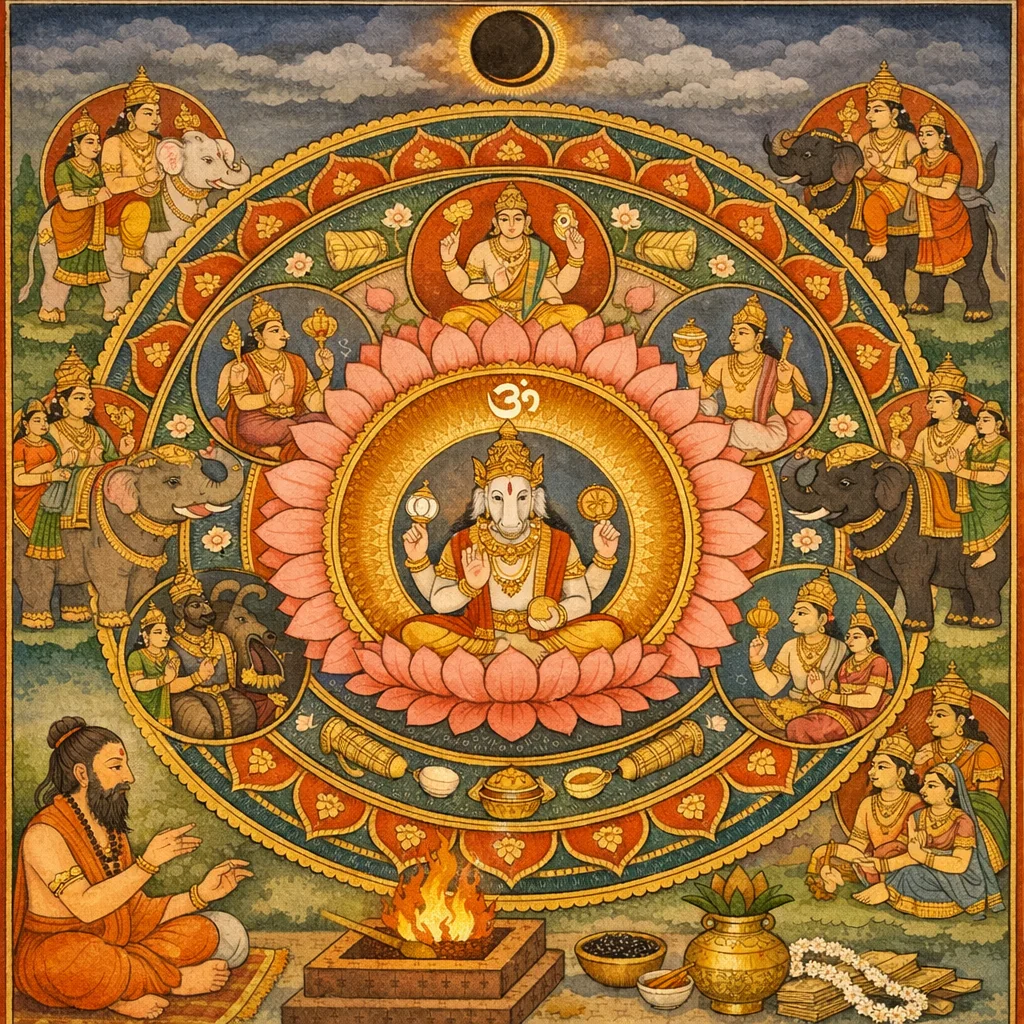
Hayagrīva-pūjā-vyākhyāna (Worship Procedure and Mantra-Siddhi of Hayagrīva)
Sanatkumāra teaches a praṇava (Oṃ)-centered mantra system allied to Viṣṇu, giving its ritual identifiers: ṛṣi Indu, chandas Virāṭ, devatā Dadhivāmana; bīja Tāra/Oṃ; śakti Vahnijāyā. He prescribes bodily nyāsa and an eighteen-mantra installation, then details pūjā and homa: three-lakh japa with one-tenth homa using ghee-soaked offerings, plus specific oblations (pāyasa, curd-rice, red lotuses, apāmārga) for prosperity, fear-removal, disease-relief, influence, release from bondage, and food abundance. The chapter expands into yantra/maṇḍala design—lotus-core worship, ṣaḍaṅga worship on filaments and petals, placements of the four Vyūhas, Śaktis, weapons, dikpālas, and the eight directional elephants with their consorts. A second mantra-stream culminates in Hayagrīva (Turagānana), with Brahmā as ṛṣi and Anuṣṭubh as chandas, surrounded by outer rings of Vedāṅgas, Mothers, Bhairavas, avatāras, rivers, grahas, mountains, and nakṣatras. It concludes with consecrated water and eclipse rites using a seed preparation to bestow Sarasvata-siddhi—mastery of speech and learning.
Shlokas
Verse 1
सनत्कुमार उवाच । प्रणवो हृदयं विष्णुर्नेन्तः सुरपतिस्तथा । महाबलाय स्वाहांतो मंत्रो वसुधराक्षरः ॥ १ ॥
Sanatkumāra said: The Praṇava (Oṃ) is the very heart of Viṣṇu; within it abides also the Lord of the gods. The mantra that ends with “svāhā” is for the Greatly Powerful One, and it is the world-supporting akṣara, the syllable that upholds the earth.
Verse 2
मुनिरिंन्दुर्विराट् छन्दो देवता दधिवामनः । तारो बीजं तथा शक्तिर्वह्निजाया प्रकीर्तिता ॥ २ ॥
The seer (ṛṣi) is Indu; the metre (chandas) is Virāṭ; the presiding deity (devatā) is Dadhivāmana. The seed-syllable (bīja) is Tāra (Oṃ), and the power (śakti) is proclaimed as Vahnijāyā, the consort of Fire.
Verse 3
चंद्राक्षिरामबाणेंषु नेत्रसंख्यैर्मनूद्भवैः । वर्णैः षडंगं कृत्वा च मूर्ध्नि भाले च नेत्रयोः ॥ ३ ॥
Using the letters that arise from the mantras—equal in number to the eyes—one should perform the sixfold nyāsa (ṣaḍaṅga-nyāsa), placing them upon the head, the forehead, and the two eyes, in the mantric group beginning with “Caṃdrākṣi, Rāma, Bāṇa….”
Verse 4
कर्णयोर्घ्राणयोरोष्टतालुकण्ठभुजेषु च । पृष्टे हृद्युदरे नाभौ गुह्ये चोरुस्थले पुनः ॥ ४ ॥
In the ears and the nostrils; on the lips, the palate, the throat, and the arms; on the back; in the region of the heart and the abdomen; at the navel; in the secret parts; and again at the place of the thighs—these are the locations specified.
Verse 5
जानुद्वयं जङ्घयोश्च पादयोर्विन्यसेत्क्रमात् । अष्टादशैव मंत्रोत्थास्ततो देवं विचिंन्तयेत् ॥ ५ ॥
One should place the mantras in due order upon both knees, the shanks (calves), and the feet. Having thus installed the eighteen mantras, one should then meditate upon the Lord.
Verse 6
मुक्तागौरं रत्नभूषं चन्द्रस्थं भृङ्गसन्निभैः । अलकैर्विलसद्वक्त्रं कुम्भं शुद्धांबुपूरितम् ॥ ६ ॥
A water-pot—white as pearls, adorned with jewels, bearing the mark of the moon, its face made lovely by curls dark as bees—was filled with pure, sanctifying water.
Verse 7
दध्यन्नपूर्णचषकं दोर्भ्यां संदधतं भजेत् । लक्षत्रयं जपेन्मन्त्रं तद्दशांशं घृतप्लुतैः ॥ ७ ॥
One should worship the Deity while holding with both arms a bowl filled with curd and cooked rice. Then one should repeat the mantra three lakhs (300,000 times) and offer oblations equal to one-tenth of that number, with offerings drenched in ghee.
Verse 8
पायसान्नैः प्रजुहुयाद्दध्यन्नेन यथाविधि । चन्द्रांते कल्पिते पीठे पूर्वोक्तें पूजयेच्च तम् ॥ ८ ॥
One should duly offer oblations with sweet rice (pāyasa) and, according to the prescribed rule, with rice mixed with curd as well. Then, upon a seat prepared at the end of the crescent-moon design as described earlier, one should worship that Deity.
Verse 9
संकल्पमूर्तिमूलेन संपूज्य च विधानतः । केसरेषु षडंगानि संपूज्य दिग्दलेषु च ॥ ९ ॥
Then, according to the prescribed rule, one should duly worship at the base the Deity envisioned through saṅkalpa (sacred resolve). One should worship the six limbs (ṣaḍ-aṅga) upon the filaments (kesara), and also upon the directional petals (dig-dala).
Verse 10
वासुदेवं संकर्षणं प्रद्युम्नमनिरुद्धकम् । कोणपत्रेषु शांतिं च श्रियं सरस्वतीं रतिम् ॥ १० ॥
He should place (or invoke) Vāsudeva, Saṃkarṣaṇa, Pradyumna, and Aniruddha; and in the corner-petals of the ritual diagram he should also place Śānti, Śrī, Sarasvatī, and Rati.
Verse 11
ध्वजं च वैनतेयं च कौस्तुभं वनमालिकम् । शंखं चक्रं गदां शार्ङ्गं दलेष्वष्टसु पूजयेत् ॥ ११ ॥
Upon the eight petals, one should worship with reverence: the banner, Vainateya (Garuḍa), the Kaustubha jewel, the forest-garland (Vanamālā), the conch, the discus, the mace, and the Śārṅga bow.
Verse 12
दलाग्रेषु केशवादीन्दिक्पालांस्तदनंतरम् । तदस्त्राणि च सम्पूज्य गजानष्टौ समर्चयेत् ॥ १२ ॥
Upon the tips of the petals, one should next worship Keśava and the other deities, together with the guardians of the directions. Having duly worshipped their divine weapons as well, one should then reverently worship the eight elephants of the quarters.
Verse 13
ऐरावतः पुण्डरीको वामनः कुमुदोंऽजनः । पुष्पदंतः सार्वभौमः सुप्रतीकश्च दिग्गजाः ॥ १३ ॥
Airāvata, Puṇḍarīka, Vāmana, Kumuda, Añjana, Puṣpadanta, Sārvabhauma, and Supratīka—these are the elephants of the directions.
Verse 14
करिण्योऽभ्रमुकपिलोपिंगलानुपमाः क्रमात् । ताम्रकर्णी शुभ्रदंती चांगना ह्यंजना वती ॥ १४ ॥
In due order, the female elephants are named: Abhramukhā, Kapilā, Piṅgalā, and Anupamā; likewise Tāmra-karṇī (“copper-eared”), Śubhra-dantī (“white-tusked”), Cāṅganā, and Añjanavatī.
Verse 15
एवमाराधितो मंत्री दद्यादिष्टानि मंत्रिणे । श्रीकामः पायसाज्येन सहस्रं जुहुयात्सुधीः ॥ १५ ॥
Thus, when the mantra-practitioner has properly propitiated the mantra-deity, he should present the prescribed offerings to the officiating priest. One who desires prosperity should, being wise, perform a thousand oblations with pāyasa (rice-milk pudding) mixed with ghee.
Verse 16
महतीं श्रियमाप्नोति धान्याप्तिर्धान्य होमतः । शतपुष्पासमुत्थैश्च बीजैर्हुत्वा सहस्रतः ॥ १६ ॥
One attains great Śrī, exalted prosperity; and by the dhānya-homa, the fire-offering of grains, one gains an abundance of cereals. By offering, a thousand times, as oblations the seeds that arise from the śatapuṣpā plant, this result is obtained.
Verse 17
महाभयं नाशयेद्धि नात्र कार्या विचारणा । दद्ध्योदनेन शुद्धेन हुत्वा मुच्यते दुर्गतेः ॥ १७ ॥
It surely destroys great fear—there is no need for doubt. By offering a homa with pure rice cooked with curd (daddhy-odana), one is freed from misfortune and evil destiny.
Verse 18
ध्यात्वा त्रैविक्रमं रूपं जपेन्मंत्रं समाहितः । कारागृहाद्भवन्मुक्तो बद्धो मंत्रप्रभावतः ॥ १८ ॥
Having meditated on the Trivikrama form, one should, with a collected mind, repeat the mantra; by the power of the mantra, even one who is bound becomes freed from imprisonment.
Verse 19
भित्तौ संपाद्य देवेशं फलके वा प्रपूजयेत् । नित्यं सुगंधकुसुमैर्महतीं श्रियमाप्नुयात् ॥ १९ ॥
Having prepared an image of the Lord of the gods on a wall—or else on a wooden panel—one should worship Him duly. By daily offering fragrant flowers, one attains great Śrī, abundant prosperity.
Verse 20
हुत्वा रक्तोत्पलैर्मंत्री वशयेत्सकलं जगत् । अन्नाज्यैर्जुहुयान्नित्यमष्टाविंशतिसंख्यया ॥ २० ॥
Having offered oblations of red lotuses, the mantra-practitioner can bring the entire world under his influence. He should also perform daily fire-offerings with cooked rice and ghee, in the fixed count of twenty-eight oblations.
Verse 21
सिताज्यान्नं च विधिवत्प्राप्नुयादन्नमक्षयम् । अपूपैः षड्रसोपेतैर्हुनेद्वसुसहस्रकम् ॥ २१ ॥
By duly obtaining rice prepared with sugar and ghee according to the prescribed rite, one gains an inexhaustible store of food. And one should offer into the sacred fire a thousand oblations of sweet cakes (apūpa) endowed with the six tastes.
Verse 22
अलक्ष्मीं च पराभूय महतीं श्रियमाप्नुयात् । जुहुयादयुतं मंत्री दध्यन्नं च सितान्वितम् ॥ २२ ॥
Having driven away Alakṣmī, misfortune, one may attain the great prosperity of Śrī. The knower of mantra should offer ten thousand oblations, using rice cooked with curd and mixed with sugar.
Verse 23
यत्र यत्र वसेत्सोऽपि तत्रान्नगिरिमाप्नुयात् । पद्माक्षरैर्युतं बिल्वांतिकस्थो जुहुयान्नरः ॥ २३ ॥
Wherever that person may dwell, there itself he attains a “mountain of food,” an abundant provision. A man, standing near a bilva tree, should offer oblations while employing the lotus-like syllables—the sacred mantra-syllables—in the rite.
Verse 24
महालक्ष्मीं स लभते तत्र तत्र न संशयः । जुहुयात्पायसैर्लक्षं वाचस्पतिसमो भवेत् ॥ २४ ॥
He attains Mahālakṣmī there and then—of this there is no doubt. If one were to offer a hundred thousand oblations with milk-rice (pāyasa), one would become equal to Bṛhaspati, the lord of sacred speech.
Verse 25
लक्षं जप्त्वा तद्दशांशं पुत्रजीवफलैर्हुनेत् । तत्काष्टैरेधिते वह्नौ श्रेष्टं पुत्रमवाप्नुयात् ॥ २५ ॥
Having completed one lakh (one hundred thousand) recitations, one should offer into the fire a tenth of that number as oblations using the fruits of the putrajīva tree; with the fire kindled by its very wood, one obtains an excellent son.
Verse 26
ससाध्यतारं विलसत्कर्णिकं च सुवर्णकैः । विलसत्केसरं मंत्राक्षरद्वंद्वाष्टपत्रकम् ॥ २६ ॥
He should visualize a radiant lotus: its shining pericarp marked with the Sādhyatārā (the aim-fulfilling star), its golden filaments gleaming, and its eight petals formed by paired syllables of the mantra.
Verse 27
शेषयुग्मार्णांत्यपत्रं द्वादशाक्षरवेष्टितम् । तद्बहिर्मातृकावर्णैर्यंत्रं सम्पत्प्रदं नृणाम् ॥ २७ ॥
The outermost petal, formed from the final letters of the remaining paired syllables, is to be encircled by the twelve-syllabled mantra. Outside that, with the letters of the Mātṛkā (the Sanskrit alphabet), one should arrange a yantra that bestows prosperity upon people.
Verse 28
रक्तं त्रिविक्रमं ध्यात्वा प्रसूनै रक्तवर्णकैः । जुहुयादयुतं मंत्री सर्वत्र विजयी भवेत् ॥ २८ ॥
Meditating on Trivikrama (Vishnu) in a red form, the mantra-practitioner should offer oblations ten thousand times with red-colored flowers; by doing so, he becomes victorious everywhere.
Verse 29
ध्यायेञ्चंद्रासनगतं पद्मानामयुतं हुनेत् । लभेदकंटकं राज्यं सर्वलक्षणसंयुतम् ॥ २९ ॥
Meditating on the deity seated upon a lunar throne, one should offer (in fire) ten thousand lotus-flowers; thereby one obtains a thornless (trouble-free) kingdom, endowed with every auspicious mark.
Verse 30
हुत्वा लवंगैर्मध्वाक्तैरपामार्गदलैस्तु वा । अयुतं साध्यनामाढ्यं स वश्यो जायते ध्रुवम् ॥ ३० ॥
Having offered into the fire either cloves anointed with honey, or else leaves of apāmārga, for ten thousand oblations—each accompanied by the name of the person to be influenced—he surely becomes brought under control.
Verse 31
अष्टोत्तरशतं हुत्वा ह्यपामार्गदलैः शुभैः । तावज्जप्त्वा च सप्ताहान्महारोगात्प्रमुच्यते ॥ ३१ ॥
Having offered one hundred and eight oblations with auspicious apāmārga leaves, and having performed the corresponding japa for seven nights, one is released from a grievous disease.
Verse 32
उहिरत्पदमाभाष्य प्रणवोहीय शब्दतः । सर्ववार्गीश्वरेत्यंते प्रवदेदीश्वरेत्यथ ॥ ३२ ॥
Having uttered the word “uhirat,” one should then recite the Praṇava (Oṁ) in the prescribed phonetic form. At the end, one should pronounce “sarva-vārgīśvara,” and thereafter declare it as “Īśvara.”
Verse 33
सर्ववेदमयाचिंत्यपदान्ते सर्वमीरयेत् । बोधयद्वितवांतोऽयं मन्त्रस्तारादिरीरितः ॥ ३३ ॥
At the end of the contemplated word that is composed of all the Vedas, one should utter “all,” that is, the complete formula. This mantra, beginning with Tārā (Oṁ), is taught as ending with the syllable “dvi/ta,” and is said to awaken spiritual understanding.
Verse 34
ऋषिर्ब्रह्मास्य निर्दिष्टश्छंदोऽनुष्टुबुदाहृतम् । देवता स्याद्धयग्रीवो वागैश्वर्यप्रदो विभुः ॥ ३४ ॥
For this mantra, Brahmā is declared as the seer (ṛṣi), and the metre is stated to be Anuṣṭubh. The presiding deity is Hayagrīva—the all-pervading Lord—who bestows mastery and sovereignty in speech.
Verse 35
तारेण पादैर्मंत्रस्य पञ्चांगानि प्रकल्पयेत् । तुषाराद्रिसमच्छायं तुलसीदामभूषितम् ॥ ३५ ॥
Using the syllabic parts (pādas) of the Tārā-mantra, one should arrange the fivefold limb-placements (pañcāṅga-nyāsa) of the mantra, and then contemplate the deity as radiantly white like the Himālaya’s snowy peak, adorned with a garland of tulasī.
Verse 36
तुरंगवदनं वंदे तुंगसारस्वतः पदम् । ध्यात्वैवं प्रजपेन्मंत्रमयुतं तद्दशांशतः ॥ ३६ ॥
I bow to the exalted Sārasvata, the deity whose face is like that of a horse. Having thus meditated, one should recite the mantra ten thousand times, and then complete the prescribed concluding rite in the measure of one-tenth of that.
Verse 37
मध्वक्तैः पायसैर्हुत्वा विमलादिसमन्विते । पूजयेद्वेष्णवे पीठे मूर्तिं संकल्प्य मूलतः ॥ ३७ ॥
Having offered oblations into the fire of honey-mixtures and sweet milk-rice (pāyasa), together with the pure accompaniments beginning with “Vimalā,” one should worship upon the Vaiṣṇava altar-seat—first establishing the saṅkalpa and invoking the Deity’s form from its very root.
Verse 38
कर्णिकायां चतुर्दिक्षु यजेत्पूर्वादितः क्रमात् । सनंदनं च सनकं श्रियं च पृथिवीं तथा ॥ ३८ ॥
In the four directions around the lotus’s central pericarp, one should worship in due sequence beginning from the east: Sanandana, Sanaka, Śrī (Lakṣmī), and likewise Pṛthivī, the Earth-goddess.
Verse 39
तद्वहिर्दिक्षु वेदाश्च षट्कोणेषु ततोऽर्चयेत् । निरुक्तं ज्योतिषं पश्चाद्यजेद्व्याकरणं ततः ॥ ३९ ॥
Then, on the outer side in the directions, one should worship the Vedas in the six-angled compartments. After that, one should offer worship to Nirukta and Jyotiṣa, and thereafter to Vyākaraṇa.
Verse 40
कल्पं शिक्षां च छंदांसि वेदांगानि त्विमानि वै । ततोऽष्टदलमूले तु मातरोऽष्टौ समर्चयेत् ॥ ४० ॥
These indeed are the Vedāṅgas—Kalpa, Śikṣā, and Chandas. Then, at the base of the eight-petalled lotus diagram, one should duly worship the Eight Mothers.
Verse 41
वक्रतुंडादिकानष्टो दलमध्ये प्रपूजयेत् । दलाग्रेष्यर्चयेत्पश्चात्साधकश्चाष्टभैरवान् ॥ ४१ ॥
Having duly worshipped the eight deities beginning with Vakratuṇḍa in the center of the lotus‑petal array, the practitioner should then worship the eight Bhairavas upon the tips of the petals.
Verse 42
असितांगं रुरुं चैव भीषणं रक्तकनेत्रकम् । बटुकं कालदमनं दंतुरं विकटं तथा ॥ ४२ ॥
One should also invoke/recite: Asitāṅga, Ruru, Bhīṣaṇa the Terrifying, Raktakanetraka the Red‑eyed, Baṭuka, Kāladamana the Subduer of Time (Death), Dantura the Tusked, and likewise Vikata the Formidable.
Verse 43
तद्बहिः षोडशदलेष्ववतारान्हरेर्दश । शंखं चक्रं गदां पद्मं नंदकं शार्ङ्गमेव च ॥ ४३ ॥
Outside that, upon the sixteen petals, one should place the ten incarnations of Hari, and also His emblems: the conch, discus, mace, lotus, as well as Nandaka the sword and Śārṅga the bow.
Verse 44
तद्बहिर्भूगृहे शक्रमुखान्दश दिगीश्वरान् । वज्राद्यांस्तद्बहिश्चेष्ट्वाद्वारेषु च ततः क्रमात् ॥ ४४ ॥
Outside the inner shrine, in the surrounding enclosure, one should arrange Indra and the other ten Lords of the Directions; and beyond them, the vajra and the other emblems/weapons should then be placed in due order at the gateways.
Verse 45
महागणपतिं दुर्गां क्षेत्रेशं बटुकं तथा । समस्तप्रकटाद्याश्च योगिन्यस्तद्बहिर्भवेत् ॥ ४५ ॥
One should also propitiate Mahāgaṇapati, Durgā, Kṣetreśa the Lord of the sacred precinct, and Baṭuka; and likewise all the Yoginīs beginning with Prakaṭā—these are to be stationed outside that ritual space/maṇḍala.
Verse 46
तद्बहिः सप्त नद्यश्च तद्बाह्ये तु ग्रहान्नव । तद्बाह्ये पर्वतानष्टौ नक्षत्राणि च तद्बहिः ॥ ४६ ॥
Outside that lie seven rivers; beyond them are the nine Grahas (celestial influencers/planets). Beyond those are eight mountains, and outside them again are the Nakṣatras (lunar mansions/constellations).
Verse 47
एवं पंचदशावृत्त्या संपूज्य तुरगाननम् । वागीश्वरसमो वाचि धनैर्धनपतिर्भवेत् ॥ ४७ ॥
Thus, by duly worshipping Turagānana in a cycle of fifteen repetitions, one becomes equal to the Lord of Speech in eloquence, and in wealth becomes like the Lord of Riches.
Verse 48
एवं सिद्धे मनौ मंत्री प्रयोगान्कर्तुमर्हति । अष्टोत्तरसहस्रं तु शुद्धं वार्यभिमंत्रितम् ॥ ४८ ॥
When the mantra has thus been perfected, the practitioner is fit to undertake its ritual applications. He should then consecrate pure water by chanting the mantra one thousand and eight times.
Verse 49
बीजेन मासमात्रं यः पिबेद्धीमान् जितेन्द्रियः । जन्ममूकोऽपि स नरो वाक्सिद्धिं लभते ध्रुवम् ॥ ४९ ॥
For a full month, the wise and self-controlled person who drinks the preparation together with the bīja—even if mute from birth—certainly attains vāk-siddhi, the perfection of speech.
Verse 50
वियद्भुगुस्थमर्धीराबिंदुमद्बीजमीरितम् । चंद्रसूर्योपरागे तु पात्रे रुक्ममये क्षिपेत् ॥ ५० ॥
The bīja-mantra, described as having its syllables placed in the ‘sky’ and in ‘Bhṛgu’, and marked with ‘ardhīrā’ and a bindu, should be deposited in a golden vessel at the time of a lunar or solar eclipse.
Verse 51
दुग्धं वचां ततो मंत्री कंठमात्रोदके स्थितः । स्पर्शाद्विमोक्षपर्यंतं प्रजपेन्मंत्रमादरात् ॥ ५१ ॥
Then the mantra-practitioner—standing in water up to the throat—should, with reverence, recite the mantra from the moment of ritual contact until the concluding release of the rite.
Verse 52
पिबेत्तत्सर्वमचिरात्तस्य सारस्वतं भवेत् । ज्योतिष्मतीलताबीजं दिनेष्वेकैकवर्द्धितम् ॥ ५२ ॥
Let him drink all of that; before long he will attain the “Sārasvata” gift—eloquence and learning. (This is done) with the seed of the jyotiṣmatī creeper, increasing the dose by one each day.
Verse 53
अष्टोत्तरशतं यावद्भक्षयेदभिमंत्रितम् । सरस्वत्यवतारोऽसौ सत्यं स्याद्भुवि मानवः ॥ ५३ ॥
If a person eats (the offering) that has been consecrated with mantra up to one hundred and eight (times/units), that human being on earth truly becomes an incarnation of Sarasvatī.
Verse 54
किं बहूक्तेन विप्रेंद्र मनोरस्य प्रसादतः । सर्ववेदागमादीनां व्याख्याता ज्ञानवान् भवेत् ॥ ५४ ॥
What need is there to say much, O best of Brahmins? By the grace of Manora, one becomes wise—an accomplished expounder of all the Vedas, Āgamas, and related scriptures.
Verse 55
इति श्रीबृहन्नारदीयपुराणे पूर्वभागे बृहदुपाख्याने सनत्कुमारविभागे तृतीयपादे हयग्रीवोपासनानिरूपणं नाम द्विसप्ततितमोऽध्यायः ॥ ७२ ॥
Thus ends the seventy-second chapter, entitled “The Explanation of the Worship of Hayagrīva,” in the Śrī Bṛhannāradīya Purāṇa—within the Pūrva-bhāga, in the Great Narrative (Bṛhad-upākhyāna), in the Sanatkumāra section, in the Third Pāda.
Frequently Asked Questions
In śāstric mantra-vidhi, these identifiers establish lineage (ṛṣi), sonic-form/recitational structure (chandas), and the mantra’s intended divine referent (devatā). The chapter preserves this Vedic-style apparatus inside a Purāṇic setting to authorize correct recitation, nyāsa, and ritual application.
Classical sādhana manuals treat japa as internal energizing and homa as external sealing/confirmation; the one-tenth homa is a standard completion ratio (pūraścaraṇa-style logic). The chapter uses fixed counts to formalize ‘mantra-siddhi’ before allowing prayoga (applications).
The lotus diagram acts as a cosmological and theological map: the center holds the resolved deity-form; filaments/petals host limbs, Vyūhas, Śaktis, weapons, and guardians; outer rings expand to Vedas/Vedāṅgas, grahas, rivers, mountains, and nakṣatras—integrating mantra, body (nyāsa), and cosmos into a single worship architecture.
Airāvata, Puṇḍarīka, Vāmana, Kumuda, Añjana, Puṣpadanta, Sārvabhauma, and Supratīka; along with their female counterparts: Abhramukhā, Kapilā, Piṅgalā, Anupamā, Tāmra-karṇī, Śubhra-dantī, Cāṅganā, and Añjanavatī.