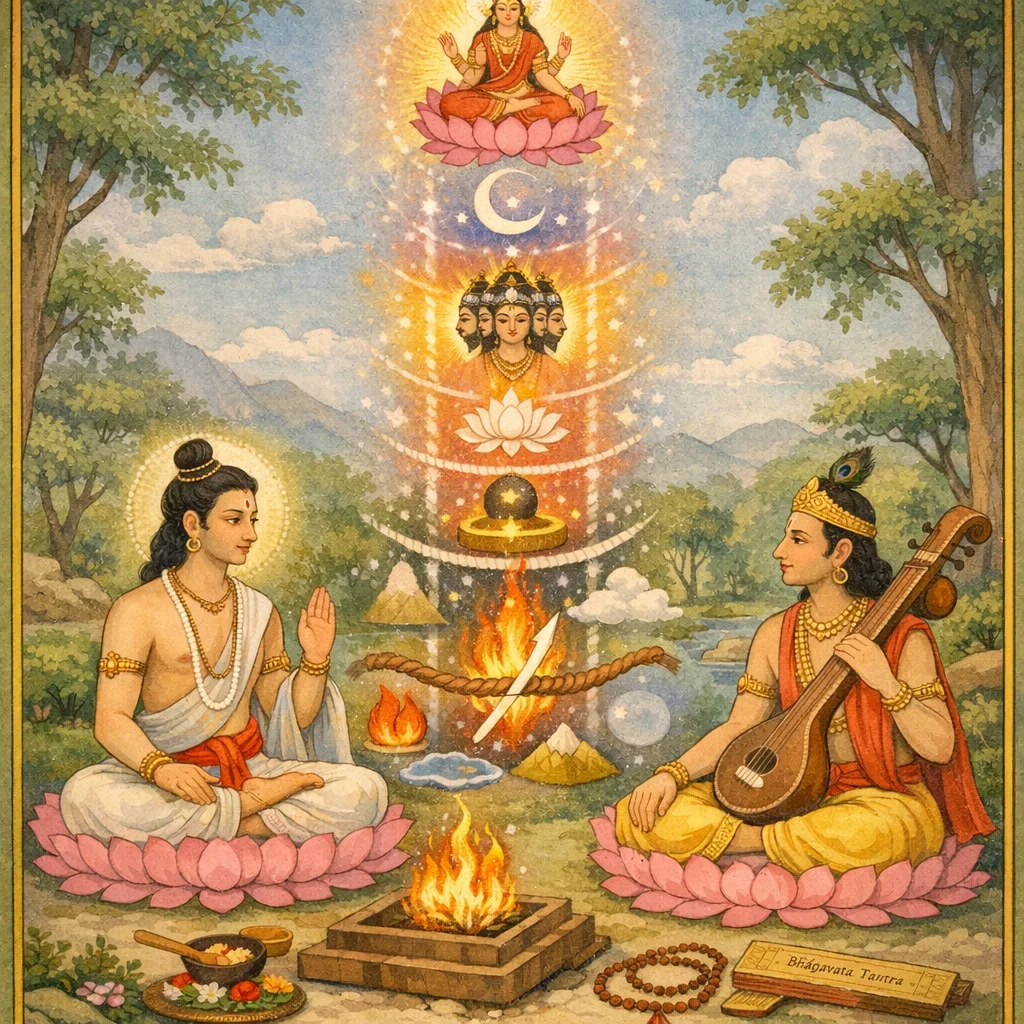
Sanatkumāra’s Bhāgavata Tantra: Tattvas, Māyā-Bonds, Embodiment, and the Necessity of Dīkṣā
Śaunaka praises Sūta for imparting Kṛṣṇa-kathā and asks what teaching arises when the Sanakādi sages assemble. Sūta recounts Nārada’s further questions after hearing Sanandana on liberation: how to worship Viṣṇu by mantra, which deities Viṣṇu-bhaktas honor, and the Bhāgavata Tantra’s guru–śiṣya method—dīkṣā, daily morning rites, monthly observances, recitations, and homa that please the Supreme. Sanatkumāra outlines a Mahātantra in four pādas (Bhoga, Mokṣa, Kriyā, Caryā), introduces paśupati–paśu–pāśa, and explains bonds born of mala/karma/māyā. He then presents a graded tattva-cosmology: Śakti, Nāda-Bindu, Sadāśiva–Īśvara–Vidyā and the Śuddhādhvā, followed by the impure path producing time, niyati, kalā, rāga, puruṣa, prakṛti, guṇas, mind and senses, elements, bodies, species, and human birth. The chapter culminates in the injunction that dīkṣā alone cuts the pāśa; liberation depends on guru-bhakti and faithful nitya–naimittika observance within one’s varṇa–āśrama, and misuse of mantra requires prāyaścitta responsibilities for the teacher.
Shlokas
Verse 1
शौनक उवाच । सूत साधो चिरं जीव सर्वशास्त्रविशारदः । यत्त्वया पायिता विद्वन्वयं कृष्णकथामृतम् ॥ १ ॥
Śaunaka said: O noble Sūta, may you live long—you who are well-versed in all the śāstras. O learned one, you have made us drink the nectar of the narrations of Śrī Kṛṣṇa.
Verse 2
श्रुत्वा तु मोक्षधर्मान्वै नारदो भगवत्प्रियः । सनंदनमुखोद्गीतान्किं पप्रच्छं ततः परम् ॥ २ ॥
After hearing the doctrines of liberation (mokṣa-dharma)—those sung from Sanandana’s own mouth—Nārada, who is dear to the Bhagavān, then asked what came next.
Verse 3
मानसा ब्रह्मणः पुत्राः सनकाद्या मुनीश्वराः । चरंति लोकानन्तसिद्धा लोकोद्धरणतत्पराः ॥ ३ ॥
The mind-born sons of Brahmā—those lordly sages beginning with Sanaka—move through the worlds, endowed with endless siddhis, intent on the uplift and deliverance of living beings.
Verse 4
नारदोऽपि महाभाग नित्यं कृष्णपरायणः । तेषां समागमे भद्रा का कथा लोकपावनी ॥ ४ ॥
O greatly fortunate one, Nārada too is ever devoted to Kṛṣṇa. When those sages assemble together, O Bhadrā, what sacred discourse is spoken there—one that purifies the worlds?
Verse 5
सूत उवाच । साधु पृष्टं महाभाग त्वया लोकोपकारिणा । कथयिष्यामि तत्सर्वं यत्पृष्ट नारदर्षिणा ॥ ५ ॥
Sūta said: O noble one, you have asked well—being intent on the welfare of the world. I shall narrate in full everything that was asked by the sage Nārada.
Verse 6
श्रुत्वा सनंदनप्रोक्तान्मोक्षधर्मान्सनातनान् । नारदो भार्गवश्रेष्ठ पुनः पप्रच्छ तान्मुनीन् ॥ ६ ॥
Having heard the eternal disciplines of liberation spoken by Sanandana, Nārada—O best among the Bhṛgus—again questioned those sages.
Verse 7
नारद उवाच । सर्वदेवेश्वरो विष्णुर्वेदे तंत्रे च कीर्तितः । समाराध्यः स एवात्र सर्वैः सर्वार्थकांक्षिभिः ॥ ७ ॥
Nārada said: “Viṣṇu, the Lord of all the gods, is praised in both the Vedas and the Tantras. Therefore, in this world He alone should be duly worshipped by all who seek the fulfillment of every worthy aim.”
Verse 8
कैर्मंत्रैर्भगवान्विष्णुः समाराध्यो मुनीश्वराः । के देवाः पूजनीयाश्च विष्णुपादपरायणैः ॥ ८ ॥
O lordly sages, by which mantras should the Blessed Lord Viṣṇu be properly worshipped? And which deities are to be revered by those who are devoted to the feet of Viṣṇu?
Verse 9
तंत्रं भागवतं विप्रा गुरुशिष्यप्रयोजकम् । दीक्षणं प्रातराद्यं च कृत्यं स्याद्यत्तदुच्यताम् ॥ ९ ॥
O brāhmaṇas, please explain that Bhāgavata Tantra which establishes the proper relationship and procedure between guru and disciple—namely, initiation (dīkṣā) and the prescribed duties beginning with the morning rites.
Verse 10
यैर्मासैः कर्मभिर्यैर्वा जप्यैर्होमादिभिस्तथा । प्रीयेत परमात्मा वै तद्ब्रूत मम मानदाः ॥ १० ॥
“By which months, by which ritual acts, and by which recitations—along with homa and other rites—does the Supreme Self indeed become pleased? Tell me that, O venerable ones who honor others.”
Verse 11
सूत उवाच । एतच्छ्रुत्वा वचस्तस्य नारदस्य महात्मनः । सनत्कुमारो भगवानुवाचार्कसमद्युतिः ॥ ११ ॥
Sūta said: Having heard these words of the great-souled Nārada, the venerable Sanatkumāra—radiant like the sun—spoke.
Verse 12
सनत्कुमार उवाच । श्रृणु नारद वक्ष्यामि तंत्रं भागवतं तव । यज्ज्ञात्वाऽमलया भक्त्या साधयेद्विष्णुमव्ययम् ॥ १२ ॥
Sanatkumāra said: Listen, O Nārada; I shall declare to you the Bhāgavata tantra. Knowing it, one can realize the imperishable Viṣṇu through stainless devotion.
Verse 13
त्रिपदार्थं चतुष्पादं महातंत्रं प्रचक्षते । भोगमोक्षक्रियाचर्याह्वया पादाः प्रकीर्तिताः ॥ १३ ॥
They describe the Mahātantra as having three principal aims and four sections (pādas). These sections are proclaimed as Bhoga, Mokṣa, Kriyā, and Caryā.
Verse 14
पादार्थास्तु पशुपतिः पशुपाशास्त्रय एव हि । पतिस्तत्र शिवोह्येको जीवास्तु पशवः स्मृताः ॥ १४ ॥
The fundamental categories are indeed three: Paśupati, the Lord of beings; paśu, the bound souls; and pāśa, the bonds. Among them, Śiva alone is the one Lord; the jīvas are remembered as ‘paśus’.
Verse 15
यावन्मोहादिसंयोगाः स्वरूपाबोधलक्षणाः । तावत्पशुत्वमेतेषां द्वैतवत्पश्य नारद ॥ १५ ॥
So long as there persists association with delusion and the like—marked by non-recognition of one’s true nature—so long does the state of ‘paśu’ remain for these beings. See it as duality, O Nārada.
Verse 16
पाशाः पंचविधास्त्वेषां प्रत्येकं तेषु लक्षणम् । पशवस्त्रिविधाश्चापि विज्ञाताः कलसंज्ञिकाः ॥ १६ ॥
Among these, the ritual “bindings” (pāśa) are of five kinds, each bearing its own defining marks. The “offerings” (paśu) too are understood to be of three kinds, known under the designation “kalasa”.
Verse 17
तलपाकलसंज्ञश्च सकलश्चेति नामतः । तत्राद्यो मलसंयुक्तो मलकर्मयुतः परः ॥ १७ ॥
They are known by the names “Talapākala” and “Sakala”. Of these, the former is associated with impurity (mala), while the latter is connected with actions (karma) involving impurity.
Verse 18
मलमायाकर्मयुतस्तृतीयः परिकीर्तितः । आद्यस्तु द्विविधस्तत्र समासकलुषस्तथा ॥ १८ ॥
The third type is declared to be that which is bound up with impurity (mala), delusion (māyā), and action (karma). But the first, in that teaching, is said to be of two kinds—one being compounded (mixed) and likewise tainted.
Verse 19
असमासमलश्चेति द्वितीयोऽपि पुनस्तथा । पक्वापक्वमलेनैव द्विविधः परिकीर्तितः ॥ १९ ॥
Likewise, the second type is called “asamāsa-mala”. Again, it too is declared to be of two kinds, distinguished solely by impurity that is “ripened” (pakva) or “unripened” (apakva).
Verse 20
शुद्धेऽध्वनि गतावेतौ विज्ञानप्रलयाकलौ । कलादितत्त्वनियतः सकलः पर्यटत्ययम् ॥ २० ॥
When these two—Vijñāna-kalā and Pralaya-kalā—have entered the pure path, this Sakala (the embodied self conditioned by the parts) continues to wander, constrained by the principles beginning with Kalā.
Verse 21
कर्मानुगशरीरेषु तत्तद्भुवनगेषु च । पाशाः पंच तथा तत्र प्रथमौ मलकर्मजौ ॥ २१ ॥
In bodies that arise in accordance with one’s karma—and in the various worlds to which those bodies belong—there are said to be five “bonds” (pāśas). Among them, the first two are born of impurity (mala) and of action (karma).
Verse 22
मायेयश्च तिरोधानशक्तिजो बिंदुजः परः । एकोऽप्यनेकशक्तिर्दृक्क्रियाच्छादनकोमलः ॥ २२ ॥
One is of Māyā, arising from the power of concealment (tirodhāna-śakti); and another is the supreme one sprung from the primordial point (bindu). Though one, he bears many powers, gently veiling both awareness (vision) and action.
Verse 23
तुषकंचुकवद्देहनिमित्तं चात्मनामिह । धर्माधर्मात्मकं कर्म विचित्रफलभोगदम् ॥ २३ ॥
Here, karma—arising for embodied selves because of the body, like a husk or outer covering—is of the nature of both dharma and adharma, and it grants the experience of varied results and enjoyments.
Verse 24
प्रवाहनित्यं तद्बीजांकुरन्यायेन संस्थितम् । इत्येतौ प्रथमौ चाथ मायेयाद्यान् श्रृणुद्विज ॥ २४ ॥
It is eternal as a continuous flow, established according to the maxim of the seed and the sprout. These two are the first; now, O twice-born one, hear about the rest that arise from Māyā.
Verse 25
सञ्चिदानंदविभवः परमात्मा सनातनः । पतिर्जयति सर्वेषामेको बीजं विभुः परम् ॥ २५ ॥
The eternal Supreme Self, whose majesty is Sat–Cit–Ānanda—existence, consciousness, and bliss—alone is the supreme Lord (Pati) who prevails over all. He is the one Seed, the transcendent and all-pervading Supreme.
Verse 26
मनस्यति न चोदेति निवृत्तिं च प्रयच्छति । वर्वर्ति दृक्क्रियारूपं तत्तेजः शांभवं परम् ॥ २६ ॥
It cognizes within the mind, yet it does not impel; and it bestows withdrawal (nivr̥tti) from outward-going activity. It abides as the very form of seeing and action—this supreme radiance is Śāmbhava (of Śiva).
Verse 27
शक्तो मया हरौ भुक्तो पशुगणस्य हि । तच्छक्तिमाद्यामेकांतां विद्रूपाख्यां वदंति हि ॥ २७ ॥
I was empowered and, indeed, employed in relation to Hari for the sake of the multitude of beings. That primal, exclusive Power is spoken of as the one called ‘Vidrūpā’.
Verse 28
तया चोज्जृंभितो बिंदुर्दिक्क्रियात्मा शिवाभिधः । अशेषतत्त्वजातस्य कारणं विभुरव्ययम् ॥ २८ ॥
And by Her, the Point (Bindu) expanded forth—called Śiva, whose very nature is the directional power of action. He is the all-pervading, imperishable cause of the entire multitude of principles (tattvas).
Verse 29
अस्मिन्निलीना निखिला इच्छायाः शक्तयः स्वकम् । कृत्यं कुर्वंति तेनेदं सर्वानुग्राहकं मुने ॥ २९ ॥
In this (Supreme reality), all the powers of will (icchā-śaktis) lie absorbed and carry out their own respective functions. Therefore, O sage, this (principle) becomes the benefactor and supporter of all.
Verse 30
चिज्जडानुग्रहार्थाय यस्य विश्वं सिसृक्षतः । आद्योन्मेषोऽस्य नादात्मा शांत्यादिभुवनात्मकः ॥ ३० ॥
When He wills to create the universe for the uplift of both the conscious and the inert, His very first stirring manifests as Nāda (primordial sound)—taking the form of the worlds beginning with Śānti and the rest.
Verse 31
तच्छक्तितत्त्वं विप्रेंद्र प्रोक्तं सावयवं परम् । ततो ज्ञानक्रियाशक्त्योस्तथोत्कर्षापकर्षयोः ॥ ३१ ॥
O best of brāhmaṇas, the supreme principle of Power (Śakti-tattva), together with all its constituent aspects, has been explained. Now the teaching proceeds to the powers of knowledge and action, and to their relative elevation and diminution (gradation).
Verse 32
प्रसरश्चाप्यभावेन तत्त्वं चैतत्सदाशिवम् । दृक्शक्तिर्यत्र न्यग्भूता क्रियाशक्तिर्विशिष्यते ॥ ३२ ॥
When outward expansion (prasara) is absent, this principle is called Sadāśiva—there, the power of pure seeing (dṛk-śakti) becomes subordinate, and the power of action (kriyā-śakti) stands predominant.
Verse 33
ईश्वराख्यं तु तत्तत्त्वं प्रोक्तं सर्वार्थकर्तृकम् । यत्र क्रिया हि न्यग्भूता ज्ञानाख्योद्रेकमश्नुते ॥ ३३ ॥
That principle is taught as the ‘Īśvara-tattva’—the effective cause that accomplishes all ends—wherein action, even ritual action, becomes subordinate and the predominance of knowledge is attained.
Verse 34
तत्तत्त्वं चैव विद्याख्यं ज्ञानरूपं प्रकाशकम् । नादो बिंदुश्च सकलः सदाख्यं तत्त्वमाश्रितौ ॥ ३४ ॥
That very Reality-principle is called Vidyā—knowledge in its luminous form, the revealer. Nāda and Bindu, together with Sakala, abide in and are grounded upon the principle known as Sadā.
Verse 35
विद्येशाः पुनरैशं तु मंत्रा विद्याभिधं पुनः । इमानि चैव तत्त्वानि शुद्धाध्वेति प्रकीर्तितम् ॥ ३५ ॥
Again, the Vidyeśas are said to belong to the domain of Īśa; the mantras are again designated as ‘Vidyā’. These very principles (tattvas) are proclaimed as the ‘Śuddhādhvā’—the pure path (of categories).
Verse 36
साक्षान्निमित्तमीशोऽत्रेत्युपादानसबिंदुराट् । पंचानां कालराहित्याक्रमो नास्तीति निश्चितम् ॥ ३६ ॥
Here the Lord is directly the efficient cause, and He is also the sovereign source that is the material cause. It is firmly concluded that, since the five principles are beyond time, no sequential order among them exists.
Verse 37
व्यापारवसतो ह्येषां विहिता खलु कल्पना । तत्त्वं वस्तुत एकं तु शिवाख्यं चित्रशक्तिकम् ॥ ३७ ॥
Indeed, their classification is formulated only with reference to their respective functions; but in reality the principle is one alone—called ‘Śiva’—endowed with manifold powers.
Verse 38
शक्तं यां वृत्तिभेदात्तुविहिताः खलु कल्पनाः । चिज्जडानुग्रहार्थाय कृत्वा रूपाणि वै प्रभुः ॥ ३८ ॥
Because of differences in functional modes (vṛtti-bheda), conceptual constructions (kalpanāḥ) are indeed posited regarding that very Power (śakti). The Lord (Prabhu) assumes forms for the sake of showing grace to both the conscious (caitanya) and the inert (jaḍa).
Verse 39
अनादिमलरुद्धानां कुरुतेऽनुग्रहं चिताम् । मुक्तिं च विश्वेषां स्वव्यापारे समर्थेताम् ॥ ३९ ॥
He bestows grace upon minds obstructed by beginningless impurities, and He is fully capable—by His own divine operation—of granting liberation (mokṣa) to all beings.
Verse 40
विधत्ते जडवर्गस्य सर्वानुग्राहकः शिवः । शिवसामान्यरूपो हि मोक्षस्तु चिदनुग्रहः ॥ ४० ॥
Śiva, the universal benefactor, bestows His grace upon the entire class of inert beings. For liberation is indeed of the nature of Śiva in a general sense; yet mokṣa, specifically, is the grace of pure consciousness.
Verse 41
सोऽनादित्वात्कर्मणो हि तत्तद्भोगं विना भवेत् । तेनानुग्राहकः शम्भुस्तद्भुक्त्यै प्रभुर्व्ययः ॥ ४१ ॥
Because karma is without beginning, without the corresponding experience of its fruits it would persist. Therefore Śambhu (Śiva), the imperishable Lord, becomes the gracious helper, enabling the soul to undergo and exhaust those karmic results.
Verse 42
कुरुते सूक्ष्मकरणभुवनोत्पत्तिमंजसा । कर्त्तोपादानकरणैर्विना कार्ये न दृश्यते ॥ ४२ ॥
It readily accounts for the arising of the subtle instruments and the worlds; yet in any effect it is never seen to occur without the agent, the material cause, and the instrumental means.
Verse 43
शक्तयः करणं चात्र मायोपादानमिष्यते । नित्यैका च शिवा शक्त्या ह्यनादिनिधना सती ॥ ४३ ॥
Here, the powers (śaktis) are taught to be the operative instruments, and Māyā is accepted as the material cause. Yet Śivā—one, eternal—exists as the Power of Śiva, truly without beginning and without end.
Verse 44
साधारणी नराणां वै भुवनानां च कारणम् । स्वभावान्मोहजननी स्वचिताजनकर्मभिः ॥ ४४ ॥
Common to all people—and a cause operating throughout the worlds—this power gives rise to delusion by its very nature, through actions born of one’s own mind and intention.
Verse 45
विश्वी सूक्ष्मा परा माया विकृतैः परत्तु सा । कर्माण्यावेक्ष्य विद्येशो मायां विक्षोभ्य शक्तिभिः ॥ ४५ ॥
That supreme Māyā is universal and subtle; yet she is distinct from and beyond the manifested modifications. Observing the karma of beings, the Lord—the Master of knowledge—stirs Māyā through His powers (śaktis).
Verse 46
विधत्ते जीवभोगार्थं वपूंषि करणानि च । सृजत्यादो कालतत्त्वं नानाशक्तिमयी च सा ॥ ४६ ॥
For the embodied jīva’s experience of pleasure and pain, she arranges bodies and their faculties; and at the very beginning she brings forth the principle of Time—she who is constituted of many śaktis.
Verse 47
भावि भूतं मवञ्चेदं जगत्कलयते लयम् । सूते ह्यनंतरं माया शक्तिं नियमनात्मिकाम् ॥ ४७ ॥
This universe—together with what is to be and what has been—moves toward laya, dissolution. Immediately thereafter, Māyā brings forth her power, whose very nature is regulation and restraint, establishing the order of creation.
Verse 48
सर्वं नियमयत्येषा तेनेयं नियतिः स्मृता । अनंतरं च सा माया नित्या विश्वविमोहिनी ॥ ४८ ॥
She governs and regulates everything; therefore she is remembered as Niyati, the cosmic law of necessity. And immediately following that is Māyā—eternal, and the deluder of the entire universe.
Verse 49
अनादिनिधना तत्त्वं कलाख्यं जनयत्यपि । एकतस्तु नृणां येन कलयित्वा मलं ततः ॥ ४९ ॥
The beginningless and endless Reality also brings forth the principle called “Kalā”. By it, the mala—the impurity of human beings—is measured out and apportioned according to its share.
Verse 50
कर्तृशक्तिं व्यंजयति तेनेदं तु कलाभिधम् । कालेन च नियत्योपसर्गतां समुपेतया ॥ ५० ॥
It makes manifest the power of agency (kartṛ-śakti); therefore it is called “Kalā”. And it operates in association with Time, having also come under the adjunct-condition of Niyati, cosmic determinism.
Verse 51
व्यापारं विदधात्येषा भूपर्यंतं स्वकीयकम् । प्रदर्शनाथ वै पुंसो विषयाणां च सा पुनः ॥ ५१ ॥
This power sets its own activity in motion, extending even to the earth’s farthest bounds; and again it does so to reveal to a man the objects of the senses.
Verse 52
प्रकाशरूपं विद्याख्यं तत्त्वं सूते कलैव हि । विद्या त्वावरणं भित्वा ज्ञानशक्तेः स्वकर्मणा ॥ ५२ ॥
Indeed, the principle called Vidyā—whose very nature is light—brings forth the manifesting kalā. Yet Vidyā, by its own function, breaks through the veil that covers the power of knowledge.
Verse 53
विषयान्दर्शयत्येषात्मनांशाकारणं ह्यतः । करोति भोग्यं यानासौ करणेन परेण वै ॥ ५३ ॥
This instrument makes the sense-objects perceptible; therefore it is regarded as a causal factor, a portion of the Self. Indeed, by that higher instrument it renders those objects fit to be experienced.
Verse 54
उद्बुद्धशक्तिः पुरुषः प्रचोद्य महदादिकान् । भोग्ये भोगं च भोक्तारं तत्परं करणं तु सा ॥ ५४ ॥
When the Puruṣa, with his power awakened, impels Prakṛti, the evolutes beginning with Mahat arise; within the field of the enjoyables there appear enjoyment, the enjoyer, and the instruments devoted to that enjoyment—those instruments are indeed she, Prakṛti.
Verse 55
भोग्येस्य भोग्यतिर्मासाञ्चिद्व्यक्तिर्भोग उच्यते । सुखादिरूपो विषयाकारा बुद्धिः समासतः ॥ ५५ ॥
The manifestation of consciousness (cit) as the act of experiencing with respect to an object to be enjoyed is called “bhoga” (experience/enjoyment). In brief, it is buddhi (intellect) assuming the form of the object, appearing as pleasure and the like.
Verse 56
भोग्यं भोक्तुश्च स्वेनैव विद्याख्यं करणं तु तत् । यद्यर्कवत्प्रकाशा धीः कर्मत्वाञ्च तथापि हि ॥ ५६ ॥
For both the object to be enjoyed and the enjoyer, one’s own “vidyā”—that very intellect—is the instrument. Though understanding shines like the sun, yet because it operates as an activity, it is counted as karma, an operative factor.
Verse 57
करणांतरसापेक्षा शक्ता ग्राहयितुं च तम् । संबन्धात्कारणाद्यैस्तद्भोगौत्सुक्येन चोदनात् ॥ ५७ ॥
Relying on auxiliary instruments, the cognitive power can apprehend that object—through connection with it, through causes and the like, and through the impelling force born of eagerness to taste its enjoyment.
Verse 58
तञ्चष्टाफलयोगाञ्च संसिद्धा कर्तृतास्य तु । अकर्तृत्वाभ्युपगमे भोक्तृत्वाख्या वृथास्य तु ॥ ५८ ॥
And the connection with the desired results is established only when his agency—his being a doer—is accepted. But if non-agency is admitted, then calling him an “enjoyer,” the experiencer of results, becomes meaningless.
Verse 59
किं च प्रधानचरितं व्यर्थं सर्वं भवेत्ततः । कर्तृत्वरहिते पुंसि करणाद्यप्रयोजके ॥ ५९ ॥
Moreover, if the person (puruṣa) were devoid of agency, then all activity attributed to primordial Nature (pradhāna) would become pointless, since the instruments and the rest—body, senses, mind, and so on—would have no purpose to serve.
Verse 60
भोगस्यासंभवस्तस्मात्स एवात्र प्रवर्तकः । करणादिप्रयोक्तॄत्वं विद्ययैवास्य संमतम् ॥ ६० ॥
Since enjoyment of results cannot arise on its own, he alone is the instigator here; and his role as the user of the instruments—such as the senses and other faculties—is accepted only through vidyā, true knowledge.
Verse 61
अनंतरं कलारागं सूते भिद्यंगरूपकम् । येन भोग्याय जनिता भिद्यंगे पुरुषे पुनः ॥ ६१ ॥
Thereafter arises the attachment called “kalā-rāga,” taking the form of differentiation into limbs and functions. By this, once again, the person—divided into limbs—is produced for the sake of experiencing the objects of enjoyment.
Verse 62
क्रियाप्रवृत्तिर्भवति तेनेदं रागसंज्ञिकम् । एभिस्तत्त्वैश्च भोक्तृत्वदशायां कलितो यदा ॥ ६२ ॥
When activity (kriyā) begins to operate, this condition is therefore called “rāga” (attachment). And when, through these very tattvas, one is fashioned into the state of being an enjoyer (bhoktṛtva), then bondage becomes established.
Verse 63
नित्यस्तदायमात्मा तु लभते पुरुषाभिधाम् । कलैव प्रश्चादव्यक्तं सूते भोग्याय चास्य तु ॥ ६३ ॥
This eternal Self, in that condition, comes to be designated as “Puruṣa”; and thereafter, as it were through a portion (kalā), the Unmanifest (avyakta) brings forth the world to become the object of experience for him.
Verse 64
सप्तग्रंथिविधानस्य यत्तद्गौणस्यकारणम् । गुणानामविभागोऽत्र ह्याधारे क्ष्मादिभागवत् ॥ ६४ ॥
The reason the (so-called) secondary scheme of the “seven-knotted” arrangement is spoken of is this: in the underlying substratum here, the qualities (guṇas) are not separately divided—just as, in a composite basis, the portions of earth and the other elements are not found in isolation.
Verse 65
आधारोऽपि च यस्तेषां तदव्यक्तं च गीयते । त्रय एव गुणा ह्यषामव्यक्तादेव संभवः ॥ ६५ ॥
That which is also their support is called the Unmanifest (Avyakta). Indeed, these three guṇas arise only from the Unmanifest.
Verse 66
सत्त्वं रजस्तमःप्रख्या व्यापारनियमात्मिका । गुणतो धीश्च विषयाध्यवसायस्वरूपिणी ॥ ६६ ॥
Intellect (dhī) is known as threefold—sattva, rajas, and tamas. It is the inner principle that governs activity and restraint, and, according to the guṇas, it becomes decisive ascertainment regarding the objects of the senses.
Verse 67
गुणतस्त्रिविधा सापि प्रोक्ता कर्मानुसारतः । महत्तत्तवादहंकारो जातः संरंभवृत्तिमान् ॥ ६७ ॥
That nature (prakṛti) too is said to be threefold in terms of the guṇas, and is described as operating in accordance with karma. From the principle of Mahat (cosmic intellect), ahaṃkāra—the sense of “I”—is born, endowed with the impulse of self-assertive activity.
Verse 68
संभोदादस्य विषयः प्राप्नोति व्यवहार्यताम् । सत्त्वा द्विगुणभेदेन स पुनस्त्रिविधो भवेत् ॥ ६८ ॥
Through cognition/awareness, its object becomes fit for practical usage in ordinary dealings. And that “sattva,” when divided by a twofold distinction, again becomes threefold.
Verse 69
तैजसो राजसश्चैव तामसश्चेति नामतः । तत्र तैजसतो ज्ञानेंद्रियाणि मनसा सह ॥ ६९ ॥
They are designated by name as taijasa, rājasa, and tāmasa. Among these, from the taijasa aspect arise the organs of knowledge, together with the mind (manas).
Verse 70
प्रकाशान्व यतस्तस्माद्वोधकानि भवन्ति हि । राजसाञ्च क्रियाहेतोस्तथा कर्मेंद्रियाणि तु ॥ ७० ॥
Because they partake of illumination (prakāśa), they indeed become instruments of cognition; and because rajas is the cause of activity, the organs of action likewise arise from it.
Verse 71
तामसाञ्चैव जायन्ते तन्मात्रा भूतयोनयः । इच्छारूपं च संकल्पव्यापारं तत्र वै मनः ॥ ७१ ॥
From the tāmasa (dark, inert) aspect arise the tanmātras, the subtle elements, and the womb-sources of the gross elements. In that process the mind (manas) truly functions as desire in form, operating through saṅkalpa—volition and conceptual resolve.
Verse 72
द्विधाधिकारि तञ्चित्तं भोक्तृभोगोपपादकम् । बहिः करणभावेन स्वोचितेन यतः सदा ॥ ७२ ॥
That mind (citta) functions with a twofold authority, establishing both the experiencer (bhoktṛ) and the experienced (bhoga). For it is ever engaged in its own fitting mode as an external instrument (bahiḥ-karaṇa).
Verse 73
इंद्रियाणां च सामर्थ्यं संकल्पेनात्मवृत्तिना । करोत्यंतःस्थितं भूयस्ततोऽन्तः करणं मनः ॥ ७३ ॥
By saṅkalpa (resolve) and its own inner mode of operation, the mind gathers and strengthens the powers of the senses within itself; therefore the mind is called the inner instrument (antaḥkaraṇa).
Verse 74
मनोऽहंकारबुद्ध्याख्यमस्त्यन्तः कारणं त्रिधा । इच्छासंरंभबोधाख्या वृत्तयः क्रमतोऽस्य तु ॥ ७४ ॥
The inner instrument (antaḥkaraṇa) is threefold—mind (manas), ego-sense (ahaṃkāra), and intellect (buddhi). Its functions, in order, are called desire (icchā), volitional impulse/effort (saṃrambha), and cognition (bodha).
Verse 75
ज्ञानेंद्रियाणि श्रोत्रं त्वक् चक्षुर्जिह्वा च नासिका । ग्राह्याश्च विषया ह्येषां ज्ञेयाः शब्दादयो मुने ॥ ७५ ॥
The organs of knowledge are the ear, the skin, the eye, the tongue, and the nose. And their grasped objects are to be known as sound and the rest, O sage.
Verse 76
शब्दस्पर्शरूपरसगन्धाः शब्दादयो मताः । वाक्पाणिपादपायूपस्थास्तु कर्मेंद्रियाण्यपि ॥ ७६ ॥
Sound, touch, form, taste, and smell are held to be the sense-objects beginning with sound. Likewise, speech, hands, feet, the anus, and the genitals are also the organs of action (karmendriyas).
Verse 77
वचनादानगमनोत्सर्गानंदेषु कर्मसु । करणानि च सिद्धिना न कृतिः करणैर्विना ॥ ७७ ॥
In actions such as speaking, giving, going, releasing (letting go), and rejoicing, the proper instruments are what bring accomplishment; no action is possible without its instruments.
Verse 78
दशधा करणैश्चेष्टां कार्यमाविश्य कार्यते । चेष्टंते कार्यमालंब्य विभुत्वात्करणानि तु ॥ ७८ ॥
Action is accomplished when the tenfold instruments enter into the task. Depending upon the work at hand, the instruments operate—because the instruments are pervasive, able to function throughout the body.
Verse 79
तन्मात्राणि तु खवायुस्तेजोऽम्भः क्ष्मेति पञ्च वै । तेभ्यो भूतान्येकगुणान्याख्यातानि भवंति हि ॥ ७९ ॥
The subtle elements (tanmātras) are indeed five—space, air, fire, water, and earth. From these arise the gross elements, each declared to possess its own specific quality.
Verse 80
इति पञ्चसु शब्दोऽयं स्पर्शो भूतचतुष्टये । रूपं त्रिषु रसश्चैव द्वयोर्गंधः क्षितौ तथा ॥ ८० ॥
Thus, sound is present in all five elements; touch exists in the four elements; form (color/visibility) is found in three; taste in two; and smell exists only in earth.
Verse 81
कार्याण्येषां क्रमेणैवावकाशो व्यूहकल्पनम् । पाकश्च संग्रहश्चैव धारणं चेति कथ्यते ॥ ८१ ॥
Their functions, in proper sequence, are taught to be: granting space (allocation), arranging into an ordered formation, maturation (refinement), consolidation (compilation), and preservation (retention).
Verse 82
आशीतोष्णौ महा वाद्यौ शीतोष्णौ वारितेजसोः । भास्वदग्नौ जले शुक्लं क्षितौ शुक्लाद्यनेकधा ॥ ८२ ॥
Great winds are marked by cold and heat; water and fire, too, are known through cold and heat. Fire is radiant; in water there is whiteness; and in earth, whiteness and other varied qualities appear in many forms.
Verse 83
रूपं त्रिषु रसोंऽभः सु मधुरः षड्विधः क्षितौ । गन्धः क्षितावसुरभिः सुरभिश्च प्रकीर्तितः ॥ ८३ ॥
Form (rūpa) is present in three elements; taste (rasa) belongs to water and is spoken of as sweet, while on earth it becomes sixfold. Smell (gandha) in earth is taught to be of two kinds: foul and fragrant.
Verse 84
तन्मात्रं तद्भूतगुणं करणं पोषणं तथा । भूतस्य तु विशेषोऽयं विशेषरहितं तु तत् ॥ ८४ ॥
The tanmātra (subtle element), the corresponding quality of that gross element, the organ (of perception/action), and nourishment as well—this is the specific character of a bhūta (gross element); but that (the tanmātra) is devoid of such particular differentiation.
Verse 85
इमानि पञ्चभूतानि संनिविष्टानि सर्वतः । पञ्चभूतात्मकं सर्वं जगत्स्थावरजङ्गमम् ॥ ८५ ॥
These five great elements are present everywhere. The entire universe—both the immovable and the moving—is constituted of the five elements.
Verse 86
शरीरसंनिविष्टत्वमेषां तावन्निरूप्यते । देहेऽस्थिमांसकेशत्वङ्नखदन्ताश्च पार्थिवाः ॥ ८६ ॥
Now their manner of abiding within the body is explained: in the body, bones, flesh, and hair—as well as nails and teeth—belong to the earthy element (pṛthivī).
Verse 87
मूत्ररक्तकफस्वेदशुक्रादिषु जलस्थितिः । हृदि पंक्तौ दृशोः पित्ते तेजस्तद्धर्मदर्शनात् ॥ ८७ ॥
Water is present in urine, blood, phlegm, sweat, semen, and the like. Fire (tejas) is present in the heart, in the digestive tract, in the eyes, and in bile—because their characteristic functions are observed there.
Verse 88
प्राणादिवृत्तिभेदेन वायुश्चैवात्र संस्थितः । वियत्सर्वासु नाडीषु गर्भवृत्यनुषंगतः ॥ ८८ ॥
Here the vital Wind (vāyu) abides in differentiated functions such as prāṇa and the rest; and the inner space (viyat) pervades all the nāḍīs, being connected with the womb-like, enclosing mode of operation (garbha-vṛtti).
Verse 89
प्रयोक्त्यादिमहीप्रांतमेतदंडार्थसाधनम् । प्रत्यात्मनियतं भोगभेदतो व्यवसीयते ॥ ८९ ॥
This entire cosmic “egg” (brahmāṇḍa)—from the creator onward down to the earth’s farthest bounds—serves as the instrument for the fruition of its purpose; and it is determined, for each individual self, according to the differing modes of experience (bhoga).
Verse 90
तत्त्वान्येवं कलाद्यानि प्रतिपुंनियतानि हि । देहेषु कर्मवशतः सर्वेषु विचरंति हि ॥ ९० ॥
Thus the various principles (tattvas), beginning with the kalās (constituent powers), are indeed allotted to each individual; and, driven by the force of karma, they move about through all embodied forms.
Verse 91
मायेयश्चैव पाशोऽयं येनावृतमिदं जगत् । अशुद्धाध्वामतो ह्येष धरण्यादिकलावधिः ॥ ९१ ॥
This indeed is the fetter born of Māyā, by which this entire world is veiled. Therefore it is called the “impure path of manifestation,” extending from the earth-element up to the higher kalās (cosmic constituents).
Verse 92
तत्र भूमण्डलस्थोऽसौ स्थावरो जङ्गमात्मकः । स्थावरा गिरिवृक्षाद्या जङ्गमस्त्रिविधः पुनः ॥ ९२ ॥
There, upon the terrestrial sphere, that creation is of two kinds: the immovable and the movable. The immovables are such as mountains and trees, while the movables are again of three types.
Verse 93
स्वेदजाश्चांडजाश्चैव तथैव च जरायुजाः । चराचरेषु लक्षाणां चतुराशीतियोनयः ॥ ९३ ॥
Among all moving and unmoving beings, there are said to be eighty-four lakh (8.4 million) kinds of birth: those born from sweat, those born from eggs, and likewise those born from a womb (with a placenta).
Verse 94
भ्रममाणस्तेषु जीवः कदाचिन्मानुषं वपुः । प्राप्नोति कर्मवशतः परं सर्वार्थसाधकम् ॥ ९४ ॥
Wandering among those states of existence, the individual soul sometimes attains a human body—by the force of its own actions (karma)—a supreme condition that can accomplish every true aim of life.
Verse 95
तत्रापि भारते खण्डे ब्राह्मणादिकुलेषु च । महापुण्यवशेनैव जनिर्भवति दुर्लभा ॥ ९५ ॥
Even among those realms, in the land of Bhārata—and specifically in families such as those of brāhmaṇas—birth is rare, attainable only through the force of great accumulated merit (puṇya).
Verse 96
जनिश्च पुंस्त्रियोर्योगः शुक्रशोणितयोगतः । बिंदुरेकः प्रविशति यदा गर्भे द्वयात्मकः ॥ ९६ ॥
Conception arises from the union of man and woman, through the conjunction of semen and menstrual blood. When a single seed-drop enters the womb as a principle of dual nature, pregnancy begins.
Verse 97
तदा रजोऽधिके नारी भवेद्रेतोऽधिके पुमान् । मलकर्मादिपाशेन कश्चिदात्मा नियंत्रितः ॥ ९७ ॥
When the female element (rajas) predominates, a girl is born; when the male seed (retaḥ) predominates, a boy is born. Yet an individual self is constrained and governed by the bonds of impurity, karma, and the like.
Verse 98
जीवभावं तदा तस्मिन्सकलः प्रतिपद्यते । अथ तत्राहृतैर्मात्रा पानान्नाद्यैश्च पोषितः ॥ ९८ ॥
Then, in that new body, the whole being assumes the condition of an individual soul (jīva). Thereafter, nourished by the mother with drink, food, and the like that she brings, it is sustained.
Verse 99
पक्षमासादिकालेन वर्धते वपुरत्र हि । दुःखाद्यः पीडितश्चैवाच्छन्नदेहो जरायुणा ॥ ९९ ॥
Indeed, in this condition the body grows with the passage of time—by fortnights, months, and so on; and the embodied being is tormented by pain and the like, its body enveloped by the fetal membrane (jarāyu).
Verse 100
एवं तत्र स्थितो गर्भे प्राग्जन्मोत्थं शुभाशुभम् । स्मरंस्तिष्टति दुःखात्मापीड्यमानो मुहुर्मुहुः ॥ १०० ॥
Thus, abiding there in the womb, the suffering soul repeatedly remembers the good and evil arising from its previous birth, and remains continually tormented again and again.
Verse 101
कालक्रमेण बालोऽसौ मातरं पीडयन्नपि । संपीडितो निःसरति योनियंत्रादवाङ्मुखः ॥ १०१ ॥
In the course of time, that child—though bringing distress to the mother—emerges, pressed and squeezed, from the mechanism of the womb, coming forth with the face turned downward.
Verse 102
क्षणं तिष्ठति निश्चेष्टस्ततो रोदितुमिच्छति । ततः क्रमेण स शिशुर्वर्धमानो दिनेदिने ॥ १०२ ॥
For a moment he remains motionless; then he longs to cry. Thereafter, in due sequence, that infant grows—day by day.
Verse 103
बालपौगंडभेदेन युवत्वं प्रतिपद्यते । एवं क्रमेण लोकेऽस्मिन्देहिनां देहसंभवः ॥ १०३ ॥
Through the successive stages of childhood and boyhood one attains youth; likewise, in this world, the taking on of a body by embodied beings occurs step by step.
Verse 104
मानुषं दुर्लभं प्राप्य सर्वलोकोपकारकम् । यस्तारयति नात्मानं तस्मात्पापतरोऽत्र कः ॥ १०४ ॥
Having obtained the rare human life—able to benefit all worlds—if one still does not ferry one’s own self across saṃsāra, who here could be more sinful than that person?
Verse 105
आहारश्चैव निद्रा च भयं मैथुनमेव च । पश्वादीनां च सर्वेषां च सर्वेषां साधारणमितीरितम् ॥ १०५ ॥
Food, sleep, fear, and sexual union—these are said to be common to all beings, including animals and the rest.
Verse 106
चतुर्ष्वेवानुरक्तो यः स मूर्खो ह्यात्मधातकः । मनुष्याणामयं धर्मः रवबंधच्छेदनात्मकः ॥ १०६ ॥
He who clings only to the “four” (limited aims and objects) is truly a fool and a slayer of his own self. Such is the dharma of men—by its very nature it cuts through the bonds forged by clamorous noise and empty talk.
Verse 107
पाशबंधनविच्छेदो दीक्षयैव प्रजायते । अतो बंधनविच्छित्त्यै मंत्रदीक्षां समाचरेत् ॥ १०७ ॥
The severing of the noose-like bondage arises only through dīkṣā (initiation). Therefore, to break that bondage, one should duly undertake mantra-initiation (mantra-dīkṣā).
Verse 108
दीक्षाज्ञानाख्यया शक्त्या ह्यपध्वंसितबन्धनः । शुद्धात्मतत्त्वनामासौ निर्वाणपदमश्नुते ॥ १०८ ॥
By the power known as dīkṣā-jñāna (initiatory knowledge), his bonds are utterly destroyed; established in the pure reality of the Self, he attains the state of nirvāṇa.
Verse 109
स्वशक्त्यात्मिकया दृष्ट्या शिवं ध्यायति पश्यति । यजते शिवमंत्रैश्च स्वपरेषां हिताय सः ॥ १०९ ॥
With the vision that is of the nature of his own inner power, he meditates upon Śiva and directly beholds Him; and with Śiva-mantras he performs worship, for the welfare of himself and of others.
Verse 110
शिवार्कशक्तिदीधित्या समर्थीकृतचिद्दृशा । शिवशक्त्यादिभिः सार्द्धं पश्यत्यात्मगतावृतिः ॥ ११० ॥
Empowered in the vision of consciousness by the radiance of Śiva—the Sun-like Power—he beholds, together with Śiva, Śakti, and the rest, the veils that have entered and covered the Self.
Verse 111
अंतःकरणवृत्तिर्या बोधाख्या सा महेश्वरम् । न प्रकाशयितुं शक्ता पाशत्वान्निगडादिवत् ॥ १११ ॥
That modification of the inner instrument (antaḥkaraṇa) called “cognition” cannot reveal Maheśvara, for it is bound by the pāśa—like a shackle and the like.
Verse 112
दीक्षैव परमो हेतुः पाशविच्छेदने पुनः । अतः शास्त्रोक्तविधिना मन्त्रदीक्षां समाचरेत् ॥ ११२ ॥
Initiation (dīkṣā) alone is the supreme cause for cutting the bonds of pāśa. Therefore one should duly undertake mantra-initiation according to the procedure taught in the śāstras.
Verse 113
दीक्षितस्तंत्रविधिना स्ववर्णाचारतत्परः । अनुष्ठानं प्रकुर्वीत नित्यनैमित्तिकात्मकम् ॥ ११३ ॥
One duly initiated according to the tantric procedure, devoted to the proper conduct of one’s own varṇa and traditional discipline, should perform observances consisting of both daily (nitya) and occasional (naimittika) duties.
Verse 114
निजवर्णाश्रमाचारान्मनसापि न लंघयेत् । यो यस्मिन्नाश्रमे तिष्ठन्दीक्षां प्राप्नोति मानवः ॥ ११४ ॥
One should not transgress the duties and disciplines of one’s own varṇa and āśrama—even in the mind. For a human being receives dīkṣā while remaining established in the āśrama in which one stands.
Verse 115
स तस्मिन्नाश्रमे तिष्ठेत्तद्धर्माननुपालयेत् । कृतान्यपि न कर्माणि बंधनाय भवंति हि ॥ ११५ ॥
Therefore let one remain in that very āśrama and faithfully observe its dharmas; for even actions performed do not become a cause of bondage when aligned with that dharma.
Verse 116
एकं तु फलदं कर्म मंत्रानुष्ठानसंभवम् । दीक्षितोऽभिलषेद्भोगान्यद्यल्लोकगतानसौ ॥ ११६ ॥
Only that rite is truly fruit-giving which arises from the proper observance of mantra-discipline; the one who has received dīkṣā may then desire whatever enjoyments, belonging to any world, he wishes.
Verse 117
मंत्राराधनसामर्थ्यात्तद्भुक्त्वा मोक्षमश्नुते । नित्यं नैमित्तिकं दीक्षां प्राप्य यो नाचरेन्नरः ॥ ११७ ॥
By the power gained through proper worship of mantras, one enjoys its fruits and then attains liberation. But the person who, having received dīkṣā for the daily and occasional rites, does not practice them, fails in his duty.
Verse 118
कंचित्कालं पिशाचत्वं प्राप्यांते मोक्षमश्नुते । तस्मात्तु दीक्षितः कुर्य्यान्नित्यनैमित्तिकादिकम् ॥ ११८ ॥
If he does not practice, he undergoes the state of a piśāca for some time, yet ultimately attains liberation. Therefore, one who has been duly initiated should perform the regular (nitya) and occasional (naimittika) rites and related duties.
Verse 119
अनुष्ठानं च तेनास्य दीक्षां प्राप्याऽनुमीयते । नित्यनैमित्तिकाचार पालकस्य नरस्य तु ॥ ११९ ॥
And by that very observance it is inferred that he has obtained initiation (dīkṣā); for in the case of a man who upholds the regular (nitya) and occasional (naimittika) disciplines of conduct, such initiation is understood to be present.
Verse 120
दीक्षावैकल्यविरहात्सद्यो मुक्तिस्तु जायते । तत्रापि गुरुभक्तस्य गतिर्भवति नान्यथा ॥ १२० ॥
When initiation (dīkṣā) is free from defect or deficiency, immediate liberation indeed arises. Even then, however, true attainment belongs to the devotee of the Guru—never otherwise.
Verse 121
दीक्षया गुरुमूर्तिस्थः सर्वानुग्राहकः शिवः । दृष्टाद्यर्थतया यस्य गुरुभक्तिस्तु कृत्रिमा ॥ १२१ ॥
Through dīkṣā, Śiva—gracious to all—abides in the very form of the Guru. But for one whose devotion to the Guru is for visible gains and worldly ends, that guru-bhakti is merely artificial.
Verse 122
कृतेऽपि विफलं तस्य प्रायश्चित्तं पदे पदे । कायेन मनसा वाचा गुरुभक्तिपरस्य च ॥ १२२ ॥
Even if he performs rites or disciplines, they become fruitless for him. But for one devoted to guru-bhakti, there should be prāyaścitta at every step—by body, by mind, and by speech.
Verse 123
प्रायश्चित्तं भवेन्नैव सिद्धिस्तस्य पदे पदे । गुरुभक्तियुते शिष्ये सर्वस्वविनिवेदके ॥ १२३ ॥
For such a disciple there is no need of expiatory rites; success attends him at every step—when he is endowed with guru-bhakti and has surrendered everything to the teacher.
Verse 124
मिथ्याप्रयुक्तमन्त्रस्तु प्रायश्चित्ती भवेद्गुरुः ॥ १२४ ॥
But if a mantra is employed wrongly, the guru becomes liable to perform prāyaścitta (expiation).
Frequently Asked Questions
The chapter frames bondage as pāśa—beginningless limitations rooted in mala/karma/māyā that bind the antaḥkaraṇa and prevent direct realization. Dīkṣā is described as pāśa-chedana (bond-cutting) through initiatory knowledge (dīkṣā-jñāna), enabling stable establishment in the Self and making mantra-worship effective for both bhoga and mokṣa.
Nārada’s questions begin with Viṣṇu’s worship and the Bhāgavata Tantra, but Sanatkumāra’s exposition uses Śaiva-tantric categories (paśupati/paśu/pāśa; Śiva–Śakti; Śuddhādhvā). The chapter’s operative point is not sectarian rivalry but a tantra-style soteriology: the Supreme is approached through mantra, guru-mediated initiation, and purity of devotion, with Śiva-language used to articulate grace and liberation.
The initiated practitioner is instructed to maintain varṇa–āśrama duties and perform nitya (daily) and naimittika (occasional) rites without transgression. When aligned with one’s dharma and mantra-discipline, actions are said not to rebind; neglect of the prescribed regimen is censured, and correct mantra-use is emphasized, including expiation rules in cases of misuse.