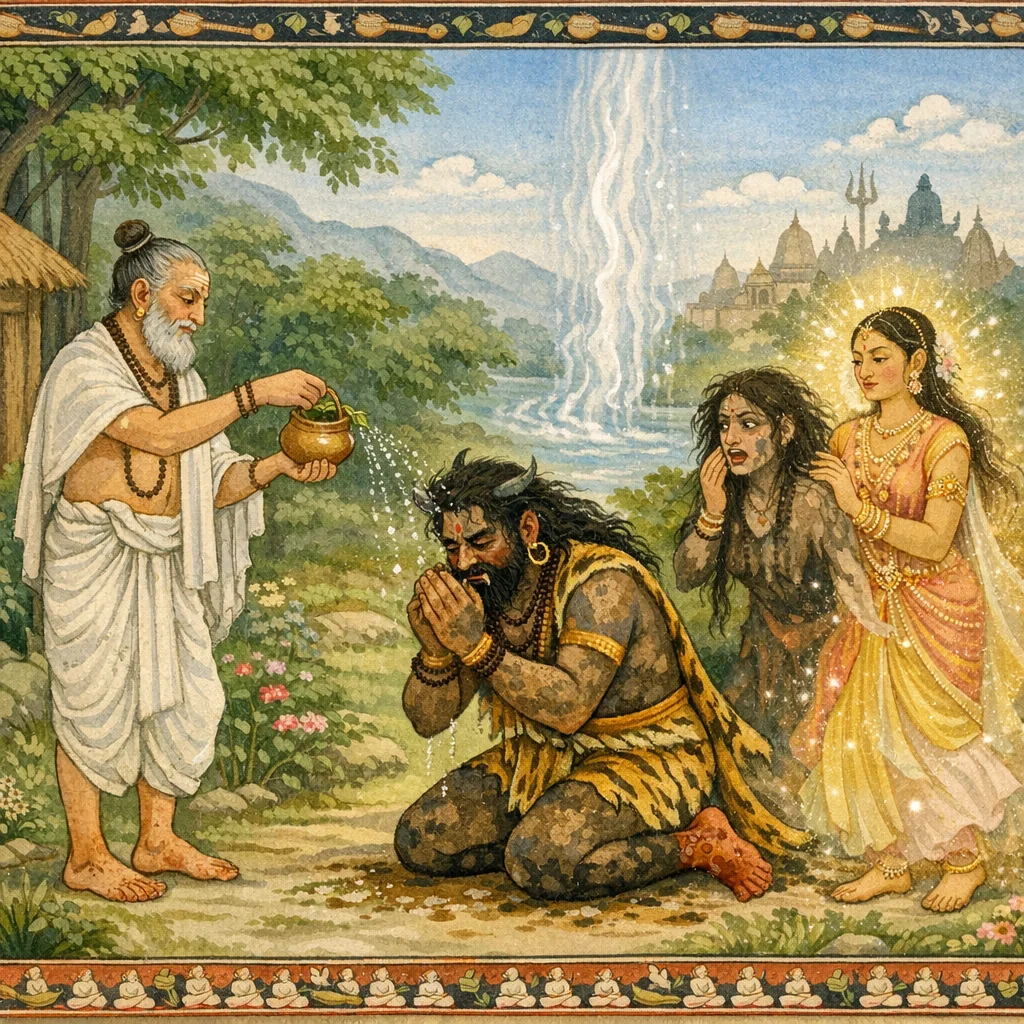
The Greatness of the Gaṅgā (Gaṅgā-māhātmya): Saudāsa/Kalmāṣapāda’s Curse and Release
Nārada asks Sanaka about King Saudāsa's curse and redemption. Sanaka narrates: The King killed a tigress (a rākṣasī), prompting her mate to seek revenge. Impersonating Vasiṣṭha, the demon tricked the King into offering meat. The real Vasiṣṭha cursed the King to become a rākṣasa. Restrained by Queen Madayantī, the King accepted the curse, his feet stained by curse-water (becoming Kalmāṣapāda). After suffering as a demon, he was purified by drops of Gaṅgā water brought by a righteous Brāhmaṇa. He then went to Vārāṇasī, worshipped Sadāśiva, and attained mokṣa through devotion to Hari.
Shlokas
Verse 1
नारद उवाच । शप्तः कथं वसिष्ठेन सौदासो नृपसत्तमः । गङ्गाबिन्दूभिषेकेण पुनः शुद्धोऽबवत्कथम् ॥ १ ॥
Nārada said: “How was King Saudāsa—the foremost among kings—cursed by Vasiṣṭha? And how did he become purified again through an ablution with drops of the Gaṅgā?”
Verse 2
सर्वमेतदशेषेण भ्रातर्मे वक्तुमर्हसि । श्रृण्वतां वदतां चैव गङ्गाख्यानं शुभावहम् ॥ २ ॥
O brother, you should relate all of this completely. For those who listen—and for those who recite as well—the narrative of the Gaṅgā is a bearer of auspiciousness.
Verse 3
सनक उवाच । सौदासः सर्वधर्मज्ञः सर्वज्ञो गुणवाञ्छुचिः । बुभुजे पृथिवीं सर्वां पितृवद्रञ्जयन्प्रजाः ॥ ३ ॥
Sanaka said: Saudāsa—knower of all dharma, discerning in all matters, virtuous and pure—ruled the whole earth, delighting his subjects as a father delights his children.
Verse 4
सगेरण यथा पूर्वं महीयं सप्तसागरा । रक्षिता तद्वदमुना सर्वधर्माविरोधिना ॥ ४ ॥
Just as in former times Sagara protected this earth—encircled by the seven oceans—so too did he protect it, acting in a manner that conflicted with no dharma.
Verse 5
पुत्रपौत्रसमायुक्तः सर्वैश्वर्यसमन्वितः । त्रिंशदष्टसहस्त्राणि बुभुजे पृथिवीं युवा ॥ ५ ॥
Endowed with sons and grandsons and possessed of every prosperity, the youthful king enjoyed and ruled the earth for thirty-eight thousand years.
Verse 6
सौदासस्त्वेकदा राजा मृगयाभिरतिर्वनम् । विवेज्ञ सबलः सम्यक् शोधितं ह्यासमन्त्रिभिः ॥ ६ ॥
Once, King Saudāsa—fond of the chase—entered the forest with his retinue, after it had been thoroughly searched and made secure by his ministers.
Verse 7
निषादैः सहितस्तत्र विनिघ्रन्मूगसंचयम् । आससाद नदीं रेवां धर्मज्ञः स पिपासितः ॥ ७ ॥
There, accompanied by Niṣādas and striking down a gathered multitude of deer, that knower of dharma—tormented by thirst—came upon the river Revā (Narmadā).
Verse 8
सुदासतनयस्तत्र स्नात्वा कृत्वाह्निकं मुने । भुक्त्वा च मन्त्रिभिः सार्ध्दं तां निशां तत्र चावसत् ॥ ८ ॥
O sage, there Sudāsa’s son bathed and performed his daily rites; then, having eaten together with his ministers, he spent that night there as well.
Verse 9
ततः प्रातः समुथाय कृत्वा पौर्वाह्णिकीं क्रियाम् । बभ्राम मन्त्रिसहितो नर्मदातीरजे वने ॥ ९ ॥
Then, rising early in the morning and having performed the forenoon rites, he wandered about—accompanied by his ministers—in the forest that lay on the banks of the Narmadā.
Verse 10
वनाद्वनान्तरं गच्छन्नेक एव महीपत्तिः । आकर्णकृष्टबाणः सत् कृष्णसारं समन्वगात् ॥ १० ॥
Moving alone from one forest tract to another, the lordly king—having drawn his arrow back to the ear—pursued the black antelope.
Verse 11
दूरसैन्योऽश्वमारूढः स राजानुव्रजन्मृगम् । व्याघ्रद्वयं गुहासंस्थमपश्थमपश्यत्सुरते रतम् ॥ ११ ॥
With his troops left far behind, mounted on horseback, the king chased the deer; and there he saw a pair of tigers dwelling in a cave—lying at ease and absorbed in sexual union.
Verse 12
मृगपृष्टं परित्यज्य व्याघ्रयोः संमुखं ययौ । धनुःसंहितबाणेन तेनासौ शरशास्त्रवित् ॥ १२ ॥
Abandoning the chase after the deer, he advanced straight toward the two tigers; and, with an arrow already set upon the bowstring, that expert in the science of missiles confronted them.
Verse 13
तां व्याघ्रीं पातयामास तीक्ष्णाग्रनतपर्वणा । पतमाना तु साव्याघ्री षट्रत्रिंशद्योजनायता ॥ १३ ॥
With a sharp-pointed, jointed weapon, he struck that tigress down. As she fell, that tigress—thirty-six yojanas in length—came crashing to the earth.
Verse 14
तडित्वद्धोरनिर्घोषा राक्षसी विकृताभवत् । पतितां स्वप्रियां वीक्ष्य द्विषन्स व्याघ्रराक्षसः ॥ १४ ॥
With a dreadful roar like a flash of lightning, the rākṣasī became hideously transformed. Seeing his beloved fallen, that tiger-like rākṣasa seethed with hatred and flared up fiercely.
Verse 15
प्रतिक्रियां करिष्यामीत्युक्तवा चांतर्दधे तदा । राजा तु भयसंविग्नो वनेसैन्यं समेत्य च ॥ १५ ॥
Saying, “I shall take counter-measures,” he then vanished from sight. But the king, shaken with fear, gathered his forest-troops as well.
Verse 16
तद्रृत्तं कथयन्सर्वान्स्वां पुरीं स न्यवर्त्तत । शङ्कमानस्तु तद्रक्षःकृत्या द्राजा सुदासजः ॥ १६ ॥
After relating that entire episode to everyone, he returned to his own city; yet King Sudās’s son remained apprehensive, fearing the rākṣasa’s witchcraft.
Verse 17
परितत्याज मृगयां ततः प्रभृति नारद । गते बहुतिथे काले हयमेधमखं नृपः ॥ १७ ॥
From that time onward, O Nārada, the king completely gave up the hunt. And when a long time had passed, the ruler undertook the great sacrificial rite of the Aśvamedha.
Verse 18
समारेभे प्रसन्नात्मा वशिष्टाद्यमुनीश्वरैः । तत्र ब्रह्मादिदेवेभ्यो हविर्दत्त्वा यथाविधि ॥ १८ ॥
With a serene and joyful heart, he began the rite in the company of the lordly sages headed by Vasiṣṭha; and there, having duly offered the sacred oblation (havis) to Brahmā and the other deities according to rule, he proceeded onward.
Verse 19
समाप्य यज्ञनिष्क्रांतो वशिष्टः स्नातकोऽपि च । अत्रान्तरे राक्षसोऽसौ नृपहिम्सितभार्यकः । कर्तुं प्रतिक्रियां राज्ञे समायातोरुषान्वितः ॥ १९ ॥
After completing the sacrifice, Vasiṣṭha—having also finished the purificatory bath of a snātaka—departed. Meanwhile, that rākṣasa, whose wife had been wronged by the king, arrived in a fury to exact retaliation upon the king.
Verse 20
स राक्षसस्तस्य गुरौ प्रयाते वशिष्टवेषं तु तदैव धृत्वा । राजानमभ्येत्य जगाद भोक्ष्ये मांसं समिच्छाम्यहमित्युवाच ॥ २० ॥
When the guru had departed, the rākṣasa at once assumed the guise of Vasiṣṭha. Approaching the king, he said, “I will eat; I desire meat,” and thus spoke.
Verse 21
भूयः समास्थाय स सूदवषं पक्त्वामिषं मानुपमस्य वादात् । स्थितश्च राजापि हरि यपात्रे धृत्वा गुरोरागमनं प्रतीक्षन् ॥ २१ ॥
Then, complying once again under the cook’s pressing insistence, he cooked meat. And the king too stood waiting for the guru’s arrival, holding the offering in a vessel used for presenting food.
Verse 22
तन्मांसं हेमपात्रस्थं सौदासो विनयान्वितः । समागताय गुरवे ददौ तस्मै ससादरम् ॥ २२ ॥
Then Saudāsa, endowed with humility, placed that flesh in a golden vessel and respectfully offered it to the guru who had arrived.
Verse 23
तं दृष्ट्वा चिन्तयामास गुरुः किमिति विस्मितः ॥ २३ ॥
Seeing him, the teacher—astonished—began to ponder: “What could be the reason for this?”
Verse 24
अपश्यन्मानुषं मासं परमेण समाधिना । अहोऽस्य राज्ञो दौःशील्यमभक्ष्यं दत्तवान्मम ॥ २४ ॥
For a whole human month I remained unaware, absorbed in the highest samādhi. Alas—what depravity in this king! He has given me what must not be eaten.
Verse 25
इति विरमयमापन्नः प्रमन्युरभवन्मुनिः । अभोऽज्यं मद्विघाताय दत्त हि पृथिवीपते ॥ २५ ॥
Having thus tried to restrain (him) and bring the matter to a close, the sage became deeply indignant: “Alas, O lord of the earth—indeed ghee has been given for my destruction!”
Verse 26
तस्मात्तवापि भवतु ह्येतदेव हि भोजनम् । नृमांसं रक्षसामेव भोज्यं दत्तं मम त्वया ॥ २६ ॥
Therefore, let this alone indeed be your food as well. Human flesh is food only for rākṣasas—it was given to me by you.
Verse 27
तद्याहि राक्षसत्वं त्वं तदाहारोचितं नृपा । इति शापं ददत्यस्मिन्सौदासो भयविह्वूलः ॥ २७ ॥
“Therefore, O king, you shall become a rākṣasa, fit only for that kind of food.” Saying thus, Saudāsa—overwhelmed with fear—pronounced this curse upon him.
Verse 28
आज्ञत्पो भवतैवेति सकंपोऽस्म व्यजिज्ञपत् । भूश्च चिन्तयामास वशिष्टस्तेन नोदितः ॥ २८ ॥
“Indeed, I have been commanded by you,” he submitted, trembling. And the Earth-goddess Bhū began to reflect, while Vasiṣṭha—thus prompted by him—also contemplated the matter.
Verse 29
रक्षसा वंचितं भूपं ज्ञातवान् दिव्यचक्षुषा । राजापि जलमादाय वशिष्टं शप्तुमुद्यतः ॥ २९ ॥
With his divine sight he came to know that the king had been deceived by a rākṣasa. The king too, taking water in his hand, was about to curse Vasiṣṭha.
Verse 30
समुद्यतं गुरुं शप्तं दृष्ट्वा भूयो रुपान्वितम् । मदयंती प्रियातस्य प्रत्युवाचाथ सुव्रता ॥ ३० ॥
Seeing the venerable one—who had risen up and was uttering a curse—again endowed with form, the virtuous lady Madayantī, beloved of him, then replied.
Verse 31
मदयंत्युवाच । भो भो क्षत्रियदायाद कोप संहर्तुमर्हसि । त्वया यत्कर्म भोक्तव्यं तत्प्रात्पं नात्र संशयः ॥ ३१ ॥
Madayantī said: “O heir of the Kṣatriyas, restrain your anger. Whatever deed is to be experienced as its result by you—this has already come to you; of this there is no doubt.”
Verse 32
गुरु तुम्कृत्य हुंम्कृत्य यो वदेन्मृढधीर्नरः । अरण्ये निर्जले देश स भवेद्बुह्यराक्षसः ॥ ३२ ॥
That foolish-minded man who addresses his guru with contemptuous noises—uttering “tum” and “hum”—is reborn as a Buhya-rākṣasa, dwelling in a waterless region of the forest.
Verse 33
जितेन्द्रिया जितक्रोधा गुरु शुश्रूषणे रताः । प्रयान्ति ब्रह्मसदनमिति शास्त्रेषु निश्चयः ॥ ३३ ॥
Those who have conquered the senses, subdued anger, and delight in devoted service to the guru attain the abode of Brahmā—this is the settled conclusion of the śāstras.
Verse 34
तयोक्तो भूपतिः कोपं त्यक्त्वा भार्यां ननन्द च । जलं कुत्र क्षिपामीति चिन्तयामास चात्मना ॥ ३४ ॥
Thus addressed by them, the king cast off his anger and was pleased with his wife; and within himself he pondered, “Where shall I pour out (dispose of) this water?”
Verse 35
तज्जलं यत्र संसिक्तं तद्भवेद्भस्म निश्चितम् । इति मत्वा जलं तत्तु पादयोर्न्यक्षिपत्स्वयम् ॥ ३५ ॥
Wherever that water was sprinkled, it certainly turned to ash. Understanding this, he himself poured that very water upon his own feet.
Verse 36
तज्जलस्पर्शमात्रेण पादौ कल्माषतां गतौ । कल्माषपाद इत्येवं ततः प्रभृति विस्तृतः ॥ ३६ ॥
By the mere touch of that water, his feet became darkened and stained; thus, from that time onward, he was widely known as “Kalmāṣapāda” (the one with blemished feet).
Verse 37
कल्माषपादो मतिमान् प्रिययाश्चासितस्तदा । मनसा सोऽतिभीतस्तु ववन्दे चरणं गुरोः ॥ ३७ ॥
Then Kalmāṣapāda, though intelligent, was swayed by his beloved; terrified in his mind, he bowed down at the feet of his guru.
Verse 38
उवाच च प्रपन्नस्तं प्राञ्जलिर्नयकोविदः । क्षमस्व भगवन्सर्वं नापराधः कृतो मया ॥ ३८ ॥
The wise one, having taken refuge in Him and standing with folded hands, spoke: “O Bhagavān, Blessed Lord, forgive everything; no offense has been committed by me.”
Verse 39
तच्छुत्वोवाच भूपालं मुनिर्निःश्वस्य दुःखितः । आत्मानं गर्हयामास ह्यविवेकपरायणम् ॥ ३९ ॥
Hearing that, the sage—sorrowful and sighing—spoke to the king and began to reproach himself, for he had been devoted to lack of discernment.
Verse 40
अविवेको हि सर्वेषामापदां परमं पदम् । विवेकरहितो लोके पशुरेव न संशयः ॥ ४० ॥
Indeed, lack of discernment is the ultimate breeding-ground of all calamities. One who is devoid of discrimination in this world is, without doubt, no better than an animal.
Verse 41
राज्ञा त्वजानता नूनमेतत्कर्मोचितं कृतम् । विवेकरहितोऽज्ञोऽहं यतः पापं समाचरेत् ॥ ४१ ॥
Indeed, this act was done by the king without understanding what was proper. I am ignorant and devoid of discernment, for I have proceeded to commit sin.
Verse 42
विवेकनियतो याति यो वा को वापि निर्वृत्तिम् । इत्युक्तवा चात्मनात्मानं प्रत्युवाच मुनिर्नृपम् । नात्यन्तिंकं भवेदेतद्दादशाब्दं भविष्यति ॥ ४३ ॥
“Whoever is disciplined by viveka reaches nirvṛtti (cessation, serene withdrawal).” Having said this, the sage replied to the king from the standpoint of the Ātman: “This will not be final; it will last for twelve years.”
Verse 43
गङ्गाबिन्दूभिषिक्तस्तु त्यक्त्त्वा वै राक्षसीं तनुम् । पूर्वरुपं त्वमापन्नो भोक्ष्यसे मेदिनीमिमाम् ॥ ४४ ॥
But when you are sprinkled with drops of the sacred Gaṅgā, you will surely abandon this rākṣasa-form. Regaining your former appearance, you shall rule and enjoy this very earth.
Verse 44
तद्बिंदुसेकसंभूतज्ञानेन गतकल्मषः । हरिसेवापरो भूत्वा परां शान्तिं गमिष्यसि ॥ ४५ ॥
By the knowledge born of that sprinkling of drops, your impurities will be removed; becoming wholly devoted to the service of Hari, you will attain supreme peace.
Verse 45
इत्युक्त्वाथर्वविद्भूपं वशिष्टः स्वाश्रमं ययौ । राजापि दुःखसंपन्नो राक्षसीं तानुमाश्रितः ॥ ४६ ॥
Having said this, Vasiṣṭha—knower of the Atharva-veda—departed to his own hermitage. And the king too, overwhelmed with sorrow, fell under a rākṣasī-like condition, a demonic state of being.
Verse 46
क्षुत्पपासाविशेषार्तो नित्यं क्रोधपरायणः । कृष्णक्षपाद्युतिर्भीमो बभ्राम विजने वने ॥ ४७ ॥
Afflicted intensely by hunger and thirst, ever given over to anger, Bhīma—dark-hued like the radiance of a black night—wandered about in a lonely forest.
Verse 47
मृगांश्च विविधांस्तत्र मानुषांश्च सरीसृपान् । विहङ्गमान्प्लवङ्गांश्च प्रशस्तांस्तानभक्षयत् ॥ ४८ ॥
There he did not eat the many kinds of deer, nor humans, nor reptiles; he also refrained from eating birds and monkeys—those creatures worthy of regard.
Verse 48
अस्थिभिर्बहुभिर्भूयः पीतरक्तकलेवरैः । रक्तान्तप्रेतकेशैशअच चित्रासीद्भूर्भयंकरी ॥ ४९ ॥
Again and again the earth appeared terrifying—strewn with many bones, with bodies yellowed and blood-stained, and with ghostly hair matted and smeared with blood, forming a dreadful spectacle.
Verse 49
ऋतुत्रये स पृथिवीं शतयो जनविस्तृताम् । कृत्वातिदुःखितां पश्चाद्वनान्तरमुपागमत् ॥ ५० ॥
Over a period of three seasons, he made the earth—spreading across hundreds of yojanas and filled with multitudes of people—exceedingly afflicted; thereafter, he went into the depths of a forest.
Verse 50
तत्रापि कृतवान्नित्यं नरमांसाशनं सदा । जगाम नर्मदातीरं मुनिसिद्धनिषेवितम् ॥ ५१ ॥
Even there, he continued constantly—day after day—to eat human flesh. Then he went to the bank of the Narmadā, a place frequented and revered by sages and perfected beings (siddhas).
Verse 51
विचरन्नर्मदातीरे सर्वलोकभयंकरः । अपश्यत्कंचन मुनिं रमन्तं प्रियया सह ॥ ५२ ॥
While wandering along the bank of the Narmadā, he—terrifying to all the worlds—saw a certain sage, delighting together with his beloved.
Verse 52
क्षुधानलेन संतत्पस्तं मुनिं समुपाद्रवत् । जाग्राह चातिवेगेन व्याधो मृगशिशं यथा ॥ ५३ ॥
Scorched by the fire of hunger, he rushed at the sage and, with great speed, seized him—just as a hunter seizes a young deer.
Verse 53
ब्राह्मणी स्वपतिं वीक्ष्य निशाचरकरस्थितम् । शिरस्यञ्जलिमाधाय प्रोवाच भयविह्वला ॥ ५४ ॥
Seeing her own husband held fast in the grasp of a night-roaming rākṣasa, the brāhmaṇa woman, trembling with fear, placed her joined palms upon her head and spoke.
Verse 54
ब्राह्मण्युवाच । भो भो नृपतिशार्दूल त्राहि मां भयविह्वलाम् । प्राणप्रिय प्रदानेन कुरु पूर्णं मनोरथम् ॥ ५५ ॥
The brāhmaṇa woman said: “O mighty tiger among kings—save me, for I tremble with fear. By granting me what is dearer than life itself, fulfill my wish completely.”
Verse 55
नाम्ना मित्रसहस्त्वं हि सूर्यवंशसमुद्भवः । न राक्षसस्ततोऽनाथां पाहि मां विजने वने ॥ ५६ ॥
Truly, by name you are “Mitra-saha”—a friend to thousands—and you are born of the Solar dynasty. You are not a rākṣasa; therefore protect me, helpless, here in this lonely forest.
Verse 56
या नारी भर्त्तृरहिता जीवत्यपि मृतोपमा । तथापि बालवैधव्यं किं वक्ष्याम्यरिमर्दन ॥ ५७ ॥
A woman without her husband is, though living, as if dead. Even so, what can I say of widowhood in childhood, O slayer of foes?
Verse 57
न मातापितरौ जाने नापि बंधुं च कंचन । पतिरेव परो बंधुः परमं जीवनं मम ॥ ५८ ॥
“I recognize neither mother nor father, nor any other relative at all. My husband alone is my supreme kinsman—indeed, he is my very life.”
Verse 58
भवान्येत्त्यखिलान्धर्मान्योषितां वर्त्तनं यथा । त्रायस्व बन्धुरहितां बालापत्यां जनेश्वर ॥ ५९ ॥
O Lord of the people, come and teach me the whole range of dharmas—how a woman should rightly conduct herself; protect me, who am without kin and burdened with a young child.
Verse 59
कथं जीवामि पत्यास्मिन्हीना हि विजने वने । दुहिताहं भगवतस्त्राहि मां पतिदानतः ॥ ६० ॥
“How can I live, deprived of my husband, in this lonely forest? I am the daughter of the Lord—save me, O revered one, and give me to a husband.”
Verse 60
प्रणदानात्परं दानं न भूतं न भविष्यति । वदन्तीति महाप्राज्ञाः प्राणदानं कुरुष्व मे ॥ ६१ ॥
The great wise ones declare: “No gift has ever been, nor will ever be, higher than the gift of protection.” Therefore, grant me the gift of life—save me.
Verse 61
इत्युक्तावा सा पपातास्य राक्षसस्य पदाग्रतः । एवं संप्रार्थ्यमानोऽपि ब्राह्मण्या राक्षसो द्विजम् ॥ ६२ ॥
Having spoken thus, she fell at the feet of that rākṣasa. Yet, even though the brāhmaṇa woman earnestly implored him, the rākṣasa still seized the twice-born man.
Verse 62
अभक्षयकृष्णसारशिशुं व्याघ्रो यथा बलात् ॥ ६२ ॥
Just as a tiger, by sheer force, seizes a fawn of the blackbuck (kṛṣṇasāra) as its prey.
Verse 63
ततो विलप्य बहुधा तस्य पत्नी पतिव्रता । पूर्वशापहतं भूपमशपत्क्रोधिता पुनः ॥ ६३ ॥
Then, after lamenting in many ways, his devoted wife—angered again—cursed the king, who had already been struck down by a former curse.
Verse 64
पतिं मे सुरतासक्तं यस्माद्धिंसितवान्बलात् । तस्मात्स्त्रीसङ्गमं प्रात्पस्त्वमपि प्राप्स्यसे मृतिम् ॥ ६४ ॥
Because you violently harmed my husband while he was absorbed in amorous pleasure, therefore—having fallen into association with women—you too shall meet death.
Verse 65
शप्त्वैवं ब्राह्मणी क्रुद्धा पुनः शापान्तरं ददौ । राक्षसत्वं ध्रुवं तेऽस्तु मत्पतिर्भक्षितो यतः ॥ ६५ ॥
Having thus cursed (him), the enraged brāhmaṇa woman again pronounced another curse: “Since my husband has been devoured, may you certainly become a rākṣasa.”
Verse 66
सोऽपि शापद्वयं श्रुत्वा तया दत्तं निशाचरः । प्रमन्युः प्राहि विसृजन्कोपादङ्गारसंचयम् ॥ ६६ ॥
Hearing the twofold curse uttered by her, that night-ranger too—Pramanyu—spoke, casting off the heap of burning embers that had arisen from his wrath.
Verse 67
दुष्टे कस्मात्प्रदत्तं मेवृथा शापद्वयं त्वया । एकस्यैवापराधस्य शापस्त्वेको ममोचितः ॥ ६७ ॥
O wicked one, why have you vainly given me a double curse? For a single offence, only one curse is fitting for me.
Verse 68
यस्मात्क्षिपसि दुष्टाग्येमयि शापन्तरं ततः । पिशाचयोनिमद्यैव याहि पुत्रसमन्विता ॥ ६८ ॥
Because you, wicked woman, cast yet another curse upon me, therefore—together with your son—go this very day into the womb of a piśāca, a ghoulish being.
Verse 69
तेनैवं ब्रह्मणी शत्पा पिशाचत्वं तदा गता । क्षुधार्ता सुस्वरं भीमारुरोदापत्यसंयुता ॥ ६९ ॥
Thus, by the power of that curse, Śatpā, in Brahmā’s presence, became a piśācī. Tormented by hunger, fearsome and loud-voiced, she wailed bitterly together with her offspring.
Verse 70
राक्षसश्च पिशाची च क्रोशन्तौ निर्जने वने । जग्मतुर्नर्मदातीरे वनं राक्षससेवितम् ॥ ७० ॥
A rākṣasa and a piśācī, crying out in a desolate forest, went to a woodland on the bank of the Narmadā, a place frequented by rākṣasas.
Verse 71
औदासीन्यं गुरौ कृत्वा राक्षसीं तनुमाश्रितः । तत्रास्ते दुःखसंतत्पः कश्चिल्लोकविरोधकृत् ॥ ७१ ॥
Having shown indifference toward his teacher, he took on a rākṣasa-like nature. There he remains, scorched by unceasing sorrow—one who acts in opposition to the world and the righteous order of dharma.
Verse 72
राक्षसं च पिशाचीं च दृष्ट्वा रववटमागतौ । उवाच क्रोधबहुलो वटस्थो ब्रह्मराक्षसः ॥ ७२ ॥
Seeing the rākṣasa and the piśācī arrive at the banyan tree, the brahmarākṣasa who dwelt upon that tree, filled with anger, spoke.
Verse 73
किमर्थमागतौ भीमौ युवां मत्स्थानमीप्सितम् । ईदृशौ केन पापेन जातौ मे ब्रुवतां ध्रुवम् ॥ ७३ ॥
“For what purpose have you two, dreadful in appearance, come here—desiring my abode? By what sin were you born in such a state? Tell me the truth with certainty.”
Verse 74
सौदासस्तद्वचः श्रुत्वातया यच्चात्मना कृतम् । सर्वं निवेदयित्वास्मै पश्चादेतदुवाच ह ॥ ७४ ॥
Saudāsa, having heard those words, disclosed to him everything that had been done—both by her and by himself—and afterwards spoke as follows.
Verse 75
सौदास उवाच । कस्त्वं वद महाभाग त्वया वै किं कृतं पुरा । सख्युर्ममाति स्नेहेन तत्सर्वं वक्तुमर्हसि ॥ ७५ ॥
Saudāsa said: “O greatly fortunate one, tell me—who are you, and what did you do in former times? Out of deep affection for me, as a friend, you should rightly recount all of that.”
Verse 76
करोति वञ्चनं मित्रे यो वा को वापि दुष्टधीः । स हि पापपालं भुंक्ते यातनास्तु युगायुतम् ॥ ७६ ॥
Whoever—any person of wicked understanding—deceives a friend, surely partakes of the fruit of sin and endures torments for tens of thousands of ages.
Verse 77
जन्तूनां सर्वदुःखानि क्षीयन्ते मित्रदर्शनात् । तस्मान्मित्रेषु मतिमान्न कुर्याद्वंचनं कदा ॥ ७७ ॥
All the sufferings of living beings diminish upon seeing a true friend; therefore, a wise person should never deceive friends at any time.
Verse 78
कल्माषपादेनेत्युक्तो वटस्थो ब्रह्मराक्षसः । उवाच प्रीतिमापन्नो धर्मवाक्यानि नारद ॥ ७८ ॥
Thus addressed by Kalmāṣapāda, the Brahma-rākṣasa dwelling upon the banyan tree became pleased and spoke words of Dharma to Nārada.
Verse 79
ब्रह्मराक्षस उवाच । अहमासं पुरा विप्रो मागधो वेदपारगः । सोमदत्त इति ख्यातो नाम्ना धर्मपरायणः ॥ ७९ ॥
The Brahma-rākṣasa said: “Formerly I was a brāhmaṇa of Magadha, fully versed in the Vedas. I was known as Somadatta, devoted to righteousness.”
Verse 80
प्रमत्तोऽहं महाभाग विद्यया वयसा धनैः । औदासीन्यं गुरोः कृत्वा प्रात्पवानीदृशीं गतिम् ॥ ८० ॥
O greatly fortunate one, I grew heedless through learning, youth, and wealth; having treated my guru with indifference, I have now fallen into such a state.
Verse 81
नलभेऽहं सुखं किं चिज्जिताहारोऽतिदुःखितः । मया तु भक्षिता विप्राः शतशोऽथ सहस्रशः ॥ ८१ ॥
I find no happiness at all; though I restrain my food, I am exceedingly afflicted. Truly, I have devoured brāhmaṇas—by the hundreds, even by the thousands.
Verse 82
क्षुत्पिपासापरो नित्यमन्तस्तापेन पीडितः । जगत्रासकरो नित्यं मांसाशनपरायणः ॥ ८२ ॥
Ever driven by hunger and thirst, tormented by inner anguish, he continually becomes a source of fear to the world and remains devoted to eating flesh.
Verse 83
गुर्ववज्ञा मनुष्याणां राक्षसत्वप्रदायिनी । मयानुभूतमेतद्धि ततः श्रीमान्न चाचरेत् ॥ ८३ ॥
Disrespect toward one’s guru causes a human being to sink into a rākṣasa-like, demonic disposition. I have personally experienced this truth; therefore, the wise and fortunate should never commit it.
Verse 84
कल्माषपाद उवाच । गुरुस्तु कीदृशः प्रोक्तः कस्त्वयाश्लाघितः पुरा । तद्वदस्व सरवे सर्वं परं कौतूहलं हि मे ॥ ८४ ॥
Kalmāṣapāda said: “What kind of guru has been described as the ideal, and who was formerly praised by you? Tell me everything in full, for my curiosity is intense.”
Verse 85
ब्रह्मराक्षस उवाच । गुरवः सन्ति बहवः पूज्या वन्द्याश्च सादरम् । यातानहं कथयिष्यामि श्रृणुष्वैकमनाः सरवे ॥ ८५ ॥
The Brahmarākṣasa said: “There are many gurus, worthy of reverent worship and respectful salutations. I shall speak of those whom I have approached—listen, all of you, with single-pointed attention.”
Verse 86
अध्यापकश्च वेदानां वेदार्थयुतिबोधकः । शास्त्रवक्ता धर्मवक्ता नीतिशास्त्रोपदेशकः ॥ ८६ ॥
He is a teacher of the Vedas, who makes the Vedas’ meaning understood through sound reasoning; a proclaimer of the śāstras, a speaker on dharma, and an instructor in nīti-śāstra, the science of polity and ethics.
Verse 87
मन्त्रोपदेशव्याख्याख्याकृद्वेदसदंहहृत्तथा । व्रतोपदेशकश्चैव भयत्रातान्नदो हि च ॥ ८७ ॥
He gives mantra-instructions and their explanations, bestowing sacred renown; he removes sins even of those devoted to the Veda; he also teaches vratas (holy vows), rescues from fear, and indeed provides food.
Verse 88
श्वशुरो मातुलश्चैव ज्येष्ठभ्राता पिता तथा । उपनेता निषेक्ता च संस्कर्त्ता मित्रसत्तम ॥ ८८ ॥
The father-in-law, the maternal uncle, the eldest brother, and the father; likewise the giver of Upanayana (the sacred-thread initiation), the begetter, and the performer of the purificatory saṃskāras—these are indeed the noblest of friends.
Verse 89
एते हि गुरवः प्रोक्ताः पूज्या वन्द्यश्च सादरम् ॥ ८९ ॥
These indeed are declared to be the true gurus; they should be worshipped and respectfully saluted with sincere reverence.
Verse 90
कल्माषपाद उवाच । गुरवो बहवः प्रोक्ता एतेषां कतमो वरः । तुल्याः सर्वेऽप्युत सरवे तद्यथावद्धि ब्रूहि मे ॥ ९० ॥
Kalmāṣapāda said: “Many kinds of teachers have been spoken of. Among them, which one is the best? Or are they all indeed equal? Tell me correctly, as it truly is.”
Verse 91
ब्रह्मराक्षस उवाच । साधु साधु महाप्राज्ञ यत्पृष्टं तद्वदामि ते । गुरुमाहात्म्यकथनं श्रवणं चानुमोदनम् ॥ ९१ ॥
The Brahmarākṣasa said: “Well said, well said, O greatly wise one. What you have asked, that I shall tell you: the recounting of a guru’s greatness, the hearing of it, and the approving, joyful assent (anumodana).”
Verse 92
सर्वेषां श्रेय आधत्ते तस्माद्वक्ष्यामि सांप्रतम् । एते समानपूजार्हाः सर्वदा नात्र संशयः ॥ ९२ ॥
Since this brings the highest good for all, I shall now explain it. These teachers are always equally worthy of reverence—of this there is no doubt.
Verse 93
तथापि श्रुणु वक्ष्यामि शास्त्राणां सारनिश्चयम् । अध्यापकाश्च वेदानां मन्त्रव्याख्याकृतस्तथा ॥ ९३ ॥
Even so, listen: I shall declare the settled essence of the śāstras—namely, the teachers of the Vedas, and likewise those who compose explanations of the Vedic mantras.
Verse 94
पिता च धर्मवक्ता च विशेषगुरवः स्मृताः । एतेषामपि भूपाल श्रृणुष्व प्रवरं गुरुम् ॥ ९४ ॥
The father and the expounder of Dharma are remembered as special kinds of gurus. Yet, O king, listen to the most excellent guru even among these.
Verse 95
सर्वशास्त्रार्थतत्वज्ञैर्भाषितं प्रवदामि ते । यः पुराणानि वदति धर्मयुक्तानि पणडितः ॥ ९५ ॥
I shall declare to you what has been spoken by those who know the true purport and principles of all the śāstras: the learned one who expounds the Purāṇas in harmony with Dharma is indeed a paṇḍita.
Verse 96
संसारपाशविच्छेदकरणानि स उत्तमः । देवपूजार्हकर्माणि देवतापूजने फलम् ॥ ९६ ॥
That discipline is the highest, for it cuts the bonds of saṃsāra. And deeds worthy of worship of the devas yield their fruit through the worship of the deities.
Verse 97
जायते च पुराणेभ्यस्तस्मात्तानीह देवताः । सर्ववेदार्थसाराणि पुराणानीति भूपते ॥ ९७ ॥
And indeed, from the Purāṇas the devas (and the knowledge of them) arise; therefore, O king, the Purāṇas here are the very essence of the meaning of all the Vedas.
Verse 98
वदन्ति मुनयश्चैव तदूक्ता परमो गुरुः । यः संसारार्णत्वं तर्त्तुमुद्योगं कुरुते नरः ॥ ९८ ॥
So declare the sages, and so has the supreme Guru taught: the one who, with earnest striving, endeavors to cross the ocean of saṃsāra is truly fit for deliverance.
Verse 99
श्रुणुयात्स पुराणानि इति शास्त्रविभागकृत् । प्रोक्तवान्सर्वधर्माश्च पुराणेषु महीपते ॥ ९९ ॥
“Let him listen to the Purāṇas”—thus declared the arranger of the divisions of sacred learning; and in the Purāṇas, O king, he expounded in full all the duties of dharma.
Verse 100
तर्कस्तु वादहेतुः स्यान्नीतिस्त्वैहिकसाधनम् । पुराणानि महाबुद्धे इहामुत्र सुखाय हि ॥ १०० ॥
Reasoning (tarka) is the ground of debate, and nīti—ethical conduct and polity—is a means to worldly success; but the Purāṇas, O great-minded one, are truly for happiness both here and hereafter.
Verse 101
यः श्रृणोति पुराणानि सततं भक्तिसंयुतः । तस्य स्यान्निर्मला बुद्धिर्भूयो धर्मपरायणः ॥ १ ॥
Whoever continually listens to the Purāṇas with devotion—his intellect becomes purified, and he becomes ever more devoted to dharma.
Verse 102
पुराणश्रवणाद्भक्तिर्जायते श्रीपतौ शुभा । विष्णुभक्तनृणां भूप धर्मे बुद्धिः प्रवर्त्तते ॥ २ ॥
By listening to the Purāṇa, auspicious devotion arises toward Śrīpati, the Lord of Lakṣmī. O king, in those who are devotees of Viṣṇu, the intellect becomes actively inclined toward dharma.
Verse 103
धर्मात्पापानि नश्यन्ति ज्ञानं शुद्धं च जायते । धर्मार्थकाममोक्षाणां ये फलान्यभिलिप्सवः ॥ ३ ॥
Through dharma, sins are destroyed and pure knowledge arises. Those who seek dharma’s fruits—artha, kāma, and mokṣa—should take refuge in dharma.
Verse 104
श्रुणुयुस्ते पुराणानि प्राहुरित्थं पुराविदः । अहं तु गौतममुनेः सर्वज्ञाद्ब्रह्यवादिनः ॥ ४ ॥
The knowers of ancient lore said they would listen to your Purāṇas in this very manner. But I received them from the sage Gautama—omniscient, a true expounder of Brahman.
Verse 105
श्रुतवान्सर्वधर्मार्थ गङ्गातीरे मनोरमे । कदाचित्परमेशस्य पूजां कर्त्तुमहं गतः ॥ ५ ॥
Having learned the purport of all dharmas, on the delightful bank of the Gaṅgā I once went forth to perform worship of the Supreme Lord.
Verse 106
उपस्थितायापि तस्मै प्रणामं न ह्यकारिषम् । स तु शान्तो महाबुद्धिर्गौतमस्तेजसां निधिः ॥ ६ ॥
Even though he came and stood before me, I did not offer him a bow. Yet Gautama—peaceful, of great intelligence, a treasury of spiritual radiance—remained composed.
Verse 107
मन्त्रोदितानि कर्मणि करोतीतिमुदं ययौ । यस्त्वर्चितो मया देवः शिवः सर्वजगद्गुरुः ॥ ७ ॥
He rejoiced, thinking, “He performs the rites exactly as enjoined by the mantras.” For the deity whom I worshipped is Lord Śiva, the guru of the entire world.
Verse 108
गुर्ववज्ञा कृतायेन राक्षसंत्वे नियुक्तवान् । ज्ञानतोऽज्ञानतो वापि योऽवज्ञां कुरुते गुरोः ॥ ८ ॥
Whoever has shown contempt toward the guru is assigned to the state of a rākṣasa. Whether knowingly or unknowingly, one who disrespects the teacher incurs this grave consequence.
Verse 109
तस्यैवाशु प्रणश्यन्ति धीविद्यार्थात्मजक्रियाः । शुश्रूषां कुरुते यस्तु गुरुणां सादरं नरः ॥ ९ ॥
For such a person, understanding, learning, prosperity, children, and the fruit of one’s actions quickly perish—if he serves the gurus only outwardly, with showy reverence.
Verse 110
तस्य संपद्भवेद्भूप इति प्राहुर्विपश्चितः । तेन शापेन दग्धोऽहमन्तश्चैव क्षधाग्निना ॥ १० ॥
The wise declare, “O king, prosperity will come to him.” Yet by that very curse I have been scorched—within as well—by the fire of hunger.
Verse 111
मोक्षं कदा प्रयास्यामि न जाने नृपसत्तम । एवं वदति विप्रेन्द्र वटस्थेऽस्मिन्निशाचरे ॥ ११ ॥
“When will I attain liberation (mokṣa)? I do not know, O best of kings.” Thus spoke the foremost of brāhmaṇas, while staying here beneath this banyan tree in the night.
Verse 112
धर्मशास्त्रप्रसंगेन तयोः पापं क्षयं गतम् । एतस्मिन्नन्तरे प्राप्तः कश्चिद्विप्रोऽतिधार्मिकः ॥ १२ ॥
Through their discussion of Dharmaśāstra, the sin of those two was brought to exhaustion. Meanwhile, in that very interval, a certain brāhmaṇa—exceedingly righteous—arrived.
Verse 113
कलिङ्गदेशसम्भूतो नान्म्रा गर्ग इति स्मृतः । वहन्गङ्गाजलं स्कंधे स्तुवन् विश्वेश्वरं प्रभुम् ॥ १३ ॥
Born in the land of Kaliṅga, he was remembered as Garga, also known by the name Nānmrā. Bearing the water of the Gaṅgā upon his shoulder, he went on praising Lord Viśveśvara, the supreme Master.
Verse 114
गायन्नामानि तस्यैव मुदा हृष्टतनू रुहः । तमागतं मुनिं दृष्ट्वा पिशाचीराक्षसौ च तौ ॥ १४ ॥
Singing the Names of that very Lord in gladness, their bodies thrilled with joy. And seeing the sage arrive, those two—a Piśācī and a Rākṣasa—turned their attention toward him.
Verse 115
प्राप्तं नः पारणेत्युक्त्वा प्राद्ववन्नूर्ध्वबाहवः । तेन कीर्तितनामानि श्रुत्वा दूरे व्यवस्थिताः । अशक्तास्तं धर्षयितुमिदमूचुश्च राक्षसाः ॥ १५ ॥
Crying, “We have obtained our pāraṇa—the breaking of the fast!”, they rushed forward with arms raised. But on hearing the Names he was chanting, they kept their distance. Unable to assail him, the rākṣasas then spoke these words.
Verse 116
अहो विप्र महाभाग नमस्तुभ्यं महात्मने । नामकीर्तनमाहात्म्याद्राक्षसा दूरगावयम् ॥ १६ ॥
O fortunate brāhmaṇa, salutations to you, great-souled one. By the power and glory of kīrtana—chanting the Divine Name—we rākṣasas are compelled to remain far away.
Verse 117
अस्माभिर्भक्षिताः पूर्वं विप्राः कोटिसहस्रशः । नामप्रावरणं विप्र रक्षति त्वां महाभयात् ॥ १७ ॥
“In the past we have devoured brāhmaṇas by tens of thousands and by crores. Yet, O brāhmaṇa, the protective covering of the Divine Name shields you from great terror.”
Verse 118
नामश्रवणमात्रेण राक्षसा अपि भो वयम् । परां शान्तिं समापन्ना महिम्ना ह्यच्युतस्य वै ॥ १८ ॥
O sage, even we—though Rākṣasas—by the mere hearing of the Holy Name have attained supreme peace, solely through the glory of Acyuta, the Unfailing Lord.
Verse 119
सर्वथा त्वं महाभाग रागादिरुहितोह्यसि । गंगाजलाभिषेकेण पाह्यस्मात्पातकोच्चयात् ॥ १९ ॥
O greatly fortunate one, in every way you are truly free from passion and the like. Yet, by the ablution with the waters of the Gaṅgā, protect us from this accumulated mass of sins.
Verse 120
हरिसे वापरो भूत्वा यश्चात्मानं तु तारयेत् । स तारयेज्जगत्सर्वमिति शंसन्ति सूरयः ॥ २० ॥
The sages proclaim: whoever becomes wholly devoted to Hari and thereby rescues his own self—he indeed becomes one who can deliver the entire world.
Verse 121
अवहाय हरेर्नाम घोरसंसारभेषजम् । केनोपायेन लभ्येत मुक्तिः सर्वत्र दुर्लभा ॥ २१ ॥
If one casts aside the Name of Hari—the medicine for the dreadful disease of worldly existence—then by what means could liberation, so hard to obtain everywhere, ever be attained?
Verse 122
लोहोडुपेन प्रतरन्निमजत्युदके यथा । ततैवाकृतपुण्यास्तु तारयन्ति कथं परान् ॥ २२ ॥
Just as one who tries to cross water on an iron boat sinks, so too those who have not amassed merit—how could they possibly ferry others across?
Verse 123
अहो चरित्रं महतां सर्वलोकसुखा वहम् । यथा हि सर्वलोकानामानन्दाय कलानिधिः ॥ २३ ॥
Ah, wondrous indeed is the conduct of the great: it bears happiness for all worlds, just as the moon—treasury of nectar-like rays—exists for the delight of all beings.
Verse 124
पृथिव्यां यानि तीर्थानि पवित्राणि द्विजोत्तम् । तानि सर्वाणि गङ्गायाः कणस्यापि समानि न ॥ २४ ॥
O best of the twice-born, all the sacred and purifying pilgrimage places on earth are not equal even to a single particle of the River Gaṅgā.
Verse 125
तुलसीदलप्रदलसंम्मिश्रमपि सर्षपमात्रकम् । गङ्गाजलं पुनात्येव कुलानामेकविंशतिम् ॥ २५ ॥
Even a mustard-seed-sized amount of Gaṅgā water, mixed with Tulasi leaves and petals, indeed purifies twenty-one generations of a family.
Verse 126
तस्माद्विप्र महाभाग सर्वशास्त्रार्थकोविद । गङ्गाजलप्रदानेन पाह्मस्मान्पापकर्मिणः ॥ २६ ॥
Therefore, O blessed brāhmaṇa—knower of the purport of all śāstras—by the gift of Gaṅgā water, protect us who are engaged in sinful deeds.
Verse 127
इत्याख्यातं राक्षसैस्तैर्गङ्गामाहात्म्यमुत्तमम् । निशम्य विस्मया विष्टो बभूव द्विजसतमः ॥ २७ ॥
Thus, those rākṣasas narrated the supreme greatness of the Gaṅgā. Hearing it, the foremost of the twice-born was overwhelmed with amazement.
Verse 128
एषामपीद्दशी भक्तिर्गङ्गायां लोकमातरि । किमु ज्ञानप्रभावाणां महतां पुण्यशालिनाम् ॥ २८ ॥
If even such people have devotion of this kind toward Gaṅgā, the Mother of the worlds, then what need be said of the great and meritorious, whose power is born of spiritual knowledge?
Verse 129
अथासौ मनसा धर्मं विनिश्चित्य द्विजोत्तमः । सर्वपूतहितो भक्तः प्राप्नोतीति परं पदम् ॥ २९ ॥
Then that best of the twice-born, having firmly ascertained dharma in his mind, becomes a devotee intent on the welfare of all beings—and thus attains the supreme state.
Verse 130
ततो विप्रः कृपाविष्टो गङ्गाजलप्रनुत्तममम् । तुलसीदलसंमिश्रं तेषु रक्षःस्वसेचयत् ॥ ३० ॥
Then the brāhmaṇa, moved by compassion, sprinkled upon those rākṣasas the most excellent water of the Gaṅgā, mixed with tulasī leaves.
Verse 131
राक्षसास्तेन सिक्तास्तु सर्षपोपमबिंदुना । विमृज्य राक्षसं भावमभवन्देवतोपमाः ॥ ३१ ॥
But when those rākṣasas were sprinkled with that drop—no larger than a mustard seed—they wiped away their demonic disposition and became like the gods.
Verse 132
ब्राह्मणी पुत्र सम्यक्ते जग्मुर्हस्तथैव च । कोटिसूर्यप्रतीकाशा बभूवुर्विवुधर्पभाः ॥ ३२ ॥
That brāhmaṇa woman and her son then departed at once. All around, the splendor of the celestial beings shone forth, radiant like tens of millions of suns.
Verse 133
शंखचक्रगदाचिह्ना हरिसारुप्यमागताः । स्तुवंतो ब्राह्मणं सम्यक्ते जग्मुर्हरिमन्दिरम् ॥ ३३ ॥
Marked with the emblems of the conch, discus, and mace, they attained likeness to Hari; and, duly praising that brāhmaṇa, they went to the temple of Hari.
Verse 134
राजा कल्माषपादस्तु निजरुपं समास्थितः । जगाम महतीं चिन्तां दृष्ट्वा तान्मुक्तिगानधान् ॥ ३४ ॥
But King Kalmāṣapāda, having regained his own true form, fell into deep concern on seeing those sages intent upon the song of liberation (mokṣa).
Verse 135
तस्मिन् राज्ञि सुदुःखार्ते गूढरुपा सरस्वती । धर्ममूलं महावाक्यं बभाषेऽगाधया गिरा ॥ ३५ ॥
When that king was tormented by intense sorrow, Sarasvatī—concealed in form—spoke a profound, foundational maxim of Dharma in a voice of unfathomable depth.
Verse 136
भो भो राजन्महाभाग न दुःखं गन्तुमर्हसि । राजस्तवापि भोगान्ते महच्छ्रेयो भविष्यति ॥ ३६ ॥
O noble king, do not go into grief. Even for you, O king, when the enjoyment of worldly pleasures comes to its end, a great good—true welfare—will arise.
Verse 137
सत्कर्मधूतपापा ये हरिभक्तिपरायणाः । प्रयान्ति नात्र संदेहस्तद्विष्णोः परमं पदम् ॥ ३७ ॥
Those whose sins have been washed away by righteous deeds, and who are wholly devoted to Hari through bhakti—without any doubt—attain that supreme abode of Viṣṇu.
Verse 138
सर्वभूतदयायुक्ता धर्ममार्गप्रवर्तिनः । प्रयान्ति परमं स्थानं गुरुपूजापरायणाः ॥ ३८ ॥
Those endowed with compassion for all beings, who set others upon the path of dharma, and who are devoted to the worship of the Guru, attain the Supreme Abode.
Verse 139
इतीरितं समाकर्ण्य भारत्या नृपसतमः । मनसा निर्वृत्तिं प्राप्यसस्मार च गुरोर्वचः ॥ ३९ ॥
Having thus heard what Bhāratī had spoken, the best of kings attained inward peace in his mind, and he then remembered the words of his guru.
Verse 140
स्तुवन्गुरुं च तं विग्नं हरिं चैवातिहर्षितः । पीर्ववृत्तं च विप्राय सर्वं तस्मै न्यवेदयत् ॥ ४० ॥
Overjoyed, he praised his teacher and that remover of obstacles—Hari—and then reported to the brāhmaṇa everything that had happened before.
Verse 141
ततो नृपस्तु कालिंगं प्रणम्य विधिर्वमुने । नामानि व्याहरन्विष्णोः सद्यो वाराणसीं ययौ ॥ ४१ ॥
Then the king—Kāliṅga—bowed down to the sage Vidhirvamuni; and, uttering the names of Viṣṇu, he immediately set out for Vārāṇasī.
Verse 142
षण्मासं तत्र गङ्गायां स्नात्वा दृष्ट्वा सदाशिवम् । ब्राह्मणीदत्तश पात्तु मुक्तो मित्रसहोऽभवत् ॥ ४२ ॥
After bathing in the Gaṅgā there for six months and beholding Sadāśiva, he was released from bondage. Protected by the gift given by a brāhmaṇī, he became one accompanied by a friend.
Verse 143
ततस्तु स्वपुरीं प्राप्तो वसिष्ठेन महात्मना । अभिषिक्तो मुनुश्रेष्ट स्वकं राज्यमपालयत् ॥ ४३ ॥
Then, having returned to his own capital with the great-souled Vasiṣṭha, the best of sages was consecrated by abhiṣeka and thereafter protected and governed his own kingdom.
Verse 144
पालयित्वा महीं कृत्स्त्रां भुक्त्वा भोगान्स्त्रियं विना । वशिष्टात्प्राप्य सन्तानं गतो मोक्षं नृपोत्तमः ॥ ४४ ॥
Having protected the entire earth and enjoyed royal pleasures without attachment to women, that best of kings—after obtaining progeny through Vasiṣṭha—attained liberation (mokṣa).
Verse 145
नैतच्चित्रं द्विजश्रेष्ट विष्णोर्वाराणसीगुणान् । गृणञ्छृण्वन्स्मरन्गङ्गां पीत्वा मुक्तो भवेन्नरः ॥ ४५ ॥
This is not at all surprising, O best of the twice-born: in Vārāṇasī, by praising, hearing, and remembering the virtues of Viṣṇu, and by drinking the water of the Gaṅgā, a man becomes liberated.
Verse 146
तस्मान्माहिम्ने विप्रेन्द्र गङ्गायाः शक्यते नहि । पारं गन्तुं सुराधीशैर्ब्रह्मविष्णुशिवरपि ॥ ४६ ॥
Therefore, O best of brāhmaṇas, the greatness of the Gaṅgā cannot be fully reached or comprehended—even by the lords of the gods, and even by Brahmā, Viṣṇu, and Śiva.
Verse 147
यन्नामस्मरणादेव महापातककोटिभिः । विमुक्तो ब्रह्मसदनं नरो याति न संशयः ॥ ४७ ॥
By the mere remembrance of her Name (Gaṅgā), a man is freed from crores of great sins and goes to the abode of Brahmā—of this there is no doubt.
Verse 148
गङ्गा गङ्गेति यन्नाम सकृदप्युच्यते यदा । तदैव पापनिमुक्तो ब्रह्मलोके महीयते ॥ ४८ ॥
When the name “Gaṅgā, Gaṅgā” is uttered even once, at that very moment one is freed from sin and is honored in the world of Brahmā.
Verse 149
इति श्रीबृहन्नारदीयपुराणे पूर्वभागे प्रथमपादे गङ्गा माहात्म्ये नवमोऽध्यायः ॥ ९ ॥
Thus ends the Ninth Chapter, “The Greatness of the Gaṅgā,” in the First Pāda of the Pūrva-bhāga of the sacred Bṛhan-Nāradīya Purāṇa.
Frequently Asked Questions
Gaṅgā-jala functions as a śāstric prāyaścitta and a bhakti-saturated purifier: even a mustard-seed-sized drop (with tulasī) reverses rākṣasa/piśāca identity, exhausts accumulated pāpa, and reorients the redeemed toward Hari. The narrative frames Gaṅgā not merely as a river but as a salvific medium that operationalizes mokṣa-dharma.
Guru-apacāra is presented as a root cause of spiritual and social collapse: it precipitates demonic rebirth (brahmarākṣasa state), destroys learning and prosperity, and distorts discernment. Conversely, guru-sevā and restraint of anger are shown as stabilizing forces that preserve dharma and enable purification.
The king’s restoration culminates in Vārāṇasī and Gaṅgā practice: bathing, remembrance/praise of Viṣṇu, and darśana of Sadāśiva are treated as convergent liberative acts. The text thus aligns tīrtha-yātrā with bhakti and inner purification as a complete mokṣa-dharma pathway.