Manvantaras and Indras; Sudharmā’s Liberation through Viṣṇu-Pradakṣiṇā; Supremacy of Hari-Bhakti
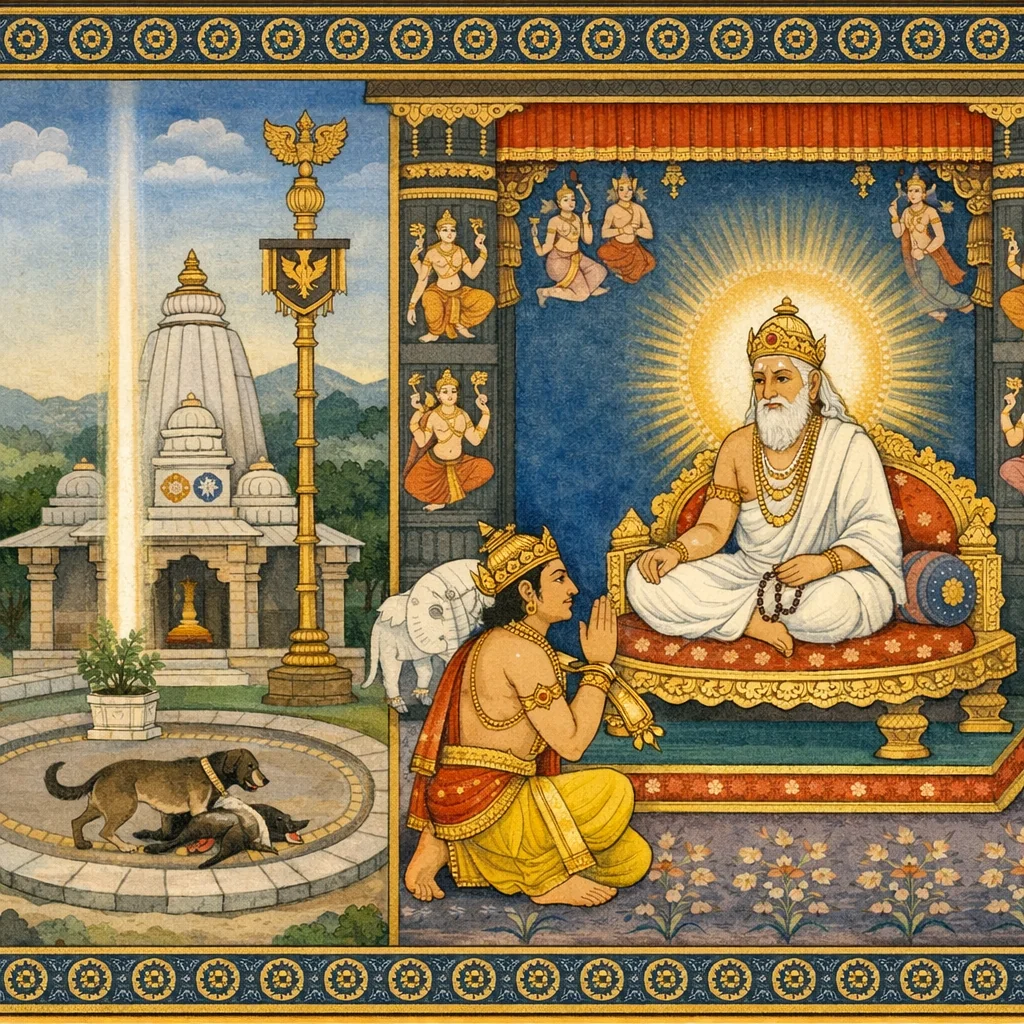
Sanaka introduces a Vaiṣṇava hymn whose hearing and singing destroy sins. He recalls an ancient dialogue: Indra, amid celestial pleasures, asks Bṛhaspati about creation in a former Brahmā-kalpa and the true nature and duties of Indra and the gods. Bṛhaspati admits the limits of his knowledge and directs Indra to Sudharmā, a being descended from Brahmaloka dwelling in Indra’s city. In Sudharmā’s assembly hall, Indra seeks the account of the past kalpa and the means by which Sudharmā attained superiority. Sudharmā explains Brahmā’s day (1000 caturyugas) and lists the fourteen Manus, their corresponding Indras, and various deva-gaṇas across the manvantaras, stressing the recurring pattern of cosmic administration. He then tells his own former birth: a sinful vulture slain near Viṣṇu’s temple; a dog carried him while circling the shrine, inadvertently performing pradakṣiṇā, and thus both attained the supreme state. The chapter ends with the declared fruit of bhakti: even mechanical circumambulation yields great merit; intentional worship and constant remembrance of Nārāyaṇa remove sins, end rebirth, and grant Viṣṇu’s abode; hearing or reciting this teaching equals the merit of an Aśvamedha.
Shlokas
Verse 1
सनक उवाच । अतः परं प्रवक्ष्यामि विभूतिं वैष्णवीं मुने । यां श्रृण्वतां कीर्तयतां सद्यः पापक्षयो भवेत् ॥ १ ॥
Sanaka said: “Now, O sage, I shall expound the Vaiṣṇava vibhūti—the sacred glory of Viṣṇu’s divine manifestations; by hearing it and singing it in praise, sins are destroyed at once.”
Verse 2
वैवस्वतेंऽतरे पूर्वं शक्रस्य च बृहस्पतेः । संवादः सुमहानासीत्तं वक्ष्यामि निशामय ॥ २ ॥
Before the Vaivasvata Manvantara, there once occurred a most exalted dialogue between Śakra (Indra) and Bṛhaspati. Listen attentively; I shall now recount it.
Verse 3
एकदा सर्वभोगाढ्यो विबुधैः परिवारितः । अप्सरोगणसंकीर्णो बृहस्पतिमभाषत ॥ ३ ॥
Once, abounding in every enjoyment and surrounded by the gods—amid a throng of apsarās—he addressed Bṛhaspati.
Verse 4
इन्द्र उवाच । बृहस्पते महाभाग सर्वतत्त्वार्थकोविद । अतीतब्रह्मणः कल्पे सृष्टिः कीदृग्विधा प्रभो ॥ ४ ॥
Indra said: “O Bṛhaspati, greatly fortunate one, knower of the meaning of all tattvas—O Lord, what was creation like in Brahmā’s former kalpa?”
Verse 5
इन्द्रस्तु कीदृशः प्रोक्तो विवुधाः कीदृशाः स्मृताः । तेषां च कीदृशं कर्म यथावद्वक्तुमर्हसि ॥ ५ ॥
Please explain, in proper order and with accuracy: what kind of being Indra is said to be, what is meant by the gods (vivudhas), and what duties and actions (karma) are assigned to them.
Verse 6
बृहस्पतिरुवाच । न ज्ञायते मया शक्र पूर्वेद्युश्चरितं विधेः । वर्तमानदिनस्यापि दुर्ज्ञेयं प्रतिभाति मे ॥ ६ ॥
Bṛhaspati said: O Śakra, I do not know even what the Ordainer (Brahmā) did yesterday; even the events of this very day appear difficult for me to comprehend.
Verse 7
मनवः समतीताश्च तान्वक्तुमपि न क्षमः । यो विजानाति तं तेऽद्य कथयामि निशामय ॥ ७ ॥
The Manus have already passed away, and I am not even able to recount them. Yet he who truly knows them—I shall speak of him to you today; listen with full attention.
Verse 8
सुधर्म इति विख्यातः कश्चिदास्ते पुरे तव । भुञ्जानो दिव्यभोगांश्च ब्रह्मलोकादिहागतः ॥ ८ ॥
In your city there dwells a certain one renowned as Sudharma—enjoying celestial delights, having come here from Brahmaloka.
Verse 9
स वा एत द्विजानाति कथयामि निशामय । एवमुक्तस्तु गुरुणा शक्रस्तेन समन्वितः ॥ ९ ॥
That teaching is indeed known to the twice-born (dvija); I shall explain it—listen attentively. Thus addressed by his guru, Śakra proceeded onward, accompanied by him.
Verse 10
देवतागणसंकीर्णः सुधर्मनिलयं ययौ ॥ १० ॥
Surrounded by hosts of gods, he proceeded to Sudharmā—the divine hall of assembly.
Verse 11
समागतं देवपतिं बृहस्पतिसमन्वितम् । दृष्ट्वा यथार्हं देवर्षे पूजयामास सादरम् ॥ ११ ॥
Seeing the lord of the gods arrive, accompanied by Bṛhaspati, the divine sage received him with due honor and worshipped him respectfully.
Verse 12
सुधर्मेणार्चितः शंक्रो दृष्ट्वा तच्छ्रियमुत्तमाम् । मनसा विस्मयाविष्टः प्रोवाच विनयान्वितः ॥ १२ ॥
Honoured by Sudharmā, Śaṅkara, seeing that supreme splendour, became inwardly filled with wonder and, with humility, spoke.
Verse 13
इंद्र उवाच । अतीतब्रह्मकल्पस्य वृत्तांतं वेत्सि चेद्बुध । तदाख्याहि समायात एतत्प्रष्टुं सयाजकः ॥ १३ ॥
Indra said: “O wise one, if you know the account of the past Brahmā-kalpa, then tell it. I have come here together with my priests to ask you about this.”
Verse 14
गतनिद्रांश्च देवांश्च येन जानासि सुव्रत । तद्वदस्वाधिकः कस्मादस्मद्भ्योऽपि दिवि स्थितः ॥ १४ ॥
O you of excellent vows, tell us that truth by which you know the gods who have awakened from sleep. And explain: who is that superior one, dwelling in heaven, who is greater even than us?
Verse 15
तेजसायशसा कीर्त्या ज्ञानेन च परंतप । दानेन वा तपोभिर्वा कथमेतादृशः प्रभो ॥ १५ ॥
O scorcher of foes, by what means—by spiritual radiance, by renown, by fame, by knowledge, by charity, or by austerities—does one become such as you, O Lord?
Verse 16
इत्युक्तो देवराजेन सुधर्मा प्रहसंस्तदा । प्रोवाच विनयाविष्टः पूर्ववृत्तं यथाविधि ॥ १६ ॥
Thus addressed by the king of the gods, Sudharmā then smiled and—filled with humility—recounted the earlier events in due and proper order.
Verse 17
सुधर्म उवाच । चतुर्युगसहस्त्राणि ब्रह्मणो दिनमुच्यते । एकस्मिन् दिवसे शक्र मनवश्च चतुर्दश ॥ १७ ॥
Sudharma said: A thousand cycles of the four yugas are declared to constitute a single day of Brahmā. O Śakra (Indra), within one such day there are fourteen Manus.
Verse 18
इंद्राश्चतुर्दश प्रोक्ता देवाश्च विविधाः पृथक् । इंद्राणां चैव सर्वेषां मन्वादीनां च वासव ॥ १८ ॥
Fourteen Indras are declared, and the gods are of many kinds, each distinct. And for all those Indras—as well as for the Manus and the rest—(the ruler is) Vāsava.
Verse 19
तुल्यता तेजसा लक्ष्म्या प्रभावेण बलेन च । तेषां नामानि वक्ष्यामि श्रृणुष्व सुसमाहितः ॥ १९ ॥
Equal in radiance, in fortune, in influence, and in strength—now I shall declare their names; listen with a fully collected mind.
Verse 20
स्वायंभुवो मनुः पूर्वं ततः स्वारोचिषस्तथा । उत्तमस्तामसश्चैव रैवतश्चाक्षुषस्तथा ॥ २० ॥
First came Svāyambhuva Manu; after him likewise came Svārociṣa. Then followed Uttama and Tāmasa, and also Raivata and Cākṣuṣa.
Verse 21
वैवस्वतो मनुश्चैव सूर्यसावर्णिरष्टमः । नवमो दक्षसावर्णिः सर्वदेवहिते रतः ॥ २१ ॥
Vaivasvata is indeed the Manu of the present age; the eighth is Sūryasāvarṇi; and the ninth is Dakṣasāvarṇi, devoted to the welfare of all the gods.
Verse 22
दशमो ब्रह्मसावर्णिर्द्धर्मसावर्णिकस्ततः । ततस्तु रुद्रसावर्णी रोचमानस्ततः स्मृतः ॥ २२ ॥
The tenth Manu is Brahma-sāvarṇi; after him is Dharma-sāvarṇika. Then comes Rudra-sāvarṇi, and after him is remembered the Manu Rocamāna.
Verse 23
भौत्यश्चतुर्दशः प्रोक्त एते हि मनवः स्मृताः । देवानिंद्रांश्च वक्ष्यामि श्रृणुष्व विबुधर्षभ ॥ २३ ॥
Thus Bhautya is declared as the fourteenth; these indeed are remembered as the Manus. Now I shall also describe the gods and the Indras—listen, O best among the wise.
Verse 24
यामा इति समाख्याता देवाः स्वायंभुवेंऽतरे । शचीपतिः समाख्यातस्तेषामिंद्रो महापतिः ॥ २४ ॥
In the Manvantara of Svāyambhuva, the gods were known as the Yāmas; and Śacīpati, the lord of Śacī, was renowned as their Indra, the great chief.
Verse 25
पारावताश्च तुषिता देवाः स्वारोचिषेंऽतरे । विपश्चिन्नाम देवेन्द्रं सर्वसंपत्समन्वितः ॥ २५ ॥
In the Svārociṣa Manvantara, the gods were the Pārāvatas and the Tuṣitas; and the lord of the gods, Indra, was named Vipaścit, endowed with every prosperity.
Verse 26
सुधामानस्तथा सत्याः शिवाश्चाय प्रर्तदनाः । तेषामिंद्रः सुशांतिश्च तृतीये परिकीर्तितः ॥ २६ ॥
Likewise, there are the groups called the Sudhāmānas, the Satyas, the Śivas, and also the Prartadanas. Among them, the Indra is Suśānti, declared for the third group.
Verse 27
सुताः पाराहराश्चैव सुत्याश्चासुधियस्तथा । तेषामिंद्रः शिवः प्रोक्तः शक्रस्तामसकेंऽतरे । विभानामा देवपतिः पञ्चमः परिकीर्तितः ॥ २७ ॥
The Sutās, the Pārāharas, the Sutyas, and the Asudhiyas—among them, Śiva is declared to be the Indra; and in the interval of the Tāmasa Manvantara he is called Śakra. The deva-lord named Vibhā is proclaimed as the fifth.
Verse 28
अमिताभादयो देवाः षष्ठेऽपि च तथा श्रृणु । आर्याद्या विबुधाः प्रोक्तास्तेषामिंद्रो मनोजवः ॥ २८ ॥
Hear also of the sixth group: the gods beginning with Amitābha. The wise ones beginning with Ārya are declared there; among them, Manojava is the Indra (chief).
Verse 29
आदित्यवसुरुद्राद्या देवा वैवस्वतंऽतरे । इन्द्रः पुरंदरः प्रोक्तः सर्वकामसमन्वितः ॥ २९ ॥
In the Vaivasvata Manvantara, the gods are said to be the Ādityas, Vasus, Rudras, and others; and Indra is declared to be Purandara, endowed with the fulfillment of all desires.
Verse 30
अप्रमेयाश्च विबुधाः सुतपाद्याः प्रकीर्तिताः । विष्णुपूजाप्रभावेण तेषामिंद्रो बलिः स्मृतः ॥ ३० ॥
Those gods, proclaimed immeasurable—beginning with Sutapā—through the power of worship of Viṣṇu, are said to have Bali as their Indra (lord).
Verse 31
पाराद्या नवमे देवा इन्द्रश्चाद्भुत उच्यते । सुवासनाद्या विबुधा दशमे परिकीर्तिताः ॥ ३१ ॥
In the ninth group are the gods beginning with Pāra, and Indra is said to be ‘Adbhuta’ (the Wondrous). In the tenth group, the celestial beings beginning with Suvāsana are declared.
Verse 32
शांतिर्नाम च तत्रेंद्रः सर्वभोगसमन्वितः । विहंगॄमाद्या देवाश्च तेषामिंद्रो वृषः स्मृतः ॥ ३२ ॥
There, the lord (Indra) is named Śānti and is endowed with every enjoyment. The gods beginning with the celestial birds (Vihaṅgas) are under him; and their Indra is remembered as Vṛṣa.
Verse 33
एकादशे द्वादशे तु निबोधकथायामि ते । ऋभुनामा च देवेंद्रो हरिनाभास्तथा सुराः ॥ ३३ ॥
Now, regarding the eleventh and the twelfth, listen as I explain them to you: there is a Devendra named Ṛbhu, and likewise the gods called Harinābha.
Verse 34
सुत्रामाद्यास्तथा देवास्त्रयोदशतमेऽन्तरे । दिवस्पतिर्महावीर्यस्तेषामिंद्रः प्रकीर्तितः ॥ ३४ ॥
Likewise, in the thirteenth Manvantara, the gods beginning with Sutrāman are mentioned; and the mighty Divaspati is celebrated as their Indra.
Verse 35
चतुर्दशे चाक्षुपाद्या देवा इन्द्रः शुचिः स्मृतः । एवं ते मनवः प्रोक्ता इंद्रा देवाश्च तत्त्वतः ॥ ३५ ॥
In the fourteenth Manvantara, the gods are known as the Cākṣupas, and Śuci is remembered as Indra. Thus, in truth, the Manus, the Indras, and the hosts of devas have been declared to you.
Verse 36
एकस्मिन्ब्रह्यदिवसे स्वाधिकारं प्रभुंजते ॥ ३६ ॥
Within a single day of Brahmā, they enjoy and exercise their allotted authority and sphere of office.
Verse 37
लेकेषु सर्वसर्गेषु सृष्टिरेकविधा स्मृता । कर्त्तारो बहवः संति तत्संख्यां वेत्ति कोविदः ॥ ३७ ॥
In all worlds and in every cycle of creation, creation is remembered as one in essential nature. Yet the agents are many—who indeed knows their full number?
Verse 38
मयि स्थिते ब्रह्मलोके ब्रह्माणां बहवो गताः । तेषां संख्या न संख्यातु शक्तोऽस्म्यद्य द्विजोत्तम ॥ ३८ ॥
While I remain established in Brahmaloka, many Brahmās have passed away. Even today, O best of the twice-born, I am not able to count their number.
Verse 39
स्वर्गलोकमपि प्राप्य यावत्कालं श्रृणुष्व मे । चत्वारो मनवोऽतीता मम श्रीश्चातिविस्तरा ॥ ३९ ॥
Even if one attains Svargaloka, listen to me for as long as time allows. Four Manus have already passed, and my Śrī—my prosperity and auspicious splendor—has also been exceedingly vast.
Verse 40
स्थातव्यं च मयात्रैव युगकोटिशतं प्रभो । ततः परं गमिष्यामि कर्मभूमिं श्रृणुष्व मे ॥ ४० ॥
O Lord, I must remain right here for a hundred crores of yugas. After that, I shall depart for the realm where actions are performed. Listen to me.
Verse 41
मया कृतं पुरा कर्म वक्ष्यामि तव सुव्रत । वदतां श्रृण्वतां चैव सर्वपापप्रणाशनम् ॥ ४१ ॥
O you of excellent vow, I shall tell you of a deed I performed long ago—one that destroys all sins for those who recount it and for those who listen to it.
Verse 42
अहमांस पुरा शक्र गृध्रः पापो विशेषतः । स्थितश्च भूमिभागे वै अमेध्यामिषभोजनः ॥ ४२ ॥
Formerly, O Shakra (Indra), I was a vulture—especially sinful—dwelling upon the ground and living on impure flesh.
Verse 43
एकदाहं विष्णुगृहे प्राकारे संस्थितः प्रभो । पतितो व्याधशस्त्रेण सायं विष्णोर्गृहांगणे ॥ ४३ ॥
O Lord, once, while I was standing on the enclosing wall of Vishnu’s temple, in the evening I was struck down by a hunter’s weapon and fell into the courtyard of Vishnu’s shrine.
Verse 44
मयि कंठगतप्राणे भषणो मांसलोलुपः । जग्राह मां स्ववक्रेण श्वभिरन्यैश्चरन्द्रुतः ॥ ४४ ॥
When my life-breath had risen to my throat, Bhashana—greedy for flesh—seized me in his own jaws, while other dogs too tore at me.
Verse 45
वहन्मां स्वमुखेनैव भीतोऽन्यैर्भषणैस्तथा । गतः प्रदक्षिणा कारं विष्णोस्तन्मंदिरं प्रभो ॥ ४५ ॥
Carrying me in his own mouth, and frightened also by the threats and taunts of others, he went in pradakṣiṇā, circumambulating the temple of Lord Viṣṇu, O Lord.
Verse 46
तेनैव तुष्टिमापन्नो ह्यंतरात्मा जगन्मयः । मम चापि शुनश्चापि दत्तावन्परमं पदम् ॥ ४६ ॥
Pleased by that very act, the Inner Self—pervading the entire universe—was satisfied and granted the supreme state to me, and also to the dog.
Verse 47
प्रदक्षिणा कारतया गतस्यापीदृशं फलम् । संप्राप्तं विबुधश्रेष्ट किं पुनः सम्यगर्चनात् ॥ ४७ ॥
Even one who performs pradakṣiṇā only mechanically attains such a reward, O best among the gods; how much greater, then, is the fruit of proper worship performed in the right manner?
Verse 48
इत्युक्तो देवराजस्तु सुधर्मेण महात्मना । मनसा प्रीतिमापन्नो हरिपूजा रतोऽभवत् ॥ ४८ ॥
Thus addressed by the great-souled Sudharma, the king of the gods became inwardly delighted and devoted himself to the worship of Hari (Viṣṇu).
Verse 49
तथापि निर्जराः सर्वे भारते जन्मलिप्सवः । समर्चयंति देवेशं नारायणमनामयम् । तानर्चयन्ति सततं ब्रह्माद्या देवतागणाः ॥ ४९ ॥
Even so, all the deathless gods, longing to be born in Bhārata, worship the Lord of the gods—Nārāyaṇa, the flawless and free from disease. And those very gods are continually honored by the hosts of deities beginning with Brahmā.
Verse 50
नारायणानुस्मरणोद्यतानां महात्मनां त्यक्तपरिग्रहणाम् । कथं भवत्युग्रभवस्य बंधस्तत्सङ्गलुब्धा यदि मुक्तिभाजः ॥ ५० ॥
For the great souls ever intent on remembering Nārāyaṇa, and who have cast away possessiveness, how could there be bondage born of fierce worldly becoming? Even if drawn into such company, they remain sharers in liberation.
Verse 51
ये मानवाः प्रतिदिनं परिमुक्तसङ्गा नारायणं गरुडवाहनमर्चयंति । ते सर्वपापनिकरैः परितो विमुक्ता विष्णोः पदं शुभतरं प्रतियांति हृष्टाः ॥ ५१ ॥
Those who, day after day, free from worldly attachment, worship Nārāyaṇa—the Lord who rides Garuḍa—are wholly released from multitudes of sins, and, rejoicing, attain Viṣṇu’s supremely auspicious abode.
Verse 52
ये मानवा विगतरागपरावरज्ञा नारायणं सुरगुरुं सततं स्मरंति । ध्यानेन तेन हतकिल्बिषचेतनास्ते मातुः पयोधररसं न पुनः पिबंति ॥ ५२ ॥
Those humans who are free from attachment and who know the higher and the lower realities constantly remember Nārāyaṇa, the preceptor of the gods. By that meditation their consciousness is cleansed of sin, and they do not again drink milk from a mother’s breast (that is, they are not reborn).
Verse 53
ये मानवा हरिकथाश्रवणास्तदोषाः कृष्णांघ्रपद्मभजने रतचेतनास्च । ते वै पुंनति च जगंति शरीरसंगात् संभाषणादपि ततो हरिरेव पूज्यः ॥ ५३ ॥
Those whose faults are washed away by hearing the sacred narratives of Hari, and whose minds delight in bhajana at Kṛṣṇa’s lotus-feet—such persons truly purify the worlds. Even mere association and conversation with them sanctifies; therefore Hari alone is worthy of worship.
Verse 54
हरिपूजापरा यत्र महांतः शुद्धबुद्धयः । तत्रैव सकलं भद्रं यथा निम्ने जलं द्विज ॥ ५४ ॥
O twice-born one, wherever great souls of purified understanding are devoted to the worship of Hari, there alone all auspiciousness gathers—just as water naturally collects in low-lying ground.
Verse 55
हरिरेव परो बन्धुर्हरिरेव परा गतिः । हरिरेव ततः पूज्यो यतश्चेतन्यकारणम् ॥ ५५ ॥
Hari alone is the supreme kinsman; Hari alone is the highest refuge and goal. Therefore Hari alone is to be worshipped, for He is the very cause of consciousness.
Verse 56
स्वर्गापवर्गफलदं सदानंदं निरामयम् । पृज्यस्य मुनिश्रेष्ठ परं श्रेयो भविष्यति ॥ ५६ ॥
O best of sages, for one worthy of reverence, this teaching/practice becomes the highest good—granting the fruits of heaven and liberation, abiding in eternal bliss, and free from all affliction.
Verse 57
पूजयंति हरिं ये तु निष्कामाः शुद्धमानसाः । तेषां विष्णुः प्रसन्नात्मा सर्वान्कामान् प्रयच्छति ॥ ५७ ॥
Those who worship Hari with desireless intent and a purified mind—upon them Vishnu, pleased at heart, bestows every worthy fulfillment.
Verse 58
यस्त्वेतच्छृणुयाद्वापि पठेद्वा सुसमाहितः । स प्राप्नोत्यश्वमेधस्य फलं मुनिवरोत्तम ॥ ५८ ॥
Whoever, with steady concentration, listens to this teaching or recites it—O best of sages—attains the merit, the fruit, of the Aśvamedha sacrifice.
Verse 59
इत्येतत्ते समाख्यातं हरिपूजाफलं द्विज । संकोचविस्तराभ्यां तु किमन्यत्कथयामि ते ॥ ५९ ॥
Thus, O twice-born one, I have explained to you the fruit of worshipping Hari. Whether in brief or in detail, what more is there for me to tell you?
Frequently Asked Questions
It situates dharma and divine governance within cyclic cosmic time (manvantara-dharma), showing that offices like Manu and Indra are recurring roles within Brahmā’s day; this frames devotion and ritual merit as operating within a vast, ordered cosmology.
It teaches that contact with Viṣṇu’s temple and acts like pradakṣiṇā carry intrinsic devotional potency; even unintended performance can yield purification and uplift when oriented around Hari, while intentional worship is said to grant even greater fruit.
It repeatedly elevates Hari-bhakti—hearing Hari’s narratives, worship at Kṛṣṇa’s feet, desireless remembrance of Nārāyaṇa—as the direct cleanser of sin and the cause of freedom from rebirth, culminating in attainment of Viṣṇu’s abode.