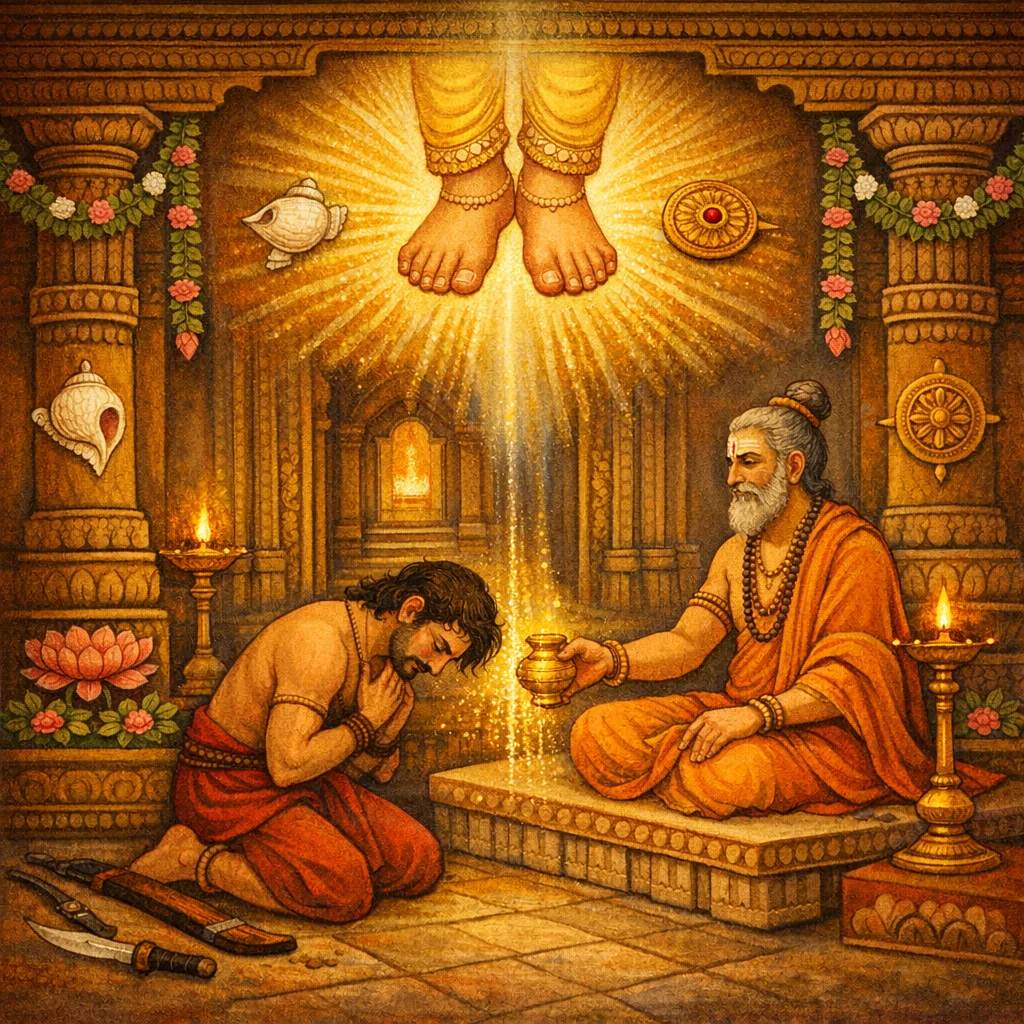
Hari-nāma Mahimā and Caraṇāmṛta: The Redemption of the Hunter Gulika (Uttaṅka Itihāsa)
Sanaka praises Kamalāpati/Viṣṇu, declaring that a single utterance of Hari’s Name destroys the sins of those deluded by sense-objects and possessiveness. He draws firm norms: homes without Hari-worship are like cremation grounds; hostility to the Vedas and hatred of cows and brāhmaṇas are rākṣasa-like; worship driven by malice ruins the worshipper; true bhaktas seek the world’s welfare and “embody Viṣṇu.” The chapter then recounts an ancient itihāsa: in Kṛta-yuga the violent sinner Gulika tries to rob Keśava’s temple and attacks the Vaiṣṇava sage Uttaṅka. Uttaṅka restrains him and teaches dharma on forbearance, the futility of possessive attachment, and the inevitability of daiva (destiny), stressing that only dharma/adharma follow one beyond death. Through satsaṅga and nearness to Hari, Gulika repents, confesses, dies, and is revived and purified by Viṣṇu’s foot-wash water (caraṇāmṛta). Freed from sin, he ascends to Viṣṇu’s abode, while Uttaṅka praises Mahāviṣṇu, concluding the bhakti-centered mokṣa-dharma teaching.
Shlokas
Verse 1
सनक उवाच । भूयः श्रृणुष्व विप्रेंद्र माहात्म्यं कमलापतेः । कस्य नो जायते प्रीतिः श्रोतुं हरिकथामृतम् ॥ १ ॥
Sanaka said: “O best of brāhmaṇas, listen again to the greatness of Kamalāpati, the Lord of Lakṣmī. Who would not rejoice to hear the nectar of Hari’s sacred narrations (Hari-kathā)?”
Verse 2
नराणां विषयान्धानां ममताकुलचेतसाम् । एकमेव हरेर्नाम सर्वपापप्रणाशनम् ॥ २ ॥
For those blinded by sense-objects and whose minds are troubled by possessive attachment, the one Name of Hari alone destroys all sins.
Verse 3
सकृद्वा न नमेद्यस्तु विष्णुं पापहरं नृणाम् । श्वपचं तं विजानीयात्कदाचिन्नालपेञ्च तम् ॥ ३ ॥
But whoever does not bow even once to Vishnu, the remover of human sin, should be known as a “dog-cooker” (an outcaste); one should never speak with him at any time.
Verse 4
हरिपूजाविहीनं तु यस्य वेश्म द्विजोत्तम । श्मशानसदृशं तद्धि कदाचिदपि नो विशेत् ॥ ४ ॥
O best of the twice-born, the house in which the worship of Hari is absent is indeed like a cremation ground; one should never enter it at any time.
Verse 5
हरिपूजाविहीनाश्च वेदविद्वेषिणस्तथा । गोद्विजद्वेषनिरता राक्षसाः परिकीर्त्तिताः ॥ ५ ॥
And those who are devoid of worship of Hari, who are hostile to the Veda, and who are intent on hatred toward cows and the twice-born—these are declared to be rākṣasas.
Verse 6
यो वा को वापि विप्रेन्द्र विप्रद्वेषपरायणः । समर्चयति गोविंदं तत्पूजा विफला भवेत् ॥ ६ ॥
O best of brāhmaṇas, whoever is devoted to hatred of brāhmaṇas—though he may worship Govinda with great reverence—finds that worship becomes fruitless.
Verse 7
अन्यश्रेयोविनाशार्थं येऽर्चयंति जनार्दनम् । सा पूजैव महाभाग पूजकानाशु हंति वै ॥ ७ ॥
Those who worship Janārdana with the aim of destroying another’s welfare—O greatly fortunate one—such worship itself swiftly destroys the worshippers.
Verse 8
हरिपूजाकरो यस्तु यदि पापं समाचरेत् । तमेव विष्णुद्वेष्टारं प्राहुस्तत्त्वार्त्थकोविदाः ॥ ८ ॥
If one who performs the worship of Hari nevertheless commits sin, the knowers of reality and true meaning declare that person to be, in truth, a hater of Viṣṇu.
Verse 9
ये विष्णुनिरताः संति लोकानुग्रहतत्पराः । धर्मकार्यरताः शश्वद्विष्णुरुपास्तु ते मताः ॥ ९ ॥
Those who are devoted to Viṣṇu, intent on the welfare of the world, and ever engaged in works of dharma—such people are regarded as verily embodying the very form of Viṣṇu.
Verse 10
कोटिजन्मार्दजितैः पुण्यैर्विष्णुभक्तिः प्रजायते । दृढभक्तिमतां विष्णौ पापबुद्धिः कथं भवेत् ॥ १० ॥
Devotion to Viṣṇu arises from merits accumulated over crores of lifetimes. For those whose devotion to Viṣṇu is firm, how could a sinful disposition even arise?
Verse 11
जन्मकोट्यर्जितं पापं विष्णुपूजारतात्मनाम् । क्षयं याति क्षणादेव तेषां स्यात्पापधीः कथम् ॥ ११ ॥
Sin accumulated over tens of millions of births is destroyed in an instant for those whose very being is devoted to the worship of Viṣṇu. How, then, could any notion of sin remain for them?
Verse 12
विष्णुभक्तिविहीना ये चंडालाः परिकीर्तिताः । चंडाला अपि वै श्रेष्ठा हरिभक्तिपरायणाः ॥ १२ ॥
Those who are devoid of devotion to Viṣṇu are spoken of as caṇḍālas; yet even caṇḍālas are truly the best when they are wholly devoted to Hari.
Verse 13
नराणां विषयांधानां सर्वदुःखविनाशिनी । हरिसेवेति विख्याता भुक्तिमुक्तिप्रदायिनी ॥ १३ ॥
For people blinded by sense-objects, it destroys every sorrow. It is renowned as “service to Hari,” and it bestows both worldly enjoyment (bhukti) and liberation (mukti).
Verse 14
संगात्स्नेहाद्भयाल्लोभादज्ञानाद्वापि यो नरः । विष्णोरुपासनं कुर्यात्सोऽक्षयं सुखमश्नुते ॥ १४ ॥
Whether out of association, affection, fear, greed, or even ignorance—any person who takes up the worship of Viṣṇu attains imperishable happiness.
Verse 15
हरिपादोदकं यस्तु कणमात्रं पिबेदपि । स स्नातः सर्वतीर्थेषु विष्णोः प्रियतरो भवेत् ॥ १५ ॥
Even if a person drinks only a single drop of the water that has washed the feet of Hari, he is regarded as having bathed in all sacred tīrthas, and he becomes especially dear to Viṣṇu.
Verse 16
अकालमृत्युशमनं सर्वव्याधिविनाशनम् । सर्वदुःखोपशमनं हरिपोदोदक स्मृतम् ॥ १६ ॥
The water that has washed the feet of Hari is remembered as that which pacifies untimely death, destroys all diseases, and brings the cessation of every sorrow.
Verse 17
नारायणं परं धाम ज्योतिषां ज्योतिरुत्तमम् । ये प्रपन्ना महात्मानस्तेषां मुक्तिर्हि शाश्वती ॥ १७ ॥
Nārāyaṇa is the supreme abode, the highest Light among all lights. For the great-souled who have surrendered to Him, liberation is indeed eternal.
Verse 18
अत्राप्युदाहरंतीममितिहासं पुरातनम् । पठतां श्रृण्वतां चैव सर्वपापप्रणाशनम् ॥ १८ ॥
Here too, I shall cite this ancient tradition (itihāsa). For those who read it and for those who listen to it, it becomes a destroyer of all sins.
Verse 19
आसीत्पुरा कृतयुगे गुलिको नाम लुब्धकः । परदारपरद्रव्यहरणे सततोद्यतः ॥ १९ ॥
In ancient times, during the Kṛta Yuga, there lived a hunter named Gulika, who was constantly intent on abducting other men’s wives and stealing other people’s wealth.
Verse 20
परनिंदापरो नित्यं जन्तूपद्रवकृत्तथा । हतवान्ब्राह्मणान् गाश्च शतशोऽथ सहस्रशः ॥ २० ॥
He was ever intent on slandering others, and he habitually caused injury to living beings; he had also killed brāhmaṇas and cows—by the hundreds, even by the thousands.
Verse 21
देवस्वहरणे नित्यं परस्वहरणे तथा । उद्युक्तः सर्वदा विप्र कीनाशानामधीश्वरः ॥ २१ ॥
O brāhmaṇa, the lord of the farmers is ever intent on seizing what belongs to the gods, and likewise on taking what belongs to others—always engaged in such appropriation.
Verse 22
तेन पापान्यनेकानि कृतानि सुमहांति च । न तेषां शक्यते वक्तुं संख्या वत्सरकोटिभिः ॥ २२ ॥
By that conduct, countless sins—indeed most grievous—were committed; their number cannot be told even in crores of years.
Verse 23
स कदाचिन्महापापो जंतृनामन्तकोपमः । सौवीरराज्ञो नगरं सर्वैश्वर्यसमन्वितम् ॥ २३ ॥
Once, that great sinner—terrible to living beings like Death itself—came to the city of the king of Sauvīra, endowed with every prosperity and royal splendor.
Verse 24
योषिद्धिर्भूषितार्भिश्च सरोभिनिर्मलोदकैः । अलंकृतं विपणिभिर्ययो देवपुरोपमम् ॥ २४ ॥
It was adorned with bands of women and ornamented maidens, with lakes of crystal-pure water, and embellished with marketplaces—so that it appeared like a city of the gods.
Verse 25
तस्योपवनमध्यस्थं रम्यं केशवमंदिरम् । छदितं हेमकलशैर्दृष्ट्वा व्याधो मुदं ययौ ॥ २५ ॥
In the midst of that grove stood the lovely temple of Keśava, its roof crowned with golden finials; seeing it, the hunter was filled with joy.
Verse 26
हराम्यत्र सुवर्णानि बहूनीति विनिश्चितम् । जगामाभ्यंतरं तस्य कीनाशश्चौर्यलोलुपः ॥ २६ ॥
Resolving, “I shall steal much gold here,” the farmer—greedy for theft—went into the interior of that place.
Verse 27
तत्रापश्यद्द्विजवरं शांतं तत्त्वार्थकोविदम् । परिचर्यापरं विष्णोरुत्तंकं तपसां निधिम् ॥ २७ ॥
There he beheld the foremost of the twice-born—serene, deeply learned in the true purport of reality—Uttaṅka, wholly devoted to the service of Viṣṇu, a very treasury of austerities.
Verse 28
एकाकिनं दयासुं च निस्पृहं ध्यानलोलुपम् । चौर्यान्तरायकर्तारं तं दृष्ट्वा लुब्धको मुने ॥ २८ ॥
O sage, seeing him alone—compassionate, free from craving, and absorbed in meditation—the hunter realized this man would hinder his thieving and took notice of him.
Verse 29
द्रव्यजातं तु देवस्य हर्तुकामोऽतिसाहसी । उत्तंकं हंतुमारेभे विधृतासिर्मदोद्धतः ॥ २९ ॥
Craving to seize the deity’s wealth, the exceedingly rash man—his sword drawn and swollen with arrogance—began to attack Uttaṅka with intent to kill.
Verse 30
पादेनाक्रम्य तद्वक्षो जटाः संगृह्य पाणिना । हंतुं कृतमतिं व्याधमुत्तंकः प्रेक्ष्य चाब्रवीत् ॥ ३० ॥
Setting his foot upon the hunter’s chest and clutching him by the matted locks with his hand, Uttaṅka—intent on killing the hunter—looked at him and spoke.
Verse 31
उत्तंक उवाच । भो भो साधो वृथा मां त्वं हनिष्यसि निरागसम् । मया किमपराद्धं ते तद्वदस्व महामत्ते ॥ ३१ ॥
Uttaṅka said: “O good sir, you will kill me in vain, though I am without fault. What offense have I committed against you? Tell me that, O greatly deluded one.”
Verse 32
कृतापराधिनां लोके शक्ताः शिक्षां प्रकुर्वते । नहि सौम्य वृथा घ्नंति सज्जना अपि पापिनः ॥ ३२ ॥
In this world, even those who have committed offenses can be corrected through discipline. O gentle one, even the virtuous do not strike down sinners without cause.
Verse 33
विरोधिष्वपि मूर्खेषु निरीक्ष्यावस्थितान् गुणान् । विरोधं नहि कुर्वंति सज्जनाः शांतचेतसः ॥ ३३ ॥
Even when faced with hostile fools, the good—calm in mind—observe whatever virtues remain in them, and therefore do not engage in opposition.
Verse 34
बहुधा बोध्यमानोऽपि यो नरः क्षमयान्वितः । तमुत्तमं नरं प्राहुर्विष्णोः प्रियतरं सदा ॥ ३४ ॥
Even when instructed or corrected again and again, the one who remains endowed with forbearance is called the best of men—ever especially dear to Lord Viṣṇu.
Verse 35
सुजनो न याति वैरं परहितबुद्धिर्वनाशकालेऽपि । छेदेऽपि चंदनतरुः सुरभयति मुखं कुठारस्य ॥ ३५ ॥
The truly virtuous do not turn to enmity; their mind is set on others’ welfare even at the time of their own ruin. So too the sandalwood tree: even when cut down, it perfumes the very face of the axe.
Verse 36
अहो विधिः सुबलवान्बा धते बहुधा जनान् । सर्वसंगविहीनोऽपि बाध्यते हि दुरात्मना ॥ ३६ ॥
Alas! Destiny (vidhi) is exceedingly powerful—it binds people in many ways. Even one free from all attachments can still be constrained by the wicked-minded.
Verse 37
अहो निष्कारणं लोके बाधंते बहुधा जनान् । सर्वसंगविहीनोऽपि बाध्यते पिशुनैर्जनैः । तत्रापि साधून्बाधंते न समानान्कदाचन ॥ ३७ ॥
Alas! In this world people harass others in many ways, even without any cause. Even one who is free from all attachments is troubled by slanderous, malicious persons. And among them, they especially trouble the sādhus—never those who are like themselves.
Verse 38
मृगमीनसज्जनानां तृणजलसंतोषविहितवृत्तानाम् । लुब्धकधीवरपिशुना निष्कारणवैरिणो जगति ॥ ३८ ॥
In this world, deer, fish, and good people—whose conduct is shaped by contentment with mere grass and water—have enemies for no reason at all: the hunter, the fisherman, and the slanderer.
Verse 39
अहो बलवती माया मोहयत्यखिलं जगत् । पुत्रमित्रकलत्रार्थं सर्वं दुःखेन योजयेत् ॥ ३९ ॥
Alas, how powerful is Māyā—she deludes the entire world, binding everything to suffering for the sake of son, friend, and spouse.
Verse 40
परद्रव्यापहारेण कलत्रं पोषितं त्वया । अंते तत्सर्वमुत्सृज्य एक एव प्रयति वै ॥ ४० ॥
By stealing another’s wealth you have maintained your wife and household; but in the end, abandoning all of that, you depart alone indeed.
Verse 41
मम माता मम पिता मम भार्या ममात्मजाः । ममेदमिति जंतूनां ममता बाधते वृथा ॥ ४१ ॥
“My mother, my father, my wife, my sons; ‘this is mine’—such possessiveness afflicts living beings, and it does so in vain.”
Verse 42
यावदर्जयति द्रव्यं बांधवास्तावदेव हि । धर्माधर्मौ सहैवास्तामिहामुत्र न चापरः ॥ ४२ ॥
So long as a person keeps acquiring wealth, relatives indeed remain close. Yet Dharma and Adharma alone abide with one—here in this world and in the next; there is no other companion.
Verse 43
धर्माधर्मार्जितैर्द्रव्यैः पोषिता येन ये नराः । मृतमग्निमुखे हुत्वा घृतान्नं भुंजते हि ते ॥ ४३ ॥
Those who sustain others with wealth gained through both Dharma and Adharma—after death, as though offered into the mouth of fire, they indeed partake of food mixed with ghee as their post-mortem lot.
Verse 44
गच्छंतं परलोकं च नरं तु ह्यनुतिष्टतः । धर्माधर्मौ न च धनं न पुत्रा न च बांधवाः ॥ ४४ ॥
When a man departs for the other world, none of these accompany him—neither wealth, nor sons, nor relatives; only his Dharma and Adharma (merit and demerit) follow him.
Verse 45
कामः समृद्धिमायाति नराणां पापकर्मिणाम् । कामः संक्षयमायाति नराणां पुण्यकर्मणाम् ॥ ४५ ॥
Desire (kāma) flourishes in those who engage in sinful deeds; but in those devoted to meritorious actions, desire wanes away.
Verse 46
वृथैव व्याकुला लोका धनादानां सदार्जने ॥ ४६ ॥
People become needlessly agitated, forever engaged in acquiring wealth and possessions.
Verse 47
यद्भावि तद्भवत्येव यदभाव्यं न तद्भवेत् । इति निश्चितबुद्धीनां न चिंता बाधते क्वचित् ॥ ४७ ॥
Whatever is destined to be will surely come to pass; whatever is not destined will never occur. Therefore, for those whose understanding is firmly settled, worry troubles them at no time.
Verse 48
देवाधीनमिदं सर्वं जगत्स्थावरजंगमम् । तस्माज्जन्म च मृत्युं च दैवं जानाति नापरः ॥ ४८ ॥
This entire universe—of the immovable and the moving—depends upon the Divine. Therefore, it is daiva, destiny alone, that determines both birth and death, and nothing else.
Verse 49
यत्र कुत्र स्थितस्यापि यद्भाव्यं तद्भवेद् ध्रुवम् । लोकस्तु तत्र विज्ञाय वृथायासं करोति हि ॥ ४९ ॥
Wherever one may be, whatever is destined to occur will surely come to pass. Yet people, even knowing this, still engage in futile exertion.
Verse 50
अहो दुःखं मनुष्याणां ममताकुलचेतसाम् । महापापानि कृत्वापि परान्पुष्यांति यत्नतः ॥ ५० ॥
Alas—how sorrowful is the lot of human beings whose minds are tossed about by “I” and “mine”: even after committing great sins, they strive earnestly to nourish and advance their own side and interests.
Verse 51
अर्जितं च धनं सर्वं भुंजते बांधवाः सदा । स्वयमेकतमो मूढस्तत्पापफलमश्नुते ॥ ५१ ॥
All the wealth one has earned is ever enjoyed by one’s relatives; but that deluded person, left alone, must himself eat the fruit of those sinful deeds.
Verse 52
इति ब्रवाणं तमृषिं विमुच्य भयविह्वलः । गुलिकः प्रांजलिः प्राह क्षमस्वेति पुनः पुनः ॥ ५२ ॥
Releasing that sage as he spoke thus, Gulika—trembling with fear—joined his palms and said again and again, “Forgive me.”
Verse 53
सत्संगस्य प्रभावेण हरिसन्निधिमात्रतः । गतपापो लुबग्दकश्च ह्यनुतापीदमब्रवीत् ॥ ५३ ॥
By the power of satsaṅga—holy association—and merely by being in Hari’s presence, the hunter, freed from sin, became remorseful and spoke these words.
Verse 54
मया कृता नि पापानि महांति सुबहूनि च । तानि सर्वाणि नष्टानि विप्रेंद्र तव दर्शनात् ॥ ५४ ॥
O great Brahmin, I have committed many sins—grave and countless; yet all of them have been destroyed simply by beholding you.
Verse 55
अहोऽहं पापधीर्नित्यं महापापमुपाचरम् । कथं मे निष्कृति र्भूयो यामि कं शरणं विभोः ॥ ५५ ॥
Alas! With a sinful mind I have continually committed grievous sins. How can there be any expiation for me? To whom shall I go for refuge, O all-pervading Lord?
Verse 56
पूर्वजन्मार्जितैः पापैर्लुब्धकत्वमवाप्तवान् । अत्रापि पापजालानि कृत्वा कां गतिमाप्नुयाम् ॥ ५६ ॥
By sins accumulated in a previous birth I attained the state of a hunter; and even here, having woven a web of further sins, what destiny shall I reach?
Verse 57
अहो ममायुः क्षयमेति शीघ्रं पापान्यनेकानि समर्ज्जितानि । प्रातिक्रिया नैव कृता मयैषां गतिश्च का स्यान्ममजन्म किं वा ॥ ५७ ॥
Alas! My lifespan is swiftly waning, and I have amassed many sins. I have performed no atonement for them—what will be my fate, and what manner of rebirth shall I attain?
Verse 58
अहो विधिः पापशता कुलं मां किं सृष्टवान्पापतरं च शश्वत् । कथं च यत्पापफलं हि भोक्ष्ये कियत्सु जन्मस्वहमुग्रकर्मा ॥ ५८ ॥
Alas—what a fate! Why has destiny fashioned me in a lineage laden with hundreds of sins, making me ever more sinful? How, and through how many births, must I endure the fruits of my sins—I who have done dreadful deeds?
Verse 59
एवं विनिंदन्नात्मानमात्मना लुब्धकस्तदा । अंतस्तापाग्निसंतप्तः सद्यः पंचत्वमागतः ॥ ५९ ॥
Thus, at that time, the hunter—condemning himself within his own mind—was scorched by the fire of inner remorse and immediately met death.
Verse 60
उत्तंकः पतितं प्रेक्ष्य लुबग्धकं तं दयापरः । विष्णुपादोदकेनैवमभ्यषिंचन्महामतिः ॥ ६० ॥
Seeing that hunter lying fallen, the great-souled Uttaṅka, moved by compassion, sprinkled him with the water that had washed Lord Viṣṇu’s feet.
Verse 61
हरिपादोदकस्पर्शाल्लुब्धको गतकल्मषः । दिव्यं विमानमारुह्य मुनिमेतदथाब्रवीत् ॥ ६१ ॥
By the touch of the water that had washed Hari’s feet, the hunter was freed from sin. Then, mounting a divine aerial chariot, he spoke these words to the sage.
Verse 62
गुलिक उवाच । उत्तंक मुनिशार्दूल गुरुस्त्वं मम सुव्रत । विमुक्तस्त्वत्प्रसादेन महापातककंचुकात् ॥ ६२ ॥
Gulika said: “O Uttaṅka, tiger among sages, you are my guru, O you of noble vows. By your grace I have been freed from the cloak-like covering of a great sin.”
Verse 63
गतस्त्वदुपदेशान्मे संतापो मुनिपुंगव । तथैव सर्वपापानि विनष्टान्यतिवेगतः ॥ ६३ ॥
O best of sages, by your instruction my anguish has departed; likewise, all my sins have been destroyed with great swiftness.
Verse 64
हरिपादोदकं यस्मान्मयि त्वं सिक्तवान्मुने । प्रापितोऽस्मि त्वया तस्मात्तद्विष्णोः परमं पदम् ॥ ६४ ॥
O sage, because you sprinkled upon me the water from Hari’s feet, therefore, through you I have attained that supreme abode of Viṣṇu.
Verse 65
त्वयाहं तारितो विप्र पापादस्माच्छरीरतः । तस्मान्नतोऽस्मि ते विद्वन्मत्कृतं तत्क्षमस्व च ॥ ६५ ॥
O brāhmaṇa, by you I have been delivered from the sin connected with this body. Therefore I bow to you, O learned one—please forgive whatever wrong has been done by me.
Verse 66
इत्युक्त्वा देवकुसुमैर्मुनिश्रेष्टं समाकिरम् । प्रदक्षिणात्रयं कृत्वा नमस्कारं चकार सः ॥ ६६ ॥
Having said this, he showered the best of sages with divine flowers; then, after performing three circumambulations, he offered his reverent prostration.
Verse 67
ततो विमानमारुह्य सर्वकामसमन्वितम् । अप्सरोगणसंकीर्णः प्रपेदे हरिमंदिरम् ॥ ६७ ॥
Then, mounting an aerial vimāna endowed with every wished-for comfort, and surrounded by hosts of apsarās, he reached the temple-abode of Hari (Viṣṇu).
Verse 68
एतद्दृष्ट्वा विस्मितोऽसौ ह्युत्तंकस्तपसांनिधिः । शिरस्यंजलिमाधाय तुष्टाव कमलापतिम् ॥ ६८ ॥
Seeing this, Uttaṅka—treasury of austerity—was filled with wonder; placing his joined palms upon his head, he praised Kamalā-pati, the Lord of Śrī, Viṣṇu.
Verse 69
तेन स्तुतो महाविष्णुर्दत्तवान्वरमत्तमम् । वरेण तेनोक्तंकोऽपि प्रपेदे परमं पदम् ॥ ६९ ॥
Thus praised, Mahāviṣṇu granted an excellent boon; and by that boon, Uttaṅka attained the Paramapada, the supreme abode.
Verse 70
इति श्रीबृहन्नारदीयपुराणे पूर्वभागे विष्णुमाहात्म्ये सप्तत्रिंशोऽध्यायः ॥ ३७ ॥
Thus ends the thirty-seventh chapter in the Viṣṇu-māhātmya section of the Pūrva-bhāga of the Śrī Bṛhan-Nāradīya Purāṇa.
Frequently Asked Questions
Caraṇāmṛta is presented as a concentrated purifier: it pacifies untimely death, destroys disease, ends sorrow, and—most crucially—burns accumulated sin instantly. In the Gulika episode it functions as a grace-bearing sacramental medium (prasāda) that completes the conversion initiated by satsaṅga and remorse, culminating in ascent to Viṣṇu’s abode.
It asserts that worship done with hostility—especially hatred toward brāhmaṇas or intent to destroy another’s welfare—becomes fruitless and even self-destructive. The text ties bhakti to ethical orientation (lokahita, dharma-kriyā), treating malice as incompatible with genuine devotion.