Saṃsāra-duḥkha: Karmic Descent, Garbhavāsa, Life’s Anxieties, Death, and the Call to Jñāna-Bhakti
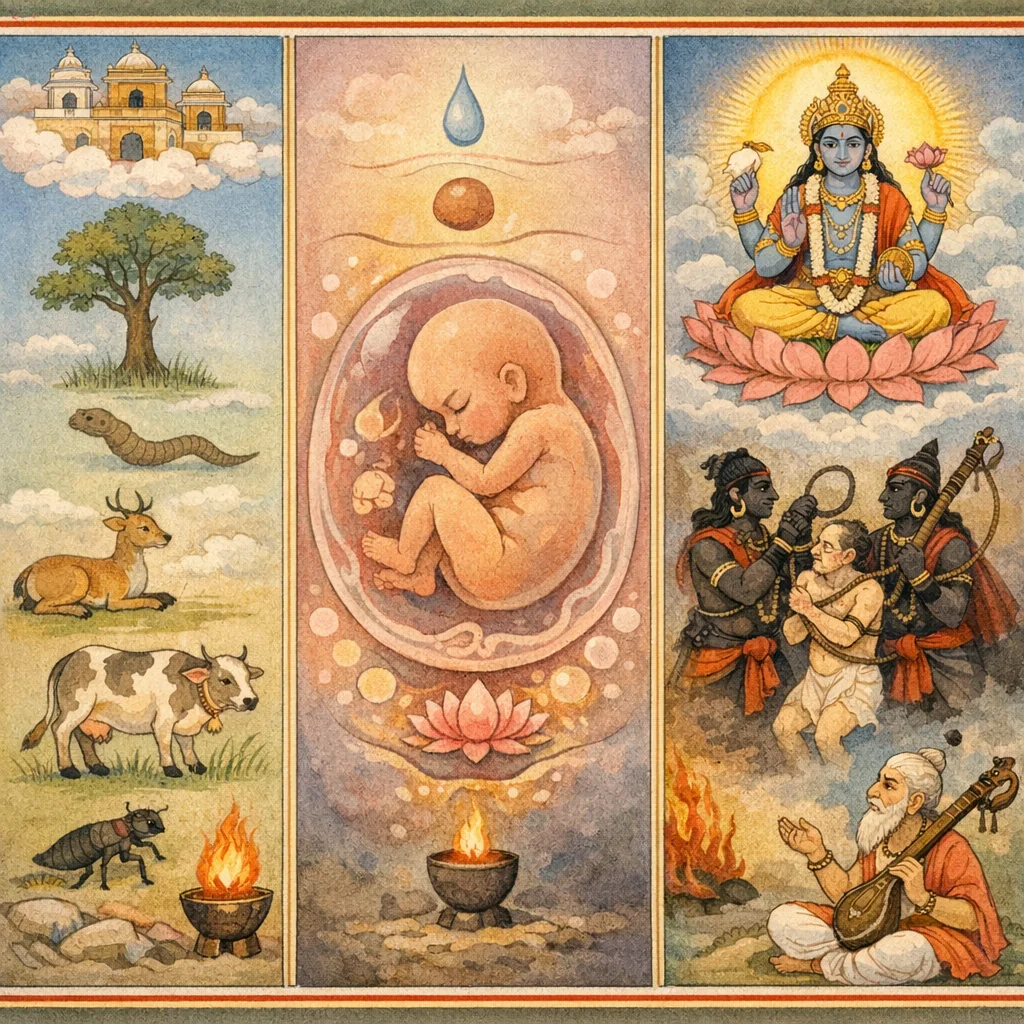
Sanaka instructs Nārada on the meaning and workings of bondage in saṃsāra: beings enjoy the fruits of merit, then fall through painful results of sin and return to lower births—first as immobiles (trees, grasses, mountains), then worms, then animals—before attaining human birth. Using imagery of botanical growth, the chapter explains how embodied impressions (saṃskāras) shape manifestation and the ripening of karmic results. It then gives a detailed account of garbhavāsa: the jīva’s entry with semen, early embryonic stages (kalala and further development), fetal suffering, and remembrance of prior hells. Birth is portrayed as violent, and forgetfulness as a consequence of ignorance. Human life unfolds through helpless infancy, undisciplined childhood, youth driven by greed and lust, anxiety-filled household life, and decrepit old age ending in death, bondage by Yama’s messengers, and renewed hell-experience. The conclusion reframes suffering as purifying exhaustion of karma and declares the remedy: diligent cultivation of supreme knowledge (jñāna) and bhakti-worship of Hari/Nārāyaṇa, the source and dissolution of the universe, as the direct means to liberation from saṃsāra.
Shlokas
Verse 1
सनक उवाच । एवं कर्मपाशनियंत्रितजंततवः स्वर्गादिपुण्यस्थानेषु पुण्यभोगमनुभूय यातीव दुःखतरं पापफलमनुभूय प्रक्षीणकर्मा वशेषेणामुं लोकमागत्य सर्वभयविह्वलेषु मृत्युबाधासंयुतेषुस्थावरादिषु जायते । वृक्षगुल्मलतावल्लीगिरयश्च तृणानि च । स्थावरा इति विख्याता महामोहसमावृताः ॥ १ ॥
Sanaka said: Thus, beings bound and driven by the noose of karma enjoy the fruits of merit in heaven and other holy realms; then they undergo the far more painful results of sin. When their karma is exhausted, they return to this world and are born among the immobile orders of existence—shaken by every fear and afflicted by the bonds of death. Trees, shrubs, creepers, mountains, and grasses are called “immovables,” veiled by great delusion.
Verse 2
स्थावरत्वे पृथिव्यामुत्पबीजानि जलसेकानुपदं सुसंस्कारसामग्रीवशादंतरुष्मप्रपाचितान्युच्छूनत्वमापद्य ततो मूलभावं तन्मूलादंकुरोत्पत्तिस्तस्मादपि पर्णकांडनालादिकं कांडेषु च प्रसवमापद्यंते तेषु च पुष्पसंभवः ॥ २ ॥
When seeds lie in the earth and are watered again and again, then—by the power of proper preparation and favorable conditions—warmed by inner heat they swell. From that they become roots; from the roots a sprout arises; from the sprout come leaves, stalks, and stems; the stems grow further, and from them flowers are born.
Verse 3
तानि पुष्पाणि कानिचिदफलानि कानिचित्फलहेतुभूतानि तेषु पुष्पेषु वृद्धभावेषु सत्सु तत्पुष्पमूलतस्तुषोत्पत्तिर्जायते तेषु तुषु भोक्तॄणां प्राणिनां संस्कारसामग्रीवशाद्धिमरश्मिकिरणासन्नतया तदोषधिरसस्तुषांतः प्रविश्य क्षीरभावं समेत्य स्वकाले तंडुलाकारतामुपगम्य प्राणिनां भोगसंस्कारवशात्संवत्सरे फलिनः स्युः ॥ ३ ॥
Among those blossoms, some are barren while others become the very cause of fruit. When the blossoms mature, a husk (tuṣa) arises from the root-source of that blossom. Then, within that husk, by the power of the saṃskāras of the beings who are to partake and by the required conditions, and by the nearness of the sun’s rays, the plant’s sap enters the husk, becomes milky, and in due time takes the form of a grain like rice. Thus, according to the beings’ impressions connected with enjoyment, within a year they become fruit-bearing.
Verse 4
स्थावरत्वेऽपि बहुकालं वानरादिभिर्भुज्यमाना हि च्छेदनदवाग्निदहनशीतातपादिदुःखमनुभूय म्रियते । ततश्च क्रिमयो भूत्वा सदादुःखबहुलाः क्षणार्ध्दं जीवंतः क्षणार्ध्दं म्रियमाणा बलवत्प्राणिपीडायां निवारयितुमक्षमाः शीतवातादिक्लेशभूयिष्ठा नित्यं क्षुधाक्षुधिता मलमूत्रादिषु सचरंतो दुःखमनुभवंति ॥ ४ ॥
Even if one attains the condition of an unmoving being, like a plant or a tree, for a long time one is eaten by monkeys and the like; one endures the pains of cutting, of being burned by forest fire, of cold and heat and other afflictions—and then dies. Thereafter, becoming worms, one is ever filled with misery: living for half a moment and dying for half a moment, unable to ward off the fierce torment inflicted by stronger creatures; greatly oppressed by cold, wind, and other hardships; always hungry and yet still hungering, moving amid filth and urine and the like, one experiences nothing but suffering.
Verse 5
तत एव पद्मयोनिमागत्य बलवद्वाधोद्वेजिता वृथोद्वेगभूयिष्ठाः क्षुत्क्षांता नित्यं वनचारिणो मातृष्वपि विषयातुरा वातादिक्लेषबहुलाः कश्मिंश्चिज्जन्मनि तृणाशनाः कस्मिंश्चिज्जन्मनि मांसामेध्याद्यदनाः कस्मिंश्चिज्जन्मनि कंदमूलफलाशना दुर्बलप्राणिपीडानिरता दुःखमनुभवंति ॥ ५ ॥
Then, entering the sphere of the Lotus-born (Brahmā), beings are afflicted by powerful injuries and terrors, overwhelmed by needless anxieties, and made to endure hunger and thirst. They wander continually in forests; even toward their mothers they are disturbed by objects of sense. Many ailments beset them, such as disorders of wind (vāta). In some births they feed on grass; in some they eat flesh and impure foods; in some they subsist on bulbs, roots, and fruits. Intent on harming weaker creatures, they experience suffering.
Verse 6
अंडजत्वेऽपि वाताशनामांसामेध्याद्यशनाश्च परपीडापरायणा नित्यं दुःखबहुला ग्राम्यपशुयोनिमागता अपि स्वजातिवियोगभारोद्वहनपाशादिबंधनताडनहलादिधारणादिसर्वदुःखान्यनुभवंति ॥ ६ ॥
Even when born from eggs, they subsist on wind, flesh, and impure foods, intent on harming other beings. Ever filled with suffering, and even when they enter the womb of domesticated animals, they undergo every kind of pain—separation from their own kind, bearing heavy loads, being bound with ropes and the like, being beaten, and being made to carry ploughs and other burdens.
Verse 7
एवं बहुयोनिषु संभ्रांताः क्रमेण मानुषं जन्म प्राप्नुवंति । केचिच्च पुण्यविशेषाद्युत्क्रमेणापि मनुष्यजन्माश्नुवते ॥ ७ ॥
Thus, wandering through many kinds of births, beings gradually attain a human birth. Yet some—by a particular excellence of merit—gain human birth even outside the usual sequence.
Verse 8
मनुष्यजन्म नापि च । चर्मकारचंडालव्याधानापितरजककुंभकारलोहकारस्वर्णकारतंतुवाचसौचिकजटिलसिद्धधावकलेखकभृतकशासनहारिनीचभृत्यद्ररिदहीनांगाधिकांगत्वादि दुःखबहुलज्वरतापशीतश्लेष्मगुल्मपादाक्षिशिरोगर्भपार्श्ववेदनादिदुःखमनुभवंति ॥ ८ ॥
They do not even obtain a proper human birth; rather, they live amid painful conditions—born into lowly or harsh occupations (leather-worker, caṇḍāla, hunter, barber, washerman, potter, blacksmith, goldsmith, weaver, tailor, matted-haired ascetic, so-called “siddha,” washer, scribe, hired laborer, tax-collector, servant, and the like), or as the poor, or with missing limbs or extra limbs. They undergo many kinds of suffering: fevers, burning heat, cold, phlegmatic disorders, abdominal tumors, and pains of the feet, eyes, head, womb, sides, and other afflictions.
Verse 9
मनुष्यत्वेऽपि यदा स्त्रीपुरुषयोर्व्यवायस्तत्समयेरेतो यदा जरायुं प्रविशति तदैव कर्मवशाज्जंतुः शुक्रेण सह जरायुं प्रविश्य शुक्रशोणितकलले प्रवर्त्तते ॥ ९ ॥
Even in human birth, when a woman and a man unite, at that very time—when the semen enters the womb—the embodied being, driven by its past actions (karma), enters the womb along with the semen and begins its course within the embryo formed from semen and blood.
Verse 10
तद्वीर्यं जीवप्रवेशात्पञ्चाहात्कललं भवति अर्द्धमासे । पलवलभावमुपेत्य मासे प्रादेशमात्रत्वमापद्यते ॥ १० ॥
After the individual soul enters that seed, within five days it becomes a gelatinous mass (kalala). In half a month it further develops, and within a month it attains the state of a small lump (palvala), reaching the measure of about a hand-span (prādeśa).
Verse 11
ततः प्रभृति वायुवशाच्चैतन्याभावेऽपि मातुरुह्ये दुःसहतापल्केशतयैकत्र स्थातुमशक्यत्वाद् भ्रमति ॥ ११ ॥
From that time onward, driven by the force of the wind, even though consciousness is absent, it wanders within the womb; for, due to the unbearable heat and the touch of hair, it is unable to remain in one place.
Verse 12
मासे द्वितीये पूर्णे पुरुषाकारमात्रतामुपगमय मासत्रितये पूर्णे करचरणाद्यवयवभावमुपगम्य चतुर्षु मासेषु गतेषु सर्वावयवानां संधिभेदपरिज्ञानं पंचस्वतीतेषु नखानामभिव्यंजककता षट्स्वतीतेषु नखसंधिपरिस्फुटतामुपगम्य नाभिसूत्रेण पुष्यमाणममेध्यमूत्रसिक्तांगं जरायुणा बंधितरक्तास्थिक्रिमिवसामज्जास्नायुकेशादिदूषिते कुत्सिते शरीरे निवासिनं स्वयमप्येवं परिदूषितदेहं मातुश्च कट्वम्ललवणात्युष्णभुक्तदह्यमात्मानं दृष्ट्वा देही पूर्वजन्मस्मरणानुभावात्पूर्वानुभूतनरकदुःथानि च स्मृत्वांतर्दुःखेन च परिदह्यमानो मातुर्देहातिमूत्रादिरुक्षेण दह्यमान एवं मनसि प्रलयति ॥ १२ ॥
When the second month is complete, the embryo attains only the outline of a human form. When the third month is complete, it develops the state of having limbs such as hands and feet. When four months have passed, it gains discernment of the joints and divisions of all its limbs. When five months have passed, the nails begin to manifest; when six months have passed, the joints of the nails become clearly defined. Nourished through the umbilical cord, its body is drenched with impure urine; bound by the placenta, it dwells in a vile body defiled by blood, bone, worms, fat, marrow, sinews, hair, and the like. Seeing itself thus in a polluted body—and also seeing that the mother, from eating pungent, sour, salty, and excessively hot foods, is scorched—the embodied soul, by the force of remembering former births, recalls the sufferings of the hells previously experienced; burning inwardly with sorrow, and scorched by the harshness of the mother’s bodily wastes such as excessive urine, it sinks into mental dissolution (faintness).
Verse 13
अहोऽत्यंतपापोऽहंपूर्वजन्मनिभृत्यापत्यमित्रयोषिद्गृहक्षेत्रधनधान्यादिष्वत्यंतरागेण कलत्रपोषणार्थं परधनक्षेत्रादिकं पश्यतो हरणाद्युपायैरपह्यत्य कामांधतया परस्त्रीहरणादिकमनुभूय महापापान्याचरंस्तैः पापैरहमेक एवंविधनरकाननुभूय पुनः स्थावरादिषु महादुःखमनुभूय संप्रति जरायुणा परिवेष्टितोऽन्तर्दुखेन बहिस्तापेन च दह्यामि ॥ १३ ॥
Alas—I am exceedingly sinful. In a former birth, out of intense attachment to servants, children, friends, women, house, land, wealth, grain, and the like, and for the sake of maintaining my wife, I stole others’ wealth and property by various means even while they watched. Blinded by lust, I committed acts such as abducting another man’s wife. Practising such great sins, I alone, through those sins, suffered such hells; and again, after experiencing great misery among immobile and other lower forms of life, now—enclosed in the womb—burning with inner anguish and outer torment, I am scorched.
Verse 14
मया पोषिता दाराश्च स्वकर्मवशादन्यतो गताः ॥ १४ ॥
Though I nourished and supported my wife and family, they too—driven by their own karma—went elsewhere.
Verse 15
अहो दुखं हि देहिनाम् ॥ १५ ॥
Alas—indeed, how much suffering there is for embodied beings!
Verse 16
देहस्तु पापात्संजातस्तस्मात्पापं न कारयेत् । भृत्यभित्रकलत्रार्थमन्यद्द्रव्यं हृतं मया ॥ १६ ॥
Since the body itself is born of sin, one should not commit sin again. Yet for the sake of servants, dependents, and my wife, I took—indeed stole—another’s wealth.
Verse 17
तेन पापेन दह्यामि जरायुपरिवेष्टितः । दृष्ट्वान्यस्य श्रियं पूर्वं सतत्पोऽहमसूयया खितः ॥ १७ ॥
By that sin I am scorched, as though wrapped in a membrane. Formerly, seeing another’s prosperity, I was ever tormented—afflicted by envy.
Verse 18
गर्भाग्निनानुदह्येयमिदानीमपि पापकृत् । कायेन मनसा वाचा परपीडामकारिषम्तेन पापेन दह्यामि त्वहमेकोऽतिदुःखितः ॥ १८ ॥
Even now I, a doer of sin, am burned by the fire of the womb. By body, mind, and speech I caused pain to others; therefore, by that sin, I alone burn—overwhelmed with intense sorrow.
Verse 19
एवं बहुविधं गर्भस्थो जंतुर्विलप्य स्वयमेव वा ॥ १९ ॥
Thus, the embodied being in the womb laments in many ways—either aloud or within itself.
Verse 20
आत्मानमाश्वास्य उत्पत्तेरनंतरं सत्संगेन विष्णोश्चरितश्रवणेन च विशुद्धमना भूत्वा सत्कर्माणि निर्वर्त्य अखिलजगदंतरात्मनः सत्यज्ञानानंदमयस्य शक्तिप्रभावानुष्टितविष्टपवर्गस्य लक्ष्मीपतेर्नारायणस्य सकलसुरासुरयक्षगंधर्वराक्षसपन्न गमुनिकिन्नरसमूहार्चितचरणकमलयुगं भक्तितः समभ्यर्च्य दुःसहः संसारच्छेदस्यकारणभूतं वेदरहस्योपनिषद्भिः परिस्फुटं सकललोकपरायणं हृदिनिधाय दुःखतरमिमं संस्कारागारमतिक्रमिष्यामीति मनसि भावयति ॥ २० ॥
Then, consoling himself after his birth, he—through holy company and by listening to the deeds of Viṣṇu—became pure in mind. Having performed righteous actions, he devotedly worshipped the lotus-pair of feet of Nārāyaṇa, the Lord of Lakṣmī, the inner Self of the entire universe, whose nature is truth, knowledge, and bliss, and whose power manifests the orders of the worlds—feet adored by hosts of gods and demons, yakṣas, gandharvas, rākṣasas, serpents, sages, and kinnaras. Placing in his heart the secret of the Veda, made clear by the Upaniṣads, the refuge of all worlds and the cause that cuts the unbearable saṃsāra, he resolved in his mind: “I shall cross beyond this most painful house of conditioning (saṃskāras).”
Verse 21
यतस्तन्मातुः प्रसूतिसमये सति गर्भस्थोदेही नारदमुने वायुनापरिपीडितो मातुश्चापि दुःखं कुर्वन्कर्मपाशेन बलाद्योनिमार्गान्निष्क्रामन्सकलयातनाभोगमेककालभवमनुभवति ॥ २१ ॥
Therefore, O sage Nārada, at the time of that mother’s delivery, the embodied being remaining in the womb is pressed and tormented by the vital winds; and causing pain to the mother as well, he is forced by the bonds of karma to emerge through the passage of birth, experiencing in a single moment the full range of sufferings and agonies.
Verse 22
तेनातिक्लेशेन योनियंत्रपीडितो गर्भान्निष्कांतो निःसंज्ञतां याति ॥ २२ ॥
Tormented by that extreme agony—crushed in the constricting ‘machine’ of the womb—when the being comes out from the womb, it falls into a state of unconsciousness.
Verse 23
तं तु बाह्यवायुः समुज्जीवयति । बाह्यवायुस्पर्शसमनंतरमेव नष्टस्मृतिपूर्वानुभूताखिलदुःखानि वर्त्तमानान्यपि ज्ञानाभावदविज्ञायात्यंतदुःखमनुभवति ॥ २३ ॥
But the external breath (air) revives him. Immediately upon the touch of the outer air, having lost memory, he fails to recognize all the sufferings previously experienced—and even those presently occurring—due to the absence of true knowledge, and thus undergoes extreme misery.
Verse 24
एवं बालत्वमापन्नो जंतुस्तत्रापि स्वमलमूत्रलित्पदेह आध्यात्मिकादिपीड्यमानोऽपि वक्तुमशक्तक्षुत्तृषापीडितो रुदिते सति स्तनादिकं देयमिति मन्वानाः प्रयतन्ते ॥ २४ ॥
Thus, upon reaching infancy, the living being—even there—bears a body smeared with its own feces and urine; though afflicted by inner (ādhyātmika) and other sufferings, it cannot speak. Tormented by hunger and thirst, it cries, and the attendants, thinking, “Milk and the like should be given,” strive to feed and soothe it.
Verse 25
एवमनेकं देहभोगमन्याधीनतयानुभूयमानो दंशादिष्वपि निवारयितुमशक्तः ॥ २५ ॥
Thus, while enduring many bodily sufferings in dependence upon others, one becomes powerless even to ward off bites and the like.
Verse 26
बाल्यभावमासाद्य मातापित्रोरुपाध्यायस्य ताडनं सदा पर्यटनशीलत्वं पांशुभस्मपंकादिषुक्रीडनं सदा कलहनियतत्वाम शुचित्वं बहुव्यापाराभासकार्यनियतत्वं तदसंभव आध्यात्मिकदुःखमेवंविधमनुभवति ॥ २६ ॥
Having fallen into a childish disposition, one undergoes inner (ādhyātmika) suffering of this kind: being constantly beaten by one’s parents and teacher, habitually roaming about, playing in dust, ash, and mud, remaining perpetually quarrelsome, living in impurity, and being endlessly engaged in the mere appearance of many activities without real accomplishment.
Verse 27
ततस्तु तरुणभावेन धनार्जनमर्जितस्य रक्षणं तस्य नाशव्ययादिषु चात्यंतदुःखिता मायया मोहिताः कामक्रोधादिदुष्टमनसाः सदासूयापरायणाः परस्वपरस्त्रीहरणोपायपरायणाः पुत्रमित्रकलत्रादिभरणोपायचिंतापरायणा वृथाहंकारदूषिताः पुत्रादिषु व्याध्यादि पीडितेषु सत्सु सर्वव्यात्पिं परित्यज्य रोगादिभिः क्लेशितानां समीपे स्वयमाध्यात्मिकदुःखेन परिप्लुता । वक्ष्यमाणप्रकारेण चितामश्नुवते ॥ २७ ॥
Then, in the vigor of youth, they become intent on guarding the wealth they have earned, and are deeply distressed by its loss, expenditure, and the like. Deluded by māyā, their minds corrupted by lust, anger, and other vices, ever devoted to envy, they pursue means of stealing others’ property and abducting others’ wives. Absorbed in anxious schemes to support sons, friends, and spouse, and tainted by vain ego, when their children and others are afflicted by disease and suffering, they abandon all proper conduct; and, standing near those tormented by illnesses and hardships, they themselves are overwhelmed by inner (ādhyātmika) sorrow. In the manner to be described, they finally reach the funeral pyre.
Verse 28
गृहक्षेत्रादिकं कम किंचिन्नापि विचारितम् । समृद्धस्य कुटुम्बस्य कथं भवति वर्त्तनम् ॥ २८ ॥
One has not reflected even a little on the house, the fields, and the like—how, then, can the upkeep of a prosperous household ever be managed?
Verse 29
मम मूलधनं नास्ति वृष्टिश्चापि न वर्षति । अश्वः पलायितः कुत्र गावः किं नागता मम ॥ २९ ॥
My principal wealth is gone, and even the rains do not fall. Where has my horse fled? Why have my cows not returned?
Verse 30
बालापत्या च मे भार्या व्याधितोऽहं च निर्धनः । अविचारात्कृषिर्नष्टा पुत्रा नित्यं रुदंति च ॥ ३० ॥
My wife is burdened with little children; I am ill and poor. Through lack of discernment my farming has failed, and my sons weep each day.
Verse 31
भग्नं छिन्नं तु मे सद्म बांधवा अपि दूरगाः । न लभ्यते वर्त्तनं च राज बाधातिदुःसहा ॥ ३१ ॥
My home is shattered and torn; even my kinsmen are far away. I find no livelihood, and the king’s oppression is unbearably harsh.
Verse 32
रिपवो मां प्रधावंते कथं जेष्टाम्यहं रिपून् । व्यवसायाक्षमश्चाहं प्रात्पाः प्राघूर्णका अमी ॥ ३२ ॥
My enemies rush upon me—how shall I conquer them? I too am incapable of steady effort, and they have come whirling like a storm.
Verse 33
एवमत्यंतचिन्ताकुलः स्वदुःखानि निवारयितुमक्षमो धिग्विधिं भाग्यहीनं मां किमर्थं विदधे इति दैवमाक्षिपति ॥ ३३ ॥
Thus, overwhelmed by intense anxiety and powerless to dispel his own sorrows, he censures the Creator: “Fie upon this fate—why did it fashion me, one bereft of fortune?” In this way he blames Destiny.
Verse 34
तथा वृद्धत्वमापन्नो हीयमानसारो जरापलितादिव्यात्पदेहो व्याधिबाध्यत्वादिकमापन्नः । प्रकंपमानावयवश्वासकासादिपीडितो लोलाविललोचनः श्लेष्मण्यात्पकंठः पुत्रदारादिभिर्भर्त्स्यमानः कदा मरणमुपयामीति चिंताकुलो मयि मृते सति मदर्जितं गृहक्षेत्रादिकं वस्तु पुत्रादयः कथं रक्षंति कस्य वा भविष्यति ॥ ३४ ॥
Likewise, when one falls into old age, one’s inner strength dwindles; the body is afflicted by the miseries of age—gray hair and the like—and is further tormented by diseases. With limbs trembling, oppressed by breathlessness, cough, and similar troubles, with restless and unsteady eyes, and with a throat choked by phlegm, one is even scolded by sons, wife, and others. Bewildered by anxiety, one thinks, “When will death come to me? And when I die, how will my sons and the rest protect the house, land, and other property earned by me—or to whom will it belong?”
Verse 35
मद्धने परैरपहृते पुत्रादीनां कथं वर्त्तनं भविष्यतीति ममतादुःखपरिप्लुतो गाढं निःश्वस्य स्वेन वयसा कृतानि कर्माणि पुनः पुनः स्मरन् क्षणे विस्मरति च संततस्त्वासन्नमरणो ॥ ३५ ॥
When his wealth has been carried off by others, he is flooded with the sorrow born of possessiveness, sighs deeply, and worries, “How will my sons and the rest live now?” As death draws near, he repeatedly recalls the actions done throughout his life—yet from one moment to the next he also forgets them, again and again.
Verse 36
व्याधिपीडितोऽन्तस्तापार्तः क्षणं शय्यायां क्षणं मंचे च ततस्ततः पर्यटन् क्षुत्तृटूपरिपूडितः किंचिन्मात्रमुदकं देहीत्यतिकार्पण्येन याचमानस्तत्रापि ज्वराविष्टानामुदकं न श्रेयस्करमिति ब्रुवतो मनसातिद्वेषं कुर्वन्मंद चैतन्यो भवति ॥ ३६ ॥
Afflicted by disease and tormented inwardly, he keeps shifting—now on the bed, now on a cot—wandering restlessly from place to place. Crushed by hunger and thirst, he begs in utter misery, “Give me just a little water.” Yet even there, when people say, “For those seized by fever, water is not beneficial,” he becomes intensely hateful in his mind and falls into a dull, clouded state of consciousness.
Verse 37
ततश्च हस्तपादाकर्षणे न तु क्षमो रुद्रद्भिबंधुजनैर्वेष्टितो वक्तुमक्षमः स्वार्जितधनादिकं कस्य भविष्यतीति चिंतापरो बाष्पाविलविलोचनः कंठे वुरघुरायमाणे सति शरीरान्निष्क्रांतप्राणो यमदूतैर्भर्त्स्यमानः पाशयंत्रितो नरकादीन्पूर्ववदश्नुते ॥ ३७ ॥
Then, unable even to endure the pulling of his hands and feet, surrounded by weeping relatives and incapable of speaking, he becomes absorbed in worry—“Who will now possess my self-earned wealth and belongings?” His eyes are blurred with tears; his throat rattles; and as the life-breath departs from the body, he is rebuked by Yama’s messengers, bound and restrained by their noose, and he experiences the hells and other torments just as described before.
Verse 38
आमलप्रक्षयाद्यद्वदग्नौ धाम्यंति धातवः । तथैव जीविनः सर्व आकर्मप्रक्षयाद् भृशम् ॥ ३८ ॥
Just as metals, when heated in fire, are intensely blown and refined as their impurities are burnt away, so too all living beings are greatly purified when their accumulated karma is exhausted.
Verse 39
तस्मात्संसारदावाग्नितापार्तो द्विजसत्तम । अभ्यसेत्परमं ज्ञानं ज्ञानान्मोक्षमवान्पुयात् ॥ ३९ ॥
Therefore, O best of the twice-born, one tormented by the scorching forest-fire of saṃsāra should diligently cultivate supreme knowledge; through knowledge, indeed, one attains mokṣa—liberation.
Verse 40
ज्ञानशून्या नरा ये तु पशवः परिकीर्तिताः । तस्मात्संसारमोक्षाय परं ज्ञानं समभ्यसेत् ॥ ४० ॥
Those who are devoid of true knowledge are declared to be like beasts. Therefore, for release from saṃsāra, one should diligently cultivate the highest knowledge.
Verse 41
मानुष्यं चैव संप्राप्य सर्वकर्मप्रसाधकम् । हरिं न सेवते यस्तु कोऽन्यस्तस्मादचेतनः ॥ ४१ ॥
Having attained human life—able to accomplish every sacred aim—one who does not serve Hari: who could be more senseless than that person?
Verse 42
अहो चित्रमहो चित्रमहो चित्रं मुनीश्वराः । आस्थिते कामदे विष्णो नरा यांति हि यातनाम् ॥ ४२ ॥
How astonishing—how astonishing—truly astonishing, O lords among sages! Even when Viṣṇu, the fulfiller of desires, is present and accessible, people still go to suffering and torment.
Verse 43
नारायणे जगन्नाथे सर्वकामफलप्रदे । स्थितेऽपि ज्ञानरहिताः पच्यंते नरकेष्वहो ॥ ४३ ॥
Even though Nārāyaṇa—the Lord of the universe, the giver of the fruits of all desires—is present, those devoid of true knowledge are still “cooked” in the hells—alas!
Verse 44
स्त्रवन्मूत्रपुरीषे तु शरीरेऽस्मिन्नृशाश्वते । शाश्वतं भावयंत्यज्ञा महामोहसमावृताः ॥ ४४ ॥
In this human body—impermanent, oozing urine and excrement—the ignorant, shrouded in great delusion, imagine the non-eternal to be eternal.
Verse 45
कुत्सितं मांसरक्ताद्यैर्देहं संप्राप्य यो नरः । संसारच्छेदकं विष्णुं न भजेत्सोऽतिपातकी ॥ ४५ ॥
That man who, having obtained this contemptible body made of flesh, blood, and the like, does not worship Viṣṇu—the Cutter of saṃsāra’s bondage—becomes a grievous sinner.
Verse 46
अहो कष्टमहो कष्टमहो कष्टं हि मूर्खता । हरिध्यानपरो विप्र चण्डालोऽपि महासुखी ॥ ४६ ॥
Alas—how grievous, how grievous indeed is folly! O brāhmaṇa, even a caṇḍāla becomes supremely happy when devoted to meditation on Hari.
Verse 47
स्वदेहान्निस्सृतं दृष्ट्वा मलमूत्रादिकिल्बिषम् । उद्वेग मानवा मूर्खाः किं न यांति हि पापिनः ॥ ४७ ॥
Seeing the foul impurities—feces, urine, and the like—issued from their own bodies, foolish people feel disgust; why then do sinners not recoil from their sin?
Verse 48
दुर्लभं मानुषं जन्म प्रार्थ्यते त्रिदशैरपि । तल्लब्ध्वा परलोकार्थं यत्नं कुर्य्याद्विचक्षणः ॥ ४८ ॥
Human birth is hard to obtain—desired even by the gods. Having gained it, the discerning should strive earnestly for the goal of the hereafter, for the highest good.
Verse 49
अध्यात्मज्ञानसंपन्ना हरिपूजापरायणाः । लभन्ते परमं स्थानं पुनरावृत्तिदुर्लभम् ॥ ४९ ॥
Those endowed with inner spiritual knowledge and wholly devoted to the worship of Hari attain the supreme abode—one from which return is hard, that is, freedom from rebirth.
Verse 50
यतो जातमिदं विश्वं यतश्चैतन्यमश्नुते । यस्मिंश्च विलयं याति स संसारस्य मोचकः ॥ ५० ॥
That from which this universe is born, from which it gains consciousness, and into which it finally dissolves—He is the liberator from saṃsāra, the cycle of worldly existence.
Verse 51
निर्गुणोऽपि परोऽनंतो गुणवानिव भाति यः । तं समभ्यर्च्य देवेशं संसारात्परिमुच्यते ॥ ५१ ॥
Though supreme, infinite, and nirguṇa—beyond all qualities—He appears as if endowed with attributes. By worshipping that Lord of the gods with due reverence, one is completely liberated from saṃsāra.
Frequently Asked Questions
It functions as a soteriological shock-text: by depicting fetal torment, karmic compulsion, and post-birth forgetfulness, it argues that embodied life is structurally conditioned by karma and avidyā, thereby motivating vairāgya (dispassion) and directing the reader toward jñāna and Hari-bhakti as the sole durable remedy.
Diligent cultivation of supreme knowledge (parama-jñāna) together with devoted worship of Hari/Nārāyaṇa; the text explicitly states that knowledge leads to liberation and that failing to serve Hari despite obtaining human birth is the height of delusion.