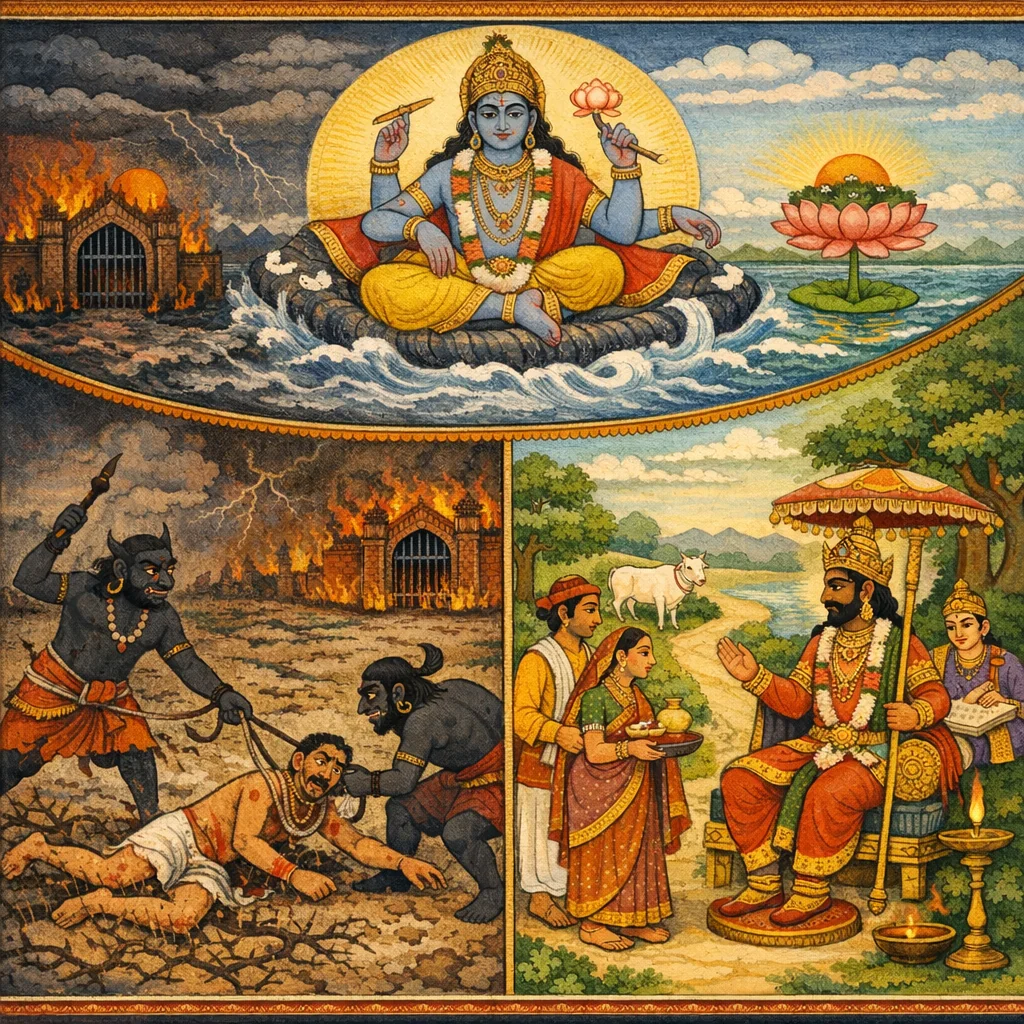
Yamapatha (The Road of Yama), Dāna-Phala, and the Imperishable Fruition of Karma
Nārada asks Sanaka to explain the exceedingly difficult post-mortem road ruled by Yama. Sanaka contrasts the fate of the righteous—especially those who give dāna—with that of sinners, describing the vast distance, harsh terrain, burning thirst, beatings by Yama’s messengers, and terrifying restraint and dragging. He then teaches the consolations and rewards of dharmic living: gifts of food, water, milk products, lamps, garments, and wealth yield corresponding enjoyments, while major gifts such as cows, land, houses, vehicles, and animals grant prosperity and celestial conveyances; service to parents and sages, compassion, the gift of knowledge, and Purāṇa recitation uplift one’s passage. Yama honors the meritorious in divine form yet warns of residual demerit; sinners are threatened, admonished through Citragupta’s accounting, judged and cast into hells, and after expiation may be reborn as immobile beings. Finally, Nārada questions how long-lived merits endure despite pralaya; Sanaka resolves this by teaching Nārāyaṇa’s imperishable nature, His guṇa-conditioned manifestation as Brahmā/Viṣṇu/Rudra, cosmic re-creation, and the non-perishing of unexperienced karma across kalpas.
Shlokas
Verse 1
नारद उवाच । कथितो भवता सम्यग्वर्णाश्रमविधिर्मुने । इदानीं श्रोतुमिच्छामि यममार्गं सुदुर्गमम् ॥ १ ॥
Nārada said: “O sage, you have clearly explained the proper ordinances of varṇa and āśrama. Now I wish to hear about the path of Yama—the exceedingly difficult road.”
Verse 2
सनक उवाच । श्रृणु विप्र प्रवक्ष्यामि यममार्गं सुदुर्गमम् । सुखदं पुण्यशीलानां पापिनां भयदायकम् ॥ २ ॥
Sanaka said: “O brāhmaṇa, listen—I shall describe the path of Yama, exceedingly difficult to traverse: it brings comfort to those of righteous conduct, but becomes a cause of terror for sinners.”
Verse 3
षडशीतिसहस्त्राणि योजनार्निनि मुनीश्वर । यममार्गस्य विस्तारः कथितः पूर्वसूरिभिः ॥ ३ ॥
O lord among sages, the extent of Yama’s road is said by the ancient seers to be eighty-six thousand yojanas.
Verse 4
ये नरा दानशीलास्तु ते यांति सुखिनो द्विज । धर्मशून्या नरा यांति दुःखेन भृशमर्दिताः ॥ ४ ॥
O twice-born one, those who are devoted to giving (dāna) go forth happily; but those devoid of dharma go forth in pain, grievously crushed by suffering.
Verse 5
अतिभीता विवश्त्राश्च शुष्ककंठौष्ठतालुकाः । क्रदंतो विस्तरं दीनाः पापिनो यांति तत्पथि ॥ ५ ॥
Terrified and bereft of self-control, their throats, lips, and palates parched dry, the sinful wail aloud in utter misery as they go along that path.
Verse 6
हन्यमाना यमभटैः प्रतोदाद्यैस्तथायुधैः ॥ ६ ॥
Beaten by Yama’s attendants and struck with goads and other weapons, they are cruelly tormented.
Verse 7
इतस्ततः प्रधावंतो यांति दुःखेन तत्पथि । क्वचित्पंकः क्वचिदूह्निः क्वचित्सेतप्तसैकतम् । क्वचिद्वै दावरुपेणः तीक्ष्णधाराः शिलाः क्वचित् ॥ ७ ॥
Running here and there, they proceed in anguish along that path: in places there is mire, in places a steep ascent, in places scorching sand; in places a forest-fire, and in places rocks with razor-sharp edges.
Verse 8
क्वचित्कंटकवृक्षाश्च दुःखारोहशिला नगाः । गाढांधकाराश्च गुहाः कंटकावरणं महत् ॥ ८ ॥
In some places there are thorny trees; elsewhere, mountains whose rocky slopes are painful to climb. There are also caves sunk in dense darkness, and vast tracts covered over with thorns.
Verse 9
वप्राग्रारोहणं चैव कन्दरस्य प्रवेशनम् । शर्कराश्च तथा लोष्टाः सूचीतुल्याश्च कण्टकाः ॥ ९ ॥
Climbing the very crest of an embankment, entering a ravine, stumbling over gravel and clods of earth, and being pierced by thorns sharp as needles—such are the hardships met upon that way.
Verse 10
शैवालं च क्वचिन्मार्गे क्वचित्कीचकपंक्तयः । क्वचिव्द्याव्राश्च गर्जंते वर्धंते च क्वचिज्ज्वराः ॥ १० ॥
In some places along the path there is slimy algae; elsewhere there are rows of reeds. In some places wild beasts roar, and in some places fevers flare up and grow.
Verse 11
एवं बहुविधक्लेशाः पापिनो यांति नारद । क्रोशंतश्च रुदन्तश्च म्लायंतश्चैव पापिनः ॥ ११ ॥
Thus, afflicted by many kinds of torments, the sinful go on, O Nārada—crying out, weeping, and utterly withering away; such indeed is the course of sinners.
Verse 12
पाशेन यंत्रिताः केचित्कृष्यमाणास्तथांकुशैः । शास्त्रास्त्रैस्ताड्यमानाश्च पृष्टतो यांति पापिनः ॥ १२ ॥
Some sinners, bound fast with nooses, are dragged along with goads; struck from behind with weapons and chastising instruments, the wicked are driven onward.
Verse 13
नासाग्रपाशकृष्टाश्च केचिदंत्रैश्च बधिताः । वहंतश्चायसां भारं शिश्राग्रेण प्रयांति वै ॥ १३ ॥
Some are dragged forward by a noose fastened to the tip of the nose; others are bound with their own intestines. Bearing heavy loads of iron, they are made to move on, pulled by the tip of the penis indeed.
Verse 14
अयोभारद्वयं केचिन्नासाग्रेण तथापरे । कर्णाभ्यां च तथा केचिद्वहंतो यांति पापिनः ॥ १४ ॥
Some sinners go bearing a pair of iron loads by the tip of the nose; others bear them likewise. And some, carrying them by both ears, proceed onward.
Verse 15
केचिच्च स्खलिता यांति ताड्यमानास्तथापरे । अत्यर्थोच्ङ्वसिताः केचित्केचिदाच्छत्रलोचनाः ॥ १५ ॥
Some stumble yet go on, while others are struck as they proceed. Some breathe in grievous distress, and some have eyes veiled, as though covered over.
Verse 16
छायाजलविहीने तु पथि यांत्यतिदुःखिताः । शोचन्तः स्वानि कर्मणि ज्ञानाज्ञानकृतानि च ॥ १६ ॥
But on a road devoid of shade and water, they proceed in extreme misery, lamenting their own deeds—those done knowingly and those done in ignorance as well.
Verse 17
ये तु नारद धर्मिष्ठा दानशीला सुबुद्धयः । अतीव सुखसंपन्नास्ते यांति धर्ममंदिरम् ॥ १७ ॥
But those, O Nārada, who are firmly established in dharma—charitable in conduct and wise in understanding—endowed with abundant well-being, go to the abode of Dharma.
Verse 18
अन्नदास्तु मुनुश्रेष्ट भुंजंतः स्वादु यांति वै । नीरदा यांति सुखिनः पिबंतः क्षीरमुत्तममम् । तक्रदा दधिदाश्चैव तत्तद्भोगं लभंति वै । घृतदा मधुदाश्चैव क्षीरदाश्च द्विजोत्तम ॥ १८ ॥
O best of sages, those who give food indeed come to enjoy sweet meals. Those who give water go happily, drinking excellent milk. Those who give buttermilk and those who give curd obtain enjoyment of those very things. Likewise, O best of twice-born, givers of ghee, givers of honey, and givers of milk attain the enjoyment corresponding to their gifts.
Verse 19
सुधापानं प्रकुर्वंतो यांति वै धर्ममंदिरम् । शाकदाः पायसं भुंजंन्दीपदो ज्वलयन्दिशः ॥ १९ ॥
Those who provide the gift of nectar-like drink truly go to the mansion of Dharma. Those who give vegetables enjoy sweet rice (pāyasa), and those who give lamps make the directions shine.
Verse 20
वस्त्रदो मुनुशार्दूल याति दिव्याम्बरावृतः । पुराकरप्रदो याति स्तूयमानोऽमरैः पथि ॥ २० ॥
O tiger among men, the giver of garments goes onward, clothed in divine raiment. The giver of “purā-kara” (a prior tribute—wealth) proceeds on the path praised by the immortal gods.
Verse 21
गोदानेन नरो याति सर्वसौख्यसमन्वितः । भूमिदो गृहदश्चैव विमाने सर्वसंपदि ॥ २१ ॥
By gifting a cow, a person departs (to the next world) endowed with every happiness. One who gives land—or a house as a gift—likewise attains a vimāna, together with all prosperity.
Verse 22
अप्सरोगणसंकीर्णे क्रीडन्याति वृषालयम् । हयदो यानदश्चापि गजदश्च द्विजोत्तम ॥ २२ ॥
In that arena of play, thronged with companies of Apsarās, he goes to the abode of the Bull (Śiva). O best of twice-born, the giver of horses, the giver of vehicles, and the giver of elephants also attain such a result.
Verse 23
धर्मालयं विमानेन याति भोगान्वितेन वै । अनडुद्दो मुनिश्रेष्ट यानारुढः प्रयाति वै ॥ २३ ॥
Indeed, borne in a pleasure-filled vimāna, the donor of a bull proceeds to the abode of Dharma. O best of sages, mounted on his vehicle, he surely goes forth.
Verse 24
फलदः पुष्पदश्चापि याति संतोषसंयुतः । तांबूलदो नरो याति प्रहृष्टो धर्ममंदिरम् ॥ २४ ॥
The giver of fruit, and likewise the giver of flowers, goes onward endowed with contentment. The person who offers tāmbūla (betel as an offering) goes joyfully to the abode of Dharma.
Verse 25
मातापित्रोश्च शुश्रूषां कृतवान्यो नरोत्तमः । स याति परितुष्टात्मा पूज्यमानो दिविस्थितैः ॥ २५ ॥
That best of men who has rendered devoted service to his mother and father goes onward with a fully contented heart, being honored by the dwellers in heaven.
Verse 26
शुश्रूषां कुरुते यस्तु यतीनां व्रतचारिणाम् । द्विजाग्र्यब्राह्मणानां च स यात्यतिसुखान्वितः ॥ २६ ॥
But whoever renders devoted service to renunciant sages who observe vows, and also to the foremost Brāhmaṇas, attains a state filled with exceedingly great happiness.
Verse 27
सर्वभूतदयायुक्तः पूज्यमानोऽमरैर्द्विजः । सर्वभोगान्वितेनासौ विमानेन प्रयाति च ॥ २७ ॥
Endowed with compassion toward all beings, that twice-born man—being honored by the immortals—departs in a celestial aerial car furnished with every enjoyment.
Verse 28
विद्यादानरतो याति पूज्यमानोऽब्जसूनुभिः । पुराणपठको याति स्तूयमानो मुनीश्वरैः ॥ २८ ॥
One devoted to the gift of knowledge departs to the higher realms, honored by the sons of the Lotus-born (Brahmā). But the reciter of the Purāṇa departs praised by the lordly sages.
Verse 29
एवं धर्मपरा यांति सुखं धर्मस्य मंदिरम् । यमश्चतुर्मुखो भूत्वा शंखचक्रगदासिभृत् ॥ २९ ॥
Thus, those devoted to Dharma go happily to the abode of Dharma; and Yama himself, becoming four-faced and bearing the conch, discus, mace, and sword, appears in a divine form.
Verse 30
पुण्यकर्मरतं सम्यक्स्नेहान्मित्रमिवार्चति । भो भो बुद्धिमतां श्रेष्ठानरकक्लेषभीरवः ॥ ३० ॥
Out of genuine affection, he duly honors one devoted to meritorious deeds as he would a friend—O best among the wise—fearing the torments of hell.
Verse 31
युष्माभिः साधितं पुण्यमत्रामुत्रसुखावहम् । मनुष्य जन्म यः प्राप्य सुकृतं न करोति च ॥ ३१ ॥
The merit you have accomplished brings happiness both here and hereafter. But whoever, having obtained a human birth, does not perform righteous and meritorious deeds, truly squanders that rare opportunity.
Verse 32
स एव पापिनां श्रेष्ट आत्मघातं करोति च । अनित्यं प्राप्य मानुष्यं नित्यं यस्तु न साधयेत् ॥ ३२ ॥
Among sinners, that person is the foremost—indeed, he commits self-destruction—who, having obtained this impermanent human life, does not strive to realize the Eternal.
Verse 33
स याति नरकं घोरं कोऽन्यस्तस्मादचेतनः । शरीरं यातनारुपं मलाद्यैः परिदूषितम् ॥ ३३ ॥
He goes to a dreadful hell—who could be more senseless than such a one? For he clings to a body that is itself a form of torment, thoroughly defiled by filth and other impurities.
Verse 34
तस्मिन्यो याति विश्वासं तं विद्यादात्मघातकम् । सर्वेषु प्राणिनः श्रेष्टास्तेषु वै बुद्धिजीविनः ॥ ३४ ॥
Know that one who places trust in that which is unworthy is a slayer of his own self. Among all living beings, the best are humans; and among humans, indeed, the best are those who live by right intellect.
Verse 35
बुद्धिमस्तु नराः श्रेष्टा नरेषु ब्राह्मणास्तथा । ब्राह्मणेषु च विद्वांसो विद्वत्सु कृतबुद्धयः ॥ ३५ ॥
Among human beings, the wise are the best; among men, the Brahmins are likewise foremost. Among Brahmins, the learned stand out; and among the learned, those whose intellect is truly cultivated and well-formed are supreme.
Verse 36
कृतबुद्धिषु कर्त्तारः कर्तृषु ब्रह्मवादिनः । ब्रह्मवादिष्वपि तथा श्रेष्टो निर्मम उच्यते ॥ ३६ ॥
Among those of cultivated understanding, the doers are foremost; among doers, the expounders of Brahman are foremost. And even among the knowers who teach Brahman, the best is said to be the one who is free from possessiveness.
Verse 37
एतेभ्योऽपि परो ज्ञेयो नित्यं ध्यानपरायणः । तस्मात्सर्वप्रयत्नेन कर्त्तव्यो धर्मसंग्रहः ॥ ३७ ॥
Higher than all these, one should know the person who is ever devoted to meditation. Therefore, with every effort, one should compile and uphold a compendium of dharma—right conduct and sacred duties.
Verse 38
सर्वत्र पूज्यते जंतुर्धर्मवान्नात्र संशयः । गच्छ स्वपुण्यैर्मत्स्थानं सर्वभोगसमन्वितम् ॥ ३८ ॥
A righteous being is honored everywhere—of this there is no doubt. Go, by the power of your own merits, to my abode, endowed with every enjoyment.
Verse 39
अस्ति चेद्दुष्कृतं किंचित्पश्चादत्रैव भोक्ष्यसे । एवं यमस्तमभ्यर्च्य प्रापयित्वा च सद्गतिम् ॥ ३९ ॥
“If there remains even a little evil deed (demerit), then later you will have to experience its result right here.” Thus Yama, having honored him and having led him onward, grants him a good destination.
Verse 40
आहूय पापिनश्चैव कालदंडेन तर्जयेत् । प्रलयांबुदनिर्घोषो ह्यंजनाद्रिसमप्रभः ॥ ४० ॥
Summoning the sinners, he threatened and chastised them with the rod of Time. His roar was like the thunder of clouds at the cosmic dissolution, and his radiance like that of Mount Añjana.
Verse 41
विद्युत्प्र भायुर्घोर्भीमो द्वात्रिंशद्भुजसंयुतः । योजनत्रयविस्तारो रक्ताक्षो दीर्घनासिकः ॥ ४१ ॥
Terrifying and fearsome, radiant like lightning, he was endowed with thirty-two arms; his body spanned three yojanas in breadth, with red eyes and a long nose.
Verse 42
दंष्ट्राकरालवदनो वापीतुल्योग्रलोचनः । मृत्युज्वरादिभिर्युक्तश्चित्रगुत्पोऽपि भीषणः ॥ ४२ ॥
With a mouth made terrifying by protruding fangs and eyes fierce like deep pits, even Citragupta appears dreadful—attended by Death, fever, and other afflictions.
Verse 43
सर्वे दूताश्च गर्जंति यमतुल्यविभीषणाः । ततो ब्रवीति तान्सर्वान्कंपमानांश्च पापिनः ॥ ४३ ॥
All the messengers roar, terrifying like Yama. Then he speaks to all those sinners who are trembling.
Verse 44
शोचन्तः स्वानि कर्माणि चित्रगुत्पो यमाज्ञया । भो भो पापा दुराचारा अहंकारप्रदूषिताः ॥ ४४ ॥
Lamenting their own deeds, Citragupta—by Yama’s command—addresses them: “Ho, ho, you sinners of wicked conduct, you who are defiled by ego!”
Verse 45
किमर्थमर्जितं पापं युष्माभिरविवेकिभिः । कामक्तोधादिदृष्टेन सगर्वेण तु चेतसा ॥ ४५ ॥
For what purpose have you, lacking discernment, incurred sin—your mind blinded by desire and swollen with pride?
Verse 46
यद्यत्पापतरं तत्तत्किमर्थं चरितं जनाः । कृतवंतः पुरा पापान्यत्यंतहर्षिताः ॥ ४६ ॥
Why is it that people commit precisely those acts which are more sinful—indeed the most sinful? In the past they have performed sins, and that too with excessive delight.
Verse 47
तथैव यातना भोज्याः किं वृथा ह्यतिदुरिवताः । भृत्यमित्रकलत्रार्थं दुष्कृतं चरितं यथा ॥ ४७ ॥
In the same way, those torments must indeed be endured—why then this needless, excessive misery? For the sake of servants, friends, and one’s spouse, a person commits evil deeds, and then must suffer accordingly.
Verse 48
तथा कर्मवशात्प्राप्ता यूयमत्रातिदुःखिताः । युष्माभिः पोषिता ये तु पुत्राद्या अन्यतोगताः ॥ ४८ ॥
So too, driven by the force of past actions, you have come here and are exceedingly distressed. Those whom you nourished—sons and others—have gone elsewhere.
Verse 49
युष्माकमेव तत्पापं प्राप्तं किं दुःखकारणम् । यथा कृतानि पापानि युष्माभिः सुबहूनि वै ॥ ४९ ॥
That sin has come upon you alone—what other cause of suffering could there be? For you have indeed committed very many sins.
Verse 50
तथा प्राप्तनि दुःखानि किमर्थमिह दुःखिताः । विचारयध्वं यूयं तु युष्माभिश्चारितं पुरा ॥ ५० ॥
When such sufferings have come upon you, why do you grieve here? Reflect, all of you—this was wrought by you yourselves in the past.
Verse 51
यमः करिष्यते दंडमिति किं न विचारितम् । दरिद्रेऽपि च मूर्खे च पंडिते वा श्रियान्विते ॥ ५१ ॥
Have you not reflected that Yama will surely administer punishment—whether one be poor, foolish, learned, or even endowed with prosperity?
Verse 52
कांदिशीके च वीरे च समवर्तीः यमः स्मृतः । चित्रगुप्तेरितं वाक्यं श्रुत्वा ते पापिनस्तदा ॥ ५२ ॥
In Kāṃdiśīka and in Vīra, Yama is remembered as Samavartin, the impartial ordainer. Hearing the words spoken by Citragupta, those sinners then became stricken and subdued.
Verse 53
शौचंतः स्वानि कर्मणि तूष्णीं तिष्टंति भीषिताः । यमाज्ञाकारिणः क्रूरश्चंडा दूता भयानकाः ॥ ५३ ॥
Terrified, they stand in silence, attending to their own duties—those dreadful, fierce, merciless messengers who act under Yama’s command.
Verse 54
चंडलाद्याः प्रसह्यैतान्नरकेषु क्षिपंति च । स्वदुष्कर्मफलं ते तु भुक्त्वांते पापशेषतः ॥ ५४ ॥
Then the Caṇḍālas and others, seizing them by force, hurl these beings into the hells. There they undergo the fruits of their own evil deeds; and when that is exhausted, they remain only with the residue of sin.
Verse 55
महीतलं च संप्राप्य भवंति स्थावरादयः । नारद उवाच । भगवन्संशयो जातो मच्चेतसि दयानिधे ॥ ५५ ॥
Having reached the surface of the earth, they become immobile beings, such as plants and the like. Nārada said: “O Blessed Lord, O ocean of compassion, a doubt has arisen within my heart.”
Verse 56
त्वं समर्थोऽसि तच्छेत्तुं यतो नो ह्यग्रजो भवान् । धर्माश्च विविधाः प्रोक्ताः पापान्यपि बहूनि च ॥ ५६ ॥
You are able to resolve it, for you are indeed our elder. Many kinds of dharmas have been taught, and many kinds of sins as well.
Verse 57
चिरभोज्यं फलं तेषामुक्तं बहुविदा त्वया । दिनांते ब्रह्मणः प्रोक्तो नाशो लोकत्रयस्य वै ॥ ५७ ॥
You have explained in many ways the enduring fruit that they are to enjoy; and you have also declared that at the close of Brahmā’s day, the destruction of the three worlds indeed occurs.
Verse 58
परार्द्धद्वितयांते तु ब्रह्माण्डस्यापि संक्षयः । ग्रामदानादिपुण्यानां त्वयैव विधिनंदन ॥ ५८ ॥
At the end of two parārdhas, even this brahmāṇḍa—the cosmic egg—comes to dissolution. Yet the merit arising from gifts, such as donating a village and the like, has been laid down by you alone, O son of Vidhi (Brahmā).
Verse 59
कल्पकोटिसहस्त्रेषु महान्भोग उदाहृतः । सर्वेषामेव लोकानां विनाशः प्राकृते लये ॥ ५९ ॥
Even across thousands of crores of kalpas, such “great enjoyment” is spoken of; yet at the time of prākṛta-laya, the primordial dissolution, the destruction of all worlds indeed occurs.
Verse 60
एकः शिष्यत एवेति त्वया प्रोक्तं जनार्दनः । एष मे संशयो जातस्तं भवाञ्छेत्तुमर्हति ॥ ६० ॥
O Janārdana, you have said that only “one” remains as the disciple. A doubt has arisen in my mind about this—please, in your kindness, resolve it.
Verse 61
पुण्यपापोपभोगानां समाप्तिर्नास्य संप्लवे । सनक उवाच । साधु साधु महाप्राज्ञ गुह्याद्गुह्यतमं त्विदम् ॥ ६१ ॥
For him, the exhaustion of the experiences of merit and sin does not occur, even at the time of cosmic dissolution. Sanaka said: “Well said, well said, O greatly wise one—this indeed is the most secret of secrets.”
Verse 62
पृष्टं तत्तेऽभिधास्यामि श्रृणुष्व सुसमाहितः । नारायणोऽक्षरोऽनंतः परं ज्योतिः सनातनः ॥ ६२ ॥
What you have asked, I shall declare to you—listen with a fully concentrated mind. Nārāyaṇa is the Imperishable, the Infinite, the supreme and eternal Light.
Verse 63
विशुद्धो निर्गुणो नित्यो मायामोहविवर्जितः । निर्गुणोऽपि परानन्दो गुणवानिव भाति यः ॥ ६३ ॥
He is perfectly pure, beyond all guṇas, eternal, and free from the delusion of māyā. Though truly nirguṇa, He is supreme bliss and yet appears as if endowed with qualities.
Verse 64
ब्रह्मविष्णुशिवाद्यैस्तु भेदवानिव लक्ष्यते । गुणोपाधिकभेदेषु त्रिष्वेतेषु सनातन ॥ ६४ ॥
Though eternal, He is perceived as if differentiated through Brahmā, Viṣṇu, Śiva and the others—because of distinctions arising from the limiting adjuncts (upādhis) of the three guṇas.
Verse 65
संयोज्य मायामखिलं जगत्कार्यं करोति च । ब्रह्मरुपेण सृजति विष्णुरुपेण पाति च ॥ ६५ ॥
Uniting His Māyā, He brings forth the whole activity of the universe; in the form of Brahmā He creates, and in the form of Viṣṇu He sustains and preserves.
Verse 66
अंते च रुद्ररुपेण सर्वमत्तीति निश्चितम् । प्रसयांते समुत्थाय ब्रह्मरुपी जनार्दनः ॥ ६६ ॥
At the end of the cosmic cycle, it is firmly concluded that He devours all in the form of Rudra. Then, at the time of creation, rising forth again, Janārdana assumes the form of Brahmā.
Verse 67
चराचरात्मकं विश्वं यथापूर्वमकल्पयत् । स्थावराद्याश्च विप्रेंद्र यत्र यत्र व्यवस्थिताः ॥ ६७ ॥
He reconstituted the universe—of the moving and the unmoving—exactly as it had been before; and, O best of brāhmaṇas, the stationary beings and the rest were set again in their own places, wherever they formerly stood.
Verse 68
ब्रह्मा तत्तज्जगत्सर्वं यथापूर्वं करोति वै । तस्मात्कृतानां पापानां पुण्यानां चैव सत्तम ॥ ६८ ॥
Brahmā indeed recreates that entire world exactly as it was before. Therefore, O best of the virtuous, the consequences of deeds already done—both sinful and meritorious—inevitably follow on.
Verse 69
अवश्यमेव भोक्तव्यं कर्मणां ह्यक्षयं फलम् । नाभुक्तं क्षीयते कर्म कल्पकोटिशतैरपि ॥ ६९ ॥
Surely, one must experience the imperishable result of one’s actions; karma not yet undergone does not perish—even across hundreds of crores of aeons.
Verse 70
अवश्यमेव भोक्तव्यं कृतं कर्म शुभाशुभम् । यो देवः सर्वलोकानामंतरात्मा जगन्मयः । सर्वकर्मफलं भुक्ते परिपूर्णः सनातनः ॥ ७० ॥
Whatever action has been done—auspicious or inauspicious—its fruit must surely be experienced. That Deva, the inner Ātman of all worlds, pervading the universe, makes all karmic results be undergone—He is the eternal One, ever complete.
Verse 71
योऽसौ विश्वंभरो देवो गुणमेदव्यवस्थितः । सूजत्यवति चात्त्येतत्सर्वं सर्वभुगव्ययः ॥ ७१ ॥
That Deva who upholds the universe, established in the manifold ordering of the guṇas, creates this whole world, protects it, and also withdraws it—He is the all-enjoying, imperishable Lord.
Frequently Asked Questions
The chapter frames dāna as immediately ‘convertible’ merit: specific offerings (anna, jala, dīpa, vastra, go/ भूमि-dāna, etc.) mature into corresponding supports and enjoyments in the post-mortem journey, demonstrating the Purāṇic dharma logic that ethical-ritual acts generate concrete karmic fruits (phala) that ease transit and orient the jīva toward Dharmaloka.
Sanaka teaches that unexperienced karma does not perish; at cosmic dissolution Nārāyaṇa remains imperishable, and through māyā/guṇa-conditioned functions He recreates the cosmos ‘as before,’ so previously accumulated merits and sins inevitably find their occasions for fruition across kalpas.