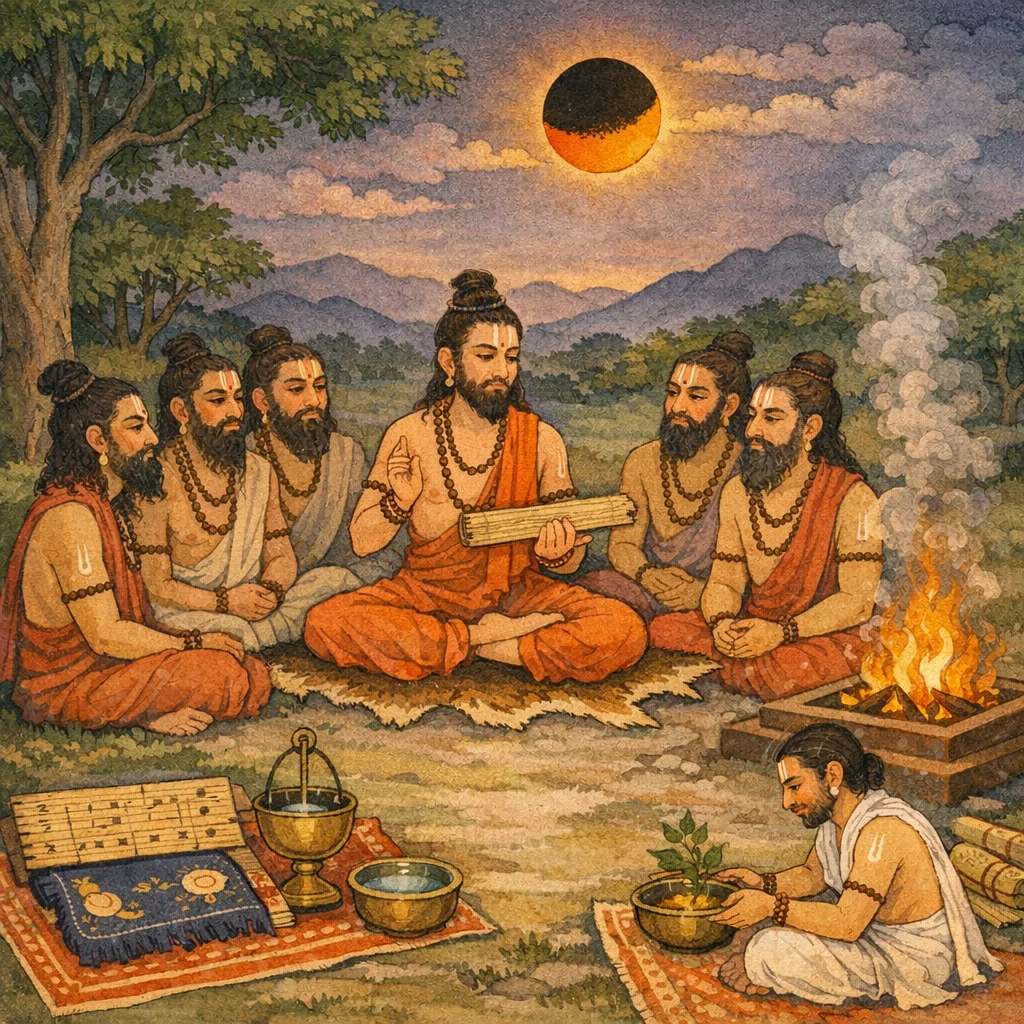
Tithi-Nirṇaya for Vratas: Ekādaśī Rules, Saṅkrānti Punya-kāla, Eclipse Observances, and Prāyaścitta
Sanaka teaches the sages that accurate tithi ascertainment is essential for Śrauta/Smārta rites, vratas, and dāna. He names the preferred fasting tithis and lays down acceptance rules based on paraviddhā versus pūrvaviddhā, time-slices (pūrvāhṇa/aparāhṇa, pradoṣa), and tithi behavior under kṣaya/vṛddhi. The chapter adjudicates tithi–nakṣatra vows in detail, especially Ekādaśī/Dvādaśī conflicts—Daśamī contamination, dual Ekādaśīs, availability of pāraṇā, and differing rules for householders and renunciants. It then prescribes eclipse discipline: no eating, continuous japa and homa through the eclipse, and distinct Vedic mantras for lunar versus solar eclipse offerings. Saṅkrānti punya-kāla windows are quantified in ghaṭikās by sign, including Dakṣiṇāyana at Karkaṭaka and Uttarāyaṇa at Makara. It concludes by rooting ritual precision in bhakti: dharma pleases Keśava and leads to Viṣṇu’s supreme abode.
Shlokas
Verse 1
सनक उवाच । तिथीनां निर्णयं वक्ष्ये प्राचश्चित्तविधिं तथा । श्रृणुष्व तन्मुनिश्रेष्ठ कर्मसिद्धिर्यतो भवेत् ॥ १ ॥
Sanaka said: I shall explain the determination of the tithis (lunar days), and also the procedure of prāyaścitta (expiation). Listen, O best of sages—for by this the rites are brought to successful accomplishment.
Verse 2
श्रौतं स्मार्त्तं व्रतं दानं यच्चान्यत्कर्म वैदिकम् । अनिर्णीतासु तिथिषु न किंचित्फलति द्विज ॥ २ ॥
O brāhmaṇa, whether it be a Śrauta rite, a Smārta observance, a vow (vrata), a gift (dāna), or any other Vedic act—if the tithi (lunar day) is not rightly ascertained, it yields no fruit at all.
Verse 3
एकादश्यष्टमी षष्टी पौर्णमासी चतुर्द्दशी । अमावास्या तृतीया च ह्युपवासव्रतादिषु ॥ ३ ॥
For fasts, vows, and kindred observances, the tithis recommended are Ekādaśī, Aṣṭamī, Ṣaṣṭhī, the full-moon day (Paurṇamāsī), Caturdaśī, the new-moon day (Amāvāsyā), and also Tṛtīyā.
Verse 4
परविद्धाः प्रशस्ताः स्युर्न ग्राह्याः पूर्वसंयुताः । नागविद्धा तु या षष्टी शिवविद्धा तु सप्तमी ॥ ४ ॥
Tithis that are “pierced” into the next day (paraviddhā) are praised, while those joined to the previous day (pūrvasaṃyutā) should not be accepted. A Ṣaṣṭhī pierced by Nāga is to be avoided, and likewise a Saptamī pierced by Śiva is to be avoided.
Verse 5
दशम्येकादशीविद्धा नोपोष्याः स्युः कदाचन । दर्शं च पौर्णमासीं च सत्पमीं पितृवासरम् ॥ ५ ॥
One should never fast on an Ekādaśī tainted by Daśamī. Likewise, one should not fast on the Darśa (new-moon day), the Paurṇamāsī (full-moon day), the Saptamī, or on a day set apart for rites to the ancestors (Pitṛ-vāsara).
Verse 6
पूर्वविद्धं प्रकुर्वाणो नरकायोपद्यते । कृष्णपक्षे पूर्वविद्धां सत्पमीं च चतुर्दशीम् ॥ ६ ॥
One who performs a rite on a pūrvaviddhā tithi (one already touched in the earlier part of the day) falls into hell. Yet in the dark fortnight (kṛṣṇa-pakṣa), Saptamī and Caturdaśī are to be observed as pūrvaviddhā.
Verse 7
प्रशस्तां केचिदाहुश्च तृतीयां नवमीं तथा । व्रतादीनां तु सर्वेषां शुक्लपक्षो विशिष्यते ॥ ७ ॥
Some declare the third lunar day, and likewise the ninth, to be especially auspicious; and for all vows and observances, the bright fortnight (Śukla-pakṣa) is regarded as superior.
Verse 8
अपराह्णाच्च पूर्वोह्णं ग्राह्यं श्रेष्टत्तरं यतः । असंभवे व्रतादीनां यदि पौर्वाह्णिकी तिथिः ॥ ८ ॥
Rather than the afternoon (aparāhṇa), the forenoon (pūrvāhṇa) should be accepted, because it is considered superior. If this is not feasible for vows and similar observances, then the tithi that falls in the forenoon is to be taken.
Verse 9
मुहूर्तद्वितयं ग्राह्यं भगवत्युदिते रवौ । प्रदोषव्यापिनी ग्राह्या तिथिर्नक्तव्रते सदा ॥ ९ ॥
When the divine Sun has risen, two muhūrtas should be taken as the proper period. And for the night-vow (naktavrata), the tithi that extends into pradoṣa (early evening twilight) should always be accepted.
Verse 10
उपोषितव्यं नक्षत्रं येनास्तं याति भास्करः । तिथिनक्षत्रसंयोगविहितव्रतकर्मणि ॥ १० ॥
In rites of vows (vratas) prescribed according to the conjunction of tithi and nakṣatra, one should observe the fast on that nakṣatra by which the Sun (Bhāskara) goes to its setting.
Verse 11
प्रदोषव्यापिनी ग्राह्या त्वन्यथा निष्फलं भवेत् । अर्द्धरात्रादधो या तु नक्षत्रव्यापिनी तिथिः ॥ ११ ॥
One should accept the tithi that extends through the pradoṣa period; otherwise the rite becomes fruitless. But the tithi which, after midnight has passed, extends into the latter part of the night while spanning the nakṣatra is to be taken as authoritative.
Verse 12
सैव ग्राह्या मुनिश्रेष्ट नक्षत्रविहितव्रते । यद्यर्द्धरात्रघगयोर्व्यात्पं नक्षत्रं तु दिनद्वये ॥ १२ ॥
O best of sages, in a vow prescribed with reference to a particular nakṣatra, that very nakṣatra alone should be accepted for fixing the observance—even if, passing beyond midnight, it extends across both days.
Verse 13
तत्पुण्यं तिथिसंयुक्तं नक्षत्रं ग्राह्यमुच्यते । अर्द्धरात्रद्वये स्यातां नक्षत्रं च तिथिर्यदि ॥ १३ ॥
That nakṣatra, when conjoined with the relevant tithi, is said to be the auspicious one to accept. If both the nakṣatra and the tithi span the two midnights (thus covering both days), then that combined period is to be taken for the rite.
Verse 14
क्षये पूर्वा प्रशस्ता स्याद्रृद्धौ कार्या तथोत्तरा । अर्ध्दरात्रद्वयव्यात्पा तिथिर्नक्षत्रसंयुता ॥ १४ ॥
When a tithi is in decline, its earlier portion is deemed auspicious; when it is increasing, the later portion should be chosen for performing rites. A tithi that spans two midnights and is conjoined with the appropriate nakṣatra is to be taken into account in fixing the proper time.
Verse 15
ह्नासवृद्धिविशून्या चेत् ग्राह्यापूर्वा तथा परा । ज्येष्ठासंमिश्रितं मूलं रोहिणी वह्निंसंयुता ॥ १५ ॥
If a given configuration is free from both decline and increase, then both Pūrvā and Parā (nakṣatras) are acceptable. Mūla when mixed with Jyeṣṭhā, and Rohiṇī when conjoined with Agni (a fiery influence), are to be treated with special consideration in electional timing.
Verse 16
मैत्रेण संयुता ज्येष्टा संतानादिविनाशिनी । ततः स्युस्तिथयः पुण्याः कर्मानुष्टानतो दिवा ॥ १६ ॥
When Jyeṣṭhā (the nakṣatra) is joined with Maitre (a benefic yoga/combination), it destroys afflictions such as harm to progeny. Therefore, the tithis that follow become meritorious for the daytime performance of prescribed rites.
Verse 17
रात्रिव्रतेषु सर्वेषु रात्रियोगो विशिष्यते । तिथिर्नक्षत्रयोगेन या पुण्या परिकीर्तिता ॥ १७ ॥
Among all vows observed at night, the proper night-time conjunction (yoga) is held to be pre-eminent; and that tithi (lunar day) which is proclaimed auspicious when joined with a particular nakṣatra (lunar mansion) is praised as highly meritorious.
Verse 18
तस्यां तु तद्वतं कार्यं सैव कार्या विचक्षणैः । उदयव्यापिनी ग्राह्या श्रवणद्वादशी व्रते ॥ १८ ॥
On that very tithi the same vow should be performed; the discerning should observe it on that day alone. In the Śravaṇa-dvādaśī vow, the Dvādaśī that extends into sunrise (udaya-vyāpinī) is to be accepted.
Verse 19
सूर्येन्दुग्रहणे यावत्तावद् ग्राह्या जपादिषु । संक्रांतिषु तु सर्वासु पुण्यकालोनिगद्यते ॥ १९ ॥
During solar and lunar eclipses, the entire duration should be taken up for japa and related observances. Likewise, at every saṅkrānti (the Sun’s ingress into a new zodiac sign), an auspicious period (puṇya-kāla) is declared.
Verse 20
स्नानदानजपादीनां कुर्वतामक्षय फलम् । तत्र कर्कटको ज्ञेयो दक्षिणायनसंक्रमः ॥ २० ॥
For those who perform sacred bathing, dāna (charitable giving), japa, and related rites, the fruit becomes imperishable. In this regard, know that the Sun’s entry into Karkaṭaka (Cancer) is the Dakṣiṇāyana-saṅkrānti, the transition into the Sun’s southern course.
Verse 21
पूर्वतो घटिकास्त्रिंशत्पुण्यकालं विदुर्बुधाः । वृषभे वृश्चिके चैव सिंहे कुम्भे तथैव च ॥ २१ ॥
The learned declare that, beginning beforehand (from the eastern side/preceding time), thirty ghaṭikās make up the auspicious period; this rule applies when the relevant placement is in Vṛṣabha (Taurus), Vṛścika (Scorpio), Siṃha (Leo), and likewise Kumbha (Aquarius).
Verse 22
पूर्वमष्टमुहूर्तास्तु ग्राह्याः स्नानजपादिषु । तुलायां चैव मेषे च पूर्वतः परतस्तथा ॥ २२ ॥
For rites such as sacred bathing and mantra-japa, the earlier eight muhūrtas of the day are to be accepted as fit. And in Tulā (Libra) as well as in Meṣa (Aries), the reckoning is to be taken as earlier and later respectively, according to the proper rule of timing.
Verse 23
ज्ञेया दशैव घटिका दत्तस्याक्षयतावहाः । कन्यायां मिथुने चैव मीने धनुषि च द्विज ॥ २३ ॥
Know, O twice-born one, that a span of exactly ten ghaṭikās is said to make a gift inexhaustibly fruitful—especially when the Moon is in Kanyā (Virgo), Mithuna (Gemini), Mīna (Pisces), or Dhanu (Sagittarius).
Verse 24
घटिकाः षोडश ज्ञेया परतः पुण्यदायिकाः । माकरं संक्रमं प्राहुरुत्तरायणसंज्ञकम् ॥ २४ ॥
Know that, after the solar ingress (saṅkrama), sixteen ghaṭikās are especially merit-bestowing. The sages call the Sun’s entry into Makara (Capricorn) the transition named Uttarāyaṇa.
Verse 25
परास्त्रिंशश्च घटिकाश्चत्वारिंशच्च पूर्ववत् । आदित्यशीतकिरणौ ग्राह्यावस्तंगतौ यदि ॥ २५ ॥
In addition, as stated earlier, one should also count thirty-six and forty ghaṭikās. If the Sun and the cool-rayed Moon have set, then those time-measures are to be taken accordingly.
Verse 26
स्नात्वा भुंजीत विप्रेंद्र परेद्युः शुद्धमंडलम् । दृष्टचंद्रा सिनीवाली नष्टचंद्रा कुहूः स्मृता ॥ २६ ॥
O best of Brahmins, after bathing one should eat on the following day, when the lunar orb is pure. The day on which the Moon is seen is remembered as Sinīvālī, and the day on which the Moon is not seen is called Kuhū.
Verse 27
अमावास्या द्विधा प्रोक्ता विद्वद्भिर्धर्मालिप्सुभिः । सिनीवालीं द्विजैर्ग्राह्या साग्निकैः श्राद्धकर्मणि ॥ २७ ॥
The learned, intent on upholding dharma, declare the Amāvāsyā (new-moon day) to be of two kinds. For the Śrāddha rite, the twice-born who maintain the sacred fires should choose the Sinīvālī Amāvāsyā.
Verse 28
कहूः स्त्रीभिस्तथा शूद्रैरपि वानग्रिकैस्तथा । अपराह्णद्वयव्यापिन्यमावास्यातिथिर्यदि ॥ २८ ॥
It is said that women, Śūdras, and forest-dwellers too should observe it when the Amāvāsyā tithi extends through both afternoon periods (spanning the two halves of the afternoon).
Verse 29
क्षये पूर्वा तु कर्त्तव्या वृद्धौ कार्या तथोत्तरा । अमावास्या प्रतीता चेन्मध्याह्णात्परतो यदि ॥ २९ ॥
When the tithi is in decrease (kṣaya), the earlier day should be adopted; when it is extended (vṛddhi), the later day should be adopted. If Amāvāsyā is perceived only after midday, the observance should be fixed accordingly, favoring the later timing.
Verse 30
भूतविद्धेति विख्यातास्रद्भिः शास्त्रविशारदैः । अत्यंतक्षयपक्षे तु परेद्युर्नापराह्णगा ॥ ३० ॥
Among the faithful well-versed in the śāstras, this is renowned as “Bhūtaviddhā.” But in the case of an extreme kṣaya (severe loss of the tithi), it should be observed on the following day—not in the afternoon of the nominal day.
Verse 31
तत्र ग्राह्या सिनीवाली सायाह्नव्यापिनी तिथिः । अर्वाचीनक्षये चचैव सायाह्नव्यापिनी तथा ॥ ३१ ॥
In that context, Sinīvālī should be taken according to the tithi that extends into the late afternoon (sāyāhna). Likewise, even when the tithi ends earlier than expected, it is still to be accepted by its pervasion into the late afternoon.
Verse 32
सिनीवाली परा ग्राह्या सर्वथा श्राद्धकर्मणि । अत्यंततिथिवृद्धौ तु भूतविद्धां परित्यजेत् ॥ ३२ ॥
In the Śrāddha rite, the Sinīvālī tithi should always be preferred. But when the tithi is excessively prolonged, one should avoid Bhūtaviddhā—the tithi “pierced” by an inauspicious interval.
Verse 33
ग्राह्या स्यादपराह्णस्था कुहूः पैतृककर्मणि । यथार्वाचीनवृद्धौ तु संत्याज्या भूतसंयुताः ॥ ३३ ॥
In ancestral rites (paitṛka-karman), the Kuhū tithi is acceptable when it falls in the afternoon (aparāhṇa). But for rites for the recently departed (ārvācīna-vṛddhi), tithis “mixed with bhūtas”—tainted by inauspicious, defiling influences—should be avoided.
Verse 34
परेद्युर्विबुधश्रेष्टैः कुहूर्ग्राह्या पराह्णगा । मध्याह्नद्वितये व्यात्पा ह्यमावास्या तिथिर्यदि ॥ ३४ ॥
O best of the wise, if the Amāvāsyā tithi (new-moon day) extends into the second midday period, then the Kuhū tithi should be observed on the previous day, taking the afternoon (parāhṇa) as its proper time.
Verse 35
तत्रेच्छया च संग्राह्या पूर्वा वाथ पराथवा । अन्वाधानं प्रवक्ष्यामि संतः संपूर्णवर्वणि ॥ ३५ ॥
In that case, according to one’s preference, one may adopt either the earlier procedure or the later one. Now, O virtuous sages of flawless conduct, I shall explain the rite of Anvādhāna.
Verse 36
प्रतिपद्दिवसे कुर्याद्यागं च मुनिसत्तम । पर्वणो यश्चतुर्थांश आद्याः प्रतिपदस्त्रयः ॥ ३६ ॥
On the day of Pratipadā one should perform yāga, the sacrificial worship, O best of sages. The first three Pratipadā days constitute one-fourth of the observance connected with the parvan, the sacred festival junction.
Verse 37
यागकालः स विज्ञेयः प्रातरुक्तो मनीषिभिः । मध्याह्नद्वितये स्याताममावास्या च पूर्णिमा ॥ ३७ ॥
The proper time for yāga (sacred offering) is to be known as the morning, as the wise have declared. The days of Amāvāsyā (new moon) and Pūrṇimā (full moon) are to be observed at the two midday periods, around noon.
Verse 38
परेद्युरेव विप्रेंद्र सद्यः कालो विधीयते ॥ ३८ ॥
O best of brāhmaṇas, the time (kāla) is to be fixed as prescribed—either for the very next day (paredyuḥ) or immediately (sadyas).
Verse 39
पूर्वद्वये परेद्युः स्यात्संगवात्परतो मनीषिभिः । सद्यः कालः परेद्युः स्याज्ज्ञेयमेवं तिथिक्षये ॥ ३९ ॥
When a tithi is lost (tithi-kṣaya), the wise declare that in the first two time-divisions the rule of the “next day” (paredyuḥ) applies. But after the saṅgava period, the “same-day time” is to be understood as belonging to the “next day”—thus it is to be known when a tithi disappears.
Verse 40
सर्वैरेकादशी ग्राह्या दशमीपरिवर्जिता । दशमीसंयुता हंतिपुण्यं जन्मत्रयार्जितम् ॥ ४० ॥
Everyone should observe Ekādaśī only when it is free from the influence of Daśamī; for Ekādaśī conjoined with Daśamī destroys the merit accumulated over three births.
Verse 41
एकादशी कलामात्रा द्वादश्यां तु प्रतीयते । द्वादशी च त्रयोदश्यामस्ति चेत्सा परा स्मृता ॥ ४१ ॥
If Ekādaśī is present only for a mere fraction (kalā) and is perceived on Dvādaśī, and if Dvādaśī itself extends into Trayodaśī, then that Dvādaśī is remembered as the Parā—the superior, decisive day for observance.
Verse 42
संपूर्णैकादशी शुद्धा द्वादश्यां च प्रतीयते । त्रयोदशी च रात्र्यंते तत्र वक्ष्यामि निर्णयम् ॥ ४२ ॥
When Ekādaśī is complete and pure, it should be understood as connected with Dvādaśī; and if it extends until the end of the night of Trayodaśī, then I shall state the proper determination for that observance.
Verse 43
पूर्वा गृहस्थैः सा कार्य्या ह्युत्तरा यतिभिस्तथा । गृहस्थाः सिद्धिमिच्छंति यतो मोक्षं यतीश्वराः ॥ ४३ ॥
The former discipline should be practiced by householders, and the latter likewise by yatis, the renunciants. For householders seek worldly accomplishment and well-being, whereas the noble ascetics seek mokṣa, liberation.
Verse 44
द्वादश्यां तु कलायां वा यदि लभ्येत पारणा । तदानीं दशमीविद्धाप्युपोष्यैकादशी तिथिः ॥ ४४ ॥
But if pāraṇā, the breaking of the fast, can be done on Dvādaśī—even within a small fraction of it—then Ekādaśī should be observed as a fast at that time, even if it is ‘pierced’ (overlapped) by Daśamī.
Verse 45
शुल्के वा यदि वा कृष्णे भवेदेकादशीद्वयम् । गृहस्थानां तु पूर्वोक्ता यतीनामुत्तरा स्मृता ॥ ४५ ॥
If, whether in the bright fortnight (Śukla) or the dark fortnight (Kṛṣṇa), a pair of Ekādaśīs occurs, then for householders the earlier one is prescribed, while for yatis, the renunciants, the later one is remembered as the rule.
Verse 46
द्वादश्यां विद्यते किंचिद्दशमीसंयुता यदि । दिनक्षये द्वितीयैव सर्वेषां परिकीर्तितां ॥ ४६ ॥
If, on Dvādaśī, there is even a slight conjunction with Daśamī, then at the end of the day the ‘second (day/tithi)’ alone is declared for everyone as the one to be observed.
Verse 47
विद्धाप्येकादशी ग्राह्या परतो द्वादशी न चेत् । अविद्धापि निषिद्धैव परतो द्वादशी यदि ॥ ४७ ॥
Even if the Ekādaśī tithi is “pierced” (overlapped by another tithi), it should still be observed when there is no Dvādaśī on the following day. But even an “unpierced” Ekādaśī is forbidden and must be rejected if Dvādaśī occurs on the next day.
Verse 48
एकादशी द्वादशी च रात्रघिशेषे त्रयोदशी । द्वादशद्वादशीपुण्यं त्रयोदश्यां तु पारणे ॥ ४८ ॥
When the fasting observance spans Ekādaśī and Dvādaśī, and Dvādaśī is left with only a slight remainder of the night so that Trayodaśī is, as it were, present, then the merit of proper Dvādaśī is gained—provided the pāraṇa (breaking of the fast) is done on Trayodaśī.
Verse 49
एकादशी कलामात्रा विद्यते द्वादशीदिने । द्वादशी च त्रयोदश्यां नास्ति वा विद्यतेऽथवा ॥ ४९ ॥
If Ekādaśī exists only for a mere fraction of time on the day of Dvādaśī, and if Dvādaśī, in relation to Trayodaśī, is absent—or even if it appears only marginally—then the proper observance should be determined in accordance with such conditions of tithi-loss.
Verse 50
विद्वाप्येकादशी तत्र पूर्वा स्याद्गृहणां तदा । यदिभिश्चोत्तरा ग्राह्या ह्यवीराभिस्तथैव च ॥ ५० ॥
Even if one knows the rule, in that situation householders should observe the earlier Ekādaśī. But for ascetics the later Ekādaśī is to be taken; and the same applies to widows as well.
Verse 51
संपूर्णैकादशी शुद्धा द्वादश्यां नास्ति किंचन । द्वादशी च त्रयोदशयामस्ति तत्र कथं भवेत् ॥ ५१ ॥
When Ekādaśī is complete and pure, with no trace of Dvādaśī touching it, yet Dvādaśī is present during a yāma (time-period) of Trayodaśī—how, then, is the proper observance to be determined?
Verse 52
पूर्वा गृहस्थैः कार्यात्र यतिभिश्चोत्तरा तिथिः । उपोष्यैव द्वितीयेति केचिदाहुश्च भक्तितः ॥ ५२ ॥
Here, householders should observe the earlier tithi, while renunciants (yatis) should observe the later tithi. And some devotees, out of bhakti to Śrī Viṣṇu, say that one should fast and perform the vow on the second day itself.
Verse 53
एकादशी यदाविद्धा द्वादश्यां न प्रतीयते । द्वादशी च त्रयोदश्यामस्ति तत्रैव चापरे ॥ ५३ ॥
When the Ekādaśī tithi is “pierced” (overlapped) and is not recognized as falling on Dvādaśī, and when Dvādaśī itself extends into Trayodaśī—then, in that very situation, some authorities prescribe a different observance.
Verse 54
उपोष्या द्वादशी शुद्धा सर्वैरेव न संशयः । केचिदाहुश्च पूर्वां तु तन्मतं न समंजसम् ॥ ५४ ॥
The pure Dvādaśī day is indeed to be observed as the fasting day—about this there is no doubt among all authorities. Some, however, say it should be the earlier day; but that opinion is not consistent.
Verse 55
संक्रातौ रविवारे च पातग्रहणयोस्तथा । पारणं चोपवासं च न कुर्यात्पुत्रवान्गृही ॥ ५५ ॥
On Saṅkrānti, on Sundays, and likewise on the occasions of eclipses and the inauspicious pāta periods, a householder who has a son should undertake neither pāraṇa (breaking the fast) nor upavāsa (fasting).
Verse 56
अर्केऽह्नि पर्वरारौ च चतुर्दश्यष्टमी दिवा । एकादश्यामहोरात्रं भुक्त्वा चांद्रायणं चरेत् ॥ ५६ ॥
If one eats on a Sunday, or on the parva-night of lunar junction, or during the daytime on Caturdaśī (the fourteenth) or Aṣṭamī (the eighth), or if one has eaten through the full day and night of Ekādaśī—then one should undertake the Cāndrāyaṇa expiatory observance for purification.
Verse 57
आदित्यग्रहणे प्राप्ते पूर्वयामत्रये तथा । नाद्याद्वै यदि भुंजीत सुरापेन समो भवेत् ॥ ५७ ॥
When a solar eclipse occurs—likewise during the three watches before it—one should not eat; if one does eat, one becomes equal to a drinker of liquor.
Verse 58
अन्वाधानेष्टिमध्ये तु ग्रहणे चंद्रसूर्ययोः । प्रायश्चित्तं मुनिश्रेष्ट कर्त्तव्यं तत्र याज्ञिकैः ॥ ५८ ॥
O best of sages, if a lunar or solar eclipse occurs in the midst of the Anvādhāna iṣṭi, then the officiating ritualists must perform the prescribed expiation (prāyaścitta) for that occasion.
Verse 59
चद्रोपरागे जुहुयाद्दशमे सोम इत्यृचा । आप्यायस्व ऋचा चैव सोमपास्त इति द्विज ॥ ५९ ॥
O twice-born one, at the time of a lunar eclipse one should offer oblations—at the tenth portion—with the Ṛgvedic verse beginning “soma”; and also with the verse “āpyāyasva”, performing the rite as the Soma-drinker.
Verse 60
सूर्योपरागे जुहुयादुदुत्यं जातवेदसम् । आसत्येंनोद्वयं चैव त्रयोमंत्रा उदाहृताः ॥ ६० ॥
At the time of a solar eclipse, one should offer oblations into the sacred fire with the mantra “Ud u tyam” and with the (Agni) mantra “Jātavedasam”; likewise, “Ā satye” and the pair of “Anna” (food/prosperity) mantras are also prescribed—thus three sets of mantras are declared for this rite.
Verse 61
एवं तिथिं विनिश्चित्य स्मृतिमार्गेण पंडितः । यः करोति व्रतादीनि तस्य स्यादक्षयं फलम् ॥ ६१ ॥
Thus, having correctly ascertained the lunar date (tithi), the learned person who performs vows and related observances according to the Smṛti-method attains an imperishable, unfailing result.
Verse 62
वेदप्रणिहितो धर्मो धर्मैस्तुष्यति केशवः । तस्माद्धर्मपरा यांति तद्विष्णोः परमं पदम् ॥ ६२ ॥
Dharma is that which is enjoined by the Vedas; by such dharmic deeds Keśava is pleased. Therefore, those devoted to dharma attain the supreme abode of Viṣṇu.
Verse 63
धर्मान्ये कर्त्तुमिच्छंति ते वै कृष्णस्वरुपिणः । तस्मात्तांस्तु भवव्याधिः कदाचिन्नैव बाधते ॥ ६३ ॥
Those who desire to practice dharma are indeed of the very nature of Kṛṣṇa. Therefore, the disease of worldly becoming—saṃsāra—never afflicts them at any time.
Frequently Asked Questions
Because the chapter frames tithi as the governing temporal ‘adhikāra’ for Vedic action: if the rite is performed on an improperly ascertained tithi, its phala is nullified, regardless of the act’s external correctness.
As a general rule, paraviddhā (tithi ‘piercing’ into the next day) is praised, while pūrvasaṃyutā/pūrvaviddhā is rejected—though the chapter notes specific exceptions (e.g., in kṛṣṇa-pakṣa for Saptamī and Caturdaśī).
It prioritizes a ‘pure’ Ekādaśī free from Daśamī influence, but introduces hierarchy based on pāraṇā availability and tithi-pervasion: householders generally take the earlier Ekādaśī when two occur, renunciants the later; and if pāraṇā on Dvādaśī is obtainable even briefly, the fast may still be kept with nuanced exceptions.
Saṅkrānti is assigned an auspicious window measured in ghaṭikās that varies by rāśi; acts like bathing, gifting, and japa within that window yield imperishable merit, linking astronomical transition to dharmic opportunity.
One should avoid eating during the eclipse and the three watches before it, undertake japa/observances through the eclipse duration, and (for ritualists) perform homa with specified Vedic mantras—distinct sets for lunar vs solar eclipses—along with expiation if an eclipse interrupts Anvādhāna iṣṭi.