Gṛhastha-nitya-karman: Śauca, Sandhyā-vidhi, Pañca-yajña, and Āśrama-krama
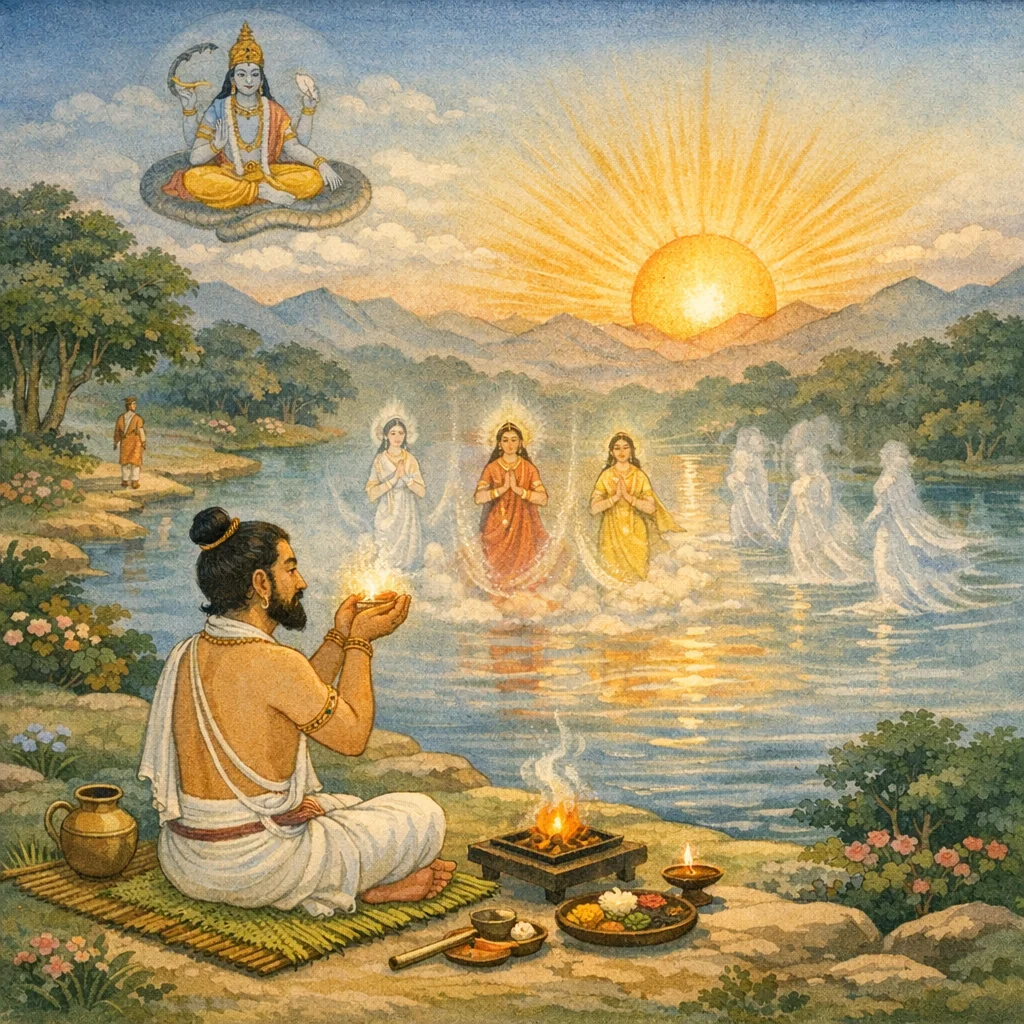
Sanaka teaches Nārada the householder’s daily righteous discipline beginning at brahma-muhūrta: proper direction and restraint during elimination, forbidden places, and the doctrine of outer and inner purity. He prescribes śauca by earth and water, acceptable sources of clay, and graded numbers of cleansing applications, with multipliers by āśrama and allowances for illness, calamity, and women’s situations. He then details ācāmana with prescribed touches, tooth-stick choice with mantra, bathing while invoking rivers, tīrthas, and mokṣa-giving cities, and the full Sandhyā rite—saṅkalpa, vyāhṛti-sprinkling, nyāsa, prāṇāyāma, mārjana, aghamarṣaṇa, arghya to Sūrya, and meditation on Gāyatrī/Sāvitrī/Sarasvatī—warning against neglect. The chapter sets bathing frequency by āśrama, enjoins Brahmayajña, Vaiśvadeva, honoring the atithi, and the pañca-mahāyajñas, then turns to vānaprastha austerities and yati conduct, culminating in Nārāyaṇa-centered Vedānta meditation and the promise of Viṣṇu’s supreme abode.
Shlokas
Verse 1
सनक उवाच । गृहस्थस्य सदाचारं वक्ष्यामि मुनिसत्तम । यद्रूतां सर्वपापानि नश्यंत्येव न संशयः ॥ १ ॥
Sanaka said: O best of sages, I shall explain the righteous conduct of a householder; by observing it, all sins are destroyed—without any doubt.
Verse 2
ब्राह्मे मुहूर्ते चोत्थाय पुरुषार्थाविरोधिनीम् । वृत्तिं संचिंतयेद्विप्र कृतकेशप्रसाधनः ॥ २ ॥
Rising in the Brahma-muhūrta, O brāhmaṇa, after cleansing and arranging one’s hair, one should reflect upon a livelihood that does not conflict with the four aims of human life—dharma, artha, kāma, and mokṣa.
Verse 3
दिवासंध्यासु कर्णस्थब्रह्मसूत्र उदड्मुखः । कुर्यान्मूत्रपुरीषे तु रात्रौ चेद्दक्षिणामुखः ॥ ३ ॥
At the daytime sandhyās, with the sacred thread (yajñopavīta) placed upon the ear, one should pass urine or stool facing north; but if it is at night, one should do so facing south.
Verse 4
शिरः प्रावृत्य वस्त्रेण ह्यंतर्द्धाय तृणैर्महीम् । वहन्काष्टं करेणैकं तावन्मौनी भवेद्द्विजः ॥ ४ ॥
Covering his head with a cloth, concealing the ground with grass, and holding a piece of wood in one hand—so long should the twice-born observe mauna, the vow of sacred silence.
Verse 5
पथि गोष्टे नदीतीरे तडागगृहसन्निधौ । तथा वृक्षस्य च्छायायां कांतारे वह्निसन्निधौ ॥ ५ ॥
On a road, in a cowshed, on a riverbank, near a pond or a dwelling; likewise in a tree’s shade, in the wilderness, or close to a fire—one should keep restraint and propriety, avoiding impure or improper acts in such places.
Verse 6
देवालये तथोद्याने कृष्टभूमौ चतुष्पथे । ब्राह्मणानां समीपे च तथा गोगुरुयोषिताम् ॥ ६ ॥
In a temple (devālaya), in a garden, on cultivated land, at a crossroads, near brāhmaṇas, and likewise in the presence of cows, one’s guru, and women—one should observe proper restraint and decorum.
Verse 7
तुषांगारकपालेषु जलमध्ये तथैव च । एवमादिषु देशेषु मलमूत्रं न कारयेत् ॥ ७ ॥
One should not void feces or urine on heaps of chaff, on charcoal or potsherds, nor in the midst of water; likewise, in any such improper places, one should not do so.
Verse 8
शौचे यत्नः सदा कार्यः शौचमूलो द्विजः स्मृतः । शौचाचारविहीनस्य समस्तं कर्म निष्फलम् ॥ ८ ॥
One should ever strive for śauca, purity; the dvija, the twice-born, is said to be rooted in purity. For one who lacks the conduct of cleanliness, every act becomes fruitless.
Verse 9
शौचं तु द्विविधं प्रोक्तं ब्राह्ममाभ्यंतरं तथा । मृज्जलाभ्यां बहिः शुद्धिर्भावशुद्धिस्तथांतरम् ॥ ९ ॥
Śauca, purity, is taught to be of two kinds—external and internal—and it is indeed a Brahmic discipline that uplifts the spirit. External purity is attained by earth (clean clay/ash) and water; internal purity is the cleansing of bhāva, one’s feelings and intentions.
Verse 10
गृहीतशिश्रश्चोत्थाय शौचार्थं मृदमाहरेत् । न मूषकादिखनितां फालोत्कृष्टां तथैव च ॥ १० ॥
After relieving oneself, one should rise and bring clean earth for the sake of śauca; but one should not use earth dug up by rats and the like, nor earth freshly turned up by the plough.
Verse 11
वापीकूपतडागेभ्यो नाहरेदपि मृत्तिकाम् । शौचं कुर्यात्प्रयत्नेन समादाय शुभां मृदम् ॥ ११ ॥
One should not take earth from wells, step-wells, or ponds. With care and effort, one should perform śauca using auspicious, clean earth gathered from a proper place.
Verse 12
लिंगे मृदेका दातव्या तिस्रो वा मेढ्रयोर्द्वयोः । एतन्मूत्रमुत्सर्गे शौचमाहूर्मनीषिणः ॥ १२ ॥
For cleansing the genital organ, one should apply one portion of earth, or else three portions for the two testicles. Such is the śauca prescribed by the wise after the discharge of urine.
Verse 13
एका लिंगे गुदे पंच दश वामे तथोभयोः । सप्त तिस्रः प्रदातव्याः पादयोर्मृत्तिकाः पृथक् ॥ १३ ॥
Apply purifying earth once to the genital organ; five times to the anus; ten times to the left hand, and likewise to both hands. To the two feet, separately, apply earth seven and three times, respectively.
Verse 14
एतच्छौचं विडुत्सर्गे गंधलेपापनुत्तये । एतच्छौचं गृहस्थस्य द्विगुणं ब्रह्मचारिणाम् ॥ १४ ॥
This is the rule of purity after evacuating excreta, meant to remove foul odor and clinging impurity. This standard applies to the householder; for brahmacārins (celibate students) it is to be observed in double measure.
Verse 15
त्रिगुणां तु वनस्थानां यतीनां तच्चर्गुणम् । स्वस्थाने पूर्णशौचं स्यात्पथ्यर्द्धं मुनिसत्तम ॥ १५ ॥
For forest-dwellers (vānaprasthas) the standard of purity is threefold; for renunciants (yatīs) it is fourfold. In one’s proper place it should be complete purity; while on the road, only half of the prescribed observance is to be maintained, O best of sages.
Verse 16
आतुरे नियमो नास्ति महापदि तथैव च । गंधलेपक्षयकरं शौर्चं कुर्याद्विचक्षणः ॥ १६ ॥
For one who is sick, no strict rule is to be enforced; the same applies in times of great calamity. A discerning person should perform such purification as removes foul smell and bodily soiling.
Verse 17
स्त्रीणामनुपनीतानां गंधलेपक्षयावधि । व्रतस्थानां तु सर्वेषां यतिवच्छौचमिष्यते ॥ १७ ॥
For women who have not undergone upanayana, purity is to be observed until any applied perfume or unguent has worn off; but for all who are established in a vow (vrata), the prescribed standard of purity is like that of an ascetic (yati).
Verse 18
विधवानां च विप्रेंद्र एतदेव निगद्यते । एवं शौचं तु निर्वर्त्य पश्चाद्वै सुसमाहितः ॥ १८ ॥
O best of brāhmaṇas, this very same rule is prescribed for widows as well. Having thus completed the rite of purification (śauca), one should thereafter remain well-composed, collected, and attentive.
Verse 19
प्रागास्य उदगास्यो वाप्याचामेत्प्रयर्तेंद्रियः । त्रिश्चतुर्धा पिबेदापो गंधफेनादिवर्जिताः ॥ १९ ॥
Facing east or else facing north, with the senses restrained, one should perform ācamana. One should sip water three or four times—water free from smell, foam, and other impurities.
Verse 20
द्विर्मार्जयेत्कपोलं च तलेनोष्ठौ च सत्तम । तर्जन्यंगुष्ठयोगेन नासारंध्रद्वयं स्पृशेत् ॥ २० ॥
O best of the virtuous, one should wipe the cheeks twice and also wipe the lips with the palm; then, joining the forefinger and thumb, one should touch both nostrils.
Verse 21
अगुंष्ठानामिकाभ्यां च चक्षुः श्रोत्रे यथाक्रमम् । कनिष्ठांगुष्ठयोगेन नाभिदेशे स्पृशेद्द्विजः ॥ २१ ॥
Using the thumb and ring-finger, the twice-born should touch the eyes and the ears respectively, in due order; and joining the little finger with the thumb, he should touch the region of the navel.
Verse 22
तलेनोरःस्थलं चैव अंगुल्यग्रैः शिरः स्पृशेत् । तलेन चांगुलाग्रैर्वा स्पृशेदंसौ विचक्षणः ॥ २२ ॥
With the palm one should touch the region of the chest, and with the fingertips touch the head; or else, using the palm and the fingertips, the discerning person should touch the shoulders.
Verse 23
एवमाचम्य विप्रेंद्र शुद्धिमाप्नोत्यनुत्तमाम् । दंतकाष्ठं ततः खादेत्सत्वचं शस्तवृक्षजम् ॥ २३ ॥
Thus, O best of brāhmaṇas, by performing ācamana one attains unsurpassed purity. Thereafter, one should chew a tooth-stick, with its bark intact, taken from a recommended auspicious tree.
Verse 24
बिल्वासनापामार्गणां निम्बान्मार्कादिशाखिनाम् । प्रक्षाल्य वारिणा चैव मंत्रेणाप्यभिमंत्रितम् ॥ २४ ॥
Having washed with water the leaves or twigs of bilva, āsana, apāmārga, nimba, and other such trees, one should also sanctify them by consecrating them with a mantra.
Verse 25
आयुर्बलं यशो वर्चः प्रजाः पशुवसूनि च । ब्रह्म प्रज्ञां च मेधां च त्वन्नो धेहि वनस्पते ॥ २५ ॥
Grant us long life, strength, fame, and spiritual radiance; grant offspring, cattle, and wealth as well; and bestow on us sacred knowledge, wisdom, and retentive intelligence—O Lord of the plants.
Verse 26
कनिष्ठाग्रसमं स्थौल्ये विप्रः खादेद्दशांगुलम् । नवांगुलं क्षत्रियश्च वैश्यश्चाष्टांगुलोन्मितम् ॥ २६ ॥
When measuring the proper quantity of food by the breadth of one’s little finger, a Brāhmaṇa should eat a measure of ten finger-breadths; a Kṣatriya, nine; and a Vaiśya, eight.
Verse 27
शूद्रो वेदांगुलमितं वनिता च मुनीश्वर । अलाभे दंतकाष्ठानां गंडूषैर्भानुसंमितैः ॥ २७ ॥
O lord of sages, for a Śūdra the tooth-stick should be of the measure of one veda (twelve) finger-breadths, and likewise for a woman. When tooth-sticks are unavailable, purification may be done by rinsing the mouth with water a number of times equal to the count of the suns (twelve).
Verse 28
मुखशुद्धिर्विधीयेत तृणपत्रसमन्वितैः । करेणादाय वामेन संचर्वेद्वामदंष्ट्रया ॥ २८ ॥
For cleansing the mouth, one should use blades of grass together with leaves; holding them in the left hand, one should rub and clean with the teeth on the left side.
Verse 29
द्विजान्संघर्ष्य गोदोहं ततः प्रक्षाल्य पाटयेत् । जिह्वामुल्लिख्य ताभ्यां तु दलाभ्यां नियतेंद्रियः ॥ २९ ॥
Having rubbed and cleansed the sacred kuśa blades and the vessel used for milking, one should wash them and split the blades in two. With the senses restrained, one should gently scrape the tongue and then employ those two split blades in the rite.
Verse 30
प्रक्षाल्य प्रक्षिपेदू दूरे भूयश्चाचम्य पूर्ववत् । ततः स्नानं प्रकुर्वीत नद्यादौ विमले जले ॥ ३० ॥
After washing it, one should cast it far away; then, having again performed ācamana as before, one should proceed to bathe in pure water—such as in a river and the like.
Verse 31
तटं प्रक्षाल्य दर्भाश्च विन्यस्य प्रविशेज्जलम् । प्रणम्य तत्र तीर्थानि आवाह्य रविमंडलात् ॥ ३१ ॥
After washing the riverbank and placing darbha grass there, one should enter the water. Having bowed down, one should then invoke the sacred tīrthas there, calling them forth from the orb of the Sun.
Verse 32
गंधाद्यैर्मंडलं कृत्वा ध्यात्वा देवं जनार्दनम् । स्नायान्मंत्रान्स्मरन्पुण्यांस्तीर्थानि च विरिंचिज ॥ ३२ ॥
Having drawn a sacred circle with fragrances and other auspicious substances, and meditating on Lord Janārdana, one should bathe while remembering the mantras and the holy tīrthas—O Brahmā-born one.
Verse 33
गंगे च यमुने चैव गोदावरि सरस्वति । नर्मदे सिंधुकावेरि जलेऽस्मिन्सन्निधिं कुरु ॥ ३३ ॥
O Gaṅgā, O Yamunā, and also Godāvarī and Sarasvatī; O Narmadā, Sindhu, and Kāverī—be present here and now in this water.
Verse 34
पुष्कराद्यानि तीर्थानि गंगाद्याः सरितस्तथा । आगच्छंतु महाभागाः स्नानकाले सदा मम ॥ ३४ ॥
May the sacred tīrthas beginning with Puṣkara, and the holy rivers beginning with the Gaṅgā—O greatly blessed ones—always come to me at the time of my bathing.
Verse 35
अयोध्या मथुरा माया काशीं कांची ह्यवंतिका । पुरी द्वारावती ज्ञेया सप्तैता मोक्षदायिकाः ॥ ३५ ॥
Ayodhyā, Mathurā, Māyā (Haridvāra), Kāśī, Kāñcī, Avantikā (Ujjayinī), Purī, and Dvārāvatī are known as the seven cities that bestow liberation (mokṣa).
Verse 36
ततोऽधमर्षण जप्त्वा यतासुर्वारिसंप्लुतः । स्नानांगं तर्पणं कृत्वाचम्यार्ध्यं भानवेऽर्पयेत् ॥ ३६ ॥
Then, having recited the Aghamarṣaṇa mantra, with the breath restrained and the body drenched in water, one should complete the bathing rite, perform tarpaṇa (satisfying libations), do ācamanam (purifying sips), and offer arghya to the Sun.
Verse 37
ततो ध्यात्वा विवस्वंतं जलान्निर्गत्य नारद । परिधायाहतं धौतं द्वितीयं परिवीय च ॥ ३७ ॥
Then, O Nārada, having meditated upon Vivasvān (the Sun), he emerged from the water, put on a clean, washed garment, and also wrapped himself with a second cloth.
Verse 38
कुशासने समाविश्य संध्याकर्म समारभेत् । ईशानाभिमुखो विप्र गायत्र्याचम्य वै द्विज ॥ ३८ ॥
Seated upon a kuśa-grass seat, one should begin the Sandhyā rites. Facing the north-east direction, O brāhmaṇa, the twice-born should perform ācamana while reciting the Gāyatrī.
Verse 39
ऋतमित्यभिमंत्र्यार्थ पुनरेवाचमेद् बुधः । ततस्तु वारिणात्मानं वेष्टयित्वा समुक्ष्य च ॥ ३९ ॥
Having consecrated (the act) with the mantra “ṛtam,” the wise person should again sip water (ācamanam). Then, wrapping his body with water—sprinkling it over himself as well—he should proceed.
Verse 40
संकल्प्य प्रणवान्ते तु ऋषिच्छंदः सुरान्स्मरन् । भूरादिभिर्व्याहृतिभिः सप्तभिः प्रोक्ष्य मस्तकम् ॥ ४० ॥
After forming the ritual resolve (saṅkalpa) and concluding it with the Pranava (Oṃ), one should remember the seer (ṛṣi), the metre (chandas), and the deities; then, with the seven sacred utterances beginning with Bhūḥ, one should sprinkle (purify) the head.
Verse 41
न्यासं समाचरेन्मंत्री पृथगेव करांगयोः । विन्यस्य हृदये तारं भूः शिरस्यथ विन्यसेत् ॥ ४१ ॥
The practitioner of mantras should perform nyāsa separately on the hands and the limbs. Having placed the syllable ‘tāra’ in the heart, he should then place ‘bhūḥ’ upon the head.
Verse 42
भुवः शिखायां स्वश्चैव कवये भूर्भुवोऽक्षिषु । भूर्भुवः स्वस्तथात्रास्त्रं दिक्षु तालत्रयं न्यसेत् ॥ ४२ ॥
One should place (by nyāsa) ‘Bhuvaḥ’ on the crown-lock (śikhā), and ‘Svaḥ’ upon the mouth; ‘Bhūr’ and ‘Bhuvaḥ’ are to be placed upon the eyes. Then ‘Bhūr, Bhuvaḥ, Svaḥ’ should be set as the protective weapon (astrāstra) in the directions, and the three rhythmic claps (tāla-traya) should be performed.
Verse 43
तत आवाहयेत्संध्यां प्रातः कोकनदस्थिताम् । आगच्छ वरदे देवि त्र्यक्षरे ब्रह्मवादिनि ॥ ४३ ॥
Then, in the morning, one should invoke Sandhyā Devī, stationed upon the red lotus, saying: “Come, O boon-giving Goddess—O three-syllabled one, O proclaimer of Brahman.”
Verse 44
गायत्रि च्छंदसां मातर्ब्रह्मयोने नमोऽस्तु ते । मध्याह्ने वृषभारुढां शुक्लांबरसमावृताम् ॥ ४४ ॥
O Gāyatrī, Mother of the Vedic metres, source of Brahman—salutations to you. At midday, one should contemplate you as seated upon a bull, clad in white garments.
Verse 45
सावित्रीं रुद्रयोनिं चावाहयेद्रुद्रवादिनीम् । सायं तु गरुडारुढां पीतांबरसमावृत्ताम् ॥ ४५ ॥
One should invoke Savitrī also in her Rudra-origin form, the one who proclaims the Rudra-mantras. But in the evening, one should invoke her as seated upon Garuḍa, clad in yellow garments.
Verse 46
सरस्वतीं विष्णुयोनिमाह्वयेद्विष्णुवादिनीम् । तारं च व्याहृतीः सत्प त्रिपदां च समुच्चरन् ॥ ४६ ॥
One should invoke Sarasvatī—she who has Viṣṇu as her source and who proclaims Viṣṇu—while also uttering the sacred syllable Oṃ (tāra), the vyāhṛtis (bhūḥ, bhuvaḥ, svaḥ), and the three-footed Gāyatrī (tripadā).
Verse 47
शिरः शिखां च संपूर्य कुभयित्वा विरेचयेत् । वाममध्यात्परैर्वायुं क्रमेण प्राणसंयमे ॥ ४७ ॥
In the discipline of breath-control, one should fill the breath up to the head and the crown-lock, retain it firmly, and then exhale. Thereafter, starting from the left and then the middle (nostril/channel), one should regulate the breath step by step in due sequence.
Verse 48
द्विराचामेत्ततः पश्चात्प्रातः सूर्यश्चमेति च । आपः पुनंतु मध्याह्ने सायमग्निश्चमेति च ॥ ४८ ॥
Thereafter one should perform ācamana twice, reciting: “In the morning, may Sūrya purify me.” At midday one should recite: “May the waters purify (me).” And in the evening one should recite: “May Agni purify me.”
Verse 49
आपो हिष्ठेति तिसृभिर्मार्जनं च ततश्चरेत् । सुमुत्रिया न इत्युक्त्वा नासास्पृष्टजलेन च ॥ ४९ ॥
Then one should perform mārjana/prokṣaṇa—the cleansing by sprinkling—with three recitations of “Āpo hi ṣṭhā…”. After that, reciting “Sumutriyā naḥ…”, one should do so with water that has been touched to the nostrils.
Verse 50
द्विषद्वर्गं समुत्सार्य द्रुपदां शिरसि क्षिपेत् । ऋतं च सत्यमेतेन कृत्वा चैवाघमर्षणम् ॥ ५० ॥
Having driven away the host of enemies, one should cast (the burden of sin) upon the head of Dru-pada; by this, establishing Ṛta (cosmic order) and Satya (truth), one indeed performs the Aghamarṣaṇa—“the washing away of sin”.
Verse 51
अंतश्चरसि मंत्रेण सकृदेव पिबेदपः । ततः सूर्याय विधिवद्गन्धं पुष्पं जलांजलिम् ॥ ५१ ॥
Reciting the “Antaścarasi” mantra, one should sip water only once. Then, in proper ritual order, one should offer to Sūrya fragrant paste (gandha), flowers, and a handful of water as arghya.
Verse 52
क्षिप्त्वोपतिष्ठेद्देवर्षे भास्करं स्वस्तिकांजलिम् । ऊर्द्धूबाहुरधोबाहुः क्रमात्कल्यादिके त्रिके ॥ ५२ ॥
O divine seer, after sprinkling the prescribed water, one should stand in reverence before Bhāskara (the Sun), with the hands joined in the auspicious “svastika” añjali. In the triad of ages beginning with the Kṛta-yuga, the worship is performed in due order—raising the arms upward in one age and holding them downward in the next, respectively.
Verse 53
उहुत्यं चित्रं तच्चक्षुरित्येतात्र्रितयं जपेत् । सौराञ्छैवान्वैष्णवांश्च मंत्रानन्यांश्च नारद ॥ ५३ ॥
One should repeat in japa this triad—“uhutyaṃ”, “citraṃ”, and “tac-cakṣuḥ”. Likewise, O Nārada, one may also recite the mantras of Sūrya, Śiva, and Viṣṇu, and other mantras as well.
Verse 54
तेजोऽसि गायत्र्यसीति प्रार्थयेत्सवितुर्महः । ततोऽङ्गानि त्रिरावर्त्य ध्यायेच्छक्तीस्तदात्मिकाः ॥ ५४ ॥
Reciting, “You are radiance; you are Gāyatrī,” one should pray to the great glory of Savitṛ. Then, having mentally reviewed the limbs three times, one should meditate on the Śaktis that are of that very essence.
Verse 55
ब्रह्मणी चतुराननाक्षवलया कुम्भं करैः स्रुक्स्रवौ बिभ्राणा त्वरुणेंदुकांतिवदना ऋग्रूपिणी बालिका । हंसारोहणकेलिखण्खण्मणेर्बिंबार्चिता भूषिता गायत्री परिभाविता भवतु नः संपत्समृद्ध्यै सदा ॥ ५५ ॥
May that revered Gāyatrī—Śakti of four-faced Brahmā—wearing a rosary as a bracelet, holding the ritual water-pot and the ladle and offering-spoon; with a face radiant like the newly risen moon; appearing as the very form of the Ṛgveda, a youthful maiden—adorned with tinkling jewel-ornaments in the play of her swan-mount and beautified with bimba-like ornaments, ever contemplated by the wise—grant us always prosperity and abundance.
Verse 56
रुद्राणी नवयौवना त्रिनयना वैयाघ्रचर्मांबरा खट्वांगत्रिशिखाक्षसूत्रवलयाऽभीतिश्रियै चास्तु नः । विद्युद्दामजटाकलापविलसद्बालेंदुमौलिर्मुदा सावित्री वृषवाहना सिततनुर्ध्येया यजूरूपिणी ॥ ५६ ॥
May Rudrāṇī—ever in fresh youth, three-eyed, clad in tiger-skin—bearing the khaṭvāṅga staff, the trident, the rudrākṣa rosary and armlets—grant us the splendor of fearlessness. With joy her matted locks shine like a garland of lightning, and the crescent moon adorns her crown. She is Sāvitrī, riding the bull, radiant in a white form—worthy of meditation—whose very nature is the Yajurveda.
Verse 57
ध्येया सा च सरस्वती भगवती पीतांबरालंकृता श्यामा श्यामतनुर्जरोपरिलसद्गात्रांचिता वैष्णवी । तार्क्ष्यस्था मणिनूपुरांगदलसद्ग्रैवेयभूषोज्ज्वला हस्तालंकृतशंखचक्रसुगदापद्मा श्रियै चास्तु नः ॥ ५७ ॥
That Blessed Goddess Sarasvatī is to be meditated upon—adorned in yellow garments, dark-hued with a dark body, bearing the radiant marks of maturity upon her limbs, and established in the Vaiṣṇava nature. Seated upon Tārkṣya (Garuḍa), she shines with jeweled anklets and splendid ornaments upon her limbs and neck; her hands bear the conch, discus, mace, and lotus—may she grant us prosperity and auspicious fortune.
Verse 58
एवं ध्यात्वा जपेत्तिष्ठन्प्रातर्मध्याह्नके तथा । सायंकाले समासीनो भक्त्या तद्गतमानसः ॥ ५८ ॥
Thus having meditated, one should repeat the mantra while standing in the morning and likewise at midday; and in the evening, seated, with devotion, keeping the mind absorbed in That—the Lord.
Verse 59
सहस्रपरमां देवीं शतमध्यां दशावराम् । त्रिपदां प्रणवोपेतां भूर्भुवः स्वरुपक्रमाम् ॥ ५९ ॥
I meditate upon that Divine Goddess: supreme as the “thousand,” whose middle is the “hundred,” whose lower is the “ten”; three-footed, joined with the Pranava (Oṁ), proceeding in the sequence of Bhūḥ, Bhuvaḥ, and Svaḥ—the three worlds.
Verse 60
षट्तारः संपुटो वापि व्रतिनश्च यतेर्जपः । गृहस्थस्य सतारः स्याज्जप्य एवंविधो मुने ॥ ६० ॥
For a vow-observing practitioner and for a renunciant (yati), japa should be done with a sixfold ‘tāra’ enclosure (saṃpuṭa). But for a householder it should be with a sevenfold ‘tāra’. Such is the proper manner of japa, O sage.
Verse 61
ततो जप्त्वा यथाशक्ति सवित्रे विनिवेद्य च । गायत्र्यै च सवित्रे च प्रक्षिपेदंजलिद्वयम् ॥ ६१ ॥
Then, having performed japa to the best of one’s capacity and duly offered it to Savitṛ, one should offer two handfuls of water as añjali—one to Gāyatrī and one to Savitṛ.
Verse 62
ततो विसृज्य तां विप्र उत्तरे इति मंत्रतः । ब्रह्मणेशेन हरिणानुज्ञाता गच्छ सादरम् ॥ ६२ ॥
Then, O brāhmaṇa, release her with the mantra beginning “uttare…”, and, having been respectfully granted leave by Brahmā, Īśa (Śiva), and Hari (Viṣṇu), depart with reverence.
Verse 63
दिग्भ्यो दिग्देवताभ्यश्च नमस्कृत्य कृतांजलिः । प्रातरादेः परं कर्म कुर्यादपि विधानतः ॥ ६३ ॥
Having bowed with joined palms to the directions and to the deities who preside over the directions, one should then perform the ensuing morning duties, strictly in accordance with the prescribed rule.
Verse 64
प्रातर्मध्यंदिने चैव गृहस्थः स्नानमाचरेत् । वानप्रस्थश्च देवर्षे स्नायात्त्रिषवणं यतिः ॥ ६४ ॥
A householder should perform the ritual bath in the morning and again at midday. The forest-dweller also, O divine sage; while the renunciant (yati) should bathe at the three Sandhyā times (triṣavaṇa).
Verse 65
आतुराणां तु रोगाद्यैः पांथानां च सकृन्मतम् । ब्रह्मयज्ञं ततः कुर्याद्दर्भपाणिर्मुनीश्वर ॥ ६५ ॥
For those afflicted—by illness and the like—and for travellers as well, it is prescribed that (the Brahmayajña) may be performed only once. Therefore, O lord of sages, one should then perform the Brahmayajña, holding darbha grass in the hand.
Verse 66
दिवोदितानि कर्माणि प्रमादादकृतानि चेत् । शर्वर्याः प्रथमे यामे तानि कुर्याद्यथाक्रमम् ॥ ६६ ॥
If the duties prescribed for the daytime have been left undone through negligence, then in the first watch of the night one should perform them in their proper sequence.
Verse 67
नोपास्ते यो द्विजः संध्यां धूर्तबुद्धिरनापदि । पाषंडः स हि विज्ञेयः सर्वधर्मबहिष्कृतः ॥ ६७ ॥
That twice-born man who, with a deceitful mind and without any genuine impediment, does not perform Sandhyā worship should indeed be known as a pāṣaṇḍa (heretic); he stands excluded from all dharmic observances.
Verse 68
यस्तु संध्यादिकर्माणि कूटयुक्तिविशारदः । परित्यजति तं विद्यान्महापातकिनां वरम् ॥ ६८ ॥
But he who, though skilled in deceitful reasoning, abandons the Sandhyā rites and other daily sacred duties—know him to be foremost among great sinners.
Verse 69
ये द्विजा अभिभाषंते त्यक्तसंध्यादिकर्मणः । ते यांति नरकान्घोरान्यावच्चंद्रार्कतारकम् ॥ ६९ ॥
Those twice-born who speak with authority while having abandoned Sandhyā and other prescribed daily rites go to dreadful hells for as long as the moon, sun, and stars endure.
Verse 70
देवार्चनं ततः कुर्याद्वैश्वदेवं यथाविधि । तत्रात्यमतिथिं सम्यगन्नाद्यैश्च प्रपूजयेत् ॥ ७० ॥
Thereafter one should worship the devas and, as prescribed, perform the Vaiśvadeva offering; and there one should properly honor an eminent guest with food and other provisions.
Verse 71
वक्तव्या मधुरा वाणी तेष्वप्यभ्यागतेषु तु । जलान्नकंदमूलैर्वा गृहदानेन चार्चयेत् ॥ ७१ ॥
One should speak sweet and gentle words; and even to those who arrive unexpectedly, one should offer honor—by giving water, food, roots and tubers, or even by offering shelter in the home.
Verse 72
अतिथिर्यस्य भग्नाशो गृहात्प्रतिनिवर्तिते । स तस्मै दुष्कृतं दत्त्वा पुण्यमादाय गच्छति ॥ ७२ ॥
If a guest, with his hopes disappointed, turns back from someone’s house, he departs after handing over his demerit to that householder and taking away the householder’s merit.
Verse 73
अज्ञातगोत्रनामानमन्यग्रामादुपागतम् । विपश्चितोऽतिथिं प्राहुर्विष्णुवत्तं प्रपूजयेत् ॥ ७३ ॥
The wise call a true guest one who arrives from another village, whose name and lineage are unknown; such a guest should be honored and worshipped as one worships Lord Viṣṇu.
Verse 74
स्वग्रामवासिनं त्वेकं श्रोत्रियं विष्णुतत्परम् । अन्नाद्यैः प्रत्यहं विप्रपितॄनुद्दिश्य तर्पयेत् ॥ ७४ ॥
Each day one should satisfy a single śrotriya— a Veda-knowing brāhmaṇa living in one’s own village and devoted to Lord Viṣṇu—by offering food and other provisions, dedicating the act to the brāhmaṇas and to the Pitṛs (ancestors).
Verse 75
पंचयज्ञपरित्यागी ब्रह्माहेत्युच्यते बुधैः । कुर्यादहरहस्तस्मात्पंचयज्ञान्प्रयन्ततः ॥ ७५ ॥
The wise declare that one who abandons the five daily yajñas is called a ‘slayer of Brahman’—a grievous sinner. Therefore one should perform the five yajñas every day with earnest effort.
Verse 76
देवयज्ञो भूतयज्ञः पितृयज्ञस्तथैव च । नृपज्ञो ब्रह्मयज्ञश्च पंचयज्ञान्प्रचक्षते ॥ ७६ ॥
They declare the five yajñas to be: deva-yajña (offering to the gods), bhūta-yajña (offering to living beings), pitṛ-yajña (rite for the ancestors), nṛpa-yajña (duty toward the king and society), and brahma-yajña (the sacrifice of sacred study and teaching).
Verse 77
भृत्यमित्रादिसंयुक्तः स्वयं भुञ्जीत वाग्यतः । द्विजानां भोज्यमश्रीयात्पात्रं नैव परित्यजेत् ॥ ७७ ॥
Accompanied by servants, friends, and the like, one should eat oneself with speech restrained. One should partake of food fit for the dvijas (twice-born), and one should never disrespectfully discard one’s eating vessel.
Verse 78
संस्थाप्य स्वासमे पादौ वस्त्रार्द्धं परिधाय च । मुखेन वमितं भुक्त्वा सुरापीत्युच्यते बुधैः ॥ ७८ ॥
If one places one’s feet upon one’s own mouth, wraps oneself with only half a garment, and then eats what has been vomited from the mouth, the wise declare this to be tantamount to drinking liquor.
Verse 79
खादितार्द्धं पुनः खादेन्मोदकांश्च फलानि च । प्रत्यक्षं लवणं चैव गोमांसशीति गद्यते ॥ ७९ ॥
One should not eat again what has already been half-eaten; nor should one take modakas (sweet balls) and fruits in a manner contrary to rule. Likewise, taking salt directly, by itself, is censured—such conduct is spoken of as ‘like eating cow-flesh.’
Verse 80
अपोशाने वाचमने अद्यद्रव्येषु च द्विजः । शब्द न कारयेद्विप्रस्तं कुर्वन्नारकी भवेत् ॥ ८० ॥
During āpośana (sipping water for purification), during vācāmana (rinsing the mouth), and while handling impure substances, a twice-born should not utter words; one who does so becomes fit for hellish realms.
Verse 81
पथ्यमन्नं प्रभुञ्जीत वाग्यतोऽन्नमसुत्सयनम् । अमृतोपस्तरणमसि अपोशानं भुजेः पुरः ॥ ८१ ॥
One should eat only wholesome, suitable food, with speech restrained, and without faultfinding in the meal. Before eating, one should perform āpośana, reciting: “You are the spreading of nectar (amṛta).”
Verse 82
अमृतापिधानमसि भोज्यान्तेऽपः सकृत्पिबेत् । प्राणाद्या आहुतीर्दत्त्वाचम्य भोजनमाचरेत् ॥ ८२ ॥
Uttering, “You are the covering of nectar (amṛta),” at the end of the meal one should sip water once. Then, having offered the oblations beginning with (the mantra of) Prāṇa and having performed ācamana, one should duly complete the meal-rite.
Verse 83
ततश्चाचम्य विप्रेंद्र शास्त्रचिंतापरो भवेत् । रात्रावपि यथाशक्ति शयनासनभोजनैः ॥ ८३ ॥
Then, having performed ācamana, O best of brāhmaṇas, one should become intent on contemplating the śāstras; even at night, as far as one is able, one should maintain restraint regarding sleep, comfort of seating, and food.
Verse 84
एवं गृही सदाचारं कुर्यात्प्रतिदिनं मुने । यदाऽचारपरित्यागी प्रायश्चित्ती तदा भवेत् ॥ ८४ ॥
Thus, O sage, a householder should practice right conduct (sadācāra) each day. But when one abandons proper conduct, then one becomes obliged to perform expiatory rites (prāyaścitta).
Verse 85
दूषितां स्वतनुं दृष्ट्वा पालिताद्यैश्च सत्तम । पुत्रेषु भार्यां निःक्षिप्य वनं गच्छेत्सहैव वा ॥ ८५ ॥
O best among the virtuous, seeing one’s own body impaired and life sustained only by attendants and the like, one should entrust one’s wife to one’s sons and go to the forest—either alone or together with her.
Verse 86
भवेत्रिषवणस्नायी नखश्मश्रुजटाधरः । अधः शायी ब्रह्मचारी पञ्चयज्ञपरायणः ॥ ८६ ॥
He should bathe at the three daily sandhyās, keep his nails (and hair) and beard untrimmed, and wear matted locks (jaṭā). He should sleep on the ground, live as a brahmacārī, and be devoted to the five great daily sacrifices (pañca-yajña).
Verse 87
फलमूलाशनो नित्यं स्वाध्यायनिरतास्तथा । दयावान्सर्वभूतेषु नारायणपरायणः ॥ ८७ ॥
He lives constantly on fruits and roots, remains devoted to svādhyāya (sacred study), is compassionate toward all beings, and is wholly devoted to Nārāyaṇa.
Verse 88
वर्जयेद्ग्रामजातानि पुष्पाणि च फलानि च । अष्टौ ग्रासांश्च भुञ्जीत न कुर्याद्रात्रिभोजनम् ॥ ८८ ॥
One should avoid foods produced in villages, as well as flowers and fruits. One should eat only eight mouthfuls and should not take food at night.
Verse 89
अत्यन्तं वर्जयेत्तैलं वानप्रस्थसमाश्रमी । व्यवायं वर्जयेच्चैव निद्रालस्ये तथैव च ॥ ८९ ॥
One who has entered the vānaprastha āśrama should strictly avoid oil and oily indulgences. He should also refrain from sexual intercourse, as well as from excessive sleep and laziness.
Verse 90
शंखचक्रगदापाणिं नित्यं नारायणं स्मरेत् । वानप्रस्थः प्रकुर्वीत तपश्चांद्रायणादिकम् ॥ ९० ॥
A forest-dweller (vānaprastha) should constantly remember Nārāyaṇa, whose hands bear the conch, discus, and mace; and he should undertake austerities such as the Cāndrāyaṇa vow and related disciplines.
Verse 91
सहेत शीततापादिवह्निं परिचरेत्सदा । यदा मनसि वैराग्यं जातं सर्वेषु वस्तुषु ॥ ९१ ॥
One should patiently endure cold, heat, and even fire, and remain constantly engaged in disciplined practice—when dispassion has arisen in the mind toward all objects.
Verse 92
तदैव संन्यसेद्विप्र पतितस्त्वन्यथा भवेत् । वेदांताभ्यासनिरतः शांतो दांतो जितेंद्रियः ॥ ९२ ॥
Therefore, O brāhmaṇa, he should renounce at once; otherwise he would fall from the right path. Let him be devoted to the practice of Vedānta—peaceful, self-restrained, and master of his senses.
Verse 93
निर्द्वेद्वो निरहंकारो निर्ममः सर्वदा भवेत् । शमादिगुणसंयुक्तः कामक्रोधविवर्जितः ॥ ९३ ॥
One should always be free from malice, free from ego, and without possessiveness; endowed with virtues beginning with tranquility, and devoid of desire and anger.
Verse 94
नग्नो वा जीर्णकौपीनौ भवेन्मुंडो यतिर्द्विजः । समः शत्रौ च मित्रे च तथा मानापमानयोः ॥ ९४ ॥
Whether naked or wearing only a worn loincloth, the twice-born renunciant should be shaven-headed and steadfast as a mendicant—remaining equal toward enemy and friend alike, and likewise toward honor and dishonor.
Verse 95
एकरात्रं वसेद्ग्रामे त्रिरात्रं नगरे तथा । भैक्षेण वर्त्तयेन्नित्यं नैकान्नादीभवेद्यतिः ॥ ९५ ॥
A renunciant should stay in a village for one night, and likewise in a city for three nights. He should live constantly on alms, and the yati should not become one who eats from a single (fixed) household.
Verse 96
अनिंदितद्विजगृहे व्यंगारे भुक्तिवर्जिते । विवादरहिते चैव भिक्षार्थं पर्यटेद्यतिः ॥ ९६ ॥
A renunciant should wander for alms only to the blameless house of a twice-born, where the hearth-fire is lit, where he is not invited to dine (as a guest), and where there is no quarrel.
Verse 97
भवेत्रिषवणस्नायी नारायणपरायणः । जपेच्च प्रणवं नित्यं जितात्मा विजितेंद्रियः ॥ ९७ ॥
Let him bathe at the three daily junctures, be wholly devoted to Nārāyaṇa, and constantly repeat the Praṇava (Oṁ), self-controlled and with the senses subdued.
Verse 98
एकान्नादी भवेद्यस्तु कदाचिल्लंपटो यतिः । न तस्य निष्कृतिर्द्दष्टा प्रायश्चित्तायुतैरपि ॥ ९८ ॥
If a renunciant (yati), though living as one who eats only a single meal (ekānnādī), at some time still remains lustful and immoral, no expiation is seen for him—even by tens of thousands of acts of penance.
Verse 99
लोभाद्यदि यतिर्विप्र तनुपोषपरो भवेत् । स चंडालसमो ज्ञेयो वर्णाश्रमविगर्हितः ॥ ९९ ॥
O brāhmaṇa, if a renunciant, out of greed, becomes intent only on maintaining and indulging the body, he should be understood to be like a caṇḍāla—censured by the standards of varṇa and āśrama.
Verse 100
आत्मानां चिंतयेद्द्रेवं नारायणमनामयम् । निर्द्वंद्रं निर्ममंशांतं मायातीतममत्सरम् ॥ १०० ॥
One should contemplate Nārāyaṇa as the very Self—free from affliction, beyond all pairs of opposites, without possessiveness, serene, transcending Māyā, and devoid of envy.
Verse 101
अव्ययं परिपूर्णं च सदानन्दैकविग्रहम् । ज्ञानस्वरुपममलं परं ज्योतिः सनातनम् ॥ १०१ ॥
He is imperishable and all-perfect; His very form is nothing but eternal bliss. He is pure, the very essence of consciousness-knowledge, the supreme Light, everlasting.
Verse 102
अविकारमनाद्यंतं जगच्चैतन्यकारणम् । निर्गुणं परमं ध्यायेदात्मानं परतः परम् ॥ १०२ ॥
One should meditate on the Self—the Supreme beyond the beyond—unchanging, without beginning or end, the cause of the universe’s consciousness, attributeless (nirguṇa), and highest.
Verse 103
पठेदुपनिषद्वाक्यं वेदांतार्थांश्च चिंतयेत् । सहस्त्रशीर्षं देवं च सदा ध्यायेज्जितेंद्रियः ॥ १०३ ॥
Having mastered the senses and gained self-control, one should recite the sayings of the Upaniṣads, contemplate the meanings of Vedānta, and ever meditate upon the thousand-headed Lord.
Verse 104
एवं ध्यानपरो यस्तु यतिर्विगतमत्सरः । स याति परमानंदं परं ज्योतिः सनातनम् ॥ १०४ ॥
Thus the renunciant, devoted to meditation and free from envy, attains the supreme bliss—the eternal, highest Light.
Verse 105
इत्येवमाश्रमाचारान्यः करोति द्विजः क्रमात् । स याति परमं स्थानं यत्र गत्वा न शोचयति ॥ १०५ ॥
Thus, the twice-born who, in due order, practices the prescribed conduct of the āśramas attains the supreme abode—having reached which, one does not grieve.
Verse 106
वर्णाश्रमाचाररताः सर्वपापविवर्जिताः । नारायणपरा यांति तद्विष्णः परमं पदम् ॥ १०६ ॥
Those devoted to the proper conduct of varṇa and āśrama, free from all sins, and wholly dedicated to Nārāyaṇa, attain that supreme abode of Viṣṇu.
Frequently Asked Questions
The chapter frames śauca as a Brahmic discipline with two axes: external cleansing through earth and water (removing physical impurity) and internal purification as bhāva-śuddhi (purifying intention/affect). This aligns ritual efficacy with ethical-psychological integrity—without śauca, actions are declared fruitless.
It presents a full ritual-technology: saṅkalpa, vyāhṛti-based purification, nyāsa on hands/limbs, prāṇāyāma sequencing, mārjana with Vedic mantras, aghamarṣaṇa as sin-removal, arghya to Sūrya, and devī-dhyāna of Gāyatrī/Sāvitrī/Sarasvatī across the three times—integrating mantra, body, breath, and cosmology.
After establishing nitya-karman (purity, Sandhyā, yajñas, hospitality), it maps the āśrama progression to vānaprastha austerity and yati renunciation, culminating in Vedānta contemplation of Nārāyaṇa as the Self—imperishable, attributeless, and bliss—thereby presenting dharma as a graded path toward liberation.