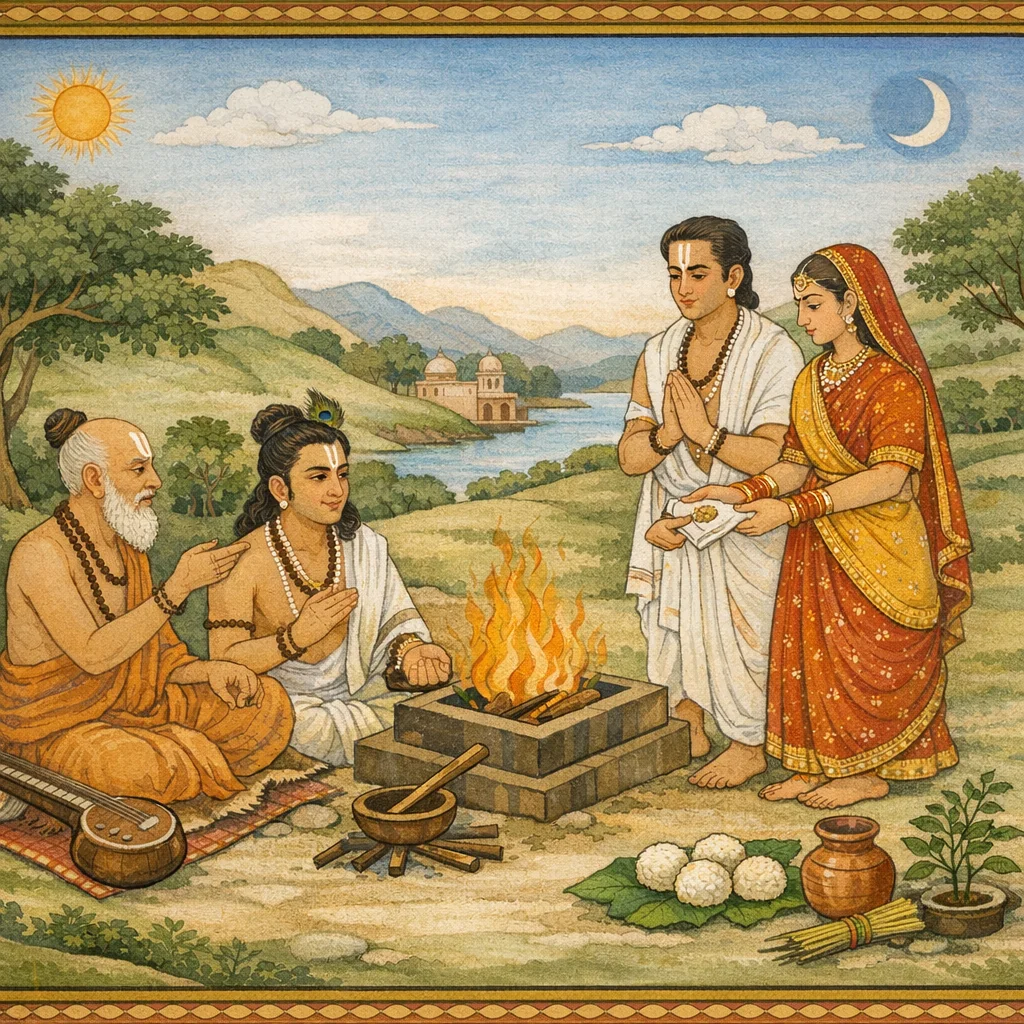
Gṛhastha-praveśa: Vivāha-bheda, Ācāra-śauca, Śrāddha-kāla, and Vaiṣṇava-lakṣaṇa
Within a Sanaka–Nārada teaching dialogue, the chapter traces the transition from completing brahmacarya (service to the guru, receiving permission, establishing the sacred fires) to entering gṛhastha life (offering dakṣiṇā and marrying). It sets standards for choosing a spouse (virtues and limits of kinship), lists disqualifying traits, and describes the eight forms of vivāha, censuring some while allowing graded alternatives. It lays down outer and inner ācāra (dress, cleanliness, restraint in speech, reverence for the guru, avoidance of slander and improper company), prescribes purificatory baths after ritually defiling contacts, and notes auspicious signs and things to avoid. It enjoins sandhyā worship, periodic sacrifices, and an extensive śrāddha calendar (astronomical junctures, eclipses, pretapakṣa, manvādi, aṣṭakā, and tīrtha settings). The conclusion is distinctly Vaiṣṇava: rites without ūrdhva-puṇḍra are declared fruitless, objections to tulasī/tilaka in śrāddha are dismissed as baseless custom, and Viṣṇu’s grace is affirmed as the guarantor of dharma’s success.
Shlokas
Verse 1
सनक उवाच । वेदग्रहणपर्यंतं शुश्रूषानियतो गुरोः । अनुज्ञातस्ततस्तेन कुर्यादग्निपरिग्रहम् ॥ १ ॥
Sanaka said: Until the completion of Vedic study, one should remain disciplined in service to one’s teacher. Then, when granted permission by that teacher, one should accept and establish the sacred fires (agni).
Verse 2
वेदाश्च धर्मशास्त्राणि वेदाङ्गान्यपि च द्विजः । अधीत्य गुरवे दत्त्वा दक्षिणां संविशेद्वृहम् ॥ २ ॥
Having studied the Vedas, the Dharmaśāstras, and also the Vedāṅgas, a twice-born man should offer the teacher the prescribed dakṣiṇā and then enter the householder’s life (gṛhastha).
Verse 3
रुपलावण्यसंपन्नां सगुणां सुकुलोद्भवाम् । द्विजः समुद्वहेत्कन्यां सुशीलां धर्म चारिणीम् ॥ ३ ॥
A twice-born man should marry a maiden endowed with beauty and grace, possessed of good qualities, born in a respectable family, well-mannered, and devoted to the practice of dharma.
Verse 4
मातृतः पंचमीं धीमान्पितृतः सप्तमीं तथा । द्विजः समुद्वहेत्कन्यथा गुरुतल्पराः ॥ ४ ॥
A wise twice-born man should marry a maiden who is beyond the fifth degree of kinship on the mother’s side and beyond the seventh degree on the father’s side; otherwise, he becomes as blameworthy as one who violates the guru’s bed.
Verse 5
रोगिणीं चैव वृत्ताक्षीं सरोगकुलसंभवाम् । अतिकेशाममकेशां च वाचालां नोद्वहेद्वुधः ॥ ५ ॥
A wise man should not marry a woman who is diseased, who has round (bulging) eyes, who is born in a family afflicted with disease, who has excessively much hair or no hair at all, or who is overly talkative.
Verse 6
कोपानां वामनां चैव दीर्घदेहां विरुपिणीम् । न्यानाधिकाङ्गीमुन्मत्तां पिशुनां नोद्वहेद् बुधः ॥ ६ ॥
A wise person should not take upon himself (as a companion or spouse) one who is prone to anger, dwarfish or excessively tall, ill-formed, with deficient or excessive limbs, mentally unbalanced, or given to slander.
Verse 7
स्थूलगुल्फां दीर्घजंघां तथैव पुरुषाकृतिम् । श्मश्रुव्यंजनसंयुक्तां कुब्जां चैवाद्वहेन्न च ॥ ७ ॥
One should not take as a bearer (for carrying a palanquin or load) a woman with thick ankles, long shanks, a masculine build, facial hair or similar marks, or one who is hunchbacked.
Verse 8
वृथाहास्यमुखीं चैव सदान्यगृह वासिनीम् । विवादशीलां भ्रमितां निष्ठुरां नोद्वहेद्रुधः ॥ ८ ॥
A wise man should not marry a woman who is frivolous and ever-smiling without cause, who constantly stays in other people’s houses, who is quarrelsome, fickle and wandering in mind, and who is harsh in speech and conduct.
Verse 9
बह्वशिनीं स्थीलदंतां स्थूलोष्ठीं घुर्घुरस्वनाम् । अतिकृष्णां रक्तवर्णां धूर्तां नैवोद्वहे द्वुधः ॥ ९ ॥
A man of discernment should never marry a woman who eats excessively, has coarse teeth and thick lips, speaks with a harsh, guttural voice, is extremely dark-complexioned, is ruddy in appearance, and is deceitful.
Verse 10
सदा रोदनशीलां च पांडुराभां च कुत्सिताम् । तासश्वासादिसंयुक्तां निद्राशीलां च नोद्वहेत् ॥ १० ॥
One should not marry a woman who is always given to crying, who appears pale, who is of reprehensible conduct, who is afflicted with cough, breathlessness and the like, and who is habitually sleepy.
Verse 11
अनर्थभाषिणीं चैव लोकद्वेष परायणाम् । परापवादनिरतां तस्कारां नोद्वहेद्वुधः ॥ ११ ॥
A wise person should not keep company with a woman who speaks what is harmful and senseless, who is devoted to hating people, who is absorbed in slandering others, and who is like a thief.
Verse 12
दीर्घनासां च कितवां तनूरुहविभूषिगताम् । गर्वितां बकवृत्तिं च सर्वथा नोद्वहेद्वुधः ॥ १२ ॥
A wise person should never, under any circumstance, accept or tolerate a long-nosed deceiver, one who is preoccupied with adorning the body’s hair, a proud person, or one whose conduct is like that of a heron.
Verse 13
बालभावादविज्ञातस्वभावामुद्वहेद्यदि । प्रगल्भां वाऽगुणां ज्ञात्वा सर्वथा तां परित्यजेत् ॥ १३ ॥
If, due to youthful immaturity, one marries a woman whose disposition is not yet understood, then upon later finding her to be shameless or of bad qualities, one should completely renounce her.
Verse 14
भर्त्तृपुत्रेषु या नारी सर्वदा निष्ठुरा भवेत् । परानुकूलिनी या च सर्वथा तां परित्यजेत् ॥ १४ ॥
A woman who is ever harsh toward her husband’s sons, and one who is wholly inclined to others outside the household, should be abandoned in every way.
Verse 15
विवाहाश्चाष्टधा ज्ञेया ब्राह्माद्या मुनिसत्तम । पूर्वः पूर्वो वरो ज्ञेयः पूर्वाभावे परः परः ॥ १५ ॥
O best of sages, marriages are understood to be eightfold, beginning with the Brāhma form. Each earlier form is deemed superior; when the earlier is not possible, the next should be adopted in proper order.
Verse 16
ब्राह्नो दैवस्तथैवार्षः प्राजापत्यस्तथासुरः । गांधर्वो राक्षसश्चैव पैशाचश्चाष्टमो मतः ॥ १६ ॥
The forms of marriage are described as Brāhma, Daiva, Ārṣa, Prājāpatya, and Āsura; likewise Gāndharva, Rākṣasa, and Paiśāca—these are held to be the eight recognized types.
Verse 17
ब्राह्मेण च विवाहेन वैवाह्यो वै द्विजोत्तमः । दैवेनाप्यथवा विप्र केचिदार्षं प्रचक्षते ॥ १७ ॥
By the Brāhma form of marriage, O best of the twice-born, the groom is duly entitled to wed; and by the Daiva form as well, O brāhmaṇa. Some, however, declare it to be the Ārṣa form.
Verse 18
प्राजापत्यादयो विप्र विवाहाः पंचज गर्हिताः । अभावेषु तु पूर्वेषां कुर्यादेव परान्बुधः ॥ १८ ॥
O brāhmaṇa, the five forms of marriage beginning with the Prājāpatya are censured. Yet when the earlier, preferred forms are not possible, a wise person should indeed adopt the later alternatives.
Verse 19
यज्ञोपवीतद्वितयं सोत्तरीयं च धारयेत् । सुवर्णकुंडले चैव धौतवस्त्रद्वयं तथा ॥ १९ ॥
He should wear two sacred threads (yajñopavīta) along with an upper garment; he should also wear golden earrings, and likewise a pair of freshly washed garments.
Verse 20
अनुलेपनलित्पांगः कृत्तकेशनखः शुचिः । धारयेद्वैणवं दंडं सोदकं च कमंडलुम् ॥ २० ॥
With his limbs anointed and well kept, his hair and nails trimmed, and remaining pure, he should carry a Vaiṣṇava staff and also a water-filled kamaṇḍalu (water-pot).
Verse 21
उष्णीषममलं छत्रं पादुके चाप्युपानहौ । धारयेत्पुष्पमाल्ये च सुगंधं प्रियदर्शनः ॥ २१ ॥
Let the devotee of pleasing appearance wear a spotless turban and carry a parasol; let him also use sandals and footwear, and wear garlands of flowers along with a pleasant fragrance.
Verse 22
नित्यं स्वाध्यायशीलः स्याद्यथाचारं समाचरेत् । परान्नं नैव भुञ्जीत परवादं च वर्जयेत् ॥ २२ ॥
One should always be devoted to svādhyāya (self-study) and conduct oneself according to proper established practice. One should not eat food given by others, and one should avoid speaking ill of others.
Verse 23
पादेन नाक्रमेत्पादमुच्छिष्टं नैव लंघयेत् । न संहताभ्यां हस्ताभ्यां कंडूयेदात्मनः शिरः ॥ २३ ॥
One should not step on another’s foot with one’s own foot, nor should one step over what is impure or leftover (ucchiṣṭa). One should also not scratch one’s head with both hands joined together.
Verse 24
पूज्यं देवालयं चैव नापसव्यं व्रजेद्दिजः । देवार्चाचमनस्नानव्रतश्राद्धक्रियादिषु ॥ २४ ॥
A dvija (twice-born) should not circumambulate a venerable person or a temple in the inauspicious leftward (apāsavya) manner. This rule applies during deity-worship, ācamana (ritual sipping for purification), bathing, the observance of vows (vrata), śrāddha rites, and related ritual acts.
Verse 25
न भवेन्मुक्तकेशश्च नैकवस्त्रधरस्तथा । नारोहेदुष्ट्रयानं च शुष्कवादं च वर्जयेत् ॥ २५ ॥
One should not remain with hair left loose, nor wear only a single garment. One should not ride a camel, and one should avoid dry, fruitless talk.
Verse 26
अन्य स्त्रियं न गच्छेच्च पैशुन्यं परिवर्जयेत् । नापसव्यं व्रजेद्विप्र गोश्चत्थानलपर्वतान् ॥ २६ ॥
One should not go to another man’s wife, and one should avoid slander. O brāhmaṇa, one should not pass by or circumambulate cows, the aśvattha tree, fire, or mountains in the inauspicious leftward (apāsavya) manner.
Verse 27
चतुष्पथं चैत्यवृक्षं र्देवखातं नृपं तथा । असूयां मत्सरत्वं च दिवास्वापं च वर्जयेत् ॥ २७ ॥
One should avoid improper conduct at a crossroads, near a shrine-tree (caitya-vṛkṣa), at a temple tank or sacred reservoir (deva-khāta), and also in the presence of a king. Likewise, one should avoid fault-finding, envy, and sleeping during the daytime.
Verse 28
न वदेत्परपापानि स्वपुण्यं न प्रकाशयेत् । स्वकं नाम स्वनक्षत्रं मानं चैवातिगोपयेत् ॥ २८ ॥
One should not speak of another’s sins, nor should one publicize one’s own merits. One should also keep well concealed one’s own name, one’s birth-star (nakṣatra), and one’s honor or status.
Verse 29
न दुर्जनैः सह वसे न्नाशास्त्रं श्रृणुयात्तथा । आसवद्यूतगीतेषु द्विजस्तु न रर्तिं चरेत् ॥ २९ ॥
A twice-born should not dwell in the company of the wicked, nor listen to improper teachings; likewise, he should not become attached to liquor, gambling, or licentious songs.
Verse 30
आर्द्रास्थि च तथोच्छिष्टं शूद्रं च पतितं तथा । सर्पं च भषणं स्पृष्ट्वा सचैलं स्नानमाचरेत् ॥ ३० ॥
After touching a wet bone, leftover food, a Śūdra, a fallen person (outcaste), a snake, or an ornament, one should perform a bath while still wearing one’s clothes, to restore ritual purity.
Verse 31
चितिं च चितिकाष्टं च यूपं चांडालमेव च । स्पृष्ट्वा देवलकं चैव सवासा जलमाविशेत् ॥ ३१ ॥
Having touched a funeral pyre, firewood meant for the pyre, a sacrificial post (yūpa), a Caṇḍāla, or even a temple-servant (devalaka), one should immediately enter water while still clothed, for purification.
Verse 32
दीपखट्वातनुच्छायाकेशवस्रकटोदकम् । अजामार्जंनिमार्जाररेणुर्द्दैवं शुभं हरेत् ॥ ३२ ॥
A lamp, a bed, a slender shadow, hair, a garment, water from a pitcher, a goat, a cat, a cleansing implement, the dust raised by a cat, and even a heaven-sent auspicious sign—these are to be received as favorable omens.
Verse 33
शूर्प्पवातं प्रेतधूमं तथा शूद्रान्नभोजनम् । वृषलीपतिसङ्गं च दूरतः परिवर्जयेत् ॥ ३३ ॥
One should keep far away from the wind of the winnowing fan, the smoke of funerary rites, eating food belonging to a Śūdra, and association with the husband of a vṛṣalī (a woman of degraded conduct).
Verse 34
असच्छास्त्र्रार्थमननं खादनं नखकेशयोः । तथैव नग्नशयनं सर्वदा परिवर्जयेत् ॥ ३४ ॥
One should always avoid pondering the meanings of false scriptures, chewing one’s nails and hair, and likewise sleeping naked.
Verse 35
शिरोभ्यंगावशिष्टेन तैलेनांगं न लेपयेत् । तांबूलमशुचिं नाद्यात्तथा सुप्तं न बोधयेत् ॥ ३५ ॥
One should not smear the body with oil left over after an oil-massage of the head. One should not eat betel while impure; likewise, one should not wake a sleeping person.
Verse 36
नाशुद्धोऽग्निं परिचरेत्पूजयेद्गुरुदेवताः । न वामहस्तेनैकेन पिबेद्वक्रेण वा जलम् ॥ ३६ ॥
When one is impure, one should not tend the sacred fire nor worship the guru and the deities. One should not drink water using only the left hand, nor drink it with the mouth bent aside in an improper manner.
Verse 37
न चाक्रमेद्गुरोश्छायां तदाज्ञां च मुनीश्वर । न निंदेद्योगिनो विप्रान्व्रतिनोऽपि यतींस्तथा ॥ ३७ ॥
O lord of sages, one should not step over the Guru’s shadow, nor transgress his command; likewise, one should not disparage yogins, Brahmin sages, those who observe vows, or renunciants (yatis).
Verse 38
परस्परस्य मर्माणि न कदापि वदेद्द्विजः । दर्शे च पौर्णमास्यां च यागं कुर्याद्यथाविधि ॥ ३८ ॥
A twice-born person should never speak of one another’s vulnerabilities or secret faults. And on the New-Moon (Darśa) and Full-Moon (Paurṇamāsī) days, he should perform the prescribed sacrifice in accordance with the rule.
Verse 39
उपसनं च होतव्यं सायं प्रातर्द्विजातिभिः । उपासनपरित्यागी सुरापीत्युच्यते बुधैः ॥ ३९ ॥
The twice-born should surely perform sandhyā-upāsanā in the evening and in the morning. One who abandons this daily worship is, by the wise, declared equal to a drinker of liquor.
Verse 40
अयने विषुवे चैव युगादिषु चतुर्ष्वपि । दर्शे च प्रेतपक्षे च श्राद्धं कुर्याद्गृही द्विजः ॥ ४० ॥
On the ayana (solstices), on the viṣuva (equinoxes), at the four yugādi beginnings, on the darśa (new-moon day), and during the pretapakṣa (fortnight for the departed), a twice-born householder should perform Śrāddha.
Verse 41
मन्वादिषु मृदाहे च अष्टकासु च नारद । नावधान्ये समायाते गृही श्राद्धं समाचरेत् ॥ ४१ ॥
O Nārada, on the Manvādi days, on the day of the mṛdāha observance, during the Aṣṭakā days, and when the season of Navā-dhānya (new grains) arrives, a householder should duly perform Śrāddha.
Verse 42
श्रोत्रिये गृहमायाते ग्रहणे चंद्रसूर्योः । पुण्यक्षेत्रेषु तीर्थेषु गृही श्राद्धं समाचरेत् ॥ ४२ ॥
When a śrotriya, a Veda-learned brāhmaṇa, arrives at one’s home; during lunar or solar eclipses; and while staying in sacred regions and tīrthas, a householder should duly perform the Śrāddha rites.
Verse 43
यज्ञो दानं तपो होमः स्वाध्यायः पितृतर्पणम् । वृथा भवति तत्सर्वमूर्द्धपुंड्रं विना कृतम् ॥ ४३ ॥
Sacrifice, charity, austerity, fire-offerings, Vedic study, and offerings to the ancestors—when performed without the ūrdhva-puṇḍra, the vertical Vaiṣṇava forehead mark—all of these become fruitless.
Verse 44
उर्द्धपुंड्रं च तुलसीं श्राद्धे नेच्छंति केचन । वृथाचारः परित्याज्यस्तस्माच्छ्रेयोऽर्थिभिर्द्विजैः ॥ ४४ ॥
Some do not approve the wearing of the ūrdhva-puṇḍra (the Vaiṣṇava forehead mark) and the use of tulasī in the śrāddha rites. Therefore, brāhmaṇas who seek the highest good should abandon such futile, baseless customs.
Verse 45
इत्येवमादयो धर्माः स्मृतिमार्गप्रचोदिताः । कार्याद्विजातिभिः सम्यक्सर्वकर्मफलप्रदाः ॥ ४५ ॥
Thus, these and similar duties—enjoined by the path of Smṛti—should be properly practiced by the twice-born; they bestow the fruits of all righteous actions.
Verse 46
सदा चारपरा ये तु तेषां विष्णुः प्रसीदति । विष्णौ प्रसन्नतां याते किमसाध्यं द्विजोत्तम ॥ ४६ ॥
But those who are ever devoted to right conduct—upon them Lord Viṣṇu becomes gracious. And when Viṣṇu is pleased, O best of the twice-born, what is there that cannot be accomplished?
Frequently Asked Questions
They provide a graded Smṛti taxonomy for lawful household formation: earlier forms (e.g., Brāhma/Daiva/Ārṣa/Prājāpatya) are treated as superior, while later forms are censured yet conditionally permitted when prior options are not feasible—showing the Purāṇa’s pragmatic dharma logic within a normative hierarchy.
It asserts that sacrifice, charity, austerity, fire-offerings, Vedic study, and ancestral offerings become fruitless without the ūrdhva-puṇḍra, and it explicitly dismisses objections to using ūrdhva-puṇḍra and tulasī during śrāddha—recasting ancestor-rites as devotionally validated rather than merely customary.