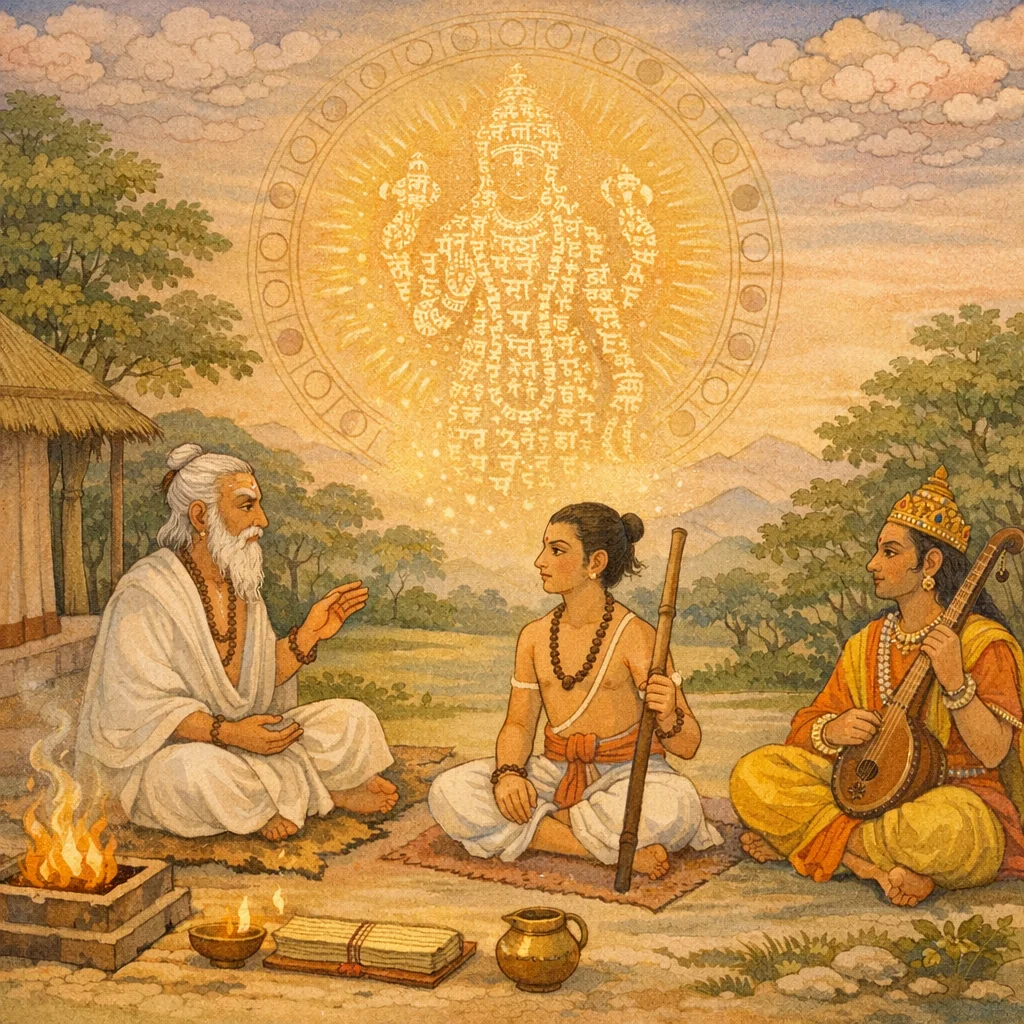
Varṇāśrama Saṁskāras, Upanayana Windows, Brahmacārin Ācāra, and Anadhyāya Prohibitions
Sanaka instructs Nārada in orthodox varṇāśrama discipline: he condemns paradharma and enjoins the saṁskāras from garbhādhāna onward; details pregnancy and birth rites (sīmantakarma, jātakarma, nāndī/vṛddhi-śrāddha), naming rules, and the proper time for cūḍākaraṇa with expiations for delay. He sets upanayana ages by varṇa, penalties for missing the chief window, and the correct emblems of the student (girdle, skins, staff materials and measures, garments). The chapter then codifies brahmacarya—dwelling with the guru, living by alms, daily Vedic recitation, Brahma-yajña and tarpaṇa, food restraints, and strict etiquette of salutations, whom to honor and whom to avoid. It concludes with auspicious and inauspicious times, gift-fruitful tithis (Manvādī/Yugādī/Akṣaya), and anadhyāya prohibitions, warning that study in forbidden periods destroys welfare and is a grave sin; finally, Veda-study is affirmed as the brāhmaṇa’s essential path, the Veda being Viṣṇu as Śabda-Brahman.
Shlokas
Verse 1
सनक उवाच । वर्णाश्रमाचारविधिं प्रवक्ष्यामि विशेषतः । श्रृणुष्व तन्मुनिश्रेष्ट सावधानेन चेतसा ॥ १ ॥
Sanaka said: “I shall explain in detail the prescribed rules of conduct for the varṇas and the āśramas. Therefore listen, O best of sages, with a mind fully attentive.”
Verse 2
यः स्वधर्मं परित्यज्य परधर्मं समाचरेत् । पाषंडः स हि विज्ञेयः सर्वधर्मबहिष्कृतः ॥ २ ॥
One who abandons one’s own svadharma and instead practices another’s paradharma should indeed be known as a pāṣaṇḍa (heretic), excluded from all dharma.
Verse 3
गर्भाधानादिसंस्काराः कार्या मंत्रविधानतः । स्त्रीणाममंत्रतः कार्या यथाकालं यथाविधि ॥ ३ ॥
The sacraments (saṃskāras) beginning with garbhādhāna should be performed according to the prescribed procedure of mantras. For women, they are to be performed without mantras—at the proper time and in the proper manner.
Verse 4
सीमंतकर्म प्रथमं चतुर्थे मासि शस्यते । षष्टे वा सत्पमे वापि अष्टमे वापि कारयेत् ॥ ४ ॥
The rite called Sīmantakarma is first commended in the fourth month of pregnancy; it may also be performed in the sixth, the seventh, or the eighth month.
Verse 5
जाते पुत्रे पिता स्नात्वा सचैलं जातकर्म च । कुर्य्याच्च नांदीश्राद्धं च स्वस्तिवाचनपूर्वकम् ॥ ५ ॥
When a son is born, the father—having bathed and donned clean garments—should perform the jātakarma (birth-rite) and also the nāndī-śrāddha, preceded by auspicious benedictory recitations (svasti-vācana).
Verse 6
हेम्ना वा रजतेनापि वृद्धिश्राद्धं प्रकल्पयेत् । अन्नेन कारयेद्यस्तु स चंडाल समो भवेत् ॥ ६ ॥
One should arrange the vṛddhi-śrāddha with gold, or even with silver; but whoever has it performed merely with food becomes equal to a caṇḍāla (an outcaste).
Verse 7
कृत्वाभ्युदयिकं श्राद्धं पिता पुत्रस्य वाग्यतः । कुर्वीत नामनिर्द्देशं सूतकांते यथाविधि ॥ ७ ॥
After performing the auspicious abhyudayika śrāddha, the father—at the proper time for the son—should, at the close of the sūtaka (birth-impurity period), formally proclaim the child’s name according to the prescribed rite.
Verse 8
अस्पष्टमर्थहीनं च ह्यतिगुर्वक्षरान्वितम् । न दद्यान्नाम विप्रेन्द तथा च विषमाक्षरम् ॥ ८ ॥
O best of brāhmaṇas, one should not bestow a name that is unclear, devoid of meaning, burdened with excessively heavy syllables, or composed of irregular, uneven syllables.
Verse 9
तृतीयवर्षे चौलं च पंचमे षष्टसम्मिते । सत्पमे चाष्टमे वापि कुर्याद् गृह्योक्तमार्गतः ॥ ९ ॥
In the third year one should perform the hair‑cutting rite (cūḍākaraṇa). Alternatively, it may be done in the fifth year, the sixth, or even the seventh or eighth—according to the procedure taught in the Gṛhya‑sūtras.
Verse 10
दैवयोगादतिक्रांते गर्भाधानादिकर्मणि । कर्तव्यः पादकृच्छ्रो वै चौले त्वर्द्धं प्रकल्पयेत् ॥ १० ॥
If, by an unavoidable turn of fate, the saṃskāras beginning with garbhādhāna have been missed or allowed to lapse, one must surely perform the penance called pāda‑kṛcchra; but for the cūḍā‑karma (tonsure), only half of that penance is to be prescribed.
Verse 11
गर्भाष्टमेऽष्टमे वाब्दे बटुकस्योपनायनम् । आषोडशाब्दपर्यंतं गौणं कालमुशंति च ॥ ११ ॥
A boy’s Upanayana (sacred‑thread initiation) is prescribed either in the eighth year counted from conception, or in the eighth year counted from birth; and the wise also declare that up to the sixteenth year the timing is still regarded as secondary (acceptable though not ideal).
Verse 12
गर्भैकादशमेऽब्दे तु राजन्यस्योपनायनम् । आद्वाविंशाब्दपर्यंतं कालमाहुर्विपश्चितः ॥ १२ ॥
For a Kṣatriya (rājanya), the upanayana (initiation into Vedic study) is prescribed in the eleventh year counted from conception; the learned declare that the permissible window extends up to the twenty‑second year.
Verse 13
वैश्वोपनयनं प्रोक्तं गर्भाद्द्वादशमे तथा । चतुर्विंशाब्दपर्यंतं गौणमाहुर्मनीषिणः ॥ १३ ॥
The rite called “vaiśva‑upanayana” (the universal upanayana) is said to be performed in the twelfth year counted from conception; and the wise declare that up to the twenty‑fourth year it remains allowable only in a secondary (less ideal) sense.
Verse 14
एतत्कालावधेर्यस्य द्विजस्यातिक्रमो भवेत् । सावित्रीपतितं विद्यात्तं तु नैवालपेत्कदा ॥ १४ ॥
If a twice-born man lets the prescribed time pass without observing the Savitrī discipline, know him as fallen from Savitrī; one should never address or associate with him at any time.
Verse 15
द्विजोपनयने विप्र मुख्यकालव्यतिक्रमे । द्वादशाब्दं चरेत्कृच्छ्रं पश्चाज्चांद्रायणं तथा । सांतपनद्वयं चैव कृत्वा कर्म समाचरेत् ॥ १५ ॥
O brāhmaṇa, if the principal time for a twice-born man’s upanayana (sacred-thread initiation) has been missed, one should observe the Kṛcchra penance for twelve years; thereafter perform the Cāndrāyaṇa vow, and, having undertaken two Sāntapana penances, then duly carry out the required rite.
Verse 16
अन्यथा पतितं विद्यात्कर्त्तापि ब्रह्महा भवेत् । र्मौजी विप्रस्य विज्ञेया धनुर्ज्या क्षत्त्रियस्य तु ॥ १६ ॥
If it is done otherwise, contrary to the rule, know it as a fall from dharma; and the doer too becomes as sinful as a slayer of a brāhmaṇa. The maujī, the sacred girdle of muñja grass, belongs to a brāhmaṇa, whereas the bowstring is the proper emblem for a kṣatriya.
Verse 17
आवी वैश्यस्य विज्ञेया श्रूयतामजिने तथा । विप्रस्य चोक्तमैणेयं रौरवं क्षत्रियस्य तु ॥ १७ ॥
Know that the proper hide for a Vaiśya is sheepskin; and hear also of the deer-skins: for a brāhmaṇa it is said to be antelope-skin, while for a kṣatriya it is raurava, the skin of a spotted deer.
Verse 18
आजं वेश्यस्य विज्ञेयं दंडान्वक्ष्ये यथाक्रमम् । पालाशं ब्राह्मणस्योक्तं नृपस्यौदुम्बरं तथा ॥ १८ ॥
Know that the staff (daṇḍa) for a Vaiśya should be made of aja-wood. I shall describe the staves in due order: for a brāhmaṇa it is said to be of palāśa-wood, and for a king (kṣatriya) of udumbara-wood.
Verse 19
बैल्वं वैश्यस्य विज्ञेय तत्प्रमाणं श्रृणुष्व मे । विप्रस्य केशमानं स्यादाललाटं नृपस्य च ॥ १९ ॥
Know that the (proper) measure for a Vaiśya is called “bailva.” Hear its standard from me: for a Brāhmaṇa it is the measure up to the hairline, and for a king (Kṣatriya) up to the forehead.
Verse 20
नासाग्रसंमितं दण्डं वैश्यस्याहुर्विपश्चितः । तथा वासांसि वक्ष्यामि विप्रादीनां यथाक्रमम् ॥ २० ॥
The wise declare that the staff for a Vaiśya should be measured up to the tip of the nose. Now I shall also describe, in due order, the garments prescribed for Brāhmaṇas and the other varṇas.
Verse 21
कषायं चैव मांजिष्टं हारिद्रं च प्रकीर्तितम् । उपनीतो द्विजो विप्र परिचर्यापरो गुरोः ॥ २१ ॥
Also proclaimed are the ochre, the madder-red, and the turmeric-yellow robes. Having received the sacred-thread initiation (upanayana, yajñopavīta), the twice-born—O brāhmaṇa—should be devoted to serving his teacher.
Verse 22
वेदग्रहणपर्यंतं निवसेद्गुरुवेश्मनि । प्रातः स्नायी भवेद्वर्णी समित्कुशफलादिकान् ॥ २२ ॥
Until he has fully mastered the Vedas, the student should reside in the teacher’s house. The brahmacārin should bathe at dawn and procure firewood, kuśa grass, fruits, and other such requisites (for the guru and the rites).
Verse 23
गुर्वर्थमाहरेन्नित्यं कल्ये कल्ये मुनीश्वर । यज्ञोपवीतमजिनं दंडं च मुनिसत्तम ॥ २३ ॥
O lord among sages, each morning without fail he should daily bring for the sake of his teacher the sacred thread (yajñopavīta), the deer-skin, and the mendicant’s staff, O best of ascetics.
Verse 24
नष्टे भ्रष्टे नवं मंत्राद्धृत्वा भ्रष्टं जले क्षिपेत् । वर्णिनो वर्त्तनं प्राहुर्भिक्षान्नेनैव केवलम् ॥ २४ ॥
If a mantra-text is lost or corrupted, one should take a fresh and correct version from the mantra-teaching and cast the faulty one into water. The sages declare that the proper livelihood of a varṇin (brahmacārin) is solely the food obtained through alms.
Verse 25
भिक्षा च श्रोत्रियागारादाहरेत्प्रयतेंद्रियः । भवत्पूर्वं ब्राह्मणस्य भवन्मध्यं नृपस्य च ॥ २५ ॥
With senses restrained, he should obtain alms from the house of a śrotriya, a learned Vedic scholar. In addressing a brāhmaṇa he should place the respectful “bhavat” first, and in addressing a king he should place “bhavat” in the middle of the address.
Verse 26
भवदत्यं विशः प्रोक्तं भिक्षाहरणकं वचः । सांयप्रातर्वह्निकार्यं यथाचारं जितेंद्रियः ॥ २६ ॥
He should speak only truthful words, as prescribed for the Vaiśya, and live by proper words that procure alms. Self-controlled, he should perform the fire-rites in the evening and in the morning, following the established discipline of conduct.
Verse 27
कुर्यात्प्रतिदिनं वर्णीं ब्रह्मयज्ञं च तर्पणम् । अग्निकार्यपरित्यागी पतितः प्रोच्यते बुधैः ॥ २७ ॥
A brahmacārin should daily perform the recitation of the Veda, the Brahma-yajña, and the tarpaṇa offerings. One who abandons the prescribed duties of the fire-ritual is declared by the wise to be a fallen person.
Verse 28
ब्रह्मयज्ञविहीनश्च ब्रह्महा परिकीर्तितः । देवताभ्यर्च्चनं कुर्याच्छुश्रूषानुपदं गुरोः ॥ २८ ॥
One who neglects the Brahma-yajña is declared to be a slayer of Brahman (brahmahā). Therefore, one should worship the deities and continually render attentive service to one’s guru.
Verse 29
भिक्षान्नं भोजयेन्नित्यं नैकान्नाशी कदाचन । आनीयानिन्द्यविप्राणां गृहाद्भिक्षां जितेंद्रियः ॥ २९ ॥
A self-controlled person should always partake only of alms-food and never become one who eats from many households. With the senses conquered, he should bring alms from the homes of blameless brāhmaṇas.
Verse 30
निवेद्य गुरवेऽश्रीयाद्वाग्यतस्तदनुज्ञया । मधुस्त्रीमांसलवणं ताम्बूलं दंतधावनम् ॥ ३० ॥
Having first informed the Guru, and with speech restrained, one should partake only with his permission. In this observance one should renounce honey, association with women, meat, salt, betel-leaf (tāmbūla), and the cleaning of the teeth.
Verse 31
उच्छिष्टभोजनं चैव दिवास्वापं च वर्जयेत् । छत्रपादुक गंधांश्च तथा माल्यानुलेपनम् ॥ ३१ ॥
One should avoid eating leftover or impure food, and also avoid sleeping during the day. Likewise, one should refrain from using an umbrella and footwear, as well as from perfumes, garlands, and bodily unguents.
Verse 32
जलकेलिं नृत्यगीतवाद्यं तु परिवर्जयेत् । परिवादं चोपतापं विप्रलापं तथांजनम् ॥ ३२ ॥
One should avoid water-sports, dancing, singing, and instrumental music; and also shun slander, causing distress to others, frivolous talk, and the use of collyrium (añjana) for adornment.
Verse 33
पाषण्ड जनसंयोगं शूद्रसंगं च वर्जयेत् । अभिवादनशीलः स्याद् वृद्धेषु च यथाक्रमम् ॥ ३३ ॥
One should avoid association with heretical people (pāṣaṇḍas) and also avoid improper company with Śūdras. One should be habituated to respectful salutations, offering due reverence to elders in the proper order.
Verse 34
ज्ञानवृद्धास्तपोवृद्धा वयोवृद्धा इति त्रयः । आध्यात्मिकादिदुःखानि निवारयति यो गुरुः ॥ ३४ ॥
There are three kinds of “elders”: those ripened in knowledge, those ripened in austerity (tapas), and those ripened in years. Yet only that one is truly the Guru who removes the sufferings, beginning with the ādhātmika—inner afflictions.
Verse 35
वेदशास्त्रोपदेशेन तं पूर्वमभिवादयेत् । असावहमिति ब्रूयाद्दिजो वै ह्यभिवादने ॥ ३५ ॥
By the instruction of the Vedas and the śāstras, one should first offer salutations to him (the elder or the teacher). Indeed, at the time of salutation, a dvija—the twice-born—should say, “I am so-and-so,” thus identifying himself.
Verse 36
नाभिवाद्याश्च विप्रेण क्षत्रियाद्याः कथंचन । नास्तिकं भिन्नमर्यादं कृतन्घं ग्रामयाजकम् ॥ ३६ ॥
A brāhmaṇa should not, under any circumstance, offer salutations as an inferior to a kṣatriya or to the other lower varṇas. Likewise, he should avoid the nāstika (denier of faith), one who breaks established norms, the ungrateful, and the village priest who performs rites for livelihood.
Verse 37
स्तेनं च कितवं चैव कदाचिन्नाभिवादयेत् । पाषण्डं पतितं व्रात्यं तथा नक्षत्रजीविनम् ॥ ३७ ॥
One should never offer respectful salutations to a thief or a cheat; nor to a pāṣaṇḍa (heretic), a fallen person, a vrātya who has strayed from Vedic discipline, or one who makes his living by the stars—astrology as livelihood.
Verse 38
तथा पातकिनं चैव कदाचिन्नाभिवादयेत् । उन्मत्तं च शठं धूर्त्तं धावन्तमशुचिं तथा ॥ ३८ ॥
Likewise, one should never offer a formal salutation to a sinner; nor should one salute a madman, a deceitful person, a rogue, someone who is running, or one who is impure.
Verse 39
अभ्यक्तशिरसं चैव जपन्तं नाभिवादयेत् । विवादशीलिनं चंडं वमंतं जलमध्यगम् ॥ ३९ ॥
One should not offer salutations to one whose head is anointed with oil, nor to one engaged in japa. Nor should one salute a quarrelsome and violent person, one who is vomiting, or one who is standing in the midst of water.
Verse 40
भिक्षान्नधारिणं चैव शयानं नाभिवादयेत् । भर्तृघ्नी पुष्पिणीं जारां सूतिकां गर्भपातिनीम् ॥ ४० ॥
One should not offer salutations to a person carrying alms-food, nor to one who is lying down. Likewise, one should not salute a husband-slayer, a menstruating woman, an adulteress, a woman in childbirth, or a woman who has caused miscarriage or abortion.
Verse 41
कृतन्घीं च तथा चंडीं कदाचिन्नाभिवादयेत् । सभायां यज्ञशालायां देवतायतनेष्वपि ॥ ४१ ॥
One should never offer salutations to an ungrateful woman, nor to a violent or impure woman—especially in an assembly, in a sacrificial hall (yajña-śālā), or even within temples, the abodes of the deities.
Verse 42
प्रत्येकं तु नमस्कारो हंति पुण्यं पुराकृतम् । श्राद्धं व्रतं तथा दानं देवताभ्यार्चनं तथा ॥ ४२ ॥
But each improper act of salutation destroys the merit accumulated earlier; likewise it undermines the fruits of śrāddha rites, religious vows (vrata), charitable giving (dāna), and also the worship of the deities.
Verse 43
यज्ञं च तर्पणं चैव कुर्वंतं नाभिवादयेत् । कृतेऽभिवादने यस्तु न कुर्यात्प्रतिवादनम् ॥ ४३ ॥
One should not offer a formal salutation to a person engaged in performing a sacrifice (yajña) or in making libations (tarpaṇa). And if someone, after being saluted, does not return the salutation in response, that too is improper conduct.
Verse 44
नाभिवाद्यः स विज्ञेयो यया शूद्रस्तथैव सः । प्रक्षाल्य पादावाचम्य गुरोरभिमुखः सदा ॥ ४४ ॥
He should be known as one who is not to be saluted with reverence—indeed, in this respect he is like a Śūdra. Having washed the feet and performed ācāmana (sipping water for purification), one should always remain facing the Guru, attentive and respectful.
Verse 45
तस्य पादौ च संगृह्य अधीयीत विचक्षणः । अष्टकासु चतुर्दश्यां प्रतिपत्पर्वणोस्तथा ॥ ४५ ॥
Having respectfully clasped the teacher’s feet, the discerning student should pursue sacred study—especially on the Aṣṭakā days, on caturdaśī (the fourteenth lunar day), and likewise at the festival-junctures of pratipat and other parvan-days.
Verse 46
महाभरण्यां विप्रेद्रं श्रवणद्वादशीदिने । भाद्रपदापरपक्षे द्वितीयायां तथैव च ॥ ४६ ॥
O best of Brahmins, observe it on the Mahābharaṇī nakṣatra, on the day of Śravaṇa-dvādaśī; and likewise on dvitīyā (the second lunar day) in the dark fortnight of Bhādrapada.
Verse 47
माघस्य शुक्लसप्तम्यां नवम्यामाश्विनस्य च । परिवेषं गते सूर्ये श्रोत्रिये गृहमागते ॥ ४७ ॥
On the bright seventh day of Māgha, and on the ninth day of Āśvina as well—when the Sun is seen with a halo (pariveṣa), and when a learned Vedic Brahmin (śrotriya) arrives at one’s house—these are regarded as especially auspicious occasions for religious observance and giving.
Verse 48
बंधिते ब्रह्मणे चैव प्रवृद्धकलहे तथा । संध्यायां गर्जिते मेघे ह्यकाले परिवर्षणे ॥ ४८ ॥
When a brāhmaṇa is put in bondage, when quarrels have greatly intensified, when clouds thunder at twilight, and when rain falls out of season—these are recognized as ominous conditions.
Verse 49
उल्काशनिप्रपाते च तथा विप्रेऽवमानिते । मन्वादिषु च देवर्षे युगादिषु चतुर्ष्वपि ॥ ४९ ॥
O divine sage, when a meteor or lightning falls, and likewise when a brāhmaṇa is insulted—also at the beginnings of a Manvantara and at the beginnings of the four Yugas—one should be especially vigilant in dharma and perform the prescribed rites.
Verse 50
नाधीयीत द्विजः कश्चित्सर्वकर्मफलोत्सुकः । तृतीया प्राधवे शुक्ला भाद्रे कृष्णा त्रयोदशी ॥ ५० ॥
No dvija (twice-born) should study the sacred texts with anxious craving for the fruits of every action. Study should also be avoided on certain tithis: the bright third lunar day in the month of Prādhava, and the dark thirteenth lunar day in the month of Bhādra.
Verse 51
कार्त्तिके नवमी शुद्धा माघे पंचदशी तिथिः । एता युगाद्याः कथिता दत्तस्याक्षयकारिकाः ॥ ५१ ॥
In Kārttika, the pure ninth lunar day (Navamī), and in Māgha, the fifteenth lunar day (Paurṇimā), are declared as ‘Yugādi’ days; gifts given on these occasions are said to yield akṣaya merit, imperishable.
Verse 52
मन्वादींश्च प्रवक्ष्यामि श्रृणुष्व सुसमाहितः । अक्षयुक्छुक्लनवमी कार्तिके द्वादशी सिता ॥ ५२ ॥
I shall now describe the Manus and the rest—listen with full attention. The ninth tithi of the bright fortnight (Śukla Navamī) is called Akṣayuk, and in Kārttika the twelfth tithi of the dark fortnight (Kṛṣṇa Dvādaśī) is likewise noted.
Verse 53
तृतीया चैत्रमासस्य तथा भाद्रपदस्य च । आषाढशुक्लदशमी सिता माघस्य सप्तमी ॥ ५३ ॥
The third tithi of the month of Caitra, and likewise of Bhādrapada; the tenth tithi of the bright fortnight of Āṣāḍha; and the seventh tithi of the bright fortnight of Māgha—these are declared auspicious tithis for religious observances.
Verse 54
श्रावणस्याष्टमी कृष्णा तथाषाढी च पूर्णमा । फाल्गुनस्य त्वमावास्या पौषस्यैकादशी सिता ॥ ५४ ॥
The dark eighth lunar day (Kṛṣṇāṣṭamī) of Śrāvaṇa, the full-moon day of Āṣāḍha, the new-moon day (amāvasyā) of Phālguna, and the bright eleventh day (Śukla-ekādaśī) of Pauṣa—these are especially sacred lunar dates for religious observance.
Verse 55
कार्तिकी फाल्गुनी चैत्रीं ज्यैष्ठी पंचदशी सिता । मन्वादयः समाख्याता दत्तस्याक्षयकारिकाः ॥ ५५ ॥
The bright fifteenth lunar day (the full-moon day) in Kārtika, Phālguna, Caitra, and Jyaiṣṭha—together with the Manvādī days—are declared to make gifts (dāna) yield inexhaustible merit.
Verse 56
द्विजैः श्रद्धं चकर्त्तव्यं मन्वादिषु युगादिषु । श्राद्धे निमंत्रिते चैवग्रहणे चंद्रसूर्ययोः ॥ ५६ ॥
Twice-born men (dvija) should perform śrāddha at the beginnings of Manvantaras and Yugas; likewise when invited to a śrāddha, and also at the times of lunar and solar eclipses.
Verse 57
अयनद्वितये चैव तथा भूकंपने मुने । गलग्रहे दुर्द्दिने च नाधीयीत कदाचन ॥ ५७ ॥
O sage, one should never undertake Vedic study during either of the two ayana transitions (solstitial changes), nor during an earthquake, nor when afflicted with a throat ailment, nor on days of severe foul weather.
Verse 58
एवमादिषु सर्वेषु अनध्यायेषु नारद । अधीयतां सुमूढानांप्रजांप्रज्ञांयशः श्रियम् ॥ ५८ ॥
O Nārada, on all such occasions of anadhyāya (when Vedic study must be suspended), those who, in delusion, still continue to study thereby forfeit progeny, intelligence, fame, and prosperity.
Verse 59
आयुष्यं बलमारोग्यं निकृंतति यमः स्वयम् । अनध्याये तु योऽधीते तं विद्याद्वब्रह्मघातकम् ॥ ५९ ॥
Yama himself cuts off one’s lifespan, strength, and health. Know that the one who studies during an anadhyāya (a prohibited period) is indeed to be regarded as a slayer of Brahman.
Verse 60
न तं संभाषयेद्विप्रन तेन सह संवसेत् । कुंडगोलकयोः केचिज्जडादीनां च नारद ॥ ६० ॥
A Brahmana should not converse with him, nor should he live together with him. O Narada, some authorities say the same applies in the case of a kunda and a golaka, and likewise with the dull-witted.
Verse 61
वदंति चोपनयनं तत्पुत्रादिषु केचन । अनधीत्य तु यो वेदमन्त्रय कुरुते श्रमम् ॥ ६१ ॥
Some say that the rite of upanayana should also be performed for one’s sons. But whoever, without having properly studied, undertakes the toil of reciting Vedic mantras is merely laboring in vain.
Verse 62
शूद्रतुल्यः स विज्ञेयो नरकस्य प्रियोऽतिथिः । अनधीतश्रुतिर्विप्र आचार प्रतिपद्यते ॥ ६२ ॥
A Brahmin who has not studied the revealed scriptures (Sruti) should be understood as equal to a Shudra—indeed, a welcome guest of hell. Yet such a Brahmin still takes on the outward forms of proper conduct.
Verse 63
नाचारफलमान्पोति यथा शूद्रस्तथैव सः । नित्यं नैमित्तिकं काम्यं यच्चान्यत्कर्म वैदिकम् ॥ ६३ ॥
He does not obtain the fruit of proper conduct—just like a Shudra; and likewise he gains no result from any Vedic rite, whether daily, occasional, desire-motivated, or any other.
Verse 64
अनधीतस्य विप्रस्य सर्वं भवति निष्फलम् । शब्दब्रह्ममयो विष्णुर्वेदः साक्षाद्धारि स्मृकतः ॥ ६४ ॥
For the brāhmaṇa who has not studied the Veda, everything becomes fruitless. Viṣṇu is of the nature of Śabda‑Brahman, and the Veda is remembered as Hari Himself, directly manifest.
Verse 65
वेदाध्यायी ततो विप्रः सर्वान्कामानवाप्नुयात् ॥ ६५ ॥
Therefore, a brāhmaṇa devoted to the study of the Veda attains all desired aims.
Frequently Asked Questions
Because varṇāśrama-dharma is presented as a regulated sacramental and ethical system; rejecting one’s ordained duty disrupts ritual order and eligibility for Vedic rites, so the text labels such a person as excluded from dharma to protect śāstric continuity and communal purity norms.
It assigns varṇa-specific windows (with an extended ‘secondary’ allowance) and declares that letting the principal time pass causes a fall from Sāvitrī discipline; restoration requires heavy prāyaścitta (long kṛcchra observance, cāndrāyaṇa, and sāntapana penances) before performing the rite properly.
Anadhyāya is the mandated suspension of Vedic study on certain calendrical junctures, omens, and disruptions (e.g., solstices, eclipses, earthquakes, severe weather, impurity/illness). The chapter frames violation as spiritually ruinous and even ‘brahma-hatyā’-like, underscoring that correct recitation is inseparable from correct time and purity.
It culminates by identifying Viṣṇu with Śabda-Brahman and remembering the Veda as Hari manifest; thus disciplined study is not merely scholastic but a devotional participation in divine presence.