Māsopavāsa (Month-long Fast) and Repeated Parāka Observances: Procedure and Fruits
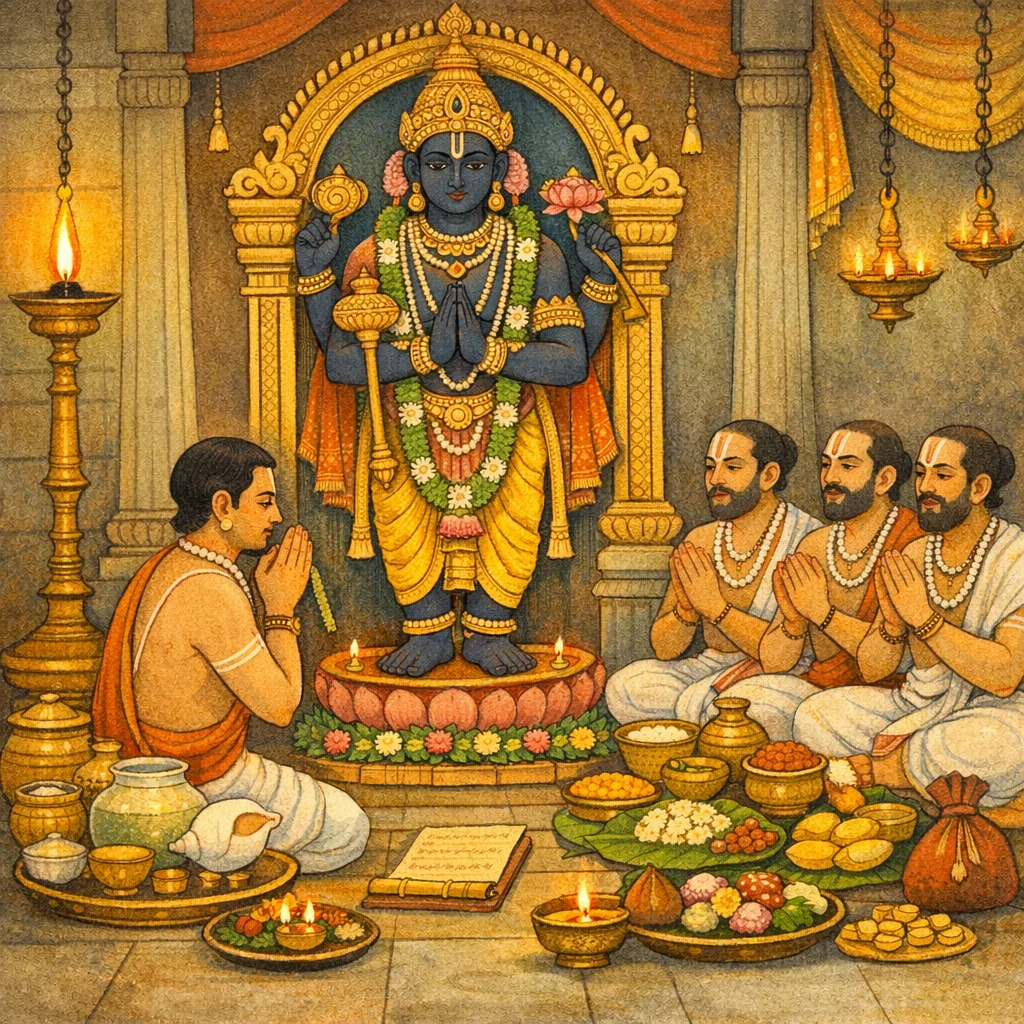
Sanaka teaches a “sin-destroying” Vaiṣṇava vow to be observed in any of four months (Āṣāḍha–Āśvina) during the bright fortnight. The votary restrains the senses, takes pañcagavya, sleeps near Viṣṇu, rises early, performs daily duties, and worships Viṣṇu without anger. In the presence of learned brāhmaṇas he performs svasti-vācana and makes a formal saṅkalpa to fast for a full month, breaking it only by the Lord’s command. He dwells in Hari’s temple, bathes the deity daily with pañcāmṛta, keeps a continuous lamp, uses apāmārga twig-chewing and prescribed bathing, worships, feeds brāhmaṇas with dakṣiṇā, and eats in a regulated manner with his kin. The chapter then lists increasing fruits for repeated observances—linking numbers of month-fasts/Parākas to merits surpassing great Vedic sacrifices—culminating in Hari-sādr̥śya and supreme bliss. Liberation is declared attainable for women and men, all āśramas, and even through devoted hearing or recitation of this teaching to Nārāyaṇa.
Shlokas
Verse 1
सनक उवाच । अन्यद् व्रत वरं वक्ष्ये तच्छृणुष्व समाहितः । सर्वापापहरं पुण्यं सर्वलोकोपकारकम् ॥ १ ॥
Sanaka said: Now I shall describe another excellent vow. Listen with a concentrated mind—this holy observance removes all sins, is truly meritorious, and brings benefit to all worlds.
Verse 2
आषाढ्रे श्रावणे वापि तथा भाद्रपदेऽपि च । तथैवाश्विनके मासे कुर्यादेतद्वतं द्विज ॥ २ ॥
Whether in Āṣāḍha, in Śrāvaṇa, likewise in Bhādrapada, and also in the month of Āśvina—O twice-born (brāhmaṇa), one should perform this vow in these months.
Verse 3
एतेष्वन्यतमे मासे शुल्कपक्षे जितेन्द्रियः । प्राशयेत्पञ्चगव्यं च स्वपेद्विष्णुसमीपतः ॥ ३ ॥
In any one of these months, during the bright fortnight, having restrained the senses, one should partake of pañcagavya; and one should sleep near (the image or presence of) Viṣṇu.
Verse 4
ततः प्रातः समुत्थाय नित्यकर्म समाप्य च । श्रद्धया पूजयेद्विष्णुं वशी क्रोधविवार्जितः ॥ ४ ॥
Then, rising early in the morning and completing one’s daily obligatory duties, one should worship Viṣṇu with faith—self-controlled and free from anger.
Verse 5
विद्वद्भिः सहितो विष्णुमर्चयित्वा यथोचितम् । संकल्पं तु ततः कुर्यास्त्वस्ति वाचनपूर्वकम् ॥ ५ ॥
Accompanied by learned brāhmaṇas, having worshipped Viṣṇu in the proper manner, one should then make the formal resolve (saṅkalpa), preceded by the recitation of auspicious benedictions (svasti-vācana).
Verse 6
मासमेकं निराहारो ह्यद्यप्रभृति केशव । मासान्तं पारणं कुर्वे देवदेव तवाज्ञया ॥ ६ ॥
O Keśava, from this day onward I shall remain without food for one month; and at the month’s end I shall perform the pāraṇa, breaking the fast by Your command, O God of gods.
Verse 7
तपोरुप नमस्तुभ्यं तपसां फल दायक । ममाभीष्टप्रदं देहि सर्वविघ्नान्निवारय ॥ ७ ॥
Salutations to You whose very form is austerity; O giver of the fruits of tapas. Grant me the fulfillment of my cherished desire, and remove all obstacles.
Verse 8
एवं समर्प्य देवस्य विष्णोर्मासव्रतं शुभम् । ततः प्रभृति मासान्तं निवसेद्धरिमन्दिरे ॥ ८ ॥
Having thus duly offered the auspicious month-long vow to Lord Viṣṇu, from that time onward one should reside in Hari’s temple until the end of the month.
Verse 9
प्रत्यहं स्नापयेद्देवं पञ्चामृतविधानतः । दीपं निरन्तरं कुर्यात्तस्मिन्मासे हरेर्गृहे ॥ ९ ॥
Each day one should bathe the Lord according to the prescribed rite of pañcāmṛta, the five nectars; and in that month, in Hari’s shrine, one should keep a lamp burning continuously.
Verse 10
प्रत्यहं खादयेत्काष्ठं ह्यपामार्ग समुद्भवम् । ततः स्नायीत विधिन्नारायणपरायणः ॥ १० ॥
Each day one should chew a small twig that has arisen from the apāmārga plant; then, devoted to Nārāyaṇa, one should bathe according to the prescribed rite.
Verse 11
ततः संस्नापयेद्विष्णुं पूर्ववत्प्रयतोऽर्चयेत् । ब्राह्मणान्भोजयेच्छक्त्या भक्तियुक्तः सदक्षिणम् ॥ ११ ॥
Then one should bathe Lord Viṣṇu (the Deity) and, with disciplined care, worship Him as prescribed earlier. With bhakti, one should feed the brāhmaṇas according to one’s capacity, offering them the proper dakṣiṇā (sacred gift).
Verse 12
स्वयं च बन्धुभिः सार्द्धं भुञ्जीत प्रयतेन्द्रियः । एवं मासोपवासांश्च व्रती कुर्यात्र्रयोदश ॥ १२ ॥
And he himself should take his meal together with his kinsmen, with the senses restrained. In this way, the observer of the vow should also perform the thirteen monthly fast-observances.
Verse 13
वर्षान्ते वेदविदुषे गां प्रदद्यात्स दक्षिणाम् । भोजयेद्वब्राह्माणांस्तत्र द्वादशैव विधानतः । शक्त्या च दक्षिणां दद्याद्रूह्यण्याभरणानि च ॥ १३ ॥
At the end of the year, one should present a cow as dakṣiṇā to a learned scholar of the Veda. One should also feed exactly twelve brāhmaṇas there, according to proper procedure. And, according to one’s capacity, one should give an additional offering, as well as ornaments of silver and gold.
Verse 14
मासोपवासत्रितयं यः कुर्यात्संयते न्द्रियः । आप्तोर्यामस्य यज्ञस् द्विगुणं फलमश्नुते ॥ १४ ॥
One who, with senses restrained, undertakes a three-month fast attains twice the merit of performing the Āptoryāma sacrifice.
Verse 15
चतुः कृत्वः कृतं येन पाराकं मुनिसत्तम । स लभेत्परमं पुण्यमष्टान्गिष्टोमसंभवम् ॥ १५ ॥
O best of sages, whoever performs the Pārāka fast four times attains the highest merit—equal to that arising from eight Aṅgiṣṭoma (Agniṣṭoma) sacrifices.
Verse 16
पञ्चकृत्वो व्रतमिदं कृतं येन महात्मना । अत्यन्गिष्टोमजं पुण्यं द्विगुणं प्राप्नुयान्नरः ॥ १६ ॥
A noble soul who performs this vow five times attains pure merit, comparable to the fruit of the Aṅgiṣṭoma sacrifice—indeed, in double measure.
Verse 17
मासोपवाषट्कं यः करोति सुसमाहितः । ज्योतिष्टोस्य यज्ञस्य फलं सोऽष्टगुणं लभेत् ॥ १७ ॥
Whoever, with steady concentration, performs the six monthly fasts gains eightfold the fruit of the Jyotiṣṭoma sacrifice.
Verse 18
निराहारः सप्तकृत्वो नरो मासोपवासकान् । अश्वमेधस्य यज्ञस्य फलमष्टगुणं लभेत् ॥ १८ ॥
A man who undertakes complete fasting—taking no food—seven times attains the fruit of the Aśvamedha sacrifice; indeed, he gains that merit eightfold, surpassing month-long fasts.
Verse 19
मासोपावासान्यः कुर्यादष्टकृत्वो मुनीश्वर । नरमेधाख्ययज्ञस्य फलं पञ्चगुणं लभेत् ॥ १९ ॥
O lord among sages, whoever undertakes the monthly fast-observances eight times obtains a fivefold reward equal to the sacrifice known as the Naramedha.
Verse 20
यस्तु मासोपवासांश्च नवकृत्वः समाचरेत् । गोमेधमखजं पुण्यं लभते त्रिगुणं नरः ॥ २० ॥
But the man who duly performs month-long fasts nine times attains merit born of the Gomedha sacrifice—threefold in measure.
Verse 21
दशकृत्वस्तु यः कुर्यात्पराकं मुनिसत्तम । स ब्रह्ममेधयज्ञस्य त्रिगुणं फलमश्नुते ॥ २१ ॥
O best of sages, whoever performs the Parāka fast ten times attains a reward threefold greater than that of the Brahmamedha sacrifice.
Verse 22
एकादश पराकांश्च यः कुर्यात्संयतेन्द्रियः । स याति हरिसारुप्यं सर्वभोगसमन्वितम् ॥ २२ ॥
Whoever, with senses restrained, performs the Parāka observance eleven times attains sārūpya—likeness to Hari (Vishnu)—and is endowed with every divine enjoyment.
Verse 23
त्रयोदश पराकांश्च यः कुर्यात्प्रयतो नरः । स याति परमानन्दं यत्र गत्वा न शोचति ॥ २३ ॥
A disciplined person who duly performs the thirteen Parāka observances attains the supreme bliss; having reached that state, one does not grieve again.
Verse 24
मासोपवासनिरता गङ्गास्नानपरायणाः । धममार्गप्रवक्तारो मुक्ता एव न सशंयः ॥ २४ ॥
Those devoted to monthly fasts, dedicated to bathing in the Gaṅgā, and who proclaim the path of Dharma are indeed liberated—there is no doubt of it.
Verse 25
अवीराभिर्यतिभिर्ब्रह्यचारिभिः । मासोपवासः कर्त्तव्यो वनस्थैश्च विशेषतः ॥ २५ ॥
Ascetics and brahmacārins, free from worldly passion, should undertake a month-long fast—especially those dwelling in the forest, the vānaprasthas.
Verse 26
नारी वा पुरुषो वापि व्रतमेतत्सुदुर्लभम् । कृत्वा मोक्षमवान्पोति योगिनामपि दुर्लभम् ॥ २६ ॥
Whether woman or man, this vow is exceedingly rare; by performing it one attains liberation (moksha), hard to obtain even for yogins.
Verse 27
गृहस्थो वानप्रस्थो वा व्रती वा भिक्षुरेव वा । मूर्खो वा पण्डितो वापि श्रुत्वैतन्मोक्षभाग्भवेत् ॥ २७ ॥
Whether a householder or a forest-dweller, a vow-keeper or a mendicant; whether ignorant or learned—by hearing this teaching, one becomes entitled to liberation.
Verse 28
इदं पुण्यं व्रताख्यानं नारायण परायणः । श्रृणुयाद्वाचयेद्वापि सर्वपापैः प्रमुच्यते ॥ २८ ॥
One wholly devoted to Nārāyaṇa, if he listens to this meritorious account of the sacred vow—or even recites it—is freed from all sins.
Frequently Asked Questions
Saṅkalpa formally defines intention, duration, and the deity-centered aim of the vrata, while svasti-vācana ritually ‘seals’ the undertaking through auspicious Vedic benedictions in the presence of learned brāhmaṇas—establishing correctness (vidhi) and dharmic legitimacy.
Pañcāmṛta abhiṣeka expresses daily purification and intimate service (sevā) to the deity-form of Viṣṇu, while an unbroken lamp signifies uninterrupted devotion and wakeful presence before Hari; together they convert austerity (upavāsa) into sustained bhakti-practice.
The comparison translates the prestige of śrauta yajñas into a bhakti-austerity framework, presenting fasting as an accessible equivalent or surpassing path; it also indexes the vrata within a Vedic merit economy familiar to dharma literature.
It explicitly extends the vow’s salvific reach to women and men, householders and forest-dwellers, mendicants, and both the learned and unlearned—stating that even hearing or reciting the account with devotion to Nārāyaṇa removes sins and grants liberation-eligibility.