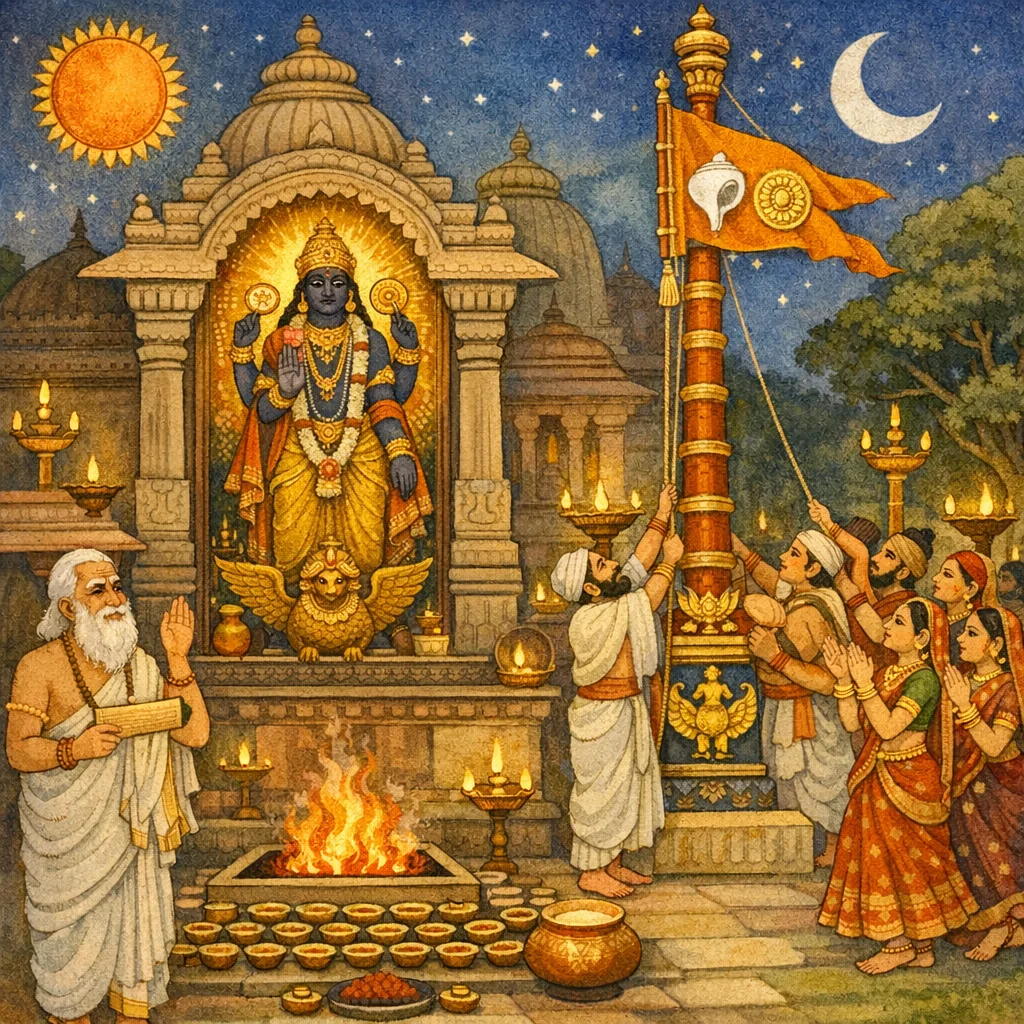
Dhvajāropaṇa and Dhvajāgopaṇa: Procedure, Stotra, and Phala (Merit) of Raising Viṣṇu’s Flag
Sanaka teaches a sacred vow focused on raising and protecting Lord Viṣṇu’s ceremonial dhvaja (flag), declaring it a sin-destroying rite whose merit equals or surpasses renowned gifts and tīrtha observances. Beginning on Kārtika śukla-daśamī, one purifies the body and keeps discipline; on ekādaśī one practices restraint and constant remembrance of Nārāyaṇa. With brāhmaṇas, svasti-vācana and nāndī-śrāddha are performed; the banner and staff are consecrated with the Gāyatrī, and Sūrya, Garuḍa (Vainateya), and the Moon are worshipped, while Dhātā and Vidhātā are honored on the flagstaff. A gṛhya-style fire is kindled and 108 pāyasa oblations are offered with Puruṣa-sūkta, Viṣṇu-stotras, Irāvatī, and specific offerings for Garuḍa and solar/pacification hymns, ending with a night vigil near Hari. With music and stotra the banner is carried and installed at the gateway or temple summit; Viṣṇu is worshipped and a long stotra recited. The rite concludes by honoring brāhmaṇas and guru, feeding, pāraṇa, and a phalaśruti promising swift destruction of sin, sārūpya for thousands of yugas while the flag stands, and merit even for those who merely see it and rejoice.
Shlokas
Verse 1
सनक उवाच । अन्यद्व्रतं प्रवक्ष्यामि ध्वजारोपणसंज्ञितम् । सर्वपापहरं पुण्यं विष्णुप्रीणनकारणम् ॥ १ ॥
Sanaka said: I shall now teach another sacred vow, known as the raising of the banner. It is a meritorious rite that removes all sins and becomes a cause for pleasing Lord Viṣṇu.
Verse 2
यः कुर्याद्विष्णुभवने ध्वजारोपणमुत्तमम् । संपूज्यते विग्निञ्च्याद्यैः किमन्यैर्बहुभाषितैः ॥ २ ॥
Whoever performs the excellent rite of raising a flag in the temple of Viṣṇu is honored and worshipped even by Vighneśa (Gaṇeśa) and other divine beings—what need is there to say more at length?
Verse 3
हेमभारसहस्त्रं तु यो ददाति कुटुम्बिने । तत्फलं तुल्यमात्रं स्याद्धूजारोपणकर्मणः ॥ ३ ॥
Even if one were to give a householder a thousand loads of gold, the merit gained would be only equal to the fruit of the religious rite of planting dhūjā, the sacred tree or plant.
Verse 4
ध्वजारोपणतुल्यं स्याद्गङ्गास्नानमनुत्तमम् । अथवा तुलसिसेवा शिवलिङ्गप्रपूजनम् ॥ ४ ॥
The unsurpassed act of bathing in the Gaṅgā is said to be equal to raising the sacred banner for worship. Likewise, serving Tulasī and performing full worship of the Śiva-liṅga yield comparable merit.
Verse 5
अहोऽपूर्वमहोऽपूर्वमहोऽपूर्वमिदं द्विज । सर्वपाप हरं कर्म ध्वजागोपणसंज्ञितम् ॥ ५ ॥
Wondrous indeed—wondrous indeed—truly wondrous is this, O twice-born one: this act, known as “Dhvajāgopaṇa,” the rite of safeguarding the sacred flag, destroys all sins.
Verse 6
सन्ति वै यानि कार्याणि ध्वजारोपणकर्मणि । तानि सर्वाणि वक्ष्यामि श्रृणुष्व गदतो मम ॥ ६ ॥
Whatever acts are prescribed in the rite of raising the sacred flag, I shall explain them all. Listen as I speak.
Verse 7
कार्तिकस्य सिते पक्षे दशम्यां प्रयतो नरः । स्नानं कुर्यात्प्रयत्नेन दन्तधावनपूर्वकम् ॥ ७ ॥
On the tenth lunar day (Daśamī) of Kārtika’s bright fortnight, a disciplined person should carefully perform the ritual bath, beginning first with the cleansing of the teeth.
Verse 8
एकाशी ब्रह्मचारी च स्वपेन्नारायणं स्मरन् । धौताम्बरधरः शुद्धो विप्रो नारायणाग्रतः ॥ ८ ॥
Observing Ekādaśī and keeping brahmacarya, remembering Nārāyaṇa even in sleep, the purified brāhmaṇa—clad in clean, washed garments—should remain before Nārāyaṇa.
Verse 9
ततः प्रातः समुत्थाय स्नात्वाचम्य यथाविधि । नित्यकर्माणि निर्वर्त्य पश्चाद्विष्णुं समर्चयेत् ॥ ९ ॥
Then, rising early in the morning, one should bathe and perform ācamana according to rule; having completed the daily obligatory duties, one should thereafter worship Lord Viṣṇu with full reverence.
Verse 10
चतुर्भिर्ब्राह्मणैः सार्ध्दं कृत्वा च स्वस्तिवाचनम् । नान्दीश्राद्धं प्रकुर्वीत ध्वजारोपणकर्मणि ॥ १० ॥
Together with four brāhmaṇas, having first arranged the recitation of auspicious benedictions (svasti-vācana), one should perform the Nāndī-śrāddha on the occasion of the rite of raising the ceremonial flag (dhvaja-āropaṇa).
Verse 11
ध्वजस्तम्भो च गायत्र्या प्रोक्षयेद्वस्त्रसंयुतौ । सूर्यं च वैनतेयं च हिमांशुं तत्परोऽर्चयेत् ॥ ११ ॥
He should sprinkle and consecrate the banner and the flagstaff, together with their cloth coverings, while reciting the Gāyatrī. Then, with focused devotion, he should worship Sūrya, Vainateya (Garuḍa), and Himāṃśu (the Moon).
Verse 12
धातारं च विधातारं पूजयेद्धजदण्डके । हरिद्राक्षतगन्धाद्यैः शुक्लपुष्पैर्विशेषतः ॥ १२ ॥
Upon the flagstaff (dhvaja-daṇḍa), one should worship Dhātā and Vidhātā, offering turmeric, akṣata (unbroken rice), fragrances and the like—especially white flowers.
Verse 13
ततो गोचर्ममात्रघं तु स्थण्डिलं चोपलिप्य वै । आधायान्गिं स्वगृह्योत्त्या ह्याज्यभागादिकं क्रमात् ॥ १३ ॥
Then, having plastered the sthaṇḍila—the ritual ground—measuring the size of a cowhide, one should establish the sacred fire according to the directions of one’s own Gṛhya tradition; thereafter, in proper sequence, one should perform the ghee-offerings and the other prescribed portions.
Verse 14
जुहुयात्पायसं चैव साज्यमष्टोत्तरं शतम् । प्रथमं पौरुषं सूक्तं विष्णोर्नुकमिरावतीम् ॥ १४ ॥
One should offer into the sacred fire pāyasa—rice-milk—mixed with ghee, making a total of one hundred and eight oblations; and first one should recite the Puruṣa-sūkta, together with hymns in praise of Viṣṇu and the hymn known as Irāvatī.
Verse 15
ततश्च वैनतेयाय स्वाहेत्यष्टाहुतीस्तथा । सोमो धेनुमुदुत्यं च जुहुयाच्च ततो द्विज ॥ १५ ॥
Then, addressing Vainateya (Garuḍa) with the exclamation “svāhā,” one should offer eight oblations; thereafter, O dvija, one should also make offerings with the mantras “Somo dhenuḥ” and “Udutyaṃ.”
Verse 16
सौरमन्त्राञ्जपेत्तत्र शान्तिसूत्कानि शक्तितः । रात्रौ जागरणं कुर्यादुपकण्ठं हरेः शुचुः ॥ १६ ॥
There one should repeat the Saura (solar) mantras and, according to one’s capacity, recite the Śānti-sūktas, hymns of pacification. At night, purified, one should keep vigil, staying near the presence of Hari (Viṣṇu).
Verse 17
ततः प्रातः समुत्थाय नित्यकर्म समाप्य च । गन्धपुष्पादिभिर्देवमर्चयेत्पूर्ववत्क्रमात् ॥ १७ ॥
Then, rising early in the morning and completing one’s obligatory daily rites, one should worship the Lord in due order as previously prescribed, with offerings such as fragrance, flowers, and the like.
Verse 18
ततो मङ्गलवाद्यैश्च सूक्तपाठैश्च शौभनम् । नृत्यैश्च रतोत्रपठनैर्नयेद्विष्णवालये ध्वजम् ॥ १८ ॥
Thereafter, with auspicious instruments, with the recitation of sacred sūktas, with splendid celebration, and with dances and the chanting of laudatory stotras, one should carry the banner (dhvaja) to the temple of Viṣṇu.
Verse 19
देवस्य द्वारदेशे वा शिखरे वा मुदान्वितः । सुस्थिरं स्थापयेद्विप्र ध्वजं सस्तम्भसंयुतम् ॥ १९ ॥
O brāhmaṇa, with a joyful and reverent mind, one should firmly install the temple flag—together with its staff—either at the gateway area of the deity’s shrine or upon the summit of the temple.
Verse 20
गन्धपुष्पाघक्षतैर्द्देवं धूपदीपैर्मनोहरैः । भक्षयभोज्यादिसंयुक्तैर्नैवेद्यैश्च हरिं यजेत् ॥ २० ॥
One should worship Lord Hari with fragrances, flowers, and akṣata (unbroken grains), with pleasing incense and lamps, and with naivedya—food offerings that include sweets and other fit foods.
Verse 21
एवं देवालये स्थाप्य शोभनं ध्वजमुत्तमम् । प्रदक्षिणमनुव्रज्य स्तोत्रमेतदुदूरयेत् ॥ २१ ॥
Thus, having installed the splendid, excellent flag in the temple, one should then proceed in pradakṣiṇa (circumambulation) and recite this hymn aloud.
Verse 22
नमस्ते पुण्डरीकाक्ष नमस्ते विश्वभावन । नमस्तेऽस्तु हृषीकेश महापुरुष पूर्वज ॥ २२ ॥
Salutations to You, O Lotus-eyed Lord; salutations to You, O Sustainer of the universe. Salutations indeed to You, O Hṛṣīkeśa—O Supreme Person, the Primeval Ancestor.
Verse 23
येनेदमखिलं जातं यत्र सर्वं प्रतिष्टितम् । लयमेष्यति यत्रैवं तं प्रपन्नोऽस्मि केशवम् ॥ २३ ॥
I take refuge in Keśava—by whom this entire universe is born, in whom all things are established, and into whom, indeed, all things finally dissolve.
Verse 24
न जानन्ति परं भावं यस्य ब्रह्यादयः सुराः । योगिनोयं न पश्यन्ति तं वन्दं ज्ञानरुपिणम् ॥ २४ ॥
Even the gods beginning with Brahmā do not know His supreme reality; even yogins do not behold Him. I bow to that One whose very form is pure knowledge.
Verse 25
अन्तरिक्षंतु यन्नाभिर्द्यौर्मूर्द्धा यस्य चैव हि । पादोऽभूद्यस्य पृथिवी तं वन्दे विश्वरुपिणम् ॥ २५ ॥
I bow to that Lord of the cosmic form—whose navel is the mid-space, whose head is the heaven, and whose foot has become the earth.
Verse 26
यस्य श्रोत्रे दिशः सर्वा यच्चक्षुर्दिनकृच्छशी । ऋक्सामयजुषी येन तं वन्दे ब्रह्ररुपिणम् ॥ २६ ॥
I bow to that One of Brahman-nature, for whom all the directions are as ears, whose eyes are the Sun and the Moon, and by whom the Ṛg, Sāma, and Yajur Vedas are manifest and upheld.
Verse 27
यन्मुखाद्वाह्मणा जाता यद्वाहोरभवन्नृपाः । वैश्या यस्योरुतो जाताः पद्भ्यां शूद्रो व्यजायत ॥ २७ ॥
From His mouth the Brāhmaṇas were born; from His arms the rulers (Kṣatriyas) arose; from His thighs the Vaiśyas were born; and from His feet the Śūdra came into being.
Verse 28
मायासङ्गममात्रेण वदन्ति पुरुषं त्वजम् । स्वभावविमलं शुद्धं निर्विकारं निरञ्जनम् ॥ २८ ॥
Only through association with Māyā do they speak of the Puruṣa as “born”; in truth He is by nature spotless and pure—unchanging and stainless.
Verse 29
क्षीरब्धि शायिनं देवमनन्तमपराजितम् । सद्भक्तवत्सलं विष्णुं भक्तिगम्यं नमाम्यहम् ॥ २९ ॥
I bow to Lord Viṣṇu—the divine One who reclines upon the Ocean of Milk, the infinite and unconquered; the One who is tenderly devoted to true devotees, and who is attained through bhakti.
Verse 30
पृथिव्यादीनि भूतानि तन्मात्राणींन्द्रियाणि च । सूक्ष्मासूक्ष्माणि येनासंस्तं वन्दे सर्वतोमुखम् ॥ ३० ॥
I bow to that All-faced Lord by whom the beings beginning with earth, the subtle elements (tanmātras), and the sense-faculties were brought into manifestation—both the subtle and the gross.
Verse 31
यद्ब्रह्म परमं धाम सर्वलोकोत्तमोत्तमम् । निर्गुणं परमं सूक्ष्मं प्रणतोऽस्ति पुनः पुनः ॥ ३१ ॥
I bow again and again to that Brahman—the supreme abode—most exalted beyond all worlds, beyond the guṇas, supreme, and exceedingly subtle.
Verse 32
अविकारमजं शुद्धं सर्वतोबाहुमीश्वरम् । यमामनन्ति योगीन्द्राः सर्वकारणकारणम् ॥ ३२ ॥
Unchanging, unborn, and pure—the Lord whose arms are everywhere—whom the greatest of yogins proclaim as the Cause of all causes.
Verse 33
यो देवः सर्वभूतानामन्तरात्मा जगन्मयः । निर्गुणः परमात्मा च स मे विष्णुः प्रसीदतु ॥ ३३ ॥
May that Viṣṇu be gracious to me—the Divine who is the inner Self of all beings, who pervades the whole universe, who is beyond the guṇas, and who is the Supreme Self (Paramātman).
Verse 34
हृदयस्थोऽपि दूरस्थो मायया मोहितात्मनाम् । ज्ञानिनां सर्वगो यस्तु स मे विष्णुः प्रसीदतु ॥ ३४ ॥
Though dwelling in the heart, He seems far away to those whose minds are deluded by Māyā; but to the wise He is all-pervading—may that Viṣṇu be gracious to me.
Verse 35
चतुर्भिश्च चतुर्भिश्च द्वाभ्यां पञ्चभिरेव च । हूयते च पुनर्द्वाभ्यां स मे विष्णुः प्रसीदतु ॥ ३५ ॥
With four and four (oblations), with two, and likewise with five; and again it is offered with two—may that Viṣṇu be gracious to me.
Verse 36
ज्ञानिनां कर्मिणां चैव तथा भक्तिमतां नृणाम् । गतिदाता विश्वमृग्यः स मे विष्णुः प्रसीदतु ॥ ३६ ॥
May that Viṣṇu be pleased with me—He who grants the ultimate goal to those who follow knowledge, ritual action, and devotion alike, and who is sought by the whole universe.
Verse 37
जगद्धितार्थं ये देहा ध्रियन्ते लीलया हरेः । तानर्चयन्ति विबुधाः स मे विष्णुः प्रसीदतु ॥ ३७ ॥
May that Viṣṇu be gracious to me—Hari, who for the welfare of the world assumes bodies in divine play (līlā); those forms are worshipped even by the wise and the gods.
Verse 38
यमामनन्ति वै सन्तः सच्चिदानन्दविग्रहम् । निर्गुणं च गुणाधारं स मे विष्णुः प्रसीदतु ॥ ३८ ॥
May that Viṣṇu be gracious to me—He whom the holy ones indeed proclaim as the embodiment of Existence, Consciousness, and Bliss (sat-cit-ānanda); who is beyond the guṇas, yet the very support of all guṇas.
Verse 39
इति स्तुत्वा नमेद्विष्णुं ब्राह्मणांश्च प्रपूजयेत् । आचार्यं पूजयेत्पश्चाद्दक्षिणाच्छादनादिभिः ॥ ३९ ॥
Thus, having offered praise, one should bow to Viṣṇu and duly honor the brāhmaṇas. Thereafter, one should worship one’s teacher as well, with honoraria (dakṣiṇā), clothing, and other offerings.
Verse 40
ब्राह्मणान्भोजयेच्छक्त्या भक्ति भावसमन्वितः । पुत्रमित्रकलत्राद्यैः स्वयं च सह बन्धुभिः ॥ ४० ॥
With devotion (bhakti) and a reverent attitude, one should feed the brāhmaṇas according to one’s capacity; then, together with sons, friends, wife, and other family members, one should eat oneself along with one’s relatives.
Verse 41
कुर्वीत पारणं विप्र नारायणपरायणः । यस्त्वेतत्कर्म कुर्वीत ध्वजारोपणमुत्तमम् । तस्य पुण्यफलं वक्ष्ये श्रृणुष्व सुसमाहितः ॥ ४१ ॥
O brāhmaṇa devoted to Nārāyaṇa, one should perform the pāraṇa, the concluding rite of breaking the fast. And whoever performs this most excellent act—the raising of the sacred banner (dhvajāropaṇa)—listen with full attention as I now describe the meritorious fruit that arises from it.
Verse 42
पटो ध्वजस्य विप्रेन्द्र यावच्चलति वायुना । तावन्ति पापजालानि नश्यन्त्येव न संशयः ॥ ४२ ॥
O best of brāhmaṇas, for as long as the cloth of the sacred flag flutters in the wind, so long do clusters of sins perish—of this there is no doubt.
Verse 43
महापातकयुक्तो वा युक्तो वा सर्वपातकैः । ध्वजं विष्णुगृहे कृत्वा मुच्यते सर्वपातकैः ॥ ४३ ॥
Whether one is tainted by a great sin or burdened with every kind of sin, by raising and dedicating a banner in the house-temple of Lord Viṣṇu, one is freed from all sins.
Verse 44
यावद्दिनानि तिष्टेत ध्वजो विष्णुगृहे द्विज । तावद्युगसहस्त्राणि हरिसारुप्यमश्नुते ॥ ४४ ॥
O twice-born one, for as many days as the banner stands in the house-temple of Lord Viṣṇu, for that many thousands of yugas the devotee attains sārūpya—likeness in form to Lord Hari.
Verse 45
आरोपितं ध्वजं दृष्ट्वा येऽभिनन्दन्ति धार्मिकाः । तेऽपि सर्वे प्रमुच्यन्ते महापातककोटिभिः ॥ ४५ ॥
Even righteous people who merely behold the raised banner and rejoice in it—such persons too are all released from crores of great sins.
Verse 46
आरोपितो ध्वजो विष्णुगृहे धुन्वन्पटं स्वकम् । कर्तुः सर्वाणि पापानि धुनोति निमिषार्द्धतः ॥ ४६ ॥
A banner raised at the house-temple of Lord Viṣṇu, as it flutters its own cloth, shakes off all the sins of the one who set it up—in but half a moment.
Verse 47
यस्त्वारोप्य गृहे विष्णोर्ध्वजं नित्यमुपाचरेत् । स देवयानेन दिवं यातीव सुमतिर्नृपः ॥ ४७ ॥
Whoever, having raised the banner of Lord Viṣṇu in his home, worships it daily—O King—such a wise person goes to heaven by the divine path (devayāna).
Frequently Asked Questions
The chapter presents dhvaja-installation as a sustained, visible act of Viṣṇu-sevā whose efficacy continues as long as the flag cloth flutters. Its phalaśruti ties ongoing physical presence (the standing dhvaja) to ongoing pāpa-kṣaya, granting sārūpya for vast durations and extending benefit even to observers who rejoice—framing the rite as both personal and communal mokṣa-oriented dharma.
Key components include: Kārtika śukla-daśamī purification and discipline; ekādaśī restraint and constant remembrance; svasti-vācana with brāhmaṇas; nāndī-śrāddha; consecration of banner and staff with Gāyatrī; worship of Sūrya, Garuḍa, Candra and Dhātā-Vidhātā; a gṛhya fire-rite with 108 pāyasa āhutis alongside Puruṣa-sūkta and other named hymns; night vigil; festive procession; installation at gateway or temple summit; Viṣṇu pūjā, stotra-recitation, and concluding honors/feeding/pāraṇa.
The text promises immediate and ongoing destruction of sins while the flag flutters, liberation from even grave sins through dedicating the banner, attainment of sārūpya with Hari for thousands of yugas corresponding to the days the flag stands, and heavenly ascent (devayāna) for one who raises and worships the flag daily.