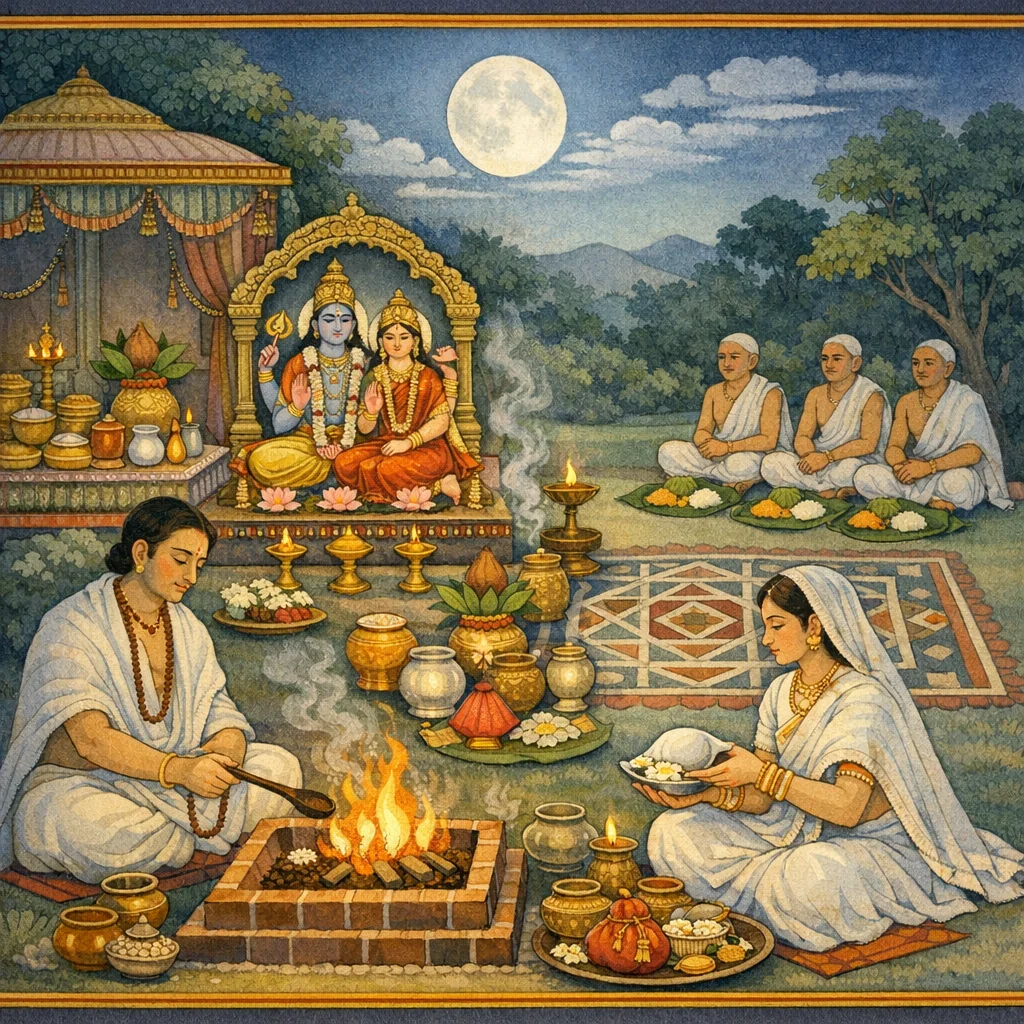
Pūrṇimā-vrata (Lakṣmī–Nārāyaṇa-vrata): Observance, Moon Arghya, and Annual Udyāpana
Sanaka teaches Nārada an “excellent vow,” the Pūrṇimā-vrata, praised for destroying sin, removing sorrow, and protecting from evil dreams and harmful planetary influences. Beginning in Mārgaśīrṣa on the bright full-moon day, the votary purifies himself (tooth-cleaning, bath, white garments, ācamana), remembers Nārāyaṇa, and after a formal saṅkalpa worships Lakṣmī–Nārāyaṇa with devotional upacāras, kīrtana/recitation, and a gṛhya-style homa on a square sthaṇḍila, offering ghee and sesame in accord with the Puruṣa-sūkta, followed by the Śānti-sūkta for pacification. On the full-moon day he fasts, offers arghya to the Moon with white flowers and akṣata, and keeps a night vigil while avoiding pāṣaṇḍas. Next morning worship continues; Brāhmaṇas are fed, then the household eats. This monthly fast is observed for a year and concludes with a Kārtika udyāpana: a decorated maṇḍapa with a sarvatobhadra design, kumbha installation, pañcāmṛta abhiṣeka, gifting a pratimā to the teacher with dakṣiṇā, Brāhmaṇa-feeding, sesame gifts and tila-homa—bringing prosperity and ultimately Viṣṇu’s abode.
Shlokas
Verse 1
सनक उवाच । अन्यद्व्रतवरं वक्ष्य श्रृणुष्व मुनिसत्तम । सर्वपापहरं पुण्यं सर्वदुःखनिबर्हणम् ॥ १ ॥
Sanaka said: “Now I shall teach another excellent vow; listen, O best of sages. It is meritorious, it removes all sins, and it destroys all sorrow.”
Verse 2
ब्राह्मणक्षत्रियविशां शूद्राणां योषितां तथा । समस्तकामफलदं सर्वव्रतफलप्रदम् ॥ २ ॥
It bestows the fruits of all desired aims upon Brahmins, Kshatriyas, Vaishyas, Shudras, and likewise upon women; granting the fruits of all vows.
Verse 3
दुःस्वन्पनाशनं धर्म्यं दुष्टग्रहनिवारणम् । सर्वलोकेषु विख्यातं पूर्णिमाव्रतमुत्तम् । येन चीर्णेन पापानां राशिकोटिः प्रशाम्यति ॥ ३ ॥
The supremely excellent Pūrṇimā-vrata (full-moon vow) is righteous; it destroys evil dreams and wards off harmful planetary influences. Renowned in all worlds, when this vow is duly observed, even crores of accumulated heaps of sins are pacified.
Verse 4
मार्गशीर्षे सितेपक्षे पूर्णायां नियतः शुचिः । स्नानं कुर्याद्यथाचारं दन्तधावनपूर्वकम् ॥ ४ ॥
In the month of Mārgaśīrṣa, on the full-moon day of the bright fortnight, a disciplined and pure person should bathe according to proper custom—after first cleaning the teeth.
Verse 5
शुक्लाम्बरधरः शुद्धो गृहमागगत्य वाग्यतः । प्रक्षाल्य पादावाचम्य स्मरत्रारायणं प्रभुम् ॥ ५ ॥
Clad in clean white garments, purified, and having returned home with speech restrained, one should wash the feet, perform ācamana (sipping water for purification), and then remember Lord Nārāyaṇa, the Supreme Master.
Verse 6
नित्यं देवार्चनं कृत्वा पश्वात्संकल्पपूर्वकम् । लक्ष्मी नारायणं देवमर्चयेद्भक्तिभावतः ॥ ६ ॥
Having performed the daily worship of the Deities, one should thereafter—after making a formal resolve (saṅkalpa)—worship Lord Lakṣmī-Nārāyaṇa with the feeling of devotion.
Verse 7
आवाहनासनाद्यैश्च गन्धपुष्पादिभिर्व्रती । नमो नारायणायेति पूजयेद्भक्तितत्परः ॥ ७ ॥
The votary, intent on devotion, should worship (the Lord) with the rites beginning with invocation and offering a seat, along with fragrances, flowers, and the like, reverently chanting, “Namo Nārāyaṇāya” (Obeisance to Nārāyaṇa).
Verse 8
गीतैर्वाद्यैश्च नृत्यैश्च पुराणपठनादिभिः । स्तोत्रैर्वाराधयेद्देवं व्रतकृत्सुसमाहितः ॥ ८ ॥
With devotional songs, instrumental music, and dance; with recitation of Purāṇas and related sacred readings; and with hymns of praise—one who is observing a vow should worship the Lord, remaining well-composed and fully attentive.
Verse 9
देवस्य पुरतः कृत्वा स्थण्डिलं चतुरस्रेकम् । अरत्निमात्रं तत्रान्गिं स्थापयेद्गृह्यमार्गतः । आज्यभागान्तर्पयन्तं कृत्वा पुरुषसूक्ततः । चरणा च तिलैश्वापि घृतेन जुहुयात्तथा ॥ ९ ॥
Having prepared, in front of the Deity, a square ritual ground (sthaṇḍila) measuring one aratni (forearm), one should install the sacred fire there according to the Gṛhya (domestic-ritual) procedure. Then, in accordance with the Puruṣa-sūkta, having offered the prescribed portions of ghee (ājya-bhāga) as oblations, one should likewise make the proper offerings with sesame seeds and with ghee.
Verse 10
एकवारं द्विवारं वात्रिवारं वापि शक्तितः । होमं कुर्यात्प्रयत्नेन सर्वपापनिवृत्तये ॥ १० ॥
According to one’s capacity—once, twice, or even three times—one should earnestly perform the homa, the fire-offering, for the cessation of all sins.
Verse 11
प्रायश्चित्तादिकं सर्वं स्वगृह्योक्तविधानतः । समाप्य होमं विधिवच्छान्तिसूक्तं जपेद्रुधः ॥ ११ ॥
Having completed all expiatory rites and related observances according to the procedure taught in one’s own Gṛhya-sūtra, and having duly finished the homa, one should then correctly recite the Śānti-sūkta as a pacificatory chant.
Verse 12
पश्चाद्देवं समागत्य पुनः पूजां प्रकल्पयेत् । तथोपवासं देवाय ह्यर्पयेद्भक्तिसंयुतः ॥ १२ ॥
Afterwards, having approached the Deity again, one should arrange worship once more; and, endowed with devotion, one should duly offer that fast to the Lord.
Verse 13
पौर्णमास्यां निराहारः स्थित्वा देव तवाज्ञया । भोक्ष्यामि पुण्डरीकाक्ष परेऽह्नि शरणं भव ॥ १३ ॥
“On the full-moon day, O Lord, I shall remain without food in obedience to Your command. O Lotus-eyed One, I will eat on the following day—be my refuge.”
Verse 14
इति विज्ञाप्य देवायह्यर्घ्यं दद्यात्तथैन्दवे । जानुभ्यामवनीं गत्वा शुक्लपुष्पाक्षतान्वितः ॥ १४ ॥
Having thus made his request to the Deity, he should then offer arghya to the Moon as well; and, going down to the ground on both knees, he should do so accompanied by white flowers and unbroken grains of rice (akṣata).
Verse 15
क्षीरोदार्णवसंभूत अत्रिगोत्रसमुद्भव । ग्रहाणार्घ्यं मया दत्तं रोहिणीनायक प्रभो । एवमर्घ्यं प्रदायेन्दोः प्रार्थयेत्प्राञ्जलिस्ततः ॥ १५ ॥
O you born from the Ocean of Milk, sprung from the lineage of Atri—O Lord, beloved leader of Rohiṇī—accept the arghya I have offered. Having thus presented arghya to the Moon, one should then pray with joined palms.
Verse 16
तिष्टन्पूर्वमुखो भूत्वा पश्यन्निन्दुं च नारद ॥ १६ ॥
O Nārada, standing with your face turned toward the east, gaze upon the Moon.
Verse 17
नमः शुक्लांशवे तुभ्यं द्विजराजाय ते नमः । रोहिणीपतये तुभ्यं लक्ष्मीभ्रात्रे नमोऽस्तु ते ॥ १७ ॥
Salutations to you, O bearer of white rays; salutations to you, O king of the twice-born. Salutations to you, the lord of Rohiṇī; may my obeisance be to you, the brother of Lakṣmī.
Verse 18
ततश्च जागरं कुर्यात्पुराणश्रवणादिभिः । जितेन्द्रियश्च संशुद्धः पाषण्डालोकवर्जितः ॥ १८ ॥
Thereafter, one should keep the sacred vigil by means such as listening to the Purāṇas and related pious acts—self-controlled, purified, and avoiding the company of pāṣaṇḍas (heretical/impious people).
Verse 19
ततः प्रातः प्रकुर्वीत स्वाचारं च यथाविधि । पुनः संपूजयेद्देवं यथाविभवविस्तरम् ॥ १९ ॥
Then, in the morning, one should perform one’s prescribed daily conduct according to rule; and again worship the Lord, expanding the worship in accordance with one’s means.
Verse 20
ब्राह्मणान्भोजयेच्छक्त्या ततश्च प्रयतो नरः । बन्धुभृत्यादिभिः सार्धं स्वयं भुञ्जीत वाग्यतः ॥ २० ॥
According to his capacity, a man should first feed the Brāhmaṇas; then, self-controlled and attentive, he should partake of the meal himself together with his relatives, servants, and others—restraining his speech.
Verse 21
एवं पौषादिमासेषु पूर्णमास्यामुपोषितः । अर्चयेद्भक्तिसंयुक्तो नारायणमनायमम् ॥ २१ ॥
Thus, in the months beginning with Pauṣa and the rest, having observed a fast on the full-moon day, one should worship Nārāyaṇa with devotion—He who is free from all affliction and decay.
Verse 22
एवं संवत्सरं कृत्वा कार्तिक्यां पूर्णिमादिने । उद्यापनं प्रकुर्वीत तद्विधानं वदामि ते ॥ २२ ॥
Having observed it in this manner for a full year, one should perform the concluding rite (udyāpana) on the full-moon day in the month of Kārtika. I shall now tell you the proper procedure for that.
Verse 23
मण्डपं कारयेद्दिव्यं चतुरस्त्रं सुमङ्गलम् । शोभितं पुष्पमालाभिर्वितानध्वजराजितम् ॥ २३ ॥
One should have a splendid pavilion (maṇḍapa) constructed—square in form and highly auspicious—adorned with garlands of flowers, and beautified with canopies and flags.
Verse 24
बहुदापसमाकीर्णं किङ्किणीजालशोभितम् । दर्पंणैश्चामरैश्चैव कलशैश्च समावृतम् ॥ २४ ॥
It was filled in many ways with attendants and retinues, adorned with nets of tinkling bells, and surrounded with mirrors, chowries (yak-tail fans), and auspicious water-pots (kalaśas).
Verse 25
तन्मध्ये सर्वतोभद्रं पञ्चवर्णविराजितम् । जलपूर्णं ततः कुम्भं न्यसेत्तस्योपरि द्विज ॥ २५ ॥
In the midst of it, the twice-born should place the Sarvatobhadra design, radiant with five colors; then, above it, he should set a water-filled ritual pot (kumbha).
Verse 26
पिधाय कुम्भं वस्त्रेण सुसूक्ष्मेणाति शोभितम् । हेम्ना वा रजतेनापि तथा ताम्रेण वा द्विज । लक्ष्मीनारायणं देवं कृत्वा तस्योपरि न्यसेत् ॥ २६ ॥
Having covered the kumbha with a very fine, beautifully adorned cloth—whether of gold, of silver, or likewise of copper, O twice-born—one should fashion (install) the deity Lakṣmī-Nārāyaṇa and place Him upon it.
Verse 27
पञ्चामृतेन संस्नाप्याभ्यर्च्यगन्धादिभिः क्रमात् । भक्ष्मैर्भोज्यादिनैवेद्यैर्भक्तितः संयतेन्द्रियः ॥ २७ ॥
Having bathed (the deity) with pañcāmṛta, the five nectars, and then worshipped in due sequence with fragrances and the like, one should—devoted and with the senses restrained—offer naivedya of edible items and other food offerings.
Verse 28
जागरं च तथा कुर्यार्त्सम्यक्छ्ररद्धासमन्वितः । परेऽह्नि प्रातर्विधिवत्पूर्ववद्विष्णुमर्चयेत् ॥ २८ ॥
In the same manner, one should keep vigil (jāgara) with proper faith; and on the following day, in the morning, one should worship Viṣṇu according to the prescribed rite, just as before.
Verse 29
आचार्याय प्रदातव्या प्रतिमा दक्षिणान्विता । ब्राह्मणान्भोजयेच्छक्त्या विभवे सत्यवारितम् ॥ २९ ॥
One should present a pratimā (sacred image) to one’s ācārya, accompanied by dakṣiṇā. According to one’s means, one should also feed Brāhmaṇas—without false pretence, and with truthful restraint regarding one’s resources.
Verse 30
तिलदानं प्रकुर्वीत यथाशक्त्या समाहितः । कुर्यादग्नौ च विधिवतिलहोमं विचक्षणः ॥ ३० ॥
With a composed mind and according to one’s capacity, one should make the gift of sesame; and the wise should also, in the sacred fire, duly offer the sesame oblation (tila-homa) in the prescribed manner.
Verse 31
एवं कृत्वा नरः सम्यक् लक्ष्मीनारायणव्रतम् । इह भुक्त्वा महाभोगान्पुत्रपौत्रसमन्वितः ॥ ३१ ॥
Thus, having duly performed the Lakṣmī–Nārāyaṇa vow, a man enjoys great prosperities in this very world, endowed with sons and grandsons.
Verse 32
सर्वपापविनिर्मुक्तः कुलायुतसमन्वितः । प्रयाति विष्णुभवनं योगिनामपि दुर्लभम् ॥ ३२ ॥
Freed from all sins and accompanied by a multitude of his lineage, he attains the abode of Viṣṇu—an attainment difficult to reach even for yogins.
Frequently Asked Questions
The chapter frames the vow as a graha-śānti and doṣa-praśamana practice: worship of Lakṣmī–Nārāyaṇa plus mantra-governed homa (Puruṣa-sūkta) and Śānti-sūkta recitation functions as a pacificatory ritual complex, with Chandra-arghya explicitly aligning the observance to lunar influence and mental auspiciousness.
Śauca (bath, white clothing, ācamana), saṅkalpa, Lakṣmī–Nārāyaṇa pūjā with upacāras, gṛhya-homa with ghee/sesame offerings and prescribed sūktas, fasting on Pūrṇimā, Chandra-arghya with akṣata and white flowers, night vigil with Purāṇa-śravaṇa, next-day worship and Brāhmaṇa-feeding, and annual udyāpana with maṇḍapa/kumbha/pratimā-dāna and tila-homa.
Udyāpana is the formal completion rite that ‘seals’ a year-long vrata through intensified worship, gifts, and feeding of Brāhmaṇas; Kārtika is traditionally Vaiṣṇava-auspicious and ritually potent for Viṣṇu-centered observances, making it a fitting calendrical endpoint for a Lakṣmī–Nārāyaṇa vow.