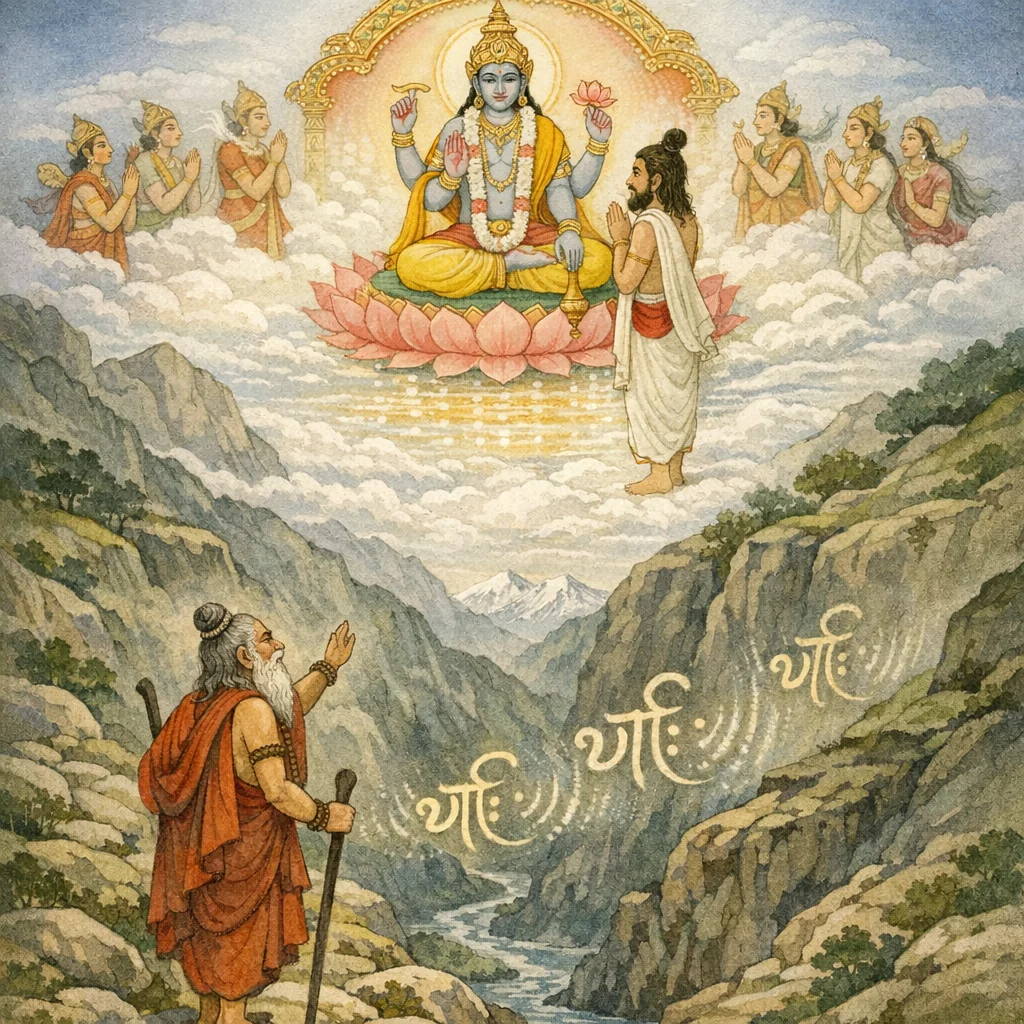
Śuka’s Yoga-ascent, the Echo of ‘Bhoḥ’, and the Vaikuṇṭha Vision
Sūta relates that Nārada, though satisfied yet still longing, questions a Brahmin sage who has attained Śuka-like realization, asking where liberated beings devoted to mokṣa “dwell.” The reply presents Śukadeva’s liberation as the model: grounded by śāstric injunction, he performs krama-yoga (progressive inward placement of awareness), sits in perfect stillness, withdraws from attachments, and ascends through yogic mastery. Gods honor him; Vyāsa follows calling “Śuka,” and Śuka answers in an all-pervading manner with the single syllable “bhoḥ,” leaving a lasting echo in mountain ravines. Transcending the guṇas—casting off rajas and tamas, then even sattva—he attains the nirguṇa state, reaches Śvetadvīpa and Vaikuṇṭha, beholds four-armed Nārāyaṇa, and offers a stotra suffused with avatāras and vyūhas. The Lord confirms Śuka’s perfection, praises rare bhakti, and instructs him to return to console Vyāsa, linking Nara-Nārāyaṇa’s teaching with Vyāsa’s authorship of the Bhāgavata. The chapter concludes that reciting and hearing these disciplines of liberation increase devotion to Hari.
Shlokas
Verse 1
सूत उवाच । एतच्छ्रृत्वा तु वचनं नारदो भगवानृषिः । पुनः पप्रच्छ तं विप्र शुकाभिपतनं मुनिम् ॥ १ ॥
Sūta said: Having heard these words, the venerable sage Nārada again questioned that Brahmin muni—he who had attained the state of Śuka.
Verse 2
नारद उवाच । भगवन्सर्वमाख्यातं त्वयाऽतिकरुणात्मना । यच्छ्रृत्वा मानसं मेऽद्य शांतिमग्र्यामुपागतम् ॥ २ ॥
Nārada said: “O Blessed One, you—whose very nature is great compassion—have explained everything. Having heard it, my mind today has attained the highest peace.”
Verse 3
पुनश्च मोक्षशास्त्रं मे त्वमादिश महामुने । नहि सम्पूर्णतामेति तृष्णा कृष्णगुणार्णवे ॥ ३ ॥
“Again, O great sage, teach me the scripture of liberation; for my longing does not reach fulfillment in the ocean of Śrī Kṛṣṇa’s virtues.”
Verse 4
ये तु संसारनिर्मुक्ता मोक्ष शास्त्रपरायणाः । कुत्र ते निवसंतीह संशयो मे महानयम् ॥ ४ ॥
“But those who are freed from saṃsāra and wholly devoted to the teachings of liberation—where do they dwell here? This is a great doubt of mine.”
Verse 5
तं छिन्धि सुमहाभागत्वत्तो नान्यो विदांवरः । सनं. उ । धारयामास चात्मानं यथाशास्त्रं महामुनिः ॥ ५ ॥
“Cut off this doubt, O greatly fortunate one—for apart from you there is no other foremost knower among the wise.” Having thus addressed (Sanatkumāra), the great sage then composed and steadied himself according to the injunctions of the scriptures.
Verse 6
पादात्प्रभृति गात्रेषु क्रमेण क्रमयोगवित् । ततः स प्राङ्मुखो विद्वानादित्येन विरोचिते ॥ ६ ॥
Beginning from the feet and moving through the limbs in proper sequence, the knower of progressive (krama) Yoga should arrange his awareness in meditation. Then that learned practitioner, facing east, should perform it in the radiance of the Sun, Āditya.
Verse 7
पाणिपादं समाधाय विनीतवदुपाविशत् । न तत्र पक्षिसंघातो न शब्दो न च दर्शनम् ॥ ७ ॥
Drawing in his hands and feet, he sat with humble discipline. There, no flock of birds gathered, no sound arose at all, and nothing was to be seen.
Verse 8
यत्र वैयासकिर्द्धाम्नि योक्तुं समुपचक्रमे । स ददर्श तदात्मानं सर्वसंगविनिःसृतः ॥ ८ ॥
There, when Vaiyāsaki began to enter his own inner abode—the state of samādhi—he beheld his very Self, having completely withdrawn from all attachments.
Verse 9
प्रजहास ततो हासं शुकः सम्प्रेक्ष्य भास्करम् । स पुनर्योगमास्थाय मोक्षमार्गोपलब्धये ॥ ९ ॥
Then Śuka laughed aloud, gazing upon Bhāskara, the Sun. Thereafter, taking up Yoga once again, he set himself to realize the path of liberation (mokṣa).
Verse 10
महायोगीश्वरो भूत्वा सोऽत्यक्रामद्विहायसम् । अंतरीक्षचरः श्रीमान्व्यासपुत्रः सुनिश्चितः ॥ १० ॥
Having become a great lord of Yoga, he traversed the open sky. Moving through the mid-air, the illustrious son of Vyāsa proceeded with firm resolve.
Verse 11
तमुंद्यंतं द्विजश्रेष्टं वैनतेयसमद्युतिम् । ददृशुः सर्वभूतानि मनोमारुतरंहसम् ॥ ११ ॥
All beings beheld that foremost of the twice-born sages as he rose—radiant like Vainateya (Garuḍa) and swift as the wind and the mind.
Verse 12
यथाशक्ति यथान्यायं पूजयांचक्रिरे तथा । पुष्प वर्षैश्च दिव्यैस्तमवचक्रुर्दिवौकसः ॥ १२ ॥
Then, according to their ability and in due propriety, they performed worship; and the dwellers of heaven showered him with divine rains of flowers.
Verse 13
तं दृष्ट्वा विस्मिताः सर्वे गंधर्वाप्सरसां गणाः । ऋषयश्चैव संसिद्धाः कोऽयं सिद्धिमुपागतः ॥ १३ ॥
Seeing him, all the hosts of Gandharvas and Apsarases were astonished; and the perfected sages too wondered, “Who is this that has attained such spiritual perfection?”
Verse 14
ततोऽसौ स्वाह्रयं तेभ्यः कथयामास नारद । उवाच च महातेजास्तानृषीन्संप्रहर्षितः ॥ १४ ॥
Then Nārada related to them his own experience and account; and that mighty, radiant sage, greatly delighted, spoke to those ṛṣis.
Verse 15
पिता यद्यनुगच्छेन्मां क्रोशमानः शुकेति वै । तस्मै प्रतिवचोदेयं भवद्भिस्तु समाहितैः ॥ १५ ॥
If my father should run after me, crying out, “O Śuka!”, then you—being composed and attentive—must give him a fitting reply.
Verse 16
बाढमुक्तस्ततस्तैस्तु लोकान्हित्वा चतुर्विधान् । तमो ह्यष्टविधं त्यक्त्वा जहौ पञ्चविधं रजः ॥ १६ ॥
Fully released from those bonds, he abandoned the fourfold worlds; casting off the eightfold darkness (tamas), he then relinquished the fivefold rajas—passion and agitation.
Verse 17
ततः सत्वं जहौ धीमांस्तदद्भुतमिवाभवत् । ततस्तस्मिन्पदे नित्ये निर्गुणे लिंगपूजिते ॥ १७ ॥
Then the wise one cast off even sattva (the quality of purity); it appeared as something wondrous. Thereafter he became established in that eternal state—nirguṇa, beyond the guṇas—revered through the worship of the liṅga.
Verse 18
ततः स श्रृङ्गेऽप्रतिमे हिमवन्मेरुसन्निभे । संश्लिष्टे श्वेतपीते च रुक्मरूप्यमये शुभे ॥ १८ ॥
Then he reached an incomparable mountain-peak, resembling Himavat and Meru—auspicious, compact and well-joined, white and yellow in hue, as though made of gold and silver.
Verse 19
शतयोजनविस्तारे तिर्यागूर्द्ध्च नारद । सोऽविशंकेन मनसा तथैवाभ्यपतच्छुकः ॥ १९ ॥
O Nārada, over a span a hundred yojanas wide—sideways and upward—the parrot, with a mind free from doubt, leapt (and flew) on just the same.
Verse 20
ते श्रृङ्गेऽत्यंतसंश्लिष्टे सहसैव द्विधाकृते । अदृश्येतां द्विजश्रेष्ट तदद्भुतमिवाभवत् ॥ २० ॥
O best of the twice-born, when those two horns, tightly interlocked, were suddenly split into two, they vanished from sight; it seemed truly wondrous.
Verse 21
ततः पर्वतश्रृंगाभ्यां सहसैव विनिःसृतः । न च प्रतिजघानास्य स गतिं पर्वतोत्तमः ॥ २१ ॥
Then he suddenly burst forth between the two mountain-peaks; and that best of mountains could neither check nor strike back his onward course.
Verse 22
ततो मंदाकिनीं दिव्या मुपरिष्टादभिव्रजन् । शुको ददर्श धर्मात्मा पुष्पितद्रुमकाननम् ॥ २२ ॥
Then, moving along above the divine Mandākinī, Śuka, righteous in soul, beheld a forest-grove filled with flowering trees.
Verse 23
तस्यां क्रीडासु निरताः स्नांति चैवाप्सरोगणाः । निराकारं तु साकाराददृशुस्तं विवाससः ॥ २३ ॥
There, the hosts of Apsarās—absorbed in their sports—bathed as well; and though embodied and unclothed, they beheld Him who is formless, beyond all form.
Verse 24
तं प्रक्रमंतमाज्ञाय पिता स्नेहसमन्वितः । उत्तमां गतिमास्थाय पृष्टतोऽनुससार ह ॥ २४ ॥
Knowing that he had set forth, the father—filled with affection—took up the higher course and followed behind him.
Verse 25
शुकस्तु मारुतादूर्द्ध्वं गतिं कृत्वां तरिक्षगाम् । दर्शयित्वा प्रभावं स्वं सर्वभूतोऽभवत्तदा ॥ २५ ॥
But Śuka, rising upward beyond the wind and moving through the mid-space, displayed his extraordinary power; then he became present as all beings.
Verse 26
अथ योगगतिं व्यासः समास्थाय महातपाः । निमेषांतरमात्रेण शुकाभिपतनं ययौ ॥ २६ ॥
Then the great ascetic Vyāsa, entering the yogic mode of movement, in the span of a single blink went to the place where Śuka had descended.
Verse 27
स ददर्श द्विधा कृत्वा पर्वताग्रं गतं शुकम् । शशंसुर्मुनयः सिद्धा गतिं तस्मै सुतस्य ताम् ॥ २७ ॥
He saw Śuka, as though splitting his course in two, go to the mountain’s summit; and the perfected sages—the siddhas and seers—proclaimed to him that very path attained by his son.
Verse 28
ततः शुकेतिशब्देन दीर्घेण क्रंदितं तदाः । स्वयं पित्रा स्वरेणोञ्चैस्त्रींल्लोकाननुनाद्य वै ॥ २८ ॥
Then, with a long-drawn cry of “Śuketi!”, the father himself called out loudly, making the three worlds resound.
Verse 29
शुकः सर्वगतिर्भूत्वा सर्वात्मा सर्वतोमुखः । प्रत्यभाषत धर्मात्मा भोः शब्देनानुनादयन् ॥ २९ ॥
Śuka—becoming all-pervading in his movement, one with the Self of all and facing every direction—replied. That righteous-souled one made the call “bhoḥ!” resound as he spoke.
Verse 30
तत एकाक्षरं नादं भोरित्येवमुदीरयन् । प्रत्याहरज्जगत्सर्वमुञ्चैः स्थावरजंगमम् ॥ ३० ॥
Then, uttering the single-syllabled sound “bho” aloud, he drew back the entire world—both the immovable and the moving—into that call.
Verse 31
ततः प्रभृति वाऽद्यापि शब्दानुञ्चारितान्पृथक् । गिरिगह्वरपृष्टेषु व्याजहार शुकं प्रति ॥ ३१ ॥
From that time onward—even to this day—those clearly uttered words resound back, each distinct, along the faces of mountain caves and ravines, as though speaking to Śuka.
Verse 32
अंतर्हितप्रभावं तं दर्शयित्वा शुकस्तदा । गुणान्संत्यज्य सत्त्वादीन्पदमध्यगमत्परम् ॥ ३२ ॥
Then Śuka, having revealed that hidden divine potency, renounced the guṇas beginning with sattva and attained the supreme state—the highest abode.
Verse 33
महिमानं तु तं दृष्ट्वा पुत्रस्यामिततेजसः । सोऽनुनीतो भगवता व्यासो रुद्रेण नारद ॥ ३३ ॥
But upon beholding the greatness of his son of immeasurable splendor, Vyāsa—O Nārada—was consoled and reconciled by the Blessed Lord Rudra.
Verse 34
किमु त्वं ताम्यसि मुने पुत्रं प्रति समाकुलः । पश्यसि विप्र नायांतं ब्रह्यभूतं निजांतिरे ॥ ३४ ॥
Why do you grieve, O sage, so distressed about your son? O brāhmaṇa, do you not see him here—having become one with Brahman—close by your very side?
Verse 35
इत्येवमनुनीतोऽसौ व्यासः पुनरुप्राव्रजत् । श्वाश्रमं स शुको ब्रह्मभूतो लोकांश्चचार ह ॥ ३५ ॥
Thus, having been consoled and persuaded in this way, Vyāsa once again departed for his hermitage. And Śuka—established in Brahman—wandered freely through the worlds.
Verse 36
तत कालांतरे ब्रह्मन्व्यासः सत्यवतीसुतः । नरनारायणौ द्रष्टुं ययौ बदरिकाश्रमम् ॥ ३६ ॥
Then, after some time, O Brahmin, Vyāsa—the son of Satyavatī—went to the hermitage of Badarī to behold Nara and Nārāyaṇa.
Verse 37
तत्र दृष्ट्वा तु तौ देवौ तप्यमानो महत्तपः । स्वयं च तत्र तपसि स्थितः शुकमनुस्मरन् ॥ ३७ ॥
There, having seen those two divine beings, the great ascetic continued performing intense austerities; and he himself remained established in that penance, repeatedly remembering Śuka.
Verse 38
यावत्तत्र स्थितो व्यासः शुकः परमयोगवित् । श्वेतद्वीपं गतस्तात यत्र त्वमगमः पुरा ॥ ३८ ॥
So long as Vyāsa remained there, Śuka—the supreme knower of Yoga—went to Śvetadvīpa, dear one, the very place where you had gone before.
Verse 39
तत्र दृष्टप्रभावस्तु श्रीमान्नारायणः प्रभुः । दृष्टः श्रुतिविमृग्यो हि देवदेवो जनार्दनः ॥ ३९ ॥
There, the glorious Lord Nārāyaṇa—whose majesty is directly witnessed—was seen; for Janārdana, the God of gods, is indeed the One whom the Vedas seek to know, and yet He becomes visible to the devotee.
Verse 40
स्तुतश्च शुकदेवेन प्रसन्नः प्राह नारद । श्रीभगवानुवाच । त्वया दृष्टोऽस्मि योगीन्द्र सर्वदेवरहःस्थितः ॥ ४० ॥
Praised by Śukadeva, the Lord was pleased and spoke to Nārada. The Blessed Lord said: “O lord of yogins, you have indeed beheld Me—abiding in the secret presence of all the gods.”
Verse 41
सनत्कुमारादिष्टेन सिद्धो योगेन वाडव । त्वं सदागतिमार्गस्थो लोकान्पश्य यथेच्छया ॥ ४१ ॥
O Vāḍava, perfected by the yoga taught by Sanatkumāra, you now stand firm upon the ever-righteous path; therefore behold the worlds as you desire, by your own will.
Verse 42
इत्युक्तो वासुदेवेन तं नत्वारणिसंभवः । वैकुंठं प्रययौ विप्र सर्वलोकनमस्कृतम् ॥ ४२ ॥
Thus addressed by Vāsudeva, the one born from the araṇi (fire-sticks) bowed to Him; and, O brāhmaṇa, he departed for Vaikuṇṭha, revered by all the worlds.
Verse 43
वैमानिकैः सुरैर्जुष्टं विरजापरिचेष्टितम् । यं भांतमनुभांत्येते लोकाः सर्वेऽपि नारद ॥ ४३ ॥
O Nārada, That Supreme Reality is attended by the celestial gods who move in vimānas, and is untouched by the activity of rajas (passion). When That shines, all these worlds shine after It.
Verse 44
यत्र विदुमसोपानाः स्वर्णरत्नविचित्रिताः । वाप्य उत्पलंसंछन्नाः सुरस्त्रीक्रीडनाकुलाः ॥ ४४ ॥
There, the stairways are made of coral and adorned with gold and gems; the ponds are covered with lotuses and filled with celestial women engaged in playful sport.
Verse 45
दिव्यैर्हंसकुलैर्घुष्टाः स्वच्छांबुनिभृताः सदा । तत्र द्वाःस्थैश्चतुर्हस्तेनार्नाभरणभूषितैः ॥ ४५ ॥
They resounded with the calls of celestial flocks of swans and were ever filled with clear water. There, at the gateway, stood doorkeepers with four hands, adorned with jeweled ornaments.
Verse 46
विष्वक्सेनानुगैः सिद्धैः कुमुदाद्यैरवा रितः । प्रविश्याभ्यांतरं तत्र देवदेवं चतुर्भुजम् ॥ ४६ ॥
Unhindered by the perfected Siddhas who followed Viṣvaksena—Kumuda and others—he entered within, and there beheld the God of gods, the four-armed Lord.
Verse 47
शांतं प्रसन्नवदनं पीतकौशेयवाससम् । शंखचक्रगदापद्मैर्मूर्तिमद्भिरुपासितम् ॥ ४७ ॥
Peaceful and serene, with a gracious, radiant face, clad in yellow silk—He is worshipped in His manifest form, bearing the conch, discus, mace, and lotus.
Verse 48
वक्षस्थलस्थया लक्ष्म्या कौस्तुभेन विराजितम् । कटीसूत्रब्रह्मसूत्रकटकांगदभूषितम् ॥ ४८ ॥
He shone, adorned with Lakṣmī abiding upon His chest and with the Kaustubha jewel; and He was ornamented with a waist-girdle, the sacred thread, bracelets, and armlets.
Verse 49
भ्राजत्किरीटवलयं मणिनूपुरशोभितम् । ददर्श सिद्धनि करैः सेव्यमानमहर्निशम् ॥ ४९ ॥
He beheld that radiant One, adorned with a shining crown and arm-ornaments, beautified by jeweled anklets—unceasingly served day and night by hosts of Siddhas.
Verse 50
तं दृष्ट्वा भक्तिभावेन तुष्टाव मधुसूदनम् । शुक उवाच । नमस्ते वासुदेवाय सर्वलोकैकसाक्षिणे ॥ ५० ॥
Seeing Him, he praised Madhusūdana with a heart full of devotion. Śuka said: “Salutations to Vāsudeva, the sole Witness of all the worlds.”
Verse 51
जगद्बीजस्वरूपाय पूर्णाय निभृतात्मने । हरये वासुकिस्थाय श्वेतद्वीपनिवासिने ॥ ५१ ॥
Salutations to Hari—the very seed-form of the universe, Perfect and all-complete, inwardly tranquil in essence; who abides upon Vāsuki and dwells in Śvetadvīpa.
Verse 52
हंसाय मत्स्यरूपाय वाराहतनुधारिणे । नृसिंहाय ध्रुवेज्याय सांख्ययोगेश्वराय च ॥ ५२ ॥
Salutations to the Lord as Haṃsa; to Him who assumed the form of the Fish; to the Bearer of the Boar-body; to Narasiṃha; to the revered deity worshipped by Dhruva; and to the Supreme Lord of Sāṅkhya and Yoga as well.
Verse 53
चतुःसनाय कूर्माय पृथवे स्वसुरवात्मने । नाभेयाय जगद्धात्रे विधात्रेंऽतकारय च ॥ ५३ ॥
Salutations to the Four Kumāras; to Kūrma, the Tortoise incarnation; to Pṛthu; to the Self who is the very essence of the gods; to Nābhēya; to the Sustainer of the world; to Vidhātṛ, the Ordainer; and also to Antakāra, the Maker of the end.
Verse 54
भार्गवेंद्राय रामाय राघवाय पराय च । कृष्णाय वेदकर्त्रे च बुद्धकल्किस्वरूपिणे ॥ ५४ ॥
Salutations to the foremost of the Bhārgavas, Rāma (Paraśurāma); to Rāma; to Rāghava; and to the Supreme. Salutations to Kṛṣṇa as well—the author and arranger of the Veda—and to Him whose forms are Buddha and Kalki.
Verse 55
चतुर्व्युहाय वेद्याय ध्येयाय परमात्मने । नरनारायणाख्याय शिषिविष्टाय विष्णवे ॥ ५५ ॥
Salutations to Viṣṇu—knowable through the doctrine of the four Vyūhas, truly to be known and meditated upon, the Supreme Self—who is famed as Nara-Nārāyaṇa and who abides within the disciple as the indwelling guide.
Verse 56
ऋतधाम्ने विधाम्ने च सुपर्णाय स्वरोचिषे । ऋभवे सुव्रताख्याय सुधाम्ने चाजिताय च ॥ ५६ ॥
Salutations to Him whose abode is Truth, the Ordainer; to the noble-winged Lord (Suparṇa), radiant with His own splendor; to the Exalted One famed for sacred vows; to Him whose abode is nectar-like bliss; and to Ajita, the Unconquered.
Verse 57
विश्वरूपाय विश्वाय सृष्टिस्थित्यंतकारिणे । यज्ञाय यज्ञभोक्ते च स्थविष्ठायाणवेऽर्थिने ॥ ५७ ॥
Salutations to Him who is the form of the whole universe and the universe itself, who brings about creation, preservation, and dissolution; to Him who is the sacrifice (yajña) and also the enjoyer of sacrifice; to the most vast and yet the most subtle—the very ground and meaning of all things.
Verse 58
आदित्यसोमनेत्राय सहओजोबलाय च । ईज्याय साक्षिणेऽजायबहुशीर्षांघ्रिबाहवे ॥ ५८ ॥
Salutations to Him whose eyes are the Sun and the Moon; to Him endowed with might, vigor, and strength; to the Adorable One, the Witness; to Aja, the Unborn—He of many heads, feet, and arms.
Verse 59
श्रीशाय श्रीनिवासाय भक्तवश्याय शार्ङ्गिणे । अष्टप्रकृत्यधीशाय ब्रह्मणेऽनंतसक्तये ॥ ५९ ॥
Salutations to Śrīśa, Lord of Śrī, and to Śrīnिवāsa, the Abode of Śrī; to Him who is won over by the bhakti of His devotees; to the wielder of the Śārṅga bow; to the sovereign over the eightfold Prakṛti; to Brahman, whose power is infinite and boundless.
Verse 60
बृहदारण्यवेद्याय हृषीकेशाय वेधसे । पुंडरीकनिभाक्षाय क्षेत्रज्ञाय विभासिने ॥ ६० ॥
Salutations to Him who is known through the Bṛhadāraṇyaka Upaniṣad; to Hṛṣīkeśa, Lord of the senses; to Vedhas, the Creator; to Him whose eyes are like lotuses; to Kṣetrajña, the Knower of the field, the indwelling Self; and to the Radiant One who illumines all.
Verse 61
गोविंदाय जगत्कर्त्रे जगन्नाथाय योगिने । सत्याय सत्यसंधाय वैकुंठायाच्युताय च ॥ ६१ ॥
Salutations to Govinda, the creator of the universe; to Jagannātha, Lord of the world, the supreme Yogi; to the Truth, to Him whose resolve is ever true; to Vaikuṇṭha and to Acyuta, the unfailing Lord.
Verse 62
अधोक्षजाय धर्माय वामनाय त्रिधातवे । घृतार्चिषे विष्णवे तेऽनंताय कपिलायय च ॥ ६२ ॥
Salutations to You—Adhokṣaja, the Transcendent beyond the senses, Dharma itself; to Vāmana, Lord of the three constituents; to You whose radiance is like purified ghee, to Viṣṇu; to the Infinite Ananta; and also to Kapila.
Verse 63
विरिंचये त्रिककुदे ऋग्यजुःसामरूपिणे । एकश्रृंगाय च शुचिश्रवसे शास्त्रयोनये ॥ ६३ ॥
Salutations to Viriñca (Brahmā), the three-peaked one; to Him whose form is the Ṛg, Yajus, and Sāman; to the One-horned Lord of pure renown, the very source-womb of the scriptures.
Verse 64
वृषाकपय ऋद्धाय प्रभवे विश्वकर्मणे । भूर्भुवुःस्वःस्वरूपाय दैत्यघ्ने निर्गुणाय च ॥ ६४ ॥
Salutations to the Lord—known as Vṛṣākapi—who is fullness and prosperity itself; to the Supreme Master, the universal Craftsman; to Him whose very form is the three worlds (bhūr, bhuvaḥ, svaḥ); to the slayer of the Daityas; and to the One beyond all qualities (nirguṇa).
Verse 65
निरंजनाय नित्याय ह्यव्ययायाक्षराय च । नमस्ते पाहि मामीश शरणागतवत्सल ॥ ६५ ॥
Salutations to You—stainless, eternal, undecaying, and imperishable. O Lord, protect me; O lover of those who take refuge in You, I have come to You for shelter.
Verse 66
इति स्तुतः स भगवाञ्च्छंखचक्रगदाधरः । आरणेयमुवाचेदं भृशं प्रणतवत्सलः ॥ ६६ ॥
Thus praised, the Blessed Lord—bearing the conch, discus, and mace—spoke these words to Āraṇeya, exceedingly affectionate to those who bow down in surrender.
Verse 67
श्रीभगवानुवाच । व्यासपुत्र महाभाग प्रीतोऽस्मि तव सुव्रत । विद्यामाप्नुहि भक्तिं च ज्ञानी त्वं मम रूपधृक् ॥ ६७ ॥
The Blessed Lord said: “O noble son of Vyāsa, O greatly fortunate one of excellent vows, I am pleased with you. Attain true knowledge and devotion; you are a knower, bearing My very form.”
Verse 68
यद्रूपं मम दृष्टं प्राक् श्वेतद्वीपे त्वया द्विज । सोऽहमेवावतारार्थं स्थितो विश्वंभरात्मकः ॥ ६८ ॥
O twice-born one, the very form that was seen by you earlier in Śvetadvīpa—that is I myself, now abiding here for the purpose of incarnation, in the nature of the All-Sustainer who upholds the universe.
Verse 69
सिद्धोऽसि त्वं महाभाग मोक्षधर्मानुनुचिंतया । वरलोकान्यथा वायुर्यथा रवं सविता तथा ॥ ६९ ॥
O greatly fortunate one, you have attained perfection through constant contemplation on the dharma of liberation. As the wind reaches the higher worlds, and as the Sun spreads its radiance, so do you attain those excellent realms.
Verse 70
नित्यमुक्तस्वरूपस्त्वं पूज्यमानः सुरैर्नरैः । भक्तिर्हि दुर्लभा लोके मयि सर्वपरायणे ॥ ७० ॥
You are of the very nature of eternal liberation, worshipped by gods and by human beings. For devotion is indeed rare in this world—devotion to Me, who am the supreme refuge of all.
Verse 71
तां लब्ध्वा नापरं किंचिल्लब्धव्यमवशिष्यते । आकल्पांतः तपः संस्थौ नरनारायणावृषी ॥ ७१ ॥
Having attained That, nothing else remains to be attained. The sages Nara and Nārāyaṇa, steadfast in tapas, abide in that state until the end of the aeon.
Verse 72
तयोर्निदेशतो व्यासो जनक स्तव सुव्रतः । कर्ता भागवतं शास्त्रं तदधीष्व भुवं व्रज ॥ ७२ ॥
At their instruction, Vyāsa—O Janaka, you of good vows, composer of the hymn in your praise—became the author of the Bhāgavata scripture. Study that, and then go forth upon the earth.
Verse 73
स तप्यति तपस्त्वद्य पर्वते गंधमादने । त्वद्वियोगेन खिन्नात्मा तं प्रसादय मत्प्रियम् ॥ ७३ ॥
Even now he is performing austerities on Mount Gandhamādana. His heart is afflicted by separation from you—so please be gracious to him, for he is dear to me.
Verse 74
एवमुक्तः शुको विप्र नमस्कृत्य चतुर्भुजम् । यथागतं निवृत्तोऽसौ पितुरंतिकमागमत् ॥ ७४ ॥
Thus addressed, O brāhmaṇa, Śuka bowed to the four-armed Lord; and then, returning the way he had come, he went back to his father’s presence.
Verse 75
अथ तं स्वंतिके दृष्ट्वा पाराशर्य्यः प्रतापवान् । पुत्रं प्राप्य प्रहृष्टात्मा तपसो निववर्त ह ॥ ७५ ॥
Then the mighty, illustrious son of Parāśara, seeing him close by and having obtained his son, became joyous at heart and desisted from his austerities.
Verse 76
नारायणं नमस्कृत्य नरं चैव नरोत्तमम् । आरणेयसमायुक्तः स्वाश्रमं समुपागमत् ॥ ७६ ॥
Having bowed to Nārāyaṇa and also to Nara, the best of men, he—accompanied by Āraṇeya—returned to his own hermitage.
Verse 77
नारायणनियोगात्तु त्वन्मुखेन मुनीश्वर । चकार संहितां दिव्यां नानाख्यानसमन्विताम् ॥ ७७ ॥
But by Nārāyaṇa’s command, O lord among sages, through your mouth he composed a divine compendium, enriched with many narratives.
Verse 78
वेदतुल्यां भागवतीं हरिभक्तिविवर्द्धिनीम् । निवृत्तिनिरतं पुत्रं शुकमध्यापयञ्च ताम् ॥ ७८ ॥
He also taught that Bhāgavatī scripture—equal to the Vedas and an increaser of devotion to Hari—to his son Śuka, who was devoted to renunciation.
Verse 79
आत्मारामोऽपि भगवान्पाराशर्यात्मजः शुकः । अधीतवान्संहितां वै नित्यं विष्णुजनप्रियाम् ॥ ७९ ॥
Even the Blessed Śuka—son of Vyāsa, grandson of Parāśara—though fully self-delighted and established in the Self, constantly studied this sacred compendium, beloved of the devotees of Lord Viṣṇu.
Verse 80
एवमेते समाख्याता मोक्षधर्मास्तवानध । पठतां श्रृण्वतां चापि हरिभक्तिविवर्द्धनाः ॥ ८० ॥
Thus, O sinless one, these disciplines of liberation have been explained to you; and for those who recite them and for those who listen to them as well, they increase devotion to Hari (Viṣṇu).
Frequently Asked Questions
It dramatizes Śuka’s all-pervasive realization: he answers while ‘facing in every direction’ as the Self of all, and the continuing echo in caves functions as a narrative sign of siddhi and non-local identity—liberation expressed as cosmic resonance rather than bodily location.
By presenting liberation as guṇa-transcendence and all-pervading selfhood rather than a single terrestrial residence, while also affirming higher divine realms (Śvetadvīpa/Vaikuṇṭha) as revelatory ‘abodes’ where the Lord becomes visible to perfected devotion.
It anchors nirguṇa attainment within a bhakti-compatible vision: the transcendent is approached through a manifest form (conch, discus, mace, lotus), integrating saguṇa worship, avatāra remembrance, and the claim that the Vedas seek Him yet He becomes directly seen by the devotee.
It provides Purāṇic authorization: Nara-Nārāyaṇa instruct Vyāsa, and the Lord directs Śuka to study and return to console Vyāsa—linking mokṣa pedagogy to the formation and transmission of a major bhakti text.