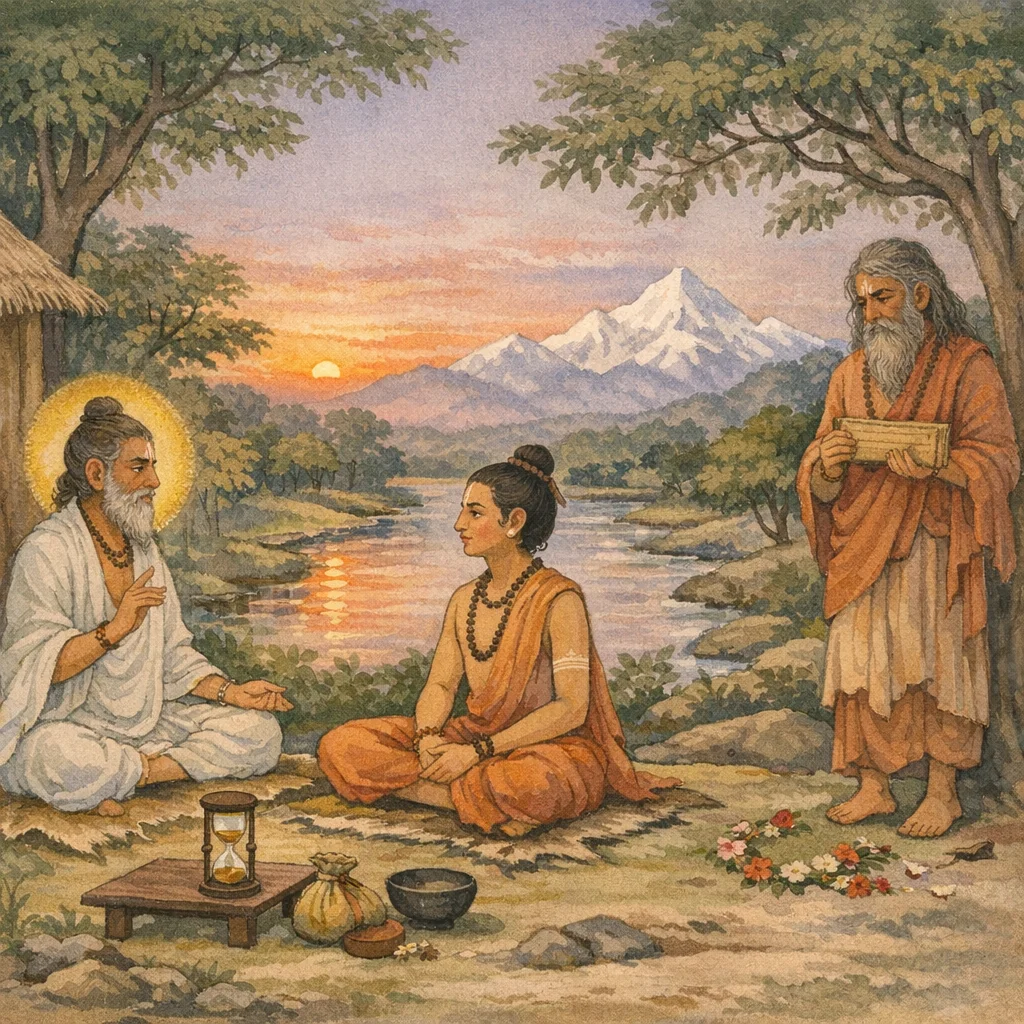
Śokanivāraṇa: Non-brooding, Impermanence, Contentment, and Śuka’s Renunciation
Sanatkumāra teaches a practical mokṣa-dharma psychology of sorrow: daily joys and griefs seize the deluded, while the wise remain unshaken. Grief is traced to attachment—brooding on the past, fault-finding where one clings, and repeated lamentation over loss and death. The remedy is deliberate non-rumination, discerning mental sorrow (removed by wisdom) from bodily illness (treated by medicine), and clear contemplation of the impermanence of life, youth, wealth, health, and companionship. The chapter widens into karmic realism: results are unequal, effort has limits, and beings are swept along by time, disease, and death; thus contentment (santoṣa) is declared true wealth. Ethical discipline is prescribed—restraint of the senses, freedom from addiction, equanimity toward praise and blame, and steady effort aligned with one’s nature. The narrative closes as Sanatkumāra departs; Śuka, understanding, goes to Vyāsa and leaves for Kailāsa; Vyāsa’s grief underscores the teaching, and Śuka’s independence models liberation.
Shlokas
Verse 1
सनत्कुमार उवाच । अशोकं शोकनाशार्थं शास्त्रं शांतिकरं शिवम् । निशम्य लभ्यते बुद्धिर्लब्धायां सुखमेधते ॥ १ ॥
Sanatkumāra said: By listening to this auspicious, peace-bestowing, beneficent scripture—free from sorrow and meant to destroy grief—one gains true understanding; and when that understanding is attained, happiness steadily grows.
Verse 2
हर्षस्थानसहस्राणि शोकस्थानशतानि च । दिवसे दिवसे मूढमाविशंति न पंडितम् ॥ २ ॥
Thousands of occasions for delight and hundreds of occasions for grief arise day after day—yet they seize only the deluded, not the wise.
Verse 3
अनिष्टसंप्रंयोगाश्च विप्रयोगात्प्रियस्य च । मनुष्या मानसैर्दुःखैर्युज्यन्ते येऽल्पबुद्धयः ॥ ३ ॥
Those of little understanding become bound to mental sorrows—through contact with what is undesirable and through separation from what is dear.
Verse 4
द्रव्येषु समतीतेषु ये गुणास्तेन्न चिंदयेत् । ताननाद्रियमाणश्च स्नेहबन्धाद्विमुच्यते ॥ ४ ॥
One should not brood over the qualities that belonged to objects now gone into the past. By ceasing to value them, one is released from the bondage of attachment.
Verse 5
दोषदर्शी भवेत्तत्र यत्र रागः प्रवर्त्तते । अनिष्टबुद्धितां यच्छेत्ततः क्षिप्रं विराजते ॥ ५ ॥
Where attachment (rāga) arises, there one becomes a finder of faults. If one restrains the habit of seeing things as undesirable, one quickly shines forth in clarity and steadiness.
Verse 6
नार्थो न धर्मो न यशो योऽतीतमनुशोचति । अस्याभावेन युज्येतं तञ्चास्य तु निवर्तते ॥ ६ ॥
For one who keeps lamenting over what has already passed, there is neither wealth, nor dharma, nor good repute. He becomes joined to their absence, and whatever he has is driven away from him.
Verse 7
गुणैर्भूतानि युज्यंते तथैव च न युज्यते । सर्वाणि नैतदेकस्य शोकस्थानं हि विद्यते ॥ ७ ॥
Beings become bound through the guṇas, and likewise they become unbound. Yet all this is not the case for the One; for in Him there exists no ground for sorrow.
Verse 8
मृतं वा यदि वा नष्टं योऽतीतमनुशोचति । दुःखेन लभते दुःखं महानर्थे प्रपद्यते ॥ ८ ॥
Whether someone has died or something has been lost, the one who keeps grieving over what is past gains only sorrow through sorrow, and falls into great misfortune.
Verse 9
दुःखोपघाते शारीरे मानसे चाप्युपस्थिते । यस्मिन्न शक्यते कर्तुं यत्नस्तन्नानुर्चितयेत् ॥ ९ ॥
When suffering has arisen—whether in the body or in the mind—if, in that situation, no remedial effort can truly be made, one should not brood over it again and again.
Verse 10
भैषज्यमेतद्दःखस्य यदेतन्नानुचिंतयेत् । चिंत्यमानं हि न व्येति भूयश्चाभिप्रवर्द्धते ॥ १० ॥
This is the medicine for sorrow: do not keep brooding over it. For when it is dwelt upon, it does not depart; rather, it grows all the more.
Verse 11
प्रज्ञया मानसं दुःखं हन्याच्छारीरमौषधैः । एतद्विज्ञाय सामर्थ्यं न वान्यैः समतामियात् ॥ ११ ॥
With discerning wisdom one should destroy mental sorrow, and with medicines one should remove bodily ailments. Knowing the true capacity of each remedy in its proper sphere, one should not confuse them by seeking equivalence between the two.
Verse 12
अनित्यं जीवितं रूपं यौवनं द्रव्यसञ्चयः । आरोग्यं प्रियसंवासं न मृध्येत्पंडितः क्वचित् ॥ १२ ॥
Life is impermanent; so are beauty, youth, accumulated wealth, health, and the company of loved ones. Knowing this, a wise person should never become deluded by any of them.
Verse 13
नाज्ञानप्रभवं दुःखमेकं शोचितुमर्हति । अशोचन्प्रतिकुर्वीत यदि पश्येदुपक्रमम् ॥ १३ ॥
One should not grieve even for a single sorrow that is born of ignorance. If one can see a way to begin remedy, one should act to counter it—without lamentation.
Verse 14
सुखात्प्रियतरं दुःखं जीविते नात्र संशयः । जरामरणदुःखेभ्यः प्रियमात्मानमुद्धरेत् ॥ १४ ॥
In embodied life, suffering becomes dearer—more familiar and compelling—than happiness; of this there is no doubt. Therefore, one should lift up one’s beloved Self from the pains of old age and death.
Verse 15
भजंति हि शारीराणि रोगाः शरीरमानसाः । सायका इव तीक्ष्णाग्राः प्रयुक्ता दृढधन्विभिः ॥ १५ ॥
Indeed, bodily illnesses—of body and of mind—assail embodied beings, like sharp-pointed arrows loosed by steadfast, mighty bowmen.
Verse 16
व्याधितस्य चिकित्साभिस्त्रस्यतो जीवितैषिणः । आमयस्य विनाशाय शरीरमनुकृष्यते ॥ १६ ॥
For one afflicted by disease—fearful and longing to preserve life—the body is drawn into treatments, strained and disciplined, so that the illness may be destroyed.
Verse 17
स्रंसंति न निवर्तंते स्रोतांसि सरितामिव । आयुरादाय मर्त्यानां रात्र्यहानि पुनःपुनः ॥ १७ ॥
As river-currents flow on and never return, so nights and days pass again and again, carrying away the lifespan of mortals.
Verse 18
अपयंत्ययमत्यंतं पक्षयोः शुक्लकृष्णयोः । जातं मर्त्यं जरयति निमिषं नावतिष्टते ॥ १८ ॥
Time passes away relentlessly through the bright and dark fortnights; it ages the mortal who is born, and it does not remain even for a moment.
Verse 19
सुखदुःखाभिभूतानामजरो जरयत्यसून् । आदित्यो ह्यस्तमभ्येति पुनः पुनरुदेति च ॥ १९ ॥
Even one who is himself ageless causes the life-breaths of those overwhelmed by pleasure and pain to wither away; and the Sun, indeed, repeatedly sets and repeatedly rises again.
Verse 20
अदृष्टपूर्वानादाय भावानपरिशंकितान् । इष्टानिष्टा मनुष्याणां मतं गच्छन्ति रात्रयः ॥ २० ॥
The nights pass on, bearing unforeseen experiences and unanticipated states of mind, as though bringing to people the outcomes they deem pleasant and unpleasant.
Verse 21
यो यदिच्छेद्यथाकामं कामानां तत्तदाप्नुयात् । यदि स्यान्न पराधीनं पुरुषस्य क्रियाफलम् ॥ २१ ॥
If the fruit of a person’s actions were not dependent on anything else, then whatever one desired at will, one would obtain exactly that among desired objects.
Verse 22
संयताश्चैव तक्षाश्च मतिमंतश्च मानवाः । दृश्यंते निष्फलाः संतः प्रहीनाश्च स्वकर्मभिः ॥ २२ ॥
Even the self-restrained, skilled artisans, and intelligent men are seen to become fruitless in life, because they have fallen away from their own proper duties and actions.
Verse 23
अपरे निष्फलाः सन्तो निर्गुणाः पुरुषाधमाः । आशाभिरण्यसंयुक्ता दृश्यन्ते सर्वकामिनः ॥ २३ ॥
Others, however, are seen to be fruitless in their lives—bereft of virtues, the lowest among men—entangled with hopes and wealth, and driven by every kind of desire.
Verse 24
भूतानामपरः कश्चिद्धिंसायां सततोत्थितः । वंचनायां च लोकेषु ससुखेष्वेव जीयते ॥ २४ ॥
Another person, ever intent on harming living beings and on deceiving people in the world, may indeed appear to live amid pleasures.
Verse 25
अचेष्टमानमासीनं श्रीः कंचिदुपतिष्टति । कश्चित्कर्माणि कुरुते न प्राप्यमधिगच्छति ॥ २५ ॥
Even one who sits inactive and makes no effort may, at times, be approached by Śrī Lakṣmī (fortune); while another performs many deeds yet does not attain what ought to be attained.
Verse 26
अपराधान्समाच्ष्टुं पुरुषस्य स्वभावतः । शुक्रमन्यत्र संभूतं पुनरन्यत्र गच्छति ॥ २६ ॥
By his very nature a man tends to commit offences; and the generative seed, formed in one place, goes again to another womb—thus the round of birth continues.
Verse 27
तस्य योनौ प्रसक्तस्य गर्भो भवति मानवः । आम्रपुष्पोपमा यस्य निवृत्तिरुपलभ्यते ॥ २७ ॥
For the man attached to that yoni (source of birth), embodiment as a human foetus arises. But for one who has attained withdrawal from such attachment, that cessation is likened to the mango tree’s blossom.
Verse 28
केषांचित्पुत्रकामानामनुसन्तानमिच्छताम् । सिद्धौ प्रयतमानानां नैवांडमुपजायते ॥ २८ ॥
Some, longing for sons and desiring an unbroken line of descendants, though striving by the prescribed means, find that no conception arises at all.
Verse 29
गर्भादुद्विजमानानां क्रुद्धादशीविषादिव । आयुष्मान् जायते पुत्रः कथं प्रेतः पितेव सः ॥ २९ ॥
From those who recoil in fear even from the womb—as if from an enraged venomous serpent—an auspicious, long-lived son is born; how, then, could the father become a preta, a restless departed spirit?
Verse 30
देवानिष्ट्वा तपस्तप्त्वा कृपणैः पुत्रहेतुभिः । दशमासान्परिधृता जायते कुलपांसनाः ॥ ३० ॥
Even if one worships the gods and performs austerities—when the miser does so solely to obtain a son—after ten months of being borne in the womb, a child is born who becomes the “dust and defilement of the lineage.”
Verse 31
अपरे धनधान्यानि भोगांश्च पितृसंचितान् । विमलानभिजायन्ते लब्ध्वा तैरेव मङ्गलैः ॥ ३१ ॥
Others obtain wealth, grain, and enjoyments amassed by their forefathers; and by gaining those very auspicious acquisitions, they are born as pure and blameless persons.
Verse 32
अन्योन्य समभिप्रेत्य मैथुनस्य समागमे । उपद्रवइवादृष्टो योनौ गर्भः प्रपद्यते ॥ ३२ ॥
When the two mutually consent and unite in sexual intercourse, an unseen force—like an impelling disturbance—causes the embryo to enter and take hold in the womb.
Verse 33
स्निग्धत्वादिंद्रियार्थेषु मोहान्मरणमप्रियम् । परित्यजति यो दुःखं सुखमप्युभयं नरः ॥ ३३ ॥
Because of attachment to the objects of the senses, and delusion, a person finds death unpleasant; but one who abandons both pain and pleasure transcends them both.
Verse 34
अत्येति ब्रह्म सोऽत्यन्तं सुखमप्यश्नुते परम् । दुःखमर्था हि त्यज्यंते पालने च न ते सुखाः ॥ ३४ ॥
He transcends even Brahman and attains the supreme, limitless bliss. For worldly aims (artha) are to be abandoned, since they bring sorrow; and even in maintaining them there is no true happiness.
Verse 35
श्रुत्वैव नाधिगमनं नाशमेषां न चिंतयेत् । अन्यामन्यां धनावस्थां प्राप्य वैशेषिका नराः ॥ ३५ ॥
By merely hearing the teaching, one should not presume true realization; nor should one brood over the loss of these worldly conditions. People, driven by their own notions and pursuits, pass again and again through ever-changing states of wealth.
Verse 36
अतृप्ता यांति विध्वंसं सन्तोषं यांति पंडिताः । सर्वे क्षयांता निचयाः पतनांताः समुच्छ्रयाः ॥ ३६ ॥
The dissatisfied fall into ruin, while the wise attain contentment. All hoards end in depletion, and all lofty elevations end in a fall.
Verse 37
संयोगा विप्रयोगांता मरणांतं हि जीवितम् । अन्तो नास्ति पिपासायास्तुष्टिस्तु परमं सुखम् ॥ ३७ ॥
All meetings end in separation, and life indeed ends in death. There is no end to craving; but contentment alone is the highest happiness.
Verse 38
तस्मात्संतोषमेवेह धनं शंसन्ति पंडिताः । निमेषमात्रमपि हि योऽधिगच्छन्न तिष्टति ॥ ३८ ॥
Therefore, the wise here declare contentment alone to be true wealth; for whatever is gained does not remain even for a moment, like the blink of an eye.
Verse 39
सशरीरेष्वनित्येषु नित्यं किमनुचिंतयेत् । भूतेषु भावं संचिंत्य ये बुद्ध्या तमसः परम् ॥ ३९ ॥
Among embodied beings—whose bodies are impermanent—what “eternal” thing should one keep contemplating? By discerning the inner reality within all creatures, the wise, through intellect, realize That which is beyond darkness (tamas).
Verse 40
न शोचंति गताध्वानः पश्यंति परमां गतिम् । संचिन्वन्नेकमेवैनं कामानावितृप्तकम् ॥ ४० ॥
Those who have finished the journey do not grieve; they behold the supreme destination. But one who keeps accumulating only this—desires—remains ever unsated.
Verse 41
व्याघ्र पशुमिवासाद्य मृत्युरादाय गच्छति । अथाप्युपायं संपश्येद्दुःखस्यास्य विमोक्षणे ॥ ४१ ॥
As a tiger seizes an animal and carries it away, so Death, having seized a person, takes him away. Therefore one should indeed seek a means for release from this suffering.
Verse 42
अशोचन्नारभेन्नैव युक्तश्चाव्यसनी भवेत् । शब्दे स्पर्शे रसे रूपे गंधे च परमं तथा ॥ ४२ ॥
Without grieving, one should not begin actions born of agitation. One should remain disciplined and free from addictions; and maintain the highest restraint regarding sound, touch, taste, form, and smell.
Verse 43
नोपभोगात्परं किंचिद्धनिनो वाऽधनस्य वा । वाक्संप्रयोगाद्भृतानां नास्ति दुःखमनामयम् ॥ ४३ ॥
For the wealthy or the poor, there is nothing higher than mere enjoyment. Yet for dependents, harsh and hurtful speech gives rise to suffering that is not easily cured.
Verse 44
विप्रयोगश्च सर्वस्य न वाचा न च विद्यया । प्रणयं परिसंहृत्य संस्तुतेष्वितरेषु च ॥ ४४ ॥
Separation from all attachments is achieved neither by mere speech nor by learning alone. Having withdrawn familiarity and affection, one should remain the same toward both the praised and the others.
Verse 45
विचरेदसमुन्नद्धः स सुखी स च पंडितः । अध्यात्मगतमालीनो निरपेक्षो निरामिषः ॥ ४५ ॥
Let him move about without arrogance; such a one is truly happy and truly wise—absorbed in the Atman, inwardly steadfast, free from dependence, and without craving for sense-objects.
Verse 46
आत्मनैव सहायेन चश्चरेत्स सुखी भवेत् । सुखदुःखविपर्यासो यदा समुपपद्यते ॥ ४६ ॥
When one moves through life with the Atman alone as one’s support, one becomes happy—especially when the inevitable alternation of pleasure and pain comes to pass.
Verse 47
नैनं प्रज्ञा सुनियतं त्रायते नापि पौरुषम् । स्वभावाद्यत्नमातिष्ठेद्यत्नवान्नावसीदति ॥ ४७ ॥
Neither mere intelligence nor even well-governed discipline saves a person—nor does sheer prowess. Therefore, beginning from one’s own nature, one should undertake steady effort; the one who strives does not sink into ruin.
Verse 48
उपद्रव इवानिष्टो योनिं गर्भः प्रपद्यते । तानि पूर्वशरीराणि नित्यमेकं शरीरिणम् ॥ ४८ ॥
Like an unwelcome calamity, the embryo enters the womb; yet the one embodied Atman is ever the same, while those bodies are only former bodies left behind.
Verse 49
प्राणिनां प्राणसंरोधे मांसश्लेष्मविचेष्टितम् । निर्दग्धं परदेहेन परदेंहं बलाबलम् ॥ ४९ ॥
When the vital breath (prāṇa) of living beings is checked, the body—driven by mere flesh and phlegm—still struggles on; then, by another body (external forces and other embodied beings), this body is burned down, showing that its strength and weakness alike depend on another body.
Verse 50
विनश्यति विनाशांते नावि नावमिवाचलाम् । संगत्या जठरे न्यस्तं रेतोबिंदुमचेतनम् ॥ ५० ॥
At the time of dissolution it perishes—like a boat upon the sea, though it seems steady. So too, by mere conjunction, an insentient drop of semen is placed within the womb.
Verse 51
केन यत्नेन जीवंतं गर्भं त्वमिह पश्यसि । अन्नपानानि जीर्यंते यत्र भक्ष्याश्च भक्षिताः ॥ ५१ ॥
By what effort do you behold here a living embryo—within that place where food and drink are digested, and where even what is meant to be eaten is itself consumed?
Verse 52
तस्मिन्नेवोदरे गर्भः किं नान्नमिव जीर्यति । गर्भे मूत्रपुरीषाणां स्वभावनियता गतिः ॥ ५२ ॥
In that very belly, is the embryo not digested like food? And within the womb, the course of urine and feces moves by its own nature, governed by an innate law.
Verse 53
धारणे वा विसर्गे च न कर्तुं विद्यतेऽवशः । प्रभवंत्युदरे गर्भा जायमानास्तथापरे ॥ ५३ ॥
Whether in retention or in release, the helpless being has no power to act otherwise. Embryos arise within the womb, and others too are born—all in accordance with that compulsion.
Verse 54
आगमेन महान्येषां विनाश उपपद्यते । एतस्माद्योनिसंबंधाद्यो जीवन्परिमुच्यते ॥ ५४ ॥
Through the authoritative Āgamas, the great ones may attain the complete destruction of bondage. And whoever, while still living, becomes fully liberated from this connection with birth (yoni-saṃbandha)—he is freed.
Verse 55
पूजां न लभते कांचित्पुनर्द्धंद्वेषु मज्जति । गर्भस्य सह जातस्य सप्तमीमीदृशीं दशाम् ॥ ५५ ॥
He gains no honor or reverence at all, and once more sinks into the pairs of opposites (pleasure and pain, gain and loss). Such is the state of the embodied jīva on the seventh stage, from the very moment of birth together with the womb-born body.
Verse 56
प्राप्नुवंति ततः पंच न भवंति शतायुषः । नाभ्युत्थाने मनुष्याणां योगाः स्युर्नात्र संशयः ॥ ५६ ॥
From that lack of spiritual exertion, only five (years) are attained; they do not become long-lived, reaching a full hundred. Without earnest rising-up and disciplined effort in human beings, yogic attainments do not arise—of this there is no doubt.
Verse 57
व्याधिभिश्च विवध्यंते व्याघ्रैः क्षुद्रमृगा इव । व्याधिभिर्भक्ष्यमाणानां त्यजतां विपुलंधनम् ॥ ५७ ॥
They are afflicted by diseases, like small animals by tigers. While being consumed by diseases, they abandon their abundant wealth.
Verse 58
वेदना नापकर्षंति यतमानास्चिकित्सकाः ॥ ५८ ॥
Even when physicians exert themselves, they are unable to remove the pain.
Verse 59
ते चापि विविधा वैद्याः कुशला संमतौषधाः । व्याधिभिः परिकृष्यंते मृगा ज्याघ्रैरिवार्दिताः ॥ ५९ ॥
Even those many physicians—skilled and approved in their medicines—are themselves dragged down by diseases, like deer harried by tigers.
Verse 60
ते पिबंति कषायांश्च सर्पीषि विविधानि च । दृश्यंते जरया भग्ना नागैर्नागा इवोत्तमाः ॥ ६० ॥
They drink medicinal decoctions and many kinds of ghee; yet they are seen broken by old age—like the finest elephants brought down by other elephants.
Verse 61
कैर्वा भुवि चिकित्स्येंत रोगार्त्ता मृगपक्षिणः । श्वापदाश्च दरिद्राश्च प्रायो नार्ता भवंति ते ॥ ६१ ॥
Who on earth would treat the deer and birds afflicted by disease? And the wild beasts and the destitute—most of them indeed remain unaided and continue in distress.
Verse 62
घोरानपि दुराधर्षान्नृपतीनुग्रतेजस । आक्रम्य रोग आदत्ते पशून्पशुपचो यथा ॥ ६२ ॥
Even formidable kings, hard to overpower and blazing with fierce majesty—disease attacks them and carries them off, just as a butcher seizes animals.
Verse 63
इति लोकमनाक्रंदं मोहशोकपरिप्लुतम् । स्रोतसा महसा क्षिप्रं ह्रियमाणं बलीयसा ॥ ६३ ॥
Thus the world—unable even to cry out, overwhelmed by delusion and sorrow—was swiftly being swept away by a vast, powerful current.
Verse 64
न धनेन न राज्येन नोग्रेण तपसा तथा । स्वभावा ह्यतिवर्तंते ये निर्मुक्ताः शरीरिषु ॥ ६४ ॥
Not by wealth, not by kingship, nor even by severe austerity are innate tendencies overcome; only those truly freed from identification with the embodied state transcend their own nature.
Verse 65
उपर्यपरि लोकस्य सर्वो भवितुमिच्छति । यतते च यथाशक्ति न च तद्वर्तते तथा ॥ ६५ ॥
All wish to be foremost among people; each strives according to his strength—yet events do not unfold in that very way.
Verse 66
न म्रियेरन्नजीर्येरन्सर्वे स्युः सार्वकामिकाः । नाप्रियं प्रतिपद्येरन्नुत्थानस्य फलं प्रति ॥ ६६ ॥
If all beings had steadfast exertion, none would die or grow old; all would fulfill every desire, and none would meet with anything unpleasant as the fruit of such striving.
Verse 67
ऐश्वर्यमदमत्ताश्च मानान्मयमदेन च । अप्रमत्ताः शठाः क्रूरा विक्रांताः पर्युपासते ॥ ६७ ॥
Intoxicated by power and wealth, and also by pride and vanity, the unrepentant—deceitful, cruel, and overbearing—keep watch and lie in wait for the virtuous.
Verse 68
शोकाः प्रतिनिवर्तंते केषांचिदसमीक्षताम् । स्वं स्वं च पुनरन्येषां न कंचिदतिगच्छति ॥ ६८ ॥
Sorrows recoil and return upon those who do not reflect with discernment; truly, each bears only what is his own—no one passes beyond or takes another’s share.
Verse 69
महञ्च फलवैषम्यं दृश्यते कर्मसंधिषु । वहंति शिबिकामन्ये यांत्यन्ये शिबिकारुहः ॥ ६९ ॥
In the workings and junctions of karma, a great inequality of outcomes is seen: some carry the palanquin, while others ride within it.
Verse 70
सर्वेषामृद्धिकामानामन्ये रथपुरः सराः । मनुजाश्च गतश्रीकाः शतशो विविधाः स्त्रियाः ॥ ७० ॥
For all who yearn for prosperity, there are others—endowed with chariots, splendid cities, and even lakes of pleasure; and there are also men whose fortune has faded, and hundreds of women of many kinds.
Verse 71
द्वंद्वारामेषु भूतेषु गच्छन्त्येकैकशो नराः । इदमन्यत्परं पश्य नात्र मोहं करिष्यसि ॥ ७१ ॥
Among beings who delight in the sport of opposites—pleasure and pain, gain and loss—people move on, each one alone. Behold this higher truth, apart from all that; then, in this matter, you will not fall into delusion.
Verse 72
धर्मं चापि त्यजा धर्मं त्यज सत्यानृतां धियम् । सर्वं त्यक्त्वा स्वरूपस्थः सुखी भव निरामयः ॥ ७२ ॥
Abandon even conventional dharma; abandon dharma as identity and attachment. Renounce the mind that wavers between truth and untruth. Having relinquished all, abide established in your own essential nature—be happy, free from affliction.
Verse 73
एतत्ते परमं गुह्यमाख्यातमृषिसत्तम । येन देवाः परित्यज्य भर्त्यलोकं दिवं गताः ॥ ७३ ॥
O best of sages, I have disclosed to you this supreme secret—by which the gods, abandoning the world of servitude, attained heaven.
Verse 74
सनंदन उवाच । इत्युक्त्वा व्यासतनयं समापृच्छ्य महामुनिः । सनत्कुमारः प्रययौ पूजितस्तेन सादरम् ॥ ७४ ॥
Sanandana said: Having spoken thus, the great sage Sanatkumāra took leave of Vyāsa’s son; and being respectfully honored by him, he departed with due regard.
Verse 75
शुकोऽपि योगिनां श्रेष्टः सम्यग्ज्ञात्वा ह्यवस्थितम् । ब्रह्मणः पदमन्वेष्टुमुत्सुकः पितरं ययौ ॥ ७५ ॥
Śuka too—foremost among yogins—having rightly understood the established truth, eagerly went to his father to seek the Supreme Abode of Brahman.
Verse 76
ततः पित्रा समागम्य प्रणम्य च महामुनिः । शुकः प्रदक्षिणीकृत्य ययौ कैलासपर्वतम् ॥ ७६ ॥
Then, after meeting his father and bowing to him, the great sage Śuka—having circumambulated him in reverence—departed for Mount Kailāsa.
Verse 77
व्यासस्तद्विरहाद्दूनः पुत्रस्नेहसमावृतः । क्षणैकं स्थीयतां पुत्र इति च क्रोश दुर्मनाः ॥ ७७ ॥
Afflicted by separation from him, Vyāsa—overwhelmed by affection for his son—cried out in distress: “Son, stay here just for a single moment.”
Verse 78
निरपेक्षः शुको भूत्वा निःस्नेहो मुक्तबन्धनः । मोक्षमेवानुसंचित्य गत एव परं पदम् ॥ ७८ ॥
Becoming like Śuka—free from dependence, without attachment, and released from all bonds—he held liberation (mokṣa) alone as his single aim and indeed attained the supreme state.
Verse 79
इति श्रीबृहन्नारदीयपुराणे पूर्वभागे बृहदुपाख्याने द्वितीयपादे एकषष्टितमोऽध्यायः ॥ ६१ ॥
Thus ends the sixty-first chapter in the First Part of the Śrī Bṛhannāradīya Purāṇa, within the Great Narrative (Bṛhad-upākhyāna), in the Second Pada.
Frequently Asked Questions
Because repeated rumination strengthens saṅkalpa-driven attachment and reactivates grief; the text frames sorrow as a mental formation sustained by attention, so withdrawing fixation (along with viveka and vairāgya) prevents its growth and enables clarity.
It assigns mental sorrow to be removed by discerning wisdom (jñāna/viveka) and bodily ailments to be treated by medicines, warning against confusing their domains—an early “scope-of-remedy” principle within mokṣa-dharma counsel.
Śuka embodies non-dependence and freedom from attachment, while Vyāsa’s grief dramatizes the very bondage the teaching diagnoses; the narrative seals the instruction by showing renunciation as lived practice rather than mere hearing.