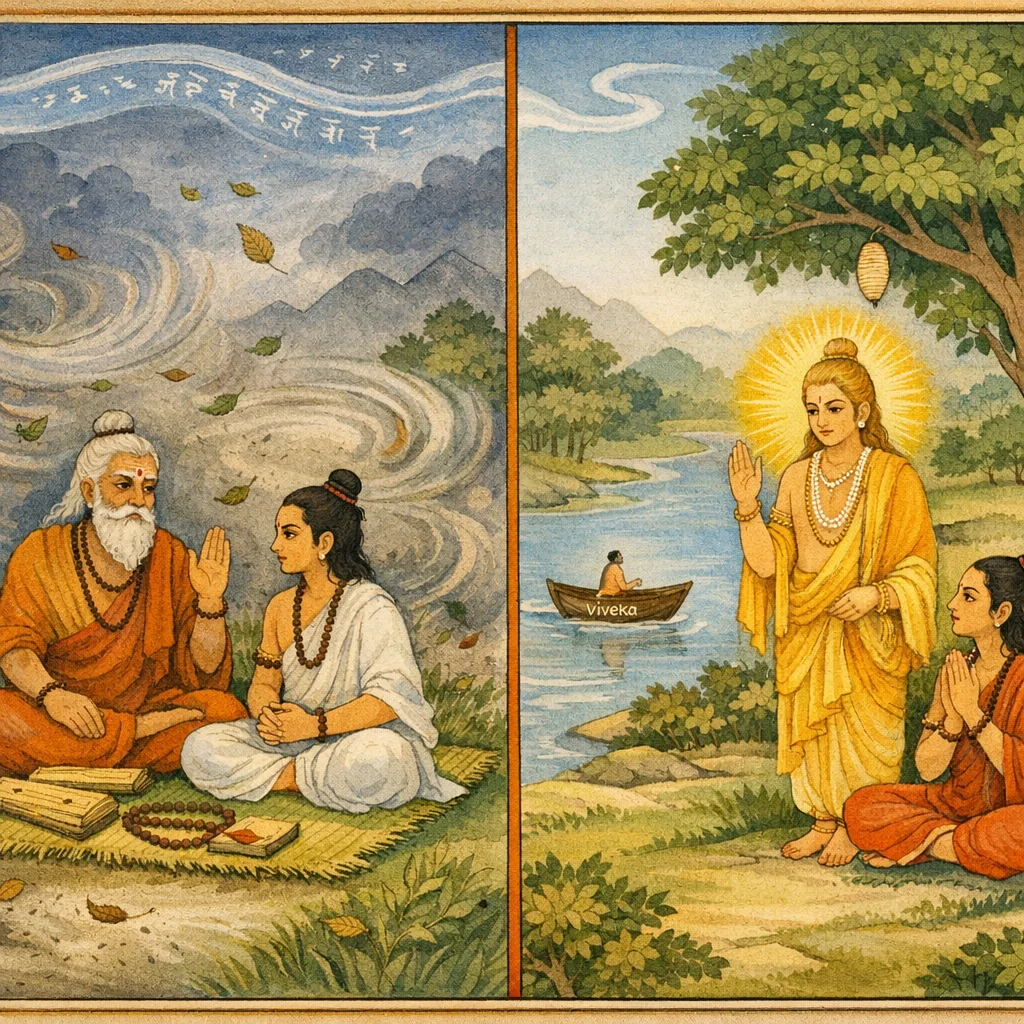
Anadhyaya and the Winds: From Vedic Recitation Protocol to Sanatkumara’s Moksha-Upadesha
Sanandana relates that Vyāsa, seated in meditation with Śuka, hears a bodiless voice urging the restoration of brahma-śabda through Vedic study. After long recitation a fierce wind rises, and Vyāsa declares anadhyāya, a suspension of Vedic recitation. When Śuka asks the wind’s source, Vyāsa explains deva-path and pitṛ-path tendencies and enumerates the winds/vital airs and their cosmic functions—forming clouds, carrying rain, aiding the rising of the luminaries, governing the life-breath, and Parivaha that drives beings toward death. He states why strong wind forbids Vedic recitation, departs to the celestial Gaṅgā, and instructs Śuka to continue svādhyāya. Śuka persists, and Sanatkumāra approaches privately; at Śuka’s request he delivers an extended mokṣa-dharma teaching: knowledge as supreme, renunciation over attachment, ethical restraints (non-injury, compassion, forgiveness), mastery of desire and anger, and metaphors of bondage such as the silkworm’s cocoon and the boat of discernment crossing a river. The chapter ends with an analysis of karma and saṃsāra and liberation through self-restraint and nivṛtti.
Shlokas
Verse 1
सनन्दन उवाच । अवतीर्णेषु विप्रेषु व्यासः पुत्रसहायवान् । तूर्ष्णीं ध्यानपरो धीमानेकांते समुपाविशत् ॥ १ ॥
Sanandana said: When the venerable Brahmins had arrived, the wise Vyāsa—accompanied by his son—sat down in a secluded place, silent and wholly absorbed in meditation.
Verse 2
तमुवाचाशरीरी वाक् व्यासं पुत्रसमन्वितम् । भो भो महर्षे वासिष्ठ ब्रह्मघोषो न वर्तते ॥ २ ॥
A bodiless voice spoke to Vyāsa, who was accompanied by his son: “O great sage, O Vāsiṣṭha! The sacred proclamation of Brahman—the true spiritual utterance—does not prevail (here).”
Verse 3
एको ध्यानपरस्तूष्णीं किमास्से चिंतयन्निव । ब्रह्मघोषैर्विरहितः पर्वतोऽयं न शोभते ॥ ३ ॥
Why do you sit here alone, silent and wholly absorbed in meditation, as though lost in thought? This mountain does not shine when it is bereft of the sounds of sacred Brahmanic recitation.
Verse 4
तस्मादधीष्व भगवन्सार्द्धं पुत्रेण धीमता । वेदान्वेदविदा चैव सुप्रसन्नमनाः सदा ॥ ४ ॥
Therefore, O venerable one, study the Vedas together with your intelligent son, and also in the company of a true knower of the Vedas—ever keeping the mind perfectly serene and joy-filled.
Verse 5
तच्छुत्वा वचनं व्यासो नभोवाणीसमीरितम् । शुकेन सह पुत्रेण वेदाभ्यासमथाकरोत् ॥ ५ ॥
Having heard those words uttered by a voice from the sky, Vyāsa then began the disciplined study and recitation of the Veda together with his son Śuka.
Verse 6
तयोरभ्यसतोरेवं बहुकालं द्विजोत्तम । वातोऽतिमात्रं प्रववौ समुद्रानिलवीजितः ॥ ६ ॥
O best of the twice-born, as those two continued their practice in this way for a long time, an exceedingly fierce wind began to blow, driven on by the ocean’s gale.
Verse 7
ततोऽनध्याय इति तं व्यासः पुत्रमवारयत् । शुको वारितमात्रस्तु कौतूहलसमन्वितः ॥ ७ ॥
Then Vyāsa checked his son, saying, “This is a time of anadhyāya—when Vedic recitation must be suspended.” But Śuka, restrained only for a moment, remained filled with curiosity.
Verse 8
अपृच्छत्पितरं तत्र कुतो वायुरभूदयम् । आख्यातुमर्हति भवान्सर्वं वायोर्विचेष्टितम् ॥ ८ ॥
There he asked his father, “From where has this Wind arisen? You are worthy to explain everything—the entire course of the Wind’s workings.”
Verse 9
शुकस्यैतद्वचः श्रुत्वा व्यासः परमविस्मितः । अनध्यायनिमित्तऽस्मिन्निदं वचनमब्रवीत् ॥ ९ ॥
Hearing these words of Śuka, Vyāsa was utterly astonished; and on this occasion of anadhyāya—the suspension of Vedic study—he spoke the following statement.
Verse 10
दिव्यं ते चक्षुरुत्पन्नं स्वस्थं ते निश्चलं मनः । तमसा रजसा चापि त्यक्तः सत्ये व्यवस्थितः ॥ १० ॥
A divine vision has arisen in you; your mind is tranquil and unwavering. Casting off tamas and rajas as well, you are established in Truth (satya).
Verse 11
तस्यात्मनि स्वयं वेदान्बुद्ध्वा समनुचिंतय । देवयानचरो विष्णोः पितृयानश्च तामसः ॥ ११ ॥
Realizing the Vedas within one’s own Self and contemplating them well, one follows the deva-path (deva-yāna) that leads to Viṣṇu; but the pitṛ-path (pitṛ-yāna) is of a tamasic, darkening and lower tendency.
Verse 12
द्वावेतौ प्रत्ययं यातौ दिवं चाधश्च गच्छतः । पृथिव्यामंतरिक्षे च यतः संयांति वायवः ॥ १२ ॥
These two have become established as the determining courses—one that goes upward to heaven and one that goes downward; from them the winds move and converge within the earth and in the mid‑region (the atmosphere).
Verse 13
सप्त ते वायुमार्गा वै तान्निबोधानुपूर्वशः । तत्र देवगणाः साध्याः समभूवन्महाबलाः ॥ १३ ॥
Indeed there are seven pathways of vāyu, the vital wind; understand them in due order. In those paths or regions, the mighty divine hosts known as the Sādhyas came into being.
Verse 14
तेषामप्यभवत्पुत्रः समानो नाम दुर्जयः । उदानस्तस्य पुत्रोऽभूव्द्यानस्तस्याभवत्सुतः ॥ १४ ॥
Even among them there was a son named Samāna, hard to conquer. His son was Udāna, and Dyāna was born as the son of Udāna.
Verse 15
अपानश्च ततो जज्ञे प्राणश्चापि ततः परम् । अनपत्योऽभवत्प्राणो दुर्द्धर्षः शत्रुमर्दनः ॥ १५ ॥
From that source Apāna was born, and thereafter Prāṇa as well. Prāṇa remained without offspring—unyielding and formidable, a crusher of enemies.
Verse 16
पृथक्क्र्म्माणि तेषां तु प्रवक्ष्यामि यथा तथा । प्राणिनां सर्वतो वायुश्चेष्टा वर्तयते पृथक् ॥ १६ ॥
Now I shall explain, in due order, the distinct functions of those (vital airs). In living beings, the all-pervading Vāyu separately sets each activity in motion.
Verse 17
प्रीणनाञ्चैव सर्वेषां प्राण इत्यभिधीयते । प्रेषयत्यभ्रसंघातान्धूमजांश्चोष्मजांस्तथा ॥ १७ ॥
Because it gladdens and sustains all beings, it is called Prāṇa. It also drives forth the masses of clouds, as well as those born of smoke and those born of heat.
Verse 18
प्रथमः प्रथमे मार्गे प्रवहो नाम सोऽनिलः । अंबरे स्नेहमात्रेभ्यस्तडिद्भ्यश्चोत्तमद्युतिः ॥ १८ ॥
In the first course of movement, the first wind is called Pravaha. In the sky, it produces the finest radiance—arising from mere moisture and from lightning.
Verse 19
आवहो नाम सोऽभ्येति द्वितीयः श्वसनो नदन् । उदयं ज्योतिषां शश्वत्सोमादीनां करोति यः ॥ १९ ॥
Next comes the second wind, called Āvaha, a roaring and rushing breath; it is he who continually brings about the rising of the luminaries—beginning with the Moon and the rest.
Verse 20
अंतर्देहेषु चोदानं यं वदंति मनीषिणः । यश्चतुर्भ्यः समुद्रेभ्यो वायुर्द्धारयते जलम् ॥ २० ॥
The wise speak of that inner impulse, udāna, moving within embodied beings; and it is that very Vāyu, the Wind, who holds and sustains the waters drawn up from the four oceans.
Verse 21
उद्धृत्य ददते चापो जीमूतेभ्यो वनेऽनिलः । योऽद्धिः संयोज्य जीमूतान्पर्जन्याय प्रयच्छती ॥ २१ ॥
In the forest, the wind lifts up the waters and gives them to the clouds; and the ocean, gathering the clouds together, delivers them to Parjanya, the rain-bearing power.
Verse 22
उद्वहो नाम बंहिष्ठस्तृतीयः स सदागतिः । संनीयमाना बहुधा येन नीला महाघनाः ॥ २२ ॥
The third wind is called Udvaha, exceedingly strong and ever-moving; by it the dark, massive rain-clouds are gathered up and driven in many directions.
Verse 23
वर्षमोक्षकृतारंभास्ते भवंति घनाघनाः । योऽसौ वहति देवानां विमानानि विहायसा ॥ २३ ॥
Those dense masses of clouds arise as the initiators of the release of rain; and that very wind, moving through the sky, carries the vimānas, the aerial chariots of the gods.
Verse 24
चतुर्थः संवहो नाम वायुः स गिरिमर्दनः । येन वेगवता रुग्णाः क्रियन्ते तरुजा रसाः ॥ २४ ॥
The fourth vital wind is called Saṃvaha, the “crusher of mountains.” By its swift force, the sap born of trees is churned and made to flow.
Verse 25
पंचमः स महावेगो विवहो नाम मारुतः । यस्मिन्परिप्लवे दिव्या वहंत्यापो विहायसा ॥ २५ ॥
The fifth is the mighty, swift wind named Vivaha; when it surges forth, the divine waters are borne along through the sky.
Verse 26
पुण्यं चाकाशगंगायास्तोयं तिष्ठति तिष्ठति । दूरात्प्रतिहतो यस्मिन्नेकरश्मिर्दिवाकरः ॥ २६ ॥
The holy water of the celestial Gaṅgā remains there—steadfast, ever remaining—at that place where even a single ray of the Sun, coming from afar, is checked and turned back.
Verse 27
योनिरंशुसहस्रस्य येन याति वसुंधराम् । यस्मादाप्यायते सोमो निधिर्दिव्योऽमृतस्य च ॥ २७ ॥
He is the source of the thousand-rayed Sun; by His power it moves on its course over the earth. From Him the Moon is nourished and waxes; He is also the divine treasure-house of amṛta, immortality.
Verse 28
षष्ठः परिवहो नाम स वायुर्जीवतां वरः । सर्वप्राणभृतां प्राणार्न्योऽतकाले निरस्यति ॥ २८ ॥
The sixth vital wind is called Parivaha; it is the foremost of airs for living beings. At the time of death, it drives out the life-breaths of all who bear prāṇa.
Verse 29
यस्य धर्मेऽनुवर्तेते मृत्युवैवस्वतावुभौ । सम्यगन्वीक्षता बुद्ध्या शांतयाऽध्यात्मनित्यया ॥ २९ ॥
He in whose dharma even Death and Vaivasvata (Yama) move in accord—because he rightly examines with a tranquil intellect ever established in the Self—makes even them subject to his righteousness.
Verse 30
ध्यानाभ्यासाभिरामाणां योऽमृतत्वाय कल्पते । यं समासाद्य वेगेन दिशामंतं प्रपेदिरे ॥ ३० ॥
He who, delighting in repeated practice of meditation, becomes fit for immortality—upon swiftly reaching Him, they attained the very limit of all directions, the supreme transcendent goal.
Verse 31
दक्षस्य दश पुत्राणां सहस्राणि प्रजापतेः । येन वृष्ट्या पराभूतस्तोयान्येन निवर्तते ॥ ३१ ॥
Of Dakṣa Prajāpati’s ten sons there were thousands. By one power the rains are overcome, and by another the waters are restrained and made to recede.
Verse 32
परीवहो नाम वरो वायुः स दुरतिक्रमः । एवमेते दितेः पुत्रा मरुतः परमाद्भुताः ॥ ३२ ॥
There is an excellent wind named Parīvaha—irresistible and hard to overcome. In the same way, these Maruts, the sons of Diti, are utterly wondrous.
Verse 33
अनारमंतः सर्वांगाः सर्वचारिणः । एतत्तु महदाश्चर्यं यदयं पर्वतोत्तमः ॥ ३३ ॥
They do not cease their activity; their limbs are complete, and they move about everywhere. Yet this is the great wonder—that this mountain is the best of mountains.
Verse 34
कंपितः सहसा तेन पवमानेन वायुना । विष्णोर्निःश्वासवातोऽयं यदा वेगसमीरितः ॥ ३४ ॥
He was suddenly shaken by that purifying wind—truly, this is the wind of Viṣṇu’s exhalation—when it is driven forth with forceful speed.
Verse 35
सहसोदीर्यते तात जगत्प्रव्यथते तदा । तस्माद्ब्रह्मविदो ब्रह्म न पठंत्यतिवायुतः ॥ ३५ ॥
When the wind suddenly rises, dear one, the world is shaken and disturbed. Therefore, knowers of Brahman do not recite the sacred Brahman-texts when the wind is excessively strong.
Verse 36
वायोर्वायुभयं ह्युक्तं ब्रह्य तत्पीडितं भवेत् । एतावदुक्त्वा वचनं पराशरसुतः प्रभुः ॥ ३६ ॥
It is indeed declared that even Vāyu, the Wind-god, has fear of Vāyu; and Brahmā too becomes afflicted by that. Having spoken only this much, the mighty son of Parāśara concluded his statement.
Verse 37
उक्त्वा पुत्रमधीष्वेति व्योमगंगामगात्तदा । ततो व्यासे गते स्नातुं शुको ब्रह्मविदां वरः ॥ ३७ ॥
Having said to his son, “Study this!”, Vyāsa then went to the celestial Gaṅgā. After Vyāsa had departed to bathe, Śuka—the foremost among the knowers of Brahman—went to bathe as well.
Verse 38
स्वाध्यायमकरोद्ब्रह्मन्वेदवेदांगपारगः । तत्र स्वाध्यायसंसक्तं शुकं व्याससुतं मुने ॥ ३८ ॥
O Brāhmaṇa, he engaged in svādhyāya (sacred self-study) and became a master of the Vedas and the Vedāṅgas. There, O sage, he saw Śuka—the son of Vyāsa—deeply absorbed in that very svādhyāya.
Verse 39
सनत्कुमारो भगवानेकांते समुपागतः । उत्थाय सत्कृतस्तेन ब्रह्मपुत्रो हि कार्ष्णिना ॥ ३९ ॥
The blessed Sanatkumāra came to him in private; and Kārṣṇiṇā, the son of Brahmā, rose to receive him and honoured him with due reverence.
Verse 40
ततः प्रोवाच विप्रेंद्र शुकं विदां वरः । किं करोषि महाभाग व्यासपुत्र महाद्युते ॥ ४० ॥
Then the foremost among the knowers spoke to Śuka, O chief of Brahmins: “What are you doing, O greatly fortunate one—O illustrious son of Vyāsa?”
Verse 41
शुक उवाच । स्वाध्याये संप्रवृत्तोऽहं ब्रह्मपुत्राधुना स्थितः । त्वद्दर्शनमनुप्राप्तः केनापि सुकृतेन च ॥ ४१ ॥
Śuka said: “I am engaged in svādhyāya, sacred study, and at present abide as a son of Brahmā. By some meritorious deed, I have attained the blessing of your darśana.”
Verse 42
किंचित्त्वां प्रष्टुमिच्छामि तत्त्वं मोक्षार्थसाधनम् । तद्वदस्व महाभाग यथा तज्ज्ञानमाप्नुयाम् ॥ ४२ ॥
I wish to ask you something: the true tattva and the means that lead to mokṣa. O greatly fortunate one, please explain it, so that I may attain knowledge of that Reality.
Verse 43
सनत्कुमार उवाच । नास्ति विद्यासमं चक्षुर्नास्ति विद्यासमं तपः । नास्ति रागसमं दुःखं नास्ति त्यागसमं सुखम् ॥ ४३ ॥
Sanatkumāra said: “There is no eye like knowledge, and no austerity like knowledge. There is no sorrow like attachment, and no happiness like renunciation.”
Verse 44
निवृत्तिः कर्मणः पापात्सततं पुण्यशीलता । सद्वृत्तिः समुदाचारः श्रेय एतदनुत्तमम् ॥ ४४ ॥
Turning away from sinful deeds, abiding always in meritorious virtue, and maintaining noble character through proper daily conduct—this indeed is the unsurpassed path to the highest welfare.
Verse 45
मानुष्यमसुखं प्राप्य यः सज्जति स मुह्यति । नालं स दुःखमोक्षाय संगो वै दुःखलक्षणः ॥ ४५ ॥
Having obtained this human state—so hard to gain and fraught with suffering—whoever becomes attached is deluded. Such a one is unfit for release from sorrow, for attachment itself is indeed the mark of suffering.
Verse 46
सक्तस्य बुद्धर्भवति मोहजालविवर्द्धिनी । मोहजालावृतो दुःखमिहामुत्र तथाश्नुते ॥ ४६ ॥
For one who is attached, the intellect becomes a nourisher of the net of delusion; and, veiled by that web of delusion, one suffers both here in this world and hereafter.
Verse 47
सर्वोपायेन कामस्य क्रोधस्य च विनिग्रहः । कार्यः श्रेयोर्थिना तौ हि श्रेयोघातार्थमुद्यतौ ॥ ४७ ॥
By every possible means, one who seeks the highest good should restrain desire and anger, for those two are ever poised to destroy one’s welfare.
Verse 48
नित्यं क्रोधात्तपो रक्षेच्छ्रियं रक्षेञ्च मत्सरात् । विद्यां मानावमानाभ्यामात्मानं तु प्रमादतः ॥ ४८ ॥
One should always protect one’s austerity from anger; protect prosperity from envy; protect learning from both honor and dishonor; and protect oneself from heedlessness.
Verse 49
आनृशंस्यं परो धर्मः क्षमा च परमं बलम् । आत्मज्ञानं परं ज्ञानं सत्यं हि परमं हितम् ॥ ४९ ॥
Compassion is the highest dharma; forgiveness is the supreme strength. Knowledge of the Self (Ātman) is the highest knowledge; truthfulness indeed is the greatest good.
Verse 50
येन सर्वं परित्यक्तं स विद्वान्स च पंडितः । इंद्रियैरिंद्रियार्थेभ्यश्चरत्यात्मवशैरिह ॥ ५० ॥
He by whom everything has been renounced—he alone is truly learned and truly wise; here in this world he moves among sense-objects with senses that are under the control of the Self (Ātman).
Verse 51
असज्जमानः शांतात्मा निर्विकारः समाहितः । आत्मभूतैरतद्भूतः सह चैव विनैव च ॥ ५१ ॥
Not clinging to anything, peaceful in self, free from inner change, and steadily collected—he remains unattached among those who are as his own self, and likewise among those who are not; whether in company or in solitude, he is the same.
Verse 52
स विमुक्तः परं श्रेयो न चिरेणाधिगच्छति । अदर्शनमसंस्पर्शस्तथैवाभाषाणं सदा ॥ ५२ ॥
Such a one, being freed, attains the Supreme Good without delay—remaining ever without worldly seeing, without contact, and likewise always without worldly speech.
Verse 53
यस्य भूतैः सह मुने स श्रेयो विंदते महत् । न हिंस्यात्सर्वभूतानि भूतैर्मैत्रायणश्चरेत् ॥ ५३ ॥
O sage, one who lives in harmony with all beings attains the highest good. Let him not injure any creature, but move through life with friendliness toward all that lives.
Verse 54
नेदं जन्म समासाद्य वैरं कुर्वीत केन चित् । आकिंचन्यं सुसंतोषो निराशिष्ट्वमचापलम् ॥ ५४ ॥
Having attained this human birth, let one create enmity with none. Let one cultivate non-possessiveness, deep contentment, freedom from craving for fruits, and steady, unfickle firmness.
Verse 55
एतदाहुः परं श्रेय आत्मज्ञस्य जितात्मनः । परिग्रहं परित्यज्य भव तातजितेंद्रियः ॥ ५५ ॥
They declare this to be the supreme good for one who knows the Self and has conquered the mind: renounce all grasping and attachment, dear one, and become a conqueror of the senses.
Verse 56
अशोकं स्थानमातिष्ट इह चामुत्र चाभयम् । निराशिषो न शोचंति त्यजेदाशिषमात्मनः ॥ ५६ ॥
Abide in the sorrowless state—fearless both here and hereafter. Those free from expectation do not grieve; therefore renounce the personal craving for reward.
Verse 57
परित्यज्याशिषं सौम्य दुःखग्रामाद्विमोक्ष्यसे । तपरोनित्येन दांतेन मुनिना संयतात्मना ॥ ५७ ॥
O gentle one, by abandoning craving for reward you will be freed from the very “village” of sorrow. This is attained by the ever-austere sage—self-restrained, disciplined, and master of the senses.
Verse 58
अजितं जेतुकामेन भाव्यं संगेष्वसंगिना । गुणसंगेष्वेष्वनासक्त एकचर्या रतः सदा ॥ ५८ ॥
One who longs to conquer the unconquered (the mind) should remain unattached even while moving among attachments. Unclinging amid the contacts of the guṇas, ever devoted to solitary discipline, let him always abide thus.
Verse 59
ब्राह्मणो न चिरादेव सुखमायात्यनुत्तमम् । द्वंद्वारामेषु भूतेषु वराको रमते मुनिः ॥ ५९ ॥
A true brāhmaṇa soon attains unsurpassed bliss; but the pitiable one—though called a “muni”—delights among beings who sport in the play of dualities.
Verse 60
किंचिन्प्रज्ञानतृप्तोऽसौ ज्ञानतृप्तो न शोचति । शुभैर्लभेत देवत्वं व्यामिश्रैर्जन्म मानुषम् ॥ ६० ॥
One who is even somewhat content through higher discernment, and fulfilled by true knowledge, does not grieve. By pure auspicious deeds one attains the state of the devas; by mixed deeds one is born among humans.
Verse 61
अशुभैश्चाप्यधो जन्म कर्मभिर्लभतेऽवशः । तत्र मृत्युजरादुःखैः सततं समभिद्रुतम् ॥ ६१ ॥
And by inauspicious deeds one helplessly attains a lower birth; there one is continually afflicted by death, old age, and suffering.
Verse 62
संसारं पश्यते जंतुस्तत्कथं नावबुध्से । अहिते हितसंज्ञस्त्वमध्रुवे ध्रुवसंज्ञकः ॥ ६२ ॥
A living being sees this cycle of saṃsāra—so how is it that you still do not understand? You take what is harmful to be beneficial, and you call the impermanent as though it were permanent.
Verse 63
अनर्थे वार्थसंज्ञस्त्वं किमर्थं नावबुध्यसे । संवेष्ट्यमानं बहुभिर्मोहतंतुभिरात्मजैः ॥ ६३ ॥
Why do you label what is truly harmful as ‘benefit’ and fail to understand? You are being tightly wrapped by many threads of delusion—attachments born from your own self.
Verse 64
कोशकारवदात्मानं वेष्टितो नावबुध्यसे । अलं परिग्रहेणेह दोषवान् हि परिग्रहः ॥ ६४ ॥
Like a silkworm wrapped in its own cocoon, you do not recognize your own Self while encased by possessions. Enough of hoarding here—possessiveness itself is indeed full of faults.
Verse 65
कृमिर्हि कोशकारस्तु बध्यते स्वपरिग्रहात् । पुत्रदारकुटुंबेषु सक्ताः सीदंति जंतवः ॥ ६५ ॥
For the worm that spins a cocoon becomes bound by its own accumulation; likewise, living beings sink into misery when attached to sons, wife, and family.
Verse 66
सरःपंकार्णवे मग्ना जीर्णा वनगजा इव । मोहजालसमाकृष्टान्पश्यजंतून्सुदुःखितान् ॥ ६६ ॥
Behold the creatures—sunken in the lake-like ocean of mire, like aged elephants of the forest—dragged along by the net of delusion and plunged into extreme sorrow.
Verse 67
कुटुंबं पुत्रदारं च शरीरं द्रव्यसंचयम् । पारक्यमध्रुवं सर्वं किं स्वं सुकृतदुष्कृते ॥ ६७ ॥
Family, sons and wife, the body, and the accumulation of wealth—all of this is truly ‘another’s’ and impermanent. What, then, is genuinely one’s own? Only one’s merit and demerit (good and bad deeds).
Verse 68
यदा सर्वं परित्यज्य गंतव्यमवशेन वै । अनर्थे किं प्रसक्तस्त्वं स्वमर्थं नानुतिष्टसि ॥ ६८ ॥
When, indeed, one must helplessly depart—abandoning everything—why are you so attached to what is worthless? Why do you not pursue your true good?
Verse 69
अविश्रांतमनालंबमपाथेयमदैशिकम् । तमः कर्त्तारमध्वानं कथमेको गमिष्यसि ॥ ६९ ॥
How will you, all alone, travel a road that grants no respite, offers no support, provides no provisions, has no guide—and whose very maker is darkness?
Verse 70
नहि त्वां प्रस्थितं कश्चित्पृष्टतोऽनुगमिष्यति । सुकृतं दुष्कृतं च त्वां गच्छंतमनुयास्यतः ॥ ७० ॥
When you depart, no one will follow behind you. Only your good deeds and your evil deeds will accompany you as you go onward.
Verse 71
विद्या कर्म च शौर्यं च ज्ञानं च बहुविस्तरम् । अर्थार्थमनुशीर्यंते सिद्धार्थस्तु विमुच्यते ॥ ७१ ॥
Learning, ritual action, valor, and even extensively elaborated knowledge are pursued again and again for the sake of worldly gain; but the one who has attained the true goal is released from bondage.
Verse 72
निबंधिनी रज्जुरेषा या ग्रामे वसतो रतिः । छित्वैनां सुकृतो यांति नैनां छिंदंति दुष्कृतः ॥ ७२ ॥
This attachment to ‘village-life’ is a binding rope. The meritorious cut it and go beyond, but the sinful do not cut it.
Verse 73
तुल्यजातिवयोरूपान् हृतान्पस्यसि मृत्युना । न च नामास्ति निर्वेदो लोहं हि हृदयं तव ॥ ७३ ॥
You see people of the same birth, age, and beauty being carried away by Death—yet there is not even the slightest dispassion in you; truly, your heart is made of iron.
Verse 74
रूपकूलां मनः स्रोतां स्पर्शद्वीपां रसावहाम् । गंधपंकां शब्दजलां स्वर्गमार्गदुरारुहाम् ॥ ७४ ॥
The mind’s current is a stream whose banks are form; it bears islands of touch and carries taste along. It is the mire of smell and the water of sound—thus the path to heaven is hard to climb.
Verse 75
क्षमारित्रां सत्यमयीं धर्मस्थैर्यकराकराम् । त्यागवाताध्वगां शीघ्रां बुद्धिनावं नदीं तरेत् ॥ ७५ ॥
With the boat of discernment—its rudder forgiveness, its very substance truth, and its strength the firm upholding of dharma—driven swiftly by the wind of renunciation, one should cross the river of saṃsāra.
Verse 76
त्यक्त्वा धर्ममधर्मं च ह्युभे सत्यानृते त्यज । त्यज धर्ममसंकल्पादधर्मं चाप्यहिंसया ॥ ७६ ॥
Having abandoned both dharma and adharma, relinquish even the pair of truth and untruth. Renounce ‘dharma’ through freedom from intention (non-volitional action), and abandon ‘adharma’ through ahiṃsā, non-violence.
Verse 77
उभे सत्यानृते बुद्धिं परमनिश्चयात् । अस्थिस्थूणं स्नायुयुतं मांसशोणितलेपनम् ॥ ७७ ॥
With firm and highest certainty, regard both truth and untruth alike as mere notions of the mind. This body is only a pillar of bones, bound with sinews, plastered over with flesh and blood.
Verse 78
धर्मावनद्धं दुर्गंधिं पूर्णं मूत्रपुरीषयोः । जराशोकसमाविष्टं रोगायतनमस्थिरम् ॥ ७८ ॥
This body, bound by the notion of dharma, is foul-smelling, filled with urine and feces; engulfed by old age and sorrow, it is a dwelling-place of disease and is unstable.
Verse 79
रजस्वलमनित्यं च भूतावासं समुत्सृज । इदं विश्वं जगत्सर्वमजगञ्चापि यद्भवेत् ॥ ७९ ॥
Abandon this dwelling of beings, stained by rajas and impermanent. For this whole universe—the entire world—whatever comes to be is, in truth, not the real and enduring world.
Verse 80
महाभूतात्मकं सर्वमस्माद्यत्परमाणुमत् । इंद्रियाणि च पंचैव तमः सत्त्वं रजस्तथा ॥ ८० ॥
All this is made of the great elements (mahābhūtas), from the gross level down to the atomic. And there are also the five sense-faculties, as well as tamas, sattva, and rajas.
Verse 81
इत्येष सप्तदशको राशिख्यक्तसंज्ञकः । सर्वैरिहेंद्रियार्थैश्च व्यक्ताव्यक्तैर्हि हितम् ॥ ८१ ॥
Thus, this seventeenfold aggregate is called “the collection known as the manifest (vyakta).” It is formed here from all the objects of the senses, and indeed serves as the basis for understanding both the manifest and the unmanifest (avyakta).
Verse 82
पंचविंशक इत्येष व्यक्ताव्यक्तमयो गणः । एतैः सर्वैः समायुक्तमनित्यमभिधीयते ॥ ८२ ॥
This group, consisting of the manifest and the unmanifest, is called “the twenty-five.” Whatever is compounded of all these is declared to be impermanent.
Verse 83
त्रिवर्गोऽत्र सुखं दुःख जीवितं मरणं तथा । य इदं वेद तत्त्वेन सस वेद प्रभवाप्ययौ ॥ ८३ ॥
Here are found the trivarga—the three aims of life—along with happiness and sorrow, and likewise life and death. Whoever knows this in its true essence, he indeed knows the arising and dissolution of all things.
Verse 84
इन्द्रियैर्गृह्यते यद्यत्तद्व्यक्तमभिधीयते । अव्यक्तमथ तज्ज्ञेयं लिंगग्राह्यमतींद्रियम् ॥ ८४ ॥
Whatever is grasped by the sense-organs is called the manifest (vyakta). But what is to be known as the unmanifest (avyakta) lies beyond the senses and is apprehended only through its indicative marks (liṅga).
Verse 85
इन्द्रियैर्नियतैर्देही धाराभिरिव तर्प्यते । लोके विहितमात्मानं लोकं चात्मनि पश्यति ॥ ८५ ॥
When the senses are restrained, the embodied being is satisfied, as though refreshed by steady streams. He then beholds the Self established in the world, and the world reflected within the Self.
Verse 86
परावरदृशः शक्तिर्ज्ञानवेलां न पश्यति । पश्यतः सर्वभूतानि सर्वावस्थासु सर्वदा ॥ ८६ ॥
The Power that beholds both the higher and the lower does not notice any “moment of knowing.” For that Seer, all beings are ever seen, in every condition, at all times.
Verse 87
ब्रह्मभूतस्य संयोगो नाशुभेनोपपद्यते । ज्ञानेन विविधात्क्लेशान्न निवृत्तिश्च देहजात् ॥ ८७ ॥
For one established in Brahman, association with the inauspicious is not possible. Yet even through knowledge there is no complete cessation of the many afflictions that arise from the body.
Verse 88
लोकबुद्धिप्रकाशेन लोकमार्गो न रिष्यति । अनादिनिधनं जंतुमात्मनि स्थितमव्ययम् ॥ ८८ ॥
By the illumination of right understanding in the world, the path of life is not ruined. One should recognize the living being as beginningless and endless—imperishable—an abiding reality within the Self.
Verse 89
अकर्तारममूढं च भगवानाह तीर्तवित् । यो जन्तुः स्वकृतैस्तैस्तैः कर्मभिर्नित्यदुःखितः ॥ ८९ ॥
The Blessed Lord, knower of the saving tīrtha, declared: “A creature is ever afflicted by sorrow through those very deeds it has itself performed—though the Self is not the doer and is not deluded.”
Verse 90
स्वदुःखप्रतिघातार्थं हंति जंतुरनेकधा । ततः कर्म समादत्ते पुनरन्यन्नवं बहु ॥ ९० ॥
To ward off his own suffering, a creature harms others in many ways; from that, he takes up karma again—many new actions once more.
Verse 91
तप्यतेऽथ पुनस्तेन भुक्त्वाऽपथ्यमिवातुरः । अजस्रमेव मोहांतो दुःखेषु सुखसंज्ञितः ॥ ९१ ॥
Then he is scorched again by that very thing—like a sick man who has eaten what is unwholesome; for the one whose end is delusion continually mistakes suffering itself to be happiness.
Verse 92
वध्यते तप्यते चैव भयवत्यर्मभिः सदा । ततो निवृत्तो बंधात्स्वात्कर्मणामुदयादिह ॥ ९२ ॥
He is struck down and tormented again and again, always by fear-laden afflictions. Yet here, he turns back from bondage when his own karmas arise to be exhausted and their effects begin to unfold.
Verse 93
परिभ्रमति संसारे चक्रवद्बाहुवर्जितः । संयमेन च संबंधान्निवृत्त्या तपसो बलात् ॥ ९३ ॥
Deprived of the “arms” of right means, one keeps wandering in saṃsāra like a wheel. But through self-restraint (saṃyama) one severs attachments; through withdrawal (nivṛtti), by the power of austerity (tapas), one gains release.
Verse 94
सम्प्राप्ता बहवः सिद्धिं अव्याबाधां सुखोदयाम् ॥ ९४ ॥
Many have attained the spiritual perfection that is unobstructed, from which true happiness arises.
Frequently Asked Questions
It frames Vedic study as a regulated śāstric discipline: recitation is not merely devotional sound but a practice governed by purity, circumstance, and prescribed interruptions. The violent wind becomes a canonical trigger for anadhyāya, and the chapter explicitly ties this to the protection of brahma-text recitation, reinforcing Vedic protocol within a Purāṇic narrative.
Vyāsa describes named winds as both cosmic movers (clouds, rain, luminaries, waters) and as vital functions within embodied beings, presenting a single governing Vāyu that differentiates into specific courses. This integrates cosmology, physiology, and ritual timing (anadhyāya) into one explanatory system.
Liberation is grounded in knowledge and renunciation: restrain desire and anger, cultivate compassion, forgiveness, truthfulness, and non-injury, and abandon possessiveness and attachment to impermanent relations and wealth. The teaching culminates in a nivṛtti-oriented path where discernment carries one across saṃsāra.