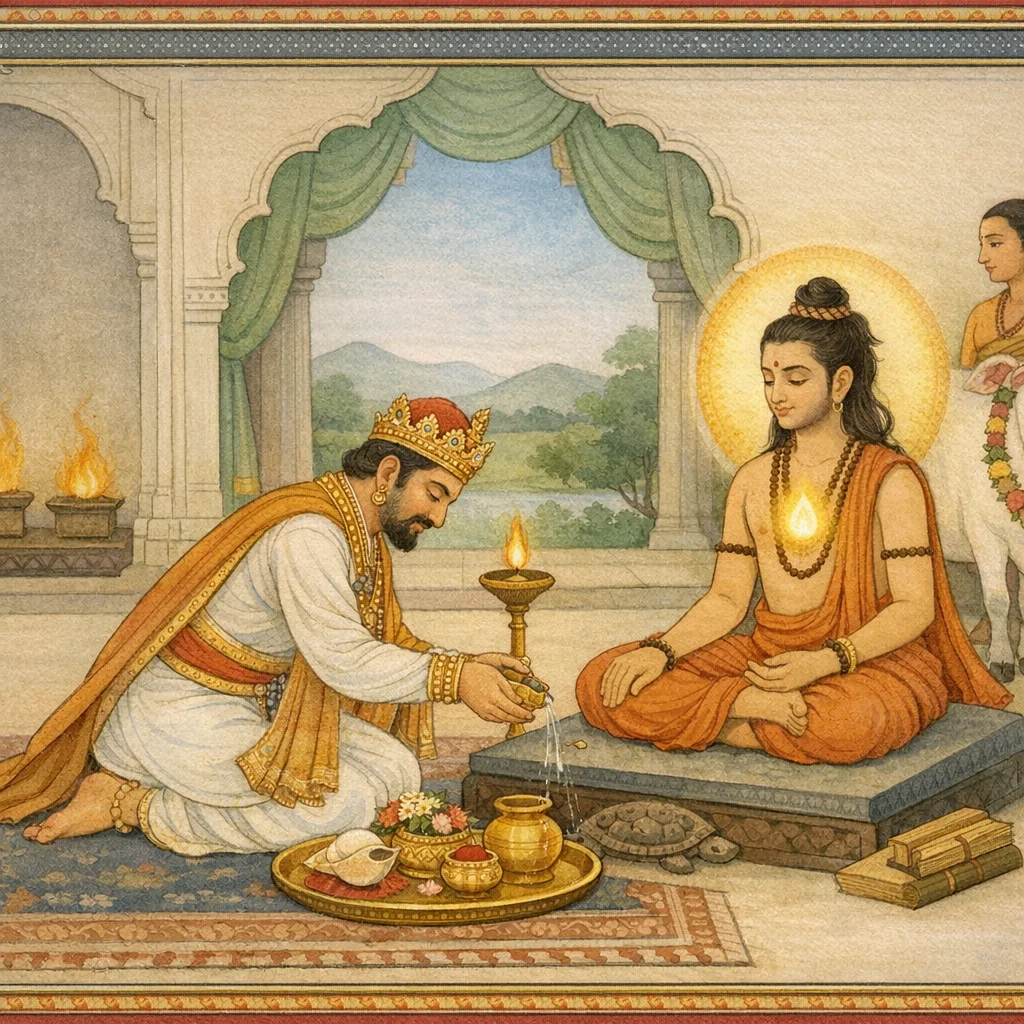
Janaka Instructs Śuka: Āśrama-Sequence, Guru-Dependence, and Marks of Liberation
Sanandana recounts a royal instruction: King Janaka honors Śuka (Vyāsa’s son) with arghya, pādya, a seat, a cow-gift, and mantra-worship, then asks his purpose. Śuka says he has come by Vyāsa’s command, seeking clarity on pravṛtti and nivṛtti, the brāhmaṇa’s duty, the nature of mokṣa, and whether liberation is gained by knowledge and/or tapas. Janaka teaches the āśrama sequence: after upanayana, brahmacarya is for Veda-study, austerity, and disciplined conduct; with guru-permission and samāvartana one enters gṛhastha, maintaining the sacred fires; then comes vānaprastha; finally the fires are internalized and one abides in brahma-āśrama, free of attachment and dualities. Pressed on guru-dependence, Janaka affirms that knowledge is the ferry and the guru enables the crossing, and that means are relinquished after attainment. The chapter notes merit across many births and the possibility of early liberation, and cites Yayāti’s mokṣa-verses on inner light, fearlessness, ahiṃsā, equanimity, sense-restraint, and purified intellect. Janaka recognizes Śuka’s established detachment; Śuka, steady in Self-vision, returns north to Vyāsa and reports the liberating dialogue, while the Vedic disciples continue transmission and ritual service.
Shlokas
Verse 1
सनन्दन उवाच । ततः स राजा सहितो मंत्रिभिर्द्विजसत्तम । पुरः पुरोहितं कृत्वा सर्वाण्यंतः पुराणि च ॥ १ ॥
Sanandana said: Then that king—accompanied by his ministers, O best of the twice-born—placing the royal priest at the fore and bringing along all the inner-palace attendants (the entire harem), proceeded onward.
Verse 2
शिरसा चार्ध्यमादाय गुरुपुत्रं समभ्यगात् । महदासनमादाय सर्वरत्नतम् ॥ २ ॥
Bearing the arghya, the respectful offering, upon his head, he approached the teacher’s son; and taking a great seat—most excellent, adorned with all gems—he presented it.
Verse 3
प्रददौ गुरुपुत्राय शुकाय परमोचितम् । तत्रोपविष्टं तं कार्ष्णिशास्त्रदृष्टेन कर्मणा ॥ ३ ॥
He bestowed upon the guru’s son, Śuka, what was supremely fitting; and when Śuka was seated there, he served him with rites prescribed in the Kāṛṣṇi-śāstra, the scripture related to Kṛṣṇa.
Verse 4
पाद्यं निवेद्य प्रथमं सार्ध्यं गां च न्यद्दे । स च तांमंत्रतः पूजां प्रतिगृह्य द्विजोत्तमः ॥ ४ ॥
First he offered water for washing the feet (pādya). Then he presented the offering (nivedya) together with a cow. The foremost among the twice-born, the brāhmaṇa, accepted that mantra-accompanied worship and was duly honored.
Verse 5
पर्यपृच्छन्महातेजाराज्ञः कुशलमव्ययम् । उदारसत्त्वाभिजनो राजापि गुरुसूनवे ॥ ५ ॥
That greatly radiant one asked the king about his undiminishing welfare; and the king too—noble in character and birth—asked after the well-being of the Guru’s son.
Verse 6
आवेद्य कुशलं भूमौ निषसाद तदाज्ञया । सोऽपि वैयासकिं भूयः पृष्ट्वा कुशलमव्ययम् । किमागमनिमित्येव पर्यपृच्छद्विधानवित् ॥ ६ ॥
After reporting that all was well, he sat down on the ground as instructed. Then the knower of proper conduct again asked Vaiyāsaki about his unfailing well-being, and inquired, “For what reason have you come?”
Verse 7
शुक उवाच । पित्राहमुक्तो भद्रं ते मोक्षधर्मार्थकोविदः । विदेहराजोह्याद्योमे जनको नाम विश्रुतः ॥ ७ ॥
Śuka said: “My father instructed me—may auspiciousness be yours—being well-versed in the meaning and principles of mokṣa-dharma. The king of Videha, renowned by the name Janaka, was my foremost exemplar.”
Verse 8
तत्र त्वं गच्छ तूर्णं वै स ते हृदयसंशयम् । प्रवृत्तौ च निवृत्तौ च सर्वं छेत्स्यत्यसंशयम् ॥ ८ ॥
Therefore go there at once; he will cut away the doubt lodged in your heart. Concerning both engagement in action (pravṛtti) and withdrawal from action (nivṛtti), he will resolve everything for you without any uncertainty.
Verse 9
सोऽहं पितुर्नियोगात्त्वा मुपप्रष्टुमिहागतः । तन्मे धर्मभृतां श्रेष्ट यथावद्वक्तुमर्हसि ॥ ९ ॥
Thus, by my father’s command, I have come here to question you. Therefore, O best among the upholders of Dharma, you should tell me the matter rightly and in due order.
Verse 10
किं कार्यं ब्राह्मणेनेह मोक्षार्थश्च किमात्मकः । कथं च मोक्षः कर्तव्यो ज्ञानेन तपसापि वा ॥ १० ॥
What, indeed, is the duty of a brāhmaṇa in this world? What is the true nature of the goal called liberation (mokṣa)? And how is liberation to be accomplished—through knowledge, or through austerity (tapas) as well?
Verse 11
जनक उवाच । यत्कार्यं ब्राह्मणेनेह जन्मप्रभृति तच्छुणु । कृतोपनयनस्तात भवेद्वेदपरायणः ॥ ११ ॥
Janaka said: Hear what a brāhmaṇa should do here, beginning from birth. Dear one, having undergone the upanayana rite, he should become devoted to the study and recitation of the Veda.
Verse 12
तपसा गुरुवृत्त्या च ब्रह्मचर्येण चान्वितः । देवतानां पितॄणां च ह्यतृष्णश्चानसूयकः ॥ १२ ॥
Endowed with austerity (tapas), with conduct befitting one’s teacher, and with the discipline of brahmacarya, he remains free from craving for the gods and the ancestors, and is without envy or fault-finding.
Verse 13
वेदानधीत्य नियतो दक्षिणामपवर्त्य च । अभ्यनुज्ञामनुप्राप्य समावर्तेत वै द्विजः ॥ १३ ॥
Having duly studied the Vedas with discipline, and having duly offered the teacher’s fee (dakṣiṇā), the twice-born should, upon receiving the teacher’s permission, perform the rite of completion (samāvartana) and return to household life.
Verse 14
समावृत्तस्तु गार्हस्थ्ये सदारो नियतो वसेत् । अनसूयुर्यथान्यायमाहिताग्निरनादृते ॥ १४ ॥
But after completing his student life, one should dwell in the householder āśrama—married, disciplined, free from envy—maintaining the sacred fires according to rule and showing disrespect to none.
Verse 15
उत्पाद्य पुत्रपौत्रांश्च वन्याश्रमपदे वसेत् । तानेवाग्नीन्यथान्यायं पूजयन्नतिथिप्रियः ॥ १५ ॥
Having begotten sons and grandsons, one should dwell in the forest āśrama (vānaprastha). Delighting in the reception of guests, he should duly honor those very sacred fires according to proper rule.
Verse 16
सर्वानग्नीन्यथान्यायमात्मन्यारोप्य धर्मवित् । निर्द्वंद्वो वीतरागात्मा ब्रह्माश्रमपदे वसेत् ॥ १६ ॥
Knowing dharma, one should, in the prescribed manner, internalize all the sacred fires within oneself; then, free from the pairs of opposites and with the self devoid of attachment, one should dwell in the state of the Brahma-āśrama.
Verse 17
शुक उवाच । उत्पन्ने ज्ञानविज्ञाने प्रत्यक्षे हृदि शश्वते । न विना गुरुसंवासाज्ज्ञानस्याधिगमः स्मृतः ॥ १७ ॥
Śuka said: Even when knowledge and realized discernment arise—directly manifest within the heart and enduring—still it is remembered that true attainment of knowledge does not occur without close association with a Guru.
Verse 18
किमवश्यं तु वस्तव्यमाश्रमेषु न वा नृप । एतद्भवंतं पृच्छामि तद्भवान्वक्तुमर्हति ॥ १८ ॥
O king, what is it that must inevitably be lived out—within the stages of life (āśramas) or outside them? I ask you this; you are worthy to explain it.
Verse 19
जनक उवाच । न विना ज्ञानविज्ञाने मोक्षस्याधिगमो भवेत् । न विना गुरुसंबधाज्ज्ञानस्याधिगमस्तथा ॥ १९ ॥
Janaka said: Without knowledge and realized understanding, liberation (mokṣa) cannot be attained. Likewise, without a relationship with the Guru, true knowledge cannot be attained either.
Verse 20
आचार्यः प्लाविता तस्य ज्ञानं प्लव इहोच्यते । विज्ञाय कृतकृत्यस्तु तीर्णस्तत्रोभयं त्यजेत् ॥ २० ॥
For him, the teacher (ācārya) is the one who causes him to cross, and knowledge is here called the ferry-boat. Having realized the truth and become one who has accomplished what is to be accomplished, once he has crossed, he should relinquish both (the teacher as a means and the knowledge as a means).
Verse 21
अनुच्छेदाय लोकानामनुच्छेदाय कर्मणाम् । कृत्वा शुभाशुभं कर्म मोक्षो नामेह लभ्यते ॥ २१ ॥
For the continuity of worlds and for the continuity of action itself (karma), one performs deeds—both auspicious and inauspicious; and thus what is called ‘liberation’ is obtained here, in this very life.
Verse 22
भावितैः कारणैश्चार्यं बहुसंसारयोनिषु । आसादयति शुद्धात्मा मोक्षं हि प्रथमाश्रमे ॥ २२ ॥
O revered one, by well-cultivated causes (right disciplines) accumulated across many births in the cycle of saṁsāra, a purified soul indeed attains liberation—even in the very first stage of life.
Verse 23
तमासाद्य तु मुक्तस्य दृष्टार्थस्य विपश्चितः । त्रिधाश्रमेषु कोन्वर्थो भवेत्परमभीप्सतः ॥ २३ ॥
But for the wise one who has reached That—liberated and whose purpose is already fulfilled—for one who seeks the Supreme above all, what meaningful aim could remain in the three āśramas?
Verse 24
राजसांस्तामसांश्चैव नित्यं दोषान्विसर्जयेत । सात्त्विकं मार्गमास्थाय पश्येदात्मानमात्मना ॥ २४ ॥
One should ever cast away the faults born of rajas and tamas; taking refuge in the sāttvika path, one should behold the Self by the Self.
Verse 25
सर्वभूतेषु चात्मानं सर्वभूतानि चात्मनि । संपश्यन्नैव लिप्येत जले वारिचरगो यथा ॥ २५ ॥
Seeing the Self in all beings, and all beings within the Self, one is not tainted, just as a water-bird moves in water yet is not wetted by it.
Verse 26
पक्षीवत्पवनाद्वर्ध्वममुत्रानुंत्यश्नुते । विहाय देहं निर्मुक्तो निर्द्वंद्वः शुभसंगतः ॥ २६ ॥
Like a bird rising upward on the wind, he ascends and hereafter attains that higher state. Casting off the body, fully released, free from all pairs of opposites, and united with the auspicious and holy, he reaches fulfillment.
Verse 27
अत्र गाथाः पुरा गीताः श्रृणु राज्ञा ययातिना । धार्यते या द्विजैस्तात मोक्षशास्त्रविशारदैः ॥ २७ ॥
Now listen, dear one, to the ancient verses once sung by King Yayāti—verses preserved and recited by learned brāhmaṇas well-versed in the scriptures of liberation (mokṣa).
Verse 28
ज्योतिश्चात्मनि नान्यत्र रत्नं तत्रैव चैव तत् । स्वयं च शक्यं तद्द्रष्टुं सुसमाहितर्चतसा ॥ २८ ॥
The Light is within the Self and nowhere else; that jewel is there alone. And one can behold it for oneself—by worshiping with a perfectly gathered, concentrated mind.
Verse 29
न बिभेति परो यस्मान्न बिभेति पराच्च यः । यश्च नेच्छति न द्वेष्टि ब्रह्म संपद्यते स तु ॥ २९ ॥
He whom others do not fear, and who fears none; who neither desires nor hates—such a one truly attains Brahman.
Verse 30
यदा भावं न कुरुते सर्वभूतेषु पापकम् । पूर्वैराचरितो धर्मश्चतुराश्रमसंज्ञकः ॥ ३० ॥
When one harbors no sinful intent toward any living being, that is the Dharma practiced by the ancients—known as the discipline of the four āśramas.
Verse 31
अनेन क्रमयोगेन बहुजातिसुकर्मणाम् । कर्मणा मनसा वाचा ब्रह्म संपद्यते तदा ॥ ३१ ॥
By this step-by-step discipline (krama-yoga), through the meritorious deeds gathered over many births—by action, by mind, and by speech—one then attains Brahman.
Verse 32
संयोज्य तपसात्मानमीर्ष्यामुत्सृज्य मोहिनीम् । त्यक्त्वा कामं च लोभं च ततो ब्रह्मत्वमश्नुते ॥ ३२ ॥
Disciplining the self through austerity (tapas), casting away jealousy that deludes the mind, and abandoning desire and greed—thereafter one attains the state of Brahman.
Verse 33
यदा श्राव्ये च दृश्ये च सर्वभूतेषु चाव्ययम् । समो भवति निर्द्वुद्वो ब्रह्म संपद्यते तदा ॥ ३३ ॥
When one becomes even-minded—free from all dualities—toward what is heard and what is seen, and toward the Imperishable present in all beings, then one attains Brahman.
Verse 34
यदा स्तुति च र्निदां च समत्वेन च पश्यति । कांचनं चाऽयसं चैव सुखदुःखे तथैव च ॥ ३४ ॥
When one beholds praise and blame with equal vision, and likewise sees gold and iron—and pleasure and pain—as the same, then one abides in true equanimity.
Verse 35
शीतमुष्णं तथैवार्थमनंर्थं प्रियमप्रियम् । जीवितं मरणं चैव ब्रह्म संपद्यते तदा ॥ ३५ ॥
Then cold and heat, gain and loss, the pleasant and the unpleasant, and even life and death—all are realized as Brahman.
Verse 36
प्रसार्येह यथांगानि कूर्मः संहरते पुनः । तर्थेद्रियाणि मनसा संयंतव्यानि भिक्षुणा ॥ ३६ ॥
Just as a tortoise, having extended its limbs, draws them back again, so too should a mendicant restrain the senses by means of the mind.
Verse 37
तमः परिगतं वेश्य यथा दीपेन दृश्यते । तथा बुद्धिप्रदीपेन शक्य आत्मा निरीक्षितुम् ॥ ३७ ॥
Just as an object enveloped in darkness becomes visible by a lamp, so too the Self can be discerned by the lamp of purified intellect.
Verse 38
एतत्सर्वं प्रपश्यामि त्वयि बुद्धिमतांवर । यञ्चान्यदपि वेत्तव्यं तत्त्वतो वेत्ति तद्भवान् ॥ ३८ ॥
O best among the wise, I see all this in you; and whatever else is yet to be known—your reverence knows that too, in its true reality.
Verse 39
ब्रह्मर्षे विदितश्वासि विषयांतमुपागतः । गुरोश्चैव प्रसादेन तव चैवोपशिक्षया ॥ ३९ ॥
O Brahmarṣi, you are indeed known as accomplished; you have reached the final limit of sense-objects—through your guru’s grace and through your own disciplined training and instruction.
Verse 40
तस्य चैव प्रसादेन प्रादुर्भूतं महामुनेः । ज्ञानं दिव्यं समादीप्तं तेनासि विदितो विदितो मम ॥ ४० ॥
By his grace alone, O great sage, radiant divine knowledge has manifested. Through that, you have become fully known to me—indeed, well known to me.
Verse 41
अर्धिकं तव विज्ञानमधि कावगतिस्तव । अधिकं च तवैश्वर्यं तञ्च त्वं नावबुध्यसे ॥ ४१ ॥
Your learning is only partial; your grasp of poetry is likewise limited. Your lordly power (aiśvarya) is greater still—yet even that, you do not truly understand.
Verse 42
बाल्याद्वा संशयाद्वापि भयाद्वापि विमेषजात् । उत्पन्ने चापि विज्ञा ने नाधिगच्छंति तांगतिम् ॥ ४२ ॥
Whether due to immaturity, doubt, fear, or even a moment’s lapse—though knowledge may arise, they still do not attain that supreme state.
Verse 43
व्यवसायेन शुद्धेन मद्विधैश्छिन्नसंशयाः । विमुच्य हृदयग्रंथीनार्तिमासादयंति ताम् ॥ ४३ ॥
With purified, resolute effort, people like me—whose doubts have been cut off—loosen the knots of the heart and thereby reach that state where all anguish is ended.
Verse 44
मवांश्चोत्पन्नविज्ञानः स्थिरबगुद्धिरलोलुपः । व्यवसायादृते ब्रह्यन्नासादयति तत्पदम् ॥ ४४ ॥
O Brahman, even one who has gained discernment, whose intellect is steady and who is free from greed, does not attain that supreme state without determined effort (vyavasāya).
Verse 45
नास्ति ते सुखदुःखेषु विशेषो नास्ति वस्तुषु । नौत्सुक्यं नृत्यगीतेषु न राग उपजायते ॥ ४५ ॥
For you there is no distinction between pleasure and pain, and no special valuation of objects. You feel no excitement for dance and song, and no attachment arises within you.
Verse 46
न बंधुषु निबंधस्ते न भयेष्वस्ति ते भयम् । पश्यामित्वां महाभाग तुल्यनिंदात्मसंस्तुतिम् ॥ ४६ ॥
You have no entanglement even with relatives, and amid fearful situations you have no fear. O greatly fortunate one, I see you as one who regards blame and self-praise as equal.
Verse 47
अहं च त्वानुपश्यामि ये चान्येऽपि मनीषिणः । आस्थितं परमं मार्गे अक्षयं चाप्यनामयम् ॥ ४७ ॥
I too behold you—and so do the other wise seers—steadfast on the supreme path, a way that is imperishable and free from affliction.
Verse 48
यत्फलं ब्राह्मणस्येह मोक्षार्थश्चापदात्मकः । तस्मिन्वै वर्तसे विप्रकिमन्यत्परिपृच्छसि ॥ ४८ ॥
That very fruit which a brāhmaṇa seeks here—aimed at liberation and grounded in the way of spiritual discipline—you are already engaged in, O learned one. What else, then, do you wish to ask?
Verse 49
सनंदन उवाच । एतच्छ्रुत्वा तु वचनं कतात्मा कृतनिश्चयः । आत्मनात्मानमास्थाय दृष्ट्वा चात्मानमात्मना ॥ ४९ ॥
Sanandana said: Having heard these words, he became self-possessed and firm in resolve; established in the Self (Ātman), he beheld the Self by the Self.
Verse 50
कृतकार्यः सुखी शांतस्तूष्णीं प्रायादुदङ्मुखः । शैशिरं गिरिमासाद्य पाराशर्यं ददर्श च ॥ ५० ॥
Having fulfilled his purpose, he became content and calm; remaining silent, he set out facing north. Reaching the Śaiśira mountain, he then beheld Pārāśarya (Vyāsa).
Verse 51
शिष्यानध्यापयंतं च पैलादीन्वेदसंहिताः । आरर्णेयो विशुद्धात्मा दिवाकरसमप्रभः ॥ ५१ ॥
And he was teaching his disciples—Paila and the others—the Vedic Saṃhitās. That Ārarṇeya, pure in soul, shone with a radiance equal to the sun.
Verse 52
पितुर्जग्राह पादौ चज सादरं हृष्टमानसः । ततो निवेदयामास पितुः सर्वमुदारधीः ॥ ५२ ॥
With a joyful heart, he respectfully took hold of his father’s feet; then, being noble-minded, he reported everything in full to his father.
Verse 53
शुको जनकराजेन संवादं मोक्षसाधनम् । तच्छ्रत्वा वेदकर्तासौ प्रहृष्टेनांतरात्मना ॥ ५३ ॥
Śuka related to King Janaka the dialogue that is a means to liberation (mokṣa); hearing it, that composer of the Vedas became inwardly delighted at heart.
Verse 54
समालिंग्य सुतं व्यासः स्वपार्श्वस्थं चकार च ॥ ५४ ॥
Embracing his son, Vyāsa placed him close by his own side.
Verse 55
ततः पैलादयो विप्रा वेदान् व्यासादधीत्य च । शैलश्रृंगाद्भुवं प्राप्ता याजनाध्यापने रताः ॥ ५५ ॥
Thereafter, the brahmin sages beginning with Paila, having studied the Vedas from Vyāsa, came down from the mountain peak to the earth and devoted themselves to conducting sacrifices for others and teaching the Veda.
Frequently Asked Questions
It establishes śāstric hierarchy and epistemic legitimacy: knowledge of mokṣa is approached through proper guru-honor (arghya, pādya, mantra-pūjā, dāna). The ritual reception frames the ensuing teaching as authorized transmission rather than mere debate.
It integrates both: Janaka presents krama (stage-wise discipline) and acknowledges action’s role in sustaining worlds, yet insists mokṣa is impossible without knowledge grounded in guru-relationship; once realization is complete, the means (including conceptual supports) are relinquished.
It allows for early liberation—potentially even in the first āśrama—when purified causes from many births mature, while also teaching the normative āśrama ladder as a disciplined pathway for most aspirants.