Śuka’s Origin, Mastery of Śāstra, and Testing at Janaka’s Court
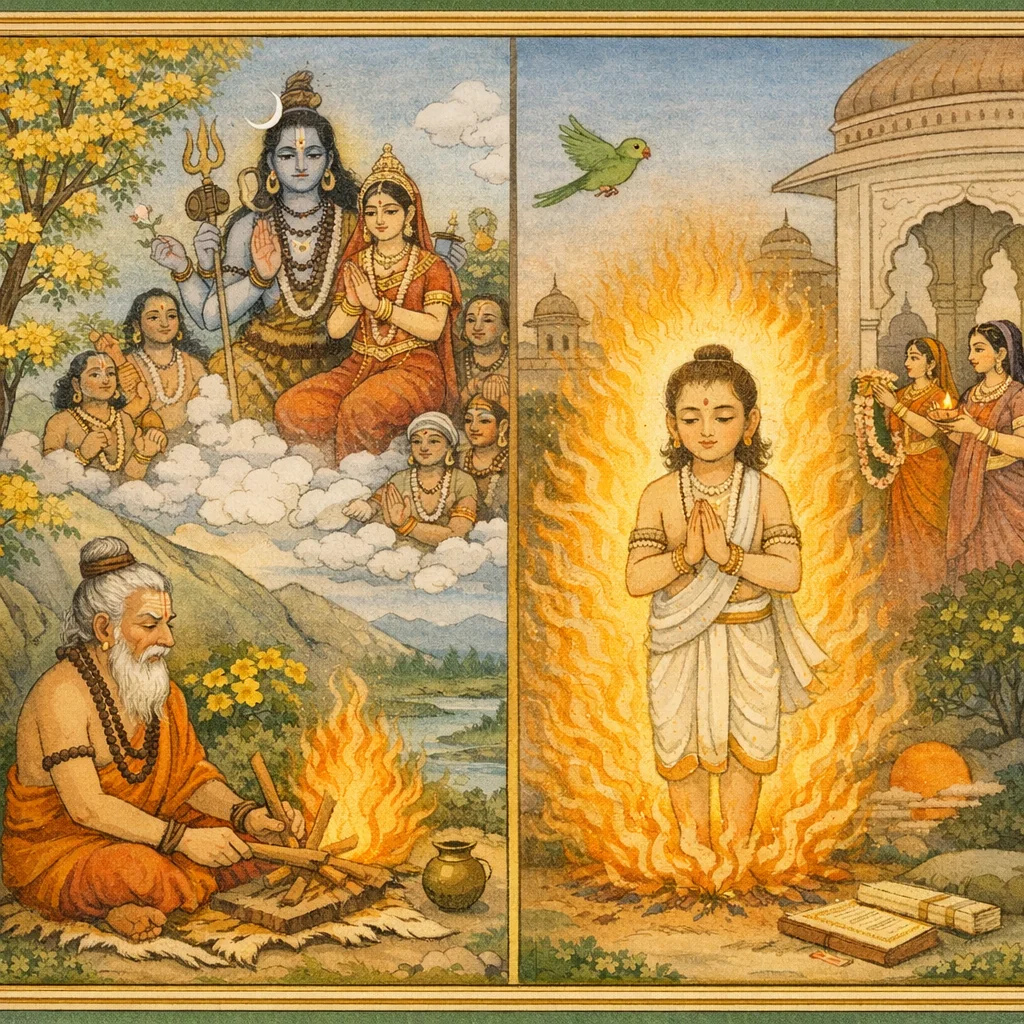
Nārada asks Sanandana to explain Śuka’s origin. Sanandana recounts Vyāsa’s austerities on Mount Meru in a karṇikāra forest, where Mahādeva Śiva appears with divine hosts and grants the boon of purity and spiritual splendor. As Vyāsa kindles fire with the araṇis, he is briefly disturbed by the apsaras Ghṛtācī, who takes a parrot form, and from that araṇi circumstance Śuka is born—radiant and already endowed with Vedic knowledge. The celestials rejoice; Śuka receives initiation and divine vision. He studies the Vedas, Vedāṅgas, Itihāsa, Yoga, and Sāṅkhya, and Vyāsa sends him to King Janaka for final clarity on mokṣa. On the way he is warned to avoid displays of power and ego. In Mithilā he is tested by palace hospitality and courtesans, yet remains absorbed in meditation, performs sandhyā, and keeps unwavering equanimity.
Shlokas
Verse 1
नारद उवाच । अनूचानप्रसंगेन वेदांगान्यखिलानि च । श्रुतानि त्वन्मुखांभोजात्समासव्यासयोगतः ॥ १ ॥
Nārada said: In the course of disciplined study, I have heard from your lotus-mouth all the Vedāṅgas in their entirety—taught both in brief and in detailed exposition.
Verse 2
शुकोत्पत्तिं समाचक्ष्व विस्तरेण महामते । सनंदन उवाच । मेरुश्रृङ्गे किल पुरा कर्णिकारवनायते ॥ २ ॥
“O great sage, explain to me in detail the origin of Śuka.” Sanandana said: “Once upon a time, on the peak of Mount Meru, there was a forest of karṇikāra trees.”
Verse 3
विजहार महोदेवो भौमैभूतगणैवृतः । शैलराजसुता चैव देवी तत्राभवत्पुरा ॥ ३ ॥
There Mahādeva sported, surrounded by the earthly hosts of beings; and in earlier times the Goddess too—daughter of the Lord of mountains—was present there.
Verse 4
तत्र दिव्यं तपस्तेपे कृष्णद्वैपायनः प्रभुः । योगेनात्मानमाविश्य योगधर्मपरायणः ॥ ४ ॥
There, the revered Kṛṣṇa-Dvaipāyana (Vyāsa) performed a sublime austerity; entering into his own Self through yoga, he remained wholly devoted to the discipline and dharma of yoga.
Verse 5
धारयन्स तपस्तेपे पुत्रार्थं सुनिसंत्तमः । अग्नेर्भूमेस्तथा वायोरंतरिक्षस्य चाभितः ॥ ५ ॥
Enduring his vow, that most excellent man performed austerities for the sake of obtaining a son—propitiating Agni (fire), Bhūmi (earth), Vāyu (wind), and the region of Antarikṣa (mid-space) on all sides.
Verse 6
वीर्येण संमतः पुत्रो मम भूयादिति स्म ह । संकल्पेनाथ सोऽनेन दुष्प्रापमकगृतात्मभिः ॥ ६ ॥
“Let there be for me a son approved by valor,”—so he declared. And by that very saṅkalpa, he attained what is hard to gain for those who have not disciplined themselves.
Verse 7
वरयामास देवेशमास्थितस्तप उत्तमम् । अतिष्टन्मारुताहारः शतं किल समाः प्रभुः ॥ ७ ॥
Having undertaken the highest tapas, he sought the Lord of the gods. Living on air alone as his sustenance, that mighty one is said to have endured so for a full hundred years.
Verse 8
आराधयन्महादेवं बहुरूपमुमापतिम् । तत्र ब्रह्मर्षयश्चैव सर्वे देवर्षयस्तथा ॥ ८ ॥
They worshipped Mahādeva—Umā’s lord—who manifests in many forms; and there, all the Brahmarṣis as well as all the Devarṣis were present too.
Verse 9
लोकपालाश्च साध्याश्च वसुभिश्चाष्टभिः सह । आदित्याश्चैव रुद्राश्च दिवाकरनिशाकरौ ॥ ९ ॥
There were the Lokapālas, guardians of the worlds, and the Sādhyas together with the eight Vasus; likewise the Ādityas and the Rudras—and also the Sun and the Moon.
Verse 10
विश्वा वसुश्च गंधर्वः सिद्धाश्चाप्सरासांगणाः । तत्र रुद्रो महादेवः कर्णिकारमयीं शुभाम् ॥ १० ॥
There were the Viśvas, the Vasus, the Gandharvas, the Siddhas, and hosts of Apsarases. There, Rudra—Mahādeva—shone in an auspicious splendor, as though formed of karṇikāra blossoms.
Verse 11
धारयानः स्रजं भाति शारदीव निशाकरः । तस्निन् दिव्ये वने रम्ये देवदेवर्षिसंकुले ॥ ११ ॥
Wearing a garland, he shone like the autumn moon. In that divine and delightful forest, thronged with gods and heavenly seers, he appeared in radiant splendor.
Verse 12
आस्थितः परमं योगं व्यासः पुत्रार्थमुद्यतः । न चास्य हीयते वर्णो न ग्लानिरुपजायते ॥ १२ ॥
Vyāsa, intent on gaining a son, undertook the supreme discipline of Yoga; yet his bodily radiance did not wane, nor did weariness arise.
Verse 13
त्रयाणामपिलोकानां तदद्भुतमिवाभवत् । जटाश्च तेजसा तस्य वैश्वानरशिखोपमाः ॥ १३ ॥
To all the three worlds it seemed a marvel; and his matted locks (jaṭā), by the power of his radiance, appeared like the blazing flames of the cosmic fire Vaiśvānara.
Verse 14
प्रज्वलंत्यः स्म दृश्यंते युक्तस्यामिततेजसः । एवं विधेन तपसा तस्य भक्त्या च नारद ॥ १४ ॥
Flaming radiances are indeed seen around that disciplined one of immeasurable splendor. Thus, O Nārada, by such tapas (austerity) and by bhakti to Him, this divine brilliance arises.
Verse 15
महेश्वरः प्रसन्नात्मा चकार मनसा मतिम् । उवाच चैनं भगवांस्त्र्यंबकः प्रहसन्निव ॥ १५ ॥
Maheshvara, serene at heart, formed a resolve within his mind; and the Blessed Tryambaka spoke to him, as if smiling.
Verse 16
यथा ह्यग्नियथा वायुर्यथा भूमिर्यथा जलम् । यथा खे च तथा शुद्धो भविष्यति सुतस्तंव ॥ १६ ॥
As fire is pure, as the wind is, as the earth is, as water is—and as the sky too is—so likewise your son will become pure.
Verse 17
तद्भावभागी तद्बुद्धिस्तदात्मा तदुपाश्रयः । तेजसा तस्य लोकांस्त्रीन्यशः प्राप्स्यति केवलम् ॥ १७ ॥
Sharing in His very state of being—his mind fixed on Him, his self identified with Him, and taking refuge in Him alone—by the power of that Lord’s radiance he attains the three worlds and undivided glory.
Verse 18
एवं लब्ध्वा वरं देवो व्यासः सत्यवतीसुतः । अरणिं त्वथ संगृह्य ममंथाग्निचिकीर्षया ॥ १८ ॥
Thus, having obtained the boon, the divine Vyāsa, son of Satyavatī, then gathered the fire-sticks (araṇis) and churned them, desiring to kindle the sacred fire.
Verse 19
अथ रूपं परं विप्र बिभ्रतीं स्वेन तेजसा । घृताचीं नामाप्सरसं ददर्श भगवान्नृषिः ॥ १९ ॥
Then, O brāhmaṇa, the blessed sage beheld the apsaras named Ghṛtācī, bearing a supreme beauty and shining with her own radiance.
Verse 20
स तामप्सरसं दृष्ट्वा सहसा काममोहितः । अभवद्भगवान्व्यासो वने तस्मिन्मुनीश्वर ॥ २० ॥
Seeing that apsaras, the venerable sage Vyāsa, in that forest, was suddenly overcome and deluded by desire, O lord among sages.
Verse 21
सा तु कृत्वा तदा व्यासं कामसंविग्नमानसम् । शुकीभूया महारम्या घृताची समुपागमत् ॥ २१ ॥
Then she, having stirred Vyāsa’s mind with desire, transformed into a most lovely female parrot; and the exceedingly charming apsaras Ghṛtācī drew near to him.
Verse 22
स तामप्सरसं दृष्ट्वा रूपेणान्येनसंवृताम् । स्मरराजेनानुगतः सर्वगात्रातिगेन ह ॥ २२ ॥
Seeing that apsaras, concealed in another form, he was pursued by Kāma, the king of desire (Smara), who swiftly pervaded all his limbs.
Verse 23
स तु महता निगृह्णन् हृच्छयं मुनिः । न शशाक नियंतुं तं व्यासः प्रविसृतं मनः ॥ २३ ॥
But that sage, though strongly restraining the heart’s impulse, could not master it—Vyāsa was unable to rein in the mind that had surged forth and wandered outward.
Verse 24
भावित्वाञ्चैव भाव्यस्य घृताच्या वपुषा । हृतम् यत्नान्नियच्छतश्चापि मुने एतञ्चिकीर्षया ॥ २४ ॥
O sage, even when one strives to restrain the mind with the intent of such spiritual practice, the mind—projecting what is yet to come—is carried away by Ghṛtācī’s alluring form, sweet as ghṛta, that is, by the pleasures of the senses.
Verse 25
अरण्यामेव सहसा तस्य शुक्रमवापतत् । शुक्रे निर्मथ्यमानेऽस्यां शुको जज्ञे महातपाः ॥ २५ ॥
Suddenly, right there in the forest, his semen fell. When that semen was, as it were, churned in that very place, the great ascetic Śuka was born.
Verse 26
परमर्षिर्महायोगी अरणीगर्भसंभवः । यथैव हि समिद्धोऽग्निर्भाति हव्यमुपात्तवान् ॥ २६ ॥
That supreme seer, the great yogin—born from the womb of the fire-drill (araṇi)—shone forth, even as a well-kindled fire blazes when it has received the sacrificial oblation (hāvya).
Verse 27
तथा रूपः शुको जज्ञे प्रज्वलन्निव तेजसा । बिभ्रञ्चित्रं च विप्रेंद्र रूपवर्णमनुत्तमम् ॥ २७ ॥
In that very form Śuka was born—blazing, as it were, with tejas, with splendor; and, O best of brahmins, he bore a wondrous, unsurpassed beauty and complexion.
Verse 28
तं गंगां सरितां श्रेष्ठां मेरुपृष्ठे स्वरूपिणीम् । अभ्येत्य स्नापयामास वारिणा स्वेन नारद ॥ २८ ॥
Approaching Gaṅgā—the foremost of rivers—who was manifest in her own form upon the back of Mount Meru, Nārada bathed her with his own water.
Verse 29
कृष्णाजिनं चांतरिक्षाच्छुकार्थे भुव्यवापतत् । जगीयंत च गंधर्वा ननृतुञ्चाप्सरोगणाः ॥ २९ ॥
And for Śuka a black antelope-skin (kṛṣṇājina) fell from the sky onto the earth. The Gandharvas began to sing, and the hosts of Apsarases danced.
Verse 30
देवदुन्दुभयश्चैव प्रावाद्यंत महास्वनाः । विश्वावसुश्च गंधर्वस्तथा तुंबुरुनारदौ ॥ ३० ॥
And the divine kettledrums (devadundubhi) resounded with a mighty roar. The Gandharva Viśvāvasu, as well as Tumburu and Nārada too, began their celestial music and praise.
Verse 31
हाहाहूहूश्च गंधर्वौ तुष्टुवुः शुकसंभवम् । तत्र शक्रपुरोगाश्च लोकपालाः समागताः ॥ ३१ ॥
The two Gandharvas, Hāhā and Hūhū, praised Śuka, the son of Vyāsa; and there too the guardians of the worlds—led by Śakra (Indra)—assembled.
Verse 32
देवा देवर्षथयश्चटैव तथा ब्रह्मर्षयोऽपि च । दिव्यानि सर्वपुष्पाणि प्रववर्ष च मारुतः ॥ ३२ ॥
The gods, the divine seers, and likewise the Brahma-seers as well—then the Wind-god showered down all kinds of celestial flowers.
Verse 33
जंगमं स्थावरं चैव प्रहृष्टमभवज्जगत् । तं महात्मा स्वयं प्रीत्या देव्या सह महाद्युतिः ॥ ३३ ॥
The whole world—both the moving and the unmoving—became filled with joy. That great-souled, radiant one himself, out of affection, approached and honored him together with the Goddess.
Verse 34
जातमात्रं मुनेः पुत्रं विधिनोपानयत्तदा । तस्य देवेश्वरः शक्तो दिव्यमद्भुतदर्शनम् ॥ ३४ ॥
At that very time, the sage’s son—though newly born—was duly invested with the sacred upanayana initiation. And the Lord of the gods, fully able, granted him a divine and wondrous vision.
Verse 35
ददौ कमंडलुं प्रीत्या देवा वासांसि चाभितः । हंसाश्च शतपत्राश्च सारसाश्च सहस्रशः ॥ ३५ ॥
Pleased at heart, he lovingly presented a kamaṇḍalu (water-pot); and the gods all around offered garments. And in their thousands came swans, śatapatra-birds, and sārasas (cranes).
Verse 36
प्रदक्षिणमवर्तंत शुकाश्चाषाश्च नारद । आरणे यस्तदा दिव्यं प्राप्य जन्म महामुनिः ॥ ३६ ॥
O Nārada, parrots and mynas began to circumambulate to the right in reverence; and the great sage—having then attained a divine birth in the forest—appeared there.
Verse 37
तत्रैवोवास मेधावी व्रतचारी समाहितः । उत्पन्नमात्रं तं वेदाः सरहस्याः ससंग्रहाः ॥ ३७ ॥
Right there he dwelt—wise, steadfast in his vows, and fully collected in mind. And as soon as he came into being, the Vedas, together with their inner secrets and their compendia, became manifest to him.
Verse 38
उपतस्थुर्मुनिश्रेष्टं यथास्य पितरं तथा । बृहस्पतिं स वव्रे च वेदवेदांगभाष्यवित् ॥ ३८ ॥
They attended upon that foremost of sages just as they would upon their own father. And he, being a knower of the commentarial teachings of the Veda and the Vedāṅgas, chose Bṛhaspati as his preceptor.
Verse 39
उपाध्यायं द्विजश्रेष्ट धर्ममेवानुचिंतयन् । सोऽधीत्य वेदानखिलान्सरहस्यान्ससंग्रहान् ॥ ३९ ॥
O best of the twice-born, honoring his teacher and reflecting only on Dharma, he studied all the Vedas, together with their esoteric teachings and their compendia.
Verse 40
इतिहासं च कार्त्स्न्येन वेदशास्त्राणि चाभितः । गुरवे दक्षिणां दत्त्वा समावृत्तो महामुनिः ॥ ४० ॥
Having thoroughly mastered the Itihāsa in its entirety and the Vedic śāstras in every respect, the great sage—after giving the teacher his dakṣiṇā—returned, his studentship complete.
Verse 41
उग्रं तपः समारेभे ब्रह्मचारी समाहिताः । देवतानामृषीणां च बाल्येऽपि सुमहातपाः ॥ ४१ ॥
As a disciplined brahmacārin, steady in collectedness, he undertook fierce tapas; and even in childhood he became a great ascetic, revered among the devas and the ṛṣis.
Verse 42
संमत्रणीयो जन्यश्च ज्ञानेन तपसा तथा । न त्वस्य रमते बुद्धिराश्रमेषु मुनीश्वर ॥ ४२ ॥
Worthy of counsel and well-born, endowed with knowledge and tapas as well, yet—O lord of sages—his mind finds no delight in the disciplines of the āśramas, the ordered stages of life.
Verse 43
त्रिषु गार्हस्थ्यमूलेषु मोक्षधर्मानुदर्शिनः । स मोक्षमनुचिंत्यैव शुकः पितरमभ्यगात् ॥ ४३ ॥
Having observed the disciplines of liberation rooted in the three foundations of household life, Śuka—contemplating only mokṣa—went to his father.
Verse 44
प्राहाभिवाद्य च तदा श्रेयोऽर्थी विनयान्वितः । मोक्षधर्मेषु कुशलो भगवान् प्रब्रवीतु मे ॥ ४४ ॥
Then, having respectfully bowed, the seeker of the highest good, endowed with humility, said: “O Bhagavān, skilled in the principles of liberation (mokṣa-dharma), please teach me.”
Verse 45
यथैव मनसः शांतिः परमा संभवेन्मुने । श्रृत्वा पुत्रस्य वचनं परमर्षिरुवाच तम् ॥ ४५ ॥
“O sage, how may the supreme peace of mind arise?”—having heard his son’s words, the great ṛṣi addressed him.
Verse 46
अधीष्व मोक्षशास्त्रं वै धर्मांश्च विविधानपि । पितुर्निदेशाज्जग्राह शुको ब्रह्मविदां वरः ॥ ४६ ॥
“Study indeed the scripture of liberation (mokṣa-śāstra), and also the many forms of dharma.” At his father’s command, Śuka—foremost among the knowers of Brahman—accepted that teaching and set himself to it.
Verse 47
योगशास्त्रं च निखिलं कापिलं चैव नारद । शतं ब्राह्म्या श्रिया युक्तं ब्रह्मतुल्यपराक्रमम् ॥ ४७ ॥
O Nārada, (he taught) the complete science of Yoga, and also Kapila’s doctrine (Sāṅkhya)—a hundred (treatises/teachings), endowed with Brahmic splendor, possessing prowess equal to Brahman itself.
Verse 48
मेने पुत्रं यथा व्यासो मोक्षशास्त्रविशारदम् । उवाच गच्छेति तदा जनकं मिथिलेश्वरम् ॥ ४८ ॥
Just as Vyāsa regarded him as a son, and knowing him to be skilled in the scriptures of liberation, he then said: “Go to Janaka, the lord of Mithilā.”
Verse 49
स ते वक्ष्यति मोक्षार्थं निखिलेन नराधिपः । पितुर्नियोगादगमज्जनकं मेथखिलं नृपम् ॥ ४९ ॥
That king will explain to you, in full, the means to liberation. By his father’s command he went to King Janaka of Mithilā.
Verse 50
प्रष्टुं धर्मस्य निष्टां वै मोक्षस्य च परायणम् । उक्तश्च मानुषेण त्वं तथा गच्छेत्यविस्मितः ॥ ५० ॥
Wishing to inquire into the steadfast culmination of Dharma and the supreme refuge that is Mokṣa, you were addressed by a human being, “Go”; and, unastonished, you proceeded accordingly, saying, “So be it—let us go.”
Verse 51
न प्रभावेण गंतव्यमंतरिक्षचरेण वै । आर्जवेनैव गंतव्यं न सुखाय क्षणात्त्वया ॥ ५१ ॥
Do not go forth by mere display of power, as though moving through the sky; go only by straightforwardness. Do not forsake integrity for momentary pleasure.
Verse 52
न द्रष्टव्या विशेषा हि विशेषा हि प्रसंगिनः । अहंकारो न कर्तव्यो याज्ये तस्मिन्नराधिपे ॥ ५२ ॥
Do not seek or insist upon special privileges, for such distinctions only breed entanglements. Assume no ego when that king is the yajamāna, the ritual patron to be served.
Verse 53
स्थातव्यं वसथे तस्य स ते छेत्स्यति संशयम् । स धर्मकुशलो राजा मोक्षशास्त्रविशारदः ॥ ५३ ॥
Stay in his residence; he will surely cut away your doubt. That king is adept in dharma and well-versed in the teachings of liberation (mokṣa).
Verse 54
यथा यथा च ते ब्रूयात्तत्कार्यमविशंकया । एवमुक्तः स धर्मात्मा जगाम मिथिलां मुनिः ॥ ५४ ॥
“Whatever you may instruct, that shall be carried out without doubt.” Thus addressed, that righteous sage departed for Mithilā.
Verse 55
पभ्द्यां शक्तोंतरिक्षेण क्रांतुं भूमिं ससागराम् । सगिरीं श्चाप्यतिक्रम्य भारतं वर्षमासदत् ॥ ५५ ॥
Empowered to traverse the earth through the sky, he crossed the ocean-girt world—its mountains as well—and reached the land of Bhārata-varṣa.
Verse 56
स देशान्विविधान्स्फीतानतिक्रम्य महामुनिः । विदेहान्वै समासाद्य जनकेन समागमत् ॥ ५६ ॥
Passing beyond many prosperous and varied regions, the great sage reached the land of Videha and there met King Janaka.
Verse 57
राजद्वारं समासाद्य द्वारपालैर्निवारितः । तस्थौ तत्र महायोगी क्षुत्पिपासादिवर्जितः ॥ ५७ ॥
Reaching the king’s gate, he was stopped by the gatekeepers; yet the great yogin stood there, free from hunger, thirst, and the like.
Verse 58
आतपे ग्लानिरहितो ध्यानयुक्तश्च नारद । तेषां तु द्वारपालानामेकस्तत्र व्यवस्थितः ॥ ५८ ॥
O Nārada, even in the heat he remained without fatigue, absorbed in meditation; and among those gatekeepers, one stood stationed there.
Verse 59
मध्यंगतमिवादित्यं दृष्ट्वा शुकमवस्थितम् । जूजयित्वा यथान्यायमभिवाद्य कृताञ्जलिः ॥ ५९ ॥
Seeing Śuka standing there like the sun at midday, he honored him in due manner, offered reverential salutations, and stood with hands folded.
Verse 60
प्रावेशयत्ततः कक्षां द्वितीयां राजवेश्मनः । तत्रांतःपुरसंबद्धं महच्चैत्रग्थोपमम् ॥ ६० ॥
Then he led (him) into the second chamber of the royal palace; there was a vast hall connected to the inner apartments, splendid—like the celestial chariot of Caitra.
Verse 61
सुविभक्तजलाक्रीडं रम्यं पुष्पितपादपम् । दर्शयित्वासने स्थाप्य राजानं च व्यजिज्ञपत् ॥ ६१ ॥
Having shown him a delightful place, well arranged with water-sports and flowering trees, he seated the king upon a throne and then addressed him with reverence.
Verse 62
श्रुत्वा राजा शुकं प्राप्तं वारस्त्रीः स न्ययुंक्त च । सेवायै तस्य भावस्य ज्ञानाय मुनिसतम ॥ ६२ ॥
Hearing that Śuka had arrived, the king appointed court-women to attend him—so as to serve him, to observe his inner disposition, and to understand the mind of that foremost sage.
Verse 63
तं चारुकेश्यः शुश्रेण्यस्तरुण्यः प्रियदर्शनाः । सूक्ष्मरक्तांबरधरास्तप्तकांचनभूषणाः ॥ ६३ ॥
Lovely-haired, well-bred young women—pleasing to behold—attended him, clad in fine crimson garments and adorned with gleaming golden ornaments.
Verse 64
संलापालापकुशाला भावज्ञाः सर्वकोविदाः । परं पंचाशतस्तस्य पाद्यादीनि व्यकल्पयन् ॥ ६४ ॥
Skilled in refined conversation and eloquent speech, perceptive of bhāva—inner intent and feeling—and proficient in every art, they arranged for him more than fifty forms of hospitality, beginning with pādya, water for washing the feet, and other offerings.
Verse 65
देश कालोपपन्नेन साध्वन्नेनाप्यतर्पयन् । तस्य भुक्तवतस्तात तास्ततः पुरकाननम् ॥ ६५ ॥
Even with wholesome food suited to the place and season, he did not feel satisfied. And after he had eaten, dear one, those women withdrew into the city’s grove-garden.
Verse 66
सुरम्यं दर्शयामासुरेकैकत्वेन नारद । क्रीडंत्यश्च हसंत्यश्च गायंत्यश्चैव ताः शुकम् ॥ ६६ ॥
O Nārada, those maidens showed the parrot that exceedingly charming sight, one by one—playing, laughing, and singing as they did so.
Verse 67
उदारसत्वं सत्वज्ञास्सर्वाः पर्य्यचरंस्तदा । आरणेयस्तु शुद्धात्मा जितक्रोधो जितेंद्रियः ॥ ६७ ॥
Then all who understood the nature of sattva attended upon that noble-minded one. And Āraṇeya, pure in soul, had conquered anger and mastered his senses.
Verse 68
ध्यानस्थ एव सततं न हृष्यति न कुप्यति । पादशौचं तु कृत्वा वै शुकः संध्यामुपास्य च ॥ ६८ ॥
Ever established in meditation, he neither exults nor becomes angry. Having washed his feet in purification, Śuka then worshiped the Sandhyā—the twilight prayer—as well.
Verse 69
निषसादासने पुण्ये तमेवार्थं व्यचिंतयत् । पूर्वरात्रे तु तत्रासौ भूत्वा ध्यानपरायणः ॥ ६९ ॥
He sat down upon a sacred seat and contemplated only that very purpose. During the first part of the night, remaining there, he became wholly devoted to meditation.
Verse 70
मध्यरात्रे यथान्याय्यं निद्रामाहारयत्प्रभुः । ततः प्रातः समुत्थाय कृत्वा शौचमनंतरम् ॥ ७० ॥
At midnight, the Lord took rest in the proper manner. Then, rising in the early morning, He performed purification rites immediately thereafter.
Verse 71
स्त्रीभिः परिवृत्तो धीमान्ध्यानमेवान्वपद्यत । अनेन विधिना तत्र तदहःशेषमप्युत ॥ ७१ ॥
Though surrounded by women, the wise man took refuge only in dhyāna, meditation; and by that very method he passed the remainder of that day there as well.
Verse 72
तां च रात्रिं नृपकुले वर्तयामास नारद ॥ ७२ ॥
And Nārada spent that night in the royal household.
Frequently Asked Questions
The araṇi motif sacralizes Śuka’s emergence by aligning it with Vedic fire-generation symbolism: spiritual knowledge and purity are portrayed as ‘kindled’ through tapas and ritual power, making Śuka’s birth a doctrinal emblem of yogic and Vedic potency rather than ordinary procreation.
It functions as a didactic contrast: even a great ascetic experiences a momentary disturbance of mind, underscoring the Purāṇic teaching on the mind’s volatility, while simultaneously framing Śuka as the purified outcome—one whose life trajectory is oriented toward mokṣa and unwavering meditation.
Janaka represents the ideal of jñāna integrated with kingship and worldly responsibility; sending Śuka to Janaka reinforces the mokṣa-dharma principle that liberation-knowledge must be stabilized through testing, humility, and instruction from a proven knower beyond one’s immediate lineage.
His steadiness in meditation (dhyāna), mastery over senses (indriya-jaya), and equanimity (samatva) amid refined pleasures—demonstrating that authentic vairāgya is internal and does not depend on external austerity alone.