Kalpa-Lakṣaṇa and Gṛhya-Kalpa: Classifications, Purifications, Implements, and Spatial Rite-Design
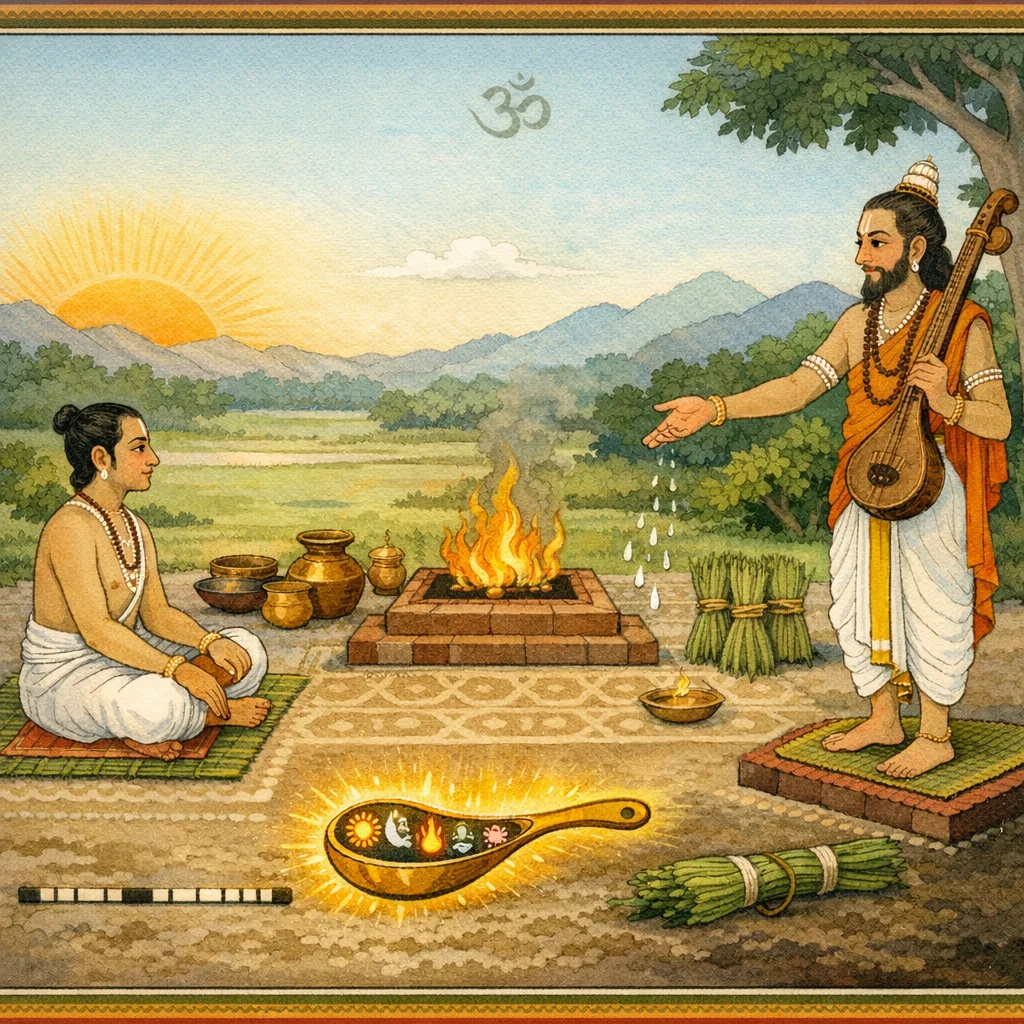
Nārada instructs the sages with a structured account of Kalpa as the Vedic “manual of procedure,” identifying Nakṣatra-kalpa (deities of the lunar mansions), Āṅgirasa-kalpa (ṣaṭkarman/abhicāra operations), and Śānti-kalpa (pacificatory rites for omens in the divine, terrestrial, and atmospheric realms). He then teaches Gṛhya-kalpa for household practice: the auspicious primacy of oṃkāra and sacred sound; proper gathering and use of kuśa/darbha; safeguards of non-violence (pari-samūhana); purification by cow-dung plastering and water sprinkling; bringing and installing the fire; protective spatial arrangements (the south as danger, installation of Brahmā, vessels to the north/west, the yajamāna facing east); selection of assistants (two brahmacārins of one’s śākhā, flexibility when priests are unavailable); and precise aṅgula-based measurements for rings, ladles, bowls, distances, and “full vessel” standards. The chapter culminates in a symbolic theology of ritual implements (six deities in the sruva and bodily correspondences of offerings), uniting ritual engineering with cosmic meaning.
Shlokas
Verse 1
अथातः संप्रवक्ष्यामि कल्पग्रन्थं मुनीश्वर । यस्य विज्ञानमात्रेण स्यात् कर्मकुशलो नरः 1. ॥ १ ॥
Now, O best of sages, I shall fully explain the Kalpa-text, the manual of ritual procedure; by the mere understanding of it, a person becomes skilled in the performance of rites.
Verse 2
नक्षत्रकल्पो वेदानां संहितानां तथैव च । चतुर्थः स्यादाङ्गिरसः शान्तिकल्पश्च पञ्चमः ॥ २ ॥
For the Vedas—and likewise for their Saṃhitās—the fourth is said to be the Nakṣatra-kalpa; the next (the fifth) is the Āṅgirasa-kalpa, and also the Śānti-kalpa.
Verse 3
नक्षत्राधीश्वराख्यानं विस्तरेण यथातथम् । नक्षत्रकल्पे निर्दिष्टं ज्ञातव्यं तदिहापि च ॥ ३ ॥
The detailed account of the presiding lords of the lunar mansions (nakṣatras), exactly as it is, has been set forth in the Nakṣatra-kalpa; that same teaching should be understood here as well.
Verse 4
वेदकल्पे विधानं तु ऋगादीनां मुनीश्वर । धर्मार्थकाममोक्षाणां सिद्ध्यै प्रोक्तं सविस्तरम् ॥ ४ ॥
O lord among sages, in the Veda-kalpa the detailed procedures for the Ṛg and the other Vedas have been taught, for the successful attainment of dharma, artha, kāma, and mokṣa.
Verse 5
मन्त्राणामृषयश्चैव छन्दांस्यथ च देवताः । निर्दिष्टाः संहिताकल्पे मुनिभिस्तत्त्वदर्शिभिः ॥ ५ ॥
The ṛṣis of the mantras, their metres (chandas), and the presiding deities have all been specified in the Saṃhitā and Kalpa traditions by sages who behold the truth.
Verse 6
तथैवाङ्गिरसे कल्पे षट्कर्माणि सविस्तरम् । अभिचारविधानेन निर्दिष्टानि स्वयम्भुवा ॥ ६ ॥
Likewise, in the Āṅgirasa Kalpa the six ritual operations (ṣaṭkarman) are set forth in full detail—ordained by Svayambhū (Brahmā) through the procedures of abhicāra for specific effects.
Verse 7
शान्तिकल्पे तु दिव्यानां भौमानां मुनिसत्तम । तथान्तरिक्षोत्पातानां शान्तयो ह्युदिताः पृथक् ॥ ७ ॥
But in the Śānti-kalpa, O best of sages, the pacificatory rites (śānti) are taught separately—for celestial omens, for terrestrial omens, and likewise for portents arising in the mid-air.
Verse 8
संक्षेपेणैतदुद्दिष्टं लक्षणं कल्पलक्षणे । विशेषः पृथगेतेषां स्थितः शाखान्तरेषु च ॥ ८ ॥
Thus, in brief, this defining mark of the Kalpas has been stated under the topic of their characteristics; the distinct particulars of each are also found separately in the different Vedic branches (śākhās).
Verse 9
गृह्यकल्पे तु सर्वेषामुपयोगितयाऽधुना । वक्ष्यामि ते द्विजश्रेष्ठ सावधानतया शृणु ॥ ९ ॥
Now, with a view to practical use for all, I shall explain to you the Gṛhya-kalpa, the code of domestic rites, O best of the twice-born; listen with complete attentiveness.
Verse 10
ॐकारश्चाथ शब्दश्च द्वावेतौ ब्रह्मणः पुरा । कण्ठं भित्वा विनिर्यातौ तस्मान्माङ्गल्यकाविमौ ॥ १० ॥
In the beginning, these two—Om (oṃkāra) and the sacred Word (śabda)—burst forth from Brahmā, breaking through his throat; therefore both are inherently auspicious.
Verse 11
कृत्वा प्रोक्तानि कर्माणि तदूर्द्ध्वानि करोति यः । सोऽथ शब्दं प्रयुञ्जीत तदानन्त्यार्थमिष्यते ॥ ११ ॥
Having first performed the prescribed rites as taught, whoever then proceeds to the higher practices should thereafter employ the sacred Word (śabda), for it is intended to lead to the Infinite (ananta).
Verse 12
कुशाः परिसमूहाय व्यस्तशाखाः प्रकीर्तिताः । न्यूनाधिका निष्फलाय कर्मणोऽभिमतस्य च ॥ १२ ॥
Kuśa-grass is prescribed to be gathered into a compact bunch, with its tips kept separated. If taken in a deficient or excessive measure, the intended rite becomes fruitless.
Verse 13
कृमिकीटपतङ्गाद्या भ्रमति वसुधातले । तेषां संरक्षणार्थाय प्रोक्तं परिसमूहनम् ॥ १३ ॥
Worms, insects, moths, and other such creatures wander upon the surface of the earth. For their protection, the practice called “pari-samūhana” (careful gathering/sweeping) has been prescribed.
Verse 14
रेखाः प्रोक्ताश्च यास्तिस्रः कर्तव्यास्ताः समा द्विज । न्यूनाधिका न कर्तव्या इत्येव परिभाषितम् ॥ १४ ॥
The three prescribed lines should be made even and uniform, O twice-born (dvija). They are not to be made fewer or more—this is the stated rule.
Verse 15
मेदिनी मेदसा व्याप्ता मधुकैटभदैत्ययोः । गोमयेनोपलेप्येयं तदर्थमिति नारद ॥ १५ ॥
“The earth is pervaded with the fat of the demons Madhu and Kaiṭabha; therefore, for purification and protection, it should be plastered with cow-dung for that very purpose,” said Nārada.
Verse 16
वन्ध्या दुष्टा च दीनाङ्गी मृतवत्सा स च या भवेत् । यज्ञार्थं गोमयं तस्या नाहरेदिति भाषितम् ॥ १६ ॥
It is taught that for sacrificial use (yajña) one should not collect cow-dung from a cow that is barren, ill-tempered, sickly, or one whose calf has died.
Verse 17
ये भ्रमन्ति सदाकाशे पतङ्गाद्या भयङ्कराः । तेषां प्रहरणार्थाय मतं प्रोद्धरणं द्विज ॥ १७ ॥
O twice-born one, those fearsome beings—beginning with the winged creatures—who ever roam the sky: to strike them down, the approved method is to hurl upward (a weapon).
Verse 18
स्रुवेण च कुशेनापि कुर्यादुल्लेखनं भुवः । अस्थिकण्टकसिर्द्ध्य्थं ब्रह्मणा परिभाषितम् ॥ १८ ॥
With a sruva (ritual ladle) or even with a blade of kuśa-grass, one should lightly mark the ground; this procedure, taught by Brahmā, is prescribed for properly dealing with and removing impurities such as bones and thorn-like matter.
Verse 19
आपो देवगणाः सर्वे तथा पितृगणा द्विज । तेनाद्भिरुक्षणं प्रोक्तं मुनिभिर्विधिकोविदैः ॥ १९ ॥
O twice-born one, the Waters (Āpaḥ) themselves are all the hosts of the devas, and likewise all the hosts of the pitṛs (ancestors). Therefore the sages skilled in ritual procedure have prescribed sprinkling with water as a rite of purification.
Verse 20
अग्नेरानयनं प्रोक्तं सौभाग्यस्त्रीभिरेव च । शुभदे मृण्मये पात्रे प्रोक्ष्याद्भिस्तं निधापयेत् ॥ २० ॥
The bringing of the sacred Fire (Agni) is enjoined to be done by auspicious married women. Having sprinkled it with pure water, one should place that Fire in a clay vessel that bestows auspiciousness.
Verse 21
अमृतस्य क्षयं दृष्ट्वा ब्रह्माद्यैः सर्वदैवतैः । वेद्यां निधापितस्तस्मात्समिद्गर्भो हुताशनः ॥ २१ ॥
Seeing that amṛta, the nectar of immortality, was being depleted, Brahmā and all the gods therefore placed the Fire (Hutāśana) upon the altar, bearing the fuel-sticks (samid) within him, so that the rite might be duly sustained.
Verse 22
दक्षिणस्यां दानवाद्याः स्थिता यज्ञस्य नारद । तेभ्यः संरक्षणार्थाय ब्रह्माणं तद्दिशि न्यसेत् ॥ २२ ॥
O Nārada, on the southern side of the sacrifice stand the Dānavas and other hostile beings. Therefore, for protection from them, one should install Brahmā in that very direction.
Verse 23
उत्तरे सर्वपात्राणि प्रणीताद्यानि पश्चिमे । यजमानः पूर्वतः स्युर्द्विजाः सर्वेऽपि नारद ॥ २३ ॥
All the ritual vessels should be placed to the north; the praṇīta-water and related items should be set to the west. The yajamāna should sit facing the east, and all the dvijas as well—O Nārada.
Verse 24
द्यूते च व्यवहारे च यज्ञकर्मणि चेद्भवेत् । कर्त्तोदासीनचित्तस्तत्कर्म नश्येदिति स्थितिः ॥ २४ ॥
Whether in gambling, in worldly dealings, or even in sacrificial rites—if the doer’s mind remains udāsīna, detached and unattached, then that action is said to be nullified and does not bind; such is the settled doctrine.
Verse 25
ब्रह्माचार्यौ स्वशाखौ हि कर्तव्यौ यज्ञकर्मणि । ऋत्विजां नियमो नास्ति यथालाभं समर्चयेत् ॥ २५ ॥
In the sacrificial rite, two brahmacārins (students of holy continence) belonging to one’s own Vedic branch should indeed be appointed. As for the officiating priests (ṛtvij), there is no rigid restriction—one should duly honor and employ them as they are available.
Verse 26
द्वे पवित्रे त्र्यङ्गुलेस्तः प्रोक्षिणी चतुरङ्गुला । आज्यस्थाली त्र्यङ्गुलाथ चरुस्थाली षडङ्गुला ॥ २६ ॥
The two pavitra-rings of kuśa grass are each three aṅgulas in measure. The sprinkling ladle (prokṣiṇī) is four aṅgulas. The ghee-bowl (ājyasthālī) is three aṅgulas, and the pot for cooked oblation-rice (carusthālī) is six aṅgulas.
Verse 27
द्व्यङ्गुलं तूपयमनमेकं सम्मार्जनाङ्गुलम् । स्रुवं षडङ्गुलं प्रोक्तं स्रुचं सार्द्धत्रयाङ्गुलम् ॥ २७ ॥
The measure called upayamāna is said to be two aṅgulas; the aṅgula used for cleansing is one. The ladle called sruva is declared to be six aṅgulas in length, and the sruc is three and a half aṅgulas.
Verse 28
प्रादेशमात्रा समिधः पूर्णपात्रं षडङ्गुलम् । प्रोक्षिण्या उत्तरे भागे प्रणीतापात्रमष्टभिः ॥ २८ ॥
The fuel-sticks (samidh) should be one prādeśa (a span) in length. The filled vessel should measure six aṅgulas. To the north of the prokṣiṇī, the praṇītā-vessel should be placed at a distance of eight aṅgulas.
Verse 29
यानि कानि च तीर्थानि समुद्राः सरितस्तथा । प्रणीतायां समासन्नात्तस्मात्तां पूरयेज्जलैः ॥ २९ ॥
Therefore, when the consecrated praṇītā-vessel is brought near, one should fill it with water, invoking within it all sacred tīrthas, the oceans, and the rivers that exist.
Verse 30
वैदिका वस्त्रहीना च नग्ना संप्रोच्यते द्विज । परिस्तीर्य्य ततो दर्भैः परिदध्यादिमां बुधः ॥ ३० ॥
O twice-born one, the Vedic rite is called “naked” when it lacks the proper coverings and required ritual appurtenances. Therefore, having spread darbha-grass, the wise should then arrange and perform this rite in due order.
Verse 31
इन्द्र वज्रं विष्णुचक्रं वामदेवत्रिशूलकम् । दर्भरूपतया त्रीणि पवित्रच्छेदनानि च ॥ ३१ ॥
Indra’s thunderbolt, Viṣṇu’s discus, and Vāmadeva’s trident—these three, when envisioned in the form of darbha-grass, are likewise the sacred cutters used in preparing pavitra (purificatory rings or strands).
Verse 32
प्रोक्षणी च प्रकर्तव्या प्रणीतोदकसंयुता । तेनातिपुण्यदं कर्म पवित्रमिति कीर्तितम् ॥ ३२ ॥
One should also prepare the sprinkling vessel (prokṣaṇī), filled with consecrated water (praṇītodaka). By its means the rite becomes exceedingly merit-giving; therefore it is proclaimed to be purifying.
Verse 33
आज्यस्थाली प्रकर्तव्या पलमात्रप्रमाणिका । कुलालचक्रघटितं आसुरं मृण्मयं स्मृतम् ॥ ३३ ॥
An ājya-sthālī (a small vessel for ghee) should be made to the measure of one pala; it is said to be of the “āsura” type, made of clay and fashioned on the potter’s wheel.
Verse 34
तदेव हस्तघटितं स्थाल्यादि दैविकं भवेत् । स्रुवे च सर्वकर्माणि शुभान्यप्यशुभानि च ॥ ३४ ॥
Only that which is fashioned by the hand—such as a cooking pot (sthālī) and the like—becomes “daivika,” fit for sacred use. And in the ladle (sruva) are included all ritual acts, both auspicious and inauspicious.
Verse 35
तस्य चैव पवित्रार्थं वह्नौ तापनमीरितम् । अग्रे धृतेन वैधव्यं मध्ये चैव प्रजाक्षयः ॥ ३५ ॥
For its purification, heating in fire is enjoined. If it is held at the front with ghee, it brings widowhood; and if held in the middle, it causes the destruction of progeny.
Verse 36
मूले च म्रियते होता तस्माद्धार्यं विचार्य तत् । अग्निः सूर्यश्च सोमश्च विरञ्चिरनिलो यमः ॥ ३६ ॥
When the root is cut off, the hotṛ (sacrificial agent) also perishes; therefore, having reflected, one should uphold that very root, the foundation. Fire, the Sun, Soma, Virañci (Brahmā), Anila (Vāyu), and Yama are to be understood as its sustaining powers.
Verse 37
स्रुवे षडेते दैवास्तु प्रत्यङ्गुलमुपाश्रिताः । अग्निर्भोगार्थनाशाय सूर्यो व्याधिकरो भवेत् ॥ ३७ ॥
In the sruva (sacrificial ladle), these six deities are said to be stationed, each abiding within a measure of a finger’s breadth. Agni is there to destroy the fruits of indulgence, and the Sun becomes the producer of disease.
Verse 38
निष्फलस्तु स्मृतः सोमो विरञ्चिः सर्वकामदः । अनिलो वृद्धिदः प्रोक्तो यमो मृत्युप्रदो मतः ॥ ३८ ॥
Soma is remembered as yielding no fruit; Virañci (Brahmā) is the giver of all desired aims. Anila (Vāyu) is declared to bestow growth and increase, and Yama is regarded as the giver of death.
Verse 39
सम्मार्जनोपयमनं कर्तव्यं च कुशद्वयम् । पूर्वं तु सर्वशाखं स्यात्पञ्चशाखं तथा परम् ॥ ३९ ॥
For the rite, one should prepare the cleansing implement and the upayamana, along with a pair of kuśa grasses. The first kuśa should be many-branched, and the other should likewise be five-branched.
Verse 40
श्रीपर्णी च शमी तद्वत्खदिरश्च विकङ्कतः । पलाशश्चैव विज्ञेयाः स्रुवे चैव तथा स्रुचि ॥ ४० ॥
Śrīparṇī and Śamī likewise, as well as Khadira and Vikaṅkata, and also Palāśa—these are to be understood as the proper woods for making the sruva (ladle) and the sruc (offering-spoon).
Verse 41
हस्तोन्मितं स्रुवं शस्तं त्रिदशाङ्गुलिकं स्रुचम् । विप्राणां चैतदाख्यातं ह्यन्येषामङ्गुलोनकम् ॥ ४१ ॥
The sruva is prescribed as the measure of a hand-span, and the sruc as thirty finger-breadths. This measurement is declared for brāhmaṇas; for others, it is one finger-breadth less.
Verse 42
शूद्रा णां पतितानां च खरादीनां च नारद । दृष्टिदोषविनाशार्थं पात्राणां प्रोक्षणं स्मृतम् ॥ ४२ ॥
O Nārada, for vessels that have been looked upon by Śūdras, by the fallen (patita), or by donkeys and the like, sprinkling with sanctified water (prokṣaṇa) is taught as the means to remove the impurity arising from that sight.
Verse 43
अकृते पूर्णपात्रे तु यज्ञच्छिद्रं समुद्भवेत् । तस्मिन् पूर्णीकृते विप्र यज्ञसम्पूर्णता भवेत् ॥ ४३ ॥
If the rite of the “full vessel” (pūrṇa-pātra) is not performed, a flaw arises in the sacrifice. But when that pūrṇa-pātra is duly completed, O brāhmaṇa, the sacrifice becomes fully perfected.
Verse 44
अष्टमुष्टिर्भवेत् किञ्चित् पुष्कलं तच्चतुष्टयम् । पुष्कलानि तु चत्वारि पूर्णपात्रं विदुर्बुधाः ॥ ४४ ॥
A “kiñcit” is understood to be eight handfuls; a “puṣkala” consists of four such measures. And four puṣkalas together are known by the learned as a “full vessel” (pūrṇa-pātra).
Verse 45
होमकाले तु सम्प्राप्ते न दद्यादासनं क्वचित् । दत्ते तृप्तो भवेद् वह्निः शापं दद्याच्च दारुणम् ॥ ४५ ॥
When the time for homa has arrived, one should not give away one’s seat. If it is given, Agni takes it as his share, becomes ‘satisfied,’ and may bestow a dreadful curse.
Verse 46
आघारौ नासिके प्रौक्तौ आज्यभागौ च चक्षुषी । प्राजापत्यं मुखं प्रोक्तं कटिर्व्याहृतिभिः स्मृता ॥ ४६ ॥
The two āghāra offerings are declared to be the two nostrils; the two ghee portions (ājyabhāga) are the two eyes. The prājāpatya rite is said to be the mouth, and the waist is remembered as the vyāhṛtis, the sacred utterances.
Verse 47
शीर्षं हस्तौ च पादौ च पञ्चवारुणमीरितम् । तथास्विष्टकृतं विप्र श्रोत्रे पूर्णाहुतिस्तथा ॥ ४७ ॥
The head, the hands, and the feet are declared to be purified by the fivefold Vāruṇa rite. Likewise, O brāhmaṇa, the concluding oblation (sviṣṭakṛt) is to be performed; and with regard to the ears, the full oblation (pūrṇāhuti) is also prescribed.
Frequently Asked Questions
The classification establishes Kalpa’s scope across specialized ritual domains—astral (nakṣatra), effect-oriented operations (āṅgirasa/abhicāra), and pacification (śānti)—so that the subsequent Gṛhya-kalpa is understood as a practical subset within a larger Vedāṅga framework.
Sprinkling is framed as purification because Waters are identified with divine and ancestral hosts, making consecrated water a medium of sacral reset. Cow-dung plastering is justified as protective purification of the ground, presented through a mythic-ritual explanation (removing demonic taint associated with Madhu and Kaiṭabha).
Metrological precision is treated as a condition of efficacy: deficiency or excess renders rites fruitless, and correct proportions ensure the rite is properly ‘clothed’ with its required appurtenances. The chapter uses measurement as a practical control system for reproducible ritual outcomes.
It encodes a cosmological reading of ritual technology: the implement is not merely a tool but a microcosm where divine powers are stationed in measured loci. This sacralizes procedure and frames correct handling as interaction with living divine presences.