Śreyas and Paramārtha: The Ribhu–Nidāgha Teaching on Non-Dual Self (Advaita)
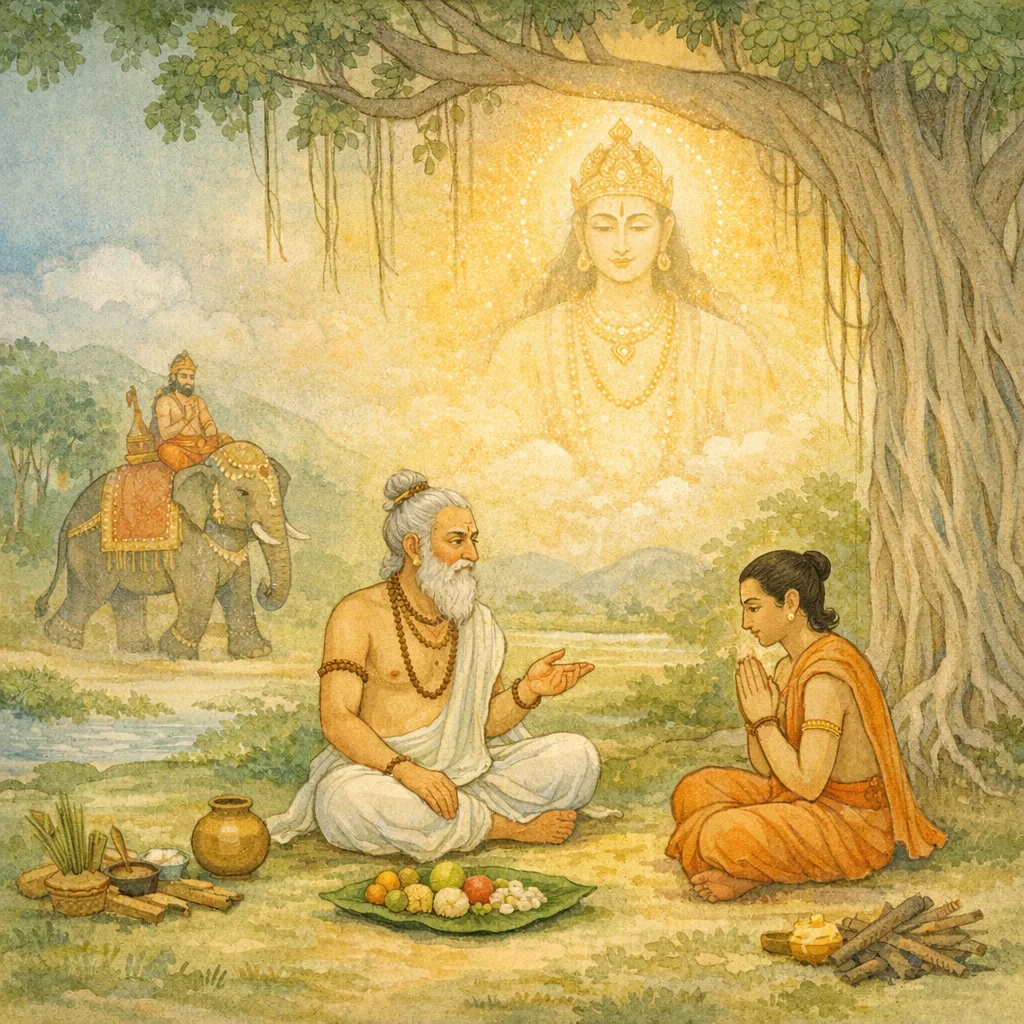
Sanandana recounts how a king, after hearing discriminative teaching that doership belongs to the guṇas driven by karma and not to the Self, renews his inquiry into the “highest good.” The brāhmaṇa-teacher redefines śreyas: wealth, sons, and kingship are secondary, while true śreyas is communion with the Paramātman and steady meditation on the Self. Ritual action is shown to be perishable because it depends on perishable materials (the clay-and-pot analogy; fuel, ghee, kuśa), whereas paramārtha is imperishable and not a manufactured result—Self-knowledge is both the means and the end. The chapter then unfolds the ancient Ribhu–Nidāgha episode: hospitality and questions about food become a doorway to deny identification with hunger and thirst; questions about dwelling and travel are shown inapplicable to the all-pervading Puruṣa. A second meeting uses the king/elephant hierarchy to expose “above/below” distinctions as mental constructions. Nidāgha recognizes Ribhu as Guru; the teaching culminates in the declaration that the universe is undivided and is Vāsudeva’s very nature. The king abandons bheda-buddhi (notions of difference) and attains jīvanmukti through awakened remembrance and non-dual vision.
Shlokas
Verse 1
सनंदन उवाच । निशम्य तस्येति वचः परमार्थसमन्वितम् । प्रश्रयावनतो भूत्वा तमाह नृपतिर्द्विजम् ॥ १ ॥
Sanandana said: Having heard those words of his—endowed with the highest truth—the king, bowing with humility and reverence, then addressed the twice-born sage.
Verse 2
राजोवाच । भगवन्यत्त्वया प्रोक्त परमार्थमयं वचः । श्रुते तस्मिन्भ्रमंतीव मनसो मम वृत्तयः ॥ २ ॥
The King said: “O Bhagavān, the words you have spoken are filled with the highest truth. Yet, on hearing them, the movements of my mind seem to whirl about in confusion.”
Verse 3
एतद्विवेकविज्ञानं यदि शेषेषु जंतुषु । भवता दर्शितं विप्र तत्परं प्रकृतेर्महत् ॥ ३ ॥
O Brahmin sage, if you have truly revealed to other living beings this viveka-jñāna—discriminative knowledge—then it is supremely directed toward Mahat, the Great Principle of Prakṛti, primordial Nature.
Verse 4
नाहं वहामि शिबिकां शिबिका मयि न स्थिता । शरीरमन्यदस्मत्तो येनेयं शिबिका धृता ॥ ४ ॥
“I do not carry the palanquin, for the palanquin is not resting in me. The body is something other than I; it is by that body that this palanquin is borne.”
Verse 5
गुण प्रवृत्तिर्भूतानां प्रवृत्तिः कर्मचोदिता । प्रवर्तंते गुणाश्चैते किं ममेति त्वयोदितम् ॥ ५ ॥
The activity of beings is nothing but the activity of the guṇas, and that activity is impelled by karma. These very guṇas keep operating—so how can the notion “this is mine” be rightly asserted, as you have said?
Verse 6
एतस्मिन्परमार्थज्ञ मम श्रोत्रपथं गते । मनो विह्वलतामेति परमार्थार्थतां गतम् ॥ ६ ॥
O knower of the supreme truth, as this has entered the pathway of my ears, my mind becomes overwhelmed—having reached the very purport of the supreme meaning.
Verse 7
पूर्वमेव महाभाग कपिलर्षिमहं द्विज । प्रष्टुमभ्युद्यतो गत्वा श्रेयः किंत्वत्र संशये ॥ ७ ॥
Earlier, O fortunate twice-born one, I went to sage Kapila, resolved to ask about the highest good; yet on this matter I still remain in doubt.
Verse 8
तदंतरे च भवता यदिदं वाक्यमीरितम् । तेनैव परमार्थार्थं त्वयि चेतः प्रधावति ॥ ८ ॥
And in the midst of this, the words you have spoken—by those very words my mind rushes toward you, seeking the supreme purport of the highest truth.
Verse 9
कपिलर्षिर्भगवतः सर्वभूतस्य वै किल । विष्णोरंशो जगन्मोहनाशाय समुपागतः ॥ ९ ॥
Indeed, the sage Kapila is said to be a portion of Viṣṇu—the Blessed Lord of all beings—who came forth to destroy the delusion that enchants the world.
Verse 10
स एव भगवान्नूनमस्माकं हितकाम्यया । प्रत्यक्षतामनुगतस्तथैतद्भवतोच्यते ॥ १० ॥
Surely that very Lord, desiring our welfare, has come into direct presence; thus is this rightly spoken by you.
Verse 11
तन्मह्यं मोहनाशाय यच्छ्रेयः परमं द्विज । तद्वदाखिल विज्ञानजलवीच्युजधिर्भवान् ॥ ११ ॥
Therefore, O twice-born sage, tell me that supreme good which destroys delusion. For you are an ocean whose waves are the waters of all knowledge.
Verse 12
ब्राह्मण उवाच । भूयः पृच्छसि किं श्रेयः परमार्थेन पृच्छसि । श्रेयांसि परमार्थानि ह्यशेषाण्येन भूपते ॥ १२ ॥
The Brāhmaṇa said: “Again you ask of the highest good; you ask with your gaze fixed on the supreme end. Truly, O king, all genuine ‘goods’ are nothing other than that very supreme goal itself.”
Verse 13
देवताराधनं कृत्वा धनसंपदमिच्छति । पुत्रानिच्छति राज्यं च श्रेयस्तस्यैव तन्नृप ॥ १३ ॥
Having worshipped the deity, one longs for wealth and prosperity; one longs for sons and even for kingship. Yet, O king, the highest good (śreyas) belongs to that very devotee.
Verse 14
विवकिनस्तु संयोगः श्रेयोऽसौ परमात्मना । कर्मयज्ञादिकं श्रेयः स्वर्लोकपलदायि यत् ॥ १४ ॥
But for the discerning, communion with the Supreme Self—the Paramātman—is the highest good; rites such as action and sacrifice are a lesser good, for they bestow only the fruits of the heavenly worlds.
Verse 15
श्रेयः प्रधानं च फले तदेवानभिसंहिते । आत्मा ध्येयः सदा भूप योगयुक्तैस्तथा परैः ॥ १५ ॥
Even without deliberately aiming for it, that fruit arises in which the highest good (śreyas) is foremost. Therefore, O king, the Self is ever to be meditated upon—by those disciplined in yoga and by the lofty-minded as well.
Verse 16
श्रेय स्तस्यैव संयोगः श्रेयो यः परमात्मनः । श्रेयांस्येवमनेकानि शतशोऽथ सहस्त्रशः ॥ १६ ॥
The highest good is indeed that very union—the supreme good born of communion with the Paramātman. Thus, the forms of what is beneficial are many, by the hundreds and even by the thousands.
Verse 17
संत्यत्र परमार्थास्तु न त्वेते श्रूयतां च मे । धर्मोऽयं त्यजते किं तु परमार्थो धनं यदि ॥ १७ ॥
Here indeed there are higher truths; yet I should not accept these words of yours—because if wealth were the supreme good (paramārtha), then this very dharma would be cast aside.
Verse 18
व्ययश्चक्रियत कस्मात्कामप्राप्त्युपलक्षणः । मुत्रश्चेत्परमार्थाख्यः सोऽप्यन्यस्य नरेश्वर ॥ १८ ॥
Why then is expenditure undertaken at all—when it is merely a sign of desire being attained? And if urine were called the ‘highest purpose,’ even that, O king, belongs to someone else.
Verse 19
परमार्थभूतः सोऽन्यस्य परमार्थो हि नः पिता । एवं न परमार्थोऽस्ति जगत्यत्र चराचरे ॥ १९ ॥
He is the very embodiment of the Supreme Truth; indeed, He is the highest aim for others, and He is our Father. Thus, in this moving and unmoving world, no other true paramārtha exists.
Verse 20
परमार्थो हि कार्याणि करणानामशेषतः । राज्यादिप्राप्तिरत्रोक्ता परमार्थतया यदि ॥ २० ॥
Indeed, paramārtha is the true end of all actions and all their instruments, without remainder. Even the attainment of kingship and the like is spoken of here as ‘paramārtha’—if it is taken in that ultimate sense.
Verse 21
परमार्था भवंत्यत्र न भवंति च वै ततः । ऋग्यजुःसामनिष्पाद्यं यज्ञकर्म मतं तव ॥ २१ ॥
Here, the highest spiritual aims are indeed attained; yet they do not arise merely from that outward performance. In your view, sacrificial ritual is the yajña-act carried out on the basis of the Ṛg, Yajus, and Sāma Vedas.
Verse 22
परमार्थभूतं तत्रापि श्रूयतां गदतो मम । यत्तु निष्पाद्यते कार्यं मृदा कारणभूतया ॥ २२ ॥
Hear from me, even there, the highest truth as I speak: whatever effect is produced is accomplished by clay, which stands as its material cause.
Verse 23
तत्कारणानुगमनाज्जायते नृप मृन्मयम् । एवं विनाशिभिर्द्रव्यैः समिदाज्यकुशादिभिः ॥ २३ ॥
O king, an earthen object comes into being by depending upon its cause—clay. In the same way, effects arise from perishable materials such as fuel-sticks, ghee, kuśa grass, and the like.
Verse 24
निष्पाद्यते क्रिया या तु सा भवित्री विनाशिनी । अनाशी परमार्थस्तु प्राज्ञैरभ्युपगम्यते ॥ २४ ॥
Any action that is produced and carried out is bound to come into being and then perish. But the Supreme Reality (paramārtha) is imperishable—this is what the wise accept.
Verse 25
यत्तुं नाशि न संदेहो नाशिद्रव्योपपादितम् । तदेवापलदं कर्म परमार्थो मतो मम ॥ २५ ॥
That which is perishable—there is no doubt—being established upon perishable materials: only that is action without true fruit. This, in my view, is the highest purport.
Verse 26
मुक्तिसाधनभूतत्वात्परमार्थो न साधनम् । ध्यानमेवात्मनो भूपपरमार्थार्थशब्दितम् ॥ २६ ॥
Because the supreme goal (paramārtha) is itself the very means to liberation (mokṣa), it is not something separate to be ‘accomplished’ as a tool. Indeed, O king, meditation on the Self (Ātman) alone is what is designated by the term ‘paramārtha’—the true highest purpose.
Verse 27
भेदकारि परेभ्यस्तु परमार्थो न भेदवान् । परमार्थात्मनोर्योगः परमार्थ इतीष्यते ॥ २७ ॥
Distinctions arise only in relation to other things; the Supreme Reality (Paramārtha) itself is not divided. The union of the Supreme Reality and the Ātman is declared to be the Supreme Truth.
Verse 28
मिथ्यैतदन्यद्द्रव्यं हि नैतद्द्रव्यमयं यतः । तस्माच्छ्रेयांस्यशेषाणि नृपैतानि न संशयः ॥ २८ ॥
This other so-called “substance” is indeed false, for it is not constituted of true substance. Therefore, O king, all these are surely the highest goods—there is no doubt.
Verse 29
परमार्थस्तु भूपाल संक्षेपाच्छ्रूयतां मम । एको व्यापी समः शुद्धो निर्गुण प्रकृतेः परः ॥ २९ ॥
O king, hear from me the highest truth in brief: the Supreme is one, all-pervading, equal toward all, pure, beyond the guṇas, and transcendent to Prakṛti (material nature).
Verse 30
जन्मवृद्ध्यादिरहित आत्मा सर्वगतो नृप । परिज्ञानमयो सद्भिर्नामजात्यादिभिविभुः ॥ ३० ॥
O king, the Ātman is free from birth, growth, and the like; it is all-pervading. It is of the very nature of perfect knowledge; yet, by the conventions of the wise, it is spoken of through names, classes, and other designations.
Verse 31
न योगवान्न युक्तोऽभून्नैव पार्थिवः योक्ष्यति । तस्यात्मपरदेहेषु सतोऽप्येकमयं हि तत् ॥ ३१ ॥
He was not a yogin, nor was he truly disciplined; nor will he, O king, become so. For him, even though the Ātman exists in his own body and in the bodies of others, that Reality is one and the same.
Verse 32
विज्ञानं परमार्थोऽसौ वेत्ति नोऽतथ्यदर्शनः । वेणुरंघ्रविभेदेन भेदः षङ्जादिसंज्ञितः ॥ ३२ ॥
He who knows vijñāna, true knowledge, and that paramārtha, the highest Reality, truly knows; but one of false vision does not. Just as, by the differing finger-holes of a flute, the musical divisions are named Ṣaḍja and the rest.
Verse 33
अभेदो व्यापिनो वायोस्तथा तस्य महात्मनः । एकत्वं रूपभेदश्च वाह्यकर्मप्रवृत्तिजः ॥ ३३ ॥
As the all-pervading wind is in essence undivided, so too is that Mahātman, the Self. Its oneness is real; the seeming diversity of forms arises only from involvement in outward actions.
Verse 34
देवादिभेदमध्यास्ते नास्त्येवाचरणो हि सः । श्रृण्वत्र भूप प्राग्वृत्तं यद्गीतमृभुणा भवेत् ॥ ३४ ॥
He who clings to distinctions such as “deva” and “other” remains ensnared in difference; for him there is truly no right conduct. Now listen, O King, to an ancient episode—what was once sung by Ṛbhu.
Verse 35
अवबोधं जनयतो निदाधस्य द्विजन्मनः । ऋभुर्नामाऽबवत्पुत्रो ब्रह्मणः परमेष्टिनः ॥ ३५ ॥
To awaken avabodha, true understanding, in Nidādha, the twice-born seeker, there was born a son named Ṛbhu—born of Brahmā, Parameṣṭhin, the Supreme Ordainer.
Verse 36
विज्ञात तत्त्वसद्भावो निसर्गादेव भूपते । तस्य शिष्यो निदाघोऽभूत्पुलस्त्यतनयः पुरा ॥ ३६ ॥
O King, his true nature as a knower of tattva, reality, was understood from the very beginning; and in former times Nidāgha, son of Pulastya, became his disciple.
Verse 37
प्रादादशेषविज्ञानं स तस्मै परया मुदा । अवाप्तज्ञान तत्त्वस्य न तस्याद्वैतवासना ॥ ३७ ॥
With supreme joy he bestowed upon him the entirety of sacred knowledge. Yet in one who has not realized the truth (tattva) of that knowledge, no inward inclination toward non-duality (Advaita) arises.
Verse 38
स ऋभुस्तर्कयामास निदाघस्य नरेश्वर । देविकायास्तटे वीर नागरं नाम वै पुरम् ॥ ३८ ॥
O king, the sage Ṛbhu reflected upon Nidāgha and came to the heroic city called Nāgara, situated on the bank of the river Devikā.
Verse 39
समृद्धमतिरम्यं च पुलस्त्येन निवेशितम् । रम्योपवनपर्यंतं स तस्मिन्पार्थवोत्तम ॥ ३९ ॥
O best of Pṛthā’s sons, he stayed there—in a place prosperous and delightful, established by Pulastya and stretching out to charming groves and pleasure-gardens.
Verse 40
निदाधनामायोगज्ञस्तस्य शिष्योऽभवत्पुरा । दिव्ये वर्षसहस्त्रे तु समतीतेऽस्य तत्पुरम् ॥ ४० ॥
In ancient times, Nidādhana, skilled in Yoga, became his disciple. And when a thousand divine years had passed, he then reached his abode.
Verse 41
जगाम स ऋभुः शिष्यं निदाघमवलोकितुम् । स तस्य वैश्वदेवंति द्वारालोकनगोचरः ॥ ४१ ॥
Then Ṛbhu went to see his disciple Nidāgha. At that time Nidāgha was engaged in the Vaiśvadeva rite, and Ṛbhu came into his sight at the doorway.
Verse 42
स्थित स्तेन गृहीतार्थो निजवेश्म प्रवेशितः । प्रक्षालितांघ्रिपाणिं च कृतासनपरिग्रहम् ॥ ४२ ॥
Even a thief—once restrained, relieved of the stolen goods, and brought into one’s own house—should be received as a guest: his feet and hands are to be washed, and a seat (āsana) offered.
Verse 43
उवाच स द्विजश्रेष्टो भुज्यतामिति सादरम् । ऋभुरुवाच । भो विप्रवर्य भोक्तव्यं यदत्र भवतो गृहे ॥ ४३ ॥
That best of the twice-born respectfully said, “Please partake.” Ṛbhu replied, “O foremost of Brahmins, one should indeed partake of whatever is here in your house.”
Verse 44
तत्कथ्यतां कदन्नेषु न प्रीतिः सततं मम । निदाघ उवाच । सक्तुयावकव्रीहीनामपूपानां च मे गृहे ॥ ४४ ॥
“Then tell me: why do I never feel lasting delight in cooked foods?” Nidāgha said: “In my house there are saktu (roasted flour), yava (barley), vrīhi (rice), and also apūpas (cakes).”
Verse 45
यद्रोचते द्विजश्रेष्ट तावद्भुंक्ष्व यथेच्छया । ऋभुरुवाच । कदन्नानि दिजैतानि मिष्टमन्नं प्रयच्छ मे ॥ ४५ ॥
“O best of the twice-born, eat for as long as it pleases you, just as you wish.” Ṛbhu said: “Give me coarse foods—those fit for ascetics—and offer me sweet food as well.”
Verse 46
संयावपायसादीनि चेक्षुका रसवंति च । निदाघ उवाच । गृहे शालिनि मद्गेहे यत्किंचिदति शोभनम् ॥ ४६ ॥
Nidāgha said: “In my house, O Śālīna, there is whatever is exceedingly delightful—such as saṃyāva, pāyasa and the like, and also sweet, juicy sugarcane preparations.”
Verse 47
भोज्येषु साधनं मिष्टं तेनास्यान्नं प्रसाधय । इत्युक्ता तेन सा पत्नी मिष्टमन्नं द्विजस्य तत् ॥ ४७ ॥
“Among the dishes, prepare something sweet; with it, season and serve his meal.” Thus instructed by him, the wife prepared that sweet food for the brāhmaṇa.
Verse 48
प्रसाधितवती तद्वै भर्तुर्वचनगौरवात् । न भुक्तवंतमिच्छातो मिष्टमन्नं महामुनिम् ॥ ४८ ॥
Out of reverence for her husband’s words, she indeed prepared the meal. Yet she did not wish to offer the great sage sweet food while he had not yet eaten.
Verse 49
निदाघः प्राहभूपाल प्रश्रयावनतः स्थितः । निदाघ उवाच । अपि ते परमा तृप्तिरुत्पन्ना पुष्टिरेव ॥ ४९ ॥
Nidāgha, standing humbly and bowing with reverence, spoke to the king: “Has supreme contentment arisen in you—indeed, true nourishment and well-being?”
Verse 50
अपि ते मानसं स्वस्थमाहारेण कृतं द्विज । क्व निवासी भवान्विप्र क्व वा गंतुं समुद्यतः ॥ ५० ॥
O twice-born, is your mind at ease after taking food? Where do you reside, O brāhmaṇa, and where are you now preparing to go?
Verse 51
आगम्यते च भवता यतस्तश्च निवेद्यताम् । ऋमुरुवाच । क्षुधितस्य च भुक्तेऽन्ने तृप्तिर्ब्रह्मन्विजायते ॥ ५१ ॥
“From where have you come, and for what purpose? Please tell me.” Ṛmu said: “O Brāhmaṇa, when a hungry person eats food, satisfaction naturally arises.”
Verse 52
न मे क्षुधा भवेत्तॄप्तिः कस्मान्मां द्विज पृच्छति । वह्निना पार्थिवेनादौ दग्धे वै क्षुरापीश्वः ॥ ५२ ॥
For me there is neither hunger nor satiety—so why, O twice-born, do you question me about it? In the beginning, when the earthly body was burned by fire, the Lord indeed remained as the razor-edged Sovereign, beyond all bodily states.
Verse 53
भवत्यंभसि च क्षीणे नृणां तृष्णासमुद्भवः । क्षुत्तृष्णे देहधर्माख्ये न ममैते यतो द्विज ॥ ५३ ॥
When the body’s water is depleted, thirst arises in people. Hunger and thirst—known as conditions of the body—are not “mine,” O twice-born; therefore I do not identify with them.
Verse 54
ततः क्षुत्संभवाभावात्तृप्तिरस्त्येव मे सदा । मनसः स्वस्थता तुष्टिश्चित्तधर्माविमौ द्विज ॥ ५४ ॥
Therefore, since the very arising of hunger has ceased, I am always indeed content. O twice-born one, mental well-being and satisfaction—these two are the qualities of the mind.
Verse 55
चेतसो यस्य यत्पृष्टं पुमानेभिर्न युज्यते । क्व निवासस्तवेत्युक्तं क्व गंतासि च यत्त्वया ॥ ५५ ॥
What men ask does not truly apply to the One whose nature is beyond the mind. Thus, when you said, “Where is your dwelling, and where do you go?”, such questions do not fit Him.
Verse 56
कुतश्चागम्यते त्वेतात्र्रितयेऽपि निबोध मे । पुमान्सवर्गतो व्यापीत्याकाशवदयं यतः ॥ ५६ ॥
From where, indeed, does this arise? Explain it to me clearly, even in a threefold manner. For this Person (Puruṣa), together with all His categories, is all-pervading like space itself.
Verse 57
कुतः कुत्र क्व गंतासीत्येतदप्यर्थवत्कथम् । सोऽहं गंता न चागंता नैकदेशनिकेतनः ॥ ५७ ॥
From where, to where, and by what path would I go—how could even this question be meaningful? I am that Self (Ātman): neither a goer nor a non-goer, for I dwell in no single place.
Verse 58
त्वं चान्ये च न च त्वं त्वं नान्ये नैवाहमप्यहम् । मिष्टन्ने मिष्टमित्येषा जिह्वा सा मे कृता तव ॥ ५८ ॥
You are, and others are—yet you are not merely ‘you’; nor are they truly ‘others’; and I too am not this separate ‘I’. When sweet food is present, this tongue says, ‘Sweet!’—this tongue of mine has been fashioned by You.
Verse 59
किं वक्ष्यतीति तत्रापि श्रूयतां द्विजसत्तमा । मिष्टमेव यदामिष्टं तदेवोद्वेगकारणम् ॥ ५९ ॥
“What will he say?”—even there, listen, O best of the twice-born. When what is sweet becomes unwelcome, that very sweetness becomes the cause of agitation.
Verse 60
अमिष्टं जायते मिष्टं मिष्टादुद्विजते जनः । आदिमध्यावसानेषु किमन्नं रुचिकारणम् ॥ ६० ॥
From what is unpleasant, the pleasant arises; and from the pleasant, people again grow dissatisfied. At the beginning, in the middle, and at the end—what food is truly the cause of lasting relish?
Verse 61
मृण्मयं हि मृदा यद्वद्गृहं लिप्तं स्थिरीभवेत् । पार्थिवोऽयं तथा देहः पार्थिवैः परमाणुभिः ॥ ६१ ॥
Just as a house made of clay becomes firm when plastered with clay, so too this body—being of the earth-element—becomes solid through earth-made atoms.
Verse 62
यवगोधूममुद्गादि र्घृतं तैलं पयो दधि । गुडः फलानीति तथा पार्थिवाः परमाणवः ॥ ६२ ॥
Barley, wheat, green gram and the like; ghee; oil; milk; curd; jaggery; and fruits—these too are said to be minute particles (atoms) belonging to the earth-element.
Verse 63
तदेतद्भवता ज्ञात्वा मिष्टामिष्टविचारि यत् । तन्मनः शमनालबि कार्यं प्राप्यं हि मुक्तये ॥ ६३ ॥
Knowing this, and discerning what is pleasant and what is unpleasant, one should undertake the practice grounded in calming the mind—for liberation is indeed attained through it.
Verse 64
इत्याकर्ण्य वचस्तस्य परमार्थाश्रितं नृप । प्रणिपत्य महाभागो निदाघो वाक्यमब्रवीत् ॥ ६४ ॥
Having thus heard his words grounded in the highest truth, O King, the noble Nidāgha bowed down in reverence and then spoke.
Verse 65
प्रसीद मद्धितार्थाय कथ्यतां यस्त्वमागतः । नष्टो मोहस्तवाकर्ण्य वचांस्येतानि मे द्विज ॥ ६५ ॥
Be gracious, for my welfare. Tell me why you have come. Hearing these words of yours, O twice-born one, my delusion has been dispelled.
Verse 66
ऋभुरुवाच । ऋभुरस्मि तवाचार्यः प्रज्ञादानाय ते द्विज । इहागतोऽहं दास्यामि परमार्थं सुबोधितम् ॥ ६६ ॥
Ṛbhu said: “I am Ṛbhu, your teacher, O twice-born one, and I have come here to bestow wisdom upon you. I shall give you the highest truth, clearly explained.”
Verse 67
एक एवमिदं विद्धि न भेदि सकलं जगत् । वासुदेवाभिधेयस्य स्वरुपं परात्मनः ॥ ६७ ॥
Know this as one alone: the entire universe is not truly divided. It is the very nature of the Supreme Self, who is denoted by the name “Vāsudeva.”
Verse 68
ब्रह्मण उवाच । तथेत्युक्त्वा निदाधेन प्रणिपातपुरः सरम् । पूजितः परया भक्त्यानिच्छितः प्रययौ विभुः ॥ ६८ ॥
Brahmā said: Having said, “So be it,” the mighty one departed at once—after Nidāgha had first bowed down in prostration and worshipped him with supreme devotion, though the Lord had not sought such worship.
Verse 69
पुनवर्षसहस्त्रंते समायातो नरेश्वर । निदाघज्ञानदानाय तदेव नगरं गुरुः ॥ ६९ ॥
O king, after another thousand years the Guru returned to that very city, in order to bestow wisdom upon Nidāgha.
Verse 70
नगरस्य बहिः सोऽथ निदाघं दृष्टवान् मुनिम् । महाबलपरीवारे पुरं विशति पार्थिवे ॥ ७० ॥
Then, outside the city, he saw the sage Nidāgha. Surrounded by a retinue of great strength, the king entered the city.
Verse 71
दूरस्थितं महाभागे जनसंमर्दवर्जकम् । क्षुत्क्षामकण्ठमायांतमरण्यात्ससमित्कुशम् ॥ ७१ ॥
O greatly fortunate one, I saw him staying at a distance, away from the press of crowds—his throat parched from hunger—coming from the forest carrying fuel-sticks and kuśa grass.
Verse 72
दृष्ट्वा निदाघं स ऋभुरुपागत्याभिवाद्य च । उवाच कस्मादेकांतं स्थीयत भवता द्विज ॥ ७२ ॥
Seeing Nidāgha, the sage Ṛbhu drew near, offered reverent salutations, and said: “O twice-born one, why do you stand alone in seclusion?”
Verse 73
निदाघ उवाच । भो विप्र जनसंमर्द्दो महानेष जनेश्वरे । प्रविवक्षौ पुरे रम्ये तेनात्र स्थीयते मया ॥ ७३ ॥
Nidāgha said: “O brāhmaṇa, in this royal city there is a great press of people. I wish to enter that delightful town; therefore I am standing here.”
Verse 74
ऋभुरुवाच । नराधिपोऽत्र कतमः कतमश्चेतरो जनः । कथ्यतां मे द्विजश्रेष्ट त्वमभिज्ञो मतो मम ॥ ७४ ॥
Ṛbhu said: “Who here is the ruler among men, and who is the other person? O best of twice-born, tell me—for I regard you as one who truly knows.”
Verse 75
निदाघ उवाच । योऽयं गजेंद्रमुन्मत्तमद्रिश्रृंगसमुच्छ्रयम् । अधिरुढो नरेन्द्रोऽयं परितो यस्तथेतरः ॥ ७५ ॥
Nidāgha said: “This is the king, mounted upon an intoxicated lordly elephant, towering like a mountain-peak; and the one standing around him is the other.”
Verse 76
ऋभुरुवाच । एतौ हि गजराजानौ दृष्टौ हि युगपन्मया । भवता निर्विशेषेण पृथग्वेदोपलक्षितौ ॥ ७६ ॥
Ṛbhu said: “Indeed, I saw these two royal elephants at the same time; yet you, without any partiality, distinguished them separately by the marks taught in the Veda.”
Verse 77
तत्कथ्यतां महाभाग विशेषो भवतानयोः । ज्ञातुमिच्छाम्यहं कोऽत्र गजः को वा नराधिपः ॥ ७७ ॥
O greatly fortunate one, please explain the distinction between these two. I wish to know: in this matter, who is the elephant, and who indeed is the king of men?
Verse 78
निदाध उवाच । गजोयोऽयमधो ब्रह्मन्नुपर्यस्यैष भूपतिः । वाह्यवाहकसंबंधं को न जानाति वै द्विज ॥ ७८ ॥
Nidādha said: “O Brahmin, this is the elephant below, and above it sits this king. Who indeed, O twice-born, does not know the relation between the carrier and the one who is carried?”
Verse 79
ऋभुरुवाच । ब्रह्मन्यथाहं जानीयां तथा मामवबोधय । अधः सत्त्वविभागं किं किं चोर्द्धमभिधीयते ॥ ७९ ॥
Ṛbhu said: O Brahman, instruct me so that I may understand correctly. What is meant by the division of existence below, and what all is described as being above?
Verse 80
ब्राह्मण उवाच । इत्युक्त्वा सहसारुह्य निदाघः प्राह तं ऋभुम् । श्रयतां कथयाम्येष यन्मां त्वं परिपृच्छसि ॥ ८० ॥
The Brāhmaṇa said: Having spoken thus, Nidāgha quickly mounted up and said to Ṛbhu, “Lean in attentively; I shall now tell you what you have asked me.”
Verse 81
उपर्यहं यथा राजा त्वमधःकुंजरो यथा । अवबोधाय ते ब्रह्मन्दृष्टांतो दर्शितो मया ॥ ८१ ॥
As I am above like a king, so you are below like an elephant. O Brahman, I have shown you this illustration so that you may understand.
Verse 82
ऋभुरुवाच । त्वं राजेव द्विजश्रेष्ट स्थितोऽहं गजवद्यदि । तदेवं त्वं समाचक्ष्व कतमस्त्वमहं तथा ॥ ८२ ॥
Ṛbhu said: “O best among the twice-born, if you stand like a king and I am set like an elephant, then tell me plainly—what, then, am I, and what are you?”
Verse 83
ब्राह्मण उवाच । इत्युक्तः सत्वरस्तस्य चरणावभिवंद्य सः । निदाधः प्राह भगवन्नाचार्यस्त्वमृभुर्मम् ॥ ८३ ॥
The Brāhmaṇa said: Thus addressed, Nidādha quickly bowed at his feet and said, “O Blessed One, you are my teacher—truly, you are Ṛbhu himself.”
Verse 84
नान्यस्याद्वैतसंस्कारसंस्कृतं मानसं तथा । यथाचार्यस्य तेन त्वां मन्ये प्राप्तमहं गुरुम् ॥ ८४ ॥
No one else has a mind so refined by the disciplines of non-duality as a true teacher has. Therefore, I deem that I have attained you as my Guru.
Verse 85
ऋभुरुवाच । तवोपदेशदानाय पूर्वशुश्रूषणात्तव । गुरुस्नेहादृभुर्नामनिदाघं समुपागतः ॥ ८५ ॥
Ṛbhu said: “To impart instruction to you—because of your earlier devoted service—and out of a teacher’s affection, I, Ṛbhu by name, have come to Nidāgha.”
Verse 86
तदेतदुपदिष्टं ते संक्षेपेण महामते । परमार्थसारभूतं यत्तदद्वैतमशेषतः ॥ ८६ ॥
O great-minded one, this has been taught to you in brief—the non-dual truth in its entirety, the very essence of the supreme reality.
Verse 87
ब्राह्मण उवाच । एवमुक्त्वा ददौ विद्यां निदाघं स ऋभुर्गुरुः । निदाघोऽप्युपदेशेन तेनाद्वैतपरोऽभवत् ॥ ८७ ॥
The Brāhmaṇa said: Thus having spoken, the guru Ṛbhu bestowed the sacred knowledge upon Nidāgha. And Nidāgha too, by that instruction, became devoted to Advaita, the truth of non-duality.
Verse 88
सर्वभूतान्यभेदेन ददृशे स तदात्मनः । तथा ब्रह्मतनौ मुक्तिमवाच परमाद्विजः ॥ ८८ ॥
He beheld all beings without distinction, as the very Self. Thus the supreme twice-born sage declared that liberation is in the state of Brahman itself.
Verse 89
तथा त्वमपि धर्मज्ञ तुल्यात्मरिपुबांधवः । भव सर्वगतं ज्ञानमात्मानमवनीपते ॥ ८९ ॥
So you too, O knower of dharma—equal-minded toward friend and foe—become the all-pervading Knowledge, and realize the Self, O lord of the earth.
Verse 90
सितनीलादिभेदेन यथैकं दृश्यते नभः । भ्रांतदृष्टिभिरात्मापि तथैकः सन्पृथक् पृथक् ॥ ९० ॥
Just as the one sky is perceived as different—white, blue, and so on—so too the Self, though truly one, appears as many to those whose vision is deluded.
Verse 91
एकः समस्तं यदिहास्ति किंचित्तदच्युतो नास्ति परं ततोऽन्यत् । सोऽहं स च त्वं स च सर्वमेतदात्मांस्वयं भात्यपभेदमोहः ॥ ९१ ॥
Acyuta alone is all that exists here, whatever it may be; beyond Him there is nothing else. He is “I,” He is “you,” and He is everything—indeed, the Self shines by itself, while the delusion of difference is only a mistaken notion.
Verse 92
सनंदन उवाच । इतीरितस्तेन स राजवर्यस्तत्याज भेदं परमार्थदृष्टिः । स चापि जातिस्मरणावबोदस्तत्रैव जन्मन्यपवर्गमाप ॥ ९२ ॥
Sanandana said: Thus instructed by him, that foremost of kings—endowed with the vision of the highest Truth—abandoned all notions of difference. And, awakened to the knowledge born of remembering past births, he attained liberation in that very life.
Verse 93
परमार्थाध्यात्ममेतत्तुभ्यमुक्तं मुनीश्वर । ब्राह्मणक्षत्रियविशां श्रोर्तॄणां चापि मुक्तिदम् ॥ ९३ ॥
O lord among sages, this highest spiritual teaching concerning the Supreme Truth has been declared to you; for Brahmins, Kshatriyas, Vaishyas, and also for those who listen with faith, it is a giver of liberation.
Verse 94
यथा पृष्टं त्वया ब्रह्मंस्तथा ते गदितं मया । ब्रह्मज्ञानमिदं शुद्धं किमन्यत्कथयामि वै ॥ ९४ ॥
O Brahmin, just as you questioned, so have I spoken to you. This is the pure knowledge of Brahman—what else, indeed, should I say?
Frequently Asked Questions
Because ritual effects depend on perishable instruments and materials (fuel, ghee, kuśa; like clay producing a pot) and therefore arise and perish, yielding limited heavenly fruits; by contrast, paramārtha is imperishable and is realized as Self-meditation/knowledge, which directly leads to liberation.
Ribhu uses these questions to deny body–mind identification: hunger and thirst are bodily conditions, satisfaction is a mental mode, and ‘dwelling/going’ presuppose spatial limitation—none of which apply to the all-pervading Self (Puruṣa) that is beyond mind and undivided like space.
It exposes relational distinctions (‘above/below’, ‘carrier/carried’, ‘king/elephant’) as conceptual overlays. When Nidāgha is forced to define who is truly above or below, the constructed nature of difference becomes evident, preparing him to recognize the non-dual Self beyond such predicates.
That the universe is not truly divided; it is the nature of the Supreme Self denoted as Vāsudeva—Acyuta alone is everything (‘I’, ‘you’, and all), while perceived difference is a bhrama (mistaken notion).