Threefold Suffering, Twofold Knowledge, and the Definition of Bhagavān (Vāsudeva); Prelude to Keśidhvaja–Janaka Yoga
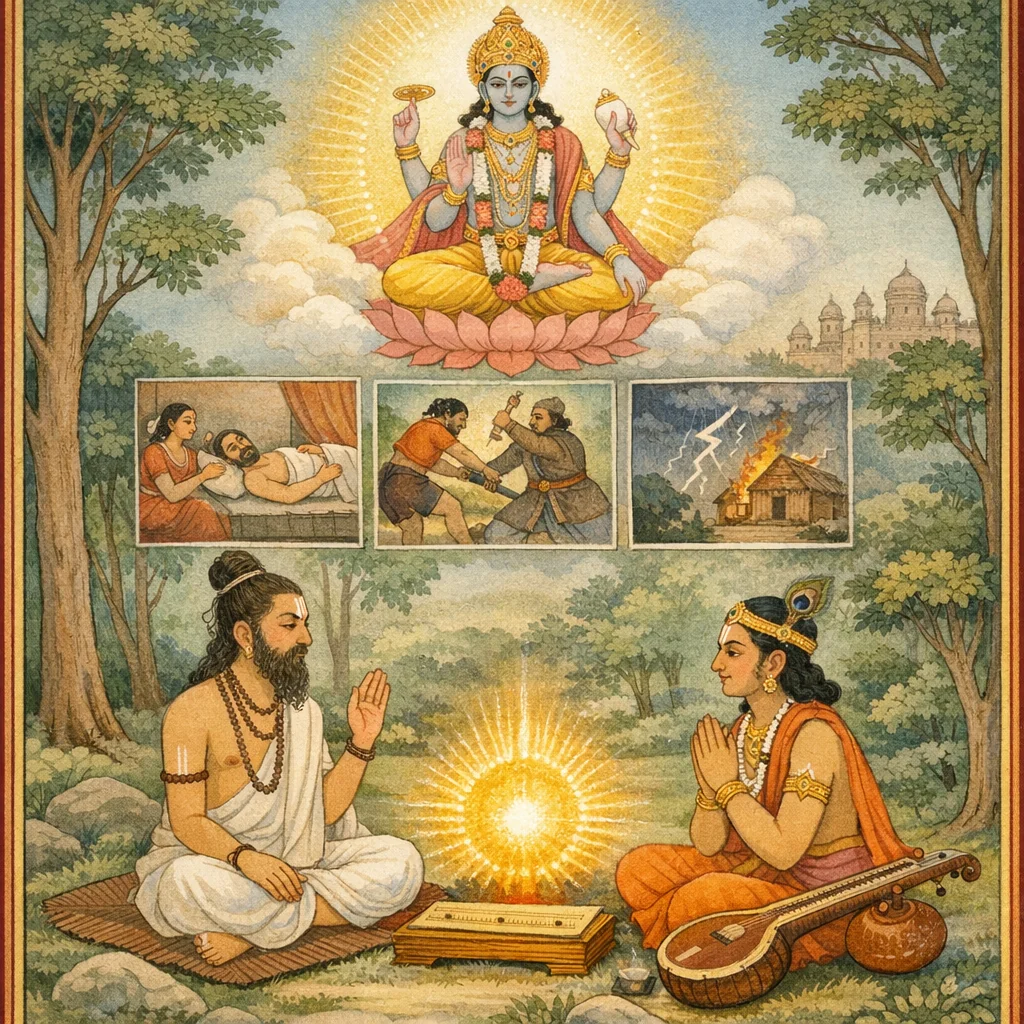
Sūta recounts Nārada’s affectionate questioning of Sanandana after a teaching on the Self in Maithilā. Nārada asks how the threefold afflictions may be avoided. Sanandana replies that embodied life is inevitably stamped with triple suffering from the womb to old age, and that the supreme remedy is attainment of Bhagavān—pure bliss beyond all agitation. He then sets forth the means as knowledge and practice, with knowledge being twofold: Āgama-based śabda-brahman and viveka-born para-brahman, supported by the Atharvaṇa śruti’s model of lower and higher vidyā. The chapter establishes a rule-governed theological semantics: “Bhagavān” denotes the Imperishable Supreme; bhaga is defined as six opulences (sovereignty, strength, fame, prosperity, knowledge, dispassion), and the title is affirmed as properly referring to Vāsudeva. Yoga is declared the sole destroyer of kleśas, and the Keśidhvaja–Khāṇḍikya (Janaka) narrative is introduced: a dispute over kingship becomes the setting for prāyaścitta, guru-dakṣiṇā, and instruction that avidyā is the “I” and “mine” imposed on the non-Self, culminating in a turn toward Yoga and Self-knowledge.
Shlokas
Verse 1
सूत उवाच । तच्छृत्वा नारदो विप्रा मैथिलाध्यात्ममुत्तमम् । पुनः पप्रच्छ तं प्रीत्या सनंदनमुदारधीः ॥ १ ॥
Sūta said: O brāhmaṇas, having heard that supreme Maithila teaching on the Self, Nārada—broad-minded and delighted—again questioned Sanandana with affection.
Verse 2
नारद उवाच । आध्यात्मिकादित्रिविधं तापं नानुभवेद्यथा । प्रब्रूहि तन्मुने मह्यं प्रपन्नाय दयानिधे ॥ २ ॥
Nārada said: O sage, teach me how one may not experience the threefold afflictions, beginning with the inner (ādhyātmika). O treasure-house of compassion, tell me—for I have taken refuge in you.
Verse 3
सनंदन उवाच । तदस्य त्रिविधं दुःखमिह जातस्य पंडित । गर्भे जन्मजराद्येषुस्थानेषु प्रभविष्यतः ॥ ३ ॥
Sanandana said: “O learned one, for the embodied being born in this world, suffering is threefold; it arises in the womb, and in the conditions of birth, old age, and the like.”
Verse 4
निरस्तातिशयाह्लादसुखभावैकलक्षणा । भेषजं भगवत्प्राप्तिरैका चात्यंतिकी मता ॥ ४ ॥
That alone is held to be the ultimate, endless remedy: attaining Bhagavān—whose very nature is a single, unsurpassed state of bliss, free from all excess and agitation.
Verse 5
तस्मात्तत्प्राप्तये यत्नः कर्तव्यः पंडितैर्नरैः । तत्प्राप्तिहेतुज्ञानं च कर्म चोक्तं महामुने ॥ ५ ॥
Therefore, wise men must strive to attain That (the Supreme Goal). And, O great sage, both the knowledge of the cause that leads to Its attainment and the appropriate spiritual practice (karma) have been taught.
Verse 6
आगमोत्थं विवेकाञ्च द्विधा ज्ञानं तथोच्यते । शब्दब्रह्मागममयं परं ब्रह्मविवेकजम् ॥ ६ ॥
Knowledge is thus said to be twofold: that which arises from Āgama (scriptural tradition) and that which arises from discernment (viveka). The Brahman in the form of sound (śabda-brahman) is constituted of Āgama, while the Supreme Brahman (para-brahman) is born of discriminative insight.
Verse 7
मनुरप्याह वेदार्थं स्मृत्वायं मुनिसत्तमः । तदेतच्छ्रूयतामत्र सुबोधं गदतो मम ॥ ७ ॥
This foremost of sages, Manu too, having recalled the purport of the Vedas, spoke. Therefore, hear here this same teaching, clearly explained, as I now declare it.
Verse 8
द्वे ब्रह्मणी वेदितव्ये शब्दब्रह्म परं च यत् । शब्दब्रह्मणि निष्णातः परं ब्रह्माधिगच्छति ॥ ८ ॥
Two forms of Brahman are to be known: Brahman as sacred sound (śabda-brahman) and Brahman as the Supreme (para-brahman). One who is fully accomplished in the Brahman of sound attains the Supreme Brahman.
Verse 9
द्वे विद्ये वेदितव्ये चेत्याह चाथर्वणी श्रुतिः । परमा त्वक्षरप्राप्तिर्ऋग्वेदादिमया परा ॥ ९ ॥
The Atharvaṇa śruti proclaims that two kinds of knowledge are to be known. The supreme is that by which the Imperishable (Akṣara) is attained; the other is the knowledge of the Ṛgveda and the rest of the Vedic corpus.
Verse 10
यत्तदव्यक्तमजरमनीहमजमव्ययम् । अनिर्देश्यमरूपं च पाणिपादादिसंयुतम् ॥ १० ॥
That Supreme is unmanifest, undecaying, desireless, unborn, and imperishable; it is indescribable and formless—yet (in a transcendent sense) endowed with hands, feet, and the like.
Verse 11
विभुं सर्वगतं नित्यं भूतयोनिमकारणम् । व्याप्यं व्याप्तं यतः सर्वं तं वै पश्यंति सूरयः ॥ ११ ॥
The wise behold that Supreme Lord—mighty, all-pervading, eternal—the source-womb of all beings, yet Himself without any (material) cause; for from Him everything is pervaded and spread throughout.
Verse 12
तद्ब्रह्म तत्परं धाम तद्ध्येयं मोक्षकांक्षिभिः । श्रुतिवाक्योदितं सूक्ष्मं तद्विष्णोः परमं पदम् ॥ १२ ॥
That is Brahman; that is the supreme abode. It is to be meditated upon by those who seek liberation. Subtle, proclaimed by the words of Śruti—this is the highest station of Viṣṇu.
Verse 13
तदेव भगवद्वाच्यं स्वरूपं परमात्मनः । वाचको भगवच्छब्दस्तस्योद्दिष्टोऽक्षयात्मनः ॥ १३ ॥
That very essential nature of the Supreme Self is what is denoted by the word “Bhagavān”; and the word “Bhagavān” is the signifying term specifically intended for that Imperishable Self.
Verse 14
एवं निगदितार्थस्य यत्तत्वं तस्य तत्त्वतः । ज्ञायते येन तज्ज्ञानं परमन्यत्त्रयीमयम् ॥ १४ ॥
Thus, that knowledge by which the real essence of what has been stated is known in its true reality—know that knowledge to be supreme, distinct from the (mere) triad of the Vedas.
Verse 15
अशब्दगोचरस्यापि तस्य वै ब्रह्मणो द्विजा । पूजायां भगवच्छब्दः क्रियते ह्यौपचारिकः ॥ १५ ॥
O twice-born ones, even for that Brahman which is beyond the reach of words, in worship the designation “Bhagavān” is employed only in a figurative, conventional sense.
Verse 16
शुद्धे महाविभूत्याख्ये परे ब्रह्मणि वर्त्तते । भगवन्भगवच्छब्दः सर्वकारणकारणे ॥ १६ ॥
The word “Bhagavān” is used with reference to the Supreme Brahman—pure, known as the possessor of great divine majesty—who abides as the Cause of all causes.
Verse 17
ज्ञेयं ज्ञातेति तथा भकारोऽर्थद्वयात्मकः । तेनागमपिता स्रष्टा गकारोऽयं तथा मुने ॥ १६ ॥
The syllable “bha” bears a twofold meaning—“that which is to be known” and “the knower”. Therefore, O sage, the syllable “ga” is to be understood as the father of the Āgamas and also as the Creator.
Verse 18
ऐश्वर्यस्य समग्रस्य वीर्यस्य यशसः श्रियः । ज्ञानवैराग्ययोश्चैव षण्णां भग इतीरणा ॥ १७ ॥
Complete sovereignty, heroic power, fame, prosperity, and also knowledge and dispassion—these six are declared to be the meaning of the term “bhaga,” divine opulence.
Verse 19
वसंति तत्र भूतानि भूतात्मन्यखिलात्मनि । सर्वभूतेष्वशेषेषु वकारार्थस्ततोऽव्ययः ॥ १८ ॥
All beings dwell there—in the Self of beings, the all-pervading Self. Since He abides in every being without remainder, the syllable “va” therefore signifies the Imperishable (Avyaya).
Verse 20
एवमेव महाशब्दो भगवानिति सत्तम । परमब्रह्मभूतस्य वासुदेवस्य नान्यगः ॥ १९ ॥
Even so, O best among the virtuous, the great and exalted word “Bhagavān” pertains to none other than Vāsudeva, whose very nature is the Supreme Brahman.
Verse 21
तत्र पूज्यपदार्थोक्तिः परिभाषासमन्वितः । शब्दोऽयं नोपचारेण चान्यत्र ह्युपचारतः ॥ २० ॥
In that context, the statement denotes a venerable object and is accompanied by a defining rule (paribhāṣā). There the term is not used figuratively; elsewhere, however, it is applied only in a figurative sense.
Verse 22
उत्पत्तिं प्रलयं चैव भूतानामागतिं गतिम् । वेत्ति विद्यामविद्यां च स वाच्यो भगवानिति ॥ २१ ॥
He who knows the arising and dissolution of beings, their coming and their going, and who also knows true knowledge (vidyā) and ignorance (avidyā)—he is to be called “Bhagavān.”
Verse 23
ज्ञानशक्तिबलैश्वर्यवीर्यतेजांस्यशेषतः । भगवच्छब्दवाच्यानि विना हेयैर्गुणादिभिः ॥ २२ ॥
Perfect knowledge, power, strength, lordship, valor, and splendor—without remainder—are what the word “Bhagavān” denotes, and this is so only when these qualities are free from all blameworthy traits and the like.
Verse 24
सर्वाणि तत्र भूतानि वसंति परमात्मनि । भूतेषु वसनादेव वासुदेवस्ततः स्मृतः ॥ २३ ॥
All beings dwell there in the Supreme Self (Paramātman). And because He dwells within all beings, He is therefore remembered as Vāsudeva.
Verse 25
खांडिक्यं जनकं प्राह पृष्टः केशिध्वजः पुरा । नामव्याख्यामनंतस्य वासुदेवस्य तत्त्वतः ॥ २४ ॥
Formerly, when questioned, Keśidhvaja spoke to Khāṇḍikya Janaka, explaining in truth the meaning of the Name of Ananta—Vāsudeva.
Verse 26
भूतेषु वसते सोंऽतर्वसंत्यत्र च तानि यत् । धाता विधाता जगतां वासुदेवस्ततः प्रभुः ॥ २५ ॥
He dwells within all beings, and all beings abide in Him. Therefore Vāsudeva is the Lord—both the sustainer and the ordainer of the worlds.
Verse 27
स सर्वभूतप्रकृतिं विकारं गुणादिदोषांश्च मुने व्यतीतः । अतीतसर्वावरणोऽखिलात्मा तेनास्तृतं यद्भुवनांतरालम् ॥ २६ ॥
O sage, He transcends the very nature of all beings and all its modifications, as well as the defects beginning with the guṇas. Beyond every covering and veil, the Self of all, it is by Him that the entire expanse between the worlds is pervaded.
Verse 28
समस्तकल्याणगुणं गुणात्मको हित्वातिदुःखावृतभूतसर्गः । इच्छागृहीताभिमतोरुदेहः संसाधिताशेषजगद्धितोऽसौ ॥ २७ ॥
He is the very essence of all auspicious virtues, the Lord of all qualities. Though embodied creation is veiled by intense suffering, by His own will He assumes the vast form He chooses and accomplishes the welfare of the entire universe.
Verse 29
तेजोबलैश्वर्यमहावबोधं स्ववीर्यशक्त्यादुगुणैकराशिः । परः पराणां सकला न यत्र क्लेशादयः संति परावरेशे ॥ २८ ॥
In Him are amassed radiance, strength, sovereignty, and supreme consciousness—an undivided treasury of virtues such as His own heroism and power. He is the Supreme beyond all the supreme; in that Lord of both higher and lower realms, afflictions and the like do not exist at all.
Verse 30
स ईश्वरो व्यष्टिसमष्टिरूपोऽव्यक्तस्वरूपः प्रकटस्वरूपः । सर्वेश्वरः सर्वनिसर्गवेत्ता समस्तशक्तिः परमेश्वराख्यः ॥ २९ ॥
He is the Lord, bearing the form of both the individual (vyaṣṭi) and the cosmic totality (samaṣṭi); His true nature is unmanifest, yet He also appears in manifest form. He is the Lord of all, knower of the entire order of creation, endowed with all powers, and is known as Parameśvara, the Supreme Lord.
Verse 31
स ज्ञायते येन तदस्तदोषं शुद्धं परं निर्मलमेव रूपम् । संदृश्यते चाप्यवगम्यते च तज्ज्ञानमतोऽन्यदुक्तम् ॥ ३० ॥
That by which the Supreme—free from every defect, pure, transcendent, and utterly stainless in essence—is known; and that by which He is, as it were, directly seen and truly understood: that alone is called “knowledge.” Anything else is said to be other than knowledge.
Verse 32
स्वाध्यायसंयमाभ्यां स दृश्यते पुरुषोत्तमः । तत्प्राप्तिकारणं ब्रह्म तवेतत्प्रतिपद्यते ॥ ३१ ॥
Through svādhyāya (scriptural self-study) and saṃyama (self-restraint), Puruṣottama, the Supreme Person, is truly perceived. The Brahman that is the cause of attaining Him—this, O you, is to be rightly understood and realized.
Verse 33
स्वाध्यायाद्योगमासीत योगात्स्वाध्यायमामनेत् । स्वाध्याययोगसंपत्त्या परमात्मा प्रकाशते ॥ ३२ ॥
From svādhyāya (sacred self-study) one should enter into yoga, and from yoga one should return again to svādhyāya. Through the perfected union of svādhyāya and yoga, the Supreme Self, Paramātmā, becomes manifest.
Verse 34
तदीक्षणाय स्वाध्यायश्चक्षुर्योगस्तथापरम् । न मांसचक्षुषा द्रष्टुं ब्रह्मभूतः स शक्यते ॥ ३३ ॥
To behold That Supreme Reality, the ‘eye’ is svādhyāya and likewise the higher discipline of yoga. One who has become Brahman cannot be seen with the fleshly eye.
Verse 35
नारद उवाच । भगवंस्तमहं योगं ज्ञातुमिच्छामि तं वद । ज्ञाते यन्नाखिलाधारं पश्येयं परमेश्वरम् ॥ ३४ ॥
Nārada said: “O Blessed One, tell me that Yoga which I long to know—by knowing it, may I behold the Supreme Lord, Parameśvara, the support of all and the foundation of the entire universe.”
Verse 36
सनंदन उवाच । केशिध्वजो यथा प्राह खांडिक्याय महात्मने । जनकाय पुरा योगं तथाहं कथयामि ते ॥ ३५ ॥
Sanandana said: “Just as Keśidhvaja formerly taught Yoga to the great-souled Khāṇḍikya—and to King Janaka—so too shall I explain that Yoga to you.”
Verse 37
नारद उवाच । खांङिक्यः कोऽभवद्बह्यन्को वा केशिध्वजोऽभवत् । कथं तयोश्च संवादो योगसंबन्धवानभूत् ॥ ३६ ॥
Narada said: “Who was Khāṃṅikya, and who was Keśidhvaja? How did a dialogue between the two arise that was connected with Yoga?”
Verse 38
सनंदन उवाच । धर्मध्वजो वै जनक तस्य पुशेऽमितध्वजः । कृतध्वजोऽस्य भ्राताभूत्सदाध्यात्मरतिर्नृपः ॥ ३७ ॥
Sanandana said: “Indeed there was a progenitor named Dharmadhvaja. From him was born Amitadhvaja. His brother was Kṛtadhvaja, a king ever devoted to the knowledge of the Self (Ātman).”
Verse 39
कृतध्वजस्य पुत्रोऽभूद्धन्यः केशिध्वजो द्विजः । पुत्रोऽमितव्वजस्यापि खांडिक्यजनकाभिधः ॥ ३८ ॥
Kṛtadhvaja’s son was the twice-born Keśidhvaja, renowned as “Dhanya.” And Amitavvaja’s son too was known as Khāṇḍikya, also called Janaka.
Verse 40
कर्ममार्गे हि खांडिक्यः स्वराज्यादवरोपितः । पुरोधसा मंत्रिभिश्च समवेतोऽल्पसाधनः ॥ ३८ ॥
Indeed, Khāṇḍikya—fallen from his own sovereignty—entered upon the path of karma, the way of ritual action. Accompanied by his family priest and ministers, he went forth with only scant resources.
Verse 41
राज्यान्निराकृतः सोऽथ दुर्गारण्यचरोऽभवत् । इयाज सोऽपि सुबहून यज्ञाञ्ज्ञानव्यपाश्रयः ॥ ३९ ॥
Cast out from his kingdom, he then came to dwell in an inaccessible forest. There too, relying upon spiritual knowledge, he performed many yajñas, sacred sacrifices.
Verse 42
ब्रह्मविद्यामधिष्टाय तर्तुं मृत्युमपि स्वयम् । एकदा वर्तमानस्य यागे योगविदां वर ॥ ४० ॥
Established in Brahma-vidyā, the knowledge of Brahman, he was able—even by himself—to cross beyond death. Once, while a yajña was in progress, O best among the knowers of Yoga, this occurred.
Verse 43
तस्य धेनुं जघानोग्रः शार्दूलो विजने वने । ततो राजा हतां ज्ञात्वा धेनुं व्याघ्रेण चर्त्विजः ॥ ४१ ॥
In a lonely forest, a fierce tiger slew his cow. Then the king and the officiating priest, learning that the cow had been killed by the tiger, were filled with grave concern.
Verse 44
प्रायश्चित्तं स पप्रच्छ किमत्रेति विधीयताम् । ते चोचुर्नवयंविद्मः कशेरुः पृच्छ्यतामिति ॥ ४२ ॥
He asked about the expiation (prāyaścitta), saying, “What is to be prescribed here?” They replied, “We do not know—ask Kaśeru.”
Verse 45
कशेरुरपि तेनोक्तस्तथेति प्राह नारद । शुनकं पृच्छ राजेन्द्र वेद स वेत्स्यति ॥ ४३ ॥
Kaśeru too, when addressed by him, replied, “So be it,” O Nārada. “O best of kings, ask Śunaka—he knows the Veda and will explain it.”
Verse 46
स गत्वा तमपृच्छञ्च सोऽप्याह नृपतिं मुने । न कशेरुर्नचैवाहं न चान्यः सांप्रतं भुवि ॥ ४४ ॥
Having gone to him and questioned him, he too replied, “O sage, at present on earth there is neither Kaśeru, nor I, nor anyone else (like that).”
Verse 47
वेत्त्येक एव त्वच्छत्रुः खांडिक्यो यो जितस्त्वया । स चाह तं व्रजाम्येष प्रष्टुमात्मरिपुं मुने ॥ ४५ ॥
Only one knows your enemy—Khāṇḍikya, whom you have conquered. He said, “I shall go to him now, O sage, to question him about the inner foe (ātma-ripu), the enemy within.”
Verse 48
प्राप्त एव मया यज्ञे यदि मां स हनिष्यति । प्रायश्चित्तं स चेत्पृष्टो वदिष्यति रिपुर्मम ॥ ४६ ॥
If, having come to the yajña, he truly slays me, then—when questioned—my enemy himself will speak of the prāyaścitta, the rite of expiation.
Verse 49
ततश्चाविकलो योगो मुनिश्रेष्ट भविष्यति । इत्युक्त्वा रथमारुह्य कृष्णाजिनधरो नृपः ॥ ४७ ॥
“Then, O best of sages, your Yoga will become unobstructed and complete.” Saying so, the king, clad in a black antelope-skin, mounted his chariot.
Verse 50
वनं जगाम यत्रास्ते खांडिक्यः स महीपतिः । तमायांतं समालोक्य खांजडिक्यो रिपुमात्मनः ॥ ४८ ॥
He went to the forest where King Khāṇḍikya was staying. Seeing him approach, Khāṃjaḍikya—his own enemy—looked on.
Verse 51
प्रोवाच क्रोधताम्राक्षः समारोपितकार्मुकः । खांडिक्य उवाच । कृष्णाजिनत्वक्कवचभावेनास्मान्हनिष्यसि ॥ ४९ ॥
With eyes reddened by wrath, his bow already strung, he spoke. Khāṇḍikya said: “You will slay us because you are clad in the protective armor of a black antelope-skin.”
Verse 52
कृष्णाजिनधरे वेत्सि न मयि प्रहरिष्यति । मृगानां वद पृष्टेषु मूढ कृष्णाजिनं न किम् ॥ ५० ॥
You think, “Because I wear a black antelope-skin, he will not strike me.” But tell me, fool—upon the backs of deer, is there not also a black antelope-skin?
Verse 53
येषां मत्वा वृथा चोग्राः प्रहिताः शितसायकाः । स त्वामहं हनिष्यामि न मे जीवन्विमोक्ष्यसे ॥ ५१ ॥
Thinking that my fierce, sharp arrows had been shot in vain against others, I will now slay you—you shall not escape from me alive.
Verse 54
आतताय्यसि दुर्बुद्धे मम राज्यहरो रिपुः । केशिध्वज उवाच । खांडिक्य संशयं प्रष्टुं भवंतमहमागतः ॥ ५२ ॥
“You are a murderous aggressor, wicked-minded one—an enemy who has stolen my kingdom!” Keśidhvaja said: “O Khāṇḍikya, I have come to you to ask about a doubt.”
Verse 55
न त्वां हंतुं विचार्यतैत्कोपं बाणं च मुंच वा । ततः स मंत्रिभिः सार्द्धमेकांते सपुरोहितः ॥ ५३ ॥
Reflecting thus, he decided not to kill him; curbing his anger, he withheld the arrow. Then, with ministers and priest, he withdrew to a secluded spot.
Verse 56
मंत्रयामास खांडिक्यः सर्वैरेव महामतिः । तमूर्मंत्रिणो वध्यो रिपुरेष वशंगतः ॥ ५४ ॥
Khāṇḍikya, the great-minded one, consulted with all his counselors. The ministers said, “This enemy has fallen under our control; he should be put to death.”
Verse 57
हतेऽत्र पृथिवी सर्वा तव वश्या भविष्यति । खांडिक्यश्चाह तान्सर्वानेवमेव न संशयः ॥ ५५ ॥
“When he is slain, the whole earth here will come under your control.” Khāṇḍikya also said to all of them, “It will be exactly so—there is no doubt.”
Verse 58
हते तु पृथिवी सर्वा मम वश्या भविष्यति । परलोकजयस्तस्य पृथिवी सकला मम ॥ ५६ ॥
But once he is slain, the whole earth will come under my sway. For the one who conquers the world beyond, the entire earth is mine.
Verse 59
न हन्मि चेल्लोकजयो मम वयत्वस्सुंधरा । परलोकजयोऽनंतः स्वल्पकालो महीजयः ॥ ५७ ॥
If I do not slay the foe, then my conquest of this world is but a youthful, fleeting ornament. The conquest of the next world is endless, whereas victory over the earth endures only a short while.
Verse 60
तस्मान्नैनं हनिष्येऽहं यत्पृच्छति वदामि तत् । ततस्तमभ्युपेत्याह खांडिक्यो जनको रिपुम् ॥ ५८ ॥
“Therefore I will not kill him; whatever he asks, I shall tell him.” Having resolved thus, Khāṇḍikya approached his enemy, King Janaka, and spoke to him.
Verse 61
प्रष्टव्यं यत्त्वया सर्वं तत्पृच्छ त्वं वदाम्यहम् । ततः प्राह यथावृत्तं होमधेनुवधं मुने ॥ ५९ ॥
“Ask whatever you wish to ask—ask it all; I will tell you.” Then, O sage, he recounted exactly as it had happened the slaying of the sacrificial cow Homadhenu.
Verse 62
ततश्च तं स पप्रच्छ प्रायश्चित्तं हि तद्रूतम् । स चाचष्ट यथान्यायं मुने केशिध्वजाय तत् ॥ ६० ॥
Then he asked about the proper expiation (prāyaścitta) for that deed; and the other, in accordance with the rule of dharma, explained it to the sage Keśidhvaja.
Verse 63
प्रायश्चित्तमशेषं हि यद्वै तत्र विधीयते । विदितार्थः स तेनैवमनुज्ञातो महात्मना ॥ ६१ ॥
Indeed, there was laid down there whatever complete prāyaścitta—full expiation—was prescribed. Having understood its meaning, he was thus granted permission by that great-souled one.
Verse 64
यागभूमिमुपागत्य चक्रे सर्वां क्रियां क्रमत् । क्रमेण विधिवद्यागं नीत्वा सोऽवभृथाप्लुतः ॥ ६२ ॥
Having reached the sacrificial ground, he performed every rite in due order; and, having conducted the sacrifice step by step according to rule, he then undertook the concluding avabhṛtha bath.
Verse 65
कृतकृत्यस्ततो भूत्वा चिंतयामास पार्थिवः । पूजिता ऋत्विजः सर्वे सदस्या मानिता मया ॥ ६३ ॥
Then the king, feeling that his duties had been duly fulfilled, began to reflect: “All the officiating priests have been worshipfully honored, and the learned members of the assembly have been duly respected by me.”
Verse 66
तथैवार्थिजनोऽप्यर्थोजितोऽभिमतैर्मया । यथाहं मर्त्यलोकस्य मया सर्वं विचष्टितम् ॥ ६४ ॥
In the same way, even the seeker of wealth is won over by me through the objects he desires; for I have observed and understood everything about the mortal world.
Verse 67
अनिष्पन्नक्रियं चेतस्तथा न मम किं यथा । इत्थं तु चिंतयन्नेव सम्मार स महीपतिः ॥ ६५ ॥
“My mind is incapable of completing any resolve; it does not remain under my control at all.” Thinking in this way again and again, that king fell into delusion and despair.
Verse 68
खांडिक्याय न दत्तेति मया वैगुरुदक्षिणा । स जगाम ततो भूयो रथमारुह्य पार्थिवः ॥ ६६ ॥
Thinking, “I did not give Khāṇḍikya the guru’s due fee (guru-dakṣiṇā),” the king set out again, mounting his chariot once more.
Verse 69
स्वायंभुवः स्थितो यत्र खांडिक्योऽरण्यदुर्गमम् । खांडिक्योऽपि पुनर्द्दष्ट्वा तमायान्तं धृतायुधः ॥ ६७ ॥
In that hard-to-reach forest stronghold where Svāyaṁbhuva was staying, Khāṇḍikya too was present. And Khāṇḍikya, weapon in hand, seeing him approach once again, readied himself.
Verse 70
तस्थौ हंतुं कृतमतिस्ममाह स पुनर्नृपः । अहं तु नापकाराय प्राप्तः खांडिक्य मा क्रुधः ॥ ६८ ॥
Resolved to strike, he stood ready; but the king spoke again: “O Khāṇḍikya, do not be angry. I have come not to harm you.”
Verse 71
गुरोर्निष्कृतिदानाय मामवेहि सेमागतम् । निष्पादितो मया यागः सम्यक् त्वदुपदेशतः ॥ ६९ ॥
Know that I have come to offer my guru the due recompense and amends. The sacrifice (yajña) has been properly completed by me, exactly in accordance with your instruction.
Verse 72
सोऽहं ते दातुमिच्छामि वृणीष्व गुरुदक्षिणाम् । इत्युक्तो मंत्रयामास स भूयो मंत्रिभिः सह ॥ ७० ॥
“Therefore I wish to give you a gift; choose the guru’s fee (guru-dakṣiṇā).” Thus addressed, he deliberated again together with his ministers.
Verse 73
गुरोर्निष्कृतिकामोऽय किमयं प्रार्थ्यतां मया । तमूचुर्मंत्रिणो राज्यमशेषं याच्यतामयम् ॥ ७१ ॥
“This man longs for expiation for his offense against the Guru; what, then, should I ask of him?” The ministers said: “Demand from him the entire kingdom.”
Verse 74
कृताभिः प्रार्थ्यते राज्यमनायासितसैनिकैः । प्राहस्य तानाह नृपः स खांडिक्यो महापतिः ॥ ७२ ॥
When the Kṛtas—whose troops had not been wearied in battle—begged for the kingdom, King Khāṇḍikya, that great lord, laughed and spoke to them.
Verse 75
स्वल्पकालं महीराज्यं मादृशैः प्रार्थ्यते कथम् । एतमेतद्भंवतोऽत्र स्वार्थ साधनमंत्रिणः ॥ ७३ ॥
“How could people like us seek a sovereignty over the earth that lasts but a little while? This indeed is what you ministers, pursuing your own advantage, are trying to accomplish here.”
Verse 76
परमार्थः कथं कोऽत्र यूयं नात्र विचक्षणाः । इत्युक्त्वा समुपेत्यैंनं स तु केशिध्वजं नृपम् ॥ ७४ ॥
“How can there be any paramārtha, the highest truth, here? You are not discerning in this matter.” Saying this, he approached King Keśidhvaja.
Verse 77
उवाच किमवश्यं त्वं दास्यसि गुरुदक्षिणाम् । बाढमित्येव तेनोक्तः खांडिक्यस्तमथाब्रवीत् ॥ ७५ ॥
He asked, “What guru-dakṣiṇā—the offering due to the Guru—will you certainly give?” When the other replied, “Surely,” Khāṇḍikya then spoke to him.
Verse 78
भवानध्यात्मविज्ञानपरमार्थविचक्षणः । यदि चेद्दीयते मह्यं भवता गुरुनिष्क्रयः ॥ ७६ ॥
You are discerning in the science of the Self and in the supreme Truth. If you are willing, then grant me the “guru-niṣkraya”—the means of release through the Guru, the decisive guidance by which a disciple is set free.
Verse 79
तत्क्लेशप्रशमायालं यत्कर्म तदुदीरय । केशिध्वज उवाच । न प्रार्थितं त्वया कस्मान्मम राज्यमकंटकम् ॥ ७७ ॥
“Teach me that practice which is sufficient to pacify this affliction.” Keśidhvaja said: “Why have you not asked from me for my kingdom—free of thorns, that is, free from troubles and opposition?”
Verse 80
राज्यलाभाः द्धि नास्त्यन्यत्क्षत्रियाणामतिप्रियम् । खांडिक्य उवाच । केशिध्वज निबोध त्वं मया न प्रार्थितं यतः ॥ ७८ ॥
For kṣatriyas, nothing is dearer than the gaining of a kingdom. Khāṇḍikya said: “Keśidhvaja, understand this—what I seek has not been asked from you for that reason; it is not for sovereignty.”
Verse 81
राज्यमेतदशेषेण यन्न गृघ्रंति पंडिताः । क्षत्रियाणामयं धर्मो यत्प्रजापरिपालनम् ॥ ७९ ॥
Wise people do not covet sovereignty in its entirety for its own sake. The true duty (dharma) of a kṣatriya is this: the protection and righteous governance of the subjects.
Verse 82
वधश्च धर्मयुद्धेन स्वराज्यपरिपंथिनाम् । यत्राशक्तस्य मे दोषो नैवास्त्यपकृते त्वया ॥ ८० ॥
And the slaying, in a righteous war according to dharma, of those who obstruct one’s rightful sovereignty—therein no fault belongs to me, who was powerless, for it was you who committed the wrongdoing.
Verse 83
बंधायैव भवत्येषा ह्यविद्या चाक्रमोज्झिता । जन्मोपभोगलिप्सार्थमियं राज्यस्पृहा मम ॥ ८१ ॥
This indeed becomes a cause of bondage—this avidyā, this ignorance not cast away. For the sake of craving repeated birth and worldly enjoyment, this longing for kingship has arisen in me.
Verse 84
अन्येषां दोपजानेव धर्ममेवानुरुध्यते । न याच्ञा क्षत्रबंधूनां धर्मायैतत्सतां मतम् ॥ ८२ ॥
For others, dharma is pursued only as a secondary gain; but for true kṣatriyas, begging is not held to be a means of upholding dharma—this is the view of the virtuous.
Verse 85
अतो न याचित राज्यमविद्यांतर्गतं तव । राज्यं गृध्नंति विद्वांसो ममत्वाकृष्टचेतसः ॥ ८३ ॥
Therefore I did not ask you for kingship, for sovereignty lies within the domain of avidyā. It is those ‘learned’ men whose minds are drawn by possessiveness who crave for a kingdom.
Verse 86
अहंमानमह्य पानमदमत्ता न मादृशाः । केशिध्वज उवाच । अहं च विद्यया मृत्युं तर्तुकामः करोमि वै ॥ ८४ ॥
Intoxicated by self-conceit and by the pride of drinking, none are like me. Keśidhvaja said: “And I, by means of true knowledge (vidyā), strive indeed to cross beyond death.”
Verse 87
राज्यं यज्ञांश्च विविधान्भोगे पुण्यक्षयं तथा । तदिदं ते मनो दिष्ट्या विवेकैश्चर्यतां गतम् ॥ ८५ ॥
Kingdoms, many kinds of sacrifices (yajñas), and worldly enjoyments also lead to the exhaustion of merit. Therefore, blessed indeed are you—through discernment (viveka), your mind has turned toward the path of right conduct and wise restraint.
Verse 88
श्रूयतां चाप्यविद्यायाः स्वरूपं कुलनंदन । अनात्मन्यात्मबुद्धिर्या ह्यस्वे स्वविषया मतिः ॥ ८६ ॥
Hear also the true nature of ignorance (avidyā), O delight of your lineage: it is the notion of “I” in what is not the Self (Ātman), and the conviction of “mine” regarding what is not one’s own.
Verse 89
अविद्यातरुसंन्भूतं बीजमेतद्द्विधा स्थितम् । पंचभूतात्मके देहे देही मोहतमोवृत्तः ॥ ८७ ॥
This seed, born from the tree of ignorance (avidyā), stands in a twofold form. In a body constituted of the five elements, the embodied self moves under the sway of delusion and darkness (tamas).
Verse 90
अहमेतदितीत्युञ्चैः कुरुते कुमतिर्मतिम् । आकाशवाय्वग्रिजलपृथिवीभिः पृथक् स्थिते ॥ ८८ ॥
Though the Self (Ātman) is truly distinct from space, air, fire, water, and earth, a deluded intellect still loudly forms the notion, “I am this (body).”
Verse 91
आत्मन्यात्ममयं भावं कः करोति कलेवरे । कलेवरोपभोग्यं हि गृहक्षेत्रादिकं च यत् ॥ ८९ ॥
Who, indeed, can establish Self-natured awareness within the body? For whatever is enjoyed by the body—house, land, and the like—belongs only to the body’s experience.
Verse 92
अदेहे ह्यात्मनि प्राज्ञो ममेदमिति मन्यते । इत्थं च पुत्रपौत्रेषु तद्देहोत्पादितेषु च ॥ ९० ॥
Though the Self (Ātman) is bodiless, one who mistakes reality thinks, “This is mine.” In the same way, he extends this sense of “mine” to sons and grandsons, and even to the bodies that arise from that body—his progeny.
Verse 93
करोति पंडितः स्वाम्यमनात्मनि कलेवरे । सर्वदेहोपभोगाय कुरुते कर्म मानवः ॥ ९१ ॥
The so-called learned man claims ownership over the body, which is not the Self; and for the sake of enjoying through the whole body, a human being performs karma.
Verse 94
देहं चान्यद्यदा पुंसस्सदा बंधाय तत्परम् । मृण्मयं हि यथा गेहं लिप्यते वै मृदंभसा ॥ ९२ ॥
When a man regards the body as something other and yet calls it “I” or “mine,” that very attitude becomes wholly devoted to bondage. As a clay house is smeared again with mud and water, so bodily identification repeatedly accrues further binding impurities.
Verse 95
पार्थिवोऽयं तथा देहो मृदंभोलेपनस्थितिः । पंचभोगात्मकैर्भोगैः पंचभोगात्मकं वपुः ॥ ९३ ॥
This body is earthly in nature, sustained by clay, water, and coatings. By enjoyments constituted of the five sense-objects, the body itself becomes constituted of those five enjoyments.
Verse 96
आप्यायते यदि ततः पुंसो गर्वोऽत्र किंकृतः । अनेकजन्मसाहस्त्रं ससारपदवीं व्रजन् ॥ ९४ ॥
Even if a person becomes prosperous, what cause is there for pride in that? For he has wandered along the road of saṃsāra through thousands of births.
Verse 97
मोहश्रमं प्रयातोऽसौ वासनारेणुगुंठितः । प्रक्षाल्यते यदा सौम्य रेणुर्ज्ञानोष्णवारिणा ॥ ९५ ॥
Worn out by delusion, the soul becomes covered with the dust of latent impressions (vāsanās). But, O gentle one, when that dust is washed away by the warm water of spiritual knowledge, clarity arises.
Verse 98
तदा संसारपांथस्य याति मोहश्रमः शमम् । मोहश्रमे शमं याते स्वच्छांतःकरणः पुमान् ॥ ९६ ॥
Then, upon the road of saṃsāra, the weariness born of delusion comes to rest. When that wearying delusion is pacified, a person’s inner instrument—mind and heart—becomes clear and purified.
Verse 99
अनन्यातिशयाधारः परं निर्वाणमृच्छति । निर्वाणमय एवायमात्मा ज्ञानमयोऽमलः ॥ ९७ ॥
One whose sole support is the Supreme attains the highest Nirvāṇa. This very Self (Ātman) is of the nature of Nirvāṇa—pure, stainless, and made of consciousness-knowledge.
Verse 100
दुःखाज्ञानमया धर्माः प्रकृतेस्ते तुनात्मनः । जलस्य नाग्निना संगः स्थालीसंगात्तथापि हि ॥ ९८ ॥
The qualities and conditions made of suffering and ignorance belong to Prakṛti, not to the Self. Just as water has no real contact with fire—its seeming association is only because it is in the same vessel—so too the Self only appears connected with those qualities.
Verse 101
शब्दोद्रेकादिकान्धर्मान्करोति हि यथा बुधः । तथात्मा प्रकृतेः संगादहंमानादिदूषितः ॥ ९९ ॥
Just as a learned person produces (or adopts) modes of conduct such as heightened speech and the like, so too the Self—through association with Prakṛti—becomes tainted by egoism (ahaṃkāra), pride, and related faults.
Verse 102
भजते प्राकृतान्धर्मान्न्यस्तस्तंभो हि सोऽव्ययः । तदेतत्कथितं बीजमविद्याया मया तव ॥ १०० ॥
Even after casting aside the supporting pillar, the imperishable one still takes up worldly, material duties. This indeed is what I have explained to you as the seed of ignorance (avidyā).
Verse 103
क्लेशानां च क्षयकरं योगादन्यन्न विद्यते ॥ १०१ ॥
There is nothing other than Yoga that brings about the destruction of the afflictions (kleśas).
Frequently Asked Questions
The chapter asserts a paribhāṣā (defining rule) that “Bhagavān” is the signifier for the Imperishable Supreme Self, and then identifies that Supreme as Vāsudeva—who indwells all beings and in whom all beings abide—thereby treating the usage as primary in that context rather than merely figurative.
The text presents a disciplined reciprocity: from svādhyāya one enters Yoga, and from Yoga one returns to svādhyāya; through their accomplished union the Supreme Self becomes manifest. Yoga is singled out as the destroyer of kleśas, while viveka yields para-brahman realization.
It dramatizes the shift from external conflict and ritual concerns (cow killed during yajña, prāyaścitta, avabhṛtha) to the ‘inner enemy’ (avidyā). The guru-dakṣiṇā request becomes a request for liberating instruction, framing Yoga and Self-knowledge as superior to transient sovereignty and merit-exhausting enjoyments.