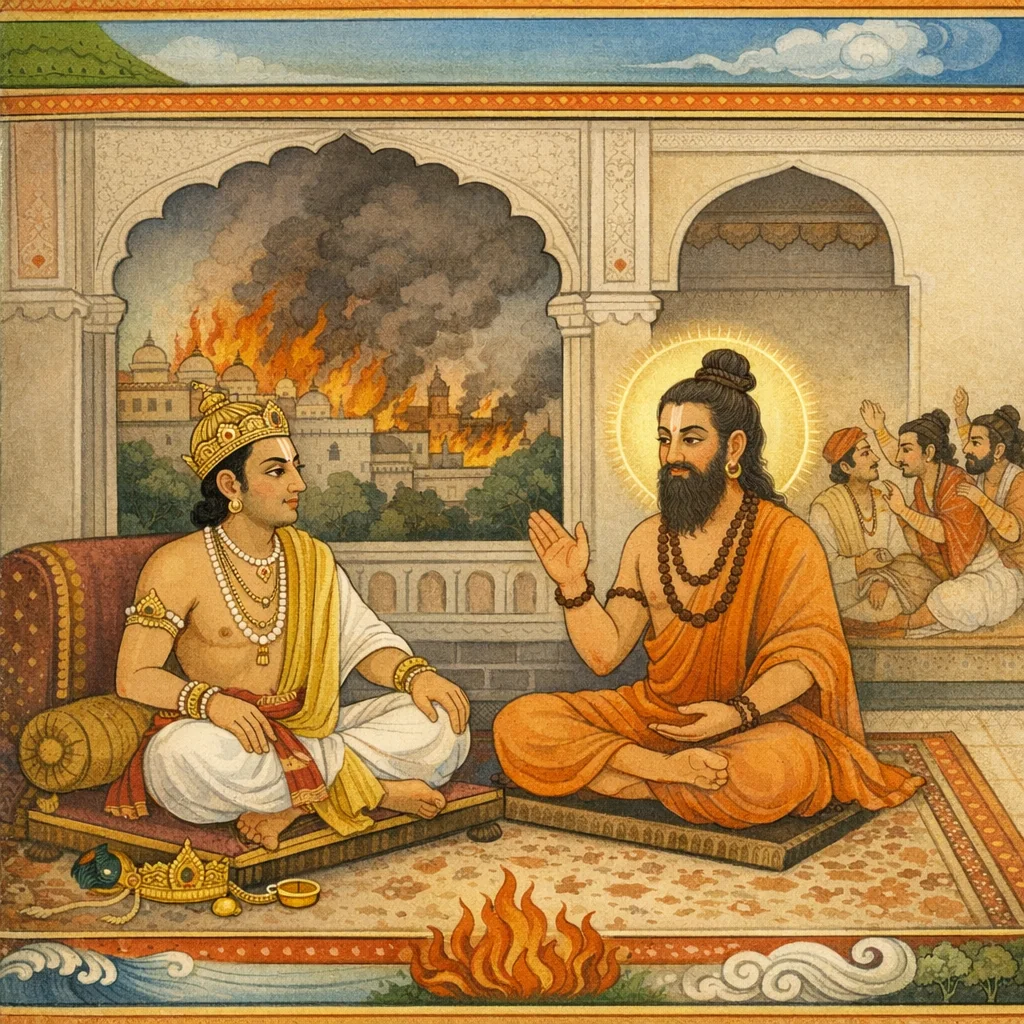
Janaka’s Quest for Liberation; Pañcaśikha’s Sāṅkhya on Renunciation, Elements, Guṇas, and the Deathless State
Sūta says that Nārada, after hearing Sanandana’s dharma of liberation, again requests instruction in adhyātma (1–3). Sanandana then recounts an ancient episode: King Janaka of Mithilā, though surrounded by rival teachers and ritual talk about the after-death state, remains intent on the truth of the Ātman (4–7). The Sāṅkhya sage Pañcaśikha—connected to Kapila’s line through Āsuri and perfected in renunciation—arrives in Mithilā (8–18). Janaka debates and confounds many teachers, yet is drawn to Pañcaśikha, who teaches the “supreme good” as Sāṅkhya liberation and unfolds progressive vairāgya: from caste-identity, to attachment to karma, to complete dispassion (19–23). The discourse critiques unstable ritual-fruit motivations and examines the grounds of knowledge (perception, scripture, settled conclusion), answering materialist denials and confusion about selfhood and rebirth (24–44). Janaka raises annihilationist doubts—if awareness ends at death, what is the value of knowledge? (49–52). Pañcaśikha replies by analyzing the embodied aggregate—five elements, triads of cognition, organs of knowledge and action, buddhi, and the guṇas—culminating in renunciation as the essence of prescribed action and the markless, sorrowless “deathless state” (53–85). Janaka becomes steady in the teaching, shown by his famed words during a city fire: “Nothing of mine burns” (86–87).
Shlokas
Verse 1
सूत उवाच । सनंदनवचः श्रुत्वा मोक्षधर्माश्रितं द्विजाः । पुनः पप्रच्छ तत्त्वज्ञो नारदोऽध्यात्मसत्कथाम् ॥ १ ॥
Sūta said: O twice-born sages, having heard the words of Sanandana, grounded in the dharma that leads to liberation, the knower of truth—Nārada—once again asked about the noble teachings concerning the inner Self (adhyātma).
Verse 2
नारद उवाच । श्रुतं मया महाभाग मोक्षशास्त्रं त्वयोदितम् । न च मे जायते तृप्तिर्भूयोभूयोऽपि श्रृण्वतः ॥ २ ॥
Nārada said: “O greatly fortunate one, I have heard the teaching of liberation as spoken by you; yet even as I listen again and again, no sense of satiety arises in me.”
Verse 3
यथा संमुच्यते जंतुरविद्याबंधनान्मुने । तथा कथय सर्वज्ञ मोक्षधर्मं सदाश्रितम् ॥ ३ ॥
O sage, explain—O omniscient one—how a living being is released from the bondage of ignorance; thus teach the ever-reliable dharma that leads to liberation (mokṣa).
Verse 4
सनंदन उवाच । अत्राप्युदाहरंतीममितिहासं पुरातनम् । यथा मोक्षमनुप्राप्तो जनको मिथिलाधिपः ॥ ४ ॥
Sanandana said: “Here too I shall cite an ancient traditional account—how Janaka, the ruler of Mithilā, attained liberation.”
Verse 5
जनको जनदेवस्तु मिथिलाया अधीश्वरः । और्ध्वदेहिकधर्माणामासीद्युक्तो विचिंतने ॥ ५ ॥
Janaka—also called Janadeva, the sovereign of Mithilā—was deeply absorbed in contemplating the dharmas and rites to be performed after death, the funeral and the post-funeral observances.
Verse 6
तस्य श्मशान माचार्या वसति सततं गृहे । दर्शयंतः पृथग्धर्मान्नानापाषंजवादिनः ॥ ६ ॥
In his house dwelt continually teachers of the śmaśāna path, the way of the cremation-ground; and various sectarian debaters—each displaying a different “dharma”—kept presenting divergent doctrines.
Verse 7
स तेषां प्रेत्यभावे च प्रेत्य जातौ विनिश्चये । आदमस्थः स भूयिष्टमात्मतत्त्वेन तुष्यति ॥ ७ ॥
And he, having ascertained their state after death and their rebirth, remained established in the Ātman and was satisfied—most of all—by the truth of the Self.
Verse 8
तत्र पंचशिखो नाम कापिलेयो महामुनिः । परिधावन्महीं कृत्स्नां जगाम मिथिलामथ ॥ ८ ॥
There, a great sage named Pañcaśikha, a follower of Kapila, after roaming over the whole earth, then went to Mithilā.
Verse 9
सर्वसंन्यासधर्माणः तत्त्वज्ञानविनिश्चये । सुपर्यवसितार्थश्च निर्द्वंद्वो नष्टसंशयः ॥ ९ ॥
He embodies all the disciplines of complete renunciation (sannyāsa); he is firmly established in decisive knowledge of reality (tattva-jñāna); his purpose is fully accomplished; he is free from the pairs of opposites, and his doubts have been destroyed.
Verse 10
ऋषीणामाहुरेकं यं कामादवसितं नृषु । शाश्वतं सुखमत्यंतमन्विच्छन्स सुदुर्लभम् ॥ १० ॥
The sages declare that there is one supreme aim among men, determined after desire has been examined and transcended. Seeking that eternal and utmost bliss, one finds it exceedingly hard to attain.
Verse 11
यमाहुः कपिलं सांख्याः परमर्षि प्रजापतिम् । स मन्ये तेन रूपेण विख्यापयति हि स्वयम् ॥ ११ ॥
Whom the Sāṅkhya sages call Kapila—the supreme seer and a Prajāpati—he, I believe, makes himself known by that very form.
Verse 12
आसुरेः प्रथमं शिष्यं यमाहुश्चिरजीविनम् । पंचस्रोतसि यः सत्रमास्ते वर्षसहस्रकम् ॥ १२ ॥
They call him the first disciple of Āsuri, long-lived indeed—he who remains at Pañcasrotas performing a satra, a continuous sacrificial session, for a thousand years.
Verse 13
पंचस्रोतसमागम्य कापिलं मंडलं महत् । पुरुषावस्थमव्यंक्तं परमार्थं न्यवेदयत् ॥ १३ ॥
Having reached the confluence of the five streams, he revealed the great Kapila-circle, the sphere of Sāṅkhya: he taught the Avyakta, the unmanifest, as the state of Puruṣa and as the supreme truth (paramārtha).
Verse 14
इष्टिमंत्रेण संयुक्तो भूयश्च तपसासुरिः । क्षेत्रक्षेत्रज्ञयोर्व्यक्तिं विबुधे देहदर्शनः ॥ १४ ॥
Endowed with the iṣṭi-mantra and further strengthened by austerity, the sage Āsuri clearly understood the distinction between Kṣetra (the Field) and Kṣetrajña (the Knower of the Field), through direct insight into the nature of the body.
Verse 15
यत्तदेकाक्षरं ब्रह्म नानारूपं प्रदृश्यते । आसुरिर्मंडले तस्मिन्प्रतिपेदे तमव्ययम् ॥ १५ ॥
That Brahman—though the one imperishable “single syllable”—is beheld as manifold in form. In that very maṇḍala, the sage Āsuri realized the unchanging, undecaying Reality.
Verse 16
तस्य पंचशिखः शिष्यो मानुष्या पयसा भृतः । ब्राह्मणी कपिली नाम काचिदासीत्कुटुम्बिनी ॥ १६ ॥
He had a disciple named Pañcaśikha, who was nourished on human milk. There was also a Brahmin woman, a householder, named Kapilī.
Verse 17
तस्यः पुत्रत्वमागत्य स्रियाः स पिबति स्तनौ । ततश्च कापिलेयत्वं लेभे बुद्धिं च नैष्टिकीम् ॥ १७ ॥
Having come to be regarded as her son, he suckled the breasts of Śrī (Lakṣmī). Thereafter he attained the state of being Kāpileya and gained unwavering, consummate spiritual intelligence.
Verse 18
एतन्मे भगवानाह कापिलेयस्य संभवम् । तस्य तत्कापिलेयत्वं सर्ववित्त्वमनुत्तमम् ॥ १८ ॥
This is what the Blessed Lord told me regarding the origin of Kāpileya. From that arose his Kāpileya-nature and his unsurpassed omniscience, the knowledge of all things.
Verse 19
सामात्यो जनको ज्ञात्वा धर्मज्ञो ज्ञानिनं मुने । उपेत्य शतमाचार्यान्मोहयामास हेतुभिः ॥ १९ ॥
O sage, King Janaka—accompanied by his ministers—having recognized the wise knower of Dharma, approached a hundred teachers and, by means of arguments, confounded them.
Verse 20
जनकस्त्वभिसंरक्तः कापि लेयानुदर्शनम् । उत्सृज्य शतमाचार्याम्पृष्टतोऽनुजगाम तम् ॥ २० ॥
But King Janaka, deeply enamored even of the mere sight of that mysterious maiden, abandoned even a hundred teachers and followed after him from behind.
Verse 21
तस्मै परमकल्याणं प्रणताय च धर्मतः । अब्रवीत्परमं मोक्षं यत्तत्सांख्यं विधीयते ॥ २१ ॥
To him—who had bowed down in accordance with dharma—he spoke of the supreme good: that highest liberation, taught as Sāṅkhya.
Verse 22
जातिनिर्वेदमुक्त्वा स कर्मनिर्वेदमब्रवीत् । कर्मनिर्वेदमुक्त्वा च सर्वनिर्वेदमब्रवीत् ॥ २२ ॥
After speaking of dispassion toward caste-identity, he spoke of dispassion toward actions (karma). And after speaking of dispassion toward actions, he then spoke of complete dispassion toward everything.
Verse 23
यदर्थं धर्मसंसर्गः कर्मणां च फलोदयः । तमनाश्वासिकं मोहं विनाशि चलमध्रुवम् ॥ २३ ॥
That for the sake of which one associates with ‘dharma’ and seeks the arising of the fruits of actions—know that to be delusion (moha): giving no real assurance, perishable, fickle, and unstable.
Verse 24
दृश्यमाने विनाशे च प्रत्यक्षे लोकसाक्षिके । आगमात्परमस्तीति ब्रुवन्नपि पराजितः ॥ २४ ॥
When destruction is plainly seen—directly evident and witnessed by the world—one who still argues, “Yet the Supreme exists only on the authority of scripture (āgama),” is defeated in that debate.
Verse 25
अनात्मा ह्यात्मनो मृत्युः क्लेशो मृत्युर्जरामयः । आत्मानं मन्यते मोहात्तदसम्यक् परं मतम् ॥ २५ ॥
For the Self (Ātman), the non-self (anātman) is truly death; suffering is death, and so too are old age and disease. Through delusion one mistakes the non-self for the Self—this is the highest form of wrong understanding.
Verse 26
अथ चेदेवमप्यस्ति यल्लोके नोपपद्यते । अजरोऽयममृत्युश्च राजासौ मन्यते यथा ॥ २६ ॥
Even if one insists, “So it is,” it still does not stand to reason in the world—just as that king imagines himself free from old age and death.
Verse 27
अस्ति नास्तीति चाप्येतत्तस्मिन्नसितलक्षणे । किमधिष्टाय तद् ब्रूयाल्लोकयात्राविनिश्चयम् ॥ २७ ॥
In that principle whose marks are indeterminate, people even speak of “it exists” and “it does not exist.” On what basis, then, can one state with certainty the rule for worldly conduct and the course of life?
Verse 28
प्रत्यक्षं ह्येतयोर्मूलं कृतांत ह्येतयोरपि । प्रत्यक्षो ह्यागमो भिन्नः कृतांतो वा न किंचन ॥ २८ ॥
Direct perception (pratyakṣa) is indeed the root of these two, and so too is kṛtānta—the settled conclusion—for them. For scripture (āgama) is distinct from direct perception; and apart from a settled conclusion, nothing is established.
Verse 29
यत्र तत्रानुमानेऽस्मिन्कृतं भावयतेऽपि च । अन्योजीवः शरीरस्य नास्तिकानां मते स्थितः ॥ २९ ॥
In this or that line of inference (anumāna), they may even imagine and construct a doctrine; yet, in the view of the nāstikas (materialists), no distinct living self (jīva) exists apart from the body.
Verse 30
रेतोवटकणीकायां घृतपाकाधिवासनम् । जातिस्मृतिरयस्कांतः सूर्यकांतोंऽबुभक्षणम् ॥ ३० ॥
When a small pellet (kaṇikā) made of semen (retas) and vāta is steeped in ghee-cooking (ghṛta-pāka), it brings forth recollection of former births (jāti-smṛti). Likewise, the use of the lodestone (ayaskānta) and the sun-stone (sūryakānta) is linked with “water-eating”—subsisting on water alone.
Verse 31
प्रेतभूतप्रियश्चैव देवता ह्युपयाचनम् । मृतकर्मनिवत्तिं च प्रमाणमिति निश्चयः ॥ ३१ ॥
It is a settled conclusion that these are the marks: a deity that delights in pretas and bhūtas, that deity’s solicitation for offerings, and the promotion of rites meant for the dead—these are taken as the proof (of such a nature).
Verse 32
नन्वेते हेतवः संति ये केचिन्मूर्तिसस्थिताः । अमूतस्य हि मूर्तेन सामान्यं नोपलभ्यते ॥ ३२ ॥
Indeed, there are certain causes established in material form; but for what is formless (amūrta), no commonality can be found with what is formed (mūrta).
Verse 33
अविद्या कर्म तृष्णा च केचिदाहुः पुनर्भवम् । तस्मिन्नष्टे च दग्धे च चित्ते मरणधर्मिणि ॥ ३३ ॥
Some declare that ignorance (avidyā), action (karma), and craving (tṛṣṇā) are the causes of rebirth. But when that mind—subject to death—has been destroyed and burnt away, rebirth no longer takes place.
Verse 34
अन्योऽस्माज्जायते मोहस्तमाहुः सत्त्वसंक्षयम् । यदा सरूपतश्चान्यो जातितः श्रुततोऽर्थतः ॥ ३४ ॥
From this misapprehension there arises another delusion; that is called the decline of sattva (clarity and inner strength). It occurs when one takes something to be “other”—different in form, different by birth, different by what is heard, and different in meaning.
Verse 35
कथमस्मिन्स इत्येव संबंधः स्यादसंहितः । एवं सति च का प्रीहिर्ज्ञानविद्यातपोबलैः ॥ ३५ ॥
How could there be any coherent connection here—this notion of “he is in this”? And if that were so, what true satisfaction could arise from knowledge, learning, austerity (tapas), or even power?
Verse 36
यदस्याचरितं कर्म सामान्यात्प्रतिपद्यते । अपि त्वयमिहैवान्यैः प्राकृतैर्दुःखितो भवेत् ॥ ३६ ॥
Whatever action of his is inferred merely from outward similarity, even you—here in this very world—may be made to suffer by other ordinary people.
Verse 37
सुखितो दुःखितो वापि दृश्यादृश्यविनिर्णयः । यथा हि मुशलैर्हन्युः शरीरं तत्पुनर्भवेत् ॥ ३७ ॥
Whether one is happy or miserable, this is the discernment between the seen and the unseen: even if the body is struck down with clubs, that very body comes to be again through rebirth.
Verse 38
वृथा ज्ञानं यदन्यञ्च येनैतन्नोपलभ्यते । ऋमसंवत्सरौ तिष्यः शीतोष्णोऽथ प्रियाप्रिये ॥ ३८ ॥
All other learning is futile—whatever it may be—if by it one does not realize This (the supreme truth). For then one remains caught in mere opposites: the seasons and the year, the star Tiṣya, cold and heat, and the pleasant and the unpleasant.
Verse 39
यथा तातानि पश्यति तादृशः सत्त्वसंक्षयः । जरयाभिपरीतस्य मृत्युना च विनाशितम् ॥ ३९ ॥
As one sees one’s elders—fathers and ancestors—pass away, so too does one’s own vitality decline; the body, overturned by old age, is finally destroyed by death.
Verse 40
दुर्बलं दुर्बलं पूर्वं गृहस्येव विनश्यति । इन्द्रियाणि मनो वायुः शोणितं मांसमस्थि च ॥ ४० ॥
As in a house the weaker parts collapse first, so in the body what is frail perishes earlier—namely the senses, the mind, the vital wind (prāṇa), the blood, the flesh, and even the bones.
Verse 41
आनुपूर्व्या विनश्यंति स्वं धातुमुपयाति च । लोकयात्राविधातश्च दानधर्मफलागमे ॥ ४१ ॥
They perish in due sequence and return to their own constituent source; and the Ordainer of the world’s course brings to fruition the results that arise from charity (dāna) and righteous conduct (dharma).
Verse 42
तदर्थं वेदंशब्दाश्च व्यवहाराश्च लौकिकाः । इति सम्यङ् मनस्येते बहवः संति हेतवः ॥ ४२ ॥
For that very purpose, the words of the Veda as well as the conventions of ordinary worldly usage exist; thus, when one reflects correctly, many supporting reasons are found.
Verse 43
ऐत दस्तीति नास्तीति न कश्चित्प्रतिदृश्यते । तेषां विमृशतामेव तत्सम्यगभिधावताम् ॥ ४३ ॥
No one is actually seen who can truly be described as either “it exists” or “it does not exist.” Only for those who reflect deeply and speak of it correctly does that reality become properly understood.
Verse 44
क्वचिन्निवसते बुद्धिस्तत्र जीर्यति वृक्षवत् । एवंतुर्थैरनर्थैश्च दुःखिताः सर्वजंतवः ॥ ४४ ॥
Wherever the intellect settles and makes its home, there it withers away like a tree. Thus, through both “gains” and “misfortunes,” all living beings become afflicted with sorrow.
Verse 45
आगमैरपकृष्यंते हस्तिपैर्हस्तिनो यथा ॥ ४५ ॥
As elephants are drawn away and guided by trained elephant-drivers, so too are people drawn and directed by the Āgamas (scriptural disciplines).
Verse 46
अर्थास्तथा हंति सुखावहांश्च लिहत एते बहवोपशुष्काः । महत्तरं दुःखमभिप्रपन्ना हित्वामिषं मृत्युवशं प्रयांति ॥ ४६ ॥
So too do worldly objects destroy even what seems to bring happiness. Many, licking at them again and again, become utterly dried up and worn out; having fallen into greater sorrow, they abandon the bait and go under the sway of Death.
Verse 47
विनाशिनो ह्यध्रुवजीविनः किं किं बंधुभिर्मत्रपरिग्रहैश्च । विहाय यो गच्छति सर्वमेव क्षणेन गत्वा न निवर्तते च ॥ ४७ ॥
For beings whose life is uncertain and perishable, what use are relatives, and what use are possessions and acquisitions? One who departs, leaving everything behind, goes in a moment—and having gone, does not return.
Verse 48
भूव्योमतोयानलवायवोऽपि सदा शरीरं प्रतिपालयंति । इतीदमालक्ष्य रतिः कुतो भवेद्विनाशिनाप्यस्य न शम विद्यते ॥ ४८ ॥
Even earth, space, water, fire, and wind continually sustain this body. Seeing this, how could attachment to it ever be proper? Yet, though it is perishable, there is no peace (restraint) in relation to it.
Verse 49
इदमनुपधिवाक्यमच्छलं परमनिरामयमात्मसाक्षिकम् । नरपतिरभिवीक्ष्य विस्मितः पुनरनुयोक्तुमिदं प्रचक्रमे ॥ ४९ ॥
Beholding this statement—free from any ulterior condition, without deceit, supremely free from affliction, and witnessed by the Self—the king was astonished, and he began once again to question the sage.
Verse 50
जनक उवाच । भगवन्यदि न प्रेत्य संज्ञा भवति कस्यचित् । एवं सति किमज्ञानं ज्ञानं वा किं करिष्यति ॥ ५० ॥
Janaka said: “O Blessed One, if after death no one retains any awareness at all, then what difference would it make—what could either ignorance or knowledge accomplish?”
Verse 51
सर्वमुच्छेदनिष्टस्यात्पश्य चैतद्द्विजोत्तम । अप्रमत्तः प्रमत्तो वा किं विशेषं करिष्यति ॥ ५१ ॥
See this, O best of the twice-born: when one is destined for total destruction, what difference will it make whether he is vigilant or negligent?
Verse 52
असंसर्गो हि भूतेषु संसर्गो वा विनाशिषु । कस्मै क्रियत कल्पेत निश्चयः कोऽत्र तत्त्वतः ॥ ५२ ॥
For in truth there is no real association with beings—or else any association is only with what is perishable. For whose sake, then, should anything be done or contrived? What certainty is there here, in reality?
Verse 53
सनंदन उवाच । तमसा हि मतिच्छत्रं विभ्रांतमिव चातुरम् । पुनः प्रशमयन्वाक्यैः कविः पंचशिखोऽब्रवीत् ॥ ५३ ॥
Sanandana said: Indeed, when the canopy of understanding was darkened by ignorance, even the clever one seemed as if confused. Then the sage-poet Pañcaśikha, soothing him again with words, spoke.
Verse 54
पंचशिख उवाच । उच्छेदनिष्टा नेहास्ति भावनिष्टा न विद्यते । अयं ह्यपि समाहारः शरीरेंद्रियचेतसाम् ॥ ५४ ॥
Pañcaśikha said: “Here there is no finality in annihilation, nor is there finality in mere affirmation. For this too is only a composite aggregation of body, senses, and mind.”
Verse 55
वर्तते पृथगन्योन्यमप्युपाश्रित्य कर्मसु । धातवः पंचधा तोयं खे वायुर्ज्योतिषो धरा ॥ ५५ ॥
Though distinct from one another, the five elements carry out their own functions by mutually supporting each other—water, space (ether), air, fire (light), and earth.
Verse 56
तेषु भावेन तिष्टंति वियुज्यंते स्वभावतः । आकाशं वायुरूष्मा च स्नेहो यश्चापि पार्थिवः ॥ ५६ ॥
Within those (bodies/beings) they abide according to their own modes; yet by their very nature they also separate. Thus space, wind, heat, moisture, and the earthy solidity manifest and dissolve in keeping with their inherent qualities.
Verse 57
एष पञ्चसमाहारः शरीरमपि नैकधा । ज्ञानमूष्मा च वायुश्च त्रिविधः कायसंग्रहः ॥ ५७ ॥
This body is a composite of five (constituents) and is not truly many in itself. The embodied aggregate is threefold—conscious awareness, heat, and vital wind.
Verse 58
इंद्रियाणींद्रियार्थाश्च स्वभावश्चेतनामनः । प्राणापानौ विकारश्च धातवश्चात्र निःसृताः ॥ ५८ ॥
From this principle are said to arise the sense-organs and their objects, innate disposition, consciousness and mind, the vital airs prāṇa and apāna, transformations, and the bodily constituents (dhātus).
Verse 59
श्रवणं स्पर्शनं जिह्वा दृष्टिर्नासा तथैव च । इंद्रियाणीति पंचैते चित्तपूर्वंगमा गुणाः ॥ ५९ ॥
Hearing, touch, the tongue, sight, and the nose—these five are called the sense-faculties; and these functions proceed with the mind going before them, as their guide.
Verse 60
तत्र विज्ञानसंयुक्ता त्रिविधा चेतना ध्रुवा । सुखदुःखेति यामाहुरनदुःखासुखेति च ॥ ६० ॥
In that context, consciousness—inseparably joined with discriminative knowledge—is indeed threefold and constant: it is spoken of as (1) pleasure, (2) pain, and also (3) that state which is neither pain nor pleasure.
Verse 61
शब्दः स्पर्शश्च रूपं च मूर्त्यर्थमेव ते त्रयः । एते ह्यामरणात्पंच सद्गुणा ज्ञानसिद्धये ॥ ६१ ॥
Sound, touch, and form—these three serve only to establish embodied (material) objecthood. But from the ‘deathless’ principle arise five noble qualities, meant for the attainment of true knowledge.
Verse 62
तेषु कर्मणि सिद्धिश्च सर्वतत्त्वार्थनिश्चयः । तमाहुः परमं शुद्धिं बुद्धिरित्यव्ययं महत् ॥ ६२ ॥
In those disciplines, success in action and decisive ascertainment of the meaning of all principles are attained. That faculty is called the supreme purity—Buddhi (discriminative intelligence), the great and imperishable.
Verse 63
इमं गुणसमाहारमात्मभावेन पश्यतः । असम्यग्दर्शनैर्दुःखमनंतं नोपशाम्यति ॥ ६३ ॥
For one who views this aggregate of the guṇas through the notion of “I” and “mine,” endless suffering does not subside, because such vision is not right understanding.
Verse 64
अनात्मेति च यदृष्टं तेनाहं न ममेत्यपि । वर्तते किमधिष्टानात्प्रसक्ता दुःखसंततिः ॥ ६४ ॥
Even after one has discerned that this is ‘not the Self,’ and even after thinking ‘not I, not mine,’ from what underlying support does the continuous chain of suffering still persist?
Verse 65
तत्र सम्यग्जनो नाम त्यागशास्त्रमनुत्तमम् । श्रृणुयात्तच्च मोक्षाय भाष्यमाणं भविष्यति ॥ ६५ ॥
There, one called Samyagjana should listen to the unsurpassed teaching of renunciation; and that teaching, when expounded, becomes a means to moksha, liberation.
Verse 66
त्याग एव हि सर्वेषामुक्तानामपि कर्मणाम् । नित्यं मिथ्याविनीतानां क्लेशो दुःखावहो तमः ॥ ६६ ॥
Indeed, renunciation alone is the essence of all the prescribed actions that have been taught; for those ever trained in falsehood, affliction arises—darkness that bears sorrow.
Verse 67
द्रव्यत्यागे तु कर्माणि भोगत्यागे व्रतानि च । सुखत्यागा तपो योगं सर्वत्यागे समापना ॥ ६७ ॥
When one renounces possessions, one should perform the prescribed duties; when one renounces sense-enjoyments, one should undertake vows (vrata). From renouncing comfort arise tapas and yoga; and in total renunciation there is complete culmination.
Verse 68
तस्य मार्गोऽयमद्वैधः सर्वत्यागस्य दर्शितः । विप्रहाणाय दुःखस्य दुर्गतिर्हि तथा भवेत् ॥ ६८ ॥
This is his path—undivided, non-dual—shown as the complete renunciation of all attachment. By it, sorrow is cast off entirely; otherwise one indeed falls into an unfortunate course.
Verse 69
पंच ज्ञानेंद्रियाण्युक्त्वा मनः षष्टानि चेतसि । बसषष्टानि वक्ष्यामि पंच कर्मेद्रियाणि तु ॥ ६९ ॥
Having stated the five organs of knowledge and the mind as the sixth within inner consciousness, I shall now describe as well the five organs of action.
Verse 70
हस्तौ कर्मेद्रियं ज्ञेयमथ पादौ गतींद्रियम् । प्रजनान दयोमेढ्रो विसर्गो पायुरिंद्रियम् ॥ ७० ॥
Know the hands as the organ of action (karmendriya); likewise the feet are the organ of locomotion. For procreation, the generative organ is the instrument; and for elimination, the anus is the organ (of action).
Verse 71
वाक्च शब्दविशेषार्थमिति पंचान्वितं विदुः । एवमेकादशेतानि बुद्ध्या त्ववसृजन्मनः ॥ ७१ ॥
Speech (vāk) is known to be fivefold—sound, its particular articulation, and meaning (together with the other aspects). In the same way, let the mind, by means of the intellect (buddhi), withdraw from these eleven faculties.
Verse 72
कर्णो शब्दश्च चित्तं च त्रयः श्रवणसंग्रहे । तथा स्पर्शे तथा रूपे तथैव रसगंधयोः ॥ ७२ ॥
The ear, sound, and the mind—these three together constitute the act of hearing. In the same way, the same threefold conjunction applies to touch and form, and likewise to taste and smell.
Verse 73
एवं पंच त्रिका ह्येते गुणस्तदुपलब्धये । येनायं त्रिविधो भावः पर्यायात्समुपस्थितः ॥ ७३ ॥
Thus, these guṇas are indeed arranged as five triads for the sake of understanding that reality; through their successive modes, this threefold state of being becomes manifest.
Verse 74
सात्त्विको राजसश्चापि तामसश्चापि ते त्रयः । त्रिविधा वेदाना येषु प्रसृता सर्वसाधिनी ॥ ७४ ॥
These three are of three kinds—sāttvika, rājasa, and tāmasa—within which the Vedic teaching too spreads in a threefold manner, as the all-accomplishing means for embodied beings.
Verse 75
प्रहर्षः प्रीतिरानंदः सुखं संशान्तचित्तता । अकुतश्चित्कुतश्चिद्वा चित्ततः सात्त्विको गुणः ॥ ७५ ॥
Joyful exhilaration, loving contentment, inner ānanda, happiness, and a thoroughly pacified mind—whether arising without any external cause or from some cause—are, by their very nature, qualities of sattva within the mind.
Verse 76
अतुष्टिः परितापश्च शोको लोभस्तथाऽक्षमा । लिंगानि रजसस्तानि दृश्यंते हेत्वहेतुतः ॥ ७६ ॥
Discontent, inner burning, sorrow, greed, and intolerance—these are the marks of rajas; they are seen to arise sometimes with a cause and sometimes without any cause.
Verse 77
अविवेकस्तथा मोहः प्रमादः स्वप्नतंद्रिता । कथंचिदपि वर्तंते विविधास्तामसा गुणाः ॥ ७७ ॥
Lack of discernment, delusion, heedlessness, and drowsiness that drifts into sleep—these and other diverse tamasic tendencies somehow persist in the mind.
Verse 78
इमां च यो वेद विमोक्षबुद्धिमात्मानमन्विच्छति चाप्रमत्तः । न लिप्यते कर्मपलैरनिष्टैः पत्रं विषस्येव जलेन सिक्तम् ॥ ७८ ॥
One who understands this liberating insight and, without negligence, diligently seeks the Self (Ātman) is not tainted by undesirable fruits of action—just as a poisonous leaf, though wetted by water, is not smeared by it.
Verse 79
दृढैर्हि पाशैर्विविधैर्विमुक्तः प्रजानिमित्तैरपि दैवतैश्च । यदा ह्यसौ दुःखसौख्ये जहाति मुक्तस्तदाऽग्र्यां गतिमेत्यलिंगः ॥ ७९ ॥
When one is freed from the many firm bonds—those arising from progeny and even those connected with the presiding deities—then, when he casts off both sorrow and happiness, he is liberated; and being without any bodily mark, he attains the highest state.
Verse 80
श्रुतिप्रमाणगममंगलैश्च शेति जरामृत्युभयादतीतः । क्षीणे च पुण्ये विगते च पापे तनोर्निमित्ते च फले विनष्टे ॥ ८० ॥
Resting in the auspicious authority of the Vedas and the established sacred teachings, he transcends the fear of old age and death. When merit is exhausted and sin has fallen away, and when the body’s causal basis and its resultant fruits have perished, he abides beyond all such conditions.
Verse 81
अलेपमाकाशमलिंगमेवमास्थाय पश्यंति महत्यशक्ता । यथोर्णनाभिः परिवर्तमानस्तंतुक्षये तिष्टति यात्यमानः ॥ ८१ ॥
Even the greatly capable can behold That only by taking support of a signless, unstained, space-like principle. Just as a spider, moving as it spins its thread, comes to rest when the thread is exhausted—though it seemed to be moving.
Verse 82
तथा विमुक्तः प्रजहाति दुःखं विध्वंसते लोष्टमिवादिमृच्छन् । यथा रुरुः शृंगमथो पुराणं हित्वा त्वचं वाप्युरगो यथा च ॥ ८२ ॥
So too, the liberated one abandons sorrow and shatters it—like a clod of earth crushed underfoot; just as the ruru deer casts off its old horn, and as a serpent leaves behind its worn-out skin.
Verse 83
विहाय गच्छन्ननवेक्षघमाणस्तथा विमुक्तो विजहाति दुःखम् । मत्स्यं यथा वाप्युदके पतंतमुत्सृज्य पक्षी निपतत्सशक्तः ॥ ८३ ॥
So too, one who is liberated walks away without looking back and thereby casts off sorrow—just as a bird, having dropped a fish that fell into the pond-water, swoops down again with full strength, unburdened.
Verse 84
तथा ह्यसौ दुःखसौख्ये विहाय मुक्तः परार्द्ध्या गतिमेत्यलिंगः ॥ ८४ ॥
So indeed, abandoning both sorrow and happiness, that liberated one—free of all marks and attachments—attains the supreme, transcendent state.
Verse 85
इदममृतपदं निशम्य राजा स्वयमिहपंचशिखेन भाष्यमाणम् । निखिलमभिसमीक्ष्य निश्चितार्थः परमसुखी विजहार वीतशोकः ॥ ८५ ॥
Hearing this “deathless state” explained here by Pañcaśikha himself, the king examined it in every way, became firm in its meaning, and—free from sorrow—abided in supreme bliss.
Verse 86
अपि च भवति मैथिलेन गीतं नगरमुपाहितमग्निनाभिवीक्ष्य । न खलु मम हि दह्यतेऽत्र किंचित्स्वयमिदमाह किल स्म भूमिपालः ॥ ८६ ॥
Moreover, it is sung of the king of Mithilā: seeing his city consumed by fire, the ruler himself is said to have declared, “Truly, nothing of mine is being burned here at all.”
Verse 87
इमं हि यः पठति विमोक्षनिश्चयं महामुने सततमवेक्षते तथा । उपद्रवाननुभवते ह्यदुः खितः प्रमुच्यते कपिलमिवैत्य मैथिलः ॥ ८७ ॥
O great sage, whoever recites this “certainty of liberation” and continually contemplates it does not suffer afflictions; free from sorrow, he is released—just as the Maithila attained Kapila.
Frequently Asked Questions
It dramatizes non-attachment (asakti) and the dissolution of “I/mine” (ahaṅkāra/mamatā) after discernment of the aggregate body-mind as non-Self, showing liberation as inward independence even amid external catastrophe.
It proceeds by analytic enumeration and discrimination: elements and constituents, organs and their operations, guṇas and mental marks, and the kṣetra/kṣetrajña-style distinction, culminating in release through correct knowledge and complete renunciation.
It acknowledges āgama as distinct from perception while insisting that a settled conclusion (kṛtānta/siddhānta) is required for establishment; mere scriptural assertion without coherent grounding in what is seen and reasoned is treated as debate-weak.