Uttaraloka (Northern Higher World), Dharma–Adharma Viveka, and Adhyatma-Prashna (Prelude)
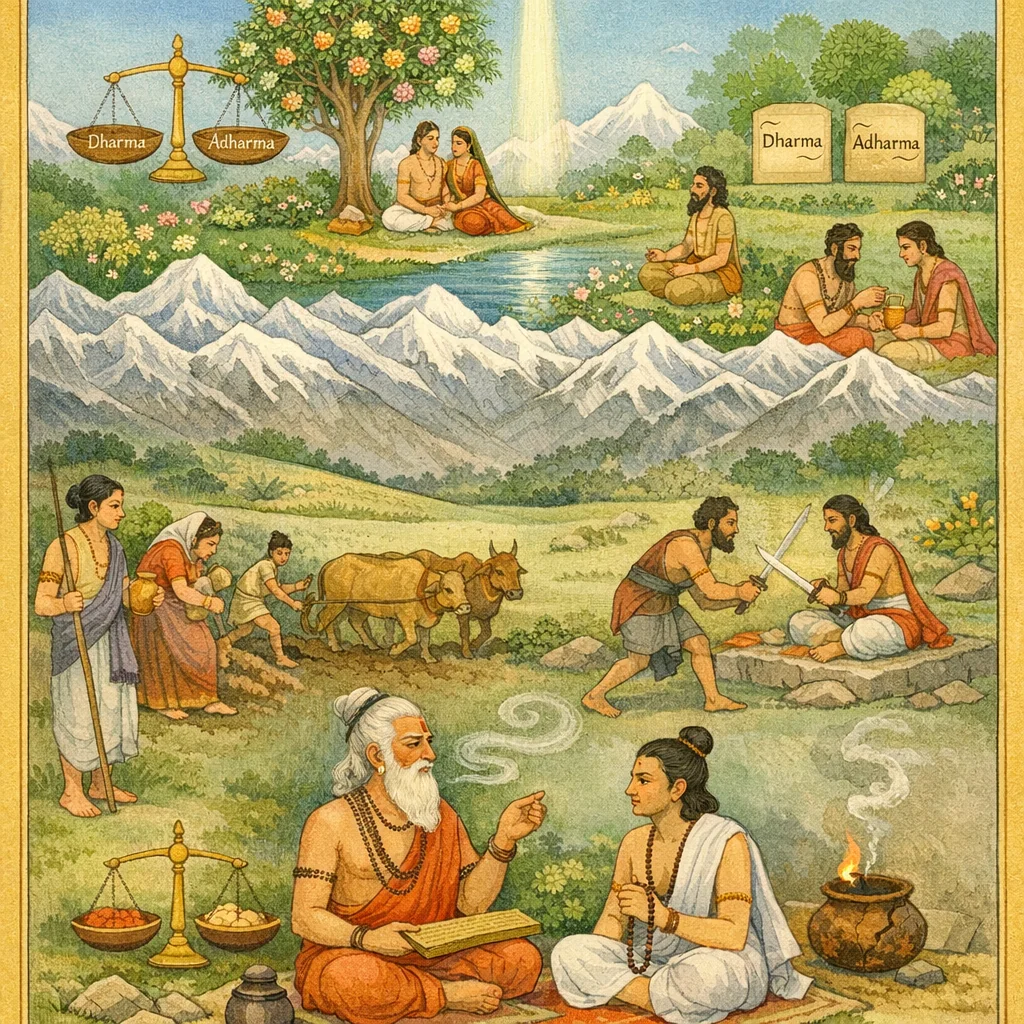
Bhāradvāja asks about an imperceptible “world beyond.” Mṛgu/Bhṛgu describes a holy northern realm beyond the Himālaya—secure and wish-fulfilling, inhabited by sinless, greedless people, untouched by disease, where death comes only at the proper time. Marks of dharma are stressed: fidelity, ahiṃsā (non-harm), and non-attachment to wealth. The teaching then contrasts worldly inequality and suffering (toil, fear, hunger, delusion) with the law of karma: this world is the field of action, and deeds ripen into corresponding destinations. Stains such as fraud, theft, slander, malice, violence, and falsehood diminish tapas; mixed dharma and adharma breed anxiety. Prajāpati, the gods, and the ṛṣis attain Brahmaloka through purified austerity, and disciplined brahmacārins serving their guru learn the path through the worlds. The chapter ends by defining wisdom as discernment of dharma and adharma, after which Bhāradvāja begins a new inquiry into adhyātma—knowledge tied to creation and dissolution, granting the highest welfare and happiness.
Shlokas
Verse 1
भरद्वाज उवाच । अस्माल्लोकात्परो लोकः श्रूयते नोपलभ्यते । तमहं ज्ञातुमिच्छामि तद्भवान्वक्तुमर्हति ॥ १ ॥
Bharadvāja said: “One hears of a world beyond this world, yet it is not directly perceived. I wish to know it—therefore, please explain it to me.”
Verse 2
मृगुरुवाच । उत्तरे हिमवत्पार्श्वे पुण्ये सर्वगुणान्विते । पुण्यः क्षेम्यश्च काम्यश्च स परो लोक उच्यते ॥ २ ॥
Mṛgu said: On the northern side of the Himālaya lies a holy region, endowed with every excellence. That realm is called the higher world—meritorious, secure, and wish-fulfilling.
Verse 3
तत्र ह्यपापकर्माणः शुचयोऽत्यंतनिर्मलाः । लोभमोहपरित्यक्ता मानवा निरुपद्रवाः ॥ ३ ॥
There, indeed, are people whose deeds are free from sin—pure and utterly stainless—who have cast away greed and delusion, and who live without disturbance or harm.
Verse 4
स स्वर्गसदृशो देशः तत्र ह्युक्ताः शुभा गुणाः । काले मृत्युः प्रभवति स्पृशंति व्याधयो न च ॥ ४ ॥
That region is like heaven itself; there, auspicious qualities are said to prevail. Death comes only at its appointed time, and diseases do not touch the inhabitants.
Verse 5
न लोभः परदारेषु स्वदारनिरतो जनः । नान्यो हि वध्यते तत्र द्रव्येषु च न विस्मयः ॥ ५ ॥
He feels no greed for another’s spouse; rather, he remains devoted to his own wife. There none is harmed, and toward wealth he feels no astonished fascination.
Verse 6
परो ह्यधर्मो नैवास्ति संदेहो नापि जायते । कृतस्य तु फलं तत्र प्रत्यक्षमुपलभ्यते ॥ ६ ॥
Indeed, there is no greater adharma than this, and no doubt even arises; for there the fruit of one’s deeds is directly experienced, here and now.
Verse 7
यानासनाशनोपेता प्रसादभवनाश्रयाः । सर्वकामैर्वृताः केचिद्धेमाभरणभूषिताः ॥ ७ ॥
Some were furnished with vehicles, seats, and rich food; they dwelt in splendid mansions, were surrounded by every desired enjoyment, and were adorned with golden ornaments.
Verse 8
प्राणधारणमात्रं तु केषांचिदुपपद्यते । श्रमेण महता केचित्कुर्वंति प्राणधारणम् ॥ ८ ॥
For some, mere breath-retention becomes possible by nature; but others can practice breath-retention only through great exertion and strain.
Verse 9
इह धर्मपराः केचित्केचिन्नैष्कृतिका नराः । सुखिता दुःखिताः केचिन्निर्धना धनिनो परे ॥ ९ ॥
Here in this world, some are devoted to dharma, while others lack moral restraint; some are happy and others unhappy; some are poor and others are wealthy.
Verse 10
इह श्रमो भयं मोहः क्षुधा तीव्रा च जायते । लोभश्चार्थकृतो तॄणां येन मुह्यंत्यपंडिताः ॥ १० ॥
Here in worldly life arise toil, fear, delusion, and intense hunger; and there is also greed born of the pursuit of wealth—by which the unwise become bewildered.
Verse 11
यस्तद्वेदो भयं प्राज्ञः पाप्मना न स लिप्यते । सोपधे निकृतिः स्तेयं परिवादोऽभ्यसूयता ॥ ११ ॥
The wise person who truly knows that truth becomes free from fear and is not tainted by sin. Deceit under a pretext, fraud, theft, slander, and malice do not cling to such a knower.
Verse 12
परोपघातो हिंसा च पैशुन्यनृतं तथा । एतान्संसेवते यस्तु तपस्तस्य प्रहीयते ॥ १२ ॥
Harming others, violence, malicious tale-bearing, and falsehood—whoever indulges in these sees his tapas, his spiritual austerity, dwindle away.
Verse 13
यस्त्वेतानाचरेद्विद्वान्न तपस्तस्य वर्द्धते । इह चिंता बहुविधा धर्माधर्मस्य कर्मणः ॥ १३ ॥
But the learned one who does not practice these prescribed disciplines finds that his tapas (austerity) does not increase. In this very life, manifold anxieties arise from actions mixed with dharma and adharma.
Verse 14
कर्मभूमिरियं लोके इह कृत्वा शुभाशुभम् । शुभैः शुभमवाप्नोति तथाशुभमथान्यथा ॥ १४ ॥
This world is the field of action: having performed here deeds that are auspicious or inauspicious, one attains the auspicious through auspicious actions—and likewise the inauspicious through the opposite.
Verse 15
इह प्रजापतिः पूर्वं देवाः सर्षिगणास्तथा । इष्टेष्टतपसः पूता ब्रह्मलोकमुपाश्रिताः ॥ १५ ॥
Here, in former times, Prajāpati—as well as the gods together with the hosts of ṛṣis—having been purified by their chosen and well-performed tapas, took refuge in and attained the world of Brahmā (Brahmaloka).
Verse 16
उत्तरः पृथिवीभागः सर्वपुण्यतमः शुभः । इहस्थास्तत्र जायंते ये वै पुण्यकृतो जनाः ॥ १६ ॥
The northern region of the earth is the most meritorious of all and auspicious. Those who perform virtuous deeds here are indeed born there, in that blessed northern realm.
Verse 17
यदि सत्कारमिच्छंति तिर्यग्योनिषु चापरे । क्षीणायुषस्तथा चान्ये नश्यन्ति पृथिवीतले ॥ १७ ॥
Some, seeking honor and recognition, fall into animal wombs; others, their lifespan diminished, perish upon the surface of the earth.
Verse 18
अन्योन्यभक्षणासक्ता लोभमोहसमन्विताः । इहैव परिवर्त्तन्ते न च यान्त्युत्तरां दिशम् ॥ १८ ॥
Those who are intent on devouring one another, possessed by greed and delusion, keep revolving here alone in saṃsāra and do not go toward the higher direction—the upward path to mokṣa.
Verse 19
गुरूनुपासते ये तु नियता ब्रह्मचारिणः । पंथानं सर्वालोकानां विजानंति मनीषिणः ॥ १९ ॥
But the disciplined brahmacārins who devotedly attend upon their gurus—those wise ones truly understand the path that passes through, and beyond, all the worlds.
Verse 20
इत्युक्तोऽयं मया धर्मः संक्षिप्तो ब्रह्मनिर्मितः । धर्माधर्मौ हि लोकस्य यो वै वेत्ति स बुद्धिमान् ॥ २० ॥
Thus have I explained this Dharma—briefly—ordained by Brahmā. Indeed, one who truly knows what is Dharma and what is Adharma in the world is wise.
Verse 21
भरद्वाज उवाच । अध्यात्मं नाम यदिदं पुरुषस्येह चिन्त्यते । यदध्यात्मं यथा चैतत्तन्मे ब्रूहि तपोधन ॥ २१ ॥
Bharadvāja said: “O treasure of austerity, tell me what is meant by ‘adhyātma’—that inner spiritual principle contemplated here with regard to the person—and explain to me how exactly it is to be understood.”
Verse 22
भृगुरुवाच । अध्यात्ममिति विप्रर्षे यदेतदनुपृच्छसि । तद्व्याख्यांस्यामि ते तात श्रेयस्करतमं सुखम् ॥ २२ ॥
Bhṛgu said: “O best of Brahmins, since you have inquired about what is called ‘adhyātma’—the inner spiritual reality—I shall explain it to you, dear one; that knowledge brings the highest good and true happiness.”
Verse 23
सृष्टिप्रलयसंयुक्तमाचार्यैः परिदर्शितम् । यज्ज्ञात्वा पुरुषो लोके प्रीतिं सौख्यं च विंदति ॥ २३ ॥
This teaching—joined to creation and dissolution—has been expounded by the preceptors; knowing it, a person in this world attains gladness and happiness.
Frequently Asked Questions
It functions as a moral-cosmological exemplum: a realm characterized by purity, non-injury, restraint, and freedom from greed—illustrating how refined dharma correlates with a secure, auspicious destination and clarifying the karmic logic behind differing conditions across births.
Harming others, violence, malicious tale-bearing, and falsehood are named as causes of tapas-kṣaya; the chapter also lists deceit with pretext, fraud, theft, slander, and malice as stains associated with ignorance and fear, contrasted with the wise knower’s purity.
After establishing dharma–adharma discernment and karmic fruition, it pivots to Bhāradvāja’s question on adhyātma, framing inner knowledge—linked to creation and dissolution—as the next step beyond moral discipline, aimed at highest good and lasting happiness.