Sṛṣṭi-pralaya-kathana: Mahābhūta-guṇāḥ, Vṛkṣa-indriya-vādaḥ, Prāṇa-vāyu-vyavasthā
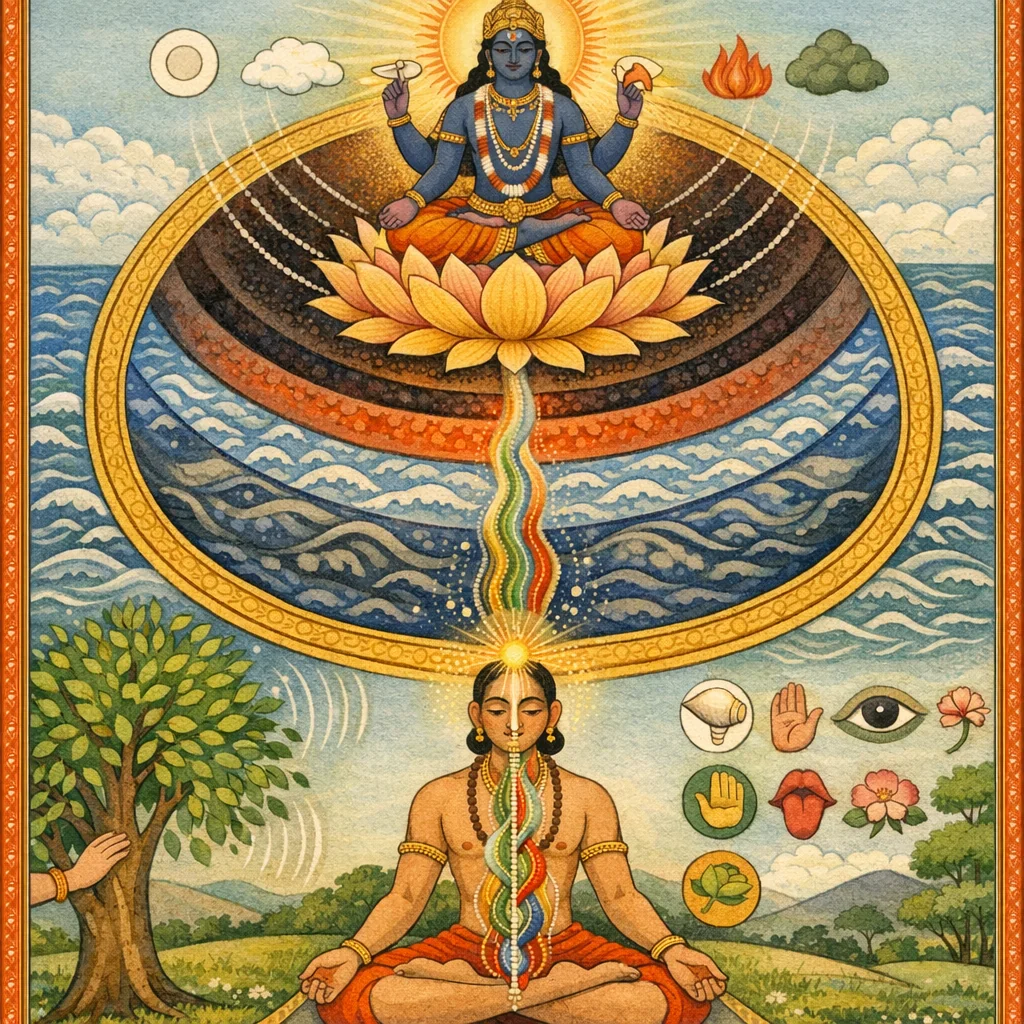
Nārada asks Sanandana about the source of creation, the seat of dissolution, the origin of beings, varṇa divisions, purity and impurity, dharma and adharma, the nature of the self, and the post-mortem path. Sanandana replies through an ancient itihāsa: Bharadvāja questions Bhṛgu on saṃsāra and mokṣa, and on knowing Nārāyaṇa—both the One worshipped and the inner worshipper. Bhṛgu describes cosmogenesis: the Unmanifest Lord brings forth Mahat; the elements unfold; a radiant lotus arises; Brahmā emerges and is portrayed through a cosmic-body correspondence. Bharadvāja then probes the cosmos’ measures and limits—earth, oceans, darkness, waters, fire, Rasātala—ending with the teaching that the Lord is immeasurable, hence “Ananta,” and that elemental distinctions dissolve in truth-vision. Creation is further explained as mind-born, with the primacy of waters and prāṇa, and a specific sequence: water before wind, then fire, then earth by compaction. The chapter develops an elemental epistemology—five elements and five senses—and defends plant sentience (trees ‘hear,’ respond to touch/heat, and register pleasure and pain). Finally it maps elements into bodily dhātus, details the five vāyus (prāṇa, apāna, vyāna, udāna, samāna), nāḍīs, digestion/agni, and a yogic ascent culminating at the crown of the head.
Shlokas
Verse 1
श्रीनारद उवाच । कुतः सृष्टमिदं ब्रह्मञ्जगत्स्थावरजंगमम् । प्रलये च कमभ्येति तन्मे ब्रूहि सनन्दन ॥ १ ॥
Śrī Nārada said: “O Brahman, from what source has this entire world—of the immovable and the moving—been created? And at the time of dissolution (pralaya), into whom does it merge? Tell me that, O Sanandana.”
Verse 2
ससागरः सगगनः सशैलः सबलाहकः । सभूमिः साग्निपवनो लोकोऽयं केन निर्मितः ॥ २ ॥
This world—together with the oceans, the sky, the mountains, the clouds, the earth, and with fire and wind—by whom has it been created?
Verse 3
कथं सृष्टानि भूतानि कथं वर्णविभक्तयः । शौचाशौचं कथं तेषां धर्माधर्मविधिः कथम् ॥ ३ ॥
How were living beings created? How were the divisions of the varṇas apportioned? How are purity and impurity determined for them? And how are the rules that distinguish dharma from adharma established?
Verse 4
कीदृशो जीवतां जीवः क्व वा गच्छंति ये मृताः । अस्माल्लोकादमुं लोकं सर्वं शंसतु मे भवान् ॥ ४ ॥
What is the nature of the soul (jīva) in living beings, and where do those who die go? From this world to that other world—please explain all of it to me, O venerable one.
Verse 5
सनंदन उवाच । श्रृणु नारद वक्ष्यामि चेतिहासं पुरातनम् । भृगुणाभिहितं शास्त्रं भरद्वाजाय पृच्छते ॥ ५ ॥
Sanandana said: “Listen, O Nārada. I shall recount an ancient sacred narrative (itihāsa)—the teaching (śāstra) spoken by Bhṛgu, when Bharadvāja questioned him.”
Verse 6
कैलासशिखरे दृष्ट्वा दीप्यमानं महौजसम् । भृगुमहर्षिमासीनं भरद्वाजोऽन्वपृच्छत ॥ ६ ॥
Seeing the great and radiant sage Bhṛgu seated upon the summit of Kailāsa, Bharadvāja approached him and respectfully inquired.
Verse 7
भरद्वाज उवाच । कथं जीवो विचरति नानायोनिषु संततम् । कथं मुक्तिश्च संसाराज्जायते तस्य मानद ॥ ७ ॥
Bharadvāja said: “How does the individual soul (jīva) continually wander through many kinds of births (yoni)? And how does liberation (mokṣa) from saṃsāra arise for him, O bestower of honor?”
Verse 8
यश्च नारायणः स्रष्टा स्वयंभूर्भगवन्स्वयम् । सेव्यसेवकभावेन वर्तेते इति तौ सदा ॥ ८ ॥
That very Nārāyaṇa—the Creator, the Self-born Lord, Bhagavān Himself—abides eternally in a twofold relation: as the One to be worshipped and as the worshipper within all beings.
Verse 9
प्रविशंति लये सर्वे यमीशं सचराचराः । लोकानां रमणः सोऽयं निर्गुणश्च निरंजनः ॥ ९ ॥
At the time of cosmic dissolution, all beings—moving and unmoving—enter into the Lord, the sovereign of restraint. He is the delight of the worlds, truly nirguṇa, without stain.
Verse 10
अनिर्दश्योऽप्रतर्क्यश्च कथं ज्ञायेत कैर्मुने । कथमेनं परात्मानं कालशक्तिदुरन्वयम् ॥ १० ॥
He is invisible and beyond the reach of reasoning—so by whom, O sage, can He be known? And how can that Supreme Self be comprehended, He who is difficult to trace through time and its power?
Verse 11
अतर्क्यचरितं वेदाः स्तुवन्ति कथमादरात् । जीवो जीवत्वमुल्लंघ्य कथं ब्रह्म समन्वयात् ॥ ११ ॥
How do the Vedas, with reverent intent, praise That whose mode of being is beyond the reach of reasoning? And how can the jīva, transcending its jīva-hood, become Brahman through true samanvaya (integration)?
Verse 12
एतदिच्छाम्यहं श्रोतुं तन्मे ब्रूहि कृपानिधे । एवं स भगवान्पृष्टो भरद्वाजेन संशयम् ॥ १२ ॥
“I wish to hear this; therefore tell me, O treasure-house of compassion.” Thus that revered sage, questioned by Bharadvāja regarding the doubt, prepared to reply.
Verse 13
महर्षिर्ब्रह्मसंकाशः सर्वं तस्मै ततोऽब्रवीत् । भृगुरुवाच । मानसो नाम यः पूर्वो विश्रुतो वै महर्षिभिः ॥ १३ ॥
Then that great sage, radiant like Brahmā, told him everything. Bhṛgu said: “The ancient sage known as Mānasā is indeed renowned among the great seers.”
Verse 14
अनादिनिधनो देवस्तथा तेभ्योऽजरामरः । अव्यक्त इति विख्यातः शाश्वतोऽथाक्षयोऽव्ययः ॥ १४ ॥
That Divine Lord is without beginning and without end; beyond all beings, He is ageless and deathless. He is renowned as Avyakta, the Unmanifest—eternal, undecaying, imperishable.
Verse 15
यतः सृष्टानि भूतानि जायंते च म्रियंति च । सोऽमृजत्प्रथमं देवो महांतं नाम नामतः ॥ १५ ॥
From Him, created beings are born and also die. That divine Lord first brought forth the principle called “Mahat,” known by that very name.
Verse 16
आकाशमिति विख्यातं सर्वभूतधरः प्रभुः । आकाशादभवद्वारि सलिलादग्निमारुतौ ॥ १६ ॥
He, the sovereign Lord who supports all beings, is renowned as Ākāśa (ether). From ether arose water; and from water arose fire and wind.
Verse 17
अग्निमारुतसंयोगात्ततः समभवन्मही । ततस्तेजो मयं दिव्यं पद्मं सृष्टं स्वयंभुवा ॥ १७ ॥
From the conjunction of fire and wind, the earth then came into being. Thereafter, the Self-born (Svayambhū) brought forth a divine lotus made of radiant energy.
Verse 18
तस्मात्पद्मात्समभवद्व्रह्मा वेदमयो विधिः । अहंकार इति ख्यातः सर्वभूतात्मभूतकृत् ॥ १८ ॥
Therefore, from that lotus arose Brahmā, the Ordainer (Vidhi), constituted of the Vedas; he is famed as Ahaṃkāra, the sense of “I,” the maker of all beings, having become the Self within all beings.
Verse 19
ब्रह्मा वै स महातेजा य एते पंच धातवः । शैलास्तस्यास्थिसंघास्तु मेदो मांसं च मेदिनी ॥ १९ ॥
That radiant Brahmā indeed is constituted of these five elements; the mountains are the masses of his bones, and the earth is his flesh and fat.
Verse 20
समुद्रास्तस्य रुधिरमाकाशमुदरं तथा । पवनश्चैव निश्वासस्तेजोऽग्निर्निम्नगाः शिराः ॥ २० ॥
The oceans are his blood; the sky is likewise his belly. The wind is his breath; fire is his radiance; and the rivers are his veins.
Verse 21
अग्नीषोमौ च चंद्रार्कौ नयने तस्य विश्रुते । नभश्चोर्ध्वशिरस्तस्य क्षितिः पादौ भुजौ दिशः ॥ २१ ॥
In that renowned Cosmic Person, Agni and Soma—indeed the Moon and the Sun—are his two eyes. The sky is his uplifted head, the earth is his feet, and the directions are his arms.
Verse 22
दुर्विज्ञेयो ह्यचिन्त्यात्मा सिद्धैरपि न संशयः । स एष भगवान्विष्णुरनन्त इति विश्रुतः ॥ २२ ॥
Indeed, his true nature is difficult to know—he is the inconceivable Self; even for the perfected sages there is no doubt of this. He is that very Bhagavān Viṣṇu, renowned as Ananta, the Infinite.
Verse 23
सर्वभूतात्मभूतस्थो दुर्विज्ञेयोऽकृतात्मभिः । अहंकारस्य यः स्रष्टा सर्वभूतभवाय वै । ततः समभवद्विश्वं पृष्टोऽहं यदिह त्वया ॥ २३ ॥
He who abides as the Self of all beings and dwells within all beings is hard to know for those whose inner nature is unrefined. He is the creator of ahaṅkāra (egoity) for the arising of all beings; from Him the entire universe came into being—this I declare, since you have asked me here.
Verse 24
भग्द्वाज उवाच । गगनस्य दिशां चैव भूतलस्यानिलस्य च । कान्यत्र परिमाणानि संशयं छिंधि तत्त्वतः ॥ २४ ॥
Bhagadvāja said: “Of the sky, the directions, the earth, and the wind—what are their respective measures? Please cut through my doubt by explaining the truth as it really is.”
Verse 25
भृगुरुवाच । अनंतमेतदाकाशं सिद्धदैवतसेवितम् । रम्यं नानाश्रयाकीर्णं यस्यांतो नाधिगम्यते ॥ २५ ॥
Bhṛgu said: This sky, ākāśa, is infinite, attended and revered by perfected beings and divine powers. It is wondrous, filled with manifold abodes; and its limit can never be reached.
Verse 26
ऊर्ध्वं गतेरधस्तात्तु चंद्रादित्यौ न पश्यतः । तत्र देवाः स्वयं दीप्ता भास्कराभाग्निवर्चसः ॥ २६ ॥
Above, and also below that course, the Moon and the Sun are not seen. There the gods shine by themselves—radiant like the sun, blazing with the splendor of fire.
Verse 27
ते चाप्यन्तं न पश्यंति नभसः प्रथितौजसः । दुर्गमत्वादनंतत्वादिति मे वद मानद ॥ २७ ॥
Even they—renowned in the heavens for their mighty splendor—do not perceive its limit. Is it because it is difficult to reach, or because it is truly infinite? Tell me, O venerable one, bestower of honor.
Verse 28
उपरिष्टोपरिष्टात्तु प्रज्वलद्भिः स्वयंप्रभैः । निरुद्धमेतदाकाशं ह्यप्रमेयं सुरैरपि ॥ २८ ॥
But above it, and higher still, this expanse of space is hemmed in by blazing realms that shine by their own light; truly, this sky is immeasurable—even to the gods.
Verse 29
पृथिव्यंते समुद्रास्तु समुद्रांते तमः स्मृतम् । तमसोंऽते जलं प्राहुर्जलस्यांतेऽग्निरेव च ॥ २९ ॥
At the boundary of the earth are the oceans; at the boundary of the oceans, darkness (tamas) is said to be. Beyond that darkness, they declare there is water; and at the boundary of that water, indeed, is fire.
Verse 30
रसातलांते सलिलं जलांते पन्नगाधिपाः । तदंते पुनराकाशमाकाशांते पुनर्जलम् ॥ ३० ॥
At the end of Rasātala there is water; at the end of that water are the lords of serpents. Beyond them again is space (ākāśa), and at the far end of space there is water once more.
Verse 31
एवमंतं भगवतः प्रमाणं सलिलस्य च । अग्निमारुततोयेभ्यो दुर्ज्ञेयं दैवतैरपि ॥ ३१ ॥
Thus, the true measure and limit of the Blessed Lord—and of the cosmic waters as well—cannot be fully known, even by the gods, though they are associated with fire, wind, and water.
Verse 32
अग्निमारुततोयानां वर्णा क्षितितलस्य च । आकाशसदृशा ह्येते भिद्यंते तत्त्वदर्शनात् ॥ ३२ ॥
The qualities (and distinctions) attributed to fire, wind, water, and even the surface of the earth are in truth like space—subtle and insubstantial; they are discerned as separate only so long as one has not realized reality. Through the vision of truth, these apparent differences are resolved.
Verse 33
पठंति चैव मुनयः शास्त्रेषु विविधेषु च । त्रैलोक्ये सागरे चैव प्रमाणं विहितं यथा ॥ ३३ ॥
The sages too recite, in the many and varied śāstras, how a pramāṇa—a true standard of measure—has been ordained for the three worlds, and for the ocean as well.
Verse 34
अदृश्यो यस्त्वगम्यो यः कः प्रमाणमुदीरयेत् । सिद्धानां देवतानां च परिमीता यदा गतिः ॥ ३४ ॥
He who is unseen and beyond all reach—who could ever proclaim a measure for Him? For even the attainments and the range of the Siddhas and the gods are, in the end, limited.
Verse 35
तदागण्यमनंतस्य नामानंतेति विश्रुतम् । नामधेयानुरूपस्य मानसस्य महात्मनः ॥ ३५ ॥
Therefore the immeasurable One is renowned as “Ananta” (the Endless). And that great-souled Being is called “Mānasa”, in accordance with His very name.
Verse 36
यदा तु दिव्यं यद्रूपं ह्रसते वर्द्धते पुनः । कोऽन्यस्तद्वेदितुं शक्यो योऽपि स्यात्तद्विधोऽपरः ॥ ३६ ॥
But when that divine form—whatever its nature—contracts and again expands, who else could truly know it, even if there were another being of the same kind?
Verse 37
ततः पुष्करतः सृष्टः सर्वज्ञो मूर्तिमान्प्रभुः । ब्रह्मा धर्ममयः पूर्वः प्रजापतिरनुत्तमः ॥ ३७ ॥
Then, from the lotus, there was brought forth the all-knowing, embodied Lord—Brahmā, the primordial one, suffused with Dharma, the unsurpassed Prajāpati.
Verse 38
भरद्वाज उवाच । पुष्करो यदि संभूतो ज्येष्ठं भवति पुष्करम् । ब्रह्माणं पूर्वजं चाह भवान्संदेह एव मे ॥ ३८ ॥
Bharadvāja said: If Puṣkara has come into being, how can Puṣkara be the eldest? And you also call Brahmā the earlier-born. This indeed is my doubt.
Verse 39
भृगुरुवाच । मानसस्येह या मूर्तिर्ब्रह्मत्वं समुपागता । तस्यासनविधानार्थं पृथिवी पद्ममुच्यते ॥ ३९ ॥
Bhṛgu said: Here, that form which arises from the mind and has attained the status of Brahman—so that a seat may be arranged for it, the Earth is spoken of as a ‘lotus.’
Verse 40
कर्णिका तस्य पद्मस्य मेरुर्गगनमुच्छ्रितः । तस्य मध्ये स्थितो लोकान्सृजत्येष जगद्विधिः ॥ ४० ॥
The pericarp of that lotus is Mount Meru, rising up to the sky. Seated in its very center, this Ordainer of the universe (Brahmā) creates the worlds.
Verse 41
भरद्वाज उवाच । प्रजाविसर्गं विविधं कथं स सृजति प्रभुः । मेरुमध्ये स्थितो ब्रह्मा तद्बहिर्द्विजसत्तम ॥ ४१ ॥
Bharadvāja said: “O best of the twice-born, how does the Lord bring forth the diverse creation of beings? And how is it that Brahmā is situated within Mount Meru—and yet also outside it?”
Verse 42
भृगुरुवाच । प्रजाविसर्गं विविधं मानसो मनसाऽसृजत् । संरक्षणार्थं भूतानां सृष्टं प्रथमतो जलम् ॥ ४२ ॥
Bhṛgu said: The Mind-born (creator) produced the manifold creation of beings by the mind alone. For the protection and sustenance of living entities, water was created first of all.
Verse 43
यत्प्राणाः सर्वभूतानां सृष्टं प्रथमतो जलम् । यत्प्राणाः सर्वभूतानां वर्द्धंते येन च प्रजाः ॥ ४३ ॥
Prāṇa is the power by which, for all beings, water was first brought forth in creation; and by prāṇa all beings grow, and progeny increases.
Verse 44
परित्यक्ताश्च नश्यंति तेनेदं सर्वमावृत्तम् । पृथिवी पर्वता मेघा मूर्तिमंतश्च ये परे । सर्वं तद्वारुणं ज्ञेयमापस्तस्तंभिरे पुनः ॥ ४४ ॥
When the Waters are forsaken, beings perish; by that watery principle this whole world is enveloped. Earth, mountains, clouds, and all other embodied forms—know all this to be under Varuṇa, lord of waters, for the Āpas again sustain and hold it together.
Verse 45
भरद्वाज उवाच । कथं सलिलमुत्पन्नं कथं चैवाग्निमारुतौ । कथं वा मेदिनी सृष्टेत्यत्र मे संशयो महान् ॥ ४५ ॥
Bharadvāja said: “How did water arise? How indeed did fire and wind come into being? And how was the earth created? Regarding this, I have a great doubt.”
Verse 46
भृगुरुवाच । ब्रह्मकल्पे पुरा ब्रह्मन् ब्रह्मर्षीणां समागमे । लोकसंभवसंदेहः समुत्पन्नो महात्मनाम् ॥ ४६ ॥
Bhṛgu said: “O Brahman, in a former Brahmā-kalpa, when the Brahmarṣis had assembled, a doubt about the origin of the worlds arose in the minds of those great-souled sages.”
Verse 47
तेऽतिष्ठन्ध्यानमालंब्य मौनमास्थाय निश्चलाः । त्यक्ताहाराः स्पर्द्धमाना दिव्यं वर्षशतं द्विजाः ॥ ४७ ॥
Relying upon meditation, they stood firm—silent and unmoving. Having abandoned food, those twice-born sages, striving in austere rivalry, endured for a hundred divine years.
Verse 48
तेषां ब्रह्ममयी वाणी सर्वेषां श्रोत्रमागमत् । दिव्या सरस्वती तत्र संबभूव नभस्तलात् ॥ ४८ ॥
Then, for all of them, a voice filled with Brahman—saturated with the Veda—entered their ears; and there the divine Sarasvatī manifested from the vault of the sky.
Verse 49
पुरास्तिमितमाकाशमनंतमचलोपमम् । नष्टचंद्रार्कपवनं प्रसुप्तमिव संबभौ ॥ ४९ ॥
Then the sky became utterly motionless—endless and mountain-like in its stillness; with the moon, the sun, and even the wind gone, it appeared as though the whole cosmos had fallen into sleep.
Verse 50
ततः सलिलमुत्पन्नं तमसीव तमः परम् । तस्माच्च सलिलोत्पीडादुदतिष्ठत मारुतः ॥ ५० ॥
Then water came into being—like a deeper darkness arising from darkness itself. And from the agitation and pressure within that water, the Wind (Māruta) arose.
Verse 51
यथाभवनमच्छिद्रं निःशब्दमिव लक्ष्यते । तच्चांभसा पूर्यमाणं सशब्दं कुरुतेऽनिलः ॥ ५१ ॥
Just as a house without openings appears to be silent, so too, when it is being filled with water, the wind makes it resound with noise.
Verse 52
तथा सलिलसंरुद्धे नभसोंऽतं निरंतरे । भित्त्वार्णवतलं वायुः समुत्पतति घोषवान् ॥ ५२ ॥
Likewise, when the expanse of the sky is continuously hemmed in by water, the wind—resounding loudly—bursts through, splitting the floor of the ocean, and surges upward.
Verse 53
एषु वा चरते वायुरर्णवोत्पीडसंभवः । आकाशस्थानमासाद्य प्रशांतिं नाधिगच्छति ॥ ५३ ॥
Or again, among these, the wind—born of the ocean’s agitation—moves to and fro; even upon reaching the realm of space, it does not attain tranquility.
Verse 54
तस्मिन्वाय्वम्बुसंघर्षे दीप्ततेजा महाबलः । प्रादुरासीदूर्ध्वशिखः कृत्वा निस्तिमिरं तमः ॥ ५४ ॥
When wind and water clashed, a radiant and mighty power manifested—its flame rising upward—making the darkness free of gloom.
Verse 55
अग्निः पवनसंयुक्तः खं समाक्षिपते जलम् । तदग्निवायुसंपर्काद्धनत्वमुपपद्यते ॥ ५५ ॥
Fire, joined with wind, draws water into space; and from the contact of that fire and wind, density—compactness—comes to be.
Verse 56
तस्याकाशं निपतितः स्नेहात्तिष्ठति योऽपरः । स संघातत्वमापन्नो भूमित्वमनुगच्छति ॥ ५६ ॥
That other portion which falls into space, yet remains held together through cohesion, becomes compacted into a mass and thereby attains the state of earth.
Verse 57
रसानां सर्वगंधानां स्नेहानां प्राणिनां तथा । भूमिर्योनिरियं ज्ञेया यस्याः सर्वं प्रसूयते ॥ ५७ ॥
Earth should be known as the womb—the source—of all tastes, all fragrances, all oils and unctuous essences, and of living beings as well; for from her everything is brought forth.
Verse 58
भरद्वाज उवाच । य एते धातवः पंच रक्ष्या यानसृजत्प्रभुः । आवृता यैरिमे लोका महाभूताभिसंज्ञितैः ॥ ५८ ॥
Bharadvāja said: “Which are those five elements that the Lord brought forth and that are to be safeguarded—those very ‘mahābhūtas’, the great elemental principles by which all these worlds are pervaded and enveloped?”
Verse 59
यदाऽसृजत्सहस्त्राणि भूतानां स महामतिः । पश्चात्तेष्वेव भूतत्वं कथं समुपपद्यते ॥ ५९ ॥
When that great-minded one created thousands of beings, how is it then that, afterward, the state of being a creature—embodied existence—is said to arise in those very beings again?
Verse 60
भृगुरुवाच । अमितानि महाष्टानि यांति भूतानि संभवम् । अतस्तेषां महाभूतशब्दोऽयमुपपद्यते ॥ ६० ॥
Bhṛgu said: The eight great principles are immeasurable, and through them beings come into manifestation. Therefore, for these, the term “mahābhūtas”—great elemental principles—is rightly applied.
Verse 61
चेष्टा वायुः खमाकाशमूष्माग्निः सलिलं द्रवः । पृथिवी चात्र संघातः शरीरं पांचभौतिकम् ॥ ६१ ॥
Activity and movement are of the nature of Vāyu; space is indeed Ākāśa; heat is Agni; water is liquidity; and earth here is solidity and aggregation—thus the body is a composite made of the five elements.
Verse 62
इत्यतः पंचभिर्युक्तैर्युक्तं स्थावरजंगमम् । श्रोत्रे घ्राणो रसः स्पर्शो दृष्टिश्चेंद्रियसंज्ञिताः ॥ ६२ ॥
Thus, all beings—whether immovable or movable—are endowed with five faculties. Hearing, smell, taste, touch, and sight are known as the indriyas, the powers of the senses.
Verse 63
भरद्वाज उवाच । पंचभिर्यदि भूतैस्तु युक्ताः स्थावरजंगमाः । स्थावराणां न दृश्यंते शरीरे पंच धातवः ॥ ६३ ॥
Bharadvāja said: If both the immobile and the moving beings are truly constituted of the five elements, then why are the five bodily constituents not seen in the bodies of the immobile, such as plants and trees?
Verse 64
अनूष्मणामचेष्टानां घनानां चैव तत्त्वतः । वृक्षाणां नोपलभ्यंते शरीरे पंच धातवः ॥ ६४ ॥
In trees—truly without bodily heat, without locomotion, and dense—one does not perceive the five bodily dhātus in the same manner as in an animal body.
Verse 65
न श्रृण्वंति न पश्यंति न गंधरसवेदिनः । न च स्पर्शं हि जानंति ते कथं पंच धातवः ॥ ६५ ॥
They neither hear nor see; they do not perceive smell or taste, and they do not even know touch. How, then, could the five elements be (manifest) in them?
Verse 66
अद्रवत्वादनग्नित्वादभूमित्वादवायुतः । आकाशस्याप्रमेयत्वाद्वृक्षाणां नास्ति भौतिकम् ॥ ६६ ॥
Because (a tree) is not liquid, not fire, not earth, and not air—and because space is immeasurable—there is, in truth, no purely material (elemental) reality in trees as an ultimate principle.
Verse 67
भृगुरुवाच । घनानामपि वृक्षणामाकाशोऽस्ति न संशयः । तेषां पुष्पपलव्यक्तिर्नित्यं समुपपद्यते ॥ ६७ ॥
Bhṛgu said: Even within dense trees there is space (ākāśa)—of this there is no doubt. Therefore the manifestation of their flowers and fresh shoots continually becomes possible.
Verse 68
ऊष्मतो म्लायते पर्णं त्वक्फलं पुष्पमेव च । म्लायते शीर्यते चापि स्पर्शस्तेनात्र विद्यते ॥ ६८ ॥
From heat the leaf withers; so too the bark, the fruit, and the flower. They fade and even fall away—therefore, in this case, “touch” (sparśa) is understood as the causal factor.
Verse 69
वाय्वग्न्यशनिनिर्घोषैः फलं पुष्पं विशीर्यते । श्रोत्रेण गृह्यते शब्दस्तस्माच्छृण्वंति पादपाः ॥ ६९ ॥
By the roaring sounds of wind, fire, and thunder, fruits and flowers fall away. Sound is apprehended by the ear; therefore, trees too “hear”.
Verse 70
वल्ली वेष्टयते वृक्षान्सर्वतश्चैव गच्छति । नह्यदृष्टश्च मार्गोऽस्ति तस्मात्पश्यंति पादपाः ॥ ७० ॥
A creeper entwines the trees and spreads in every direction. Yet its path is not seen; therefore the trees (as it were) perceive it by its grasp and movement.
Verse 71
पुण्यापुण्यैस्तथा गंधैर्धूपैश्च विविधैरपि । अरोगाः पुष्पिताः संति तस्माज्जिघ्रंति पादपाः ॥ ७१ ॥
By fragrances both auspicious and inauspicious, and by many kinds of incense-smoke (dhūpa) as well, plants become free from disease and come into bloom; therefore trees, as it were, “inhale” those scents.
Verse 72
सुखदुःखयोर्ग्रहणाच्छिन्नस्य च विरोहणात् । जीवं पश्यामि वृक्षाणामचैतन्यं न विद्यते ॥ ७२ ॥
Because they register pleasure and pain, and because what is cut sprouts again, I perceive living consciousness even in trees; for in them, insentience is not found.
Verse 73
तेन तज्जलमादत्ते जरयत्यग्निमारुतौ । आहारपरिणामाच्च स्नहो वृद्धिश्च जायते ॥ ७३ ॥
By that inner principle, it draws in the moisture (the water element) and ripens the digestive fire and the vital wind; and from the transformation of food arise nourishing unctuous essence and the body’s growth.
Verse 74
जंगमानां च सर्वेषां शरीरे पंञ्च धातवः । प्रत्येकशः प्रभिद्यंते यैः शरीरं विचेष्टते ॥ ७४ ॥
In the bodies of all moving beings there are five elemental constituents. Each functions distinctly and separately, by which the body is able to act and move.
Verse 75
त्वक् च मांसं तथास्थीनि मज्जा स्नायुश्च पंचमः । इत्येतदिह संघातं शरीरे पृथिवीमये ॥ ७५ ॥
Skin, flesh, bones, marrow, and—fifth—sinews: this is the aggregate here, in the body that is made of the earth element.
Verse 76
तेजो ह्यग्निस्तथा क्रोधश्चक्षुरुष्मा तथैव च । अग्निर्जनयते यच्च पंचाग्नेयाः शरीरिणः ॥ ७६ ॥
Splendour is indeed fire; so too are anger, the eye, and bodily heat. And whatever else fire produces—embodied beings are constituted of these five fiery factors.
Verse 77
श्रोत्रं घ्राणं तथास्यं च हृदयं कोष्ठमेव च । आकाशात्प्राणिनामेते शरीरे पंच धातवः ॥ ७७ ॥
The ear, the nose, the mouth, the heart, and the inner cavity (the trunk) as well—these are the five bodily constituents in living beings that arise from the element of space (ākāśa).
Verse 78
श्लेष्मा पित्तमथ स्वेदो वसा शोणितमेव च । इत्यापः पंचधा देहे भवंति प्राणिनां सदा ॥ ७८ ॥
Phlegm, bile, sweat, fat, and blood—thus the water-element (āpas) abides in five forms within the bodies of living beings at all times.
Verse 79
प्राणात्प्रीणयते प्राणी व्यानाव्द्यायच्छते तथा ॥ ७९ ॥
By prāṇa the embodied being is nourished and made glad; likewise, by vyāna it is held together and properly sustained.
Verse 80
गच्छत्यपानोऽधश्चैव समानो ह्यद्यवस्थितः । उदानादुच्छ्वसितीति पञ्च भेदाच्च भाषते । इत्येते वायवः पंच वेष्टयंतीहदेहिनम् ॥ ८० ॥
Apāna moves downward, and Samāna is said to abide in the middle. From Udāna arises the act of exhalation. Thus, by fivefold division, these are spoken of as the five vital airs; and these five vāyus encompass the embodied being here.
Verse 81
भूमेर्गंधगुणान्वेत्ति रसं चाद्भ्यः शरीरवान् । तस्य गंधस्य वक्ष्यामि विस्तराभिहितान्गुणान् ॥ ८१ ॥
An embodied being apprehends the qualities of fragrance from the earth, and taste from the waters. Now I shall describe in detail the characteristics of that fragrance, as they are traditionally explained.
Verse 82
इष्टश्चानुष्टगंधश्च मधुरः कटुरेव च । निर्हारी संहतः स्निग्धो रुक्षो विशद एव च ॥ ८२ ॥
It may be pleasing; it may be unappealing. It may be sweet or pungent. It may be cleansing, compact, unctuous, dry, or even clear and pure.
Verse 83
एवं नवविधो ज्ञेयः पार्थिवो गंधविस्तरः । ज्योतिः पश्यति चक्षुर्भ्यः स्पर्शं वेत्ति च वायुना ॥ ८३ ॥
Thus the earthy principle is to be known as ninefold in the expanse of scents. Light is perceived by the eyes, and touch is known through the agency of air.
Verse 84
शब्दः स्पर्शश्च रूपं च रसश्चापि गुणाः स्मृताः । रसज्ञानं तु वक्ष्यामि तन्मे निगदतः श्रृणु ॥ ८४ ॥
Sound, touch, form, and taste are remembered as sense-qualities. Now I shall explain the knowing of taste; listen as I declare it to you.
Verse 85
रसो बहुविधः प्रोक्त ऋषिभिः प्रथितात्मभिः । मधुरो लवणस्तिक्तः कषायोऽम्लः कटुस्तथा ॥ ८५ ॥
The sages of renowned spirit have declared taste (rasa) to be of many kinds: sweet, salty, bitter, astringent, sour, and pungent.
Verse 86
एष षडिधविस्तारो रसो वारिमयः स्मृतः । शब्दः स्पर्शश्च रूपश्च त्रिगुणं ज्योतिरुच्यते ॥ ८६ ॥
This ‘taste’ (rasa), understood as water-natured, is said to expand in six ways. And sound, touch, and form—these three qualities are declared to belong to fire (jyotis).
Verse 87
ज्योतिः पश्यति रूपाणि रूपं च बहुधा स्मृतम् । ह्रस्वो दीर्धस्तथा स्थूलश्चतुरस्रोऽणुवृत्तवान् ॥ ८७ ॥
Light (jyotis) perceives forms; and ‘form’ is remembered as manifold—short or long, thick, square, minute, or circular.
Verse 88
शुक्लः कृष्णस्तथा रक्तो नीलः पीतोऽरुणस्तथा । कठिनश्चिक्कणः श्लक्ष्णः पिच्छिलो मृदु दारुणः ॥ ८८ ॥
(They are) white, black, and also red; blue, yellow, and likewise tawny. (They are) hard, glossy, smooth, slimy, soft, and harsh.
Verse 89
एवं षोडशविस्तारो ज्योतीरुपगुणः स्मृतः । तत्रैकगुणमाकाशं शब्द इत्येव तत्स्मृतम् ॥ ८९ ॥
Thus the luminous principle (tejas) is remembered as having a sixteenfold expansion of qualities. Among these, ākāśa (ether/space) is said to possess a single quality alone—namely sound (śabda).
Verse 90
तस्य शब्दस्य वक्ष्यामि विस्तरं विविधात्मकम् । षड्जो ऋषभगांधारौ मध्यमोधैवतस्तथा ॥ ९० ॥
Now I shall explain in detail that sound in its many forms: namely, Ṣaḍja, Ṛṣabha, Gāndhāra, Madhyama, and likewise Dhaivata.
Verse 91
पंचमश्चापि विज्ञेयस्तथा चापि निषादवान् । एष सप्तविधः प्रोक्तो गुण आकाशसंभवः ॥ ९१ ॥
The fifth is also to be understood—Pañcama—and likewise that which is endowed with Niṣāda. Thus this quality, arising from ākāśa (ether), has been declared to be sevenfold.
Verse 92
ऐश्वर्य्येण तु सर्वत्र स्थितोऽपि पयहादिषु । मृदंगभेरीशंखानां स्तनयित्नो रथस्य च ॥ ९२ ॥
By His sovereign power, though He abides everywhere—even in milk and other substances—He is also present as the sound of the mṛdaṅga, the bherī drum, and the conch (śaṅkha), and as the thunder and the rumbling of a chariot.
Verse 93
एवं बहुविधाकारः शब्द आकाशसंभवः । वायव्यस्तु गुणः स्पर्शः स्पर्शश्च बहुधा स्मृतः ॥ ९३ ॥
Thus sound—of many forms—arises from ether (ākāśa). But the distinctive quality of air (vāyu) is touch; and touch too is remembered as being of many kinds.
Verse 94
उष्णः शीतः सुखं दुःखं स्निग्धो विशद एव च । तथा खरो मृदुः श्लक्ष्णो लवुर्गुरुतरोऽपि च ॥ ९४ ॥
It becomes hot and cold; it is pleasure and pain; it is oily (unctuous) and also clear (non-unctuous). Likewise, it is rough and soft, smooth, light, and even heavy.
Verse 95
शब्दस्पर्शौ तु विज्ञेयौ द्विगुणौ वायुरित्युत । एवमेकादशविधो वायव्यो गुण उच्यते ॥ ९५ ॥
Sound and touch are to be understood as the two qualities of air (vāyu). Thus the quality belonging to air is declared to be elevenfold.
Verse 96
आकाशजं शब्दमाहुरेभिर्वायुगुणैः सह । अव्याहतैश्चेतयते नवेति विषमा गतिः ॥ ९६ ॥
They declare that sound is born of ether (ākāśa), along with these qualities belonging to air; and when it is unimpeded it becomes perceptible—yet it does not do so uniformly: its movement is irregular.
Verse 97
आप्यायंते च ते नित्यं धातवस्तैस्तु धातुभिः । आपोऽग्निर्मारुस्चैव नित्यं जाग्रति देहिषु ॥ ९७ ॥
And those bodily constituents (dhātus) are continually nourished by the other dhātus; and within embodied beings the principles of water, fire, and wind remain ever active and alert.
Verse 98
मूलमेते शरीरस्य व्याप्य प्राणानिह स्थिताः । पार्थिवं धातुमासाद्य यथा चेष्टयते बली ॥ ९८ ॥
These principles are the very root of the body; pervading the vital breaths (prāṇas), they abide here. Reaching the earthly element within, the Mighty One brings forth activity and movement accordingly.
Verse 99
श्रितो मूर्द्धानमग्निस्तु शरीरं परिपालयेत् । प्राणो मूर्द्धनि वाग्नौ च वर्तमानो विचेष्टते ॥ ९९ ॥
When the inner fire abides in the head, it protects and sustains the body. And the vital breath (prāṇa), moving in the head and in the fire of speech, becomes active and performs its functions.
Verse 100
स जंतुः सर्वभूतात्मा पुरुषः स सनातनः । मनो बुद्धिरहंकारो भूतानि विषयश्च सः ॥ १०० ॥
That very being is the eternal Puruṣa—the inner Self of all creatures. He indeed is the mind, the intellect, and the ego; He is also the elements and the objects of the senses.
Verse 101
एवं त्विह स सर्वत्र प्राणैस्तु परिपाल्यते । पृष्ठतस्तु समानेन स्वां स्वां गतिमुपाश्रितः ॥ १०१ ॥
Thus, here in this body, it is sustained everywhere by the vital breaths; and from behind, by samāna (the equalizing breath), each vital function resorts to its own proper course and destination.
Verse 102
वस्तिमूलं गुदं चैव पावकं समुपाश्रितः । वहन्मूत्रं पुरीषं वाप्यपानः परिवर्तते ॥ १०२ ॥
Apāna Vāyu resides at the root of the bladder, at the anus, and near the digestive fire. It functions by carrying out urine and feces.
Verse 103
प्रयत्ने कर्मनियमे य एकस्त्रिषु वर्तते । उदान इति तं प्राहुरध्यात्मज्ञानकोविदाः ॥ १०३ ॥
Those skilled in the knowledge of the inner Self declare: the single vital force that functions in three spheres—exertion, action (karma), and the discipline or restraint of actions—is called Udāna.
Verse 104
संधिष्वपि च सर्वेषु संनिविष्टस्तथानिलः । शरीरेषु मनुष्याणां व्यान इत्युपदिश्यते ॥ १०४ ॥
That vital air (vāyu) which is stationed also in all the joints, within human bodies, is taught to be Vyāna.
Verse 105
बाहुष्वग्निस्तु विततः समानेन समीरितः । रसान्वारु दोषांश्च वर्तयन्नति चेष्टते ॥ १०५ ॥
In the arms, the bodily fire is spread out and stirred by the vital current called Samāna; it vigorously sets the nutritive essences in motion and also regulates the vāyu-principle and the bodily doṣas.
Verse 106
अपानप्राणयोर्मध्ये प्राणापानसमीहितः । समन्वितस्त्वधिष्ठानं सम्यक् पचति पावकः ॥ १०६ ॥
Between apāna and prāṇa, when prāṇa and apāna are properly coordinated, the inner fire—rightly supported in its seat—cooks (digests) the sustenance correctly.
Verse 107
आस्पंहि पायुपर्यंतमंते स्याद्गुदसंज्ञिते । रेतस्तस्मात्प्रजायंते सर्वस्रोतांसि देहिनाम् ॥ १०७ ॥
Indeed, the terminal region extending up to the anus is called guda (the rectum). From that source semen (retas) arises, and from it are generated all the bodily channels (srotas) of embodied beings.
Verse 108
प्राणानां सन्निपाताश्च सन्निपातः प्रजायते । ऊष्मा चाग्निरिति ज्ञेयो योऽन्नं पचति देहिनाम् ॥ १०८ ॥
From the gathering of the vital airs (prāṇas) arises their unified convergence; that heat is to be known as the bodily fire (agni), the one that digests the food of embodied beings.
Verse 109
अग्निवेगवहः प्राणो गुदांते प्रतिहन्यते । स ऊर्ध्वमागम्य पुनः समुत्क्षिपति पावकम् ॥ १०९ ॥
The prāṇa, driven by the force of fire, strikes at the end of the anus; then, rising upward again, it once more kindles and lifts the inner fire.
Verse 110
पक्वाशयस्त्वधो नाभ्या ऊर्ध्वमामाशयः स्मृतः । नाभिमूले शरीरस्य सर्वे प्राणाश्च संस्थिताः ॥ ११० ॥
The large intestine (pakvāśaya) is said to lie below the navel, and the stomach (āmāśaya) above it. At the root of the navel in the body, all the vital airs (prāṇas) are established.
Verse 111
प्रस्थिता हृदयात्सर्वे तिर्यगूर्ध्दमधस्तथा । वहंत्यन्नरसान्नाड्यो दशप्राणप्रचोदिताः ॥ १११ ॥
All the nāḍīs, issuing forth from the heart, flow sideways, upward, and downward as well; impelled by the ten prāṇas, they carry the nutritive essence of food (rasa).
Verse 112
एष मार्गोऽपि योगानां येन गच्छंति तत्पदम् । जितक्लमाः समा धीरा मूर्द्धन्यात्मानमादधन् ॥ ११२ ॥
This too is the path of the yogins, by which they reach that Supreme Abode. Conquering fatigue, even-minded and steadfast, the wise place the ātman in the crown of the head.
Verse 113
एवं सर्वेषु विहितप्राणापानेषु देहिनाम् । तस्मिन्समिध्यते नित्यमग्निः स्थाल्यामिवाहितः ॥ ११३ ॥
Thus, in all embodied beings whose inhalation and exhalation (prāṇa and apāna) are duly regulated, the inner fire is kindled ever anew—like a sacrificial fire properly established in a vessel.
Frequently Asked Questions
The chapter frames the Lord as transcendent (object of worship) and immanent (the inner agent who enables worship within beings). This supports a bhakti-compatible nondualism: devotion remains meaningful while the inner Self (antaryāmin) is affirmed as the ground of cognition, ritual intention, and liberation.
It presents a cosmogonic sequence where, in a prior kalpa, water manifests first; agitation within water yields wind; the clash of wind and water produces fire; and through fire–wind interaction and compaction/cohesion, earth forms as solidity—while ether/space functions as the pervasive subtle field in which these processes are described.
Bhṛgu argues from observable effects: trees contain space (allowing growth), respond to heat (withering), react to sound/vibration (falling fruits/flowers), respond to touch/pressure (creepers’ grasp), and respond to fragrances (blooming/health). Pleasure–pain response and regrowth after cutting are cited to infer an inner principle of consciousness.
It outlines the five vāyus and their bodily seats/functions, the circulation of nutritive essence through nāḍīs, and a yogic path wherein disciplined breath regulation kindles inner fire and the practitioner stabilizes awareness toward the crown of the head as a route to the Supreme Abode.