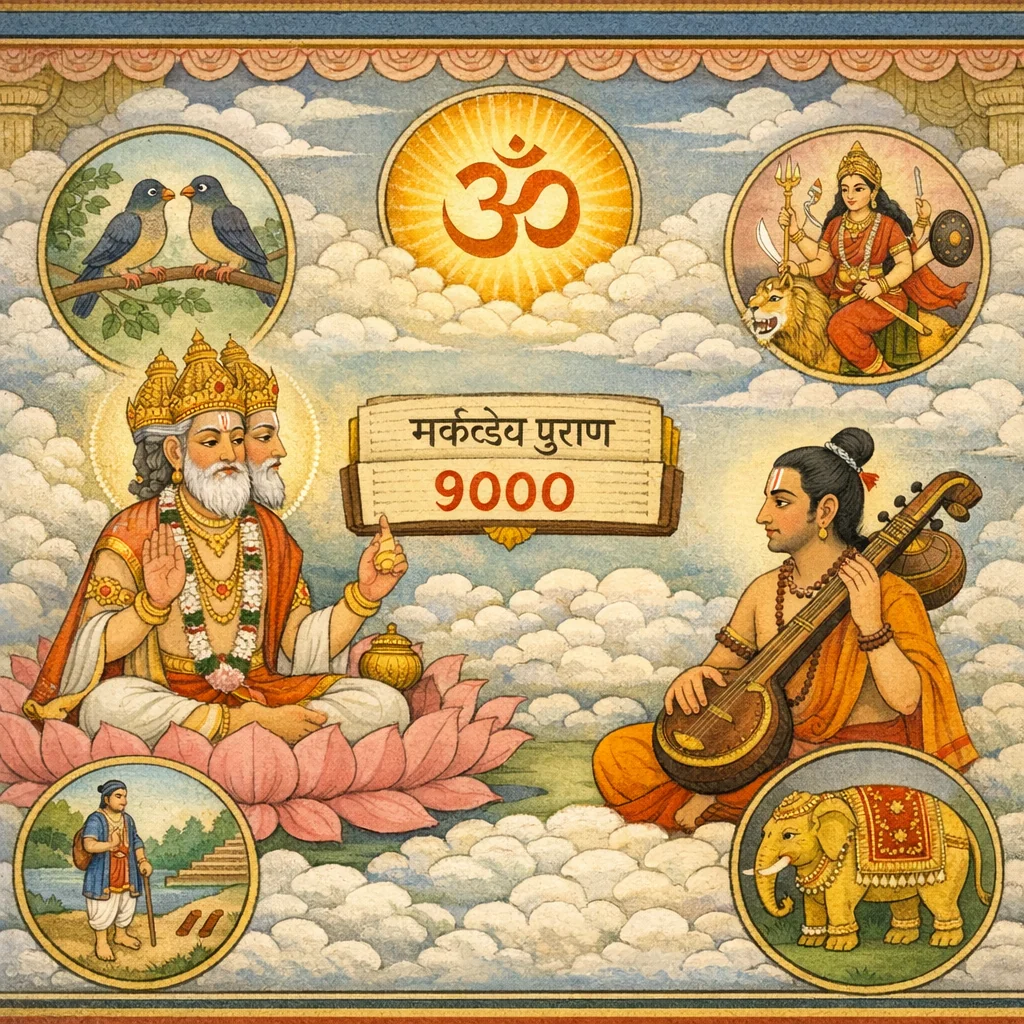
The Anukramaṇī (Summary/Index) of the Mārkaṇḍeya Purāṇa
In this chapter, Śrī Brahmā gives an anukramaṇī (summary/index) of the Mārkaṇḍeya Purāṇa: its famed extent of 9,000 verses, its bird-themed exposition of dharma, and an ordered catalogue of episodes—Mārkaṇḍeya’s question as conveyed by Jaimini; bird-dharma and origins; former births; the Sun’s wondrous transformation; Balarāma’s pilgrimage; Draupadī’s sons; Hariścandra; the Āḍībaka battle; a father–son tale; Dattātreya; Haihaya epic matter; Madālakā and Alarka; nine creation accounts including kalpa-end timing, Yakṣa creation, and Rudra-origin creation; dvīpa conduct and travels; Manvantara narratives; in the eighth division, Durgā-kathā; the rise of Praṇava from Vedic radiance; Mārtaṇḍa’s birth and greatness; Vaivasvata Manu’s lineage; Vatsaprī; Khanitra; Avikṣi and the Kimiccha-vrata; Nariṣyanta; Ikṣvāku; Nala; Rāmacandra; the Kuśa line; the Lunar dynasty; Purūravas; Nahuṣa; Yayāti; the Yadu line; Śrī Kṛṣṇa’s childhood līlā; the history of Māthura; Dvārakā; avatāra-related narration; and a concise Sāṅkhya teaching the unreality (asat) of the manifested world. It ends with phalaśruti: devotionally hearing and teaching grants supreme attainment; writing and gifting the text with a golden elephant in Kārttika yields Brahma-loka; and hearing the anukramaṇī itself bestows desired results.
Shlokas
Verse 1
श्रीब्रह्मोवाच । अथ ते संप्रवक्ष्यामि मार्कंडेयाभिधं मुने । पुराणं सुमहत्पुण्यं पठतां श्रृण्वतां सदा ॥ १ ॥
Śrī Brahmā said: Now, O sage, I shall expound to you in full the Purāṇa called the Mārkaṇḍeya—exceedingly vast and supremely meritorious for those who ever read it and for those who ever listen to it.
Verse 2
यत्राधिकृत्य शकुनीन्सर्वधर्मनिरूपणम् । मार्कंडेयपुराणं तन्नवसाहस्रमीरितम् ॥ २ ॥
That Purāṇa, which takes the birds as its theme and sets forth an exposition of all dharmas, is called the Mārkaṇḍeya Purāṇa; it is said to contain nine thousand verses.
Verse 3
मार्कंडेयमुनेः प्रश्नो जैमिनेः प्राक्समीरितः । पक्षिणां धर्मसंज्ञानं ततो जन्मनिरूपणम् ॥ ३ ॥
First, the question of the sage Mārkaṇḍeya is stated as having been previously conveyed by Jaimini; then comes the teaching that defines the dharma of birds, followed thereafter by an account of their origin (birth).
Verse 4
पूर्वजन्मकथा चैषां विक्रिया चा दिवस्पतेः । तीर्थयात्रा बलस्याथ द्रौपदेयकथानकम् ॥ ४ ॥
Also will be told the account of their previous births, and the wondrous transformation of the Lord of the Day (the Sun); then the pilgrimage of Bala (Balarāma), and the narrative concerning the sons of Draupadī.
Verse 5
हरिश्चंद्रकथा पुण्या युद्धमाडीबकाभिधम् । पितापुत्रसमाख्यानं दत्तात्रेयकथा ततः ॥ ५ ॥
Then comes the holy tale of Hariścandra; the account of the battle known as Āḍībaka; the narrative of a father and son; and thereafter, the story of Dattātreya.
Verse 6
हैहयस्याथ चरितं महाख्यानसमन्वितम् । मदालकसाकथा प्रोक्ता ह्यलर्कचरितान्विता ॥ ६ ॥
Then was recounted the great narrative of the Haihaya line, complete with an expansive epic account; and the tale of Madālakā was also told, together with the life-story of Alarka.
Verse 7
सृष्टिसंकीर्तनं पुण्यं नवधापारिकीर्तितम् । कल्पांतकालनिर्देशो यक्षसृष्टिनिरूपणम् ॥ ७ ॥
The sacred recounting of creation, set forth in nine divisions, is proclaimed to bestow merit. It also indicates the time of a kalpa’s end and describes the creation of the Yakṣas.
Verse 8
रुद्रादिसृष्टिरप्युक्ता द्वीपचर्यानुकीर्तनम् । मनूनां च कथा नानाकीर्तिताः पापहारिकाः ॥ ८ ॥
The creation beginning with Rudra has also been described, as well as the recounted accounts of journeys and conduct in the continents (dvīpas). Many stories of the Manus, too, have been told—stories that remove sin.
Verse 9
तासु दुर्गाकथात्यंतं पुण्यदा चाष्टमेंऽतरे । तत्पश्चात्प्रणवोत्पत्तिस्त्रयीतेजः समुद्भवा ॥ ९ ॥
Among those topics, in the eighth section is found the most sacred account of Durgā, bestowing great merit. After that is described the origin of the Praṇava (Oṁ), born from the radiance of the Vedic triad.
Verse 10
मार्तंडस्य च जन्माख्यातन्माहात्म्यसमन्विता । वैवस्वतान्वयश्चापि वत्सप्रीश्चरितं ततः ॥ १० ॥
It also recounts the birth of Mārtaṇḍa (the Sun), together with his sacred greatness; it further describes the lineage of Vaivasvata (Manu), and thereafter the deeds of Vatsaprī.
Verse 11
खनित्रस्य ततः प्रोक्ता कथा पुण्या महात्मनः । अविक्षिच्चरितं चैव किमिच्छव्रतकीर्त्तनम् ॥ ११ ॥
Thereafter is told the holy, merit-bestowing tale of the great-souled Khanitra; likewise the blameless account of Avikṣi, together with the proclamation of the Kimiccha-vrata.
Verse 12
नरिष्यंतस्य चरितं इक्ष्वाकुचरितं ततः । नलस्य चरितं पश्चाद्रामचन्द्रस्य सत्कथा ॥ १२ ॥
Then comes the account of Nariṣyanta, followed by the account of Ikṣvāku; thereafter the story of Nala, and then the noble, sacred narrative of Rāmacandra.
Verse 13
कुशवंशसमाख्यानं सोमवंशानुकीर्त्तनम् । पुरुरवः कथा पुण्या नहुषस्य कथाद्भुता ॥ १३ ॥
There is the narration of the Kuśa lineage and the recounting of the Lunar dynasty (Somavaṃśa); the tale of Purūravas is merit-giving, and the tale of Nahuṣa is wondrous.
Verse 14
ययातिचरितं पुण्यं यदुवंशानुकीर्त्तनम् । श्रीकृष्णबालचरितं माथुरं चरितं ततः ॥ १४ ॥
Then comes the merit-bearing narrative of Yayāti, the recounting of the Yadu lineage, the account of Śrī Kṛṣṇa’s childhood līlās, and thereafter the history connected with Māthurā (Mathurā).
Verse 15
द्वारकाचरितं चाथ कथा सर्वावतारजा । ततः सांख्यसमुद्देशः प्रपञ्चासत्त्वकीर्तनम् ॥ १५ ॥
Then comes the account of Dvārakā, and the narrative arising from all the divine avatāras. After that is a concise exposition of Sāṅkhya, and the proclamation that the manifested world is without true reality (asat).
Verse 16
मार्कंडेयस्य चरितं पुराणश्रवणे फलम् । यः श्रृणोति नरो भक्त्या पुराणमिदमादरात् ॥ १६ ॥
The sacred account of Mārkaṇḍeya is the meritorious fruit of hearing the Purāṇa. Whoever, with bhakti, listens to this Purāṇa attentively and with reverence, gains that merit.
Verse 17
मार्कंडेयाभिधं वत्स स लभेत्परमां गतिम् । यस्तु व्याकुरुते चैतच्छैवं स लभते पदम् ॥ १७ ॥
O dear child, one known as Mārkaṇḍeya attains the supreme state. And whoever expounds this Śaiva teaching likewise reaches that divine abode.
Verse 18
तत्प्रयच्छेल्लिखित्वा यः सौवर्णकरिसंयुतम् । कार्तिक्यां द्विजवर्याय स लभेंद्ब्रह्मणः पदम् ॥ १८ ॥
Whoever has that sacred text written out and then offers it, together with a golden elephant, to an excellent Brāhmaṇa in the month of Kārttika, attains the abode and state of Brahmā.
Verse 19
श्रृणोति श्रावयेद्वापि यश्चानुक्रमणीमिमाम् । मार्कंडेयपुराणस्य स लभेद्वांछितं फलम् ॥ १९ ॥
Whoever listens to, or causes others to listen to, this Anukramaṇī—the summary and index of the Mārkaṇḍeya Purāṇa—attains the wished-for fruit.
Verse 20
इति श्रीबृहन्नारदीयपुराणे पूर्वभागे बृहदुपाख्याने चतुर्थपादे मार्कण्डेयपुराणानुक्रमणीनिरूपणं नामाष्टनवतितमोऽध्यायः ॥ ९८ ॥
Thus ends the ninety-eighth chapter of the Śrī Bṛhan-Nāradīya Purāṇa, in the Pūrva section, within the Great Narrative, in the Fourth Quarter, entitled “The Exposition of the Anukramaṇī of the Mārkaṇḍeya Purāṇa.”
Frequently Asked Questions
In Purāṇic dharma, textual transmission is itself a yajña-like act: śravaṇa and pravacana purify the listener and speaker, while lekhana-dāna (commissioning/copying and gifting) sacralizes patronage—here explicitly linked to higher lokas and “desired fruit,” aligning with mokṣa-dharma and vrata-kalpa ethics.
It provides a traditional topic-order map: major narrative clusters (dynasties, avatāra-kathā, creation cycles, Durgā section, philosophical Sāṅkhya) and named episodes, enabling cross-referencing of manuscripts/recensions and rapid identification of thematic strata.