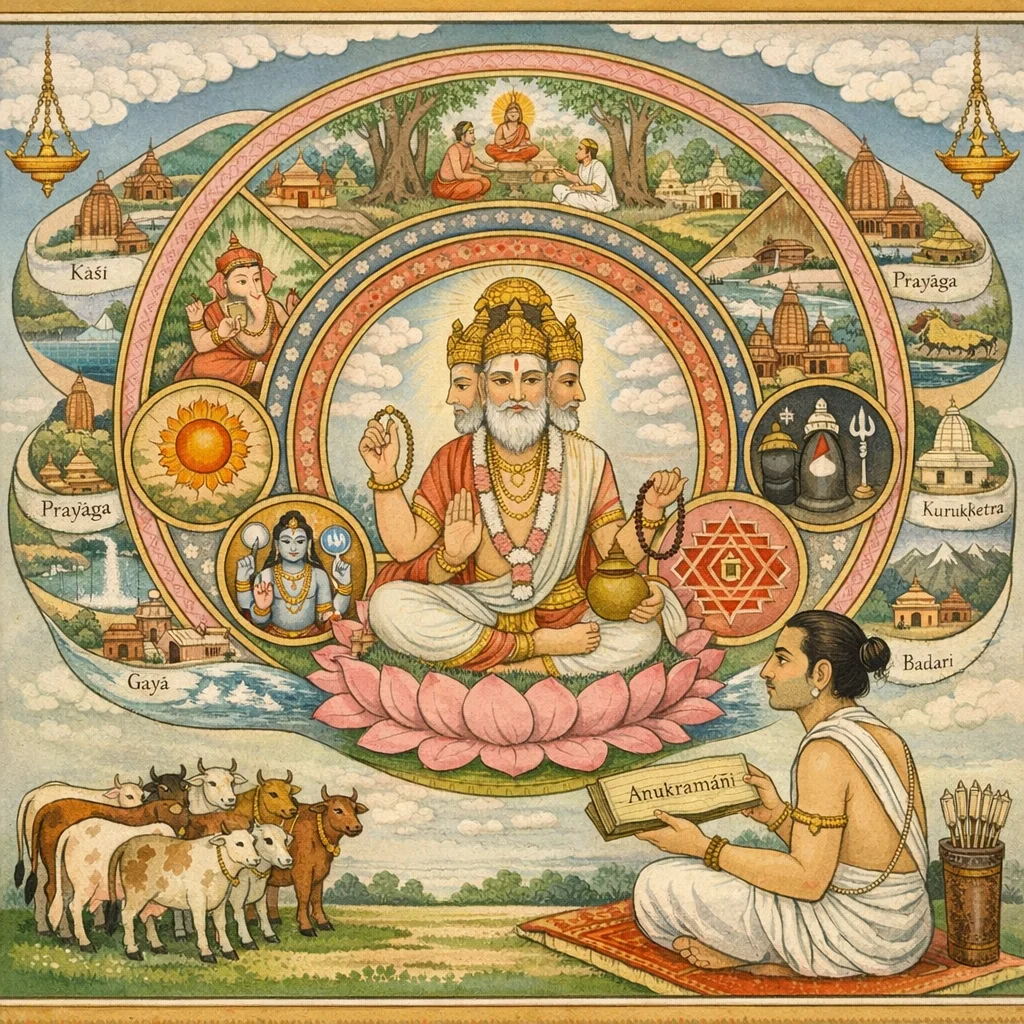
Anukramaṇī (Synoptic Table of Contents) of the Śrī Bṛhannāradīya Purāṇa
Śrī Brahmā addresses a brāhmaṇa and states the scope of the Nāradiya Purāṇa (25,000 verses, of the Bṛhat-kalpa line). The synoptic index lists: the opening Sūta–Śaunaka dialogue tradition with a brief creation account; the First Pāda with Sanaka’s teaching and the Second Pāda titled Mokṣa-dharma; Vedāṅga topics and Śuka’s origin as told by Sanandana to Nārada; and Mahātantra teachings on freeing the jīva from bondage, mantra purification, dīkṣā, mantra derivations, worship procedures, and supporting ritual corpora (prayoga, kavaca, nāma-sahasra, stotra) for Gaṇeśa, Sūrya, Viṣṇu, Śiva, and Śakti. It then notes a third section where Sanatkumāra teaches Purāṇa-lakṣaṇa, pramāṇa, and dāna with month-wise tithi rules. The Fourth Pāda (Sanātana’s instruction) begins with Pratipadā-based vratas and moves to Ekādaśī, supported by tales of Māndhātṛ–Vasiṣṭha, Rukmāṅgada, and Mohinī’s curse and release. The chapter previews extensive tīrtha-māhātmya and yātrā method for Gaṅgā, Gayā, Kāśī, Puruṣottama, Prayāga, Kurukṣetra, Haridvāra, Badarī, Kāmākṣā, Prabhāsa, Puṣkara, Gautama, Vedapāda-stuti, Gokarṇa, Setu, Narmadā, Avantī, Mathurā, Vṛndāvana, and uplifting exemplars. It concludes with śravaṇa-phala (merit of hearing/reciting) and a dāna-phala (gift of seven cows with a quiver of arrows) promising liberation or heavenly attainment.
Shlokas
Verse 1
श्रीब्रह्मोवाच । श्रृणु विप्र प्रवक्ष्यामि पुराणं नारदीयकम् । पंचविंशतिसाहस्रं बृहत्कल्पकथाश्रयम् ॥ १ ॥
Śrī Brahmā said: O brāhmaṇa, listen—I shall expound the Nāradiya Purāṇa, consisting of twenty-five thousand verses and grounded in the narrative tradition of the Bṛhat-kalpa.
Verse 2
सूतशौनकसंवादः सृष्टिसंक्षेपवर्णनम् । नानाधर्मकथाः पुण्याः प्रवृत्ते समुदाहृताः ॥ २ ॥
Here are set forth: the dialogue between Sūta and Śaunaka, a concise account of creation, and many meritorious, sacred narratives on diverse aspects of dharma, as they are handed down in tradition.
Verse 3
प्राग्भागे प्रथमे पादे सनकेन महात्मना । द्वितीये मोक्षधर्माख्ये मोक्षोपायनिरूपणम् ॥ ३ ॥
In the earlier portion, in the first pāda, the great sage Sanaka expounds the subject; and in the second pāda, called “Mokṣa-dharma,” the means to liberation are set forth.
Verse 4
वेदांगानां च कथनं शुकोत्पत्तिश्च विस्तरात् । सनंदनेन गदिता नारदाय महात्मने ॥ ४ ॥
Here are also described the Vedāṅgas, and in detail the account of Śuka’s origin—spoken by Sanandana to the great-souled Nārada.
Verse 5
महातंत्रे समुद्दिष्टं पशुपाशविमोक्षणम् । मंत्राणां शोधनं दीक्षामंत्रोद्धारश्च पूजनम् ॥ ५ ॥
In the Mahātantra are clearly set forth the liberation of the jīva from its bonds, the purification of mantras, initiation (dīkṣā), the extraction/derivation of initiation-mantras, and the procedures of worship (pūjā).
Verse 6
प्रयोगाः कवचं नामसहस्रं स्तोत्रमेव च । गणेशसूर्यविष्णूनां शिवशक्त्योरनुक्रमात् ॥ ६ ॥
In due sequence are set forth the ritual applications (prayogas), protective armors (kavacas), the thousand-name litanies (nāma-sahasras), and hymns (stotras)—for Gaṇeśa, the Sun, Viṣṇu, and for Śiva and Śakti.
Verse 7
सनत्कुमारमुनिना नारदाय तृतीयके । पुराणलक्षणं चैव प्रमाणं दानमेव च ॥ ७ ॥
In the third section, Sage Sanatkumāra taught Nārada the defining characteristics of a Purāṇa, the pramāṇa (standards of valid knowledge), and also the doctrine of dāna (charitable giving).
Verse 8
पृथक्पृथक् समुद्दिष्टं दानकालपुरःसरम् । चैत्रादिसर्वमासेषु तिथीनांचपृथक्पृथक् ॥ ८ ॥
The times for giving (dāna) have been set forth distinctly, with the proper occasion stated first; and in every month beginning with Caitra, the lunar dates (tithis) too have been specified separately, each in its own order.
Verse 9
प्रोक्तं प्रतिपदादीनां व्रतं सर्वाघनाशनम् । सनातनेन मुनिना नारदाय चतुर्थके ॥ ९ ॥
In the Fourth Pada, the sage Sanātana taught Nārada the vow beginning from the first lunar day (Pratipadā) and so on—a vrata that destroys all sin.
Verse 10
पूर्वभागोऽयमुदितो बृहदाख्यानसंज्ञितः । अस्योत्तरे विभागे तु प्रश्न एकादशीव्रते ॥ १० ॥
This earlier portion has been expounded and is known as the “Bṛhad-Ākhyāna.” In its later division, however, the inquiry concerns the vow of Ekādaśī.
Verse 11
वसिष्ठेनाथ संवादो मांधातुः परिकीर्तितः । रुक्मांगदकथा पुण्यामोहिन्युत्पत्तिकर्म च ॥ ११ ॥
Here has been recounted the dialogue of King Māndhātṛ with the sage Vasiṣṭha; and also the sacred tale of Rukmāṅgada, along with the account of the origin and deeds of Mohinī.
Verse 12
वसुशापश्च मोहिन्यै पश्चादुद्धरणक्रिया । गंगाकथा पुण्यतमा गयायात्रानुकीर्तनम् ॥ १२ ॥
Then comes the account of the Vasus’ curse upon Mohinī, followed by the rite of deliverance; the supremely meritorious narration of the Gaṅgā, and the recounting of the pilgrimage to Gayā.
Verse 13
काश्या माहात्म्यमतुलं पुरुषोत्तमवर्णनम् । यात्राविधानं क्षेत्रस्य बह्वाख्यानसमन्वितम् ॥ १३ ॥
It contains the incomparable glory of Kāśī, a portrayal of Puruṣottama (the Supreme Lord), and the prescribed rite of pilgrimage for that sacred kṣetra—together with many supporting narratives.
Verse 14
प्रयागस्याथ माहात्म्यं कुरुक्षेत्रस्य तत्परम् । हरिद्वारस्य चाख्यानं कामोदाख्यानकं तथा ॥ १४ ॥
Next it proclaims the sacred greatness of Prayāga, and then in proper sequence that of Kurukṣetra; it also relates the account of Haridvāra, and likewise the narrative known as Kāmoda.
Verse 15
बदरीतीर्थमाहात्म्यं कामाक्षायास्तथैव च । प्रभासस्य च माहात्म्यं पुष्कराख्यानकं ततः ॥ १५ ॥
Then come the sacred greatness of the Badarī tīrtha, likewise that of Kāmākṣā; the greatness of Prabhāsa as well, and thereafter the narrative of Puṣkara.
Verse 16
गौतमाख्यानकं पश्चाद्वेदपादस्तवस्ततः । गोकर्णक्षेत्रमाहात्म्यं लक्ष्मणाख्यानकं तथा ॥ १६ ॥
Thereafter comes the narrative of Gautama; then the hymn of praise to Vedapāda; next the greatness of the sacred kṣetra of Gokarṇa; and likewise the narrative of Lakṣmaṇa.
Verse 17
सेतुमाहात्म्यकथनं नर्मदातीर्थवर्णनम् । अवंत्याश्चैव माहात्म्यं मधुरायास्ततः परम् ॥ १७ ॥
It teaches the narration of Setu’s greatness, the description of the sacred tīrtha of the Narmadā, the glory of Avantī, and thereafter the greatness of Mathurā.
Verse 18
बृन्दावनस्य महिमा पशोर्ब्रह्मांतिके गतिः । मोहिनीचरितं पश्चादेवं पश्चादेवं वै नारदीयकम् ॥ १८ ॥
Next is proclaimed the greatness of Vṛndāvana; then comes the account of how even an animal, in Brahmā’s very presence, attained a higher destiny. After that follows the narrative of Mohinī—thus, topic after topic, the Nāradiya Purāṇa proceeds.
Verse 19
यः शृणोति नरो भक्त्याश्रावयेद्वा समाहितः । स याति ब्रह्मणो धाम नात्र कार्या विचारणा ॥ १९ ॥
Whoever hears this with devotion—or, composed and attentive, causes it to be recited—attains Brahman’s abode (dhāma); of this there is no need for further deliberation.
Verse 20
यस्त्वेतदिषुपूर्णायां धेनूनां सप्तकान्वितम् । प्रदद्याद्दिजंर्याय संलभेन्मोक्षमेव च ॥ २० ॥
But whoever bestows upon an excellent brāhmaṇa a set of seven cows, together with a quiver filled with arrows, truly attains liberation (mokṣa) as well.
Verse 21
यश्चानुक्रमणीमेतां नारदीयस्य वर्णयेत् । श्रृणुयद्वैकचित्तेन सोऽपि स्वर्गगतिं लभेत् ॥ २१ ॥
Whoever expounds this Anukramaṇī—the synoptic index of the Nāradiya Purāṇa—or hears it with single-pointed attention, that person too attains the path leading to heaven.
Verse 22
इति श्रीबृहन्नारदीयपुराणे पूर्वभागे बृहदुपाख्याने चतुर्थपादे नारदीयपुराणानुक्रमणीकथनं नाम सप्तनवतितमोऽध्यायः ॥ ९७ ॥
Thus ends the ninety-seventh chapter, entitled “The Account of the Anukramaṇī (Table of Contents) of the Nārada Purāṇa,” in the Pūrva-bhāga of the Śrī Bṛhannāradīya Purāṇa, within the Great Supplementary Narrative (Bṛhad-upākhyāna), in the Fourth Pāda.
Frequently Asked Questions
The chapter frames the Fourth Pāda as moving from general Pratipadā-based vrata discipline into a focused doctrinal and narrative investigation of Ekādaśī, indicating its special status as a high-merit vow supported by exempla (e.g., Rukmāṅgada) and theological framing.
It signals a complete ritual toolkit: kavaca for protection, nāma-sahasra for sustained devotional recitation, and stotra for praise—integrated with prayoga and dīkṣā procedures—showing the Purāṇa’s practical liturgical orientation across multiple deities.
By placing tīrtha-māhātmya and yātrā-vidhi alongside mokṣa-dharma, vrata, and dāna, the Anukramaṇī portrays pilgrimage as a dharma practice that accrues puṇya and supports purification, thereby functioning as an auxiliary path within a broader liberation-oriented framework.