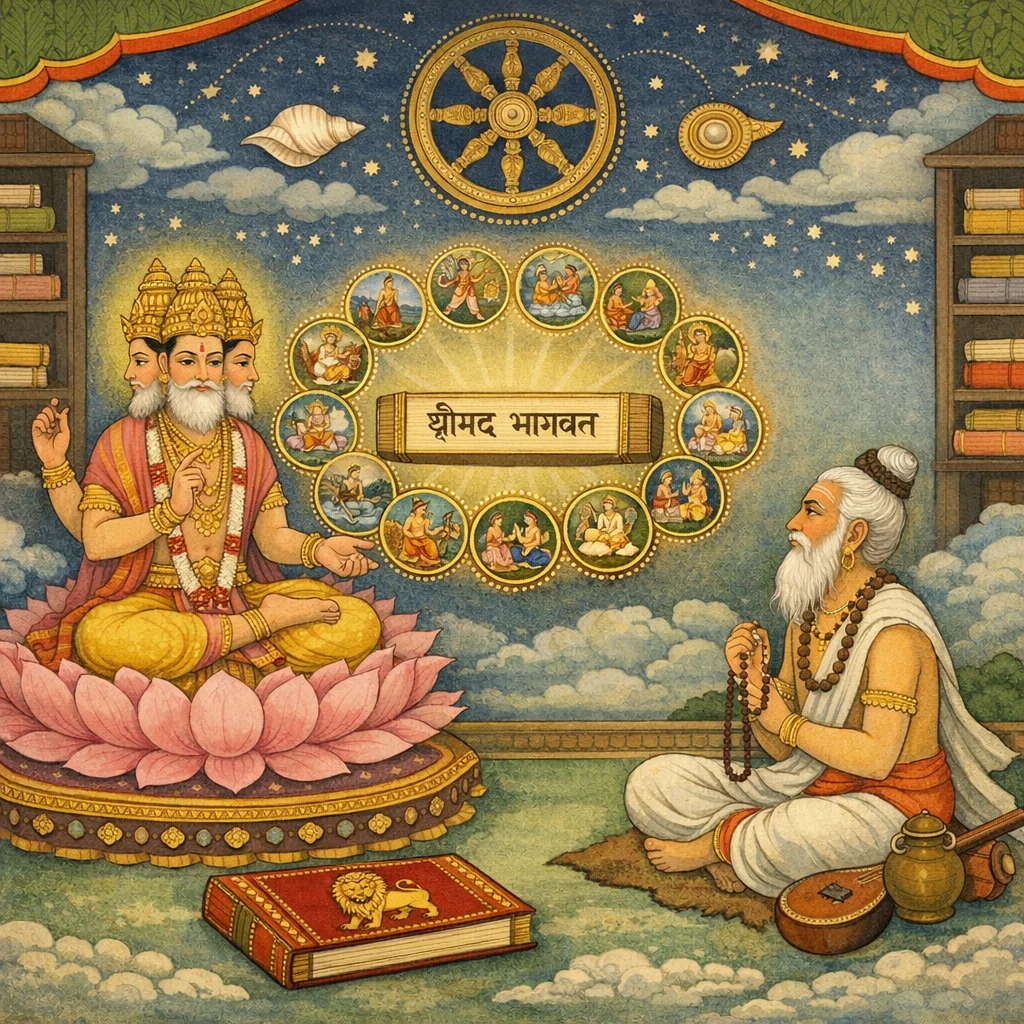
The Exposition of the Index (Anukramaṇī) of the Śrīmad Bhāgavata
Brahmā instructs Marīci by giving a compact anukramaṇī (index) of Vedavyāsa’s Śrīmad Bhāgavata Purāṇa, proclaiming it Veda-like (brahma-sammita), consisting of 18,000 verses and twelve skandhas. He then assigns the hallmark narratives and teachings to each skandha: Sūta’s assembly and the Vyāsa–Pāṇḍava–Parīkṣit frame; twofold creation and divine deeds; Vidura–Maitreya and Kapila’s Sāṅkhya; Dhruva, Pṛthu, and Prācīnabarhis; cosmography, naraka, Ajāmila, and Dakṣa; Vṛtra and the Maruts; Prahlāda with varṇāśrama; manvantaras, Gajendra, the churning of the ocean, and Bali; avatāras with the solar and lunar dynasties; Kṛṣṇa’s Vraja līlā; Mathurā–Dvārakā, removal of Earth’s burden, and nirodha; Uddhava and Yadu teachings, the Yādava destruction, signs of Kali, and Parīkṣit’s liberation; compilation of Veda-śākhās, Mārkaṇḍeya’s tapas, Sūrya manifestations, and the Sātvata doctrine—ending with an enumeration of Purāṇas. The chapter concludes by stating the merits for all who transmit and hear it, and prescribing a Prauṣṭhapadī full-moon rite of gifting the text, marked with a golden lion emblem, to a Bhāgavata brāhmaṇa.
Shlokas
Verse 1
ब्रह्मोवाच । मरीचे श्रृणु वक्ष्यामि वेदव्यासेन यत्कृतम् । श्रीमद्भागवतं नाम पुराणं ब्रह्मसम्मितम् ॥ १ ॥
Brahmā said: “O Marīci, listen. I shall speak of the work composed by Vedavyāsa—the Purāṇa named the Śrīmad Bhāgavata, revered as equal to Brahman, that is, the Veda.”
Verse 2
तदष्टादशसाहस्रं कीर्तितं पापनाशनम् । सुरपादपरूपोऽयं स्कंधैर्द्वादशभिर्युतः ॥ २ ॥
It is declared to consist of eighteen thousand (verses) and to be a destroyer of sin. This work is set in the form of the division called Surapāda and is furnished with twelve skandhas (books).
Verse 3
भगवानेव विप्रेंद्र विश्वरूपीसमीरितः । तत्र तु प्रथमस्कंधे सूतर्षीणां समागमे ॥ ३ ॥
O best of brāhmaṇas, there in the First Skandha, at the gathering of Sūta and the sages, only the Bhagavān—praised as the One of universal form—was spoken of.
Verse 4
व्यासस्य चरितं पुण्यं पांडवानां तथैव च । परीक्षितमुपाख्यानमितीदं समुदाहृतम् ॥ ४ ॥
Thus has this account been duly proclaimed: the holy life-story of Vyāsa, likewise that of the Pāṇḍavas, and the narrative concerning Parīkṣit.
Verse 5
परीक्षिच्छुकसंवादे सृष्टिद्वयनिरूपणम् । ब्रह्मनारदसंवादे देवताचरितामृतम् ॥ ५ ॥
In the dialogue between Parīkṣit and Śuka is set forth the exposition of the twofold creation; and in the dialogue between Brahmā and Nārada is the nectar-like account of the deeds of the gods.
Verse 6
पुराणलक्षणं चैव सृष्टिकारणसंभवः । द्वितीयोऽयं समुदितः स्कंधो व्यासेन धीमता ॥ ६ ॥
And (here are described) the defining characteristics of a Purāṇa, along with the arising of the cause of creation. This second Skandha has thus been composed by the wise Vyāsa.
Verse 7
चरितं विदुरस्याथ मैत्रेयेणास्य संगमः । सृष्टिप्रकरणं पश्चाद्बह्मणः परमात्मनः ॥ ७ ॥
Then (will be described) the life-story of Vidura and his meeting with Maitreya; thereafter comes the section on creation—of Brahmā, the Supreme Self (Paramātman).
Verse 8
कापिलं सांख्यमप्यत्र तृतीयोऽयमुदाहृतः । सत्याश्चरितमादौ तु ध्रुवस्य चरितं ततः ॥ ८ ॥
Here too the Sāṅkhya of Kapila is set forth—this is proclaimed as the third topic. First comes the wondrous account of Satya; thereafter follows the sacred narrative of Dhruva.
Verse 9
पृथोः पुण्यसमाख्यानं ततः प्राचीनबर्हिषम् । इत्येष तुर्यो गदितो विसर्गे स्कंध उत्तमः ॥ ९ ॥
Then comes the meritorious account of King Pṛthu, followed by that of Prācīnabarhis. Thus is the excellent fourth section of the Visarga-skandha declared.
Verse 10
प्रियव्रतस्य चरितं तद्वंश्यानां च पुण्यदम् । ब्रह्मांडांतर्गतानां च लोकानां वर्णनं ततः ॥ १० ॥
Then comes the merit-bestowing account of Priyavrata and his descendants; thereafter follows the description of the worlds contained within the Brahmāṇḍa, the cosmic egg.
Verse 11
नरकस्थितिरित्येष संस्थाने पंचमो मतः । अजामिलस्य चरितं दक्षसृष्टिनिरूपणम् ॥ ११ ॥
“The condition of hell (naraka)”—this is regarded as the fifth topic within the Saṃsthāna section; and thereafter come the account of Ajāmila and the exposition of Dakṣa’s creation.
Verse 12
वृत्राख्यानं ततः पश्चान्मरुतां जन्म पुण्यदम् । षष्ठोऽयमुदितः स्कंधोव्यासेन परिपोषणे ॥ १२ ॥
Thereafter comes the account of Vṛtra, and then the merit-bearing narration of the birth of the Maruts. Thus, in the theme of nourishment and sustenance (Paripoṣaṇa), this sixth Skandha has been set forth by Vyāsa.
Verse 13
प्रह्लादचरितं पुण्यं वर्णाश्रमनिरूपणम् । सप्तमो गदितो वत्स वासनाकर्मकीर्तने ॥ १३ ॥
The holy narrative of Prahlāda, together with the exposition of varṇa and āśrama (social and spiritual disciplines), has been spoken as the seventh section, dear child, within the account that proclaims vāsanā (latent tendencies) and karma.
Verse 14
गजेंद्रमोक्षणाख्यानं मन्वंतरनिरूपणे । समुद्रमथनं चैव बलिवैभवबंधनम् ॥ १४ ॥
Within the account that delineates the Manvantaras are included the tale of Gajendra’s liberation, the churning of the ocean, and also the episode of Bali—his splendor and his being bound and restrained.
Verse 15
मत्स्याक्तारचरितमष्टमोऽयं प्रकीर्तितः । सूर्यवंशसमाख्यानं सोमवंशनिरूपणम् ॥ १५ ॥
Thus this eighth section has been set forth, proclaiming the narrative of Matsya and the other divine descents (avatāras), together with the account of the Solar dynasty and the delineation of the Lunar dynasty.
Verse 16
वंश्यानुचरिते प्रोक्तो नवमोऽयं महामते । कृष्णस्य बालचरितं कौमारं च व्रजस्थितिः ॥ १६ ॥
O great-minded one, in the section on dynasties and lineages this ninth topic is declared: the childhood deeds of Krishna—His boyhood and His dwelling in Vraja.
Verse 17
कैशोरं मथुरास्थानं यौवनं द्वारकास्थितिः । भूभारहरणं चात्र निरोधे दशमः स्मृतः ॥ १७ ॥
In boyhood (kaiśora) He is situated at Mathurā; in youth (yauvana) He is established at Dvārakā. Here too is taught the removal of the earth’s burden. Thus, under the theme of nirodha (withdrawal/dissolution), the Tenth section is remembered as treating these matters.
Verse 18
नारदेन तु संवादो वसुदेवस्य कीर्तितः । यदोश्च दत्तात्रेयेण श्रीकृष्णोनोद्धवस्य च ॥ १८ ॥
By Nārada was recounted the dialogue of Vasudeva; likewise that of Yadu as taught by Dattātreya; and also the sacred dialogue between Śrī Kṛṣṇa and Uddhava.
Verse 19
यादवानां मिथोंतश्च मुक्तावेकादशः स्मृतः । भविष्यकलिनिर्द्देशो मोक्षो राज्ञः परीक्षितः ॥ १९ ॥
The mutual destruction of the Yādavas is recounted, and the eleventh topic is remembered as “mokṣa,” liberation; there is also an indication of the future Kali age, and the liberation of King Parīkṣit.
Verse 20
वेदशाखाप्रणयनं मार्कंडेयतपःक्रिया । सौरी विभूतिरुदिता सात्वती च ततः परम् ॥ २० ॥
The compilation of the Vedic recensions, the ascetic practices of Mārkaṇḍeya, and the manifestations of Sūrya’s glory have been described; thereafter the Sātvata (Vaiṣṇava) doctrine is set forth.
Verse 21
पुराणसंख्याकथनमाश्रये द्वादशो ह्ययम् । इत्येवं कथितं वत्स श्रीमद्भागवतं तव ॥ २१ ॥
Now I take up the account of the enumeration of the Purāṇas—this is the twelfth topic. Thus, dear child, your Śrīmad Bhāgavata has been explained in this manner.
Verse 22
वक्तुः श्रोतुश्चोपदेष्टुरनुमोदितुरेव च । साहाय्यकर्तुर्गदितं भक्तिभुक्तिविमुक्तिदम् ॥ २२ ॥
It is declared that this sacred teaching bestows devotion (bhakti), worldly well-being, and liberation upon the speaker, the listener, the instructor, the one who approves it, and even the one who assists in its transmission.
Verse 23
प्रौष्ठपद्यां पूर्णिमायां हेमसिंहसमन्वितम् । देयं भागवतायेदं द्विजायप्रीतिपूर्वकम् ॥ २३ ॥
On the full-moon day of Prauṣṭhapadī, this gift, adorned with a golden lion emblem, should be offered with heartfelt reverence to a Brāhmaṇa who is a Bhāgavata, a devotee of the Blessed Lord.
Verse 24
संपूज्य वस्त्रहेमाद्यैर्भगवद्भक्तिमिच्छता । योऽप्यनुक्रमणीमेतां श्रावयेच्छृणुयात्तथा । स पुराणश्रवणजं प्राप्नोति फलमुत्तमम् ॥ २४ ॥
Seeking devotion to the Lord, one should duly honor it with gifts such as garments, gold, and the like; whoever causes this Anukramaṇī to be recited, or likewise listens to it, attains the supreme fruit born of hearing the Purāṇa itself.
Verse 25
इति श्रीबृहन्नारदीयपुराणे पूर्वभागे बृहदुपाख्याने चतुर्थपादे श्रीमद्भागवतानुक्रमणीनिरूपणं नाम षण्णवतितमोऽध्यायः ॥ ९६ ॥
Thus ends the ninety-sixth chapter, entitled “The Exposition of the Anukramaṇī of the Śrīmad Bhāgavata,” in the First Part of the Śrī Bṛhannāradīya Purāṇa, within the Great Narrative, in the Fourth Pāda.
Frequently Asked Questions
The chapter frames the Bhāgavata as brahma-sammita—Veda-aligned in authority and soteriological efficacy—because it systematizes dharma and mokṣa through devotion to Bhagavān while retaining Purāṇic completeness (lakṣaṇas) and pedagogical structure (skandhas).
It ritualizes textual transmission as dāna: offering the Bhāgavata (with a golden lion emblem) to a Vaiṣṇava brāhmaṇa sacralizes preservation and teaching lineage, and the stated phala extends to speaker, listener, teacher, approver, and assistants.
Yes. It compresses a major Purāṇa into a navigable thematic map, linking literary taxonomy (anukramaṇī) with dharma practice (phala-śruti and dāna-vidhi), a signature ‘reference manual’ function of the Nāradiya.