The Outline (Anukramaṇī) of the Vāyavīya (Vāyu) Purāṇa
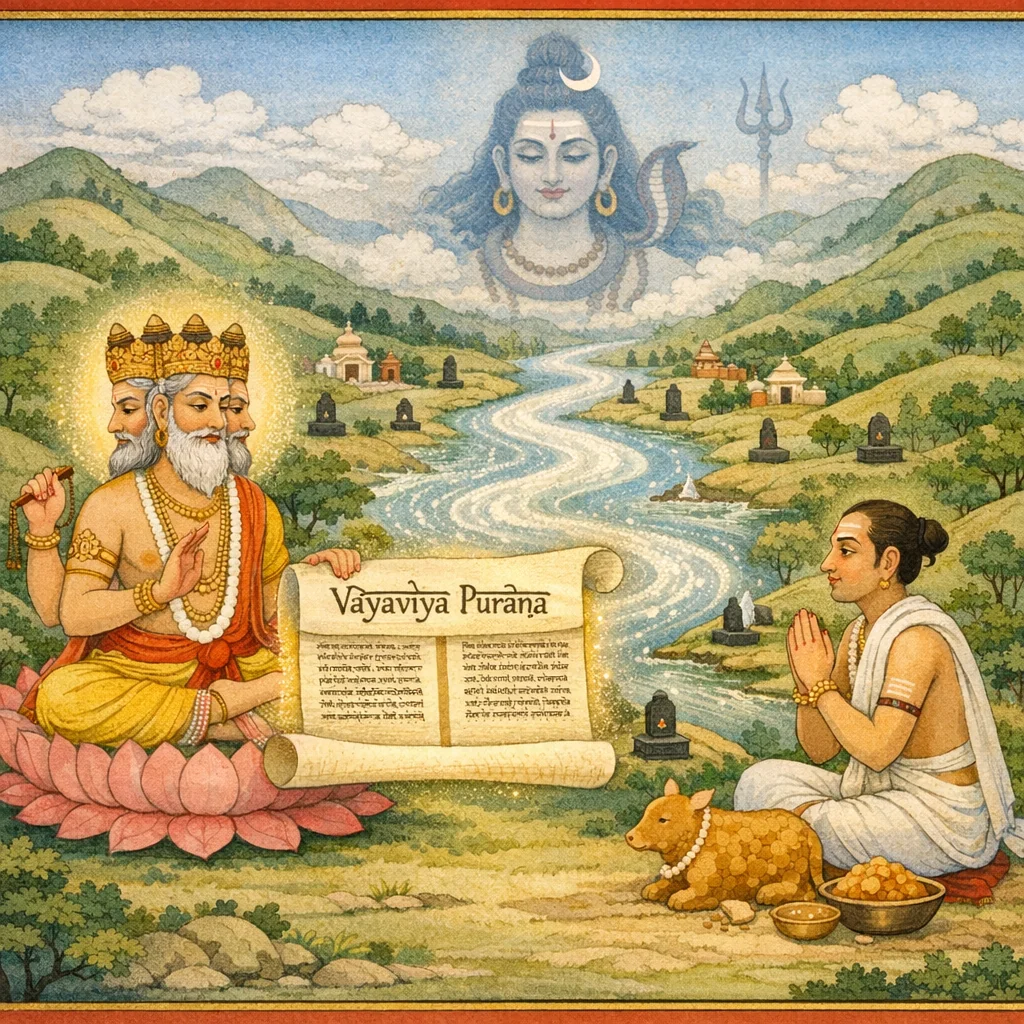
Brahmā speaks to a brāhmaṇa, praising the Vāyavīya (Vāyu) Purāṇa as a means to reach Rudra’s supreme abode. He gives its measure as 24,000 verses and places it in the Śvetakalpa, where Vāyu teaches dharma. The Purāṇa is said to be in two parts and complete in the pañcalakṣaṇa mode, beginning with sarga (creation), recounting Manvantara dynasties, and detailing the slaying of Gayāsura. It also teaches the month-mahātmyas (especially Māgha), dāna-dharma, rāja-dharma, the classification of beings across realms, and earlier divisions of vows and observances. The latter portion presents an extensive Narmadā tīrtha-mahātmya in accord with Śiva’s Saṃhitā: Śiva’s immanence on her banks, Narmadā-water as Brahman and mokṣa, and the river’s descent as divine śakti (Revā). The chapter lists confluences and tīrthas (35 saṅgamas, hundreds of sites, and hyperbolic sacred counts) and ends with rules for gifting/recitation (Śrāvaṇī gifting with a jaggery-cow) and promised fruits—Rudra-loka through fourteen Indras, and the merit of hearing the whole Purāṇa through its anukramaṇī.
Shlokas
Verse 1
ब्रह्मोवाच । श्रृणु विप्र प्रवक्ष्यामि पुराणं वायवीयकम् । यस्मिञ्च्छ्रुते लभद्धाम रुद्रस्य परमात्मनः ॥ १ ॥
Brahmā said: “Listen, O brāhmaṇa; I shall expound the Vāyavīya Purāṇa—by hearing it one attains the supreme abode of Rudra, the Supreme Self.”
Verse 2
चतुर्विंशतिसाहस्रं तत्पुराणं प्रकीर्तितम् । श्वेतकल्पप्रसंगेन धर्मानत्राह मारुतः ॥ २ ॥
That Purāṇa is declared to consist of twenty-four thousand verses. Here, in connection with the Śvetakalpa, Māruta (Vāyu) has spoken of the principles of Dharma.
Verse 3
तद्बायवीयनुदितं भागद्वयसमन्वितम् । सर्गादिलक्षणं यत्र प्रोक्तं विप्र सविस्तरम् ॥ ३ ॥
O brāhmaṇa, that Purāṇa proclaimed in the Vāyavīya tradition, comprising two parts, is the one in which the characteristics beginning with creation (sarga and the rest) are described in full detail.
Verse 4
मन्वंतरेषु वंशाश्च राज्ञां ये यत्र कीर्तिताः । गयासुरस्य हननं विस्तराद्यत्र कीर्तितम् ॥ ४ ॥
Therein, across the various Manvantaras, the royal dynasties are recounted as they are celebrated in their proper places; and there, in full detail, is also narrated the slaying of the asura Gayāsura.
Verse 5
मासानां चैव माहात्म्यं माघस्योक्तं फलाधिकम् । दानधर्मा राजधर्मा विस्तरेणोदिता स्तथा ॥ ५ ॥
And the sacred greatness of the months is described—above all, Māgha is declared to yield the highest fruit; likewise, the dharma of charity and the dharma of kings are expounded at length.
Verse 6
भूपातालककुब्व्योमचारिणां यत्र निर्णयः । व्रतादीनां च पूर्वोऽयं विभागः समुदाहृतः ॥ ६ ॥
Here is laid down the determination concerning those who move upon the earth, in Pātāla (the netherworld), through the quarters, and in the sky; and the earlier division regarding vows (vrata) and related observances is also duly set forth.
Verse 7
उत्तरे तस्य भागेतु नर्मदातीर्थवर्णनम् । शिवस्य संहितोक्ता वै विस्तरेण मुनीश्वर ॥ ७ ॥
And in its latter portion there is a description of the sacred tīrthas—the holy fords—of the Narmadā, indeed as set forth in Śiva’s Saṃhitā, explained in detail, O lord among sages.
Verse 8
यो देवः सर्वदेवानां दुर्विज्ञेयः सनातनः । स तु सर्वात्मना यस्यास्तीरे तिष्ठति संततम् ॥ ८ ॥
That eternal Deity—hard to comprehend even for all the gods—abides there continually, upon the bank of that sacred place, as the all-pervading Self.
Verse 9
इदं ब्रह्मा हारीरिदं साक्षाच्चेदं परो हरः । इदं ब्रह्म निराकारं कैवल्यं नर्मदाजलम् ॥ ९ ॥
This is Brahmā; this indeed is Hari (Viṣṇu). This is directly the Supreme Hara (Śiva). This is the formless Brahman; this is liberation itself—the sacred water of the Narmadā.
Verse 10
ध्रुवं लोकहितार्थाय शिवेन स्वशरीरतः । शक्तिः कापि सरिदृपा रेवेयमवतारिता ॥ १० ॥
Surely, for the welfare of the world, Śiva caused a certain divine Power (Śakti) from his own body to descend in the form of a river—this is the Revā.
Verse 11
ये वसंत्युत्तरे कूले रुद्रस्यानुचरा हि ते । वसंति याम्यतीरे ये लोकं ते यांति वैष्णवम् ॥ ११ ॥
Those who dwell on the northern bank are indeed attendants of Rudra. But those who dwell on the southern bank attain the Vaiṣṇava world—the realm of Viṣṇu.
Verse 12
ॐकारेश्वरमारभ्ययावत्पश्चिमसागरः । संगमाः पंच च त्रिंशन्नदीनां पापनाशनी ॥ १२ ॥
Beginning from Oṃkāreśvara and extending up to the Western Ocean, there are thirty-five confluences of rivers—each a destroyer of sin.
Verse 13
दशैकमुत्तरे तीरे त्रयोविंशतिर्दक्षिणे । पंचत्रिंशत्तमः प्रोक्तो रेवासागरसगमः ॥ १३ ॥
On the northern bank there are eleven tīrthas, and on the southern bank there are twenty-three; the thirty-fifth is declared to be the confluence where the Revā meets the ocean.
Verse 14
संगमैः सहितान्येव रेवातीरद्वयेऽपि च । चतुःशतानि तीर्थानि प्रसिद्धानि च संति हि ॥ १४ ॥
Including the sacred confluences, on both banks of the Revā there are indeed four hundred well-known pilgrimage tīrthas.
Verse 15
षष्टितीर्थसहस्राणि षष्टिकोट्यो मुनीश्वर । संति चान्यानि रेवायास्तीरयुग्मे पदे पदे ॥ १५ ॥
O lord among sages, there are sixty thousand tīrthas and sixty crores of munis; and besides these, along the Narmadā (Revā), on both banks, there are other holy places at every step.
Verse 16
संहितेयं महापुण्या शिवस्य परमात्मनः । नर्मदाचरितं यत्र वायुना परिकीर्तितम् ॥ १६ ॥
This Saṃhitā is supremely meritorious, belonging to Śiva, the Supreme Self; in it, Vāyu extensively proclaims the sacred account of the Narmadā.
Verse 17
लिखित्वेदं पुराणं तु गुडधेनुसमन्वितम् । श्रावण्यां यो ददेद्भक्त्या ब्राह्मणाय कुटुंबिने ॥ १७ ॥
Whoever has this Purāṇa written out and, on Śrāvaṇī (the full-moon day of Śrāvaṇa), donates it with devotion to a householder Brāhmaṇa, together with the gift of a ‘guda-dhenu’ (a jaggery-cow), is praised as gaining great merit.
Verse 18
रुद्रलोके वसेत्सोऽपि यावदिंद्राश्चतुर्द्दश । यः श्रावयेद्वा श्रृणुयाद्वायवीयमिदं नरः ॥ १८ ॥
That man who causes this Vāyavīya section to be recited, or who listens to it, dwells in Rudra’s world for as long as fourteen Indras—that is, through fourteen Manvantaras.
Verse 19
नियमेन हविष्याशी स रुद्रो नात्र संशयः । यश्चानुक्रमणीमेतां श्रृणोति श्रावयेत्तथा ॥ १९ ॥
He who, with disciplined observance, lives on haviṣya-food becomes, as it were, Rudra—of this there is no doubt. And whoever listens to this Anukramaṇikā, or likewise causes it to be recited for others, gains that same merit.
Verse 20
सोऽपि सर्वपुराणस्य फलं श्रवणजं लभेत् ॥ २० ॥
He too would obtain the fruit of the entire Purāṇa—namely, the spiritual merit that arises from hearing it.
Verse 21
इति श्रीबृहन्नारदीयपुराणे पूर्वभागे बृहदुपाख्याने चतुर्थपादे वायुपुराणानुक्रमणीनिरूपणं नाम पञ्चनवतितमोऽध्यायः ॥ ९५ ॥
Thus ends the ninety-fifth chapter, called “The Exposition of the Anukramaṇī (Outline) of the Vāyu Purāṇa,” in the First Part of the venerable Bṛhannāradīya Purāṇa, within the Great Narrative (Bṛhad-upākhyāna), in the Fourth Pada.
Frequently Asked Questions
The chapter uses a mokṣa-dharma register to sacralize the tīrtha: the river is presented as Śiva’s descended śakti and simultaneously as the locus of the all-pervading Supreme Self, allowing devotional theism (Śiva-tattva) and nondual liberation language (nirguṇa brahman; mokṣa) to converge in the experience of Narmadā-water.
It links three practices: (1) śravaṇa/paṭhana (hearing and recitation) of Purāṇic dharma, (2) dāna and vrata-kalpa observances (notably Śrāvaṇī gifting of the written text with an allied ‘jaggery-cow’), and (3) tīrtha-yātrā centered on the Narmadā’s banks and saṅgamas—each framed as a means to sin-destruction and ascent to Rudra-loka.