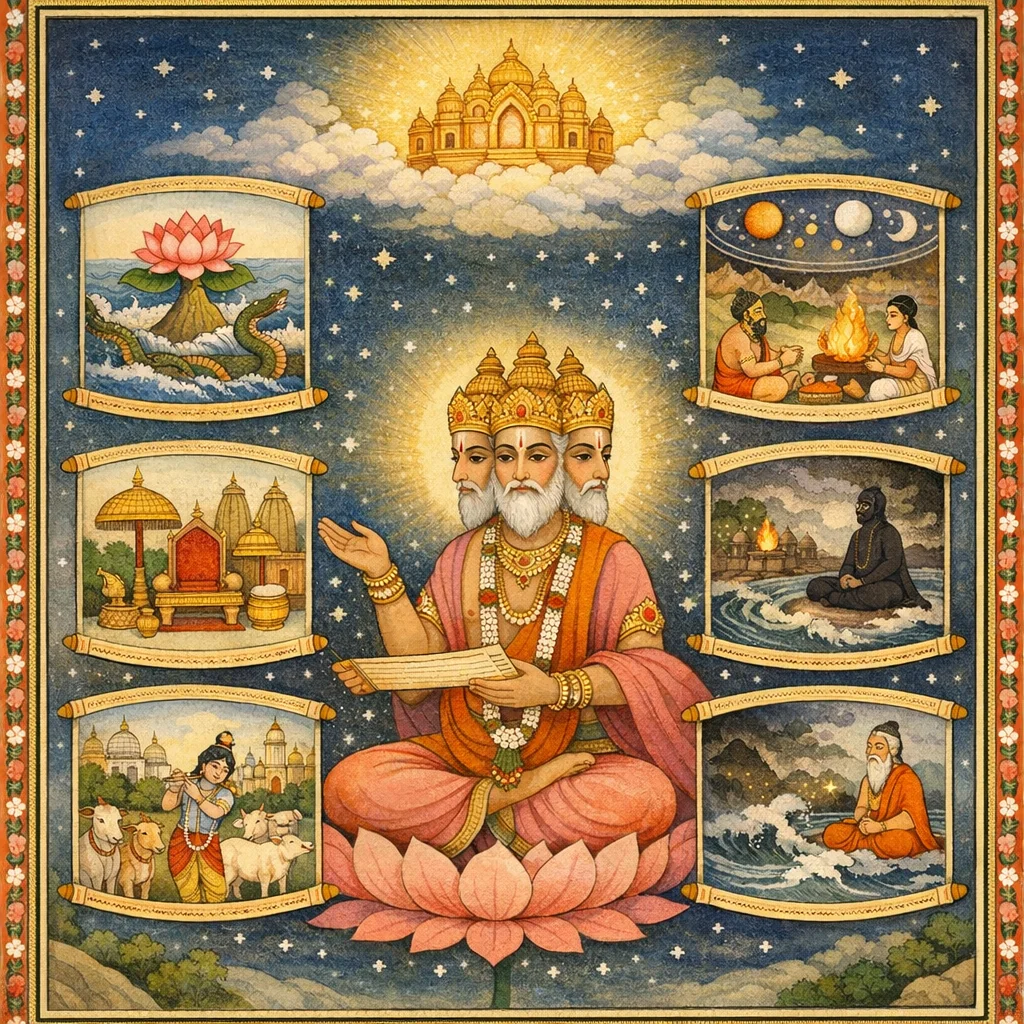
The Outline (Anukramaṇī) of the Viṣṇu Purāṇa
Brahmā proclaims an outline (Anukramaṇī) of the great Vaiṣṇava Purāṇa, the Viṣṇu Purāṇa, declaring its extent and its power to destroy sin. The chapter then lists its six aṁśas: (1) creation, the gods’ origins, the churning of the ocean, and genealogies from Dakṣa; with Dhruva, Pṛthu, Pracetas, Prahlāda, Priyavrata’s line, and the cosmography of dvīpas/varṣas. (2) subterranean realms and hells, seven heavens, solar-lunar astronomy, and the traits of weekdays; plus Bharata’s teaching on liberation and the Nidāgha–Ṛbhu dialogue. (3) manvantaras, Vyāsa’s descent, rites that free from hell, Sagara–Aurva’s dharma exposition, the śrāddha procedure, and varṇāśrama duties, followed by sadācāra and delusion born of māyā. (4) the Solar and Lunar dynasties with royal narratives. (5) inquiry into Kṛṣṇa’s avatāra and His līlās from Gokula to Mathurā and Dvārakā, slaying of daityas, marriages, and the Aṣṭāvakra account. (6) conduct in Kali-yuga, fourfold pralaya, and Khāṇḍikya’s brahma-jñāna; along with the Viṣṇudharmottara’s dharma discourses (vratas, yamas/niyamas), Dharmaśāstra–Arthaśāstra, Vedānta, Jyotiṣa, stotras, and Manus. It ends with a phalaśruti on the merits of reading, hearing, writing, gifting, and teaching the Purāṇic meaning, culminating in attainment of Viṣṇu’s abode.
Shlokas
Verse 1
श्रीब्रह्मोवाच । श्रृणु वत्स प्रवक्ष्यामि पुराणं वैष्णवं महत् । त्रयोविंशतिसहस्रं सर्वपातकनाशनम् ॥ १ ॥
Śrī Brahmā said: “Listen, dear child; I shall proclaim the great Vaiṣṇava Purāṇa—twenty-three thousand verses in extent—destroyer of all sins.”
Verse 2
यत्रादिभागे निर्विष्टाः षडंशाः शक्तिजेन ह । मैत्रेयायादिमे तत्र पुराणस्यावतारिकाम् ॥ २ ॥
In that earlier section, indeed, the six divisions were set forth by Śaktija; and there, for Maitreya, he also delivered the introductory preface to this Purāṇa.
Verse 3
आदिकारणसर्गश्च देवादीनां च संभवः । समुद्रमथनाख्यानं दक्षादीनां ततोऽन्वयः ॥ ३ ॥
It describes the primordial creation from the first cause, the origin of the gods and other beings, the account of the churning of the Ocean, and thereafter the genealogical lineages beginning with Dakṣa and others.
Verse 4
ध्रुवस्य चरितं चैव पृथोश्चरितमेव च । प्रचेतसं तथाख्यानं प्रह्लादस्य कथानकम् ॥ ४ ॥
Also recounted are the sacred deeds of Dhruva, the deeds of King Pṛthu, the account of the Pracetas, and the holy narrative of Prahlāda.
Verse 5
पृथग्राज्याधिकाराख्या प्रथमोंऽशइतीरितः । प्रियव्रताऽन्वयाख्याख्यानं द्वीपवर्षनिरूपणम् ॥ ५ ॥
The first section is declared to be called “Distinct Sovereignties and Jurisdictions”; it also contains the account of Priyavrata’s lineage and the description of the continents (dvīpas) and regions (varṣas).
Verse 6
पातालनरकाख्यानं सप्तस्वर्गनिरूपणम् । सूर्यादिवारकथनं पृथग्लक्षणसंयुतम् ॥ ६ ॥
It contains the account of Pātāla and the hells, a delineation of the seven heavens, and a description of the Sun and other celestial bodies together with an explanation of the weekdays—each set forth with its distinct characteristics.
Verse 7
चरितं भरतस्याथ मुक्तिमार्गनिदर्शनम् । निदाघऋभुसंवादो द्वितीयोंश उदाहृतः ॥ ७ ॥
Next is narrated the story of Bharata, which reveals the path to liberation; and the dialogue between Nidāgha and Ṛbhu is set forth as the second section.
Verse 8
मन्वन्तरसमाख्यानं वेदव्यासावतारकम् । नरकोद्धारकं कर्म गदितं च ततः परम् ॥ ८ ॥
Then are narrated the accounts of the Manvantaras, the descent (avatāra) of Vedavyāsa, and thereafter the rites and actions that deliver one from hell.
Verse 9
सगरस्यौर्वसंवादे सर्वधर्मनिरूपणम् । श्राद्धकल्पं तथोद्दिष्टं वर्णाश्रमनिबन्धनम् ॥ ९ ॥
In the dialogue of Sagara and Aurva, all dharmas are expounded; the procedure for Śrāddha rites is also taught, together with the regulation of duties according to varṇa and āśrama.
Verse 10
सदाचारश्च कथितो मायामोहकथा ततः । तृतीयोंऽशोऽयमुदितः सर्वपापप्रणाशनः ॥ १० ॥
Right conduct (sadācāra) has been described, and thereafter the tale of delusion born of Māyā. Thus this third section has been expounded—one that destroys all sins.
Verse 11
सूर्यवंशकथ पुण्या सोमवंशाऽनुकीर्तनम् । चतुर्थेंऽशेमुनिश्रेष्ठ नानाराजकथान्वितम् ॥ ११ ॥
In the fourth section, O best of sages, there is the meritorious account of the Solar dynasty and the recitation of the Lunar dynasty, enriched with narratives of many kings.
Verse 12
कृष्णावतारसंप्रश्नो गोकुलीया कथा ततः । पूतनादिवधो बाल्ये कौमारेऽघादिहिंसनम् ॥ १२ ॥
Next comes the inquiry into the descent (avatāra) of Kṛṣṇa, followed by the account of His life in Gokula; then, in His infancy, the slaying of Pūtanā and others, and in His boyhood, the destruction of Agha and similar foes.
Verse 13
कैशोरे कंसहननं माथुरं चरितं तथा । ततस्तु यौवने प्रोक्ता लीला द्वारवतीभवा ॥ १३ ॥
In His boyhood are described the slaying of Kaṃsa and the exploits in Mathurā; thereafter, in His youth, the divine sports (līlā) connected with Dvāravatī (Dvārakā) are proclaimed.
Verse 14
सर्वदैत्यवधो यत्र विवाहाश्च पृथग्विधाः । यत्र स्थित्वाजगन्नाथः कृष्णो योगेश्वरेश्वरः ॥ १४ ॥
There are recounted the slayings of all the Daityas and weddings of many diverse kinds. There, abiding in that very place, Krishna—the Lord of the universe, the Supreme among the lords of Yoga—stands revealed.
Verse 15
भूभारहरणं चक्रे परेषां हननादिभिः । अष्टावक्रीयमाख्यानं पंचमोंऽश इतीरितः ॥ १५ ॥
He relieved the earth of its burden by slaying hostile forces and the like. The narrative concerning Aṣṭāvakra is declared to be the fifth section.
Verse 16
कलिजं चरितं प्रोक्तं चातुर्विध्यं लयस्य च । ब्रह्मज्ञानसमुद्देशः खांडिक्यस्य निरूपितः ॥ १६ ॥
The conduct pertaining to the Kali age has been described, as well as the fourfold classification of dissolution (laya); and an outline of Brahma-knowledge (Brahma-jñāna), as taught by Khāṇḍikya, has been set forth.
Verse 17
केशिध्वजेन चेत्येष षष्ठोंऽशः परिकीर्तितः । अतः परं तु सूतेन शौनकादिभिरादरात् ॥ १७ ॥
Thus this sixth portion is proclaimed as having been recounted by Keśidhvaja at the sacred shrine; thereafter, Sūta narrates it with reverence for Śaunaka and the other sages.
Verse 18
पृष्टेन चोदिताः शश्वद्विष्णुधर्मोत्तराह्वयाः । नानाधर्मकथाः पुण्या व्रतानि नियमा यमाः ॥ १८ ॥
When questioned and thus continually prompted, the teachings known as the Viṣṇudharmottara set forth many sacred discourses on Dharma—meritorious vows (vratas), observances (niyamas), and restraints (yamas).
Verse 19
धर्मशास्त्रं चार्थशास्त्रं वेदांतं ज्योतिषं तथा । वंशाख्यानं प्रकरणात् स्तोत्राणि मनवस्तथा ॥ १९ ॥
It also contains Dharmaśāstra and Arthaśāstra, Vedānta and Jyotiṣa; genealogical narratives arranged by sections, as well as hymns (stotras) and the accounts of the Manus.
Verse 20
नानाविद्यास्तथा प्रोक्ताः सर्वलोकोपकारिकाः । एतद्विष्णुपुराणं वै सर्वशास्त्रार्थसंग्रहम् ॥ २० ॥
Thus, the many branches of knowledge have been taught as beneficial to all the worlds. Indeed, this Viṣṇu Purāṇa is a compendium that gathers the essential meaning of all the śāstras.
Verse 21
वाराहकल्पवृत्तांतं व्यासेन कथितं त्विह । यो नरः पठते भक्त्या यः श्रृणोति च सादरम् ॥ २१ ॥
Here Vyāsa has narrated the account of the Varāha Kalpa. Whoever reads it with devotion, or listens to it with reverence—(gains its auspicious spiritual fruit).
Verse 22
तावुभौ विष्णुलोकं हि व्रजेतां भुक्तभोगकौ । तल्लिखित्वा च यो दद्यादाषाढ्यां घृतधेनुना ॥ २२ ॥
Indeed, both of them go to Viṣṇu’s world, having enjoyed the rewards of their meritorious act. And whoever writes this teaching down and gives it as a gift in the month of Āṣāḍha, together with a ghee-cow (ghṛta-dhenū), attains that merit.
Verse 23
सहितं विणुभक्ताय पुराणार्थविदेद्विज । स याति वैष्णवं धाम विमानेनार्कवर्चसा ॥ २३ ॥
O brāhmaṇa, one who knows the meaning of the Purāṇas and teaches it in full to a devotee of Viṣṇu—he attains the Vaiṣṇava abode, traveling there in a celestial chariot radiant like the sun.
Verse 24
यश्च विष्णुपुराणस्य समनुक्रमणीं द्विज । कथयेच्छृणुयाद्वापि स पुराणफलं लभेत् ॥ २४ ॥
O twice-born brāhmaṇa, whoever recites—or even merely listens to—the orderly synopsis (anukramaṇī) of the Viṣṇu Purāṇa attains the full fruit of spiritual merit bestowed by that Purāṇa.
Verse 25
इति श्रीबृहन्नारदीयपुराणे पूर्वभागे बृहदुपाख्याने चतुर्थपादे विष्णुपुराणानुक्रमणीनिरूपणं नाम चतुर्नवतितमोऽध्यायः ॥ ९४ ॥
Thus ends the ninety-fourth chapter, entitled “The Exposition of the Outline (Anukramaṇī) of the Viṣṇu Purāṇa,” in the First Part of the Śrī Bṛhannāradīya Purāṇa, within the Great Narrative, in the Fourth Section (Pāda).
Frequently Asked Questions
It functions as a canonical index: by listing divisions and topics (cosmology, dynasties, avatāra-kathā, ritual law, and mokṣa teachings), it validates the Viṣṇu Purāṇa’s scope and provides a study-map that mirrors the Purāṇic method of synthesizing many śāstric domains into a single devotional framework.
Devotional reading (pāṭha) and reverent listening (śravaṇa) to the Varāha-kalpa narration, reciting or hearing the anukramaṇī itself, and also writing and gifting the text—especially in Āṣāḍha with a ghṛta-dhenū (ghee-cow)—as well as teaching Purāṇic meaning to a Viṣṇu devotee.