The Description of the Glory of the Purāṇa (Purāṇa-Māhātmya)
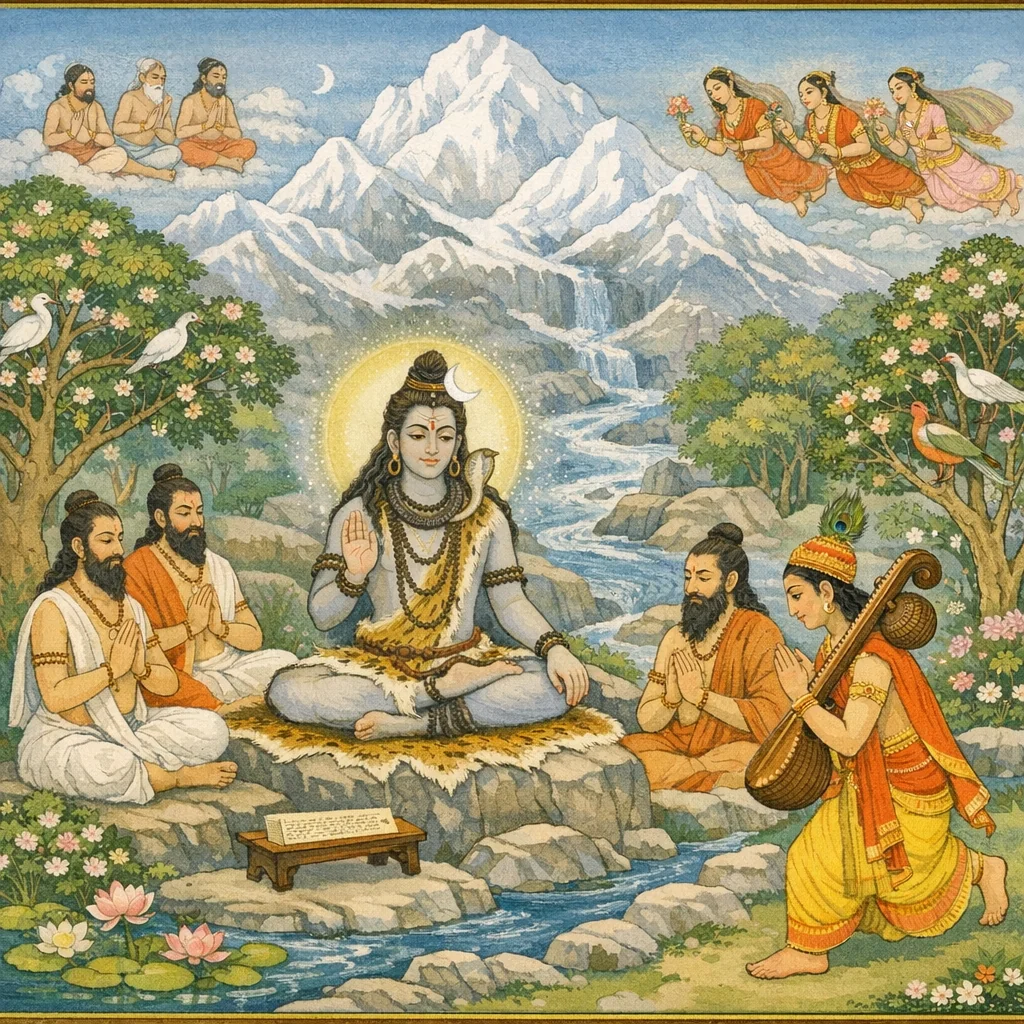
Sūta tells how the Sanakādi Kumāras, honoring Nārada’s question, visit Śiva’s realm, receive the essence of the Śiva-Āgama, and wander on as “living tīrthas.” Nārada gains the sought realized knowledge, reports to Brahmā, and goes to Mount Kailāsa, whose divine flora, birds, siddhas, apsarās, and the Alakanandā are poetically described, ending in his vision of Kapardin/Virūpākṣa/Chandraśekhara seated among yogins. Śiva kindly receives him; Nārada asks for Śāmbhava knowledge that frees the bound soul from paśu–pāśa, and Śiva teaches aṣṭāṅga-yoga. Nārada then attends Nārāyaṇa, and the chapter turns to Purāṇa-māhātmya: Veda-like authority, the fruits of hearing/reciting in temples and learned assemblies, tīrtha-yātrā merit (Mathurā, Prayāga, Setu, Kāñcī, Puṣkara, etc.), and honoring the expounder through gifts, homa, and feeding brāhmaṇas. It concludes by proclaiming Nārāyaṇa supreme, declaring the Nārada Purāṇa foremost among Purāṇas, and closing the sacrificial-session frame with Sūta returning to Vyāsa.
Shlokas
Verse 1
सूत उवाच । इत्येवमुक्त्वा मुनिना हि पृष्टास्ते वै कुमाराः किल नारदेन । संपूजिताः शास्त्रविदां वरिष्ठाः कृताह्निका जग्मुरुमेशलोकम् ॥ १ ॥
Sūta said: Having thus spoken, those Kumāras—questioned by the sage Nārada—were duly honored. The foremost among the knowers of the śāstras, after completing their daily rites, they departed for the realm of Umeśa (Śiva).
Verse 2
तत्रेशमग्र्यर्कनिभैर्मुनींद्रैः श्रीवामदेवादिभिरर्चितांघ्रिम् । सुरासुरेन्द्रैरभिवंद्यमुग्रं नत्वाज्ञया तस्य निषेदुरुर्व्याम् ॥ २ ॥
There, the Lord—whose feet were worshipped by foremost sages radiant like the rising sun, led by venerable Vāmadeva—was saluted even by the chiefs of devas and asuras. Having bowed to that awe-inspiring One, they sat upon the earth by His command.
Verse 3
श्रुत्वाथ तत्राखिलशास्त्रसारं शिवागमं ते पशुपाशमोक्षणम् । जग्मुस्ततो ज्ञानघनस्वरूपा नत्वा पुरारिं स्वपितुर्निकाशम् ॥ ३ ॥
Having heard there the Śiva-Āgama—the very essence of all the śāstras, granting release from the bonds of the jīva—they, whose nature was condensed knowledge, then departed; and, after bowing to Śiva, the foe of Tripura, they went into the presence of their own father.
Verse 4
तत्पादपद्मे प्रणतिं विधाय पित्रापि सत्कृत्य सभाजितास्ते । लब्ध्वाशिषोऽद्यापि चरन्ति शश्वल्लोकेषु तीर्थानि च तीर्थभूताः ॥ ४ ॥
Having bowed in reverence at his lotus-feet, they were honored and respectfully received even by their father. Having obtained his blessings, they still, even today, continually move through the worlds—visiting the tīrthas—and themselves becoming living tīrthas.
Verse 5
जग्मुस्ततो वै बदरीवनान्ते सुरेन्द्रवर्गैरुपसेव्यमानम् । दध्युश्चिरं विष्णुपदाब्जमव्ययं ध्यायन्ति यद्यतयो वीतरागाः ॥ ५ ॥
Then indeed they went into the depths of the Badarī forest, to the imperishable lotus of Viṣṇu’s feet—reverently attended by hosts of Indra and the gods—and they contemplated it for a long time, as passionless ascetics meditate upon it.
Verse 6
नारदोऽपि ततो विप्रा कुमारेभ्यः समीहितम् । लब्ध्वा ज्ञानं सविज्ञानं भृशं प्रीतमना ह्यभूत् ॥ ६ ॥
Then Nārada too, O brāhmaṇas, obtained from the Kumāras the desired knowledge—jñāna together with vijñāna, realized insight—and became exceedingly joyful at heart.
Verse 7
स तस्मात्स्वर्णदीतीरादागत्य पितुरन्तिके । प्रणम्य सत्कृतः पित्रा ब्रह्मणा निषसाद च ॥ ७ ॥
Then, coming from the bank of the river Svarṇadī to his father’s presence, he bowed down; and, being duly honored by his father Brahmā, he sat down.
Verse 8
कुमारेभ्यः श्रुतं यच्च ज्ञानं विज्ञानसंयुतम् । वर्णयामास तत्त्वेन सोऽपि श्रुत्वा मुमोद च ॥ ८ ॥
Whatever knowledge he had heard from the Kumāras—knowledge joined with realized understanding—he explained it truthfully, in accord with reality; and the other, hearing it, rejoiced as well.
Verse 9
अथ प्रणम्य शिरसा लब्धाशीर्मुनिसत्तमः । आजगाम च कैलासं मुनिसिद्धनिषेवितम् ॥ ९ ॥
Then, bowing his head in reverence and having received the blessing, that best of sages proceeded to Mount Kailāsa, frequented by sages and perfected beings.
Verse 10
नानाश्चर्यमयं शश्वत्सर्वर्त्तुकुसुमद्रुमैः । मंदारैः पारिजातैश्च चंपकाशोकवंजुलैः ॥ १० ॥
It is ever filled with many wonders, always adorned with trees that bear flowers in every season—mandāra and pārijāta, and also campaka, aśoka, and vañjula trees.
Verse 11
अन्यैश्च विविधैर्वृक्षैर्नानापक्षिगणावृतैः । वातोद्धूतशिखैः पांथानाह्वयद्भिरिवावृतम् ॥ ११ ॥
It was also covered with many other kinds of trees, surrounded by flocks of diverse birds—trees whose wind-tossed tops seemed, as it were, to call out to the travelers on the road.
Verse 12
नानामृगगणाकीर्णं सिद्धकिन्नरसंकुलम् । सरोभिः स्वच्छसलिलैर्लसत्कांचनपंकजैः ॥ १२ ॥
It was filled with herds of many kinds of animals, thronged with Siddhas and Kinnaras, and adorned with lakes of clear water where golden lotuses shone brilliantly.
Verse 13
शोभितं सारसैर्हंसैश्चक्राह्वाद्यैर्निनादितम् । स्वर्द्धनीपातनि र्घृष्टं क्रीडद्भिश्चाप्सरोगणैः ॥ १३ ॥
It was adorned with cranes and swans, resounding with the calls of the cakravāka and other birds; and it shone in splendor with the playful hosts of Apsarās sporting there, their ornaments gleaming brightly.
Verse 14
सलिलेऽलकनंदायाः कुचकुंकुमपिंगले । आमोदमुदितैर्नागैः सलिलैः पुष्करोद्धृतैः ॥ १४ ॥
In the waters of the Alakanandā—tawny, as though tinged with the kumkuma of women’s breasts—elephants, delighted by the fragrance, lift the water with their trunks and sport within it.
Verse 15
स्नापयद्भिः करेणूश्च कलभांश्च समाकुले । अथ श्वेताभ्रसदृशे श्रृंगे तस्य च भूभृतः ॥ १५ ॥
There it was crowded with female elephants bathing their calves in a lively throng. Then, upon the white-cloud-like peak of that mountain, the narrative moves onward.
Verse 16
वटं कालाभ्रसदृशं ददर्श शतयोजनम् । तस्याधस्तात्समासीनं योगिमण्डलमध्यगम् ॥ १६ ॥
He beheld a banyan (vaṭa) tree, dark like a mass of storm-clouds, extending for a hundred yojanas; and beneath it he saw one seated, established at the very center of a circle of yogins.
Verse 17
कपर्दिनं विरूपाक्ष व्याघ्रचर्मांबरावृतम् । भूतिभूषितसर्वांगं नागभूषणभूषितम् ॥ १७ ॥
He is Kapardin, the Lord of matted locks, Virūpākṣa of wondrous eyes, clad in a tiger-skin garment; his whole body is adorned with sacred ash (vibhūti), and he is ornamented with serpents as jewels.
Verse 18
रुद्राक्षमालया शश्वच्छोभितं चंद्रशेखरम् । तं दृष्ट्वा नारदो विप्रा भक्तिनम्रात्मकंधरः ॥ १८ ॥
O brāhmaṇas, beholding Chandrashekhara (Śiva), ever adorned with a garland of rudrākṣa beads, Nārada bowed in devotion, lowering his head in reverent homage.
Verse 19
ननाम् शिरसा तस्य पादयोर्जगदीशितुः । ततः प्रसन्नमनसा स्तुत्वा वाग्भिर्वृषध्वजम् ॥ १९ ॥
He bowed his head at the feet of that Lord of the world; then, with a tranquil and gladdened mind, he praised Vṛṣadhvaja (Śiva) with words of adoration.
Verse 20
निषसादाज्ञया स्थाणोः सत्कृतो योगिभिस्तदा । अथापृच्छच्च कुशलं नारदं जगतां गुरुः ॥ २० ॥
Then, at the command of Sthāṇu (Śiva), Nārada sat down, and the yogins honored him. Thereupon the Guru of the worlds asked Nārada of his well-being.
Verse 21
स च प्राह प्रसादेन भवतः सर्वमस्ति मे । सर्वेषां योगिवर्याणां श्रृण्वतां तत्र वाडवाः ॥ २१ ॥
And he said: “By your grace, for me all is fulfilled; all has been attained.” While the foremost of yogins listened there, the Vāḍavas—the assembled sages—heard as well.
Verse 22
पप्रच्छ शांभवं ज्ञानं पशुपाशविमोक्षणम् । स शिवः सादरं तस्य भक्त्या संतुष्टमानसः ॥ २२ ॥
He inquired about Śāmbhava knowledge—the liberating wisdom that frees the bound soul (Paśu) from the fetters of Pāśa. Lord Śiva, pleased at heart by that devotee’s bhakti, replied with respectful, attentive care.
Verse 23
योगमष्टांगसंयुक्तं प्राह प्रणतवत्सलः । स लब्ध्वा शांभवं ज्ञानं शंकराल्लोकशंकरात् ॥ २३ ॥
Affectionate toward those who bow in reverence, he taught the Yoga endowed with the eight limbs. Having received Śāmbhava knowledge from Śaṅkara, the benefactor of the worlds, he proclaimed it.
Verse 24
सुप्रसन्नमना नत्वा ययौ नारायणांतिकम् । तत्रापि नारदोऽभीक्ष्णं गतागतपरायणः ॥ २४ ॥
With a mind wholly gladdened, he bowed and went to the presence of Nārāyaṇa. There too, Nārada repeatedly devoted himself to coming and going, returning again and again in attendance.
Verse 25
सेवितं योगिभिः सिद्धैर्नारायणमतोषयत् । एतद्वः कीर्तितं विप्रा नारदीयं महन्मया ॥ २५ ॥
That sacred teaching, attended upon by yogins and perfected sages, pleases Nārāyaṇa. O brāhmaṇas, thus have I proclaimed to you this great Nāradīya Purāṇa.
Verse 26
उपाख्यानं वेदसमं सर्वशास्त्रनिदर्शनम् । चतुष्पादसमायुक्तं श्रृण्वतां ज्ञानवर्द्धनम् ॥ २६ ॥
This sacred narrative is equal to the Vedas, a compendium that reveals the essence of all śāstras; complete in its four parts, it increases the knowledge of those who listen.
Verse 27
य एतत्कीर्तयेद्विप्रा नारदीयं शिवालये । समाजे द्विजमुख्यानां तथा केशवमंदिरे ॥ २७ ॥
O brāhmaṇas, whoever recites this Nāradīya—within a temple of Śiva, in an assembly of foremost twice-born scholars, or likewise in the temple of Keśava—(attains the promised merit).
Verse 28
मथुरायां प्रयागे च पुरुषोत्तमसन्निधौ । सेतौ काञ्च्यां कुशस्थल्यां गंगाद्वारे कुशस्थले ॥ २८ ॥
In Mathurā, at Prayāga, in the very presence of Puruṣottama; at Setu, at Kāñcī, at Kuśasthalī, at Gaṅgādvāra, and at Kuśasthala—thus is proclaimed the merit of sacred presence.
Verse 29
पुष्करेषु नदीतीरे यत्र कुत्रापि भक्तिमान् । स लभेत्सर्वयज्ञानां तीर्थानां च फलं महत् ॥ २९ ॥
A devoted person, wherever he may be on the riverbank at Puṣkara, attains great merit—the fruits of all sacrifices and of all sacred pilgrimage places.
Verse 30
दानानां चापि सर्वेषां तपसां वाप्यशेषतः । उपवासपरो वापि हविष्याशी जितेंद्रियः ॥ ३० ॥
Even if one performs every kind of charity and all austerities without remainder—devoted to fasting, living on oblation-food (haviṣya), and self-controlled—such discipline is spoken of here.
Verse 31
श्रोता चैव तथा वक्ता नारायणपरायणः । शिवभक्तिरतो वापि श्रृण्वन् सिद्धिमवाप्नुयात् ॥ ३१ ॥
Whether as a listener or as a reciter, one devoted to Nārāyaṇa—or even one devoted to Śiva—by hearing this Purāṇic teaching attains siddhi, spiritual accomplishment.
Verse 32
अस्निन्नशेषपुण्यानां सिद्धीनां च समुद्भवः । कथितः सर्वपापघ्नः पठतां श्रृण्वतां सदा ॥ ३२ ॥
It is declared to be the source from which all merits and all siddhis arise, and the destroyer of all sins—for those who always read it and for those who always hear it.
Verse 33
कलिदोषहरं पुंसां सर्वसंपत्तिवर्द्धनम् । सर्वेषामीप्सितं चेदं सर्वज्ञानप्रकाशकम् ॥ ३३ ॥
For people, this sacred teaching removes the faults of the Kali age, increases every kind of prosperity, fulfills what all desire, and illumines all knowledge.
Verse 34
शैवानां वैष्णवानां च शाक्तानां सूयसेविनाम् । तथैव गाणपत्यानां वर्णाश्रमवतां द्विजाः ॥ ३४ ॥
Among Śaivas and Vaiṣṇavas, among Śāktas and the worshippers of Sūrya, and likewise among the devotees of Gaṇapati, there are twice-born who are established in the disciplines of varṇa and āśrama.
Verse 35
तपसां च व्रतानां च फलानां संप्रकाशकम् । मंत्राणां चैव यंत्राणां वेदांगानां विभागशः ॥ ३५ ॥
It elucidates the fruits of austerities and sacred vows, and it also sets forth—systematically—the mantras and yantras, as well as the divisions of the Vedāṅgas.
Verse 36
तथागमानां सांख्यानां वेदानां चैव संग्रहम् । य एतत्पठते भक्त्या श्रृणुयाद्वा समाहितः ॥ ३६ ॥
Likewise, this text contains a compendium of the Āgamas, the Sāṃkhya teachings, and the Vedas. Whoever recites it with devotion, or listens with a collected mind, gains the merit of such study.
Verse 37
स लभेद्वांछितान्कामान्देवादिष्वपि दुर्लभान् । श्रुत्वेदं नारदीयं तु पुराणं वेदसंमितम् ॥ ३७ ॥
Having heard this Nārada Purāṇa—esteemed as equal in authority to the Veda—one attains the desired wishes, even those difficult to obtain among the gods and the like.
Verse 38
वाचकं पूजयेद्भक्त्या धनरत्नांशुकादिभिः । भूमिदानैर्गवां दानै रत्नदानैश्च संततम् ॥ ३८ ॥
With devotional bhakti, one should honor the reciter or expounder with wealth, jewels, garments, and the like; and continually also with gifts of land, gifts of cows, and gifts of precious gems.
Verse 39
हस्त्यश्वरथदानैश्च प्रीणयेत्सततं गुरुम् । यस्तु व्याकुरुते विप्राः पुराणं धर्मसंग्रहम् ॥ ३९ ॥
One should constantly gratify the guru with gifts such as elephants, horses, and chariots. Yet, O brāhmaṇas, the one who expounds this Purāṇa—the compendium of Dharma—is especially worthy of such honor.
Verse 40
चतुर्वर्गप्रदं नॄणां कोऽन्यस्तत्सदृशो गुरुः । कायेन मनसा वाचा धनाद्यैरपि संततम् ॥ ४० ॥
Who else is a guru comparable to the one who grants humans the four aims of life? Therefore one should continually serve the guru through body, mind, and speech—and even with wealth and other resources.
Verse 41
प्रियं समाचरेत्तस्य गुरोर्द्धर्मोपदेशिनः । श्रुत्वा पुराणं विधिवद्धोमं कृत्वा सुरार्चनम् ॥ ४१ ॥
One should act in ways pleasing to that guru who teaches dharma. Having heard the Purāṇa, one should then perform the homa (fire-offering) according to rule and worship the deities.
Verse 42
ब्राह्मणान्भोजयेत्पश्चाच्छतं मिष्टान्नपायसैः । दक्षिणां प्रददेच्छक्त्या भक्त्या प्रीयेत माधवः ॥ ४२ ॥
Afterwards, one should feed a hundred brāhmaṇas with sweet foods and rice cooked in milk (pāyasa), and according to one’s capacity give dakṣiṇā (an honorarium). By such devotion, Mādhava (Viṣṇu) becomes pleased.
Verse 43
यथा श्रेष्ठा नदी गंगा पुष्करं च सरो यथा । काशी पुरी नगो मेरुर्देवो नारायणो हरिः ॥ ४३ ॥
As the Gaṅgā is foremost among rivers and Puṣkara foremost among lakes; as Kāśī is foremost among cities and Meru foremost among mountains—so among the gods, Nārāyaṇa (Hari) is supreme.
Verse 44
कृतं युगं सामवेदो धेनुर्विप्रोऽन्नमंबु च । मार्गो मृगेंद्रः पुरुषोऽश्वत्थः प्रह्लाद आननम् ॥ ४४ ॥
The Kṛta Yuga; the Sāma Veda; the cow; the brāhmaṇa; food and water; the path; the lord of beasts (the lion); the Puruṣa; the aśvattha (sacred fig) tree; Prahlāda; and the face—these are the stated correspondences.
Verse 45
उच्चैः श्रवा वसंतश्च जपः शेषोऽर्यमा धनुः । पावको विष्णुरिंद्रश्च कपिलो वाक्पतिः कविः ॥ ४५ ॥
He is Uccaiḥśravā; He is Vasantā (Spring); He is Japa (sacred repetition); He is Śeṣa; He is Aryamā; He is the Bow; He is Pāvaka (Fire); He is Viṣṇu; He is Indra; He is Kapila; He is Vākpati (Lord of Speech); and He is Kavi, the all-knowing Seer-Poet.
Verse 46
अर्जुनो हनुमान्दर्भश्चित्तं चित्ररथोंऽबुजम् । उर्वशी कांचनं यद्वच्छ्रेष्टाश्चैते स्वजातिषु ॥ ४६ ॥
Just as Arjuna, Hanumān, darbha-grass, the mind, Citraratha, the lotus, Urvaśī, and gold are each held to be foremost in their own class, so too are these regarded as the best within their respective kinds.
Verse 47
तथैव नारदीयं तु पुराणेषु प्रकीर्तितम् । शांतिरस्तु शिवं चास्तु सर्वेषां वो द्विजोत्तमाः ॥ ४७ ॥
So too, the Nārada Purāṇa has been proclaimed among the Purāṇas. May there be peace; may there be auspiciousness for you all, O best of the twice-born.
Verse 48
गमिष्यामि गुरोः पांर्श्वं व्यासस्यामिततेजसः । इत्युक्त्वाभ्यर्चितः सूतः शौनकाद्यैर्महात्मभिः ॥ ४८ ॥
“I shall go to the side of my guru, Vyāsa of immeasurable splendor.” Having spoken thus, the Sūta—honored and worshipped by the great souls beginning with Śaunaka—prepared to depart.
Verse 49
आज्ञप्तश्च पुनः सर्वैर्दर्शनार्थं गुरोर्ययौ । तेऽपि सर्वे द्विजश्रेष्ठाः शौनकाद्याः समाहिताः । श्रुतं सम्यगनुष्ठाय तत्र तस्थुश्च सत्रिणः ॥ ४९ ॥
Then, instructed again by them all to behold his guru, he went to see him. And those foremost among the twice-born sages—Śaunaka and the rest—composed in mind, having duly carried out what they had heard, remained there as the performers of the sacrificial session (satra).
Verse 50
कलिकल्मषविषनाशनं हरिं यो जपपूजनविधिभेषजोपसेवी । स तु निर्विषमनसा समेत्य यागं लभते सतमभीप्सितं हि लोकम् ॥ ५० ॥
Whoever serves Hari—the destroyer of the poison of Kali’s sinful taint—by the healing remedy of prescribed japa and worship, that person, with a mind free from poison (impurity), duly completing the yajña, attains the world, the state truly desired.
Verse 51
इति श्रीबृहन्नारदीयपुराणे बृहदुपाख्याने चतुर्थपादे पुराणमहिमावर्णनं नाम पंचविंशोत्तरशततमोऽध्यायः ॥ १२५ ॥
Thus ends the one-hundred-and-twenty-fifth chapter, called “The Description of the Glory of the Purāṇa,” in the Śrī Bṛhannāradīya Purāṇa, within the Great Narrative (Bṛhad-upākhyāna), in the Fourth Pada.
Frequently Asked Questions
It is presented as mokṣa-dharma par excellence: a liberating wisdom that cuts the paśu–pāśa fetters (the bound soul and its bonds). Its placement within Śiva’s instruction to Nārada authorizes the teaching through direct divine transmission and links Purāṇic listening/recitation to yogic release.
Hearing or reciting with devotion—especially in Śiva or Keśava temples or among learned twice-born—combined with guru-honoring acts (dakṣiṇā, gifts, land/cows/wealth), post-recitation homa and deity worship, and feeding brāhmaṇas according to capacity.
Nārada receives liberating instruction from Śiva (Śāmbhava-jñāna and yoga) and then repeatedly attends Nārāyaṇa; the merit statements explicitly include devotees of Nārāyaṇa and even devotees of Śiva, portraying the Purāṇa as a shared śāstric vehicle across sectarian disciplines.