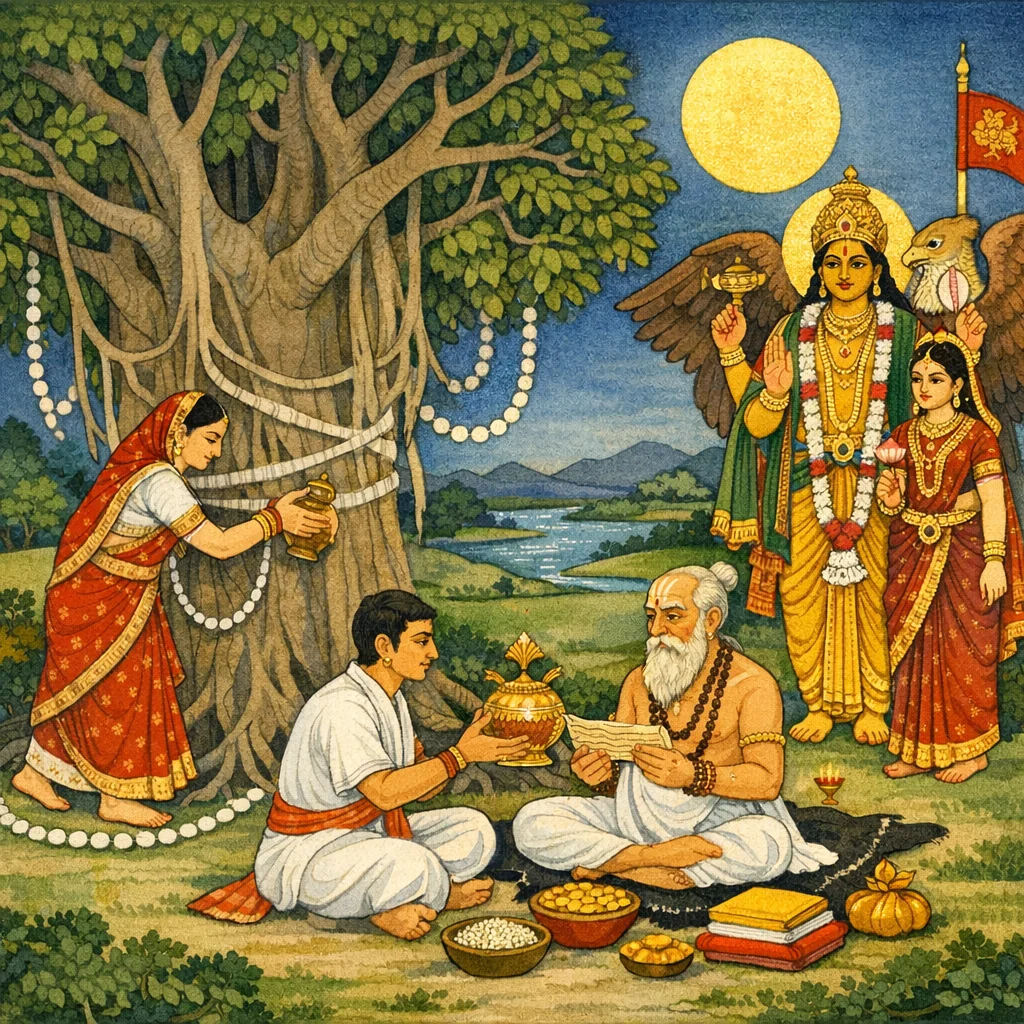
Pūrṇimā Pūrṇa-vratas: Dharmarāja-vrata, Vaṭa-Sāvitrī-vrata, and Gopadma-vrata
Sanātana instructs Nārada on “complete vows” (pūrṇa-vratas) observed on successive full-moon days. Caitra pūrṇimā is treated as a Manvantara-cycle threshold, marked by gifting a water-pot whose water is mixed with cooked food to please Soma. Vaiśākha pūrṇimā is praised as universally fruit-giving: gifts to brāhmaṇas return as like results; the Dharmarāja-vrata is prescribed with cooked food, a water-pot, and a cow-equivalent gift—especially a black antelope skin with hooves and horns, along with sesame, garments, and gold, offered with due honor to a learned dvija. Hyperbolic statements of merit follow (donating the earth with seven continents; water-pots with gold removing grief). On Jyeṣṭha pūrṇimā, women undertake the Vaṭa-Sāvitrī vow: fasting, watering the banyan, binding it with sacred thread, circumambulating 108 times, praying for lifelong marital union, feeding married women, and eating the next day for saubhāgya. On Āṣāḍha pūrṇimā, the Gopadma-vrata is taught: visualize and worship four-armed golden Hari with Śrī and Garuḍa, recite the Puruṣa Sūkta, honor the guru, and feed brāhmaṇas—thereby attaining desired aims here and hereafter by Viṣṇu’s grace.
Shlokas
Verse 1
सनातन उवाच । अथ नारद वक्ष्यामि श्रृणु पूर्णाव्रतानि ते । यानि कृत्वा नरो नारी प्राप्नुयात्सुखसंततिम् ॥ १ ॥
Sanātana said: Now, O Nārada, I shall tell you—listen—about the complete sacred vows (pūrṇa-vratas). By performing them, a man or a woman may attain an unbroken continuity of happiness and well-being.
Verse 2
चैत्रपूर्णा तु विप्रेंद्र मन्वादिः समुदाहृता । अस्यां सान्नोदकं कुंभं प्रदद्यात्सोमतुष्टये ॥ २ ॥
O best of brāhmaṇas, the full-moon day in the month of Caitra is declared to be the beginning of a Manvantara cycle. On this day one should donate a water-pot filled with water mixed with cooked food, for the satisfaction of Soma (the Moon).
Verse 3
वैशाख्यामपि पूर्णायां दानं सर्वस्य सर्वदम् । यद्यद्द्रव्यं ददेद्विप्रे तत्तदाप्नोति निश्चितम् ॥ ३ ॥
Even on the full-moon day of Vaiśākha, giving charity becomes a bestower of all results for all people. Whatever substance one gives to a brāhmaṇa, one certainly attains that very thing as its assured fruit.
Verse 4
धर्मराजव्रतं चात्र कथितं तन्निशामय । श्रृतान्नमुदकुंभं च वैशाख्यां वै द्विजोत्तमे ॥ ४ ॥
Here, the Dharmarāja-vrata has been described—listen to it. And in the month of Vaiśākha, O best of the twice-born, the giving of cooked food and a water-pot (kumbha) is also enjoined.
Verse 5
दद्याद्गोदानफलदं धर्मराजस्य तुष्टये । अत्र कृष्णाजिनं दद्यात्सखुरं च सश्रृङ्गकम् ॥ ५ ॥
To please Dharmarāja (Yamarāja), one should offer a gift that bears the merit of a cow-donation. In this rite, one should present a black antelope skin (kṛṣṇājina), complete with hooves and also with horns.
Verse 6
तिलैः सहसमाच्छाद्य वस्त्रैर्हेम्ना द्विजातये । यस्तु कृष्णाजिनं दद्यात्सत्कृत्य विधिपूर्वकम् ॥ ६ ॥
He who, duly honoring a twice-born brāhmaṇa, gives a black antelope skin (kṛṣṇājina) together with sesame seeds, garments, and gold, in accordance with proper rite, attains great religious merit.
Verse 7
सर्वशास्त्रविदे सप्तद्वीपभूमिप्रदः स वै । मोदते विष्णु लोके हि यावच्चन्द्रार्कतारकम् ॥ ७ ॥
He who bestows the earth with its seven continents upon one who is versed in all the śāstras—such a giver indeed rejoices in Viṣṇu’s world for as long as the moon, sun, and stars endure.
Verse 8
कुंभान्स्वच्छजलैः पूर्णान्हिरण्येन समन्वितान् । यः प्रदद्याद्द्विजाग्र्येभ्यः स न शोचति कर्हिचित् ॥ ८ ॥
Whoever donates pots filled with clear, pure water, together with gold, to the foremost of the twice-born brāhmaṇas, never grieves at any time.
Verse 9
अथ ज्येष्ठस्य पूर्णायां वटसावित्रिकं व्रतम् । सोपवासा वटं सिंचेत्सलिलैरमृतोपमैः ॥ ९ ॥
Now, on the full-moon day of the month of Jyeṣṭha, one should undertake the Vaṭa-Sāvitrī vow; fasting, she should water the banyan tree with water regarded as nectar-like.
Verse 10
सूत्रेण वेष्टयेच्चैव सशताष्टप्रदक्षिणम् । ततः संप्रार्थयेद्दैवीं सावित्रीं सुपतिव्रताम् ॥ १० ॥
One should also wrap it with the sacred thread and perform one hundred and eight circumambulations; thereafter, one should earnestly pray to the divine Sāvitrī, the most faithful and devoted wife.
Verse 11
जगत्पूज्ये जगन्मातः सावित्रि पतिदैवते । पत्या सहावियोगं मे वटस्थे कुरु ते नमः ॥ ११ ॥
O Sāvitrī—revered by the whole world, Mother of the universe, for whom the husband is the very deity—at this banyan tree, grant that I may never be separated from my husband. Salutations to you.
Verse 12
इति सप्रार्थ्य या नारी भोजयित्वा परेऽहनि । सुवासिनीः स्वयं भुंज्यात्सा स्यात्सौभाग्यभागिनी ॥ १२ ॥
Thus, the woman who, after respectfully entreating, feeds the married women (suvāsinīs) and then, on the following day, eats herself—she becomes a recipient of good fortune and marital auspiciousness.
Verse 13
आषाढस्य तु पूर्णायां गोपद्मव्रतमुच्यते । चतुर्भुजं महाकायं जांबूनदसमप्रभम् ॥ १३ ॥
On the full-moon day of Āṣāḍha, the observance known as the Gopadma-vrata is prescribed. In it one should contemplate/depict the Lord as four-armed, of vast form, and radiant like refined gold (jāmbūnada).
Verse 14
शंखचक्रगदापद्मरमागरुडशोभितम् । सेवितं मुनिभिर्देवैर्यक्षगंधर्वकिन्नरैः ॥ १४ ॥
Adorned with the conch, discus, mace, and lotus—resplendent with Śrī (Lakṣmī) and Garuḍa—He is revered and worshipped by sages, gods, Yakṣas, Gandharvas, and Kinnaras.
Verse 15
एवंविधं हरिं तत्र स्नात्वा पूजां समाचरेत् । पौरुषेणैव सूक्तेन गंधाद्यैरुपचारकैः ॥ १५ ॥
Having bathed Hari there in the prescribed manner, one should duly perform worship—reciting the Puruṣa Sūkta and offering ritual services such as fragrant substances and the like.
Verse 16
आचार्यं वस्त्रभूषाद्यैस्तोषयेत्स्निग्धमानसः । भोजयेन्मिष्टपक्वान्नैर्द्विजानन्यांश्च शक्तितः ॥ १६ ॥
With a heart full of affection, one should please the ācārya with garments, ornaments, and the like; and, according to one’s means, one should feed brāhmaṇas and others with sweet and well-cooked foods.
Verse 17
एवं कृत्वा व्रतं विप्र प्रसादात्कमलापतेः । ऐहिकामुष्मिकान्कामांल्लभते नात्र संशयः ॥ १७ ॥
O brāhmaṇa, having performed the vow in this manner, by the grace of Kamalāpati (Lord Viṣṇu, the consort of Lakṣmī), one attains desired aims both in this world and in the next—of this there is no doubt.
Frequently Asked Questions
The chapter uses Caitra pūrṇimā as a cosmological time-marker to sacralize the calendar, linking household dāna (water-pot with water and cooked food) to Soma’s satisfaction and to the idea of renewing auspicious continuity at a cycle-threshold.
The rite specifies cow-equivalent merit through a kṛṣṇājina (black antelope skin) offered intact (with hooves and horns), augmented by sesame, garments, and gold, and framed by honoring a learned twice-born—highlighting both ritual correctness and the dharma-legal logic of substitutionary merit.
It is explicitly oriented to saubhāgya—unbroken marital auspiciousness—expressed through fasting, banyan worship, 108 circumambulations, and a prayer to Sāvitrī for never being separated from one’s husband, followed by feeding married women.
It combines Purāṇic iconography (four-armed Hari with Śrī and Garuḍa, conch-disc-mace-lotus) with a Vedic hymn (Puruṣa Sūkta) and standard completion practices (guru-honor and brāhmaṇa-feeding), presenting devotion as textually anchored and ritually enacted.