The Description of the Caturdaśī Vrata Observed throughout the Twelve Months
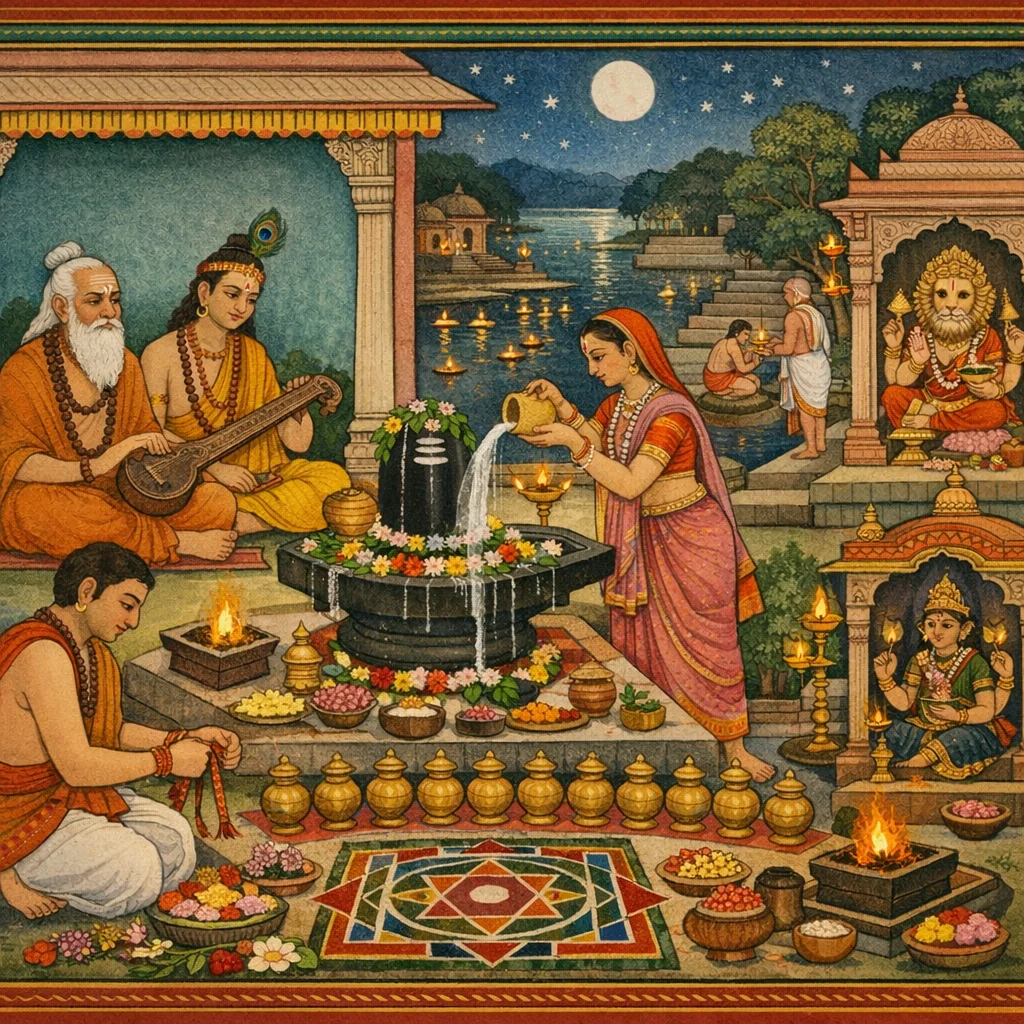
Sanātana instructs Nārada on Caturdaśī observances assigned across the twelve months and various deities. It begins with Śiva’s Caturdaśī worship—fragrances, bilva leaves, fasting or ekabhukta, honoring mothers—and completion next day by transmitting the mantra to a brāhmaṇa. Further tithi-vratas follow: Nṛsiṃha worship with ṣoḍaśopacāra and pañcāmṛta abhiṣeka; the merit of pilgrimage to Oṃkāreśvara; Liṅga-vrata (including a flour-liṅga); Rudra-vrata with pañcāgni austerity and gifting a golden cow; seasonal flower offerings and Bhādrapada pavitra-āropaṇa to the Goddess. A major section details Ananta-vrata: one-meal wheat offering, a fourteen-knotted cord tied by gender, fourteen-year observance, and udyāpana with sarvatobhadra maṇḍala, kalaśa, Ananta image, auxiliary deity worship, homa, and extensive gifts. Kadali-vrata follows—Rambhā worship in a grove and feeding maidens/sumangalis. The chapter also gives śrāddha guidance for certain deaths, Dharma/Yama-related gifts and oil-lamp rites (notably in Kārttika), the Pāśupata vow at Maṇikarṇikā, Brahma-kūrca (pañcagavya regimen), Pāṣāṇa- and Virūpākṣa-vratas, Yama-tarpaṇa in Māgha, and culminates in Śivarātri on the final Kṛṣṇa Caturdaśī, with a shared udyāpana template using fourteen pots and ritual implements.
Shlokas
Verse 1
सनातन उवाच । श्रृणु नारद वक्ष्यामि चतुर्दश्या व्रतानि ते । यानि कृत्वा नरो लोके सर्वान्कामानवाप्नुयात् ॥ १ ॥
Sanātana said: “Listen, Nārada; I shall tell you the vows observed on the fourteenth lunar day (Caturdaśī). By performing them, a person in this world may attain all desired aims.”
Verse 2
चैत्रशुक्ल चतुर्दश्यां कुंकुमागरुचन्दनैः । गन्धाद्यैर्वस्त्रमणिभिः कार्यार्या महती शिवे ॥ २ ॥
On the fourteenth lunar day (Caturdaśī) of the bright fortnight of Caitra, a grand and noble worship should be performed for Śivā, using saffron, agaru, sandalwood, fragrances and the like, along with garments and jewels.
Verse 3
वितानध्वजछत्राणि दत्वा पूज्याश्च मातरः । एवं कृत्वार्चनं विप्र सोपवासोऽथवैकभुक् ॥ ३ ॥
After gifting canopies, flags, and umbrellas, and after duly honoring the venerable mothers, O brāhmaṇa, having thus performed the worship, one should observe a fast—or else take only a single meal.
Verse 4
अश्वमेधाधिकं पुण्यं लभते मानवो भुवि । अत्रैव दमनार्चां च कारयेद्गंधपुष्पकैः ॥ ४ ॥
A person on earth gains merit greater than that of the Aśvamedha sacrifice; and right here itself, one should have the worship with damanā performed using fragrant flowers.
Verse 5
समर्पयेत्सुपूर्णायां शिवाय शिवरूपिणे । राधकृष्णचतुर्द्दश्यां सोपवासो निशागमे ॥ ५ ॥
On the night of Rādhā–Kṛṣṇa Caturdaśī (the fourteenth lunar day), at twilight—while observing a fast—one should offer worship on the full-moon night to Śiva, the Auspicious One, who is the very embodiment of auspiciousness.
Verse 6
लिंगमभ्यर्चयेच्चैवं स्नात्वा धौतांबरः सुधीः । गंधाद्यैरुपचारैश्च बिल्वपत्रैश्च सर्वतः ॥ ६ ॥
Thus, after bathing and donning clean garments, the wise devotee should duly worship the Śiva-liṅga with offerings such as sandal paste and other ritual services, and with bilva leaves placed all around.
Verse 7
दत्वा मंत्रं द्विजाग्र्याय भुंजीत च परेऽहनि । एवमेव तु कृष्णासु सर्वासु द्विजसत्तम ॥ ७ ॥
Having bestowed the mantra upon the foremost among the twice-born, one should take one’s meal on the following day. In the same manner, O best of brāhmaṇas, this observance should be kept on all the Kṛṣṇā (dark-fortnight) days as well.
Verse 8
शिवव्रतं प्रकर्तव्यं धनसंतानमिच्छता । राधशुक्लचतुर्दश्यां श्रीनृसिंहव्रतं चरेत् ॥ ८ ॥
One who desires wealth and progeny should undertake the Śiva-vrata. And on the bright Caturdaśī (fourteenth lunar day) of the month of Rādhā, one should observe the sacred vow of Śrī Nṛsiṃha.
Verse 9
उपवासविधानेन शक्तोऽशक्तस्तथैकभुक् । निशागमे तु संपूज्य नृसिंहं दैत्यसूदनम् ॥ ९ ॥
Whether one is capable or not, one should observe the fast according to the prescribed rule, or at least take a single meal; and when night arrives, one should duly worship Narasiṃha, the slayer of demons.
Verse 10
उपचारैः षोडशभिः स्नानैः पंचामृतादिभिः । ततः क्षमापयेद्देवं मन्त्रेणानेन नारद ॥ १० ॥
With the sixteen modes of worship and with ritual bathings using pañcāmṛta and the like, one should then seek the deity’s forgiveness by means of this mantra, O Nārada.
Verse 11
तत्पहाटककेशांत ज्वलत्पावकलोचन । वज्राधिकनखस्पर्शदिव्यसिंह नमोऽस्तु ते ॥ ११ ॥
Salutations to you, O divine Lion—whose mane’s tips gleam like pure gold, whose eyes blaze like fire, and whose touch of claws is harder than a thunderbolt.
Verse 12
इति संप्रार्थ्य देवेशं व्रती स्यात्स्थंडिलेशयः । जितेंद्रियो जितक्रोधः सर्वभोगविवर्ज्जितः ॥ १२ ॥
Thus, after duly praying to the Lord of the gods, the votary should lie down upon the bare ground, with senses subdued and anger conquered, completely refraining from all indulgent enjoyments.
Verse 13
एवं यः कुरुते विप्र विधिवद्व्रतमुत्तमम् । वर्षे वर्षे स लभते भुक्तभोगो हरेः पदम् ॥ १३ ॥
Thus, O brāhmaṇa, whoever performs this excellent vow in the prescribed manner—year after year—after enjoying the fruits of merit, attains the abode of Hari (Viṣṇu).
Verse 14
ॐकारेश्वरयात्रा च कार्यात्रैव मुनीश्वर । दुर्लभं वार्चनं तत्र दर्शनं पापनाशनम् ॥ १४ ॥
O best of sages, the pilgrimage to Oṃkāreśvara should indeed be undertaken. Worship there is hard to obtain, and the very sight (darśana) of that sacred place destroys sins.
Verse 15
किमत्र बहुनोक्तेन पूजाध्यानजपेक्षणम् । यद्भवेत्तत्समुद्दिष्टं ज्ञानमोक्षप्रदं नृणाम् ॥ १५ ॥
What need is there to speak at length here? Worship, meditation, and mantra-repetition (japa) are what truly matter. Whatever arises from these has already been rightly set forth—knowledge that bestows liberation upon human beings.
Verse 16
अत्र लिंगव्रतं चापि कर्त्तव्यं पापनाशनम् । पंचामृतैस्तु संस्नाप्य लिंगमालिप्य कुंकुमैः ॥ १६ ॥
Here one should also undertake the Liṅga-vrata, the sin-destroying vow. After bathing the Liṅga with the five nectars (pañcāmṛta), one should anoint the Liṅga with kuṅkuma, the saffron-red vermilion.
Verse 17
नैवेद्यैश्च फलैर्धूपैर्दीपैर्वस्त्रविभूषणैः । एवं यः पूजयेत्पैष्टं लिंगं सर्वार्थसिद्धिदम् ॥ १७ ॥
With food-offerings (naivedya), fruits, incense, lamps, and with garments and ornaments—whoever worships in this way a liṅga made of flour (paiṣṭa) attains the fulfilment of all desired aims.
Verse 18
भुक्तिं मुक्तिं स लभते महादेवप्रसादतः । ज्येष्ठशुक्लचतुर्दश्यां दिवा पंचतपा निशः ॥ १८ ॥
By the grace of Mahādeva, one attains both worldly enjoyment (bhukti) and liberation (mukti). On the fourteenth lunar day of the bright fortnight of Jyeṣṭha, one should perform the ‘five-fire’ austerity (pañcatapā) by day and keep vigil at night.
Verse 19
मुखे ददेद्धेमधेनुं रुद्रव्रतमिदं स्मृतम् । शुचिशुक्लचतुर्दश्यां शिवं संपूज्य मानवः ॥ १९ ॥
One should present a golden cow (hemadhenu) as a ritual gift to a worthy recipient—this is remembered as the Rudra-vrata. On the pure Śukla Caturdaśī, having duly worshipped Śiva, a person thus fulfils the vow.
Verse 20
देशकालोद्भवैः पुष्पैः सर्वसंपदमाप्नुयात् । नभः शुक्लचतुर्दश्यां पवित्रारोपणं मतम् ॥ २० ॥
By offering flowers native to the proper place and season, one attains every kind of prosperity. The rite called the “raising/installation of the pavitra” is prescribed on the fourteenth lunar day of the bright fortnight in the month of Nabhas (Bhādrapada).
Verse 21
तत्स्वशाखोक्तविधिना कर्तव्यं द्विजसत्तम । शताभिमंत्रितं कृत्वा ततो देव्यै निवेदयेत् ॥ २१ ॥
O best of the twice-born, it should be performed according to the procedure taught in one’s own Vedic recension; after consecrating it with a hundred recitations of the mantra, one should then offer it to the Goddess.
Verse 22
पवित्रारोपणं कृत्वा नरो नार्यथवा यदि । महादेव्याः प्रसादेन भुक्तिं मुक्तिमवाप्नुयात् ॥ २२ ॥
Whether a man or a woman performs the offering of the pavitra (sacred thread/garland), by the grace of the Great Goddess (Mahādevī) one attains both worldly enjoyment (bhukti) and liberation (mukti).
Verse 23
भाद्रशुक्लचतुर्दश्यामनन्तव्रतमुत्तमम् । कर्त्तव्यमेकभुक्तं हि गोधूमप्रस्थपिष्टकम् ॥ २३ ॥
On the fourteenth lunar day (Caturdaśī) of the bright fortnight in Bhādrapada, the excellent vow called Ananta-vrata should be observed. One should eat only once that day, taking food prepared from a prastha-measure of wheat flour.
Verse 24
विपाच्य शर्कराज्याक्तमनंताय निवेदयेत् । गन्धाद्यैः प्राक् समभ्यर्च्यः कार्पासं पट्टजं तु वा ॥ २४ ॥
Having cooked it well and mixed it with sugar and ghee, one should offer it as food to Ananta (Lord Vishnu). First, one should worship the deity with fragrances and related offerings; and then offer either a cotton cloth or a silk garment.
Verse 25
चतुर्दशग्रंथियुतं सूत्रं कृत्वा सुशोभनम् । ततः पुराणमुत्तार्य सूत्रं क्षिप्त्वा जलाशयें ॥ २५ ॥
Having prepared a handsome cord furnished with fourteen knots, then—after lifting out the Purāṇa—he cast the cord into a reservoir of water.
Verse 26
निबघ्नीयान्नवं नारी वामे दक्षे पुमान्भुजे । विपाच्य पिष्टपक्वं तत्प्रदद्याद्दक्षिणान्वितम् ॥ २६ ॥
A woman should tie the new thread on the left arm, and a man on the right arm. Then, having cooked the flour-preparation, one should offer it, accompanied by the prescribed dakṣiṇā (honorarium).
Verse 27
स्वयं च तन्मितं चाद्यादेवं कुर्याद्व्रतोत्तमम् । द्विसप्तवर्षपर्यंतं तत उद्यापयेत्सुधीः ॥ २७ ॥
He should himself partake (of the prescribed food) and also give an appropriate measured portion (to others). Thus he should observe this excellent vow for fourteen years, and then the wise one should perform its concluding rite (udyāpana).
Verse 28
मंडलं सर्वतोभद्रं धान्यवर्णैः प्रकल्प्य च । सुशोभने न्यसेत्तत्र कलशं ताम्रजं मुने ॥ २८ ॥
Having prepared an auspicious ‘sarvatobhadra’ ritual diagram with grains of various colors, O sage, one should then place there—on a well-adorned spot—a copper water-pot (kalaśa).
Verse 29
तस्योपरि न्यसेद्धैमीमनंतप्रतिमां शुभाम् । पीतपट्टांशुकाच्छन्नां तत्र तां विधिना यजेत् ॥ २९ ॥
Upon that, one should place an auspicious golden image of Ananta; covered with a yellow silk cloth, one should then worship that image there according to the prescribed rite.
Verse 30
गणेशं मातृकाः खेटाँल्लोकपांश्च यजेत्पृथक् । ततो होमं हविष्येण कृत्वा पूर्णाहुतिं चरेत् ॥ ३० ॥
One should worship Gaṇeśa, the Mātṛkās (Divine Mothers), the planetary deities, and the Lokapālas (guardians of the worlds) each separately. Thereafter, performing homa with haviṣya oblations, one should conclude with the pūrṇāhuti, the full and final offering.
Verse 31
शय्यां सोपस्करां धेनुं प्रतिमां च द्विजोत्तम । प्रदद्याद्गुरवे भक्त्या द्विजानन्यांश्चतुर्दश ॥ ३१ ॥
O best of the twice-born, with devotion one should present to the guru a furnished bed, a cow, and a sacred image (pratimā); and one should also give gifts to fourteen other brāhmaṇas.
Verse 32
संभोज्य मिष्टपक्वान्नैर्दक्षिणाभिः प्रतोषयेत् । एवं यः कुरुतेऽनंतव्रतं प्रत्यक्षमादरात् ॥ ३२ ॥
Having fed the invited ones with sweet and well-cooked foods, one should fully satisfy them with appropriate dakṣiṇā (honorary gifts). Thus, whoever performs the Ananta-vrata with direct, personal care and reverence truly fulfills the vow.
Verse 33
सोऽप्यनंतप्रसादेन जायते भुक्तिमुक्तिभाक् । कदलीव्रतमप्यत्र तद्विधानं च मे श्रृणु ॥ ३३ ॥
By the grace of Ananta, he too becomes a recipient of both worldly enjoyment and liberation. Now hear from me of the vow called the Kadali-vrata, and the procedure for observing it.
Verse 34
नरो वा यदि वा नारी रंभामुपवनस्थिताम् । स्नात्वा संपूजयेद्गंधपुष्पधान्यांकुरादिभिः ॥ ३४ ॥
Whether man or woman, having bathed, one should duly worship Rambhā who abides in the sacred grove, with perfumes, flowers, grains, sprouts, and similar offerings.
Verse 35
दधिदूर्वाक्षतैर्द्द्वीपैर्वस्त्रपक्कान्नसंयैः । एवं संपूज्य मंत्रेण ततः संप्रार्थयेद्र्वती ॥ ३५ ॥
With curd, durvā grass, unbroken rice grains (akṣata), ritual offerings, garments, and cooked food—having thus worshipped with the prescribed mantra—the vow‑observer should thereafter offer earnest prayer.
Verse 36
अप्सरो मरकन्याभिर्नागकन्याभिरार्चिते । शरीरारोग्यलावण्यं देहि देवि नमोऽस्तु ते ॥ ३६ ॥
O Goddess, worshipped by the Apsarases, the Marā maidens, and the Nāga maidens—grant me bodily health and radiant beauty. Reverence be to you.
Verse 37
इति संप्रार्थ्यं कन्यास्तु चतस्रो वा सुवासिनीः । संभोज्यां शुकसिद्वरकज्जलालक्तचर्चिताः ॥ ३७ ॥
Thus, having duly entreated, one should feed four maidens—or else auspicious married women—adorned with parrot‑green pigment, white mustard paste (sidvara), collyrium (kajjala), and red lac-dye.
Verse 38
नमस्कृत्य निजं गेहं समाप्य नियमं व्रजेत् । एवं कृते व्रते विप्र लब्ध्वा सौभाग्यमुत्तमम् ॥ ३८ ॥
Having bowed in reverence to one’s own home (the household deities and the threshold), and having duly completed the prescribed observances, one should then depart. O brāhmaṇa, performed in this manner, this vow bestows the highest good fortune.
Verse 39
इह लोके विमानेन स्वर्गलोके व्रजेत्परम् । इषकृष्णचतुर्द्दश्यां विषशस्त्रांबुवह्निभिः ॥ ३९ ॥
In this very world one gains a celestial vimāna and then proceeds to the highest heaven. On Īśa’s (Śiva’s) fourteenth lunar day of the dark fortnight (kṛṣṇa‑caturdaśī), one remains unharmed by poison, weapons, water, and fire.
Verse 40
सर्पश्वापदवज्राद्यैर्हतानां ब्रह्मघातिनाम् । चतुर्द्दश्यां क्रियाश्राद्धमेकोद्दिष्टविधानतः ॥ ४० ॥
For those slayers of brāhmaṇas who have died by serpents, wild beasts, lightning, and the like, the kriyā-śrāddha should be performed on the fourteenth lunar day, according to the ekoddiṣṭa rite meant for a single departed soul.
Verse 41
कर्तव्यं विप्रवर्गं च भोजयेन्मिष्टपक्वकैः । तर्पणं च गवां ग्रासं बलिं चैव श्वकाकयोः ॥ ४१ ॥
One should duly honor and feed the company of brāhmaṇas with sweet, well-cooked foods; one should also offer tarpaṇa libations, give fodder to cows, and place bali offerings for dogs and crows as well.
Verse 42
कृत्वाचम्य स्वयं पश्चाद्भुंजीयाद्बंधुभिः सह । एवं यः कुरुते विप्र श्राद्धं संपन्नदक्षिणम् ॥ ४२ ॥
After performing ācamana, he should then eat himself together with his relatives. O brāhmaṇa, one who performs the śrāddha in this manner—with the prescribed dakṣiṇā duly completed—brings the rite to proper fulfillment.
Verse 43
स उद्धृत्य पितॄन्गच्छेद्देवलोकं सनातनम् । इषशुक्ल चतुर्द्दश्यां धर्मराजं द्विजोत्तम ॥ ४३ ॥
Having thus uplifted and delivered his forefathers, he attains the eternal world of the gods. On the fourteenth lunar day of the bright fortnight in the month of Īṣa (Kārttika), O best of the twice-born, he reaches Dharmarāja (Yama).
Verse 44
गंधाद्यैः सम्यगभ्यर्च्य सौवर्णं भोज्य वाङवम् । दद्यात्तस्मै धर्मराजस्त्रायते भुवि नारद ॥ ४४ ॥
After duly honoring him with fragrances and the like, one should offer a gift of gold together with food and a cow. By giving these, O Nārada, Dharmarāja protects the giver upon the earth.
Verse 45
एवं यः कुरुते धर्मप्रतिमादानमुत्तमम् । स भुक्त्वेह वरान्भोगान्दिवं धर्माज्ञया व्रजेत् ॥ ४५ ॥
Thus, whoever performs this most excellent gift—the offering of an image of Dharma—after enjoying noble delights in this world, goes to heaven by Dharma’s ordinance.
Verse 46
ऊर्ज्जकृष्णचतुर्द्दश्यां तैलाभ्यंगं विधूदये । कृत्वा स्नात्वार्चयेद्धर्मं नरकादभयं लभेत् ॥ ४६ ॥
On Krishna Caturdashi in the month of Ūrja (Kārttika), at daybreak one should anoint the body with oil; then, having bathed, worship Dharma—thereby gaining freedom from fear of hell.
Verse 47
प्रदोषे तैलदीपांस्तु दीपयेद्यमतुष्टये । चतुष्पथे गृहाद्ब्राह्मप्रदेशे वा समाहितः ॥ ४७ ॥
At pradoṣa (twilight), one should light oil-lamps to please Yama; with a composed mind, do so either at a crossroads or near a Brahmin’s place outside one’s home.
Verse 48
वत्सरे हेमलंब्याख्ये मासि श्रीमति कार्तिके । शुक्लपक्षे चतुर्द्दश्यामरुणाभ्युदयं प्रति ॥ ४८ ॥
In the year called Hemalambī, in the auspicious month of Kārtika, on the fourteenth lunar day of the bright fortnight—towards the rising of Aruṇa, the dawn.
Verse 49
स्नात्वा विश्वेश्वरो देवो देवैः सह मुनीश्वर । मणिकर्णिक तीर्थे च त्रिपुंड्रं भस्मना दधत् ॥ ४९ ॥
O great sage, after bathing, the Lord Viśveśvara—together with the gods—at the Maṇikarṇikā sacred ford applied the tripuṇḍra, the three horizontal marks, with sacred ash (bhasma).
Verse 50
स्वात्मानं स्वयमभ्यर्च्य चक्रे पाशुपतव्रतम् । ततस्तत्र महापूजां लिंगे गन्धादिभिश्चरेत् ॥ ५० ॥
Having worshipped his own Self by himself, he undertook the Pāśupata vow. Thereafter, in that very place, he should perform a great worship of the Liṅga with fragrances and other offerings.
Verse 51
द्रोणपुष्पैर्बिल्वदलैरर्कपुष्पैश्च केतकैः । पुष्पैः फलैर्मिष्टपक्वैर्नैवेद्यैर्विविधैरपि ॥ ५१ ॥
With droṇa-flowers, bilva leaves, arka blossoms, and ketakī flowers—also with many kinds of flowers, fruits, and sweet cooked delicacies as varied naivedya offerings—the worship should be performed.
Verse 52
एवं कृत्वैकभुक्तं तु व्रतं विश्वेशतोषणम् । लभते वांछितान्कामानिहामुत्र च नारद ॥ ५२ ॥
Thus, by observing the one-meal vow (ekabhukta) that pleases the Lord of the universe, one attains the desired wishes—both here in this world and in the next, O Narada.
Verse 53
ब्रह्मकूर्चव्रतं चात्र कर्तव्यमृद्धिमिच्छता । सोपवासः पञ्चगव्यं पिबेद्रात्रौ जितेंद्रियः ॥ ५३ ॥
Here, one who desires prosperity should observe the Brahma-kūrca vow. Having fasted, and with the senses subdued, one should drink pañcagavya at night.
Verse 54
कपिलायास्तु गोमूत्रं कृष्णाया गोमयं तथा । श्वेतायाः क्षीरमुदितं रक्तायाश्च तथा दधि ॥ ५४ ॥
For the tawny (kapilā) cow, cow-urine is prescribed; for the black cow, cow-dung likewise. For the white cow, milk is declared; and for the red cow, similarly, curd.
Verse 55
गृहीत्वा कर्बुरायाश्च घृतमेकत्र मेलयेत् । कुशां बुना ततः प्रातः स्नात्वा सन्तर्प्यं देवताः ॥ ५५ ॥
Having taken the substance called karburā and ghṛta (sacred ghee), one should mix them together in a single place; then, on the following morning—after bathing—holding a bundle of kuśa grass, one should duly perform tarpana to satisfy the deities.
Verse 56
ब्रह्मणांस्तोषयित्वा च भुञ्जीयाद्वाग्यतः स्वयम् । ब्रह्मकूर्चव्रतं ह्येतत्सर्वपातकनाशनम् ॥ ५६ ॥
Having satisfied the brāhmaṇas, one should then eat oneself, remaining restrained in speech. This indeed is the Brahma-kūrca vow, an observance that destroys all sins.
Verse 57
यच्च बाल्ये कृतं पापं कौमारे वार्द्धकेऽपि यत् । ब्रह्मकूर्चोपवासेन तत्क्षणादेव नश्यति ॥ ५७ ॥
Whatever sin has been committed in childhood, in youth, or even in old age—by observing the Brahma-kūrca fast, it is destroyed instantly.
Verse 58
पाषाणव्रतमप्यत्र प्रोक्तं तच्छृणु नारद । सोपवासो दिवा नक्तं पाषाणाकारपिष्टचकम् ॥ ५८ ॥
Here the vow called Pāṣāṇa-vrata is also taught—listen, O Nārada. One should observe fasting, and by day and by night partake only of a flour-cake shaped like a stone.
Verse 59
प्रार्च्य गन्धादिभिर्गौरीं घृतपंक्वमुपाहरेत् । व्रतमेतच्चरित्वा तु यथोक्तं द्विजसत्तम ॥ ५९ ॥
Having duly worshipped Gaurī with perfumes and the like, one should offer a preparation cooked with ghṛta. After performing this vow exactly as prescribed, O best of the twice-born, the rite is fulfilled.
Verse 60
ऐश्वर्यसौख्यसौभाग्यरूपाणि प्राप्नुयान्नरः । मार्गशुक्लचतुर्दश्यामेकभुक्तः पुरोदितम् ॥ ६० ॥
As prescribed above, a person attains prosperity, happiness, good fortune, and beauty by eating only once on the bright fourteenth lunar day (Caturdaśī) of the month of Mārgaśīrṣa.
Verse 61
निराहारो वृषं स्वर्णं प्रार्च्य दद्याद्द्विजातये । परेऽह्नि प्रातरुत्थाय स्नात्वा सोमं महेश्वरम् ॥ ६१ ॥
While fasting (taking no food), one should duly worship and then gift a bull and gold to a twice-born (brāhmaṇa). On the following day, rising early and bathing, one should worship Soma and Maheśvara (Śiva).
Verse 62
पूजयेत्कमलैः पुष्पैर्गंधमाल्यानुलेपनैः । द्विजान्सम्भोज्य मिष्टान्नौस्तोषयेद्दक्षिणादिभिः ॥ ६२ ॥
One should worship (the deity) with lotuses and other flowers, with fragrances, garlands, and unguents; and after feeding the twice-born (brāhmaṇas) with sweet foods, one should gratify them with gifts, beginning with dakṣiṇā.
Verse 63
एतच्छिवव्रतं विप्र भुक्तिमुक्तिप्रदायकम् । कर्तॄणामुपदेष्टॄणां साह्यानामनुमोदिनाम् ॥ ६३ ॥
O brāhmaṇa, this Śiva-vrata bestows both worldly enjoyment and liberation—upon those who perform it, those who instruct it, those who assist in it, and those who approve of it.
Verse 64
पौषशुक्लचतुर्दश्यां विरूपाक्षव्रतं स्मृतम् । कपर्दीश्वरसांनिध्यं प्राप्स्याम्यत्र विचिंत्य च ॥ ६४ ॥
On the bright fourteenth lunar day (Caturdaśī) of the month of Pauṣa, the Virūpākṣa-vrata is prescribed. Meditating, “Here I shall attain the blessed proximity of Kapardīśvara (Śiva),” one should undertake it.
Verse 65
स्नात्वागाधजले विप्र विरूपाक्षं शिवं यजेत् । गंधमाल्यनमस्कारधूपदीपान्नसंपदा ॥ ६५ ॥
O brāhmaṇa, after bathing in deep water, one should worship Śiva, Virūpākṣa of the three eyes, with offerings of fragrance and garlands, with reverent prostration, and with incense, lamps, and abundant food-offerings.
Verse 66
तत्स्थं द्विजातये दत्त्वा मोदते दिवि देववत् । माघकृष्णचतुर्द्दश्यां यमतर्पणमीरितम् ॥ ६६ ॥
Having offered that oblation to a twice-born brāhmaṇa, one rejoices in heaven like a god. This is declared as the Yama-tarpaṇa to be performed on the caturdaśī, the fourteenth day of the dark fortnight of Māgha.
Verse 67
अनर्काभ्युदिते काले स्नात्वा संतर्पयेद्यमम् । द्विसप्तनामभिः प्रोक्तैः सर्वपापविमुक्तये ॥ ६७ ॥
When the sun has risen clear, unobscured by clouds, having bathed one should offer tarpaṇa to Yama, using the fourteen names (twice seven) that have been stated, for complete release from all sins.
Verse 68
तिलदर्भांबुभिः कार्यं तर्प्पणं द्विजभोजनम् । कृशरान्नं स्वयं चापि तदेवाश्नीत वाग्यतः ॥ ६८ ॥
One should perform tarpaṇa with water mixed with sesame and darbha grass, and also feed the twice-born brāhmaṇas. One should oneself partake only of kṛśarā (a simple rice-and-pulse dish), eating that alone, with restrained speech.
Verse 69
अंत्यकृष्णचतुर्दश्यां शिवरात्रिव्रतं द्विज । निर्जलं समुपोष्यात्र दिवानक्तं प्रपूजयेत् ॥ ६९ ॥
O twice-born one, on the final Kṛṣṇa Caturdaśī one should observe the vow of Śivarātri: on that day one should fast without water and worship Śiva through both day and night.
Verse 70
स्वयंभुवादिकं लिंगं पार्थिवं वा समाहितः । गंधाद्यैरुपचारैश्च सांबुबिल्वदलादिभिः ॥ ७० ॥
With the mind gathered in concentration, one should worship a self-manifest (svayambhū) liṅga and the like, or an earthen liṅga, offering fragrances and the other upacāras, together with bilva leaves and similar items moistened with water.
Verse 71
धूपैर्दीपैश्च नैवेद्यैः स्तोत्रपाठैर्जपादिभिः । ततः परेऽह्नि संपूज्य पुनरेवोपचारकैः ॥ ७१ ॥
With incense, lamps, and naivedya (food-offerings)—together with the recitation of hymns, japa, and similar acts—then, on the following day, one should again perform full worship, once more with the prescribed upacāras.
Verse 72
संभोज्य विप्रान्मिष्टान्नैर्विसृजेल्लब्धदक्षिणान् । एवं कृत्वा व्रतं मर्त्यो महादेवप्रसादतः ॥ ७२ ॥
Having fed the brāhmaṇas with sweet foods, one should respectfully send them off after giving the prescribed dakṣiṇā. A mortal who performs the vow in this manner attains its result through the grace of Mahādeva (Śiva).
Verse 73
अमर्त्यभोगान् लभते दैवतैः सुसभाजितः । अंत्यशुक्लचतुर्दश्यां दुर्गां संपूज्य भक्तितः ॥ ७३ ॥
By devoutly worshipping Durgā on the final bright-fortnight fourteenth day (Śukla Caturdaśī), one attains celestial enjoyments and is greatly honored among the gods.
Verse 74
गन्धाद्यैरुपचारैस्तु विप्रान्संभोजयेत्ततः । एवं कृत्वा व्रतं विप्र दुर्गायाश्चैकभोजनः ॥ ७४ ॥
Then, with offerings such as fragrance and the other customary upacāras, he should feed the brāhmaṇas. Having thus performed the vow, O brāhmaṇa, he should also observe the discipline of taking a single meal in honor of Durgā.
Verse 75
लभते वांछितान्कामानिहामुत्र च नारद । चैत्रकृष्णचतुर्दश्यामुपवासं विधाय च ॥ ७५ ॥
O Nārada, by observing a fast (upavāsa) on the fourteenth lunar day (caturdaśī) of the dark fortnight in the month of Caitra, one attains the desired objects of wish—both in this world and in the next.
Verse 76
केदारोदकपानेन वाचिमेधफलं भवेत् । उद्यापने तु सर्वांसां सामान्यो विधिरुच्यते ॥ ७६ ॥
By drinking the water of Kedāra (Kedāra-udaka), one gains merit equal to the Vācimedha sacrifice. As for the concluding rite (udyāpana), the prescribed procedure is said to be common to all such observances.
Verse 77
कुंभाश्चतुर्दशैवात्र सपूगाक्षतमोदकाः । सदक्षिणांशुकास्ताम्रामृन्मयाश्चाव्रणा नवाः ॥ ७७ ॥
Here, fourteen water-pots (kumbhas) are to be arranged, along with betel-nuts, akṣata (unbroken rice), and modaka (sweet offerings). They should be provided with dakṣiṇā and cloth; the pots should be of copper or clay, new and without any cracks.
Verse 78
तावंतो वशदंडाश्च पवित्राण्यासनानि च । पात्राणि यज्ञसूत्राणि तावत्येव हि कल्पयेत् ॥ ७८ ॥
Accordingly, one should prepare the same number of vaśa-daṇḍas (control-staves), pavitras (sacred kuśa rings), seats, vessels, and likewise the sacred threads (yajña-sūtras).
Verse 79
शेषं प्रागुक्तवत्कुर्याद्वित्तशाठ्यविवर्ज्जितः ॥ ७९ ॥
Free from deceit regarding wealth, one should perform the remaining part exactly as previously prescribed.
Verse 80
इति श्रीबृहन्नारदीयपुराणे पूर्वभागे बृहदुपाख्याने चतुर्थभागे द्वादशमासस्थितचतुर्दशीव्रतवर्णनं नाम त्रयोविंशत्यधिकशततमोऽध्यायः ॥ १२३ ॥
Thus ends the one-hundred-and-twenty-third chapter, titled “The Description of the Caturdaśī Vrata Observed throughout the Twelve Months,” in the First Part (Pūrvabhāga), within the Great Narrative (Bṛhad-upākhyāna), in the Fourth Section, of the venerable Bṛhan-Nāradīya Purāṇa.
Frequently Asked Questions
The rite is architected around Caturdaśī’s number-symbolism (fourteen), extending it into material culture (fourteen knots, fourteen gifts/recipients) and temporal discipline (fourteen years), culminating in udyāpana to ritually ‘seal’ the vow’s bhukti–mukti promise.
Fast or one meal; night-oriented worship; bathing and clean garments; liṅga arcana with sandal paste, fragrances, lamps, incense, naivedya; bilva leaves arranged and offered; optional damanā/flowers; then next-day completion with feeding and dakṣiṇā to brāhmaṇas.
The chapter prescribes gifts to Dharma/Yama (gold, cow, food), oil massage and bathing on Kārttika Kṛṣṇa Caturdaśī, lighting oil lamps at pradoṣa for Yama, and a formal Yama-tarpaṇa in Māgha Kṛṣṇa Caturdaśī using sesame water, darbha, brāhmaṇa-feeding, and restrained diet.
A common closure is outlined: arranging fourteen new, uncracked copper/clay pots with cloth and dakṣiṇā, plus betel-nuts, akṣata, sweets, and preparing supporting ritual items (vaśa-daṇḍas, kuśa rings/pavitra, seats, vessels, yajñopavīta), performed without deceit regarding wealth.