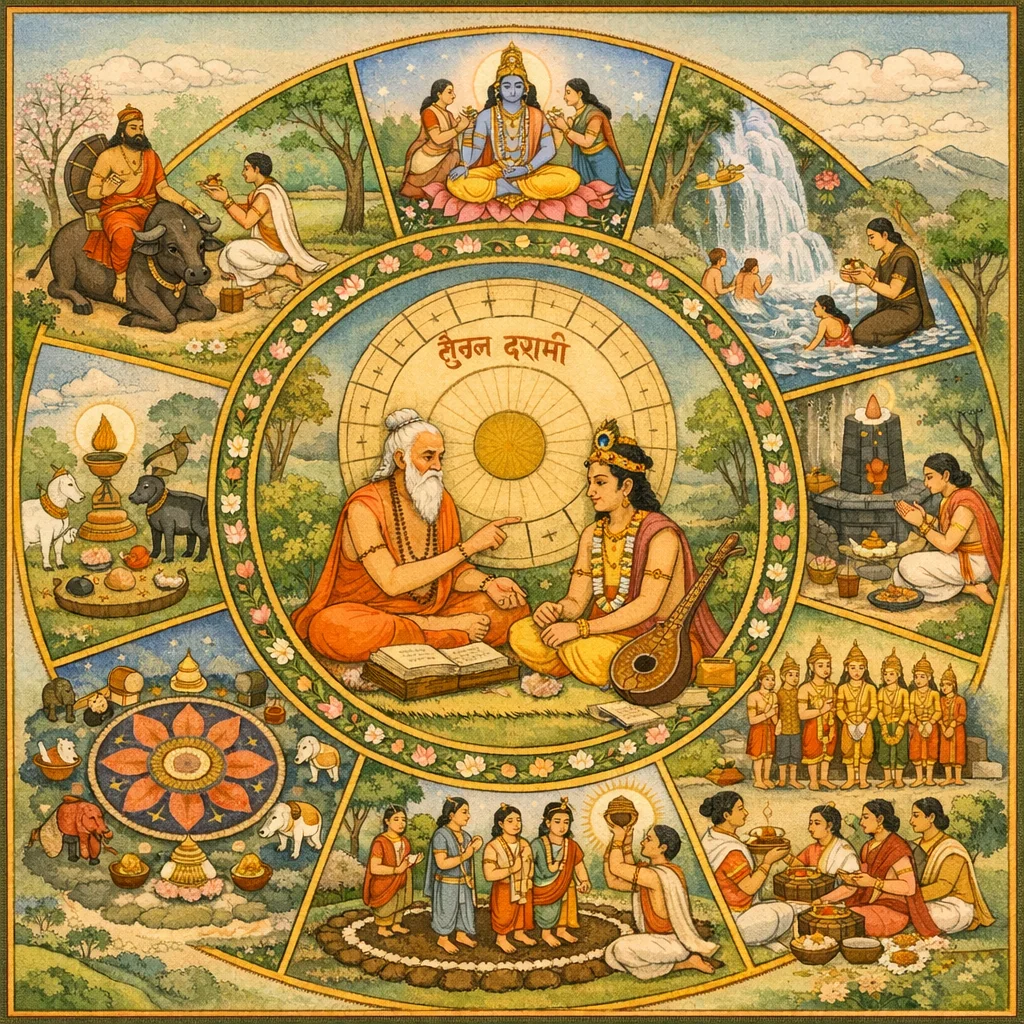
Daśamī-vrata: Observances for the Bright Tenth Day Through the Twelve Months
Sanātana instructs Nārada in Śukla Daśamī observances arranged month by month. In Caitra, Dharmarāja (Yama) is worshipped with seasonal offerings, fasting, brāhmaṇa-feeding, and prescribed dakṣiṇā, granting divine kinship. In Mādhava, Viṣṇu is adored with fragrant white flowers and many pradakṣiṇās to attain Vaiṣṇava-loka. In Jyeṣṭha, Gaṅgā’s descent and the supremely meritorious Daśaharā “Daśa-yoga” are detailed with nakṣatra, weekday, karaṇa, yoga, and zodiacal placements; ritual bathing leads to Hari’s abode. Subsequent months prescribe heaven-giving bath/japa/homa/dāna (Āṣāḍha), Śiva worship with fasting and gifts (Śrāvaṇa), and the Bhādrapada Daśāvatāra-vrata with tarpaṇa and gifting ten golden avatāra images. Āśvina presents Vijayā Daśamī with a cow-dung cakravāla, worship of Rāma and his brothers, household participation, and boons of victory and wealth. Kārtika introduces the Sārvabhauma Vrata: midnight directional bali, an eight-petalled maṇḍala, sin-destroying mantras to the dikpālas and Ananta, ending in brāhmaṇa worship and kingship-like merit. Further vows include Ārogyaka (Mārgaśīrṣa), Viśvedeva worship with Keśava’s ten forms (Pauṣa), Devāṅgirasa worship (Māgha), and finally worship of the fourteen Yamās with tarpaṇa and Sūrya-arghya, granting prosperity and Viṣṇuloka.
Shlokas
Verse 1
सनातन उवाच । अथ तेऽहं प्रवक्ष्यामि दशम्या वै व्रतानि च । यानि कृत्वा नरो भक्त्या धर्मराजप्रियो भवेत् ॥ १ ॥
Sanātana said: Now I shall explain to you the vows to be observed on the Daśamī (tenth lunar day); by performing them with devotion, a person becomes dear to Dharmarāja (Yama), the lord of righteousness.
Verse 2
चैत्रशुक्लदशम्यां तु धर्मराजं प्रपूजयेत् । तत्कालसंभवैः पुष्पैः फलैर्गंधादिभिस्तथा ॥ २ ॥
On the bright tenth day (Daśamī) of the month of Caitra, one should duly worship Dharmarāja, using flowers, fruits, fragrances, and other offerings that are seasonally available at that time.
Verse 3
सोपवासो वैकभक्तो भोजयित्वा द्विजोत्तमान् । चतुर्द्दशततस्तेभ्यः शक्त्या दद्याच्च दक्षिणाम् ॥ ३ ॥
Observing a fast and taking a single meal, one should feed the best of the twice-born (Brahmins); thereafter, according to one’s capacity, one should give them a dakṣiṇā (honorarium) amounting to fourteen hundred (units).
Verse 4
एवं यः कुरुते विप्र धर्मराजप्रपूजनम् । स धर्मस्याज्ञयागच्छेद्देवैः साधर्म्यमच्युतः ॥ ४ ॥
Thus, O brāhmaṇa, whoever performs this devoted worship of Dharmarāja, by Dharma’s command—through the grace of the unfailing Acyuta—attains a state akin to the gods, sharing their divine condition.
Verse 5
दशम्यां माधवे शुक्ले विष्णुमभ्यर्च्य मानवः । गंधाद्यैरुपचारैश्च श्वेतपुष्पैः सुगंधिभिः ॥ ५ ॥
On the bright (waxing) Daśamī, the tenth lunar day in the month of Mādhava, one should worship Lord Viṣṇu, offering fragrances and other upacāras, along with white flowers of sweet perfume.
Verse 6
शतं प्रदक्षिणाः कृत्वा विप्रन्संभोज्य यत्नतः । लभते वैष्णवं लोकं नात्र कार्या विचारणा ॥ ६ ॥
After performing a hundred circumambulations (pradakṣiṇā) and, with due care, feeding the brāhmaṇas, one surely attains the Vaiṣṇava world, the realm of Viṣṇu; there is no need for doubt or further deliberation.
Verse 7
ज्येष्ठे शुक्लदशम्यां तु जाह्नवी सरितां वरा । समायाता धरां स्वर्गात्तस्मात्सा पुण्यदा स्मृता ॥ ७ ॥
On the bright-fortnight Daśamī in the month of Jyeṣṭha, the Jāhnavī—best among rivers—descended to the earth from heaven; therefore she is remembered as the giver of merit (puṇya).
Verse 8
ज्येष्ठः शुक्लदलं हस्तो बुधश्च दशमीः तिथिः । गरानन्दव्यतीपाताः कन्येंदुवृषभास्कराः ॥ ८ ॥
Here it is stated: the nakṣatra is Jyeṣṭhā and the bright fortnight is specified; Hasta (nakṣatra) and Wednesday (Budha) are mentioned; the tithi is Daśamī. The karaṇa is Gara; the yoga is Ānanda and Vyatīpāta; and the relevant zodiacal placements are Kanyā (Virgo), Indu (the Moon), Vṛṣabha (Taurus), and Āskara (the Sun).
Verse 9
दशयोगः समाख्यातो महापुण्यतमो द्विज । हरते दश पापानि तस्माद्दशहरः स्मृतः ॥ ९ ॥
O twice-born one, this “Daśa-yoga” is proclaimed as supremely meritorious. It removes ten sins; therefore it is remembered as “Daśahara”—the destroyer of ten (sins).
Verse 10
अस्यां यो जाह्नवीं प्राप्य स्नाति संप्रीतमानसः । विधिना जाह्नवीतोये स याति हरिमन्दिरम् ॥ १० ॥
Whoever, reaching this sacred place and attaining Jāhnavī (Gaṅgā), bathes in her waters with a contented, devoted mind, according to proper rite—he goes to Hari’s abode, the divine temple of Viṣṇu.
Verse 11
आषाढशुक्लदशमी पुण्या मन्वादिकैः स्मृता । तस्यां स्नानं जपो दानं होमो वा स्वर्गतिप्रदाः ॥ ११ ॥
The tenth lunar day (Daśamī) of the bright fortnight in Āṣāḍha is remembered as holy by Manu and other authorities. On that day, bathing, japa, charitable giving, or offering oblations into the sacred fire bestow attainment of heaven (svarga).
Verse 12
श्रावणे शुक्लदशमी सर्वाशापरिपूर्तिदा । अस्यां शिवार्चनं शस्तं गन्धाद्यै रुपचारकैः ॥ १२ ॥
In the month of Śrāvaṇa, the bright-fortnight tenth day (Śukla Daśamī) is said to fulfill all cherished wishes. On this day, worship of Śiva is praised—performed with offerings such as fragrant substances and other ritual services.
Verse 13
तत्रोपवासो नक्तं वा द्विजानां भोजनं जपः । हेम्नो दान च धेन्वादेः सर्वपापप्रणाशनम् ॥ १३ ॥
There, fasting—or else eating only at night—feeding the twice-born, and the practice of japa; and also the gifting of gold and of cows and the like—these are all declared to be destroyers of every sin.
Verse 14
अथो नभस्यशुक्लायां दशम्यां द्विजसत्तम । व्रतं दशावताराख्यं तत्र स्नानं जलाशये ॥ १४ ॥
Then, O best of the twice-born, on the tenth lunar day (Daśamī) of the bright fortnight in the month of Nabhasya (Bhādrapada), one should undertake the vow called the Daśāvatāra-vrata; and on that occasion one should bathe in a reservoir of water.
Verse 15
कृत्वा संध्यादिनियमं देवर्षिपितृतर्पणम् । ततो दशावताराणि समभ्यर्चेत्समाहितः ॥ १५ ॥
Having performed the daily disciplines beginning with the Sandhyā rites, and having offered tarpaṇa (libations) to the gods, sages, and ancestors, one should then, with a collected mind, duly worship the Ten Avatāras of Viṣṇu.
Verse 16
मत्स्यं कूर्मं वराहं च नरसिंहं त्रिविक्रमम् । रामं रामं च कृष्णं च बौद्धं कल्किनमेव च ॥ १६ ॥
He manifested as Matsya, Kūrma, and Varāha; as Narasiṃha and Trivikrama; as Rāma (Paraśurāma) and Rāma (Rāmacandra); as Kṛṣṇa; as the Buddha; and also as Kalkin.
Verse 17
दशमूर्तिस्तु सौवर्णीः पूजयित्वा विधानतः । दशभ्यो विप्रवर्येभ्यो दद्यात्सत्कृत्य नारद ॥ १७ ॥
After duly worshipping ten golden images according to the prescribed rite, O Nārada, one should respectfully present them as gifts to ten foremost Brāhmaṇas.
Verse 18
उपवासं चैकभक्तं कृत्वा संभोज्य वाडवान् । विसृज्य पश्चाद्भुंजीत स्वयं स्वेष्टैः समाहितः ॥ १८ ॥
Having observed a fast (upavāsa) and the discipline of taking a single meal (ekabhakta), one should first feed the worthy guests and dependents; after dismissing them, one should then eat oneself, composed and attentive, together with one’s chosen companions.
Verse 19
भक्त्या कृत्वा व्रतं त्वेतद्भुक्त्वा भोगानिहोत्तमान् । विमानेन व्रजेदंते विष्णुलोकं सनातनम् ॥ १९ ॥
Having performed this vow with bhakti, and having enjoyed the finest delights in this world, at life’s end one departs in a celestial vimāna and attains the eternal realm of Viṣṇu.
Verse 20
आश्विने शुक्लदशमी विजया सा प्रकीर्तिता । चतुर्गोमयपिंडानि प्रातर्न्यस्य गृहांगणे ॥ २० ॥
In Āśvina, the tenth lunar day (Daśamī) of the bright fortnight is famed as Vijayā. In the morning, one should place four lumps of cow-dung in the house courtyard.
Verse 21
चक्रवालस्वरूपेण तन्मध्ये रामलक्ष्मणौ । तथा भरतशत्रुघ्नौ पूजयेच्चतुरोऽपि हि ॥ २१ ॥
Arranging them in the form of a circular enclosure (cakravāla), placing Rāma and Lakṣmaṇa in the center, and likewise Bharata and Śatrughna, one should worship all four indeed.
Verse 22
सपिधानासु पात्रीषु गोमयीषु चतसृष्ट । किन्नं धान्यं सरौप्यं तु धृत्वा धौतांशुकावृतम् ॥ २२ ॥
In four cow-dung–smeared vessels furnished with lids, one should place well-purified grains together with silver, and keep them covered with a washed, pure cloth.
Verse 23
पितृमातृभ्रातृपुत्रजाया भृत्यसमन्वितम् । संपूज्यं गन्धपुष्पाद्यैर्नैवेद्यैश्च विधानतः ॥ २३ ॥
Together with one’s father, mother, brothers, sons, wife, and attendants, one should duly perform complete worship according to the prescribed rite, offering fragrances, flowers, and other gifts, along with naivedya, the food offering.
Verse 24
नमस्कृत्याथ भुंजीत द्विजान्संभोज्य पूजितान् । एवं कृत्वा विधानं तु नरो वर्षं सुरवान्वितः ॥ २४ ॥
After offering salutations, he should then eat, having first fed and honored the twice-born (brāhmaṇas). Having thus performed the prescribed rite, the man remains endowed with heavenly blessings for a year.
Verse 25
धनधान्यसमृद्धश्च निश्चितं जायते द्विज । अथापाराह्णसमये नवम्यां संनिमंत्रिताम् ॥ २५ ॥
O twice-born one, he surely becomes endowed with abundance of wealth and grain. Therefore, at the time of apārāhṇa (the afternoon period), on the ninth lunar day (Navamī), one should duly invite what has been invoked (the deity/observance).
Verse 26
पूर्वदिक्षु शमीं विप्र गत्वा तन्मूलजां मृदम् । गृहीत्वा स्वगृहं प्राप्य गीतवादित्रनिःस्वनैः ॥ २६ ॥
O brāhmaṇa, having gone in the eastern direction to the śamī tree and taken the earth from its root, one should return to one’s home amid the sound of songs and musical instruments.
Verse 27
संपूज्य तां विधानेन सज्जीकृत्य स्वकं बलम् । निर्गत्य पूर्वद्वारेण ग्रामाद्ब्रहिरनाकुलः ॥ २७ ॥
Having duly worshipped her according to proper rites, and having readied his own forces, he calmly went out of the village through the eastern gate.
Verse 28
ततः शत्रुप्रतिकृतिं निर्मितां पत्रकादिभिः । मनसा कल्पितां वापि स्वर्णं पुंरवंशरेण वै ॥ २८ ॥
Then one should fashion an effigy of the enemy—made from leaves and the like, or even merely imagined in the mind—and offer gold as well, O descendant of Pururavā.
Verse 29
विध्येदिति भृशं प्रीतः प्राप्नुयात्स्वगृहं निशि । एवं कृतविधिर्वापि गच्छेद्वा शत्रुनिग्रहे ॥ २९ ॥
Uttering, “Let him strike (pierce)!”—exceedingly pleased—he should return to his own house at night. Or, having thus duly performed the prescribed procedure, he may also proceed to the subjugation of enemies.
Verse 30
एषैवं दशमी विप्र विधिनाऽचरिता सदा । धनं जयं सुतान् गाश्च गजाश्वं वाप्यजाविकम् ॥ ३० ॥
O brāhmaṇa, when this Daśamī observance is always performed in the prescribed manner, it bestows wealth, victory, sons, cows, elephants and horses, and also goats and sheep.
Verse 31
दद्यादिह शरीरांते स्वर्गतिं चापि नारद । दशम्यां कार्तिके शुक्ले सार्वभौमव्रतं चरेत् ॥ ३१ ॥
O Nārada, one should observe the Sārvabhauma Vrata on the bright tenth day of Kārtika; practiced in this very life, it bestows merit here and, at the end of the body, grants passage to heaven as well.
Verse 32
कृतोपवासो वैकाशी निशीथेऽपूपकादिभिः । दशदिक्षु बलिं दद्याद् गृहद्वापि पुराद्ब्रहिः ॥ ३२ ॥
Having completed the fast and keeping awake at night, at midnight one should offer bali (ritual offerings) with apūpa-cakes and similar items in the ten directions—either at the doorway of the house or outside the town.
Verse 33
मंडलेऽष्टदले क्लृप्ते गोविड्लिप्तधरातले । मन्त्रैरेभिर्द्विजश्रेष्ठ गणेशादिकृतार्चनः ॥ ३३ ॥
O best of the twice-born, after preparing an eight-petalled maṇḍala on ground plastered with cow-dung, one should perform worship—beginning with Gaṇeśa—using these mantras.
Verse 34
यो मे पूर्वगतः पाप्मा पापकेनेह कर्मणा । तमिंद्रो देवरा जोऽद्य नाशयत्वखिलेष्टदः ॥ ३४ ॥
May Indra—the king of the gods, bestower of all desired boons—today destroy the sin that has come upon me through my evil deed in this world.
Verse 35
यो मे वह्निगतः पाप्मा पापकेनेह कर्मणा । तेजोराजोऽथ वह्निस्तं नाशयत्वखिलेष्टदः ॥ ३५ ॥
May the sin that has entered my fire through an evil deed done here be destroyed; and may Agni—lord of radiance, bestower of all desired boons—consume it completely.
Verse 36
यो मे दक्षगतः पाप्मा पापकेनेह कर्मणा । तं यमः प्रेतराजो वै नाशयत्वखिलेष्टदः ॥ ३६ ॥
May Yama, king of departed spirits and bestower of all desired results, utterly destroy the sin that has settled upon my right side through evil action here; may he remove it completely.
Verse 37
यो मे नैर्ऋतिगः पाप्मा पापकेनेह कर्मणा । रक्षोराजो नैर्ऋतिस्तं नाशयत्वखिलेष्टदः ॥ ३७ ॥
May Nairṛti, king of the Rākṣasas—bestower of all desired attainments—destroy the sinful evil that has come upon me here through wicked action.
Verse 38
यो मे पश्चिमगः पाप्मा पापकेनेहकर्मणा । यादः पतिस्तं वरुणो नाशयत्वखिलेष्टदः ॥ ३८ ॥
May Varuṇa—the lord of the waters, bestower of all desired boons—destroy my sin that stands to the west, arising here from evil action.
Verse 39
यो मे वायुगतः पाप्मा पापकेनेह कर्मणा । वायुस्तं मरुतां राजो नाशयत्वखिलेष्टदः ॥ ३९ ॥
Whatever sin of mine has entered into the wind through evil action here—may Vāyu, king of the Maruts and bestower of all desired boons, destroy it utterly.
Verse 40
यो मे सौम्यगतः पाप्मा पापकेनेह कर्मणा । सोमस्तमृक्षयक्षेशो नाशयत्वखिलेष्टदः ॥ ४० ॥
O gentle one, whatever sin has come upon me here through evil action—may Soma, lord of the Ṛkṣas and Yakṣas, bestower of all desired boons, destroy it.
Verse 41
यो म ईशगतः पाप्मा पापकेनेह कर्मणा । ईशानो भूतनाथस्तं नाशयत्वखिलेष्टदः ॥ ४१ ॥
May Īśāna, Lord of beings and bestower of all desired boons, destroy the sin that has come upon me here through sinful action.
Verse 42
यो मं ऊर्द्ध्वगतः पाप्मा पापकेनेह कर्मणा । ब्रह्मा प्रजापतीशस्तं नाशयत्वखिलेष्टदः ॥ ४२ ॥
May Brahmā—the Lord of creatures (Prajāpati), bestower of all desired boons—destroy the sin that has risen against me here through wicked deeds.
Verse 43
यो मेऽधःसंस्थितः पाप्मा पापकेनेह कर्मणा । अनंतो नागराजस्तं नाशयत्वखिलेष्टदः ॥ ४३ ॥
May Ananta—the serpent-king who bestows all that is desired—destroy the sin within me that has settled below, produced here by my evil actions.
Verse 44
इत्येवं दिक्षु दशसु बलिं दत्वा समाहितः । क्षेत्रपालाय तद्बाह्ये क्षिपेद्बलिमतंद्रितः ॥ ४४ ॥
Thus, having offered the bali in the ten directions with a composed mind, one should diligently cast an offering outside the ritual ground for Kṣetrapāla, the guardian of the sacred site.
Verse 45
एवं कृतविधिः शेषं निशायां निनयेत्सुधीः । गीतैः सुमंगलप्रायैः स्तवपाठैर्जपादिभिः ॥ ४५ ॥
Having thus completed the prescribed rite, the wise should spend the remaining part of the night in auspicious devotional songs, recitation of hymns, japa (mantra-repetition), and related practices.
Verse 46
प्रातः स्नात्वा समभ्यर्च्य लोकपालान् द्विजोत्तमान् । द्वादशाभ्यर्च्य संभोज्य शक्तितो दक्षिणां ददेत् ॥ ४६ ॥
In the morning, having bathed, the best of the twice-born should duly worship the Lokapālas, guardians of the worlds, and the foremost Brāhmaṇas; then, having honored twelve Brāhmaṇas and fed them, he should give dakṣiṇā according to his means.
Verse 47
इत्थं कृत्वा व्रतं विप्र भोगान्भुक्तैहिकाञ्छुभान् । युगं स्वर्गसुखं भुक्त्वा सार्वभौमो नृपो भवेत् ॥ ४७ ॥
O brāhmaṇa, having performed the vow in this manner, one enjoys auspicious pleasures in this world; and after enjoying the happiness of heaven for a yuga, one becomes a universal sovereign king.
Verse 48
मार्गशुक्लदशम्यां तु चरेदारोग्यकं व्रतम् । गंधाद्यैरर्चयेद्विप्रान् दश तच्चरणोदकम् ॥ ४८ ॥
On the bright tenth day of Mārgaśīrṣa, one should observe the Ārogyaka vow that bestows health. One should worship ten Brāhmaṇas with fragrances and the like, and receive their caraṇodaka—foot-water—tenfold.
Verse 49
पीत्वाऽथ दक्षिणां दत्वा विसूजेदेकभोजनं । एतत्कृत्वा व्रतं विप्र ह्यारोग्यं प्राप्य भूतले ॥ ४९ ॥
Then, after drinking the prescribed offering and giving the dakṣiṇā, one should conclude the rite by taking a single meal. O brāhmaṇa, having thus performed this vow, one attains good health upon the earth.
Verse 50
धर्मराजप्रसादेन मोदते दिवि देववत् । पौषे दशम्यां शुक्लायां विश्वेदेवान् समर्चयेत् ॥ ५० ॥
By the grace of Dharmarāja, one rejoices in heaven like a god. On the bright tenth day in the month of Pauṣa, one should duly worship the Viśvedevas.
Verse 51
ऋतुं दक्षं वसून्सत्यं कालं कामं मुनिं गुरुम् । विप्रं रामं च दशधा केशवस्तान्समास्थितः ॥ ५१ ॥
Keśava abides in these ten forms: as Ṛtu, Dakṣa, the Vasus, Satya, Kāla, Kāma, the Sage (Muni), the Guru, the Brāhmaṇa (Vipra), and Rāma.
Verse 52
स्वापयित्वा दर्भमयानासनेषु च संस्थितान् । गंधैर्धूपैस्तथा दीपैर्नैवेद्यैश्चापि नारद ॥ ५२ ॥
Having laid them to rest and seated them upon seats made of darbha grass, O Nārada, one should then honor them with perfumes, incense, lamps, and offerings of food (naivedya) as well.
Verse 53
प्रत्येकं दक्षिणां दत्वा प्रणियत्य विसर्जयेत् । दक्षिणां तां द्विजाग्र्येभ्यो गुरवे वा समर्पयेत् ॥ ५३ ॥
Having given the prescribed dakṣiṇā to each, one should duly conclude and dismiss them. That dakṣiṇā should be offered to eminent brāhmaṇas, or else presented to one’s guru.
Verse 54
एवं कृतविधि श्चैकभक्तो भोगी व्रती भवेत् । लोकद्वयस्य विप्रर्षे नात्र कार्या विचारणा ॥ ५४ ॥
Thus, having performed the rite in the prescribed manner, one should become ekabhakta—taking food only once—yet remain a lawful enjoyer of permitted pleasures, living as an observer of vows. O best of brāhmaṇas, such a person gains the good of both worlds; here there is no need for doubt or further deliberation.
Verse 55
माघशुक्लदशम्यां तु सोपवासो जितेंद्रियः । देवांनगिरसो नाम दश सम्यक्समर्चयेत् ॥ ५५ ॥
On the tenth lunar day (Daśamī) of the bright fortnight in the month of Māgha, one should fast, restrain the senses, and duly worship the ten divine sages known as the Devāṅgirasas.
Verse 56
कृत्वा स्वर्णमयान्विप्र गंधाद्यैरुपचारकैः । आत्मा ह्यायुर्मनो दक्षो मदः प्राणस्तथैव च ॥ ५६ ॥
O brāhmaṇa, having fashioned (the sacred forms) of gold and honored them with offerings such as fragrance and the like, one should understand that the Self (Ātman) itself is life-span, mind, capability, vigor, and also the vital breath (prāṇa).
Verse 57
बर्हिष्मांश्च गविष्ठश्च दत्तः सत्यश्च ते दश । दश विप्रान्भोजयित्वा मधुरान्नेन नारद ॥ ५७ ॥
O Nārada, those ten were Barhiṣmān, Gaviṣṭha, Datta, Satya, and others; and having fed ten brāhmaṇas with sweet food, the rite (the act) was duly completed.
Verse 58
मूर्तीस्तेभ्यः प्रदद्यात्ताः स्वर्गलोकाप्तये क्रमात् । अंत्यशुक्लदशम्यां तु चतुर्दशं यमान्यजेत् ॥ ५८ ॥
One should, in due order, offer those sacred images to them for the attainment of the heavenly world. But on the final bright-fortnight tenth day (Śukla Daśamī), one should worship the fourteen Yamās.
Verse 59
यमश्च धर्मराजश्च मृत्युश्चैवांतकस्तथा । वैवस्वतश्च कालश्च सर्वभूतक्षयस्तथा ॥ ५९ ॥
He is called Yama, the King of Dharma; he is also Death, the Ender; Vaivasvata; Time (Kāla); and the Destroyer of all beings.
Verse 60
औदुम्बरश्च दघ्नश्च द्वौ नीलपरमेष्ठिनौ । वृकोदरश्चचित्रश्च चित्रगुप्तश्चतुर्दश ॥ ६० ॥
Audumbara and Daghna—these two are also known as Nīla and Parameṣṭhin. Likewise Vṛkodara and Citra, and also Citragupta—thus they are counted as fourteen.
Verse 61
गन्धाद्यैरुपचारैश्च समभ्यर्च्याथतर्पयेत् । तिलांबुमिश्रांजलिभिर्दर्भैः प्रत्येकशस्त्रिभिः ॥ ६१ ॥
After duly worshipping with offerings such as sandal paste and the like, one should then perform tarpaṇa, offering handfuls of water mixed with sesame while using darbha grass—three times for each recipient.
Verse 62
ततश्च दद्यात्सूर्यार्घं ताम्रपात्रेण नारद । रक्तचंदनसंदनसंमिश्रतिलाक्षतयवांबुभिः ॥ ६२ ॥
Then, O Nārada, one should offer arghya to the Sun using a copper vessel, with water mixed with red sandalwood, fragrant sandal paste, sesame, unbroken rice grains (akṣata), and barley.
Verse 63
एहि सूर्यसहस्रांशो तेजोराशे जगत्पते । गृहाणार्घ्यं मया दत्तं भक्त्या मामनुकंपय ॥ ६३ ॥
O Sūrya of a thousand rays, O vast treasury of radiance, O Lord of the universe—come! Accept the arghya I offer with devotion (bhakti), and show compassion to me.
Verse 64
इति मंत्रेण दत्वाऽर्घ्यं विप्रान्भोज्य चतुर्द्दश । रौप्यां सुदक्षिणां दत्वा विसृज्याश्नीत च स्वयम् ॥ ६४ ॥
Having offered arghya with this mantra, one should feed fourteen brāhmaṇas; then, after giving a fine silver dakṣiṇā, one should respectfully dismiss them and thereafter eat oneself.
Verse 65
एवं कृतविधिर्विप्र धर्मराजप्रसादतः । भुक्त्वा भोगांश्च पुत्रार्थानैहिकान्देवदुर्लभान् ॥ ६५ ॥
Thus, O brāhmaṇa, having duly performed the prescribed rites, and through the favor of Dharmarāja, he enjoyed worldly prosperities and the boon of sons—benefits in this very life that are difficult even for the gods to obtain.
Verse 66
विमानवरमास्थाय देहांते विष्णुलोकभाक् ॥ ६६ ॥
At the end of the body (i.e., upon death), having mounted an excellent celestial chariot, he becomes a dweller in Viṣṇu’s world.
Verse 67
इति श्रीबृहन्नारदीयपुराणे पूर्वभागे बृहदुपाख्याने चतुर्थपादे द्वादशमासस्थितदशमीव्रतनिरूपणं नामैकोनविंशत्यधिकशततमोऽध्यायः ॥ ११९ ॥
Thus ends, in the Śrī Bṛhannāradīya Purāṇa—within the Pūrva-bhāga, in the Great Narrative (Bṛhad-upākhyāna), in the Fourth Pada—the one-hundred-and-nineteenth chapter, entitled “The exposition of the Daśamī vow observed across the twelve months.”
Frequently Asked Questions
Because the chapter proclaims a highly auspicious “Daśa-yoga” configuration that is said to destroy ten sins (daśa-hara). It links the day with Gaṅgā’s descent and prescribes bathing with proper rite and devotion as the central meritorious act.
It combines daily purificatory disciplines (sandhyā, tarpaṇa) with formal worship of Viṣṇu’s ten avatāras and culminates in gifting ten golden images to ten eminent brāhmaṇas—presenting a complete vrata-kalpa sequence: preparation, worship, dāna, feeding, and promised Viṣṇuloka.
The rite externalizes and ritually neutralizes pāpa (sin) through offerings in the ten directions and invocations to deities associated with cosmic order (dikpālas and allied powers). It closes with Kṣetrapāla bali and nocturnal devotional vigil, then morning brāhmaṇa worship—integrating protection, purification, and merit transfer.
The chapter lists Yama with multiple epithets (King of Dharma, Death/Ender, Vaivasvata, Time, etc.) and additional named forms including Audumbara, Daghna, Nīla, Parameṣṭhin, Vṛkodara, Citra, and Citragupta—collectively totaling fourteen recipients of worship and tarpaṇa.