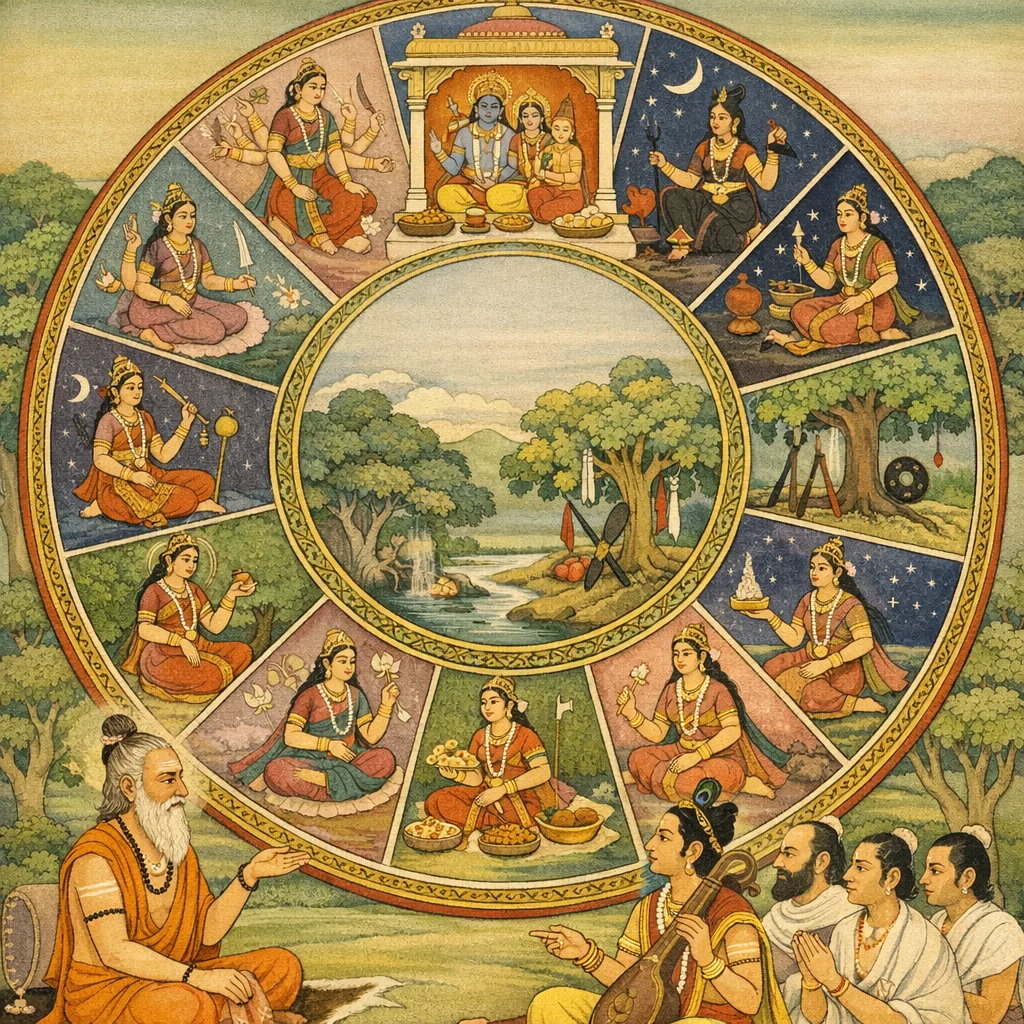
The Narration of the Navamī Vow Observed Across the Twelve Months
Sanātana instructs Nārada and the gathered brāhmaṇas on Navamī (the ninth lunar day) vratas through all twelve months. He begins with Caitra Śukla-Navamī as Śrī Rāma-navamī: fasting (or ekabhukta after the midday celebration), feeding brāhmaṇas sweet foods, and giving gifts—cows, land, sesame, gold, garments, and ornaments—bringing sin-removal and attainment of Viṣṇu’s abode. The teaching then turns to Śākta observances: a Mātṛ-vrata linked with Bhairava; worship of the sixty-four Yoginīs and Bhadrakālī; and Caṇḍikā worship with lotus petals. Later months prescribe Umā-vrata (Jyeṣṭha Navamī), night worship of Indra (visualized white upon Airāvata), Caṇḍikā’s Kaumārī form in Śrāvaṇa (night-eating or fortnight fasts), and Bhādrapada’s Nandā Navamī for Durgā. Āśvina’s Mahāpūrvā includes śamī-tree worship and nocturnal veneration of weapons/emblems, ending with bali to Bhadrakālī and dakṣiṇā. Kārtika’s Akṣayā Navamī features aśvattha-root tarpaṇa and Sūrya-arghya; subsequent months name Nandinī (Mārgaśīrṣa), Mahāmāyā worship (Pauṣa), Mahānandā (Māgha), and Ānandā (Phālguna), declaring imperishable merit and wish-fulfillment.
Shlokas
Verse 1
सनातन उवाच । अथ वक्ष्यामि विप्रेंद्र नवम्यास्ते व्रतानि वै । यानि कृत्वा नरा लोके लभंते वांछितं फलम् ॥ १ ॥
Sanātana said: Now, O best of brāhmaṇas, I shall describe the vows to be observed on Navamī. By performing them, people in this world obtain the fruits they desire.
Verse 2
चैत्रस्य शुक्लपक्षे तु श्रीरामनवमीव्रतम् । तत्रोपवासं विधिवच्छक्तो भक्तः समाचरेत् ॥ २ ॥
In the bright fortnight of Caitra is the vow of Śrī Rāma-navamī. On that occasion, a capable devotee should duly observe fasting according to the prescribed rite.
Verse 3
अशक्तश्चैकभक्तं वै मध्याह्नोत्सवतः परम् । विप्रान्संभोज्य मिष्टान्नै रामप्रीति सुमाचरेत् ॥ ३ ॥
But one who is unable to perform the full observance should, after the midday celebration, keep the vow of taking only a single meal; and, having respectfully fed brāhmaṇas with sweet foods, should practice it well for the pleasure of Śrī Rāma.
Verse 4
गोभूतिलहरिरण्याद्येर्वस्त्रालंकरणेस्तथा । एव यः कुरुते भक्त्या श्रीरामनवमीव्रतम् ॥ ४ ॥
Thus, whoever devoutly observes the Śrī Rāmanavamī vow—offering gifts such as cows, land, sesame, and gold, along with garments and ornaments—truly fulfills the vrata as prescribed.
Verse 5
विधूय चेहपापानि व्रजेद्विष्णोः परं पदम् । उक्तं मातृव्रतं चात्र भैरवेण समन्विताः ॥ ५ ॥
Shaking off the sins accumulated here (in this very life), one attains the supreme abode of Viṣṇu. Here, too, the Mātṛ-vrata—the vow of the Mother (Goddess)—has been described, together with its association with Bhairava.
Verse 6
स्रग्गंधवस्रनमनैवेद्यैश्चतुःष्टिस्तु योगिनीः । अत्रैव भद्रकालो तु योगिनीनां महाबला ॥ ६ ॥
With garlands, fragrances, garments, salutations, and naivedya (offerings of food), the sixty-four Yoginīs are to be worshipped. Here itself, Bhadrakālī—exceedingly powerful among the Yoginīs—is also to be revered.
Verse 7
ब्राह्मणश्रेष्टः सर्वासामाधिपत्येऽभिषेचिता । तस्मात्तां पूजयेच्चात्र सोपवासो जितेंद्रियः ॥ ७ ॥
The foremost of brāhmaṇas has consecrated her by abhiṣeka to sovereign authority over all. Therefore, here one should worship her, fasting (upavāsa) and with the senses restrained.
Verse 8
राधे नवम्यां दलयोश्चंडिकां यस्तु पूजयेत् । विधिना स विमानेन देवतैः सह मोदते ॥ ८ ॥
O Rādhe, whoever worships Caṇḍikā on the ninth lunar day, with due rites and lotus-petals, rejoices with the gods in a celestial vimāna.
Verse 9
ज्येष्ठशुक्लनवम्यां तु सोपवासो नरोत्तमः । उमां संपूज्य विधिवत्कुमारीर्भोजयेद्द्विजान् ॥ ९ ॥
On the Navamī of the bright fortnight of Jyeṣṭha, the best of men should fast; having duly worshipped Umā according to rule, he should feed the kumārīs and the twice-born brāhmaṇas.
Verse 10
स्वभक्त्या दक्षिणां दत्वा शाल्यन्नं पयसाऽश्नुयात् । उमाव्रतमिदं विप्र यः कुर्याद्विधिवन्नरः ॥ १० ॥
With devotion, having given the prescribed dakṣiṇā, one should partake of rice-food with milk. O brāhmaṇa, this is the Umā-vrata; the man who performs it according to vidhi fulfills the vow.
Verse 11
स भुक्त्वेह वरान्भोगानंते स्वर्गगतिं लभेत् । आषाढे मासि विप्रेंद्र यः कुर्यात्पक्षयोर्द्विज ॥ ११ ॥
O best of brāhmaṇas, the twice-born who performs this observance in the month of Āṣāḍha, in both fortnights, enjoys excellent pleasures here and in the end attains the path to heaven.
Verse 12
नक्तं चैंद्रीं समभ्यर्च्येदैरावतगतां सिताम् । स भवेद्वैवलोके तु भोगभारग्देवयानगः ॥ १२ ॥
If at night one worships Indrā—the goddess connected with Indra—visualizing her as radiant and white, mounted upon Airāvata, then in the world of Vaivasvata one becomes a bearer of enjoyments and a traveler by the gods’ celestial conveyance.
Verse 13
श्रावणे मासि विप्रेन्द्र यः कुर्यान्नक्तभोजनम् । पक्षयोरुपवासं वा कौमारीं चंडिकां यजेत् ॥ १३ ॥
O best of Brahmins, in the month of Śrāvaṇa, whoever keeps the vow of eating only at night, or fasts through both fortnights, should worship Caṇḍikā in her Kaumārī form.
Verse 14
एवं पापहरां गंधैः पुष्पैर्धूपैश्च दीपकैः । नैवेद्यैर्विविधैश्चैव कुमारीभोजनैस्तथा ॥ १४ ॥
Thus, worship should be performed in a sin-destroying way with fragrances, flowers, incense, and lamps, with various naivedya food-offerings, and also by feeding young maidens (kumārīs).
Verse 15
एवं यः कुरुते भक्त्या कौमारीव्रतमुत्तमम् । स विमानेन गच्छेद्वै देवीलोकं सनातनम् ॥ १५ ॥
Thus, whoever performs the excellent Kaumārī vow with devotion truly goes, in a celestial chariot (vimāna), to the eternal realm of the Goddess.
Verse 16
भाद्रे तु नवमी शुक्ला नंदाह्वा परिकीर्तिता । तस्यां यः पूजयेद्दुर्गां विधिवच्चोपचारकैः ॥ १६ ॥
In the month of Bhādrapada, the bright (śukla) ninth lunar day is proclaimed as “Nandā”. Whoever worships Goddess Durgā on that day, duly and with the prescribed offerings and services (upacāras), gains auspicious results.
Verse 17
सोऽश्वमेधफलं लब्ध्वा विष्णुलोके महीयते । आश्विने शुक्लनवमी महापूर्वा प्रकीर्तिता ॥ १७ ॥
Gaining merit equal to that of the Aśvamedha sacrifice, one is honored in Viṣṇu’s world. Therefore, the ninth lunar day of the bright fortnight in Āśvina is proclaimed as the supremely sacred “Mahāpūrvā.”
Verse 18
अपराह्णे शमीपूजा कार्याऽस्यां प्राग्दिशि द्विज । ततो निशायां प्राग्यामे खङ्गं धनुरिषून्गदाम् ॥ १८ ॥
O twice-born one, in the afternoon one should worship the śamī tree here, facing the eastern direction. Then, in the first watch of the night, one should worship the sword, the bow, the arrows, and the mace.
Verse 19
शूलं शक्तिं च परशुं धुरिकां चर्म खेटकम् । छत्रं ध्वजं गजं चाश्व गोवृषं पुस्तकं तुलाम् ॥ १९ ॥
(One should worship) a trident, a spear, an axe, a yoke; a leather shield; an umbrella and a banner; an elephant and a horse; a cow and a bull; a book; and a balance (scales).
Verse 20
दंडं पाशं चक्रशंखौ गंधाद्यैरुपचारकैः । संपूज्य महिषं तत्र भद्रकाल्यै समालभेत् ॥ २० ॥
After duly worshipping the staff, the noose, the discus, and the conch with ritual offerings such as fragrance and the like, one should there offer a buffalo as a sacrificial oblation to Bhadrakālī.
Verse 21
एवं बलिं विधायाथ भुक्त्वा पवान्नमेव च । द्विजेभ्यो दक्षिणां दत्वा व्रतं तत्र समापयेत् ॥ २१ ॥
Thus, after offering the ritual bali and then eating only sanctified food, one should give a dakṣiṇā to the twice-born (brāhmaṇas) and, in that very manner, conclude the vow (vrata).
Verse 22
एवं यः पूजयेद्दुर्गां नॄणां दुर्गतिनाशिनीम् । इह भुक्त्वा वरान्भोगानंते स्वर्गतिमाप्नुयात् ॥ २२ ॥
Thus, whoever worships Goddess Durgā—the destroyer of misfortune for human beings—enjoys excellent pleasures here in this world, and in the end attains the path to heaven.
Verse 23
कार्तिके शुक्लनवमी याऽक्षया सा प्रकीर्तता । तस्यामश्वत्थमूले वै तर्प्पणं सम्यगाचरेत् ॥ २३ ॥
In Kārtika, the bright-fortnight Navamī (ninth lunar day) is proclaimed as “Akṣayā,” the imperishable day. On that day one should duly perform tarpaṇa—water-offerings—at the root of the sacred aśvattha tree.
Verse 24
देवानां च ऋषीणां च पितॄणां चापि नारद । स्वशाखोक्तैस्तथा मंत्रैः सूर्यायार्घ्यं ततोऽर्पयेत् ॥ २४ ॥
And, O Nārada, for the gods, the ṛṣis, and the pitṛs (ancestors), one should thereafter offer arghya—water-libation—to the Sun, using the mantras enjoined in one’s own Vedic śākhā.
Verse 25
ततो द्विजान्भोजयित्वा मिष्टान्नेन मुनीश्वर । स्वयं भुक्त्वा च विहरेद्द्विजेभ्यो दत्तदक्षिणः ॥ २५ ॥
Then, O lord among sages, having fed the dvijas (twice-born Brahmins) with sweet and choice fare, and having given them their due dakṣiṇā (honorarium), one should eat oneself and thereafter pass the time in calm and pleasant repose.
Verse 26
एवं यः कुरुते भक्त्या जपदानं द्विजार्चनम् । होमं च सर्वमक्षय्यं भवेदिति विधेर्वयः ॥ २६ ॥
Thus, whoever, with devotion, performs japa (sacred recitation), dāna (charitable giving), dvija-arcana (honoring the twice-born), and homa (fire-offering)—all of it becomes akṣayya, imperishable; such is the ordinance of the vidhi.
Verse 27
मार्गे तु शुक्लनवमी नंदिनी परिकीर्तिता । तस्यामुपोषितो यस्तु जगदंबां प्रपूजयेत् ॥ २७ ॥
In the month of Mārgaśīrṣa, the bright-fortnight Navamī is proclaimed as Nandinī. Whoever fasts (upoṣa) on that day and duly worships Jagadambā, the Mother of the universe, gains merit.
Verse 28
गंधाद्यैः सोऽश्वमेधस्य फलभाङ्नात्र संशयः । पौषे शुक्लनवम्यां तु महामायां प्रपूजयेत् ॥ २८ ॥
By offering fragrances and the like, one surely becomes a recipient of the merit of the Aśvamedha sacrifice. On the bright-fortnight Navamī of the month of Pauṣa, one should worship Mahāmāyā with complete reverence.
Verse 29
एकभक्तपरो विप्र वाजपेयफलाप्तये । माघमासे तु वा शुक्ला नवमी लोकपूजिता ॥ २९ ॥
O brāhmaṇa, one devoted to the ekabhakta vow—taking only one meal a day—attains the fruit of the Vājapeya sacrifice. In the month of Māgha, the bright Navamī is especially revered throughout the world.
Verse 30
महानंदेति सा प्रोक्ता सदानंदकरी नृणाम् । तस्यां स्नानं तथा दानं जपो होम उपोषणम् ॥ ३० ॥
She is declared to be “Mahānandā,” ever bestowing bliss upon people. There one should perform bathing, charity (dāna), japa, fire-offering (homa), and fasting (upavāsa).
Verse 31
सर्वमक्षयतां याति नात्र कार्या विचारणा । फाल्गुनामलपक्षस्य नवमी या द्विजोत्तम ॥ ३१ ॥
On the bright-fortnight Navamī of Phālguna, O best of the twice-born, everything becomes inexhaustible; there is no need for doubt or deliberation.
Verse 32
आनंदा सा महापुण्या सर्वपापहरा स्मृता । सोपवासोऽर्चयेत्तत्र यस्त्वानंदां द्विजोत्तम ॥ ३२ ॥
That observance called Ānandā is remembered as supremely meritorious and as the remover of all sins. O best of the twice-born, whoever worships Ānandā there while fasting (upavāsa) attains its purifying fruit.
Verse 33
स लभेद्वांछितान्कामान्सत्यं सत्यं मयोदितम् ॥ ३३ ॥
He indeed attains the desired aims; this is truth—truth—declared by me.
Verse 34
इति श्रीबृहन्नारदीयपुराणे पूर्वभागे बृहदुपाख्याने चतुर्थपादे द्वादशमासस्थितनवमीव्रतकथनं नामाष्टादशाधिकशततमोऽध्यायः ॥ ११८ ॥
Thus ends, in the Śrī Bṛhannāradīya Purāṇa, in the Pūrva-bhāga (Earlier Section), within the Great Narrative (Bṛhad-upākhyāna), in the Fourth Quarter (Caturtha-pāda), the one-hundred-and-eighteenth chapter entitled “The narration of the Navamī vow observed across the twelve months.”
Frequently Asked Questions
It is presented as the paradigmatic Caitra Śukla-Navamī vrata: fasting (or one-meal alternative), brāhmaṇa-feeding, and prescribed dāna, with explicit phala—sin-removal and attainment of Viṣṇu’s supreme abode—making it a model Navamī observance in the monthly cycle.
The rite expands beyond standard pūjā into a sequence of emblem/weapon worship: śamī-tree worship in the afternoon (east-facing), then first-watch night worship of arms and symbols (sword, bow, mace, trident, etc.), concluding with bali to Bhadrakālī, followed by sanctified food and dakṣiṇā to brāhmaṇas.
It highlights ‘imperishable’ (akṣaya) merit through tarpaṇa at the aśvattha root and Sūrya-arghya using one’s own śākhā mantras, plus brāhmaṇa-feeding and dakṣiṇā; it generalizes that japa, dāna, dvija-arcana, and homa done then become inexhaustible.