द्वादशमासेषु अष्टमी-व्रत-कथनम् (Account of the Aṣṭamī Vow Across the Twelve Months)
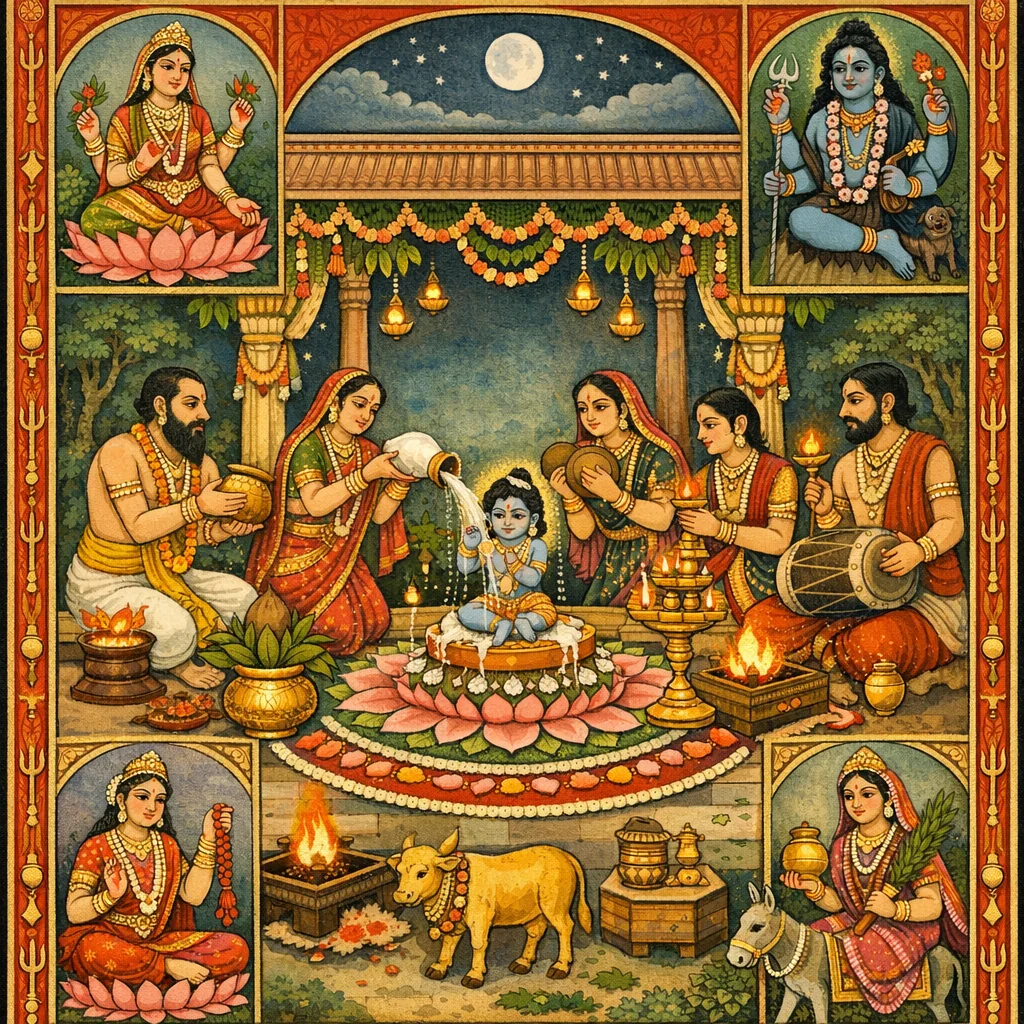
Sanātana instructs a brāhmaṇa in a yearlong sequence of Aṣṭamī-based vows across the twelve lunar months. It opens with Caitra Śuklāṣṭamī as Bhavānī’s birth festival, featuring circumambulation, yātrā, darśana, and the Aśoka-bud rite (Aśokāṣṭamī/Mahāṣṭamī). Vaiśākha and Jyeṣṭha prescribe fasting and worship of Aparājitā and Śiva/Devī forms, while Āṣāḍha details a fuller rite: night water-bath, abhiṣeka, feeding brāhmaṇas, and gold dakṣiṇā. In Bhādrapada (Nabhas) appear progeny-granting observances, including Daśāphala—a ten-day Kṛṣṇa vrata with 108 homa oblations, tulasī-leaf worship, pūrikā offerings, guru-dāna, and long practice—followed by a complete Kṛṣṇa Janmāṣṭamī liturgy (maṇḍapa, maṇḍala, kalaśa, midnight abhiṣeka, naivedya, vigil, and gifting an image and a golden cow). It further describes Rādhā-vrata, Dūrvāṣṭamī mantras for offspring, and a sixteen-day Mahālakṣmī-vrata with a ḍoraka of sixteen knots, udyāpana, moon-arghya, and sixteenfold offerings. The chapter ends by listing other Aṣṭamī observances—Durgā Mahāṣṭamī (Āśvina), Karaka-vrata (Ūrja), Gopāṣṭamī (Kārttika), Anaghā/Anagha rite (Mārgaśīrṣa), Kālabhairava fast (Mārgaśīrṣa Śuklāṣṭamī), Aṣṭakā-śrāddha and Śiva worship (Pauṣa), Bhadrakālī and Bhīṣma offerings (Māgha), Bhīmā and Śiva–Śivā worship (Phālguna), and Śītalā-Aṣṭamī with her distinctive mantra and iconography—concluding with a general monthly rule to worship Śiva/Śivā on Aṣṭamī.
Shlokas
Verse 1
सनातन उवाच । शुक्लाष्टम्यां चैत्रमासे भवान्याः प्रोच्यते जनिः । प्रदक्षिणशतं कृत्वा कार्यो यात्रामहोत्सवः ॥ १ ॥
Sanātana said: “On Śuklāṣṭamī, the bright eighth lunar day in the month of Caitra, Bhavānī’s birth is proclaimed. Having performed one hundred pradakṣiṇā—circumambulations—one should conduct the great yātrā festival, the deity’s sacred procession.”
Verse 2
दर्शनं जगदम्बायाः सर्वानंदप्रदं नृणाम् । अत्रैवाशो ककलिकाप्राशनं समुदाहृतम् ॥ २ ॥
The darśan—the auspicious beholding—of Jagadambā bestows complete bliss upon people. Here itself, the practice called “kakalikā-prāśana”, the ritual partaking of kakalikā, is also declared.
Verse 3
अशोककलिकाश्चाष्टौ ये पिबंति पुनर्वसौ । चैत्रे मासि सिताष्टम्यां न ते शोकमवाप्नुयुः ॥ ३ ॥
Those who drink eight buds of the aśoka tree on the day of Punarvasu, on the bright eighth lunar day (Śukla Aṣṭamī) in the month of Caitra, do not fall into sorrow.
Verse 4
महाष्टमीति च प्रोक्ता देव्याः पूजाविधानतः । वैशाखस्य सिताष्टम्यां समुपोष्यात्र वारिणा ॥ ४ ॥
According to the prescribed procedure for worship of the Goddess, this observance is called “Mahāṣṭamī.” On the bright eighth lunar day of Vaiśākha, one should duly undertake a fast here, sustaining oneself only with water.
Verse 5
स्नात्वापराजितां देवीं मांसीबालकवारिभिः । स्नापयित्वार्च्य गन्धाद्यैर्नैवेद्यं शर्करामयम् ॥ ५ ॥
Having bathed, one should bathe the Goddess Aparājitā with water infused with māṃsī and bālaka; then, having worshipped her with fragrances and the like, one should offer as naivedya a preparation made of sugar.
Verse 6
कुमारीर्भोजयेच्चापि नवम्यां पारणाग्रतः । ज्योतिर्मयविमानेन भ्राजमानो यथा रविः ॥ ६ ॥
One should also feed young maidens on the ninth day, before the concluding meal (pāraṇa). Radiant like the sun, one then shines forth, borne in a vimāna made of light.
Verse 7
लोकेषु विचरेद्विप्र देव्याश्चैव प्रसादतः । कृष्णाष्टम्यां ज्येष्ठमासे पूजयित्वा त्रिलोचनम् ॥ ७ ॥
O brāhmaṇa, by the Goddess’s grace he may freely wander through the worlds, having worshipped the Three-eyed Lord (Śiva) on the Kṛṣṇāṣṭamī (eighth lunar day of the dark fortnight) in the month of Jyeṣṭha.
Verse 8
शिवलोके वसेत्कल्पं सर्वदेवनमस्कृतः । ज्येष्ठशुक्ले तथाष्टम्यां यो देवीं पूजयेन्नरः ॥ ८ ॥
That man who worships the Goddess on Aṣṭamī, the eighth lunar day of the bright fortnight in the month of Jyeṣṭha, is revered by all the gods and dwells in Śiva’s world for a kalpa.
Verse 9
स विमानेन चरति गन्धर्वाप्सरसां गणैः । शुक्लाष्टम्यां तथाऽषाढे स्नात्वा चैव निशांबुना ॥ ९ ॥
He journeys in a celestial vimāna, accompanied by hosts of Gandharvas and Apsarases, having bathed—on the bright Aṣṭamī of the month of Āṣāḍha—in the water of the night.
Verse 10
तेनैव स्नापयेद्देवीं पूजयेच्च विधानतः । ततः शुद्धजलैः स्नाप्य विलिंपेत्सेंदुचंदनैः ॥ १० ॥
With that very consecrated substance one should bathe the Goddess and worship her according to the prescribed rite. Then, bathing her with pure water, one should anoint her with sandalwood paste cool as the moon.
Verse 11
नैवेद्यं शर्करोपेतं दत्वाऽचमनमर्पयेत् । भोजयित्वा ततो विप्रान्दत्वा स्वर्णं च दक्षिणाम् ॥ ११ ॥
After offering naivedya accompanied by sugar, one should present water for ācamanam. Then, having fed the brāhmaṇas, one should give gold as dakṣiṇā, the priestly honorarium.
Verse 12
विसृज्य च ततः पश्चात्स्वयं भुंजीत वाग्यतः । एतद्व्रतं नरः कृत्वा देवीलोकमवाप्नुयात् ॥ १२ ॥
Then, after completing the prescribed offering and gift, one should eat by oneself, with speech restrained. A man who performs this vow in this manner attains the realm of the Goddess.
Verse 13
नभःशुक्लेतथाष्टम्यां देवीमिष्ट्वा विधानतः । क्षीरेण स्नापयित्वा च मिष्टान्नं विनिवेदयेत् ॥ १३ ॥
On Aṣṭamī, the eighth lunar day of the bright fortnight in the month of Nabhas, having worshipped the Goddess according to the prescribed rite, one should bathe Her with milk and then offer sweet cooked food (miṣṭānna) as naivedya.
Verse 14
ततो द्विजान् भोजयित्वा परेऽह्नि स्वयमप्युत । भुक्त्वा समापयेदद्व्रतं संततिवर्धनम् ॥ १४ ॥
Then, on the following day, having fed the twice-born (dvija, the brāhmaṇas), one should also eat oneself; thus, after taking food, one should duly conclude this vow that increases progeny and lineage.
Verse 15
नभोमासे सिताष्टम्यां दशाफलमिति व्रतम् । उपवासं तु संकल्प्य स्नात्वा कृत्वा च नैत्यिकम् ॥ १५ ॥
In the month of Nabho, on the bright Aṣṭamī, one observes the vow called “Daśāphala.” Having resolved to fast (upavāsa), one should bathe and perform the prescribed daily duties.
Verse 16
तुलस्याः कृष्णावर्णाया दलैर्दशभिरर्चयेत् । कृष्णं विष्णुं तथाऽनन्तं गोविन्दं गरुडध्वजम् ॥ १६ ॥
One should worship with ten leaves of dark-hued (śyāmā) tulasī, invoking the Lord as Kṛṣṇa, Viṣṇu, Ananta, Govinda, and Garuḍa-dhvaja, He whose banner bears Garuḍa.
Verse 17
दामोदरं हृषीकेशं पद्मनाभं हरिं प्रभुम् । एतैश्च नामभिर्नित्यं कृष्णदेवं समर्चयेत् ॥ १७ ॥
One should worship Lord Kṛṣṇa daily, continually honoring Him with these divine names: Dāmodara, Hṛṣīkeśa, Padmanābha, Hari, and Prabhu, the Supreme Master.
Verse 18
नमस्कारं ततः कुर्यात्प्रदक्षिणसमन्वितम् । एवं दशदिनं कुर्याद्व्रतानामुत्तमं व्रतम् ॥ १८ ॥
Then one should offer prostration (namaskāra), together with reverent circumambulation (pradakṣiṇa). Thus should it be observed for ten days—this is the सर्वोत्तम, the best among all vows.
Verse 19
आदौ मध्ये तथा चांते होमं कुर्याद्विधानतः । कृष्णमंत्रेण जुहुयाच्चरुणाऽष्टोत्तरं शतम् ॥ १९ ॥
At the beginning, in the middle, and again at the end, one should perform the homa, in due accordance with the rite. With the Kṛṣṇa-mantra, one should offer caru—sacrificial rice-porridge—one hundred and eight times.
Verse 20
होमांते विधिना सम्यगाचार्य्यं पूजयेत्सुधीः । सौवर्णे ताम्रपात्रे वा मृन्मये वेणुपात्रके ॥ २० ॥
At the conclusion of the homa, the wise should properly honor the ācārya, in full accordance with the rule—presenting the offering in a golden vessel, or a copper vessel, or an earthen pot, or a bamboo container.
Verse 21
तुलसीदलं सुवर्णेन कारयित्वा सुलक्षणम् । हैमीं च प्रतिमां कृत्वा पूजयित्वा विधानतः ॥ २१ ॥
Having fashioned in gold an auspicious emblem of a Tulasī leaf, and also having made a golden image, one should worship it in accordance with the prescribed rites.
Verse 22
निधाय प्रतिमां पात्रे ह्याचार्याय निवेदयेत् । दातव्या गौः सवत्सा च वस्त्रालंकारभूषिता ॥ २२ ॥
Placing the sacred image in a suitable vessel, one should formally present it to the ācārya. One should also gift a cow together with her calf, adorned with cloth and ornaments.
Verse 23
दशाहं कृष्णदेवाय पूरिका दश चार्पयेत् । ताश्च दद्याद्विधिज्ञाय स्वयं वा भक्षयेद्व्रती ॥ २३ ॥
For ten days, one should each day offer ten pūrikās (fried wheat-cakes) to Lord Kṛṣṇa. Thereafter, those offerings should be given to one who knows the rite (a qualified brāhmaṇa/priest), or the vow-observing devotee may eat them himself.
Verse 24
शयनं च प्रदातव्यं यथाशक्ति द्विजोत्तम । दशमेऽह्नि ततो मूर्तिं सद्रव्यां गुरवेऽर्पयेत् ॥ २४ ॥
O best of the twice-born, one should also donate a bed according to one’s means. Then, on the tenth day, one should present to the Guru a mūrti (sacred image) together with fitting valuables.
Verse 25
व्रतांते दशविप्रेभ्यः प्रत्येकं दश पूरिकाः । दद्यादेव दशाब्दं तु कृत्वा व्रतमनुत्तमम् ॥ २५ ॥
At the conclusion of the vow, one should give to ten brāhmaṇas—ten pūrikās to each. Having performed this unsurpassed vow, one should indeed do so for ten years.
Verse 26
उपोष्य विधिना भूयात्सर्वकामसमन्वितः । अंते कृष्णस्य सायुज्यं लभते नात्र संशयः ॥ २६ ॥
Having duly observed the fast according to the prescribed rule, one becomes endowed with all desired attainments; and in the end, one gains sāyujya—union with Kṛṣṇa—of this there is no doubt.
Verse 27
कृष्णजन्माष्टमी चेयं स्मृता पापहरा नृणाम् । केवलेनोपवासेन तस्मिञ्जन्मदिने हरेः ॥ २७ ॥
This Kṛṣṇa Janmāṣṭamī is remembered as a destroyer of sins for human beings; by fasting alone on that birth-day of Hari, sin is removed.
Verse 28
सप्तजन्मकृतात्पापान्मुच्यते नात्र संशयः । उपवासी तिलैः स्नातो नद्यादौ विमले जले ॥ २८ ॥
There is no doubt: one is released from sins amassed over seven births. Having kept a fast and bathed with sesame in the spotless waters of a river and the like, one attains that purification.
Verse 29
सुदेशे मंडपे क्लृप्ते मंडलं रचयेत्सुधीः । तन्मध्ये कलशं स्थाप्य ताम्रजं वापि मृन्मयम् ॥ २९ ॥
In a fitting place, having prepared a maṇḍapa, the wise should draw the ritual maṇḍala; and in its center he should set a kalaśa (water-pot), made either of copper or of clay.
Verse 30
तस्योपरि न्यसेत्पात्रं ताम्रं तस्योपरि स्थिताम् । हैमीं वस्त्रयुगाच्छन्नां कृष्णस्य प्रतिमां शुभम् ॥ ३० ॥
Upon that kalaśa one should place a copper vessel; and upon it one should set the auspicious image of Krishna—made of gold and covered with a pair of cloths.
Verse 31
पाद्याद्यैरुपचारैस्तु पूजयेत्स्निग्धमानसः । देवकीं वसुदेवं च यशोदां नंदमेव च ॥ ३१ ॥
With a heart softened by loving devotion, one should worship with the customary offerings beginning with pādya, water for washing the feet; honoring Devakī and Vasudeva, and also Yaśodā and Nanda.
Verse 32
व्रजं गोपांस्तथा गोपीर्गाश्च दिक्षु समर्चयेत् । तत आरार्तिकं कृत्वा क्षमाप्यानम्य भक्तितः ॥ ३२ ॥
One should duly worship Vraja, the gopas, the gopīs, and the cows in all directions. Then, having performed the ārati, one should seek forgiveness and bow down with devotion.
Verse 33
तिष्ठेत्तथैवार्द्धरात्रे पुनः संस्नापयेद्धरिम् । पंचामृतैः शुद्धजलैर्गंधाद्यैः पूजयेत्पुनः ॥ ३३ ॥
In the same manner, at midnight one should again bathe Hari; and with the five nectars and with pure water, one should again worship Him with sandal-paste and the other offerings.
Verse 34
धान्याकं च यवानीं च शुंठीं खंडं च नारद । साज्यं रौप्ये धृतं पात्रे नैवेद्यं विनिवेदयेत् ॥ ३४ ॥
“O Nārada, one should offer as naivedya coriander, ajwain, dry ginger, and sugar; and also ghee—placing it in a silver vessel—one should duly present this food-offering.”
Verse 35
पुनरारार्तिकं कृत्वा दशधा रूपधारिणम् । विचिंतयन्मृगांकाय दद्यादर्घ्यं समुद्यते ॥ ३५ ॥
Having performed the ārati again, and meditating on the Moon (the one marked by the deer) as assuming ten forms, one should then rise and offer the arghya (water oblation).
Verse 36
ततः क्षमाप्य देवेशं रात्रिखंडं नयेद्व्रती । पौराणिकैः स्तोत्रपाठैर्गीतवाद्यैरनेकधा ॥ ३६ ॥
Then, having sought forgiveness from the Lord of the gods, the observer of the vow should pass the night-time period by various means—through Purāṇic recitations, the chanting of hymns, and with devotional singing and instrumental music.
Verse 37
ततः प्रभाते विप्रग्र्यान्भोजयेन्मधुरान्नकैः । दत्वा च दक्षिणां तेभ्यो विसृजेत्तुष्टमानसः ॥ ३७ ॥
Then, at dawn, one should feed eminent brāhmaṇas with sweet foods; and after giving them the prescribed honorarium (dakṣiṇā), one should respectfully send them off with a satisfied mind.
Verse 38
ततस्तां प्रतिमां विष्णोः स्वर्णधेनुधरान्विताम् । गुरवे दक्षिणां दत्वा विसृज्याश्रीत च स्वयम् ॥ ३८ ॥
Then, having offered that image of Viṣṇu together with the gift of a golden cow, and having given the guru the dakṣiṇā (ritual fee), he should duly conclude the rite and thereafter himself take refuge in the Lord.
Verse 39
दारापत्यसुहृद्भृत्यरेवं कृत्वा व्रत नरः । साक्षाद्गोकमाप्नोति विमानवरमास्थितः ॥ ३९ ॥
A man who thus performs the vow together with his wife, children, friends, and servants attains directly the divine world of the cows, seated in an excellent celestial chariot.
Verse 40
नैतेन सदृशं चान्यद्व्रतमस्ति जगत्त्रये । कृतेन येन लभ्येत कोट्यैकादशकं फलम् ॥ ४० ॥
In all the three worlds there is no other vow equal to this; by performing it one obtains the fruit of eleven koṭis—an immeasurably vast merit.
Verse 41
शुक्लाष्टम्यां नभस्यस्य कुर्याद्राधाव्रतं नरः । पूर्ववद्राधिकां हैमीं कलशस्थां प्रपूजयेत् ॥ ४१ ॥
On the bright eighth lunar day (Śukla Aṣṭamī) in the month of Nabhasya (Bhādrapada), one should undertake the vow of Rādhā. As described earlier, one should duly worship a golden image of Rādhikā placed upon a ritual water-pot (kalaśa).
Verse 42
मध्याह्ने पूजयित्वेनामेकभक्तं समापयेत् । शक्तो भक्तश्चोपवासं परेऽह्नि विधिना ततः ॥ ४२ ॥
After performing worship at midday, one should conclude with a single meal (eka-bhakta). Then, a capable devotee should observe a fast (upavāsa) on the following day, in accordance with the prescribed procedure.
Verse 43
सुवासिनीर्भोजयित्वा गुरवे प्रतिमार्पणम् । कृत्वा स्वयं च भुंजीतं व्रतमेवं समापयेत् ॥ ४३ ॥
Having fed the auspicious married women and offered a sacred image (pratimā) to the guru, one should then partake of food oneself; thus the vow (vrata) is brought to its completion.
Verse 44
व्रतेनानेन विप्रर्षे कृतेन विधिना व्रती । रहस्यं गोष्ठजं लब्ध्वा राधापरिकरे वसेत् ॥ ४४ ॥
O best of Brahmins, when the votary performs this vow according to the prescribed rite, having obtained the confidential mystery born of Gokula, he should dwell among the attendants of Rādhā.
Verse 45
दूर्वाष्टमीव्रतं चात्र कथितं तच्च मे श्रृणु । शुचौ देशे प्रजातायां द्वर्वायां द्विजसत्तम ॥ ४५ ॥
Here the Dūrvāṣṭamī vow has been described; now hear it from me, O best of the twice-born—(it is to be performed) with sacred dūrvā grass that has grown in a pure place.
Verse 46
स्थाप्य लिंगं ततो गंधैः पुष्पैर्धूपैश्च दीपकैः । नैवेद्यैरर्चयेद्भक्त्या दध्यक्षतफलादिभिः ॥ ४६ ॥
After installing the liṅga, one should worship it with devotion using fragrances, flowers, incense, and lamps, and with food-offerings (naivedya) such as curd (dadhi), unbroken rice (akṣata), fruits, and the like.
Verse 47
अर्घ्यं प्रदद्यात्पूजांते मंत्राभ्यां सुसमाहितः । त्वं दूर्वेऽमृतजन्माऽसि सुरासुरनमस्कृते ॥ ४७ ॥
At the conclusion of the worship, fully composed, one should offer arghya while reciting these two mantras: “O Dūrvā grass, you are born of nectar (amṛta); you are saluted by both the devas and the asuras.”
Verse 48
सौभाग्यं संततिं देहि सर्वकार्यकरी भव । यथा शाखा प्रशाखाभिर्विस्तृताऽसि महीतले ॥ ४८ ॥
Grant me good fortune and progeny; become the accomplisher of all my undertakings—just as a tree-branch spreads widely over the earth with its many offshoots.
Verse 49
तथा विस्तृतसंतानं देहि मेऽप्यजरामरम् । ततः प्रदक्षिणीकृत्य विप्रान्संभोज्य तत्र वै ॥ ४९ ॥
And likewise grant me abundant progeny too—a line not cut off by decay or death. Then, having circumambulated (in reverence), he fed the brāhmaṇas there indeed.
Verse 50
भुक्त्वा स्वयं गृहं गच्छेदत्वा विप्रेषु दक्षिणाम् । फलानि च प्रशस्तानि मिष्टानि सुरभीणि च ॥ ५० ॥
After eating, one should return home oneself, having given the due honorarium (dakṣiṇā) to the brāhmaṇas—along with excellent fruits that are sweet and fragrant.
Verse 51
एवं पुण्या पापहरा नृणा दूर्वाष्टमी द्विज । चतुर्णामपि वर्णानां स्त्रीजनानां विशेषतः ॥ ५१ ॥
Thus, O twice-born one, the Dūrvāṣṭamī observance is highly meritorious and removes the sins of people. It is beneficial for all four varṇas, and is especially recommended for women.
Verse 52
या न पूजयते दूर्वा नारी मोहाद्यथाविधि । जन्मानि त्रीणि वैधव्यं लभते सा न संशयः ॥ ५२ ॥
That woman who, out of delusion, does not worship dūrvā grass in the prescribed manner, attains widowhood for three births—of this there is no doubt.
Verse 53
यदा ज्येष्ठर्क्षसंयुक्ता भवेच्जैवाष्टभी द्विज । ज्येष्ठा नाम्नी तु सा ज्ञेया पूजिता पापनाशिनी ॥ ५३ ॥
O twice-born one, when the eighth lunar day (Aṣṭamī) coincides with the Jyeṣṭhā nakṣatra, it is to be known as “Jyeṣṭhā.” When worshipped, it becomes a destroyer of sins.
Verse 54
अथैनां तु समारभ्य व्रतं षोडशवासरम् । महालक्ष्म्याः समुद्दिष्टं सर्वसंपद्विवर्धनम् ॥ ५४ ॥
Then, beginning this observance, one should undertake a vow lasting sixteen days—an ordinance prescribed for Mahālakṣmī—which increases every kind of prosperity and good fortune.
Verse 55
करिष्येऽहं महालक्ष्मीव्रतं ते त्वत्परायणः । तदविघ्नेन मे यातु समाप्तिं त्वत्प्रसादतः ॥ ५५ ॥
I shall undertake Your Mahālakṣmī-vrata, devoted wholly to You. By Your grace, may it reach completion for me without any obstacle.
Verse 56
इत्युच्चार्य ततो बद्धा डोरक दक्षिणे करे । षोडशग्रंथिसहितं गुणैः षोडशभिर्युतम् ॥ ५६ ॥
Having uttered the mantra thus, one should then tie the protective cord (ḍoraka) on the right hand—made with sixteen knots and endowed with sixteen auspicious qualities.
Verse 57
ततोऽन्वहं महालक्ष्मीं गंधाद्यैरर्च्चयेद्व्रती । यावत्कृष्णाष्टमी तत्र चरेदुद्यापनं सुधीः ॥ ५७ ॥
Thereafter, the observer of the vow should worship Mahālakṣmī every day with fragrances and other offerings; and when the Kṛṣṇāṣṭamī (the eighth lunar day of the dark fortnight) arrives, the wise one should perform the concluding rite (udyāpana) of that vow.
Verse 58
वस्त्रमंडपिकां कृत्वा सर्वतोभद्रमंडले । कलशं सुप्रतिष्ठाप्य दीपमुद्द्योतयेत्ततः ॥ ५८ ॥
Having fashioned a cloth pavilion upon the sarvatobhadra maṇḍala, one should firmly install the sacred kalaśa (ritual water-pot) and thereafter kindle the lamp.
Verse 59
उत्तार्य डोरकं बाहोः कुंभस्याधो निवेदयेत् । चतस्रः प्रतिमाः कृत्वा सौवर्णीस्तत्स्वरूपिणीः ॥ ५९ ॥
Having removed the ḍoraka (sacred thread-amulet) from the arm, one should place it beneath the kumbha; then, fashioning four golden images in that very likeness, one should duly offer them.
Verse 60
स्नपनं कारयेत्तासाः जलैः पञ्चामृतैस्तथा । उपचारैः षोडशभिः पूजयित्वा विधानतः ॥ ६० ॥
One should have those sacred forms bathed (snāpana/abhiṣeka) with water and with pañcāmṛta; then, worshipping in due order with the sixteen offerings (ṣoḍaśopacāra), one should proceed according to the prescribed rule.
Verse 61
जागरस्तत्र कर्तव्यो गीतवादित्रनिः स्वनैः । ततो निशीथे संप्राप्तेऽभ्युदितेऽमृतदीधितौ ॥ ६१ ॥
There one should keep the sacred vigil (jāgara), amid the resonant sounds of song and instruments. Then, when midnight arrives and the moon—whose rays are like nectar—has risen, (the rite proceeds).
Verse 62
दत्वार्घ्यं बंधनं द्रव्यैः श्रीखंडाद्यैर्विधानतः । चंद्रमण्डलसंस्थायै महालक्ष्यै प्रदापयेत् ॥ ६२ ॥
Having offered arghya, one should, according to the prescribed rule, present the bandhana offering with substances such as śrīkhaṇḍa (sandalwood) and the like, and offer it to Mahālakṣmī established in the lunar disc (candra-maṇḍala).
Verse 63
क्षीरोदार्णवसंभूत महालक्ष्मीसहोदर । पीयूषधाम रोहिण्याः सहिताऽर्घ्यं गृहाण मे ॥ ६३ ॥
O You born from the Ocean of Milk, O brother of Mahālakṣmī, O abode of nectar—together with Rohiṇī, please accept this arghya, this ritual offering, from me.
Verse 64
क्षीरोदार्णवसम्भूते कमले कमलालये । विष्णुवक्षस्थलस्थे मे सर्वकामप्रदा भव ॥ ६४ ॥
O Kamalā (Lakṣmī) born from the Ocean of Milk, O dweller in the lotus, seated upon Viṣṇu’s chest—be for me the bestower of all desired aims.
Verse 65
एकनाथे जगन्नाथे जमदग्निप्रियेऽव्यये । रेणुके त्राहि मां देवि राममातः शिवं कुरु ॥ ६५ ॥
O Goddess Reṇukā—sole refuge, Jagannātha, beloved of Jamadagni, imperishable one—protect me. O Devī, mother of Rāma (Paraśurāma), bring forth for me auspiciousness and well-being.
Verse 66
मंत्रैरेतैर्महालक्ष्मीं प्रार्थ्य श्रोत्रिययोषितः । सम्यक्संपूज्य ताः सम्यग्गंधयावककज्जलैः ॥ ६६ ॥
Having invoked Mahālakṣmī with these mantras, one should duly honor the women of learned Brāhmaṇa households, worshipping them properly and adorning them fittingly with fragrance, saffron-like unguents, and collyrium.
Verse 67
संभोज्य जुहुयादग्नौ बिल्वपद्मकपायसैः । तदलाभे घृतैर्विप्र गृहेभ्यः समिधस्तिलान् ॥ ६७ ॥
After feeding the invited Brahmins, one should offer oblations into the sacred fire with payasa (milk-rice) prepared with bilva fruit and lotus ingredients. If these are not available, O Brahmin, one should instead offer ghee, along with fuel-sticks and sesame brought from one’s own house.
Verse 68
मृत्युंजयाय च परं सर्वरोगप्रशांतये । चंदनं तालपत्रं च पुष्पमालां तथाऽक्षतान् ॥ ६८ ॥
And one should offer these to Mṛtyuṃjaya, the Supreme Lord, for the complete pacification of all diseases: sandalwood paste, a palm leaf (as an offering), a garland of flowers, and likewise akṣata—unbroken grains of rice.
Verse 69
दुर्वां कौसुम्भसूत्रं च युगं श्रीफलमेव वा । भक्ष्याणि च नवे शूर्पे प्रतिद्रव्यं तु षोडश ॥ ६९ ॥
One should offer durvā grass, a kusumbha-colored (safflower-hued) thread, a yoke (yuga) or else a coconut; and also edible offerings placed in a new winnowing basket—sixteen of each item, for every substance offered.
Verse 70
समाच्छाद्यान्यशूर्पेण व्रती दद्यात्समन्त्रकम् । क्षीरोदार्णवसंभूता लक्ष्मीश्चन्द्रसहोदरा ॥ ७० ॥
Covering the offering with another winnowing basket, the observer of the vow should present it together with the prescribed mantra: “Lakṣmī, born of the Ocean of Milk, the sister of the Moon.”
Verse 71
व्रतेनानेन संतुष्टा भवताद्विष्णुवल्लभा । चेतस्रः प्रतिमास्तास्तु श्रोत्रियेभ्यः समर्पयेत् ॥ ७१ ॥
May Viṣṇu’s beloved goddess (Viṣṇu-vallabhā) be pleased by this vow. Then one should offer those four images to śrotriya Brahmins, learned in the Vedas.
Verse 72
ततस्तु चतुरो विप्रान् षोडशापि सुवासिनीः । मिष्टान्नेनाशयित्वा तु विसृजेत्ताः सदक्षिणाः ॥ ७२ ॥
Then one should feed four Brahmins and also sixteen suvāsinīs—auspicious married women—with sweet food; having satisfied them, one should respectfully send them off with appropriate dakṣiṇā (honor-gifts).
Verse 73
समाप्तिनियमः पश्चाद्भुञ्जीतेष्टैः समन्वितः । एतद्व्रतं महालक्ष्म्याः कृत्वा विप्र विधानतः ॥ ७३ ॥
After completing the concluding observances according to rule, one should then eat, partaking of the permitted foods one desires. O brāhmaṇa, having performed this vow of Mahālakṣmī in the prescribed manner, one attains its fruit.
Verse 74
भुक्त्वेष्टानैहिकान् कामांल्लक्ष्मीलोके वसेच्चिरम् । एषाऽशोकाष्टमी चोक्ता यस्यां पूर्णं रमाव्रतम् ॥ ७४ ॥
Having enjoyed the desired worldly pleasures, one dwells for a long time in Lakṣmī’s realm. This is called Aśokāṣṭamī, the “sorrowless eighth day,” on which the vow of Ramā (Lakṣmī) is brought to completion.
Verse 75
अत्राशोकस्य पूजा स्यादेकभक्तं तथा स्मृतम् । कृत्वाऽशोकव्रतं नारी ह्यशोका शोकजन्मनि ॥ ७५ ॥
Here the worship of Aśoka (the tree/deity) should be performed, and it is also enjoined to observe ekabhakta, taking only a single meal. A woman who undertakes the Aśoka-vrata truly becomes “aśokā,” free from sorrow, even in a birth that would otherwise be marked by grief.
Verse 76
यत्र कुत्रापि संजाता नात्र कार्या विचारणा । आश्विने शुक्लपक्षे तु प्रोक्ता विप्र महाष्टमी ॥ ७६ ॥
Wherever it may occur, no further deliberation is needed. O brāhmaṇa, in the bright fortnight of Āśvina, that day is declared to be the great Aṣṭamī, Mahāṣṭamī.
Verse 77
तत्र दुर्गाचनं प्रोक्तं सव्रैरप्युपचारकैः । उपवासं चैकभक्तं महाष्टम्यां विधाय तु ॥ ७७ ॥
There, the worship of Goddess Durgā is prescribed, together with all customary ritual services and offerings. And having observed on the Great Eighth, Mahāṣṭamī, a fast—ekabhakta, taking only a single meal—one should then proceed with the rite.
Verse 78
सर्वतो विभवं प्राप्य मोदते देववच्चिरम् । ऊर्ज्जे कृष्णादिकेऽष्टम्यां करकाख्यं व्रतं स्मृतम् ॥ ७८ ॥
Gaining prosperity and splendor from every side, one rejoices for a long time like the gods. In the month of Ūrja, on the eighth lunar day (Aṣṭamī) of the dark fortnight, the vow remembered as the Karaka-vrata is prescribed.
Verse 79
तत्रोमासहितः शंभुः पूजनीयः प्रयत्नतः । चंद्रोदयेऽर्घदानं च विधेयं व्रतिभिः सदा ॥ ७९ ॥
There, Śambhu (Śiva) together with Umā should be worshipped with earnest effort; and at moonrise, those observing the vow should always offer arghya, the ritual libation.
Verse 80
पुत्रं सर्वगुणोपेतमिच्छद्भिर्विविधं सुखम् । गोपाष्टमीति संप्रोक्ता कार्तिके धवले दले ॥ ८० ॥
Those who desire a son endowed with all virtues, and manifold happiness, should observe the vow called Gopāṣṭamī, proclaimed to fall in the bright fortnight of Kārttika.
Verse 81
तत्रकुर्याद्गवां पूजां गोग्रासं गोप्रदक्षिणाम् । गवानुगमनं दानं वांछन्सर्वाश्च संपदः ॥ ८१ ॥
There one should worship the cows, offer them a mouthful of fodder (gogrāsa), and circumambulate them in pradakṣiṇā. One who desires all prosperities should also reverently follow the cows and give gifts in charity.
Verse 82
कृष्णाष्टम्यां मार्गशीर्षे मिथुनं दर्भनिर्मितम् । अनघां चानघां तत्र बहुपुत्रसमन्वितम् ॥ ८२ ॥
On Kṛṣṇāṣṭamī—the eighth lunar day of the dark fortnight—in the month of Mārgaśīrṣa, one should fashion from darbha-grass a paired couple; and there install Anaghā and Anagha as bestowers of abundant progeny, of many sons.
Verse 83
स्थापयित्वा शुभे देशे गोमयेनोपलेपिते । पूजयेद्गन्धपुष्पाद्यैरुपचारैः पृथग्विधैः ॥ ८३ ॥
Having installed (the deity or ritual object) in an auspicious place smeared with purifying cow-dung, one should worship with incense, flowers, and other offerings—through various distinct ritual services.
Verse 84
संभोज्य द्विजदांपत्यं विसृजेल्लब्धदक्षिणम् । व्रतमेतन्नरः कृत्वा नारी वा विधिपूर्वकम् ॥ ८४ ॥
Having fed a Brahmin couple, one should respectfully send them off after offering the customary dakṣiṇā. Having performed this vow in the prescribed manner—whether man or woman—the rite is duly completed.
Verse 85
पुत्रं सल्लक्षणोपेतं लभते नात्र संशयः ॥ ८५ ॥
He obtains a son endowed with auspicious marks and virtues—of this there is no doubt.
Verse 86
मार्गाशीर्षसिताष्टम्यां कालभैरवसन्निधौ । उपोष्य जागरं कृत्वा महापापैः प्रमुच्यते ॥ ८६ ॥
On the bright eighth day (Śuklāṣṭamī) of the month of Mārgaśīrṣa, in the presence of Kālabhairava, one who fasts and keeps vigil is released from great sins.
Verse 87
यत्किंचिदशुभं कर्म कृतं मानुषजन्मनि । तत्सर्वं विलयं याति कालभैरवदर्शनात् ॥ ८७ ॥
Whatever inauspicious action has been committed in a human birth—all of it is dissolved and brought to destruction through the very darśana, the sacred sight of Kālabhairava.
Verse 88
अथ पौषसिताष्टम्यां श्राद्धमष्टकसंज्ञितम् । पितॄणां तृप्तिदं वर्षं कुलसन्ततिवर्द्धनम् ॥ ८८ ॥
Now, on the bright fortnight’s eighth lunar day in Pauṣa, one should perform the Śrāddha called “Aṣṭakā”; it grants the Pitṛs satisfaction for a full year and increases the growth and continuity of one’s family line.
Verse 89
शुक्लाष्टम्यां तु पौषस्य शिवं सम्पूज्य भक्तितः । भुक्तिमुक्तिमवाप्नोति भक्तिमेकां समाचरन् ॥ ८९ ॥
But on Pauṣa’s bright eighth lunar day, one who worships Śiva with devotion attains both worldly prosperity and liberation, by practicing single-minded bhakti.
Verse 90
कृष्णाष्टम्यां तु माघस्य भद्रकालीं समर्चयेत् । भक्तितो वैरिवृन्दघ्नीं सर्वकामप्रदायिनीम् ॥ ९० ॥
On Kṛṣṇāṣṭamī—the dark fortnight’s eighth lunar day—in the month of Māgha, one should worship Bhadrakālī with devotion; she destroys hosts of enemies and grants the fulfillment of all desires.
Verse 91
माघमासे सिताष्टम्यां भीष्मं संतर्पयद्द्विज । संततिं त्वव्यवच्छिन्नामिच्छंश्चाप्यपराजयम् ॥ ९१ ॥
O twice-born one, on the bright eighth lunar day of Māgha, one should offer rites of satisfaction to Bhīṣma, desiring unbroken progeny and also invincibility—freedom from defeat.
Verse 92
फाल्गुने त्वसिताष्टम्यां भीमां देवीं समर्चयेत् । तत्र व्रतपरो विप्र सर्वकामसमृद्धये ॥ ९२ ॥
In Phālguna, on the dark fortnight’s eighth lunar day, one should worship the goddess Bhīmā with full reverence. O brāhmaṇa, by devotedly observing the vow there, one attains the complete fulfillment and prosperity of all desired aims.
Verse 93
शुक्लाष्टम्यां फाल्गुनस्य शिवं चापि शिवां द्विज । गंधाद्यैः सम्यगभ्यर्च्य सर्वसिद्धीश्वरो भवेत् ॥ ९३ ॥
O twice-born one, on the bright Aṣṭamī of Phālguna, if one duly worships Śiva and also Śivā with fragrances and the like, one becomes the lord of all siddhis (attainments).
Verse 94
फाल्गुनापरपक्षे तु शीतलामष्टमीदिने । पूजयेत्सर्ववपक्कानैः सप्तम्यां विधिवत्कृतैः ॥ ९४ ॥
In the dark fortnight of Phālguna, on Śītalā-Aṣṭamī, one should worship Goddess Śītalā with all kinds of cooked offerings, duly prepared on Saptamī according to the prescribed rite.
Verse 95
शीतले त्वं जगन्माता शीतले त्वं जगत्पिता । शीतले त्वं जगद्वात्री शीतलायै नमोनमः ॥ ९५ ॥
O Śītalā, you are the Mother of the world; O Śītalā, you are the Father of the world. O Śītalā, you are the Nurse and Sustainer of the world—again and again, salutations to Śītalā.
Verse 96
वन्देऽहं शीतलां देवीं रासभस्थां दिगंबराम् । मार्जनी कलशोपेतां विस्फोटकविनाशिनीम् ॥ ९६ ॥
I bow to Goddess Śītalā—seated upon a donkey, sky-clad (clad in the directions), bearing a broom and a water-pot (kalaśa)—she who destroys eruptions and pox-like afflictions.
Verse 97
शीतले शीतले चेत्थं ये जपंति जले ल्थिताः । तेषां तु शीतला देवी स्याद्विस्फोटकशांतिदा ॥ ९७ ॥
Those who, standing in water, thus repeat the japa “Śītale, Śītale”—for them Goddess Śītalā surely becomes the giver of relief, pacifying eruptive, pox-like afflictions.
Verse 98
इत्येवं शीतलामन्त्रैर्यः समर्चयते द्विज । तस्य वर्षं भवेच्छांतिः शीतलायाः प्रसादतः ॥ ९८ ॥
Thus, O twice-born one, whoever duly worships Śītalā with her mantras—by Śītalā’s grace, peace and relief will abide for him throughout the year.
Verse 99
सर्वमासोभये पक्षे विधिवच्चाष्टमीदिने । शिवां वापिशिवं प्रार्च्यलभते वांछितं फलम् ॥ ९९ ॥
In every month, in both fortnights, on the Aṣṭamī day, if one duly worships either the Goddess Śivā or Lord Śiva, one attains the fruit one longs for.
Verse 100
इति श्रीबृहन्नारदीयपुराणे पूर्वभागे बृहदुपाख्याने चतुर्थपादे द्वादशमासस्थिताष्टमीव्रतकथनं नाम सप्तदशाधिकशततमोऽध्यायः ॥ ११७ ॥
Thus ends Chapter 117 of the first (Pūrva) section of the Śrī Bṛhannāradīya Purāṇa—within the Great Narrative, in the Fourth Quarter—entitled “The Account of the Aṣṭamī Vow Observed Across the Twelve Months.”
Frequently Asked Questions
Because the chapter frames Aṣṭamī as a recurring sacred time-slot whose fruit is shaped by iṣṭa-devatā orientation: Devī, Śiva, Viṣṇu/Kṛṣṇa, Rādhā, and even Pitṛ-related rites (Aṣṭakā-śrāddha). The tithi provides the ritual ‘container,’ while mantras, naivedya, and udyāpana determine the specific theological ‘content’ and phala.
It specifies a full ceremonial architecture: maṇḍapa and maṇḍala construction, kalaśa and image placement, worship of Kṛṣṇa’s parental figures and Vraja community, midnight abhiṣeka with pañcāmṛta and pure water, defined naivedya items, night vigil through recitation and music, dawn feeding with dakṣiṇā, and final gifting of the image with a golden cow—presented as unrivaled among vows.