The Exposition of the Saptamī Vow Observed Across Twelve Months (Saptamī-vrata-prakāśana)
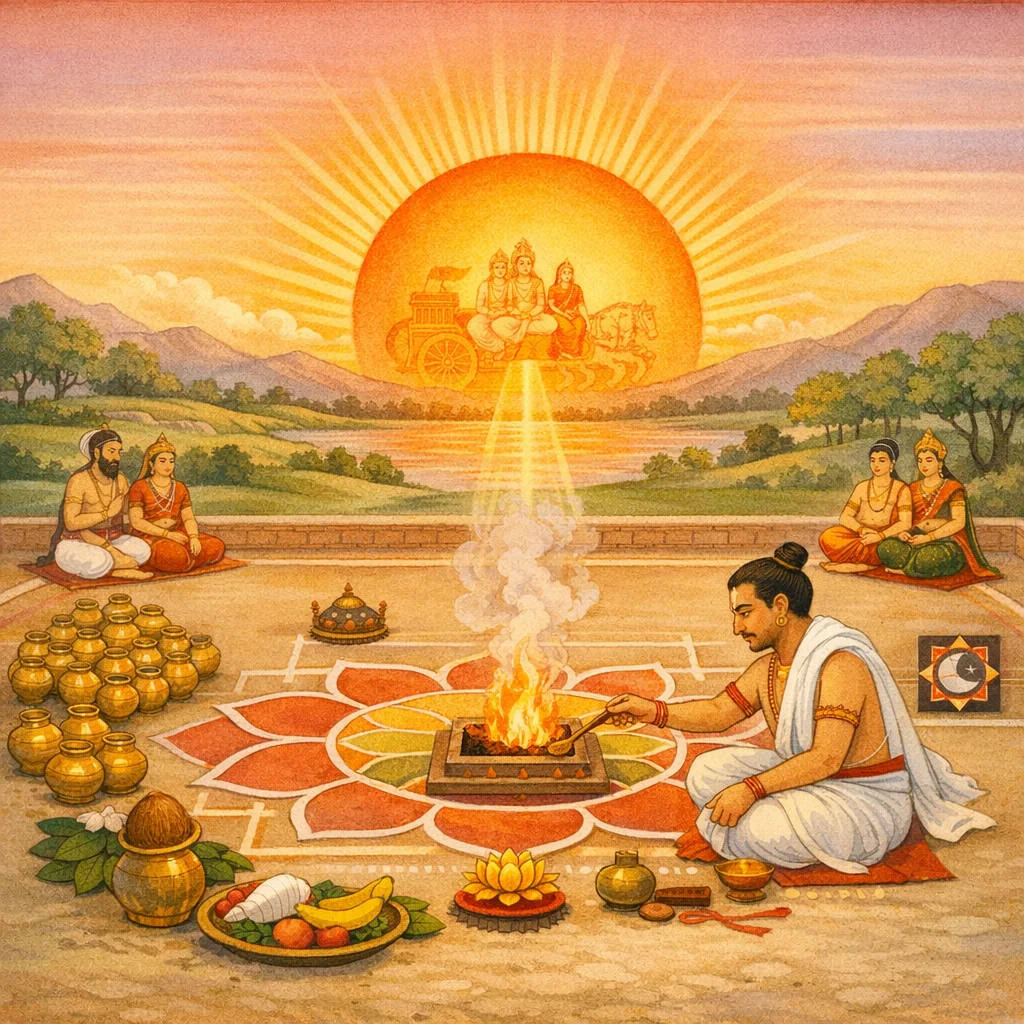
Sanātana teaches Nārada that Saptamī is a solar tithi fit for Sūrya-upāsanā and for month-by-month vratas. It opens with the Caitra-Śukla-Saptamī rite: an outdoor bath on a purified earthen altar, an eight-petalled lotus diagram, installation of Vibhāva at the center, and directional placement of paired beings (Gandharvas, Rākṣasas, serpents/Kādraveyas, Yātudhānas, Ṛṣis) with a graha in the northeast. Worship follows with standard upacāras, then homa with 800 ghee offerings and ordered oblations (64 to the Sun and likewise to the others), ending with dakṣiṇā and the promise of happiness and post-mortem ascent “through the solar orb” to the Supreme Abode. Thereafter, successive monthly Saptamīs prescribe distinct named observances: Gaṅgā-vrata with a thousand water-pots (Vaiśākha), Kamala-vrata with a tiny golden lotus and a kapilā cow (with fasting), a nimba-leaf vrata with mantra and silence, Śarkarā-saptamī honoring sugar’s solar sanctity, Indra’s birth as the Sun (Jyeṣṭha), Vivasvān’s manifestation (Āṣāḍha), Avyaṅga-vrata and Hasta-nakṣatra amplification (Śrāvaṇa), Amuktābharaṇa and Soma-aspect Maheśa worship plus Phala-saptamī fruit offerings and a protective cord (Bhādra), Śubha-saptamī and pañcagavya (Āśvina), Śāka-vrata vegetable gifts (Kārttika), Mitra-vrata identifying Viṣṇu’s right eye with Mitra (Mārgaśīrṣa), Abhaya-vrata with tri-sandhyā worship and modaka dāna (Pauṣa), Sarvāpti in Māgha-Kṛṣṇa with a golden solar disc and vigil, Acala/Trilocana-jayantī and Rathā-saptamī with chariot donation, Bhāskarī Saptamī dawn-bath with arka/badarī leaves, Putra-saptamī for progeny, and Phālguna Arkapuṭa/Trivargadā (arka-leaf worship and dietary restraint). It concludes that monthly Saptamī worship of Bhāskara is independently efficacious for fulfilling desired aims.
Shlokas
Verse 1
सनातन उवाच । श्रृणु नारद वक्ष्यामि सप्तम्यास्ते व्रतान्यहम् । यानि कृत्वा नरो भक्त्या सूर्यसायुज्यमाप्नुयात् ॥ १ ॥
Sanātana said: Hear, O Nārada; I shall declare the vows of Saptamī, the seventh lunar day. By performing them with bhakti, a man attains sāyujya—union with Sūrya, the Sun-god.
Verse 2
चैत्रे तु शुक्लसप्तम्यां बहिः स्नानं समाचरेत् । स्थंडिले गोमयालिप्ते गौरमृत्तिकयास्तृते ॥ २ ॥
In the month of Caitra, on the bright-fortnight Saptamī, one should duly bathe outdoors, upon a prepared earthen altar-place (sthaṇḍila) smeared with cow-dung and spread with pale yellow clay.
Verse 3
लिखित्वाष्टदलं पद्मं कर्णिकायां विभावम् । विन्यसेत्पूर्वपत्रे तु देवौ द्वौ कृतधातुकौ ॥ ३ ॥
Having drawn an eight-petalled lotus, one should place Vibhāva in its central pericarp (karṇikā); and upon the eastern petal one should install two deities fashioned in metal.
Verse 4
आग्नेयं च न्यसेन्पत्रे गंधर्वौ कृतकारकौ । दक्षिणे च न्यसेत्पत्रे तथैव राक्षसद्वयम् ॥ ४ ॥
On the petal in the south-east (Āgneya direction), one should set down the two Gandharvas, Kṛta and Kāraka, in fashioned form; likewise, on the southern petal one should set down the pair of Rākṣasas.
Verse 5
आकृतौ द्वौ न्यसेत्पत्रे नैर्ऋते मुनिसत्तम । काद्रवेयौ महानागौ पश्चिमे कृतचारकौ ॥ ५ ॥
O best of sages, on the south-western petal (Nairṛta) one should place two figures; and on the western petal one should place the two great Nāgas of the Kādraveya line, known as Kṛtacāraka.
Verse 6
वायव्य यातुधानौ द्वौ उत्तरे च ऋषिद्वयम् । ऐशान्ये विन्यसेत्पत्पे ग्रहमेको द्विजोत्तम ॥ ६ ॥
In the north-west (vāyavya) he should place two Yātudhānas; and in the north, a pair of Ṛṣis. In the north-east (aiśānya), upon the lotus-diagram, he should place a single Graha, O best of the twice-born.
Verse 7
तेषां संपूजनं कार्यं गंधमाल्यानुलेपनैः । दीपैर्धूपैः सनैवेद्यैस्तांबूलक्रमुकादिभिः ॥ ७ ॥
They should be worshipped with full reverence—using fragrances, garlands, and unguents; with lamps and incense; together with naivedya, the food-offering, and with betel leaves, areca-nuts, and related offerings.
Verse 8
एवं संपूज्य होमं तु घृतेनाष्टशतं चरेत् । सूर्यस्याष्टाष्ट चान्येषां प्रदद्यादाहुतीः क्रमात् ॥ ८ ॥
Thus, after duly worshipping, one should perform the fire-offering, offering ghee eight hundred times. Then, in due order, one should present oblations—sixty-four for the Sun and likewise for the others.
Verse 9
नाममंत्रेण वेद्यां वा ततः पूर्णाहुतिं ददेत् । दक्षिणा च ततो देया द्विजेभ्यः शक्तितो द्विज ॥ ९ ॥
Then, with the Name-mantra (or upon the altar), one should offer the pūrṇāhuti, the final and complete oblation. After that, O twice-born, dakṣiṇā should be given to the brāhmaṇas according to one’s capacity.
Verse 10
एतत्कृत्वा विधानं तु सर्वसौख्यमवाप्नुयात् । देहांते मण्डलं भानोर्भत्त्वा गच्छेत्परं पदम् ॥ १० ॥
Having performed this prescribed rite, one attains every kind of happiness; and at the end of life, piercing through the orb of the Sun, one goes to the Supreme Abode.
Verse 11
वैशाखशुक्लसप्तम्यां जह्नुना जाह्नवी स्वयम् । क्रोधात्पीता पुनस्त्यक्ता कर्णरंध्रात्तु दक्षिणात् ॥ ११ ॥
On the seventh lunar day (Saptamī) of the bright fortnight of Vaiśākha, Jāhnavī (Gaṅgā) herself, in anger, was drunk up by Sage Jahnu; then she was released again, flowing forth from the opening of his right ear.
Verse 12
तां तत्र पूजयेत्स्नात्वा प्रत्यूषे विमले जले । गंधपुष्पाक्षताद्यैश्च सर्वैरेवोपचारकैः ॥ १२ ॥
Having bathed at dawn in pure, spotless water, one should worship Her right there, offering fragrance, flowers, unbroken rice-grains (akṣata), and all other customary ritual services.
Verse 13
ततो घटसहस्रं तु देयं गंगाव्रते त्विदम् । भक्त्या कृतं सप्तकुलं नयेत्स्वर्गमसंशयः ॥ १३ ॥
Therefore, in this Gaṅgā-vrata one should donate a thousand water-pots. Performed with devotion (bhakti), it leads seven generations of one’s family to heaven—without doubt.
Verse 14
कमलव्रतमप्यत्र प्रोक्तं तद्विधिरुच्यते । तिलमात्रं तु सौवर्णं विधाय कमलं शुभम् ॥ १४ ॥
Here, the Kamala-vrata (Lotus Vow) has also been taught; now its procedure is described. One should fashion an auspicious lotus of gold, of the size of a sesame seed.
Verse 15
वस्त्रयुग्मावृतं कृत्वा गंधधूपादिनार्चयेत् । नमस्ते पद्महस्ताय नमस्ते विश्वधारिणे ॥ १५ ॥
Having covered (the sacred icon) with a pair of garments, one should worship with fragrance, incense, and the like, saying: “Salutations to You whose hand bears a lotus; salutations to You, the Sustainer of the universe.”
Verse 16
दिवाकर नमस्तुभ्यं प्रभाकर नमोऽस्तु ते । इति संप्रार्थ्य देवेशं सूर्ये चास्तमुपागते ॥ १६ ॥
O Maker of the day (Sūrya), salutations unto You; O Bringer of light, obeisance be to You. Thus, having earnestly prayed to the Lord of the gods, when the sun drew near to setting, the rite (recitation) came to its close.
Verse 17
सोदकुंभं तु तत्पद्मं कपिलां च द्विजेऽर्पयेत् । तद्दिने तूपवस्तव्यं भोक्तव्यं च परेऽहनि ॥ १७ ॥
Then one should offer to a brāhmaṇa a pot filled with water, that lotus, and a tawny kapilā cow. On that day one should observe upavāsa (fasting), and one should eat on the following day.
Verse 18
संभोज्य ब्राह्मणान्भक्त्या व्रतसाकल्यमाप्नुयात् । निबव्रतं च तत्रेव तद्विधानं श्रृणुष्व मे ॥ १८ ॥
Having reverently fed the brāhmaṇas with bhakti, one attains the complete fruition of the vow (vrata). And there itself, perform the concluding rite of the vow according to niyama; hear from me its proper procedure.
Verse 19
निंबपत्रैः स्मृता पूजा भास्करस्य द्विजोत्तम । खखोल्कायेति मंत्रेण प्रणवाद्येन नारद ॥ १९ ॥
O best of the twice-born, the worship of Bhāskara (the Sun) is taught to be performed with neem leaves. O Nārada, it is to be done using the mantra “khakholkāya,” preceded by the praṇava, Oṃ.
Verse 20
निंबपत्रं ततोऽश्नीयाच्छयेद्भूमौ च वाग्यतः । द्विजान्परेऽह्नि संभोज्य स्वयं भुंजीत बंधुभिः ॥ २० ॥
Then one should eat neem leaves and lie down upon the ground, observing silence. On the following day, having fed the twice-born (brāhmaṇas), one should then take one’s own meal together with one’s relatives.
Verse 21
निंबपत्रव्रतं चैतत्कर्तॄणां सर्वसौख्यदम् । सप्तमी शर्कराख्यैषा प्रोक्ता तच्चापि मे श्रृणु ॥ २१ ॥
This vow, called the “Nimba-leaf Vrata,” grants every kind of happiness to those who observe it. This seventh lunar day (Saptamī) is proclaimed to be known as “Śarkarā”; hear that also from me.
Verse 22
अमृतं पिबतो हस्तात्सूर्यस्यामृतबिंदवः । निष्पेतुर्भुवि चोत्पन्नाः शालिमुद्गयवेक्षवः ॥ २२ ॥
As the Sun drank the amṛta, drops of that nectar slipped from his hand; falling upon the earth, they became rice, green gram, barley, and sugarcane.
Verse 23
शर्करा च ततस्तस्मादिक्षुसारामृतोपमा । इष्टा रवेरतः पुण्या शर्करा हव्यकव्ययोः ॥ २३ ॥
From that essence of sugarcane arises sugar (Śarkarā), comparable to nectar. Therefore sugar is dear to Sūrya and is held meritorious for both offerings to the gods (havis) and ancestral rites (kavya).
Verse 24
शर्करासप्तमी चैव वाजिमेधफलप्रदा । सर्वदुःखोपशमनी पुत्रसंततिवर्धिनी ॥ २४ ॥
The Śarkarā-saptamī observance indeed bestows the merit of the Aśvamedha sacrifice; it pacifies all sorrows and increases progeny and family lineage.
Verse 25
अस्यांतु शर्करादानं शर्कराभोजनं तथा । कर्तव्यं हि प्रयत्नेन व्रतमेतद्रविप्रियम् ॥ २५ ॥
On this day, one should diligently give sugar in charity and also partake of sugar as food, for this vow is especially dear to Ravi, the Sun.
Verse 26
यः कुर्यात्परया भक्त्या स वै सद्गतिमाप्नुयात् । ज्येष्ठे तु शुक्लसप्तम्यां जात इंद्रो रविः स्वयम् ॥ २६ ॥
Whoever performs this with supreme devotion indeed attains the highest blessed state. And on the bright seventh lunar day in the month of Jyeṣṭha, Indra himself was born as the Sun, Ravi.
Verse 27
तं संपूज्य विधानेन सोपवासो जितेंद्रियः । स्वर्गतिं लभते विप्र देवेंद्रस्य प्रसादतः ॥ २७ ॥
O brāhmaṇa, one who worships him according to the prescribed rite—fasting and with the senses restrained—attains the path to heaven by the grace of Indra, the lord of the gods.
Verse 28
आषाढशुक्लसप्तम्यां विवस्वान्नाम भास्करः । जातस्तं तत्र संप्रार्च्य गन्धपुष्पादिभिः पृथक् ॥ २८ ॥
On the bright Saptamī of Āṣāḍha, the Sun—Bhāskara—manifested with the name Vivasvān. Therefore one should worship him there with due reverence, offering separately fragrances, flowers, and the like.
Verse 29
लभते सूर्यसायुज्यं विप्रेंद्रात्र न संशयः । श्रावणे शुक्लसप्तम्यामव्यंगाख्यं व्रतं शुभम् ॥ २९ ॥
O best of brāhmaṇas, there is no doubt that by this auspicious vow called the Avyaṅga-vrata—observed on the bright Saptamī in the month of Śrāvaṇa—one attains sāyujya, union with Sūrya.
Verse 30
कार्पासं तु चतुर्हस्तं सार्द्ध वस्त्रं हि गोपतेः । पूजांते प्रीतये देयं व्रतमेतच्छुभावहम् ॥ ३० ॥
At the conclusion of worship, one should offer to Gopati—the Lord, protector of beings—a cotton cloth measuring four cubits, together with a proper garment, for His satisfaction. This vow bestows auspiciousness.
Verse 31
यदि चेद्धस्तयुक्तेयं तदा स्यात्पापनाशिनी । अस्यां दानं जपो होमः सर्वं चाक्षय्यतां व्रजेत् ॥ ३१ ॥
And if this sacred time/observance is joined with the Hasta nakṣatra, it becomes a destroyer of sins. In it, gifts, mantra-recitation (japa), and fire-offerings (homa)—indeed all such acts—attain imperishable, undiminishing merit.
Verse 32
भाद्रे तु शुक्लसप्तम्याममुक्ताभरणव्रतम् । सोमस्य तु महेशस्य पूजनं चात्र कीर्तितम् ॥ ३२ ॥
In the month of Bhādra, on the seventh lunar day of the bright fortnight, the vow called Amuktābharaṇa is to be observed; and in that observance, the worship of Maheśa (Śiva) in his Soma aspect is also prescribed.
Verse 33
गंगादिभिः षोडशभिरुपचारैः समर्चनम् । प्रार्थ्य प्रणम्य विसृजेत्सर्वकामसमृद्धये ॥ ३३ ॥
One should worship (the deity) with the sixteen customary offerings, beginning with Gaṅgā-water and the like. Having prayed and bowed down, one should then take leave (conclude the worship), for the fulfillment and prosperity of all desired aims.
Verse 34
फलसप्तमिका चेयं तद्विधानमुदीर्यते । नालिकेरं च वृंताकं नारंगं बीजपूरकम् ॥ ३४ ॥
This is the Phala-saptamī (the Saptamī observance of fruit-offering); now its prescribed procedure is stated: coconut, eggplant (vṛntāka), orange, and citron (bījapūraka) are to be offered/used.
Verse 35
कूष्मांडं बृहतीपूगमिति सप्त फलानि वै । महादेवस्य पुरतो विन्यस्यापरदोरकम् ॥ ३५ ॥
Placing before Mahādeva seven fruits—namely kūṣmāṇḍa (ash-gourd), the bṛhatī fruit, and the areca-nut cluster (pūga), and the rest—one should then tie the protective cord (doraka) on the other arm.
Verse 36
सप्ततन्तुकृतं सप्तग्रंथियुक्तं द्विजोत्तम । संपूज्य परया भक्त्या धारयेद्वामके करे ॥ ३६ ॥
O best of the twice-born, having worshipped with supreme bhakti a sacred cord made of seven strands and furnished with seven knots, one should wear it upon the left hand.
Verse 37
स्त्री नरो दक्षिणे चैव यावद्वर्षं समाप्यते । संभोज्य विप्रान्सप्तैव पायसेन विसृज्यस तान् ॥ ३७ ॥
A woman and a man should be given as dakṣiṇā until a full year is completed. Then, having fed seven brāhmaṇas with pāyasa (sweet rice), one should respectfully dismiss them.
Verse 38
स्वयं भुंजीत मतिमान् व्रतसंपूर्तिहेतवे । फलानि तानि देयानि सप्तस्वपि द्विजेषु च ॥ ३८ ॥
A wise person should partake himself, for the sake of completing the vow; and those fruits should also be given as gifts to the brāhmaṇas—even to all seven.
Verse 39
एवं तु सप्त वर्षाणि कृत्वोपास्य यथाविधि । सायुज्यं लभते विप्र महादेवस्य तद्व्रती ॥ ३९ ॥
Thus, O brāhmaṇa, having duly performed the prescribed worship for seven years according to rule, the observer of that vow attains sāyujya—union with Mahādeva.
Verse 40
आश्विने शुक्लपक्षे तु विज्ञेया शुभसप्तमी । तस्यां कृतस्नानपूजो वाचयित्वा द्विजोत्तमान् ॥ ४० ॥
In the bright fortnight of Āśvina, one should recognize the auspicious seventh lunar day, Śubha-saptamī. On that day, having bathed and performed pūjā, one should have the best of the twice-born recite the sacred texts.
Verse 41
आरभ्य कपिलांगां च संपूज्य प्रार्थयेत्ततः । त्वामहं दद्मि कल्याणि प्रीयतामर्यमा स्वयम् ॥ ४१ ॥
Having begun the rite and duly worshipped Kapilāṅgā (the sacred tawny‑limbed one), one should then pray: “O auspicious lady, I give you (in marriage). May Aryamā himself be pleased.”
Verse 42
पालय त्वं जगत्कृत्स्नं यतोऽसि धर्मसम्भवा । इत्युक्त्वा वेदविदुषे दत्त्वा कृत्वा च दक्षिणाम् ॥ ४२ ॥
“Protect the entire world, for you are born of Dharma.” Having spoken thus, he gave the learned knower of the Veda the dakṣiṇā, the duly offered priestly honorarium.
Verse 43
नमस्कृत्य स्वयं विप्र विसृजेत्प्राशयेत्वरवयम् । पंचगव्यं व्रतं चेत्थं विधाय श्वो द्विजोत्तमान् ॥ ४३ ॥
Having first offered reverent salutations, the brāhmaṇa should himself dismiss them and then have the excellent group partake (of it). Thus, after duly performing the pañcagavya‑vrata, on the next day he should honour and feed the best of the twice‑born.
Verse 44
भोजयित्वा स्वयं चाद्यात्तदन्नं द्विजशेषितम् । कृतं ह्येतद्व्रतं विप्र सुभाष्यं श्रद्धयान्वितः ॥ ४४ ॥
Having first fed the brāhmaṇas, one should then eat oneself the very food remaining after the brāhmaṇas. O brāhmin, this vow is indeed properly performed when carried out with reverent faith and with auspicious words (right recitation).
Verse 45
देवदेवप्रसादेन भुक्तिमुक्तिमवाप्नुयात् । अथ कार्तिकशुक्लायां शाकाख्यं सप्तमीव्रतम् ॥ ४५ ॥
By the grace of the God of gods, one attains both worldly enjoyment and liberation. Now is described the vow called Śāka, to be observed on the seventh lunar day in the bright fortnight of Kārttika.
Verse 46
तस्यां तु सप्तशाकानि सस्वर्णकमलानि च । प्रदद्यात्सप्तविप्रेभ्यः शाकाहारस्ततः स्वयम् ॥ ४६ ॥
On that occasion, one should offer seven kinds of vegetables, together with golden lotus-flowers, to seven brāhmaṇas; thereafter, one should oneself subsist on a diet of vegetables.
Verse 47
द्वितीयेऽह्नि द्विजान्भोज्य दत्वा तेभ्योऽन्नदक्षिणाम् । विसृज्य बंधुभिः सार्द्धं स्वयं भुञ्जीत वाग्यतः ॥ ४७ ॥
On the second day, having fed the twice-born (brāhmaṇas) and given them food and the customary dakṣiṇā, one should dismiss them; then, together with one’s relatives, one should eat oneself, with speech restrained.
Verse 48
मार्गस्य सितसप्तम्यां मित्रव्रतमुदाहृतम् । यद्विष्णोर्दक्षिणं नेत्रं तदेव कृतवानिह ॥ ४८ ॥
On the bright seventh lunar day of the month of Mārgaśīrṣa, the vow called the Mitra-vrata is prescribed. That which is Viṣṇu’s right eye—this indeed has been established here as its sacred focus.
Verse 49
अदित्यां कश्यपाज्जज्ञे मित्रो नामा दिवाकरः । अतोऽस्यां पूजनं तस्य यथोक्तविधिना द्विज ॥ ४९ ॥
From Aditi, by Kaśyapa, was born the Sun, known as Mitra. Therefore, on this day, O twice-born one, his worship should be performed according to the prescribed rite.
Verse 50
कृत्वा द्विजान्भोजयित्वा सप्तैव मधुरादिना । सुवर्णदक्षिणां दत्वा विसृज्याश्नीत च स्वयम् ॥ ५० ॥
After preparing the rite, having fed the twice-born (brāhmaṇas) with seven sweet offerings and the like, and having given a gold dakṣiṇā, one should respectfully dismiss them and then eat oneself.
Verse 51
कृत्वैतद्विधिना लोकं सृर्य्यस्य व्रजति ध्रुवम् । द्विजो ब्राह्मं तथा शूद्रः सत्कुले जन्म चाप्नुयात् ॥ ५१ ॥
Having performed this according to the prescribed procedure, one surely attains the world of Sūrya, the Sun. A twice-born person gains the Brahmanical state, and even a Śūdra obtains birth in a noble family.
Verse 52
पौषस्य शुक्लसप्तम्यां व्रतं चाभयसंज्ञितम् । उपोष्य भानुं त्रिःसन्ध्यं समभ्यर्च्य धरास्थितः ॥ ५२ ॥
On the bright seventh lunar day (Śukla-saptamī) of the month of Pauṣa, one should observe the vow called “Abhaya.” Having fasted, one should worship Bhānu, the Sun, at the three sandhyās—morning, noon, and evening—remaining upon the ground in humility.
Verse 53
क्षीरसिक्तान्नसंबद्धं मोदकं प्रस्थसंमितम् । द्विजाय दत्वा भोज्यान्यान्सप्ताष्टभ्यश्च दक्षिणाम् ॥ ५३ ॥
Having prepared a modaka sweet bound with rice soaked in milk, measuring one prastha, one should give it to a twice-born brāhmaṇa; and one should also provide other foods and dakṣiṇā to seven or eight brāhmaṇas.
Verse 54
पृथवी वा सुवर्णं वा विसृज्याश्नीत च स्वयम् । अभयाख्यं व्रतं त्वेतत्सर्वस्याभयदं स्मृतम् ॥ ५४ ॥
Having donated land or gold, one should then partake of food oneself. This observance is called the Abhaya-vrata, and it is remembered as granting fearlessness to all.
Verse 55
मार्तंडाख्यं व्रतं नाम कथयंति द्विजाः परे । एकमेवेति च प्रोक्तमेकदैवतया बुधैः ॥ ५५ ॥
Some learned twice-born sages describe a vow called the Mārtaṇḍa-vrata; and the wise also declare it to be ‘one alone’, because it is observed with a single deity as its focus.
Verse 56
माघे तु कृष्णसप्तम्यां व्रतं सर्वाप्तिसंज्ञकम् । समुपोष्य दिने तस्मिन्सम्पूज्यादित्यबिम्बकम् ॥ ५६ ॥
In the month of Māgha, on Kṛṣṇa-saptamī—the seventh lunar day of the dark fortnight—one should undertake the vow called “Sarvāpti,” the attainment of all aims. Fasting completely on that day, one should duly worship the solar disc, the sacred image of Āditya (the Sun).
Verse 57
सौवर्णं गंधपुष्पाद्यैः कृत्वा रात्रौ च जागरम् । परेऽह्नि विप्रान्सम्भोज्य पायसेन तु सप्त वै ॥ ५७ ॥
Having prepared a golden offering together with fragrances, flowers, and the like, and having kept a night-long vigil, on the following day one should feed seven brāhmaṇas with pāyasa, sweet milk-rice.
Verse 58
दक्षिणां नालिकेराणि तेभ्यो दत्वा गुरुं ततः । सौवर्णं तु रवेर्बिम्बं युक्तं दक्षिणयान्यया ॥ ५८ ॥
First giving them dakṣiṇā in the form of coconuts, one should then offer to the Guru a golden disc representing Ravi (the Sun), accompanied by an additional dakṣiṇā.
Verse 59
समर्प्य च भृशं प्रार्थ्य विसृज्याद्यात्स्वयं ततः । एतत्सर्वाप्तिदं नाम संप्रोक्तं सार्वकामिकम् ॥ ५९ ॥
Having offered it and prayed with deep earnestness, one should then release the offering and depart on one’s own. This Name is declared to bestow all attainments, fulfilling every rightful desire.
Verse 60
व्रतस्यास्य प्रभावेण द्वैतं सिध्येद्धि सर्वथा । माघस्य शुक्लसप्तम्यामचलाख्यं व्रतं स्मृतम् ॥ ६० ॥
By the power of this vow, dvaita—duality—is surely brought to fulfillment in every way. This vow, remembered as “Acala” (the Unshakable), is to be observed on Śukla-saptamī, the seventh lunar day of the bright fortnight of Māgha.
Verse 61
त्रिलोचनजयंतीयं सर्वपापहरा स्मृता । रथाख्या सप्तमी चेयं चक्रवर्तित्वदायिनी ॥ ६१ ॥
This observance, known as Trilocana-jayantī, is remembered as the remover of all sins. And this seventh lunar day, called Rathā-saptamī, bestows the rank of a cakravartin, a universal sovereign.
Verse 62
अस्यां समर्च्य सवितुः प्रतिमां तु हैमीं हैमाश्वयुक्तरथगां तु ददेत्सहेभाम् । यो भावभक्तिसहितः स गतो हि लोकं शम्भोः स मोदत इहापि च भुक्तभोगः ॥ ६२ ॥
On this occasion, having duly worshipped a golden image of Savitṛ, the Sun, one should donate a chariot drawn by golden horses, together with elephants. Whoever does this with heartfelt bhāva-bhakti attains the world of Śambhu (Śiva); and even here in this life he rejoices, having enjoyed worthy prosperities.
Verse 63
भास्करी सप्तमी चेयं कोटिभास्वद्ग्रहोपमा । अरुणोदयवेलायामस्यां स्नानं विधीयते ॥ ६३ ॥
This is Bhāskarī Saptamī, radiant like ten million blazing suns. On this holy day, bathing is enjoined at aruṇodaya, the moment of dawn.
Verse 64
अर्कस्य च बदर्याश्च सप्त सप्त दलानि वै । निधाय शिरसि स्नायात्सप्तजन्माघशांतये ॥ ६४ ॥
Placing seven arka leaves and seven badarī leaves upon one’s head, one should bathe; it is said to soothe the sins accumulated over seven births.
Verse 65
पुत्रप्रदं व्रतं चात्र प्राहादित्यः स्वयं प्रभुः । यो माघसितप्तम्यां पूजयेन्मां विधानतः ॥ ६५ ॥
Here the Lord Āditya himself proclaimed a vow that grants offspring: whoever worships me on Saptamī in the month of Māgha, according to the prescribed rites, attains progeny.
Verse 66
तस्याहं पुत्रतां यास्ये स्वांशेन भृशतोषितः । तस्माज्जितेंद्रियो भूत्वा समुपोष्य दिवानिशम् ॥ ६६ ॥
Greatly pleased with him through a portion of My own essence, I shall be born as his son. Therefore, having conquered the senses, one should duly observe fasting, day and night.
Verse 67
पूजयेदपरे चाह्नि होमं कृत्वा द्विजां स्ततः । दध्योदनेन पयसा पायसेन च भोजयेत् ॥ ६७ ॥
Then, in the latter part of the day, having performed the homa (fire-offering) and duly worshipped, one should thereafter feed the twice-born (brāhmaṇas) with rice mixed with curd, with milk, and with sweet rice (pāyasa).
Verse 68
अनेन विधिना यस् कुरुते पुत्रसप्तमीः । लभते स तु सत्पुत्रं चिरायुषमनामयम् ॥ ६८ ॥
Whoever observes the Putra-saptamī vow according to this prescribed procedure obtains a virtuous son—long-lived and free from disease.
Verse 69
तपस्यशुक्लसप्तम्यां व्रतमर्कपुटं चरेत् । अर्कपत्रैर्यजेदर्कमर्कपत्राणि चाश्नुयात् ॥ ६९ ॥
On the bright seventh lunar day in the month of Tapasya (Phālguna), one should observe the vow called Arkapuṭa. One should worship the Arka plant using Arka leaves, and also partake of Arka leaves as one’s ritual food.
Verse 70
अर्कनाम जपेच्छश्वदित्थं चार्कपुटव्रतम् । धनदं पुत्रदं चैतत्सर्वपापप्रणाशनम् ॥ ७० ॥
Thus one should constantly repeat the name of Arka (the Sun); this is the Arkapuṭa-vrata. It bestows wealth and offspring, and it destroys all sins.
Verse 71
त्रिवर्गदामिति प्राहुः केचिदेतद्वतं द्विज । यज्ञव्रतं तथाप्यन्ये विधिवद्धोमकर्मणा ॥ ७१ ॥
O Brahmin, some call this observance “Trivargadā”; others, however, call it a “Yajña-vrata”, since it is duly performed through the rite of homa, the oblation into the sacred fire.
Verse 72
सर्वासु सर्वमासेषु सप्तमीषु द्विजोत्तमः । भास्कराराधनं प्रोक्तं सर्वकामिकमित्यलम् ॥ ७२ ॥
O best of the twice-born, on every Saptamī—the seventh lunar day—of every month, worship of Bhāskara, the Sun, is taught as sufficient in itself, granting the fulfilment of all desired aims.
Verse 73
इति श्रीबृहन्नारदीयपुराणे पूर्वभागे बृहदुपाख्याने चतुर्थपादे द्वादशमासस्थितसप्तमीव्रतनिरूपणं नाम षोडशाधिकशततमोऽध्यायः ॥ ११६ ॥
Thus ends, in the revered Bṛhannāradīya Purāṇa—within the Pūrva-bhāga, in the Great Narrative (Bṛhad-upākhyāna), in the Fourth Pada—the one-hundred-and-sixteenth chapter entitled “The exposition of the Saptamī vow observed across twelve months.”
Frequently Asked Questions
It functions as a ritual cosmogram: the lotus-maṇḍala centers Vibhāva/Āditya while the dik-sthāpanā distributes attendant classes (Gandharvas, Rākṣasas, Nāgas/Kādraveyas, Yātudhānas, Ṛṣis, and a graha) to stabilize the rite spatially. This reflects Purāṇic vrata-kalpa’s concern for correct orientation, completeness of worship, and the integration of cosmic order (dik, graha, gaṇa) into household liturgy.
The chapter grounds it in a mythic etiology: nectar drops associated with the Sun become grains and sugarcane; therefore sugar is declared प्रिय (dear) to Sūrya and suitable for both havis (deva offerings) and kavya (ancestral rites). The vow’s phala is amplified to Aśvamedha-equivalent merit, linking a simple food-gift to high sacrificial prestige.
Āditya himself states that worship on Māgha Saptamī grants sons, promising to incarnate through a portion of his own essence as the devotee’s child. The rite combines fasting, homa, and brāhmaṇa-feeding with dairy-rice offerings, aligning personal lineage goals with solar divinity and disciplined observance.